You are currently browsing the category archive for the ‘Disney Features’ category.
Director: George Scribner
Release Date: November 13, 1988
Rating: ★★
Review:
 Oliver and Company’ is the Walt Disney studio’s third film about dogs, after ‘Lady and the Tramp‘ (1955) and ‘One Hundred and One Dalmations’ (1961). Three of the first film’s characters, Peggy, Jock and Trusty, even have a cameo during Dodger’s song.
‘Oliver and Company’ contains some nice and easy looking dog animation, but it is hardly a worthy successor of the two classics. The opening scenes of ‘Oliver & Company’ introduces Oliver, a cute little orange cat to us, in a scene set to an ugly 1980s song. Oliver teams up with a cool dog called Dodger, who appears to be part of a dog gang. Only when the gang’s owner, the poor tramp Fagin (excellently voiced by Dom DeLuise) is visited by the film’s villain, Sykes, some kind of drama begins. By then the film already is 18 minutes underway.
During a totally incomprehensible framing act Oliver is taken sway by a little rich girl called Jenny, much to the dismay of her house’s star dog, poodle Georgette (voiced by Bette Midler). The gang ‘rescues’ Oliver, which leads to the only continuous and songless story part of the complete film. Surprisingly, the upper class world of Jenny and Georgette and the lower class world of Fagin and his dogs don’t seem to clash at all in this film. As soon Jenny is kidnapped, Georgette naturally teams up with the dog gang. The film ends with a wild and totally unbelievable chase, killing Sykes.
Although released five months after ‘Who Framed Roger Rabbit‘ it’s difficult to regard ‘Oliver & Co.’ as part of the Disney renaissance. It’s not as bleak as ‘The Fox and the Hound‘ or as misguided as ‘The Black Cauldron‘, but the film still feels as a continuation of the 1960s and 1970s, instead of something new, making it part of animation’s dark ages.
There are several reasons for this: first, the use of xerox, first used in ‘One Hundred and one Dalmations’ (1961), and defining Disney’s graphic style up to this film. Second, the equally graphic backgrounds, which are uninspired, dull and ugly, as are the all too angular and unappealing cars and machines. Third, the animation, which is erratic and at times downward poor, with the animation of the little girl Jenny, a far cry from the endearing Penny from ‘The Rescuers‘ (1977), being the low point. Fourth, the human designs, which apart from the main characters, look the same as in any generic animated television series from the 1980s. And fifth, the story, which, vaguely based on Charles Dickens’s ‘Oliver Twist’, is ramshackle and formulaic. Moreover, the attempt to ‘modernize’ Disney by moving the setting to contemporary New York is forced, and only a change of setting. There’s no new spirit to the film. And finally, the anonymous 1980s songs have aged the film very quickly.
There are some highlights: the dogs are all good, if not particularly inspired and owing much to ‘Lady and the Tramp’, Jenny’s butler Jenkins is well animated, as is Fagin when he struggles to give Oliver back to Jenny. But overall the film fails to entertain: Oliver himself is not particularly interesting, he is just the straight man, the little girl Jenny is too bland to gain sympathy, the songs are generic and the story (penned by no less than thirteen people) is too erratic to suck the viewer in.
Luckily, ‘Oliver and Company’ was not part of a new era, but the last convulsion of an old one. With its next film, ‘The Little Mermaid’ (1989) Disney would really enter its renaissance.
Watch Dodger’s song from ‘Oliver & Company’ yourself and tell me what you think:
Directors: Clyde Geronimi, Wilfred Jackson & Hamilton Luske
Release Date: June 16, 1955
Rating: ★★★★★
Review:
 ‘Lady and the Tramp’ is a mild and friendly film based both on story ideas by Joe Grant that went as far back as 1939, and a short story by novelist Ward Greene. It tells the story of Lady, an upper class female Cocker Spaniel living around the turn of the century.
Lady’s life of luxury seems to be threatened by the coming of a baby, but it is the babysitter, aunt Sarah, who’s her real nemesis. The cat-loving old lady quickly has Lady muzzled, and it’s up to the tramp to rescue her. They spend a night out together, but in the morning, while they’re chasing chickens “together”, Lady gets caught and ends in the city dogpound. There she discovers that the tramp is quite a ladies’ man. It seems their short-lived relationship is over, but then the tramp helps her catching a rat that has sneaked into the house and into the baby’s room…
‘Lady and the Tramp’ was the first animated feature in Cinemascope. The film uses the new technique to great effects, with the action carefully laid out to the broad screen. Its backgrounds are very beautiful, and remarkably lush or, when necessary, highly dramatic. Only in the love scene they become somewhat stylized, showing a Mary Blair influence otherwise absent from the film.
The high quality animation is a delight to watch and stands out in an age of stylized and limited animation, something the 1950s more and more became to be. Like the animals in ‘Bambi‘ (1942), the dogs have a look and feel of real animals, while, at the same time, being full characters one can relate to, with a complete range of human expressions. Even the minor characters, like the dogs in the dogpound, are perfectly animated in that respect. The voices help in this dualism, often being a combination of human and dog-like sounds.
The humans, on the other hand, are hardly seen, and only the strongly caricatured ones, Aunt Sarah, Tony and Joe, have something of a character. It is telling that the most famous and probably most romantic kiss in animation history can be seen in this movie and is a kiss between two dogs. In this scene Lady and the tramp share a meal of spaghetti, accompanied by romantic music by the two Italian restaurant owners. This scene, animated by Frank Thomas, is the undisputed highlight of the film. Honorable mention goes to the very lifelike fight between the tramp and a large rat, a strongly dramatic scene animated by Wolfgang Reitherman, which can compete with the fighting scene in ‘Bambi’ in its impact.
Watch the dining scene from ‘Lady and the Tramp’ yourself and tell me what you think:
Directors: Ted Berman, Richard Rich & Art Stevens
Release Date: July 10, 1981
Rating: ★★
Review:
 ‘The Fox and the Hound’ tells about a young adopted fox called Tod and a young hound dog called Copper, who become friends, but later enemies, partly due to their nature.
‘The Fox and the Hound’ was the feature in which the last of the nine old men, Frank Thomas and Ollie Johnston, passed on their knowledge and their legacy to a younger generation of animators. In this respect it’s the most transitional film in Disney history. And unfortunately, it shows, because it’s neither an old classic, nor does it have the spirit of a film by young Turks, despite most of the animation being nothing less than great.
On the contrary, the end product is a tame, slow moving and rather tiresome movie more belonging to a time long past than to the 1980s, the decade in which it was made. Its main flaws are in storytelling: none of the actions of the protagonists are very well motivated, the villains are hardly threatening and a lot of screen time is spent on the totally non-related antics of a sparrow called Dinky and a loony, rather annoying woodpecker called Boomer trying to catch a caterpillar. These birds, like the friendly old female owl Big Mama (voiced by black jazz singer Pearl Bailey), do nothing more than watching the main action.
The songs do not propel the action forward, either, but tend to drag the film down. And in the scenes in which Tod tries to survive in the forest, it becomes very difficult to see him interact with birds and furry animals. How he’s going to survive in the forest without killing animals remains unexplained. Finally, at the end of the film, a bear appears out of nowhere, like a deus ex machina, to be the sole reuniter of the two friends.
In fact, the only appeal of ‘The Fox and the Hound’ lies in the quality of the animation itself, and in the film’s beautiful backgrounds. Because of its out-of-time setting the film can be regarded timeless, but a timeless classic it ain’t.
Watch the fight scene from ‘The Fox and the Hound’ and tell me what you think:
Directors: Dean DeBlois & Chris Sanders
Release Date: June 21, 2002
Rating: ★★★★★
Review:
 Stitch is a genetic experiment (called ‘experiment 6-2-6’) designed to destroy, but sentenced into exile by an intergalactic councel.
All too soon our fluffy little mutant escapes and he ends at the Hawaiian island of Kauai, where he befriends lonely little Lilo, who lives a difficult life with her older sister Nani after the death of their parents. Here Stitch learns to tone down his inclination to destruction and how to love and care.
‘Lilo & Stitch’ is a very appealing film. Its designs, based on Chris Sanders’ idiosyncratic story drawings, are round, cuddly and original. Adding to the friendly atmosphere are the lush watercolor backgrounds, the first in a Disney feature since ‘Bambi‘ (1942). The animation is superb throughout, and Lilo, Stitch and Nani are round and instantly likable characters, who have nothing of the wisecracking arrogance of many other animated characters from the era. The film’s familiar family theme never gets cloying and is countered by a lot of humor. The result is a film full of love and joy.
Probably, because it was made in Orlando, Florida, far from the main company, the film also eschews the rather tiresome Disney musical convention, and features an original soundtrack featuring Elvis Presley songs and Hawaiian chants, instead. True, the plot borrows freely from ‘Men in Black’ (1997), and the science fiction setting feels a little awkward in a Disney film, but the story of loneliness, love and acceptance is well-told, and equally appealing to the young and old.
Moreover, the film proves that one can perfectly well make a good movie out of original and typical elements. A film maker like Hayao Miyazaki knows this, off course. But unfortunately, this message has been lost on the American animation studios, as very few of the subsequent American feature films succeeded in displaying this level of originality in characterization, soundtrack and design. Thus ‘Lilo & Stitch’ remains as Disney’s best attempt at an ‘author film’ (not counting the almost forgotten ‘Teacher’s Pet’ from 2004).
Unfortunately, ‘Lilo & Stitch’ seemed to be Disney’s last masterpiece of traditional animation. Even though it was followed by yet two other 2D animation features, it marked an end of an era lasting 65 years. Disney soon jumped the computer animation band wagon with rather mediocre results, arguably only hitting their stride in 2010 with ‘Tangled‘. Luckily, in 2009 the studio made a surprising, but unfortunately isolated return to the traditional medium with the excellent ‘The Princess and the Frog’.
Watch the trailer for ‘Lilo & Stitch’ yourself and tell me what you think:
Director: John Lounsberry, Wolfgang Reitherman & Art Stevens
Release Date: June 22, 1977
Rating: ★★★★½
Review:
 ‘The Rescuers’ was a joint venture of an old and a new generation of animators at the Disney studio. It is without doubt the best of the three features the studio made in the seventies.
It was Disney’s first feature film since ‘One Hundred and One Dalmatians‘ (1961) in which Wolfgang Reitherman shared the direction duties, and this fact alone arguably improves the end product.
Unlike the earlier features ‘The Aristocats’ (1970) and ‘Robin Hood‘ (1973) it doesn’t contain any reused animation (with a possible exception of animation from ‘Bambi‘ in a minor mood scene). And while ‘The Aristocats’ and ‘Robin Hood’ relied on proven formulas, both being very reminiscent of ‘Jungle Book’ (1967), ‘The Rescuers’ has a fresh story (based on a children’s book by Margery Sharp), and a unique, surprisingly gloomy atmosphere. In Sharp’s book the mice rescue a prisoner, but for the film the Disney story men chose an orphan girl named Penny to be rescued. A masterstroke, for the lovable little girl easily becomes the center of the story, which contains a lot of heart.
However, all the film’s main characters are adorable: the lovely Hungarian mouse Bianca (voiced by Eva Gabor) and her companion, the superstitious yet valiant janitor Bernard are such great characters that they were able to spawn Disney’s first sequel, ‘The Rescuers Down Under’ in 1990. Medusa is a real and wonderful villain. She hasn’t got any special powers and at times she’s portrayed as preposterous, but mostly she’s sly, mean and genuinely scary: a worthy adversary for our heroes to deal with. She was animated by Milt Kahl, the last and arguably best piece of animation he ever did for the studio.
Medusa may steal the show, but even the minor characters like Orville the Albatross, Rufus the cat, Evenrude the damselfly, Snoops and the two Alligators are delightful. They all contribute to a story, which is concise and well-told. It evolves without delays or side-ways, and leads to a great finale in Devil’s Bayou.
‘The Rescuers’ is also the first Disney feature since ‘Bambi’ (1942) not to be a musical, but to use songs to evoke moods only. All these elements contribute to a story which is both thrilling and moving. The film’s opening credits use a song and beautiful oil paintings by Mel Shaw to start the story. Unfortunately, the background paintings in the rest of the movie are more prosaic, mixing moody oil paintings with more graphic backgrounds to an uneven effect. The animation on the other hand is superb throughout.
Unfortunately, ‘The Rescuers’ proved more of a swansong of the old generation of nine old men than the beginning of a new era. The following features were much weaker, and only with ‘The Little Mermaid’ (1989) Disney found a genuinely new and strong voice. Thus stands ‘The Rescuers’ as a beacon of light in the dark ages of animation that were the 1970s and 1980s.
Watch the trailer of’The Rescuers’ and tell me what you think:
Director: Wolfgang Reitherman
Release Date: November 8, 1973
Rating: ★★★
Review:
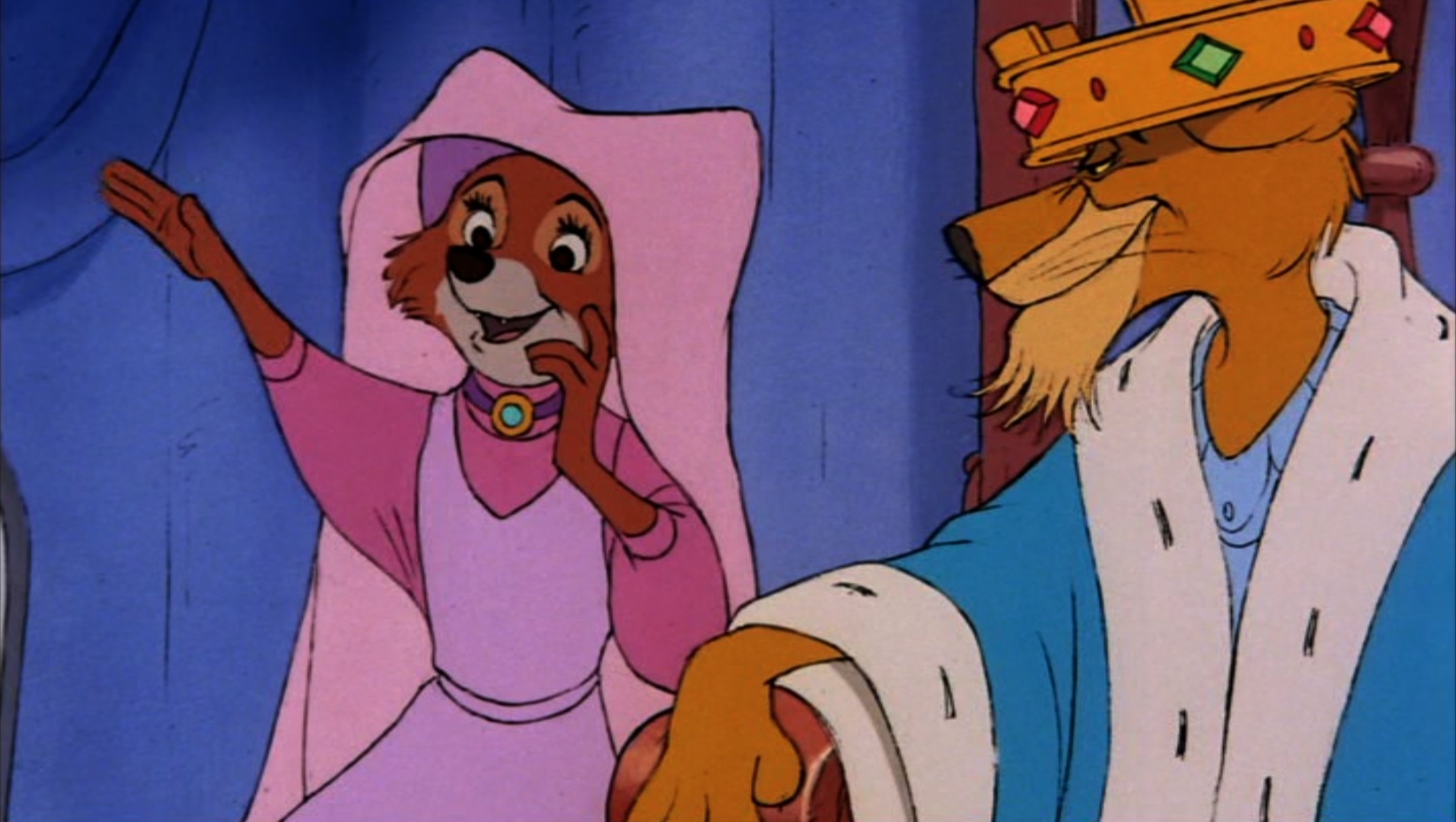
‘Robin Hood’ was Walt Disney studio’s 21st feature. The film’s story and designs lean heavily on the 1938 feature ‘The Adventures of Robin Hood’, starring Errol Flynn.
But by now the characters are portrayed as animals, a relic of an abandoned feature film project about Reynard the fox called ‘Chanticleer’. This great idea doesn’t lead to a great film, however. Despite the fine character designs, the strong voice cast (a nice mix of British and American accents) and the often superb animation, Robin Hood must be placed among the weaker Disney features.
Many of the character designs are so reminiscent of those in ‘Jungle Book’, the film almost feels like a rip-off. There’s a bear, voiced by Phil Harris, the voice of Baloo, there’s a snake with the power of hypnosis and there are some funny vultures. The story evolves at a remarkably slow pace, taking almost half an hour to introduce the characters (first Robin and Little John, then Prince John and Sir Hiss, followed by the Sheriff, and in another scene Maid Marian and Lady Kluck), before some sort of plot sets in.
More than any earlier Disney feature ‘Robin Hood’ seems particularly aimed at children: both great drama and great comedy are absent and danger is never really felt, save for two very short moments. The great finale is anything but that, and King Richard serves as an off-stage deus ex machina, putting an equally welcomed as unsatisfying end to the film.
In a 1973 letter to animator Larry Ruppel, cited in John Canemaker’s book ‘Walt Disney’s Nine Old Men & The Art of Animation’, animator Frank Thomas expressed the film’s shortcomings:
“We obviously decided to keep it on the ‘fun’ side, but I have worried that the audiences would feel it was too flimsy – that we were not being quite serious enough with our characters. For instance, does anyone really fear Prince John? Is Robin ever worried about his ability to achieve something or even how it should be done? Did winning Maid Marian make any difference in Robin’s behavior. In real life it would have.”
The rather tinned music doesn’t help, either. What’s more, the film’s three forgettable songs are all presented within a twelve minutes period of the film (0’46-0’58), with which the film reaches dead waters after the tournament scene, which was less spectacular than it could be in the first place. Even worse, the dance scene blatantly reuses complete dance animation sequences from ‘Snow White and the seven dwarfs’ (1937), ‘Jungle Book’ (1967) and ‘Aristocats’ (1970). All these aspects give the film a cheap feel. It frustrated younger animators like Don Bluth, who thought the film lacked both quality and soul, and it indirectly led to Bluth’s departure in 1979, during the production of ‘The Fox and the Hound‘ (1981).
The film’s best moments are the opening song ‘Oo-De-Lally’, sung by Roger Miller (as Alan-a-Dale), sir Hiss flying around with his head in a balloon and propelling himself like a helicopter, and King John as a whole. This is by all means a marvelous character, perfectly voiced by Peter Ustinov, and animated with gusto. Because of the film’s strong visuals (after all, it’s the only Robin Hood film starring foxes), the film fares better in memory than by actually watching it.
In all, Robin Hood is a timid, rather lifeless and all too safe feature, which makes painfully clear that in the seventies Disney’s glory days lay years behind. Indeed, it would take the studio another fifteen years to crawl out of the uncertain times the studio went through after Walt Disney’s death.
Watch the trailer for ‘Robin Hood’ and tell me what you think:
‘Robin Hood’ is available on Blu-Ray and DVD
Directors: James Algar, Clyde Geronimi, Jack Kinney
Release Date: October 5, 1949
Rating: ★★★
Review:
 The adventures of ‘Ichabod and Mr. Toad’ was the last of the Disney compilation features so typical of the 1940s.
Like ‘Fun and Fancy Free‘ (1947) it consists of only two stories, this time both drawn from literature. Both use a narrator, which gives the films a feeling of moving illustrations. Neither of the stories is particularly endearing: the story of Mr. Toad lacks the poetry of the original story, the story of Sleepy Hollow lacks speed. It would be a happy return to direct story telling (opposed to using voice overs) in ‘Cinderella‘, the next year.
The six directing animators of this feature all belong to the group of ‘nine old men’.
‘The Adventures of Ichabod and Mr Toad’ consists of the following two episodes, which I will discuss in more detail elsewhere:
1. The Wind in the Willows
2. The Legend of Sleepy Hollow
Watch ‘The Adventures of Ichabod and Mr Toad’ yourself and tell me what you think:
Directors: Clyde Geronimi, Wilfred Jackson, Jack Kinney, Hamilton Luske
Release Date: May 27, 1948
Stars: Donald Duck, Joe Carioca, The Aracuan Bird
Rating: ★★
Review:
 Melody Time’ is a compilation film in the same vein as ‘Make Mine Music’ (1946).
It consists of seven unrelated episodes, connected by a voice over and an animated brush. The songs of these sequences are sung by popular artists, who, except for the Andrews Sisters and Roy Rogers, are all but forgotten today. Even more obviously than in ‘Make Mine Music’, these songs are clearly designed for the cartoons, instead of the other way round, like in ‘Fantasia’ (1940). In any sense ‘Melody Time’ is a far cry from that latter film, and the most interesting feature of this film is not the animation, but the film’s beautifully stylized backgrounds, especially in ‘Once upon a Wintertime‘ and ‘The Legend of Johnny Appleseed‘.
The sequences themselves are mediocre, often slow and only moderately funny at best. Luckily, Disney would soon return to real features, for ‘Melody Time’ shows that the studio’s compilation features had outstayed their welcome.
Melody Time consists of the following episodes, which I will discuss in more detail, elsewhere:
Directors: Jack Kinney, Hamilton Luske & Bill Roberts
Release Date: September 27, 1947
Stars: Jiminy Cricket, Mickey Mouse, Donald Duck, Goofy, Edgar Bergen, Luana Patton
Rating: ★★★★
Review:
 Fun and Fancy Free’ was the fourth of six package features Disney released in the 1940s.
It consists of two unrelated stories, which were both originally conceived as feature films in 1940/1941. The two stories, ‘Bongo’ and ‘Mickey and the Beanstalk’ are loosely linked by Jiminy Cricket, who sings the happy-go-lucky theme song.
He plays a record to a sad doll and a gloomy bear which features Dinah Shore telling the story of Bongo in rhyme and song. This cute, if unassuming and forgettable little film (after a story by Sinclair Lewis) tells about Bongo the circus bear, who breaks free from the circus, falls in love with a cute female bear called Lulubelle, and combats a large brutal bear called Lumpjack.
Immediately after this story has ended, we follow Jiminy Cricket to a live action setting: a private party with a little girl (Luana Patton), Edgar Bergen and his two ventriloquist sidekicks, the cynical Charlie and the dumb, but gentle Mortimer.
Bergen tells a version of ‘Jack and the Beanstalk’, starring ‘famished farmers’ Mickey, Donald and Goofy in their last classic trio outing. This part had a long genesis, the early drafts of this film go back to 1940. Apparently Pinto Colvig had returned to the Disney studio, because Goofy has his voice back after having been silenced for eight years. Pinto Colvig would do Goofy’s voice in two subsequent shorts, ‘Foul Hunting‘ (1947) and ‘The Big Wash‘ (1948), before leaving again, leaving Goofy voiceless, once more. This sequence is also the last theatrical film in which Walt Disney does Mickey’s voice. Halfway the production Jimmy MacDonald took over.
This second episode of ‘Fun and Fancy Free’ is a delight, if a little bit slow. Its humor derives mostly from Charlie’s sarcastic interruptions. Nevertheless, the animation of the growing beanstalk and of Willie the giant is stunning.
Willie would be the last giant Mickey defeated, after having done with giants in ‘Giantland‘ (1933) and ‘Brave Little Tailor’ (1938). Unlike the other giants, Willie is an instantly likeable character, and he was revived as the ghost of Christmas Present in ‘Mickey’s Christmas Carol‘ (1983).
‘Fun and Fancy Free’ is a lighthearted film. Like Disney’s other package features, it is not too bad, but it is certainly not among the ranks of masterpieces.
Watch the opening scene of ‘Fun and Fancy Free’ yourself and tell me what you think:
Director: David Hand
Release Date: August 13, 1942
Rating: ★★★★★ ♕
Review:
 Although it was released after ‘Dumbo‘, ‘Bambi’ is essentially Disney’s fourth feature, and it was also the last in which the studio really pushed the envelope.
‘Bambi’ had been long in the making, with initial work already starting in 1937. In fact, it was initially planned as Disney’s second feature, but soon pushed back in favor of ‘Pinocchio’.
After having made such great and diverse efforts as ‘Snow White’, ‘Pinocchio‘ and ‘Fantasia’, Disney set the stakes even higher in Bambi, reaching a zenith in naturalism. But the film is way more than that: it’s a symphony of nature, utterly romantic in its depiction of forest life. It’s also a coming of age story and a depiction of the circle of life.
‘Bambi’ is full of great scenes, starting with the stunning opening scene, a long and complicated shot, which shows the vastness and depth of the forest using a multiplane camera, and which leads us straight into the story, when we come to follow friend owl in his flight.
The storytelling is very lean, it uses little dialogue and it consists of only a few distinct parts, which all concentrate on Bambi’s experiences. Most of the story is told by images and music only, and there are three pure mood pieces very reminiscent of a Silly Symphony like ‘The Old Mill‘ (1937) and parts of ‘Fantasia’: the April Shower sequence, the autumn sequence and Bambi’s love scene. In these sequences especially, it’s clear that atmosphere prevails above character development, and the studio indulges in beautiful imagery that is still impressive and enchanting today.
The film can be divided into eight sections (the titles are all mine):
1) Birth: which also introduces the lovable little rabbit Thumper;
2) Discovery of the world: including the introduction of the little skunk Flower and a rain scene, set to the beautiful song ‘April shower’;
3) The meadow: where both danger and other deer are introduced, including Bambi’s father and his later love interest, Feline;
4) Autumn: a short transitional mood piece;
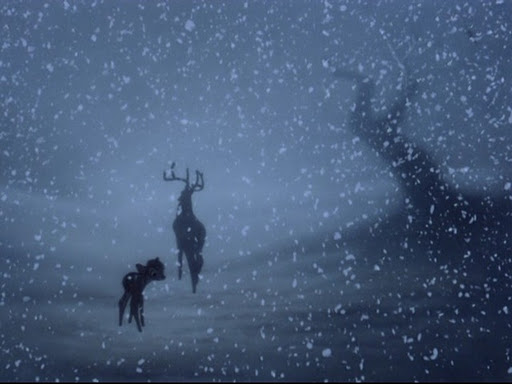
5) Winter: which includes the famous skating scene, inspired by Pluto’s difficulties on ice in ‘On ice‘ (1935) and which ends with that harrowing, yet off screen death of Bambi’s mother;
6) Spring: where all our characters have become adolescents and discover the power of love;
7) Man: where man, who never is seen on screen, but whose threatening presence is so much more felt, once again brings danger into the forest, shooting animals (including Bambi) and causing a forest fire, which leads to great dramatic and apocalyptic shots of the burning forest;
and finally
8) Birth again: in which the cycle is completed.
The first five sections take almost two-thirds of the film and are responsible for Bambi’s reputation of being a childish film full of cute animals. This may be partly true, but is does no justice to the complete film, for the last three sections, starting with the death of Bambi’s mother (which essentially ends his childhood) are more artistic, more expressionistic and more dramatic. These scenes belong to the most powerful animated images ever brought to the screen.
But throughout the complete picture the artwork is stunning: the backgrounds, based on designs by Tyrus Wong, are lush and suggestive, the use of color is very clever and often amazing, and the music, which is very important to the narrative and which uses off-screen songs to evoke moods, is rich and effective. Indeed, Bambi’s soundtrack, by composers Frank Churchill and Edward Plumb, ranks among the best scores of any animation film. Backgrounds, design, color, music – all these make the film a mood piece of an astonishing quality.
The animation itself, too, is a highlight. It was supervised by four of the later so-called ‘nine old men’: Eric Larson, Milt Kahl, Frank Thomas and Ollie Johnston, and it’s the first testimony of their legendary status. The animation is amazingly well-done both in its naturalism as in its sense of character. It ranks from pure naturalism in Bambi’s mother exploring the meadow and Bambi preparing to fight to pure character animation. A highlight of the latter is Bambi having to say hello to Feline. Bambi’s behavior in this scene is perfect that of a young bashful boy.
The only deviation from believability is during the Twitterpated sequence: Eric Larson’s animation on friend Owl is zany and cartoony, as is the animation of the lovestruck Flower. The whole sequence is a little bit ridiculous, and out of place with the rest of the film. Luckily as soon as Bambi falls in love with Feline, the last part starts, which in its drama, powerful imagery and stunning effects is the undisputed highlight of the whole movie.
Bambi never ceases to amaze: it is simply beautiful.
Watch the skating scene from ‘Bambi’ yourself and tell me what you think:
Directors:Clyde Geronimi, Wilfred Jackson and Hamilton Luske
Release Date: February 15, 1950
Rating: ★★★★★
Review:
 ‘Cinderella’ was Disney’s first fairy tale movie since ‘Snow White and the Seven Dwarfs’ (1937) and Disney’s first real feature animation film in eight years.
With its classic fairy tale story featuring a heroine, whose unhappy fate is turned, Cinderella seems to be like ‘Snow White and the Seven Dwarfs’, Disney’s only million seller feature up to that point, and, indeed, ideas for this film go back as far as 1938. However, it is very clear many things had changed for the studio since then:
First: Gone are the lush water color backgrounds. They’re replaced by way more stylized oil backgrounds, based on the colors and styling of designers Mary Blair and John Hench, who both favored bright and unrealistically vivid colors. Mary Blair’s influence is particularly strong in the dreamlike ‘So This Is Love’ sequence and the chase of Cinderella’s pumpkin couch: here the stunningly beautiful backgrounds lose all sense of realism, in favor of emotional storytelling.
Second: The animation of humans, hardly mastered in 1937, now looks fluent, convincing and even easy. It’s also striking how very realistic humans (Cinderella, the prince, the evil stepmother) blend easily and convincingly with more caricatured humans (the king, the grand duke and the two stepsisters) and anthropomorphic animals. The Disney studio clearly had matured.
Indeed, the animation studio had been greatly streamlined in the forties. Gone were the experimental, time consuming and costly work methods of ‘Snow White’, ‘Pinocchio‘ and ‘Fantasia’. For his new feature Disney would take no chances: all human scenes would be filmed first with live action actors, in order to perfect the staging before it went into animation. Only one short scene with outrageously colored soap bubbles evokes some of the earlier experimentalism.
Disney’s animation unit was now led by a group of younger, highly talented animators, who had matured their skills in the forties, and whom Walt Disney affectionately called his ‘Nine Old Men’. In Cinderella these Nine Old Men are all credited as supervising animators (alongside, like a ghost from the past, pioneer animator Norm Ferguson [see ‘Frolicking Fish‘ and ‘Playful Pluto‘], although his contribution remains unclear). The Nine Old Men would be responsible for Disney Feature animation way up to ‘The Rescuers‘ (1978). The fluent and confident animation in ‘Cinderella’ clearly shows why.
Especially the stepmother (animated by Frank Thomas) is a wonderful character: she’s very nasty, but her evilness is acted out in the subtlest way. She’s only indirectly responsible for the most dramatic scene of the film, in which the two stepsisters tear Cinderella’s dress from her body. The horror of this scene is heartfelt, especially because we had seen that this dress was made for her by some friendly birds and mice in an earlier scene .
These animals star a huge subplot with leading roles for a keen mouse called Jaq, a fat, dumb mouse called Gus, and a mean old cat called Lucifer (all animated by Ward Kimball, who went berserk on the outrageous animation of Lucifer). This subplot provides a funny counterpoint to the familiar fairytale and even completely dominates the first twenty minutes of the film.
Cinderella was a huge success and paid the studio well. Once again Disney’s attention and reputation rested with animated features and the studio would dominate the scene up to the 1980s, being practically the monopolist on animated features in the United States.
In a time when TV would cause the decline and fall of the animated cartoon industry, this was no luxury, at all.
Watch an excerpt from ‘Cinderella’:
Director: Norm Ferguson
Release Date: December 21, 1944
Stars: Donald Duck, Joe Carioca, Panchito, The Aracuan Bird
Rating: ★★★
Review:
 Donald stars in his first and only very own feature film.
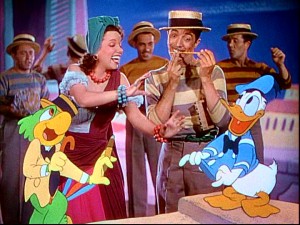
In the opening scene he receives a large package full of presents. When he opens these presents, they lead him to the mild story of Pablo the cold-blooded penguin (narrated by the melancholy voice of Disney-favorite Sterling Holloway), and to the childish story of ‘Gauchito and his flying donkey Burrito’, before it reintroduces Joe Carioca from ‘Saludos Amigos‘ (1942). Joe takes Donald to Baía, where they dance the samba with Aurora Miranda, nicely blending animation with live action, something that occurs throughout the picture.
Another package introduces the Mexican rooster Panchito. Together the trio sings the intoxicating theme song, wonderfully animated by Ward Kimball, who regarded the scene as his best work. Panchito takes Donald and Joe on a magic serape ride over Mexico, visiting Mexico City, Veracruz en Acapulco Beach, where Donald plays blind man’s buff with a bunch of girls in bathing suits. Actually, Donald keeps hunting girls like a hungry wolf throughout the picture.
‘The Three Caballeros’ was the second of two ‘Good neighbor policy’ features, focusing on South America, and the second of six compilation features Disney made until returning to real features with ‘Cinderella‘ in 1950. When compared to ‘Saludos Amigos’, ‘The Three Caballeros’ is brighter, bolder and more nonsensical. It is noteworthy for its bold color design and for its beautiful color book artwork by Mary Blair, which in its modernity looks forward to the 1950s (especially in the opening titles, during the train ride and in the Mexican Christmas episode).
It is most interesting however, because of its zany surrealism, which invades many scenes with associative images, where metamorphosis and abstraction run haywire, not even sparing Donald himself. In this respect ‘The Three Caballeros’ is the boldest feature Disney ever made.
However, its lack of story, its strong touristic content, its outdated live action imagery, its sentimental songs and the two childish stories at the beginning of the feature all harm the picture. Thus watching the movie feels like being on a colorful journey full of beautiful images that nevertheless turns out to be unsatisfactory in the end.
Watch the title song from ‘The Three Caballeros’ below:
‘The Three Caballeros’ is available on DVD


 Dr. Grob's Animation Review