You are currently browsing the category archive for the ‘Walt Disney films’ category.
Director: Charles Nichols
Release Date: October 3, 1947
Stars: Mickey Mouse, Minnie Mouse, Pluto
Rating: ★★★★★
Review:
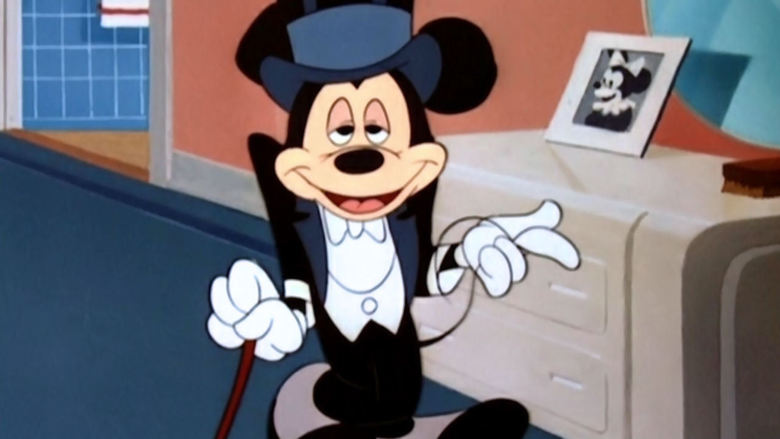 For the first time in five years (actually, since ‘Symphony Hour’) Mickey receives considerable screen time in his own cartoon, even though he has to share it once again with his dog, Pluto.
In the opening scene ‘Mickey’s Delayed Date’ we watch Mickey snoring at home, when the phone rings. It’s Minnie: she has been waiting an hour for him to come at a date with her for a dance. As soon as she has threatened him on the phone to break up if he doesn’t show up within fifteen minutes, Mickey rushes to the dance hall. Unfortunately he loses the tickets, which are brought by Pluto just in time.
Much screen time of ‘Mickey’s Delayed Date’ is devoted to Pluto in a rather long scene with a humanized tall hat. Nevertheless, it’s nice to watch Mickey in fine comic shape again, although he is less flexible here than in Riley Thomson’s shorts of the early forties. This short contains a shot of an almost naked Mickey (even without gloves).
‘Mickey’s Delayed Date’ was the first Mickey Mouse cartoon directed by Pluto-director Charles Nichols. He would direct five of the eight post-war Mickey Mouse cartoons.
Watch ‘Mickey’s Delayed Date’ yourself and tell me what you think:
This is Mickey Mouse cartoon No. 119
To the previous Mickey Mouse cartoon: Squatter’s Rights
To the next Mickey Mouse cartoon: Mickey Down Under
Director: ?
Release Date: May 27, 1948
Rating: ★★★½
Review:
 The last sequence of ‘Melody Time‘ is framed by the sentimental ballad ‘Blue Shadows’, sung by country & western singer Roy Rogers and The Sons of the Pioneers.
After a while, we see them sitting in a cartoon-style prairie, accompanied by two children. The boy asks Rogers why the coyotes howl at the moon, which prompts him into telling the tall tale of Pecos Bill, his horse Widowmaker and his love interest Slue Foot Sue.
Although it only becomes funny after several minutes, the story itself is quite good, the highlight being the part where the cowboys sing of the mighty deeds of Pecos Bill, who singlehanded creates the Gulf of Mexico, the Rio Grande, the gold in the hills and the painted desert.
Unfortunately the cartoon is rather slow-paced and accompanied by mostly dull country & western music, preventing it of becoming a real classic. Disney would tell other tall tales from American folklore, in ‘Paul Bunyan‘ (1958) and ‘The Saga of Windwagon Smith‘ (1961).
Watch ‘Pecos Bill’ yourself and tell me what you think:
Director: ?
Release Date: May 27, 1948
Stars: Donald Duck, Joe Carioca, The Aracuan Bird
Rating: ★★★★
Review:
 Sung by Ethel Smith and the Dinning Sisters, ‘Blame it on the Samba’ looks like a lost sequence from ‘The Three Caballeros‘ (1944)
The short, the sixth segment from ‘Melody Time‘, reunites Donald Duck, Joe Carioca and the Aracuan bird. The latter serves as the cartoon’s surreal character, who can cross the three dimensions, not unlike the Do-Do in ‘Porky in Wacky Land’ (1938). It’s this feature that makes ‘Blame It On The Samba’ so enjoyable.
Again, the Mary Blair-inspired backgrounds are highly stylized, even almost abstract, and extremely colorful. It also features some live action footage of Ethel Smith dancing and playing the organ and a pair of conga’s. Unfortunately, the music seems to be more about samba than being it, and it never becomes really hot.
Nevertheless, ‘Blame It On The Samba’ is a welcome diversion after Melody Time’s three tiresome episodes ‘The Legend of Johnny Appleseed‘, ‘Little Toot‘ and ‘Trees‘.
Watch ‘Blame it on the Samba’ yourself and tell me what you think:
Director: ?
Release Date: May 27, 1948
Rating: ★★
Review:
 ‘Trees’, the fifth segment from ‘Melody Time‘, is a mood piece, like ‘Night‘ (1930) and ‘The Old Mill’ (1937).
However, this religious poem about trees is easily the least interesting example of its kind, despite its rather beautiful images of trees and wildlife. Neither the music nor the poem (with its moral “only God can create a tree”) is remotely interesting, rendering this short sequence dull and forgettable.
Watch ‘Trees’ yourself and tell me what you think:
Director: ?
Release Date: May 27, 1948
Rating: ★★
Review:
 The fourth segment of ‘Melody Time‘ is based on a children’s book by former Disney animator Hardie Gramatky
In ‘Little Toot’ the Andrews Sisters sing the story of the humanized tugboat Little Toot who’s expelled first, but who becomes a hero by saving an ocean liner from a terrible storm. This storm, which contains some very spectacular animation of water, is the most interesting part of this otherwise dull and sugary story.
‘Little Toot’ is very similar to ‘Pedro the airplane’ sequence from ‘Saludos Amigos‘ (1942), but much less successful.
Watch ‘Little Toot’ yourself and tell me what you think:
Director: ?
Release Date: May 27, 1948
Rating: ★
Review:
 The third segment of ‘Melody Time‘ tells about American folk legendary hero John Chapman (1774-1845), a.k.a. Johnny Appleseed.
In the legendary version he’s a apple tree planting youth, who’s visited by a guardian angel, who resembles a mustached pioneer and who tells him to go west. Somewhere in the west Johnny finds a spot where he plants his apple trees, befriends the local animals and facilitates the coming of more pioneers. At the end of the cartoon we watch an aged Johnny Appleseed die and following his guardian angel once more to plant apple trees in heaven.
However appealing this cartoon may be to Americans, its slow and annoyingly religious story probably fails to impress the rest of the world. Johnny Appleseed is one of the most boring characters Disney ever put to screen. His animator Milt Kahl, quoted in John Canemaker’s book ‘Walt Disney’s Nine Old Men & the Art of Animation’, sums up the character’s flaws perfectly:
“There’s nothing harder to do in animation than nothing. Appleseed was such a mild character. He never got mad. He was never elated about anything. Everything was kind of in the middle. He was a weak character. Insipid.”
The only interesting features of this feature sequence are its extraordinarily beautiful backgrounds, which are based on designs by Mary Blair, who used bright and unusual colors and designs.
Watch ‘The Legend of Johnny Appleseed’ yourself and tell me what you think:
Director: ?
Release Date: May 27, 1948
Rating: ★★★★
Review:
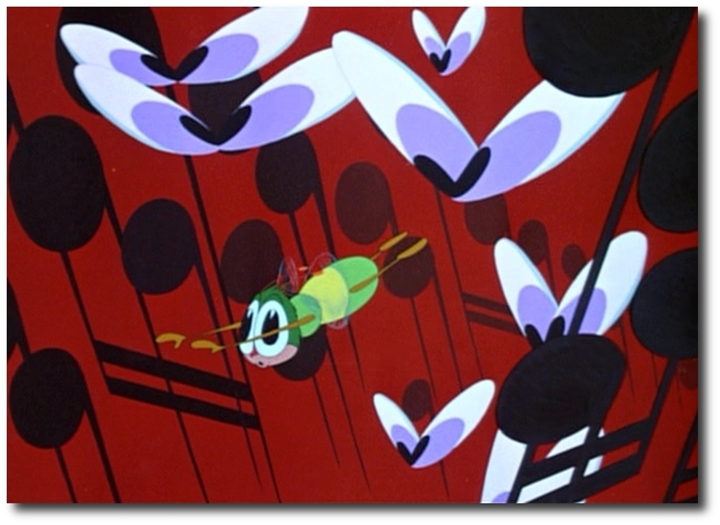 Freddy Martin and his orchestra play their jazzy variation of Nicolai Rimsky-Korsakov’s ‘Flight of the Bumblebee’ in this second segment from ‘Melody Time‘.
This music is accompanied by images of a little bumblebee fleeing from all kinds of things, in their designs loosely based on piano keys and music notes. The setting is semi-abstract and resembles the ‘After You’ve Gone’-sequence of ‘Make Mine Music’ (1946) a lot.
‘Bumble Boogie’ is far more colorful, however, with bright colors sometimes changing within semi-seconds. At one point, the little bumblebee is even rendered only in lines, anticipating the graphic style of the fifties, and of UPA in particular.
Watch ‘Bumble Boogie’ yourself and tell me what you think:
Director: ?
Release Date: May 27, 1948
Rating: ★★★★★
Review:
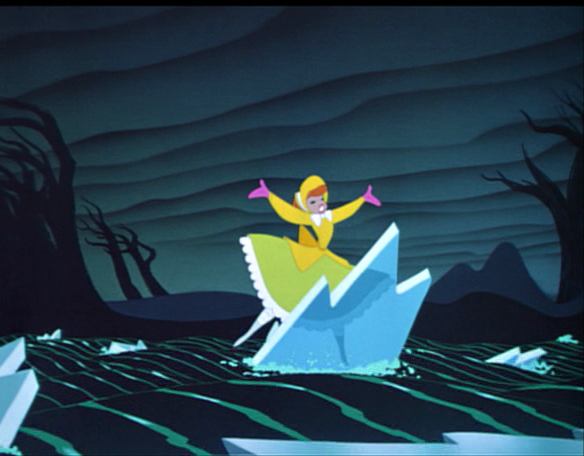 Once Upon a Winter Time’ is the first and easily the best sequence from ‘Melody Time‘.
In this film, sung by Frances Langford, we follow a young romantic couple on a sleigh ride. They go skating and are joined by an equally romantic couple of rabbits. After a short break-up the two females are caught in drifting ice and heading for a waterfall. Surprisingly, they are rescued by the couple’s two horses, who get help from a pair of birds and a pair of squirrels. They return the ladies in distress to their male counterparts, restoring love.
This sweet story is particularly interesting for its highly stylized backgrounds based on designs by Mary Blair and featuring unnatural colors, like a yellow sky. The story looks back to ‘On Ice‘ (1935) and even ‘The Ugly Duckling‘ (1931), which both feature a rescue from a waterfall, too.
Watch ‘Once upon a Wintertime’ yourself and tell me what you think:
Directors: Clyde Geronimi, Wilfred Jackson, Jack Kinney, Hamilton Luske
Release Date: May 27, 1948
Stars: Donald Duck, Joe Carioca, The Aracuan Bird
Rating: ★★
Review:
 Melody Time’ is a compilation film in the same vein as ‘Make Mine Music’ (1946).
It consists of seven unrelated episodes, connected by a voice over and an animated brush. The songs of these sequences are sung by popular artists, who, except for the Andrews Sisters and Roy Rogers, are all but forgotten today. Even more obviously than in ‘Make Mine Music’, these songs are clearly designed for the cartoons, instead of the other way round, like in ‘Fantasia’ (1940). In any sense ‘Melody Time’ is a far cry from that latter film, and the most interesting feature of this film is not the animation, but the film’s beautifully stylized backgrounds, especially in ‘Once upon a Wintertime‘ and ‘The Legend of Johnny Appleseed‘.
The sequences themselves are mediocre, often slow and only moderately funny at best. Luckily, Disney would soon return to real features, for ‘Melody Time’ shows that the studio’s compilation features had outstayed their welcome.
Melody Time consists of the following episodes, which I will discuss in more detail, elsewhere:
Director: Charles Nichols
Release Date: April 30, 1948
Stars: Pluto
Rating: ★
Review:
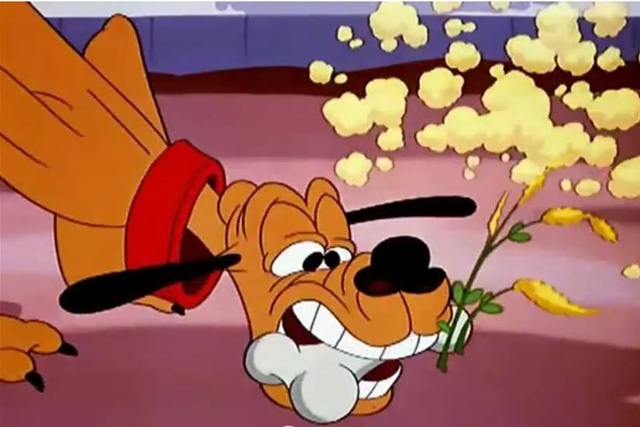 While looking for some bones he has buried, Pluto encounters a gopher who makes him sneeze, using mimosa ,all through this boring picture.
‘Bone Bandit’ is one of Pluto’s most forgettable entries, even though Pluto does not become friends with a little animal for once.
Pluto would encounter another gopher in ‘Pluto and the Gopher‘ (1950), which is only marginally better. Gophers apparently just aren’t funny, a fact also proven by ‘Donald’s Garden‘ (1942) and the Woody Woodpecker cartoon ‘Wicket Wacky‘ (1951).
Watch ‘Bone Bandit’ yourself and tell me what you think:
This is Pluto cartoon No. 24
To the previous Pluto cartoon: Pluto’s Blue Note
To the next Pluto cartoon: Pluto’s Purchase
Director: Charles Nichols
Release Date: December 26, 1947
Stars: Pluto
Rating: ★★★½
Review:
 In ‘Pluto’s Blue Note’ Pluto tries to sing along with some birds, a bee and a grasshopper, but to no avail.
When he discovers that he can use his tail as a needle to play records with, he uses these not only to impress these animals, but also five female dogs, who fall for ‘his’ crooning, Frank Sinatra-like voice. In this short Pluto performs a very silly dance, which is only topped in outrageous animation by his facial expressions while play-backing the crooning voice.
‘Pluto’s Blue Note’ certainly is one of the more inspired Pluto cartoons of the late forties, and its story a welcome deviation from the Pluto-befriends-a-little-animal formula.
Watch ‘Pluto’s Blue Note’ yourself and tell me what you think:
This is Pluto cartoon No. 23
To the previous Pluto cartoon: Mail Dog
To the next Pluto cartoon: Bone Bandit
Director: Charles Nichols
Release Date: November 14, 1947
Stars: Pluto
Rating: ★
Review:
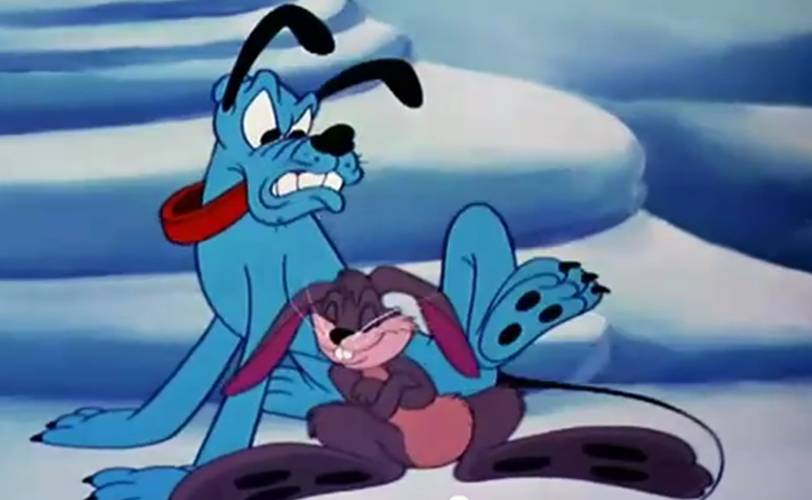 ‘Mail Dog’ is another arctic short featuring Pluto (see ‘Rescue Dog‘ from eight months earlier).
This time Pluto is a mail dog in Alaska. While delivering the mail he encounters a totem pole and a chilly rabbit. When he chases it, he accidentally delivers the mail in time, too.
This short follows the typical Pluto story, where Pluto befriends a little animal he dislikes at first. Unfortunately, there’s absolutely nothing special about this particular entry, making it one of Pluto’s most forgettable cartoons.
Watch ‘Mail Dog’ yourself and tell me what you think:
This is Pluto cartoon No. 22
To the previous Pluto cartoon: Rescue Dog
To the next Pluto cartoon: Pluto’s Blue Note
Director: Charles Nichols
Release Date: March 21, 1947
Stars: Pluto
Rating: ★★
Review:
 Pluto somehow is a rescue dog in the arctic, where he encounters the little seal from ‘Pluto’s Playmate‘ (1941).
In a story all too similar to this earlier entry, Pluto tries to get rid of it, but when the seal rescues him from almost drowning, they become friends.
This is one of the more forgettable Pluto shorts in which Pluto befriends a little animal. Its story is told quite slowly. However, it contains some broad and funny animation of Pluto. The seal would return the following year in ‘Mickey and the Seal‘.
Watch ‘Rescue Dog’ yourself and tell me what you think:
This is Pluto cartoon No. 21
To the previous Pluto cartoon: Pluto’s Housewarming
To the next Pluto cartoon: Mail Dog
Directors: Jack Kinney, Hamilton Luske & Bill Roberts
Release Date: September 27, 1947
Stars: Jiminy Cricket, Mickey Mouse, Donald Duck, Goofy, Edgar Bergen, Luana Patton
Rating: ★★★★
Review:
 Fun and Fancy Free’ was the fourth of six package features Disney released in the 1940s.
It consists of two unrelated stories, which were both originally conceived as feature films in 1940/1941. The two stories, ‘Bongo’ and ‘Mickey and the Beanstalk’ are loosely linked by Jiminy Cricket, who sings the happy-go-lucky theme song.
He plays a record to a sad doll and a gloomy bear which features Dinah Shore telling the story of Bongo in rhyme and song. This cute, if unassuming and forgettable little film (after a story by Sinclair Lewis) tells about Bongo the circus bear, who breaks free from the circus, falls in love with a cute female bear called Lulubelle, and combats a large brutal bear called Lumpjack.
Immediately after this story has ended, we follow Jiminy Cricket to a live action setting: a private party with a little girl (Luana Patton), Edgar Bergen and his two ventriloquist sidekicks, the cynical Charlie and the dumb, but gentle Mortimer.
Bergen tells a version of ‘Jack and the Beanstalk’, starring ‘famished farmers’ Mickey, Donald and Goofy in their last classic trio outing. This part had a long genesis, the early drafts of this film go back to 1940. Apparently Pinto Colvig had returned to the Disney studio, because Goofy has his voice back after having been silenced for eight years. Pinto Colvig would do Goofy’s voice in two subsequent shorts, ‘Foul Hunting‘ (1947) and ‘The Big Wash‘ (1948), before leaving again, leaving Goofy voiceless, once more. This sequence is also the last theatrical film in which Walt Disney does Mickey’s voice. Halfway the production Jimmy MacDonald took over.
This second episode of ‘Fun and Fancy Free’ is a delight, if a little bit slow. Its humor derives mostly from Charlie’s sarcastic interruptions. Nevertheless, the animation of the growing beanstalk and of Willie the giant is stunning.
Willie would be the last giant Mickey defeated, after having done with giants in ‘Giantland‘ (1933) and ‘Brave Little Tailor’ (1938). Unlike the other giants, Willie is an instantly likeable character, and he was revived as the ghost of Christmas Present in ‘Mickey’s Christmas Carol‘ (1983).
‘Fun and Fancy Free’ is a lighthearted film. Like Disney’s other package features, it is not too bad, but it is certainly not among the ranks of masterpieces.
Watch the opening scene of ‘Fun and Fancy Free’ yourself and tell me what you think:
Director: Clyde Geronimi
Release Date: February 6, 1948
Stars: Goofy
Rating: ★★
Review:
 In ‘The Big Wash’ Goofy tries to wash his unwilling circus elephant Dolores (or Dolorious as he calls her).
‘The Big Wash’ was Clyde Geronimi’s last cartoon and his only one in the Goofy series. In the years to follow he would concentrate his directing skills on feature films, with the exception of two short specials, ‘Susie, the Little Blue Coupe’ (1952) and ‘The Story of Anyburg, U.S.A.’ (1957).
‘The Big Wash’ is not really a highlight in Geronimi’s career. Like ‘Foul Hunting‘ from the previous year, it uses the original Goofy character and Pinto Colvig’s voice, and, like in the former cartoon, this results in a slow, boring and remarkably old-fashioned film. The short is cute, but terribly unfunny, especially when compared to most other Goofy cartoons or contemporary entries from other studios.
‘The Big Wash’ was the last cartoon to feature the Goofy character as it was developed in the thirties. In his next cartoon, ‘Tennis Racquet‘, Goofy was not only once again voiceless, he was also redesigned, making him more fitting to the post-war era.
Watch ‘The Big Wash’ yourself and tell me what you think:
This is Goofy cartoon No. 22
To the previous Goofy cartoon: They’re Off
To the next Goofy cartoon: Tennis Racquet
Director: Jack Hannah
Release Date: January 23, 1948
Stars: Goofy
Rating: ★★★★½
Review:
 ‘They’re Off’ was the last of four Goofy cartoons directed by Jack Hannah, and the most Jack Kinney-like of them all.
In this cartoon we follow two Goofy characters who both bet on a horse race. One of them is a typical Hannah-style underdog, and decidedly a gay stereotype. The gay Goofy’s favorite, Old Moe, wins from the other Goofy’s favorite, star horse Snapshot, because the latter just can’t resist the camera.
In one frantic scene ‘They’re off’ uses footage from ‘How to Ride a Horse’ (1941), ‘Fantasia’ (the unicorns from the Pastoral Symphony sequence) and ‘Hockey Homicide‘ (1945).
Watch ‘They’re Off’ yourself and tell me what you think:
This is Goofy cartoon No. 21
To the previous Goofy cartoon: Foul Hunting
To the next Goofy cartoon: The Big Wash
Director: Jack Hannah
Release Date: October 31, 1947
Stars: Goofy
Rating: ★★
Review:
 In ‘Foul Hunting’ Goofy is hunting ducks, which all resemble Sonja from ‘Peter and the Wolf’ in ‘Make Mine Music’ (1946).
‘Foul Hunting’ is Jack Hannah’s third Goofy cartoon, and it is very different from his first two (‘A Knight for a Day‘ and ‘Double Dribble‘ from 1946). This cartoon returns to the original Goofy character, arguably unseen since ‘Baggage Buster‘ from 1941. More surprisingly, Goofy suddenly has his voice back – apparently, Pinto Colvig had returned to Disney.
Unfortunately, it’s this voice that slows down the action, making the cartoon less funny than the voiceless entries and giving it a painfully old-fashioned appearance. After five years of cartoons with multiple Goofies, this return to the ‘real’ Goofy feels like a retrogression. Pinto Colvig would be Goofy’s voice again in the equally unfunny ‘The Big Wash‘ (1948).
Watch ‘Foul Hunting’ yourself and tell me what you think:
This is Goofy cartoon No. 20
To the previous Goofy cartoon: Double Dribble
To the next Goofy cartoon: They’re Off
Director: Jack Hannah
Release Date: December 12, 1946
Stars: Goofy
Rating: ★★★★
 In ‘Double Dribble’ we’re watching a basketball game between home team U.U. and visiting team P.U. (which has only one fan).
‘Double Dribble’ is Jack Hannah’s second Goofy cartoon, and it uses the same format as his first, ‘A Knight for a Day‘ (1946) with equally fast and funny results. There’s a sports game with a lively narrator, typical for the Goofy shorts of the forties, but there’s also one underdog-like character, whom we can follow throughout the picture, and to whom we can relate. In ‘A Knight for a Day’ it was Cedric, this time it’s a tiny Goofy, called Marathu, who makes the final and deciding score, turning the game in favor of ‘old P.U.’.
Like in ‘Hockey Homicide‘ (1945) the team members share names with Disney employees.
Watch ‘Double Dribble’ yourself and tell me what you think:
This is Goofy cartoon No. 19
To the previous Goofy cartoon: A Knight for a Day
To the next Goofy cartoon: Foul Hunting
Director: Jack Hannah
Release Date: March 8, 1946
Stars: Goofy
Rating: ★★★★★
Review:
 ‘A Knight for a Day’ is one of four Goofy cartoons directed by Jack Hannah, while Goofy’s usual director, Jack Kinney, was busy working on feature films ‘Make Mine Music’ and ‘Fun and Fancy Free‘.
Hannah, who shares Kinney’s love for fast and nonsensical cartoons, adopts the use of a jabbering sports reporter-like voice over, but applies it to a medieval setting, with hilarious results. Unlike Kinney’s Goofy cartoons however, Hannah’s cartoon consists of a real story with identifiable characters, splitting Goofy’s personality into various different ones.
During a medieval tournament, Cedric, a young squire, has to replace his master, Sir Loinsteak, when he falls with his head on an anvil, blocking him out. He has to face the champion, Sir Cumference, an evil opponent, who rides a black horse, smokes cigars and has a shield of bricks. Cedric wins the tournament, however, earning kisses from the ‘beautiful’ princess Esmeralda, who is another Goofy-like character.
‘A Knight for a Day’ is a fast and fervid cartoon, which is over before you know it.
Watch ‘A Knight for a Day’ yourself and tell me what you think:
This is Goofy cartoon No. 18
To the previous Goofy cartoon: Hockey Homicide
To the next Goofy cartoon: Double Dribble
Director: Jack Kinney
Release Date: September 21, 1945
Stars: Goofy
Rating: ★★★★★ ♕
Review:
 ‘Hockey Homicide’ is an account of a frantic ice hockey game between two teams, of which all players share names with Disney employees (while the referee is named after the cartoon’s director, Jack Kinney).
The cartoon is bursting with cartoon violence. For instance, there’s a hilarious running gag of two star players, Bertino and Ferguson, who, when they leave the penalty box, immediately start beating up each other, only to be send back into the penalty box again.
But the real treat of this fast and furious cartoon is its final sequence, when the crowd takes over and the cartoon runs totally haywire, even using non-related footage from ‘How to Play Football’ (1944), ‘How to Play Baseball‘ (1942), ‘Victory Through Air Power’ (1943) and Monstro the Whale from ‘Pinocchio‘ (1940), to add to the feeling of complete chaos.
‘Hockey Homicide’ must be the wildest, fastest and most violent cartoon Disney ever produced. Like earlier Goofy cartoons by Jack Kinney, it is clearly influenced by contemporary cartoons at Warner Bros. and MGM, and it has a genuine Tex Averyan spirit rarely seen at Dosmey outside the Goofy series.
With ‘Hockey Homicide’ the Goofy series reached its apex. More entertaining films were to follow, but none as wild and extreme as this one. After it Kinney was fully involved in feature films, only to return to the Goofy series again in 1949. By then the humor of Hollywood cartoons had toned down. In the meantime five Goofy cartoons were produced: four directed by Donald Duck-director Jack Hannah, and one by Clyde Geronimi.
Watch ‘Hockey Homicide’ yourself and tell me what you think:
This is Goofy cartoon No. 17
To the previous Goofy cartoon: Californy’er Bust
To the next Goofy cartoon: A Knight for a Day


 Dr. Grob's Animation Review