You are currently browsing the category archive for the ‘Walt Disney films’ category.
Director: Burt Gillett
Release Date: September 30, 1931
Stars: Clarabelle Cow, Horace Horsecollar, Mickey Mouse, Minnie Mouse, Pluto
Rating: ★★★
Review:
 Mickey’s got his own radio station at the barn. There, Minnie, Horace Horsecollar and Clarabelle Cow perform some music to broadcast.
All goes well, until a cat and her little kittens cause havoc in the studio. Mickey has a hard time chasing them away, and during his efforts all instruments are destroyed.
‘The Barnyard Broadcast’ reuses the cat from ‘Mickey Steps Out‘ from two months earlier, and it introduces the numerous kittens that would cause Mickey lots of trouble in the subsequent films ‘Mickey’s Orphans‘ (1931) and ‘Mickey’s Revue‘ (1932). After that their role would be taken over by the orphan mice, introduced in ‘Mickey’s Nightmare‘ (1932).
After ‘Mickey Steps Out’, ‘The Barnyard Broadcast’ is another attempt in building a finale in a string of gags. The film is not entirely successful in this and only gains momentum when Mickey chases the cat away with a broom. The technique would be perfected in the subsequent films, ‘The Beach Party‘ and ‘Mickey Cuts Up‘.
Watch ‘The Barnyard Broadcast’ yourself and tell me what you think:
This is Mickey Mouse cartoon No. 33
To the previous Mickey Mouse cartoon: Fishin’ Around
To the next Mickey Mouse cartoon: The Beach Party
Director: Burt Gillett
Release Date: September 1, 1931
Stars: Mickey Mouse, Pluto
Rating: ★
Review:
 Mickey and Pluto go fishing in a no fishing area, but the fish are making fun of them.
Pluto even gets under water, sniffing the bottom of the lake and meeting an enormous fish. This scene reuses quite some animation of Pluto sniffing from Pluto’s debut ‘The Picnic‘ (1930). Then a gamekeeper appears, but Mickey and Pluto escape him. The goat-like gamekeeper would return in Floyd Gottfredson’s Mickey Mouse comic ‘Dr. Oofgay’s Secret Serum’ (July 1934).
Like ‘Traffic Troubles‘, ‘The Moose Hunt‘ and ‘The Beach Party‘ from the same year, ‘Fishin’ Around’ is a genuine gag cartoon. It is the weakest of the lot, however, and can hardly be called a classic. The tricks the fish pull at Pluto and Mickey are amusing, but nothing more than that. Both the fish and Pluto steal a lot of screen time from Mickey, who is blander than ever before in this short.
Nevertheless, the film is a modest example of how the Disney studio tried to improve the quality of its animation. Notice, for example, the reflections and other water effects in this short. By now, they had become standard in Disney cartoons. Moreover, the cartoon starts with some quite convincing animation of Mickey rowing. There’s some clear sense of pulling weight here, even though these cycles are interspersed with less convincing animation.
Watch ‘Fishin’ Around’ yourself and tell me what you think:
This is Mickey Mouse cartoon No. 32
To the previous Mickey Mouse cartoon: Blue Rhythm
To the next Mickey Mouse cartoon: The Barnyard Broadcast
Director: Burt Gillett
Release Date: June 6, 1931
Stars: Mickey Mouse, Minnie Mouse, Pete (cameo), Pluto
Rating: ★★
Review:
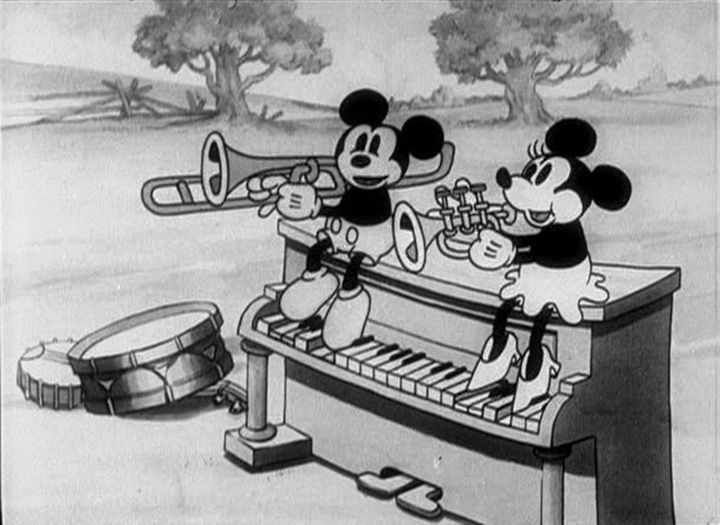 In ‘The Delivery Boy’ we watch Minnie doing the laundry in a pasture, singing the 1905 hit song ‘In the Shade of the Old Apple Tree’.
Mickey surprises her, and they dance the Charleston together to the background music. Mickey is so happy, he boxes a wasp’s nest. The wasp’s nest hits his donkey and his whole delivery, which consists of musical instruments, is spread over the pasture.
Undaunted, Mickey and Minnie start playing the piano, and all the farm animals join in, playing ‘The stars and stripes forever’. The cartoon ends when Pluto retrieves a burning dynamite stick and everything explodes. Nevertheless, Mickey is still able to finish playing John Philip Sousa’s famous march.
‘The Delivery Boy’ is as joyous as it is boring. After three years of song-and-dance routines one grows rather tired of it. Moreover, cartoons like ‘Traffic Troubles‘ and ‘The Moose Hunt‘ had proven that Mickey could do very well without them.
Pluto would cause havoc again in some of the succeeding films, like ‘Mickey Steps Out‘ (1931), ‘Mickey Cuts Up‘ (1931) and ‘The Grocery Boy‘ (1932). In these films the song-and-dance routine would give way to well-build gag-filled finales, of which the one in ‘The Delivery Boy’ is an embryonic version.
Watch ‘The Delivery Boy’ yourself and tell me what you think:
This is Mickey Mouse cartoon No. 29
To the previous Mickey Mouse cartoon: The Moose Hunt
To the next Mickey Mouse cartoon: Mickey Steps Out
Director: Burt Gillett
Release Date: April 30, 1931
Stars: Mickey Mouse, Pluto
Rating: ★★★½
Review:
 In ‘The Moose Hunt’ Mickey and Pluto are hunting moose.
They finally find a moose (or more exactly, the moose finds them). Unfortunately, in front of the moose, Mickey’s gun fails and soon the moose hunts both Mickey and Pluto. The chase ends with Mickey escaping on a flying Pluto.
‘The Moose Hunt’ is Mickey’s third gag only short, after ‘The Fire Fighters‘ (1930) and ‘Traffic Troubles‘ from earlier that year. It’s hardly as good as those earlier entries, though. Its pace is slow, and it contains some awkward gags, like the flying Pluto finale. It also contains a rare gag breaking the fourth dimension: when Mickey accidentally shoots Pluto, he suddenly addresses the audience with a “Is there a doctor in the house?”. Then, when Mickey begs Pluto to speak to him, Pluto actually speaks!
The self-conscious audience gag would remain a rarity at Disney, but it would become a staple gag at Warner Bros. when Tex Avery joined that studio. The two Pluto gags are totally out of character, and have nothing to do with him being a dog. After ‘The Moose Hunt’ we would never see Pluto flying or speaking again (apart from a short ‘Mammy’ at the end of ‘Mickey Steps Out‘), and after watching ‘The Moose Hunt’ it is easily understandable why not.
Luckily, there are other scenes that are more inspired, and in which Pluto behaves like a dog throughout. Indeed, in his very first solo scene, which reuses a little animation from ‘The Chain Gang‘ (1930), Pluto’s character as a little dumb and a little cowardly dog is pretty well established. Pluto’s looks are still unstable, but he’s excellently animated, throughout.
In ‘The Moose Hunt’ Pluto also gets his name (he was called ‘Rover’ in his first appearance in ‘The Picnic‘ from six months earlier). He now clearly is Mickey’s dog, not Minnie’s, like in the earlier film. It’s clear that the Mickey Mouse films could use an extra character, and after this film Pluto would appear in almost all succeeding Mickey Mouse films, stealing more and more screen time from Mickey.
Mickey would go hunting moose again in the way funnier ‘Moose Hunters’ from 1937, which, incidentally, doesn’t star Pluto.
Watch ‘The Moose Hunt’ yourself and tell me what you think:
This is Mickey Mouse cartoon No. 28
To the previous Mickey Mouse cartoon: The Castaway
To the next Mickey Mouse cartoon: The Delivery Boy
Director: Wilfred Jackson
Release Date: March 27, 1931
Stars: Mickey Mouse
Rating: ★★
Review:
 Mickey is a castaway, stranding on a tropical island.
Luckily, a piano is washed ashore as well, so Mickey performs for the jungle animals inhabiting the island. Unfortunately, an obnoxious little tiger disturbs him, and a great ape wants to play the piano, too, wrecking the instrument.
‘The Castaway’ was a short made out of rest material, and it shows: Mickey’s looks are wildly inconsistent, there’s not even a hint of a story, and the whole film feels like a throwback to 1929. Nevertheless, this short contains nice effect animation of waves washing ashore. It also reuses some animation of dancing sea lions from ‘Wild Waves‘ (1929) and of a dancing ape from ‘Jungle Rhythm‘ (1929), the film with which ‘The Castaway’ has most in common, which is no advertisement. In fact, Walt Disney disliked the film, thinking it didn’t look like a Walt Disney picture. And indeed, it hardly does.
The gag in which a lion gets eaten by a crocodile was borrowed from a very early Mickey Mouse comic strip from February 1930, which incidentally was the last panel drawn by Ub Iwerks himself.
‘The Castaway’ is also noteworthy for being the first Disney short to feature music by Frank Churchill, who would score many Disney shorts, and who would become particularly famous for the hit song ‘Who’s Afraid of the Big Bad Wolf’ from ‘Three Little Pigs‘ (1933) and the songs in ‘Snow White and the Seven Dwarfs’ (1937).
Watch ‘The Castaway’ yourself and tell me what you think:
This is Mickey Mouse cartoon No. 27
To the previous Mickey Mouse cartoon: Traffic Troubles
To the next Mickey Mouse cartoon: The Moose Hunt
Director: Burt Gillett
Release Date: October 9, 1930
Stars: Mickey Mouse, Minnie Mouse, Pluto (as Rover)
Rating: ★★★
Review:
 Mickey’s driving to Minnie’s house singing his own theme song. They both are going on a picnic. While Mickey and Minnie are singing and dancing across the field to the tune of ‘In the Good Old Summertime’, hundreds of wild animals take their food away. The picnic ends in rain.
‘The Picnic’ is a rather plotless and unremarkable cartoon. It nevertheless contains a nice surreal gag in which a rabbit pulls away a hole. This kind of surrealism was rare at Disney’s at that time, but later, Tex Avery would reuse this gag many times at Warner Brothers and MGM.
‘The Picnic’ would have been forgettable, did it not mark the debut of Pluto. He is called Rover in this cartoon, and appears to be Minnie’s dog rather than Mickey’s, but he’s Pluto alright. At this point there’s no reason to believe that Disney intended to make the dog a regular character. Floyd Gottfredson’s Mickey Mouse comics of January 1931 cover similar grounds, but feature a very large dog called “Tiny”.
Nevertheless, in April 1931 Pluto would return in ‘The Moose Hunt‘. This time to stay*. In fact Pluto would become a more and more important character in the Mickey Mouse cartoons, at times stealing most of the screen time from Mickey, who would become more and more a ‘straight man’. Eventually, Pluto would be given his own series, in 1937.
Watch ‘The Picnic’ yourself and tell me what you think:
This is Mickey Mouse cartoon No. 23
To the previous Mickey Mouse cartoon: The Gorilla Mystery
To the next Mickey Mouse cartoon: Pioneer Days
* Gottfredson’s Mickey Mouse comics followed three months later, introducing Pluto on July the 8th.
Director: Burt Gillett
Release Date: July 11, 1930
Stars: Clarabelle Cow, Horace Horsecollar, Mickey Mouse, Minnie Mouse
Rating: ★★★
Review:
 There’s a party at the barn. Mickey and Minnie make some music and Mickey dances with Clarabelle Cow, with a dachshund and with a fat pig, but not with Minnie, who plays the piano.
The short contains no story, but is one of sheer joy. Mickey and Minnie perform folk tunes like ‘Turkey in the Straw’, ‘Pop goes the Weasel’ (in which Mickey repeatedly grabs Minnie’s knickers), and ‘Old Folks at Home’, performed by Mickey on a mouth organ. The cartoon ends when the pig lands on Mickey.
‘The Shindig’ marks Horace Horsecollar’s first appearance as a completely humanized horse. It also contains the first love scene between him and Clarabelle Cow, whose name is written on the shed in which she lives.
In Clarabelle’s first scene, we watch her read Elinor Glyn’s novel ‘Three Weeks’. When she discovers an audience is watching her, she blushes, and quickly hides the book away. No wonder, ‘Three Weeks’ was a scandalous book, an erotic romance from 1907, apparently still controversial in 1930.
The party idea of ‘The Shindig’ was elaborated on in ‘The Whoopee Party‘ (1932), producing a cartoon full of party delight, compared to which ‘The Shindig’ pales.
Watch ‘The Shindig’ yourself and tell me what you think:
This is Mickey Mouse cartoon No. 20
To the previous Mickey Mouse cartoon: The Fire Fighters
To the next Mickey Mouse cartoon: The Chain Gang
Director: Walt Disney
Release Date: May 10, 1930
Stars: Horace Horsecollar, Mickey Mouse, Minnie Mouse, Pete
Rating: ★★★★
Review:
 ‘The Cactus Kid’ can be summarized as ‘Gallopin’ Gaucho in Mexico’. Mickey visits a Mexican canteen where Minnie’s a waitress. They make music together until Pete enters and kidnaps Minnie.
When Mickey pulls her nose, we hear Minnie speaking Spanish. The Mexican atmosphere is further enhanced by the use of music from Emmanuel Chabrier’s España, although the chase scene is accompanied by Jacques Offenbach’s (French) can-can.
Pete’s seen with a peg leg for the first time in this cartoon, although he already had a peg leg in several Oswald the Lucky Rabbit cartoons. We also hear him really speak for the first time. Actually, there’s an unprecedented amount of dialogue in this cartoon. Nevertheless, Mickey’s lips still look awkward when he speaks. Fortunately, this problem would soon be solved in the following cartoons.
Horace Horsecollar is recognizable, too, with his characteristic yoke and bowler hat. But he’s still only a partly humanized horse, here, and Mickey rides him. Only in ‘The Shindig‘ from two months later Horace Horsecollar would be fully anthropomorphized.
‘The Cactus Kid’ happened to be the last cartoon Walt Disney directed himself until his unfortunate come-back with ‘The Golden Touch’ five years later. The film was parodied as ‘Galloping Romance’, the cartoon showed in ‘Mickey’s Gala Premier‘ from 1932.
Watch ‘The Cactus Kid’ yourself and tell me what you think:
This is Mickey Mouse cartoon No. 18
To the previous Mickey Mouse cartoon: The Barnyard Concert
To the next Mickey Mouse cartoon: The Fire Fighters
Director: Ub Iwerks
Release Date: June 26, 1930
Rating: ★★
Review:
 In ‘Arctic Antics’ the song-and-dance-routine, typical of the early Silly Symphonies, is carried out by polar bears, sea lions, penguins (whose habitat actually is the Antarctic), and a walrus. The latter is reused from the Mickey Mouse short ‘Wild Waves‘ from 1929.
‘Arctic Antics’ was the last cartoon Ub Iwerks directed before he left the studio to set up one of his own. It features a rather Mickey Mouse-like polar bear, but the most interesting aspect of this cartoon is the end, in which the marching penguins disappear behind an iceberg. This gives a novelty effect of depth. This search of effects of depth would eventually lead to the invention of the multiplane camera, seven years later.
Penguins were revisited five years later, in ‘Peculiar Penguins‘ (1935). By then they had lost the out-of-place bellybuttons they got in this cartoon.
Watch ‘Arctic Antics’ yourself and tell me what you think:
This is Silly Symphony No. 11
To the previous Silly Symphony: Frolicking Fish
To the next Silly Symphony: Midnight in a Toy Shop
Director: Burt Gillett
Release Date: May 23, 1930
Rating: ★★
Review:
 Frolicking fish indeed. Even oysters, starfish and a lobster join in the dance routines, oh so typical of early Silly Symphonies. Nevertheless, this cartoon ends with some kind of story, when an evil octopus follows a small fish, who gets rid of the villain by dropping an anchor on him.
There’s not much to enjoy in ‘Frolicking Fish’ despite its merry premise. However, like ‘Autumn‘ this cartoon contains early and to many rivaling studios undoubtedly ‘unnecessary’ effect animation, this time loads and loads of bubbles.
It has entered animation history, however, by featuring the first example of ‘overlapping action’ in animation. Overlapping action acknowledges that different (body) parts move with different speeds. So one part can already start moving, before another comes to an end, and animation cycles can overlap each other in imperfect ways. This opposed to the then normal type of animation, which was based on poses, which led to straightforward animation cycles. This new type of animation was developed by animator Norm Ferguson, who had been hired by Disney in August 1929. It was a milestone at that time, a piece of animation marveled at by Ferguson’s colleagues, including Walt Disney himself. It led to the development of full animation, which would slowly replace the ‘rubber hose animation’ of the early thirties.
Overlapping Action can be seen in the three fish dancing at 2:07. Compare it to the stiff stop-and-go movements of the fish musicians following this scene, and the difference may become clear.
From ‘Frolicking Fish’ on Norm Ferguson would become one of Disney’s greatest and most influential animators of the 1930s, and he was responsible for another breakthrough piece of animation: ‘Playful Pluto‘ (1934), the first convincing piece of animation of a character thinking. He was a great influence on future Nine Old Man John Lounsberry, whom he trained as an assistant animator. Unfortunately, Ferguson’s star diminished in the 1940s, and by the 1950s his style had become old-fashioned…
Watch ‘Frolicking Fish’ yourself and tell me what you think:
This is Silly Symphony No. 10
To the previous Silly Symphony: Night
To the next Silly Symphony: Arctic Antics
‘Frolicking Fish’ is available on the DVD-set ‘Walt Disney Treasures: More Silly Symphonies’
Director: Walt Disney
Release Date: April 18, 1930
Rating: ★★
Review:
 ‘Night’ is a typical ‘mood piece’ Silly Symphony, comparable with the season mini-series (Springtime, Summer, Autumn, and Winter). This time it’s night and we watch owls, moths, fireflies, mosquitoes and frogs moving to music.
As usual in the early Silly Symphonies, there’s practically no plot, but only a dance routine, and a rather dull one, too. Nevertheless, the short manages to evoke more ‘mood’ than the other early entries.
Especially the opening scene looks beautiful with its rippling reflection of the moon in the water, predating similar scenes in ‘Water Babies‘ (1935) and ‘The Old Mill‘ (1937). Indeed, ‘Night’ can be seen as an early forerunner of the latter cartoon, and it is interesting to compare them, and awe at the tremendous strides the Disney studio had made in the mere seven years between the two shorts.
According to David Gerstein in ‘Animation Art’ the dancing frog is the embryonic form of Flip the Frog, Ub Iwerks’s own star after he had left Disney January 1930. Apparently, Iwerks wanted to make a new star out of this frog, but this idea was turned down by Walt Disney. Indeed, this frog gets quite some screen time (the last three minutes of the cartoon), and has a girlfriend, who is a clear forerunner of Flip’s sweetheart in Flip’s second cartoon, ‘Puddle Pranks‘.
Watch ‘Night’ yourself and tell me what you think:
This is Silly Symphony No. 9
To the previous Silly Symphony: Cannibal Capers
To the next Silly Symphony: Frolicking Fish
Director: Burt Gillett
Release Date: March 15, 1930
Rating: ★★★
Review:
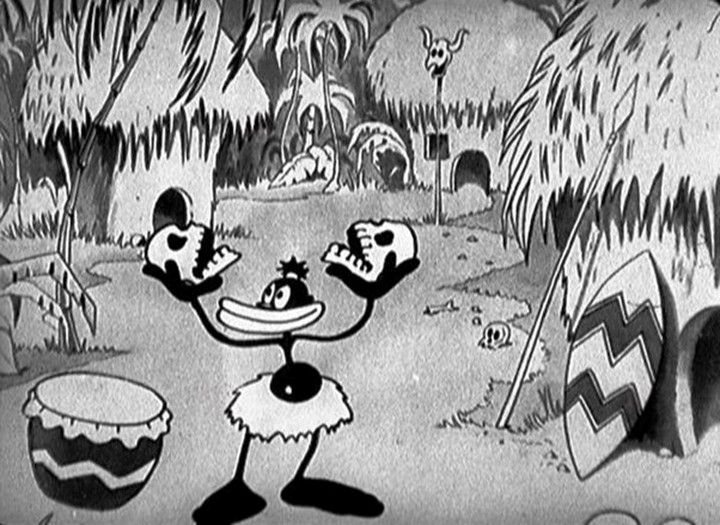 ‘Cannibal Capers’ is a typical early dance routine Silly Symphony. This time we watch dancing cannibals, followed by the antics of one poor cannibal chased by a lion.
The caricatures of the ‘primitive’ blacks are backward and quite extreme in this cartoon: the cannibals have such huge lips, they almost look like ducks(!). Nevertheless, the cartoon is less offensive than a later film like ‘Mickey’s Man Friday‘ (1935), because the cannibals at least look sympathetic (despite the skulls that lie everywhere), and are not compared to apes, like in the latter cartoon.
It also fairs better than the Betty Boop cartoon ‘I’ll Be Glad When You’re Fead You Rascal You‘ (1932), which also features cannibals, but here they’re linked to musicians of Louis Armstrong’s orchestra, making a direct connection between the racist caricatures and real Afro-Americans.
Cannibals were staple characters of cartoons from the thirties, but the caricatures managed to stay well into the fifties, being featured in shorts such as ‘His Mouse Friday‘ (Tom & Jerry, 1951), ‘Spare The Rod’ (Donald Duck, 1954) and ‘Boyhood Daze’ (Merrie Melodies, 1957).
‘Cannibal Capers’ is noteworthy, because it contains the only animation by Floyd Gottfredson that hit the screen: that of the lion running out of the jungle and of a cannibal beating the drum. Around the time this cartoon was released, Gottfredson was asked to take over the Mickey Mouse comic strip (then still written by Walt Disney himself), something he would do until 1975.
Watch ‘Cannibal Capers’ yourself and tell me what you think:
This is Silly Symphony No. 8
To the previous Silly Symphony: Autumn
To the next Silly Symphony: Night
Director: Ub Iwerks
Release Date: February 15, 1930
Rating: ★★★
Review:
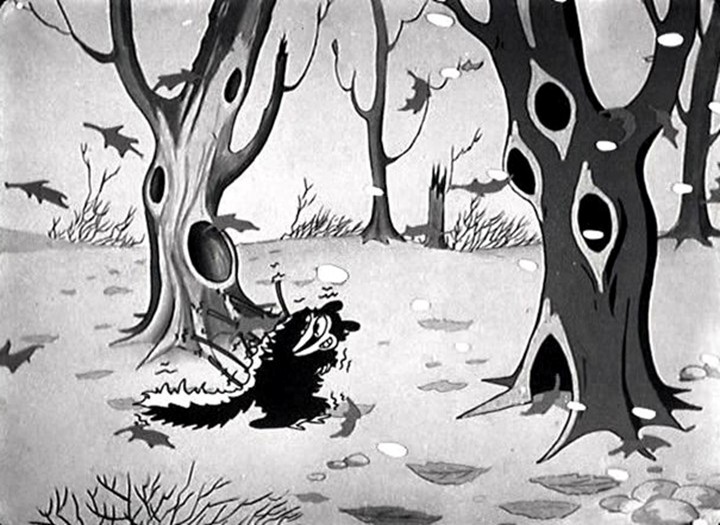 Autumn is the third entry in the season series, and it shows a small improvement in story development on the first two entries, Springtime and Summer. This time we don’t see animals just dancing, but collecting food for the winter in rhythmical fashion on Carl Stalling’s music.
We watch squirrels, crows, a skunk, a porcupine and some beavers collecting food (Disney would return to the latter species one year later in ‘The Busy Beavers‘). Then a cold winter wind make the ducks fly south and the other animals seek for shelter. At that point the cartoon suddenly ends.
Besides the tiny story element, notice the numerous falling leaves and elaborate reflections in the water, proof of Disney’s efforts to use ‘superfluous’ animation to give the cartoons more atmosphere and quality.
Watch ‘Autumn’ yourself and tell me what you think:
This is Silly Symphony No. 7
To the previous Silly Symphony: Summer
To the next Silly Symphony: Cannibal Capers
Director: Ub Iwerks
Release Date: January 4, 1930
Rating: ★★½
Review:
 ‘Summer’ is the second Silly Symphony in the season mini-series. ‘The merry bugs’ would have been a better title, because the short only focuses on insects (and one spider).
Like the other early Silly Symphonies, there’s only one long sequence of unrelated dance scenes, there’s no story whatsoever, and a lot of the animation is repetitive. This makes ‘Summer’ rather tiresome to watch. It’s undoubtedly the weakest entry of the four seasons, and one of the weakest of all Silly Symphonies. Like ‘Springtime‘ and ‘Autumn‘ it was directed by Ub Iwerks, and somehow, it shows the animator’s lesser ambitions.
Watch ‘Summer’ yourself and tell me what you think:
This is Silly Symphony No. 6
To the previous Silly Symphony: The Merry Dwarfs
To the next Silly Symphony: Autumn
Director: Walt Disney
Release Date: March 6, 1930
Stars: Mickey Mouse
Rating: ★★★★
Review:
 This is a very aptly titled short: we only see Mickey, there are no other stars or characters.
Mickey is the sole performer in his fourth concert cartoon (after ‘The Opry House‘, ‘Mickey’s Follies‘ and ‘The Jazz Fool‘, all from 1929). This time he’s playing the violin, presenting his reading of the fifth Hungarian dance by Johannes Brahms, Träumerei by Robert Schumann (which makes him cry) and, as an encore, the finale from ‘Overture William Tell‘ by Gioachino Rossini.
The whole setting is such that we’ve got the feeling we’re part of the audience ourselves, and that the man with the mocking laugh is among us. Later, the Warner Bros. studio would expand upon this idea of cartoon figures and audience interplay.
‘Just Mickey’ contains some good facial expression animation of Mickey, besides some great shadow effects during his rendering of ‘Träumerei‘. Moreover, the hand movements in this short are remarkably convincing. It is an early showcase of Walt Disney’s ambition to improve the art of animation. Being the first Mickey Mouse cartoon after Ub Iwerks’s departure in January 1930, it shows the studio could do very well without him…
Watch ‘Just Mickey’ yourself and tell me what you think:
This is Mickey Mouse cartoon No. 16
To the previous Mickey Mouse cartoon: Wild Waves
To the next Mickey Mouse cartoon: The Barnyard Concert
Director: Burt Gillett
Release Date: December 21, 1929
Stars: Mickey Mouse, Minnie Mouse
Rating: ★★★½
Review:
 In his fifteenth cartoon Mickey is a lifeguard and he saves a nearly drowning Minnie.
To comfort his sweetheart Mickey does some playing and dancing. Some animals (pinguins, sea lions, pelicans and a singing walrus) join in. This is a particularly dull sequence, Minnie cheers up, calls Mickey ‘my hero’ and kisses him. Iris out.
In this short, there’s a story at least the first half of the cartoon, making it slightly better than most of the early Mickey Mouse entries. The cartoon starts with some nice scatting by Mickey. Unfortunately, the fledgling lip-synch still accounts for some strange facial expressions on our hero. The drowning and saving part is the most interesting sequence, and contains some nice water animation, as well Mickey defying gravity by swimming through air.
‘Wild Waves’ was the first short directed by Burt Gillett. Gillett had joined Disney in April 1929. He would become the principal Mickey Mouse director of 1930 and 1931, and in 1933 he would gain fame with ‘Three Little Pigs‘. His career at Disney’s would last until 1934, when he left for the ill-fated Van Beuren Studio.
‘Wild Waves’ also was the last Walt Disney short to feature music by Carl Stalling. When Ub Iwerks left Disney in January 1930, Stalling soon followed, believing the studio had no future without this master animator. For his last film Stalling not only provided the score, but also the singing for Mickey and the Walrus. The singing walrus would be reused half a year later, in the Silly Symphony ‘Arctic Antics‘, while the dancing sea lions returned in ‘The Castaway‘ (1931).
Watch ‘Wild Waves’ yourself and tell me what you think:
This is Mickey Mouse cartoon No. 15
To the previous Mickey Mouse cartoon: The Haunted House
To the next Mickey Mouse cartoon: Just Mickey
Director: Walt Disney
Release Date: December 2, 1929
Stars: Mickey Mouse
Rating: ★★½
Review:
 ‘The Haunted House’ is Mickey’s first horror cartoon.
In this short he hides from a rain storm in a house, which appears to be haunted by skeletons. A cloaked skeleton orders Mickey to play on a harmonium, while all the skeletons dance.
This sequence reuses some footage of four skeletons dancing from ‘The Skeleton Dance‘. Unfortunately, the new animation on dancing and playing skeletons is hardly as good, and the dancing sequence feels more primitive than ‘The Skeleton Dance’. However, the opening shot is beautiful, with the house flexing in the wind. There’s also some good animation on the cloaked skeleton, and a beautifully lit scene when Mickey strikes a match.
Mickey’s role in this short is very limited, and his only function seems to be being the carrier of the audience’s fear. Indeed, he looks repeatedly into the camera for sympathy, dragging us into the haunted house with him.
The early scenes of this cartoon manage to evoke a genuine feel of horror, but in the end this short resembles the boring song-and-dance-routines of both the early Mickey Mouse and Silly Symphony series too much to be a stand out.
Mickey would return to the horror genre in ‘The Gorilla Mystery‘ (1930) and ‘The Mad Doctor‘ (1933), with much better results.
Watch ‘The Haunted House’ yourself and tell me what you think:
This is Mickey Mouse cartoon No. 14
To the previous Mickey Mouse cartoon: Jungle Rhythm
To the next Mickey Mouse cartoon: Wild Waves
Director: unknown
Release Date: May 27, 1925
Stars: Dawn O’Day (Alice), Julius
Rating: ★★★★★
Review:
 In ‘Alice’s Egg Plant’ Alice and Julius have a chicken farm, but a Russian spy chicken named ‘Little red Henski’ makes their chicken strike. Clever Alice then organizes a cock fight with a one egg admission fee.
‘Alice’s Egg Plant’ marks Dawn O’Day’s only appearance as Alice. She was supposed to be the second Alice after Virginia Davis, who quit after some arguments about her salary. But Disney’s salary offer proved to be too low for O’Day, as well. The next Alice would be Margie Gay, who would serve as Alice during 1925 and 1926
In ‘Alice’s Egg Plant’ one can already see the transition from emphasis on live action to animation. The shots of Alice are minimized in this cartoon and there are no close ups. The animation on the other hand begins to look more flexible and lifelike. Add the clever and entertaining story with its many gags, and here’s an Alice Comedy that still is entertaining today. It would also be prophetic, because Disney himself would face a frustrating strike in 1941, also led by an agitator from outside the company, Herbert K. Sorrell…
Watch ‘Alice’s Egg Plant’ yourself and tell me what you think:
‘Alice’s Egg Plant’ is available on the DVD ‘Walt Disney Treasures: Disney Rarities’
Director: Ub Iwerks
Release Date: October 4, 1929
Rating: ★★★
Review:
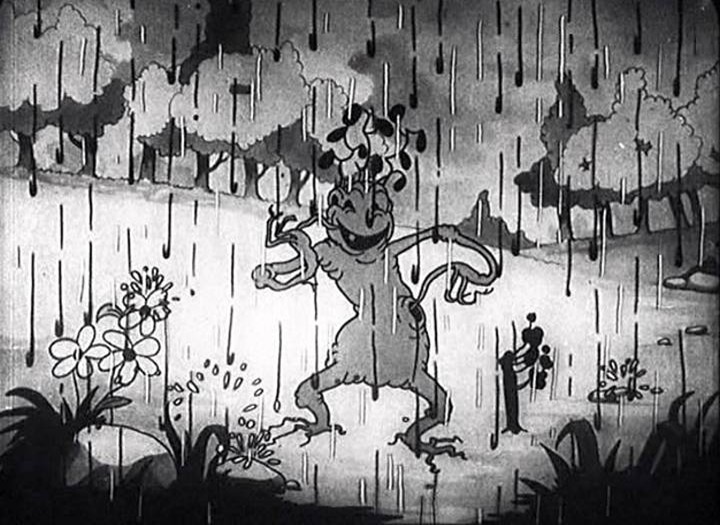 ‘Springtime’, the third entry in the Silly Symphony series, is also the first of four Silly Symphonies devoted to the seasons.
Animated by Ub Iwerks, Les Clark and Wilfred Jackson, it sets the tone for many Silly Symphonies to come: the atmosphere is fairy-tale-like, there is no story whatsoever, but only one long dance routine. One had to wait two years, until ‘The Ugly Duckling‘, to watch a Silly Symphony escaping this rather limited format.
In this particular short we watch flowers dancing to Edvard Grieg’s ‘Morning’ from ‘Peer Gynt’. The flowers are very similar to the ones in ‘Flowers and Trees‘ from 1932. There are also several dancing animals: bugs, a caterpillar, crows, grasshoppers, frogs, a spider and a heron. The latter three dance to Amilcare Ponchielli’s ‘Dance of the hours’, which would be reused in the much more famous ‘Fantasia’ (1940). Besides the dancing there’s a remarkable portion of devouring: the crow eats the caterpillar, the heron eats the four frogs. The most extraordinary scene is the short rain storm scene, in which we watch a tree bathing in the rain.
However, one other scene particularly deserves our attention: in it we watch a rippled reflection of a dancing frog in the water, an early and interesting attempt of realism. Many of these attempts were soon to follow, and the Silly Symphonies became Disney’s laboratories for experimentation towards better animation.
In ‘One Hundred and One Dalmatians‘ (1961) ‘Springtime’ is shown on television during a scene at the old De Vil mansion: we can watch the dancing flowers and frogs, and the short’s score provides the background music for a large part of the scene.
Watch ‘Springtime’ yourself and tell me what you think:
This is Silly Symphony No. 3
To the previous Silly Symphony: El Terrible Toreador
To the next Silly Symphony: Hell’s Bells
Director: Walt Disney
Release Date: September 7, 1929
Rating: ★★★
Review:
 ‘El Terrible Toreador’ is the second entry of the Silly Symphonies. It has been far lesser known than the first, ‘The Skeleton Dance‘, which is no surprise, because it contains none of the ingredients which made ‘The Skeleton Dance’ a classic: there’s no interesting mood, no spectacular animation, and there are hardly any funny gags.
Unlike the other early Silly Symphonies, ‘El Terrible Toreador’ is more silly than symphony-like. That is: it’s more of a ‘story’ consisting of silly gags than the song-and-dance-routine typical of the Silly Symphonies up to 1931.
The cartoon consists of two parts: in the first part we watch a Spanish canteen, where a large officer and a toreador are fighting for the love of a waitress. In the second part, the toreador is fighting and dancing with a bull in the arena. Surprisingly, the story of the first part is hardly developed here: the cartoon ends when the toreador has pulled the bull inside out, thus ending the fight.
‘El Terrible Toreador’ is notable for being Disney’s first attempt at the human form since the early 1920s. However, the humans are a far cry from ‘Snow White and the Seven Dwarfs’ from (only) eight years later. In this early cartoon the human characters are extraordinarily flexible and they do not move lifelike at all (I noticed I thought of them as bugs some of the time).
The most interesting feature of this short is Carl Stalling’s score. His music already bears his signature and contains many citations from ‘Carmen’ by Georges Bizet.
Watch ‘El Terrible Toreador’ yourself and tell me what you think:
This is Silly Symphony No. 2
To the previous Silly Symphony: The Skeleton Dance
To the next Silly Symphony: Springtime


 Dr. Grob's Animation Review