
You are currently browsing the category archive for the ‘Walt Disney films’ category.
Director: Wilfred Jackson
Release Date: June 8, 1932
Stars: Mickey Mouse, Minnie Mouse, Pluto
Rating: ★★½
Review:
 In this film Mickey and Minnie are farmers, which makes the film a little like a remake of ‘The Plow Boy‘ (1929).
First we watch Mickey planting seeds with help from Pluto, and Minnie milking a cow. Then Mickey decides to scare Minnie by stepping inside the scarecrow. A string of gags leads to Mickey playing the bagpipes on three geese. This starts a musical number, which is almost Silly Symphony-like in its directionless musical fun at the barnyard. We watch cows, lamb, ducks, pigeons, turkeys and chickens moving and dancing to the tune of Turkey in the Straw.
But then we cut to several chickens laying multitudes of eggs, except for poor Fanny. At this point suddenly a story develops, with Fanny laying an enormous egg, which attracts a lot of attention from her fellow chickens, the other animals, and finally, Mickey. Mickey rushes to bring his camera to make a picture of it, but unfortunately, he uses too much flash light powder, and everything explodes. This final gag was also used by Floyd Gottfredson in the Mickey Mouse comic strip, published on March 13, 1932.
‘The Musical Farmer’ is one of the weaker Mickey Mouse films of 1932. Like e.g. ‘Mickey Cuts Up‘ and ‘The Grocery Boy‘ it’s uses the part-musical-number-part-frantic-finale-formula, but by mid-1932 shots of dancing animals had become a bit tiring and old-fashioned. Moreover, Fanny’s story feels a little out of place, and I suspect that part of this film was intentionally designed as a Silly Symphony, which apparently never really took off.
Watch ‘Musical Farmer’ yourself and tell me what you think:
This is Mickey Mouse cartoon No. 42
To the previous Mickey Mouse cartoon: Mickey’s Revue
To the next Mickey Mouse cartoon: Mickey in Arabia
‘Musical Farmer’ is available on the DVD ‘Walt Disney Treasures: Mickey Mouse in Black and White Volume Two’
Director: Burt Gillett
Release Date: October 1, 1932
Rating: ★★★
Review:
 ‘Bugs in love’ was the very last of the black and white Silly Symphonies, being even released after the technicolor films ‘Flowers and Trees‘ and ‘King Neptune‘.
The short’s story is almost a copy of that of ‘The Spider and the Fly‘ (1931) and features two bugs in love, who are threatened by a mean crow. Luckily their fellow flies come to the rescue, in an elaborate battle scene, in which the flies use e.g. ink, false teeth, shoe polish, an eggbeater, a mousetrap and castor oil to defeat the crow.
The ingenuity of this particular battle scene is intriguing, but unfortunately it follows all too similar scenes in films like ‘The Spider and the Fly’, ‘The Bird Store‘ and ‘The Bears and the Bees‘. The result is a rather traditional Silly Symphony, with its repetitious animation and rhythmical sequences. Luckily, with its two color Silly Symphonies Disney had demonstrated it could do much better, and the studio did not return to this formula, until the elaborate ‘The Moth and the Flame’ from 1938.
‘Bugs in love’ is clearly related to the successful comic strip ‘Bucky Bug’, begun earlier the same year. However, it’s not entirely clear to me whether the hero bug in ‘Bugs in Love’ is Bucky himself, or not.
Watch ‘Bugs in Love’ yourself and tell me what you think:
This is Silly Symphony No. 31
To the previous Silly Symphony: King Neptune
To the next Silly Symphony: Babes in the Woods
‘Bugs in Love’ is available on the DVD ‘Walt Disney Treasures: More Silly Symphonies’
Director: Wilfred Jackson
Release Date: July 9, 1932
Rating: ★
Review:
 ‘The Bears and the Bees’ follows the adventures of two little bear cubs, who encounter a large mean bear and a bee colony.
The two cubs eat the bees’ honey, but luckily it’s the old mean bear who gets all the stings, in an elaborate battle scene, comparable to those in ‘The Spider and the Fly‘ (1931) and ‘Bugs in Love‘ (1932).
The story of ‘The Bears and the Bees’ is consistent, but remarkably boring. The two little bears look like early forerunners of Mickey’s nephews Morty and Ferdy, who would make their screen debut two years later in ‘Mickey’s Steamroller‘ (1934). It’s interesting to see how the animators tried to render these two cubs partly as animals and partly as little brats. This way of animating animals halfway anthropomorphism would become a Disney specialty, leading to masterpieces like ‘Bambi‘ (1942) and ‘Lady and the Tramp‘ (1956). In this short it can be watched in its embryonic form.
Watch ‘The Bears and the Bees’ yourself and tell me what you think:
This is Silly Symphony No. 27
To the previous Silly Symphony: The Bird Store
To the next Silly Symphony: Just Dogs
‘The Bears and the Bees’ is available on the DVD ‘Walt Disney Treasures: More Silly Symphonies’
Director: Wilfred Jackson
Release Date: January 5, 1932
Rating: ★★★
Review:
 ‘The Bird Store’ follows earlier Mickey Mouse films and Silly Symphonies in presenting half a song-and-dance routine and half a story.
This short starts quite boringly with endless bird song routines, but after 4 minutes of this a cat enters, which leads to a small story when the cat captures a small canary and all other birds free the canary and chase the cat away to a city dog pound.
The bird designs are still pretty primitive, and much more akin to those in ‘Birds of a Feather‘ from one year earlier than to ‘Birds in the Spring‘ from one year later. Most birds are clearly drawn from fantasy, and make no sense at all. The provisional realism of the canary in ‘Mickey Steps Out‘ hardly gets any follow-up here. A small highlight form the four ‘Marx Birds’, which mark the earliest instance of Hollywood caricatures in a Disney film.
Watch ‘The Bird Store’ yourself and tell me what you think:
This is Silly Symphony No. 26
To the previous Silly Symphony: The Ugly Duckling
To the next Silly Symphony: The Bears and the Bees
‘The Bird Store’ is available on the DVD ‘Walt Disney Treasures: More Silly Symphonies’
Director: Wilfred Jackson
Release Date: November 10, 1931
Rating: ★★★
Review:
 ‘The Fox Hunt’ is the most atypical Silly Symphony of the black and white era. It’s not devoted to music at all, and it features human characters.
These human hunters ride rather cartoony horses, and much of the fun comes from the silly ways the hunters ride their horses. One even rides a cow, a pig, a porcupine and a log with four dogs in it. The cartoon opens most spectacularly, with the morning sun’s beaming rays lighting a few forest scenes. A little later there’s a beautiful scene of the hunters and their horses casting long shadows on a hill. A scene like this looks all the way forward to the Ave Maria sequence of ‘Fantasia’ (1940).
The human figures are a bit of a mixed bag, but generally more convincing than those in ‘Mother Goose Melodies‘ or ‘The China Plate‘ from earlier that year. Thus, ‘The Fox Hunt’ is one of those films showcasing Disney’s ambition, even though it’s by no means a classic.
The fox hunt theme was revisited nine years later in the Donald Duck & Goofy short of the same title (1938), which uses the same skunk end gag, which itself was copied from the Oswald cartoon ‘The Fox Chase‘ (1928).
Watch ‘The Fox Hunt’ yourself and tell me what you think:
This is Silly Symphony No. 24
To the previous Silly Symphony: The Spider and the Fly
To the next Silly Symphony: The Ugly Duckling
‘The Fox Hunt’ is available on the DVD ‘Walt Disney Treasures: More Silly Symphonies’
Director: Wilfred Jackson
Release Date: October 13, 1931
Rating: ★★★½
Review:
 After ‘The Cat’s out‘ of three months earlier ‘The Spider and the Fly’ is the second silly symphony focusing on a story instead of a musical routine.
In this short a mean spider lures two flies into his web by playing harp on it, recalling a similar scene in Max Fleischer’s ‘Wise Flies‘ from 1930. The female fly is captured, but the male fly summons all the other flies to help him rescue her, which they do in a long battle scene on the music of Franz von Suppé’s overture ‘Die leichte Kavalerie’ and Franz Schubert’s Erlkönig. Here we watch flies riding horseflies and using dragonflies as bombers and shoes on caterpillars as tanks. There’s also a spectacular scene in which the flies set fire to the spider’s web, with the poor female fly still in it. Ironically, the spider’s finally captured with flypaper.
‘The Spider and the Fly’ is more melodramatic than funny, but there’s a lot going on, and one doesn’t get the time to get bored. The basic story line of this cartoon would be followed in two other Silly Symphonies: ‘Bugs in Love‘ (1932) and ‘The Moth and the Flame’ (1938), also featuring insects.
Watch ‘The Spider and the Fly’ yourself and tell me what you think:
This is Silly Symphony No. 23
To the previous Silly Symphony: The Clock Store
To the next Silly Symphony: The Fox Hunt
‘The Spider and the Fly’ is available on the DVD ‘Walt Disney Treasures: More Silly Symphonies’
Director: Wilfred Jackson
Release Date: September 16, 1931
Rating: ★★
Review:
 ‘The Clock Store’ was the last of the Silly Symphonies solely devoted to a dance routine.
This time, the traditional dance routine is performed by clocks and watches to Frank Churchill’s music. The cartoon ends with two alarm clocks fighting each other to pieces. Unfortunately, before this final scene there is no story, whatsoever, and by now the dance routine had become very tiresome, indeed.
Nevertheless, the short is beautifully made: the opening scene shows a lamplighter lighting the street lights to stunning effects. Furthermore, halfway the cartoon we watch two 18th century human figures dancing an elegant minuet. This short dance scene was the studio’s most realistic take on the human form, yet, and a spectacular sight for a 1931 cartoon.
Watch ‘The Clock Store’ yourself and tell me what you think:
This is Silly Symphony No. 22
To the previous Silly Symphony: Egyptian Melodies
To the next Silly Symphony: The Spider and the Fly
‘The Clock Store’ is available on the DVD ‘Walt Disney Treasures: More Silly Symphonies’
Director: Burt Gillett
Release Date: January 21, 1932
Stars: Mickey Mouse, Pluto
Rating: ★★½
Review:
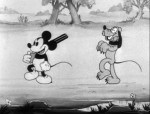 In ‘The Duck Hunt’ Mickey and Pluto are hunting ducks.
Their attempts are quite circumstantial and fail due to the inferior quality of Mickey’s gun. When the ducks discover that the female duck is only Pluto in disguise, they take revenge by taking Pluto by the ears and drag him and Mickey, who has gripped Pluto’s tail, into the air.
‘The Duck Hunt’ is a gag cartoon similar to ‘The Moose Hunt‘. Unfortunately it isn’t very funny. A lot of screen time is devoted to Mickey and Pluto marching to civil war tunes, and Pluto’s and Mickey’s flight through the air fails to become the intended great finale, because of a lack of great gags, although I liked the gag of Pluto’s flees leaving his fall by parachuting from his behind.
‘The Duck Hunt’ shows that not every Disney cartoon was a winner, despite the studio’s obvious efforts.
Watch ‘The Duck Hunt’ yourself and tell me what you think:
This is Mickey Mouse cartoon No. 37
To the previous Mickey Mouse cartoon: Mickey’s Orphans
To the next Mickey Mouse cartoon: The Grocery Boy
‘Blue Rhythm’ is available on the DVD ‘Walt Disney Treasures: Mickey Mouse in black and white’
Director: Burt Gillett
Release Date: August 7, 1931
Stars: Mickey Mouse, Minnie Mouse, Horace Horsecollar, Clarabelle Cow, Pluto?
Rating: ★★★★★
Review:
 ‘Blue Rhythm’ is a genuine concert cartoon, in the vain of ‘The Opry House‘ (1929), ‘The Jazz Fool‘ (1929), ‘Just Mickey‘ (1930) and ‘The Barnyard Concert‘ (1930).
Something has happened however, for now Mickey and the gang are not performing for their own fun or at the barnyard, but they are giving a concert in a large theater. It thus predates similar concert cartoons like ‘The Band Concert (1935), Bugs Bunny’s ‘Rhapsody Rabbit‘ (1946), and Tom & Jerry’s ‘The Cat Concerto‘ (1947), introducing several piano and conductor gags.
This is one of those rare Disney cartoons in which the music performed can be unmistakably identified as jazz (in the earlier ‘The Jazz Fool’ this is not the case, despite the cartoon’s name). In fact, the cartoon is one great rendering of the St. Louis Blues (and not ‘Blue Rhythm’, a composition also popular in 1931, and recorded by Fletcher Henderson and Mills Blue Rhythm Band).
W.C. Handy’s classic song is first performed by Mickey on the piano, borrowing some tricks from Chico Marx. Then it is sung by Minnie, followed by some scatting by the both of them. Then Mickey and Minnie leave the stage, the curtain opens to reveal a big band, to which Mickey returns to conduct. And finally the blues is performed by Mickey on the clarinet, imitating bandleader Ted Lewis, complete with the entertainer’s typical top hat.
Minnie’s blues singing resembles contemporary female vaudeville blues singers (e.g. Gertrude Lawrence, Ethel Levey and Victoria Spivey) and the pig trumpeter performs in the growling jungle style of Bubber Miley, who was a trumpeter in Duke Ellington’s band. Mickey shows to be an all round entertainer, performing as a stride pianist, a scat singer, a conductor and a clarinetist. Horace Horsecollar and Clarabelle Cow, on the other hand, are clearly a percussionist and flutist, respectively, roles they would also have in ‘The Band Concert‘ (1935), the greatest of Mickey’s concert cartoons. Also featured in Mickey’s band is a dog who may or may not be Pluto, and who plays the trombone, disturbing Mickey while doing so.
Blue Rhythm is a great cartoon, from the opening scene, in which Mickey casts a huge shadow on the curtains to the grand finale in which the excited performance makes the stage collapse. This cartoon may have few gags, it is a delightful ode to music, and to jazz in particular.
Watch ‘Blue Rhythm’ yourself and tell me what you think:
https://www.dailymotion.com/video/x3hwk77?GK_FACEBOOK_OG_HTML5=1
This is Mickey Mouse cartoon No. 31
To the previous Mickey Mouse cartoon: Mickey Steps Out
To the next Mickey Mouse cartoon: Fishin’ Around
‘Blue Rhythm’ is available on the DVD ‘Walt Disney Treasures: Mickey Mouse in black and white’
Director: Burt Gillett
Release Date: January 23, 1931
Rating: ★★½
Review:
 Following Van Beuren’s ‘A Romeo Robin‘ (1930) Disney devoted a whole Silly Symphony on birds.
The short follows the half-story formula introduced in ‘Playful Pan‘ with the first part consisting of more rhythmical movement to music than real dancing. The film starts with quite uninspired and tiresome gags about several birds moving randomly to music (opening with swans and a peacock moving to Jacques Offenbach’s barcarolle), but after 5’10 these give way to a small story about a baby chick who is taken away by an eagle but saved by a group of small birds.
The birds are drawn cartoony and not at all naturalistic. But such naturalism eventually would occur in Disney’s films, within only a couple of years, with ‘Birds in the Spring‘ being the prime example. It’s interesting to compare these two cartoons, which are only two years apart. The comparison makes ‘Birds of a Feather’ look primitive and dated, but even this cartoon knows one complex scene, in which the flock of small birds attacks the eagle. In this scene the movement of the circling birds is animated beautifully and quite convincingly, as well.
Watch ‘Birds of a Feather’ yourself and tell me what you think:
This is Silly Symphony No. 16
To the previous Silly Symphony: Playful Pan
To the next Silly Symphony: Mother Goose Melodies
‘Mother Goose Melodies’ is available on the DVD ‘Walt Disney Treasures: Silly Symphonies’
Director: Burt Gillett
Release Date: April 11, 1931
Rating: ★★½
Review:
 ‘Mother Goose Melodies’ is one of those Silly Symphonies showing the enormous strides the Walt Disney studio was taking to advance animation forward.
The cartoon easily outdoes all its contemporaries. The cartoon is extremely rich for its time, introducing us to countless characters, with only a few being stock models (the spider, some mice and some pigs). Some of the scenes are quite elaborate, like the finale, in which the book collapses and we watch all nursery rhyme figures dancing to the joyous music.
But the opening scene, which takes its time to introduce Old king Cole, is the most remarkable: it’s one long parade scene, looping the background, but otherwise remaining fresh by introducing new nursery rhyme characters all the time. Indeed, Walt Disney reused this device (and a lot of its animation) in the color cartoon ‘Parade of the Award Nominees‘ (1932), a special short for the fifth Academy Award ceremony, and in ‘The Standard Parade’ (1939), a commercial for Standard Oil.
Moreover, for the first time since ‘El Terrible Toreador‘ (1929) the studio takes its chances at the human form again. And although King Cole and his nursery rhyme friends are no ‘Snow White’, they’re a great deal more convincing than the humans in the earlier cartoon. The designs are more elaborate, and there’s much more sense of weight.
‘Mother Goose Melodies’ is also the very first Silly Symphony to feature singing characters, anticipating the operetta cartoons of 1932-1935. The short simply bursts with ideas, and is a cartoon of sheer joy. On the other hand, it’s just that: by taking the ‘song-and-dance routine’-concept to the max, this cartoon offers singing and dancing only. There is no story, there are no gags, and the short features a lot of repetitive animation. This makes ‘Mother Goose Melodies’ strangely awesome and a little boring at the same time. Nevertheless, the cartoon was so successful, Disney would revisit its theme two times, in the Silly Symphonies ‘Old King Cole‘ (1933) and ‘Mother Goose goes Hollywood’ (1938).
Watch ‘Mother Goose Melodies’ yourself and tell me what you think:
This is Silly Symphony No. 17
To the previous Silly Symphony: Birds of a Feather
To the next Silly Symphony: The China Plate
‘Mother Goose Melodies’ is available on the DVD ‘Walt Disney Treasures: Silly Symphonies’
Director: Wilfred Jackson
Release Date: July 28, 1931
Rating: ★★★½
Review:
 A cat is put out. When he tries to catch a bird, he falls down and gets knocked unconscious by a wind-flower.
Enter a nightmarish sequence, in which the cat imagines his lives are fleeing him, and that he’s being attacked by giant birds, hooting owls, bats, giant spiders and hollow trees. Luckily, in the morning it all appears to have been a dream.
‘The Cat’s Out’ is not devoid of dance routines (there are two dance scenes featuring scarecrows and a bat), but it has a surprisingly clear story, unmatched by earlier Silly Symphonies. It is arguably the first Silly Symphony with such a clear story, anticipating the straightforward storytelling of ‘The Ugly Duckling‘ of the end of the same year. This makes the short one of the most interesting Silly Symphonies of 1931.
Watch ‘The Cat’s Out’ yourself and tell me what you think:
This is Silly Symphony No. 20
To the previous Silly Symphony: The Busy Beavers
To the next Silly Symphony: Egyptian Melodies
‘The Cat’s Out’ is available on the DVD ‘Walt Disney Treasures: More Silly Symphonies’
Director: Burt Gillett
Release Date: December 16, 1930
Rating: ★★★★½
Review:
 With his double pipe, Pan makes all animals and plants, yes, even trees and clouds move and dance. The latter cause a fire with their lightning, but Pan lures the flames away to the lake, as if he were the pied piper.
Like ‘Springtime‘ (1929) ‘Playful Pan’ can be regarded as a forerunner of Disney’s groundbreaking cartoon ‘Flowers and Trees‘ (1932). The short is especially interesting for the introduction of the anthropomorphized flames, so typical of cartoons about fire. ‘Playful Pan’ is more entertaining than earlier Silly Symphonies, because half way the dance routine gives way to some kind of story, in which fire threatens the forest. This fire sequence is actually rather exciting. The fire itself is well animated, and the flames form a real threat: they do kill a humanized tree, and make all the animals flee.
The story formula of ‘Playful Pan’, in which the second half has some kind of story, was explored in many more Silly Symphonies from 1931 (e.g. ‘Birds of a Feather‘, ‘The China Plate‘. ‘The Busy Beavers‘). One had to wait until ‘The Ugly Duckling‘, from the end of that year, to watch a Silly Symphony to feature a concise story from start to end.
Watch ‘Playful Pan’ yourself and tell me what you think:
This is Silly Symphony No. 15
To the previous Silly Symphony: Winter
To the next Silly Symphony: Birds of a Feather
‘Playful Pan’ is available on the DVD ‘Walt Disney Treasures: More Silly Symphonies’
Director: Burt Gillett
Release Date: October 22, 1930
Rating: ★
Review:
 Among the earliest Silly Symphonies there was a cycle devoted to the four seasons. ‘Winter’ is the last of these four season cartoons.
Following the artistic success of ‘Autumn‘, ‘Winter’ is unfortunately as dull and plotless as the earlier ‘Springtime‘ or ‘Summer‘. The cartoon both starts an ends with a winter storm. In between we watch animals skating and dancing on Emile Waldteufel’s Skaters’ Waltz. This scene features some deer, which are a far cry from ‘Bambi‘ (1942), but who are more comfortable on ice than Bambi would ever be twelve years later. The cartoon ends when a groundhog sees his shadow again, and cold and snowy winds drive the animals back to their hiding places.
Luckily, ‘Winter’ formed the end of an era. Already with the next Silly Symphony, ‘Playful Pan‘ the Disney studio would aim to exchange the endless dance routines for more experiment, and this level of experiment would only increase from 1931 onwards…
Watch ‘Winter’ yourself and tell me what you think:
This is Silly Symphony No. 14
To the previous Silly Symphony: Monkey Melodies
To the next Silly Symphony: Playful Pan
‘Winter’ is available on the DVD ‘Walt Disney Treasures: More Silly Symphonies’
Director: Burt Gillett
Release Date: September 2, 1930
Rating: ★★
Review:
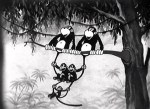
The Silly Symphonies were to be a series of great innovation, but in 1930 this was not so clear, yet, as the entries of that year were mostly preoccupied with dance routines.
The ‘innovation’ of ‘Monkey Melodies’, for example, is the embryonic story of its second half. But only with ‘Playful Pan‘ from the end of the year, some real experimentation was to kick in.
‘Monkey Melodies’ opens with monkeys, apes and parrots frolicking in the jungle in a long dance routine. After several minutes we follow two monkeys in love, who frolic to the tune of Rudy Wiedoeft’s Narcissus. The two go on a boat ride on a log, and manage to escape a crocodile, a hippo, a snake and a leopard.
‘Monkey Melodies’ is a very standard Silly Symphony, typical of 1930, the ‘story’ of the second half notwithstanding, and to be frank, the short is rather dull. Its highlight may be the effect animation of a crocodile swimming under water.
Watch ‘Monkey Melodies’ yourself and tell me what you think:
This is Silly Symphony No. 13
To the previous Silly Symphony: Midnight in a Toy Shop
To the next Silly Symphony: Winter
‘Monkey Melodies’ is available on the DVD ‘Walt Disney Treasures: More Silly Symphonies’
Director: Wilfred Jackson
Release Date: July 28, 1930
Rating: ★★
Review:
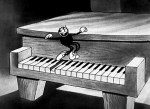
1930 saw a string of Silly Symphonies featuring animals performing endless dance routines. In ‘Midnight in a Toy Shop’, however, the dancing is being done by toys and dolls. Not that it makes a difference…
‘Midnight in a Toy Shop’ introduces the small spider, who would also be the hero of ‘Egyptian Melodies‘. To escape the freezing cold the spider enters a toy shop. First he’s afraid of everything, but when he’s playing the piano, the dolls and toys come to life, dancing to his tunes. This results in a very, very long dance routine, rendering ‘Midnight in a Toy Shop’ a rather dull short. However, in the first scene the spider leads the viewer into the scenery, and we as an audience, explore the toy shop with him. This story idea would be perfected in the intro of ‘Pinocchio‘ (1940), of which the intro of ‘Midnight in a Toy Shop’ is an embryonic version.
‘Midnight in a Toy Shop’ contains a strange mixture of primitive and more advanced designs and animation. It starts with some stunning effect animation of snow, and ends when a candle lights some fireworks, making the spider flee the shop.
Watch ‘Midnight in a Toy Shop’ yourself and tell me what you think:
This is Silly Symphony No. 12
To the previous Silly Symphony: Arctic Antics
To the next Silly Symphony: Monkey Melodies
‘Midnight in a Toy Shop’ is available on the DVD ‘Walt Disney Treasures: More Silly Symphonies’
Director: Burt Gillett
Release Date: November 20, 1930
Stars: Mickey Mouse, Minnie Mouse
Rating: ★★½
Review:
 In ‘Pioneer Days’ Mickey and Minnie are pioneers travelling in a caravan through the Midwest.
After an all too long sing-and-dance-routine they are attacked by vicious wolf-like Indians. These bring in some spectacular animation: a dance with long shadows around a bonfire, a complex attack scene, and an impressive shot taken from one of the horses circling the encampment, showing a moving background of wagons in perfect perspective.
Most spectacular is the fight between Mickey and a horrible Indian, who has kidnapped Minnie. The fight is shown in close-up, and contains quite some complex movements between the two. It’s scenes like these that show that Disney kept taking the lead in the animation field, ever pressing forward.
Of course, our hero saves the day: when he and Minnie pretend to be the cavalry all the Indians flee.
‘Pioneer Days’ is Mickey’s first of only a few films clearly set in another time period, and thus the precursor of ‘Ye Olden Days‘ and ‘The Nifty Nineties’. The film recycles some footage from ‘The Fire Fighters‘ of two dogs holding a bed to catch falling people.
Watch ‘Pioneer Days’ yourself and tell me what you think:
This is Mickey Mouse cartoon No. 24
To the previous Mickey Mouse cartoon: The Picnic
To the next Mickey Mouse cartoon: The Birthday Party
‘Pioneer Days’ is available on the DVD ‘Walt Disney Treasures: ‘Mickey Mouse in black and white’
Director: Burt Gillett
Release Date: August 18, 1930
Stars: Mickey Mouse, Peg Leg Pete, (Pluto)
Rating: ★★½
Review:
 In ‘Gallopin’ Gaucho‘ Mickey had been depicted as a bandit, but it still comes as a surprise to see him being a prisoner in ‘The Chain Gang’. We’re sure some injustice has been done, and that Mickey is in fact innocent…
Mickey is imprisoned in a mixed prison (one of the inmates is a cow), where Peg Leg Pete is one of the guards. When Pete goes to sleep Mickey brings out his harmonica, like he did in ‘The Shindig‘ one month earlier, and starts playing Vernon Dalhart’s 1924 hit ‘The Prisoner’s Song’.
This leads to an unremarkable sing-and-dance-routine, which abruptly ends in a massive jailbreak. Mickey escapes, but is followed by two bloodhounds, possibly the most elaborately designed dogs hitherto. Animated by Norm Ferguson, these bloodhounds would become the prototype of Pluto later on. Indeed, the animation of the blood hound approaching and sniffing into the camera was reused for Pluto as late as 1939 for ‘The Pointer’. The real Pluto would appear on the screen two months later in ‘The Picnic‘, and even then he still was called ‘Rover’.
The ‘birth’ of Pluto is the single most important feature of this cartoon, although it’s also noteworthy for the presence of gags involving recurring characters (something pretty new at the time), and for the chase scenes, which contain some nice perspective effects.
Watch ‘The Chain Gang’ yourself and tell me what you think:
This is Mickey Mouse cartoon No. 21
To the previous Mickey Mouse cartoon: The Shindig
To the next Mickey Mouse cartoon: The Gorilla Mystery
‘The Chain Gang’ is available on the DVD ‘Walt Disney Treasures: ‘Mickey Mouse in black and white’
Director: Burt Gillett
Release Date: June 20, 1930
Stars: Mickey Mouse, Minnie Mouse, Horace Horsecollar
Rating: ★★★★★
Review:
 In ‘The Fire Fighters’ Mickey is a fire chief who rushes to a burning building, losing almost his complete team on the way.
Together with Horace Horsecollar he rather pitifully tries to extinguish the fire. But he saves the day when he rescues Minnie from the flames.
‘The Fire fighters’ is the first Mickey Mouse cartoons since ‘The Gallopin’ Gaucho‘ to tell a straightforward story. The cartoon is simply packed with gags, which lead to an exciting finale, showing Mickey’s heroic character.
Among Mickey’s team mates is a primitive Horace Horsecollar who is only half anthropomorphized. ‘The Fire Fighters’ is also notable for its use of animals as objects (an ostrich as a pole, a cat as a siren), while objects are very much alive, indeed, most notably the ladder, which is shown sleeping in bed.
The cartoon makes clever use of animation cycles, especially in the scenes depicting the burning building. Some of the gags are quite unique, like Mickey milking a fire hydrant and a ladder that climbs itself down, a gag that has to be seen to be believed.
In all, ‘The Fire Fighters’ is one of the best of the early Mickey Mouse cartoons, and certainly Mickey’s best short of 1930.
Mickey would fighting fire again five years later in the equally inspired ‘Mickey’s Fire Brigade‘ (1935).
Watch ‘The Fire Fighters’ yourself and tell me what you think:
This is Mickey Mouse cartoon No. 19
To the previous Mickey Mouse cartoon: The Cactus Kid
To the next Mickey Mouse cartoon: The Shindig
‘The Fire Fighters’ is available on the DVD ‘Walt Disney Treasures: ‘Mickey Mouse in black and white’
Director: Burt Gillett
Release Date: March 7, 1931
Stars: Mickey Mouse, Minnie Mouse, Peg Leg Pete
Rating: ★★★★★
Review:
 In 1931 Mickey’s cartoons slowly but surely got better. ‘Traffic Troubles’ in particular is a gem, arguably being Mickey’s first great gag cartoon since his first cartoon, ‘Plane Crazy‘ (1928).
In this film Mickey is a cab driver driving an anthropomorphized car, resembling Flip the Frog’s car in ‘The Cuckoo Murder Case’ from five months earlier. His first customer is a fat pig, but he loses his passenger on a road, full of potholes and bumps. Mickey’s horror and surprise when he realizes his customer is gone, is priceless.
Mickey’s second customer is Minnie. When they get a flat tire, Peg Leg Pete makes an odd cameo as ‘Dr. Pep’ who revives Mickey’s car with some kind of potion, with disastrous results. This part leads to a great end scene in which Mickey’s car ends on a cow, rides through a barn, and crashes into a silo.
‘Traffic Troubles’ is a genuine gag cartoon without any songs or dances, but with fast action, plenty of gags building to a grand finale, and spectacular and flexible animation. It also contains a very funny scene in which a police officer asks Mickey many questions while silencing him at the same time. In short, ‘Traffic Trouble’ is arguably the best Mickey Mouse film from 1931, and Mickey’s first really great cartoon since ‘Steamboat Willie‘. But by now the Disney studio was making faster and faster strides, and Mickey’s best cartoons were still to come.
Watch ‘Traffic Troubles’ yourself and tell me what you think:
This is Mickey Mouse cartoon No. 26
To the previous Mickey Mouse cartoon: The Birthday Party
To the next Mickey Mouse cartoon: The Castaway
‘Traffic Troubles’ is available on the DVD ‘Walt Disney Treasures: Mickey Mouse in Black and White Volume Two’


 Dr. Grob's Animation Review