You are currently browsing the category archive for the ‘Walt Disney films’ category.
Director: James Algar
Release Date: 1942
Rating: ★★½
Review:
 Of all milestones of Disney animation, ‘Four Methods of Flush Riveting’ is the most unassuming and certainly the most boring.
It was made in early 1941, thus before The United States had entered the war, for the Lockheed Aircraft Corporation, which was located nearby the Disney studio at Burbank. The film was “produced under the technical direction of the Lockheed Aircraft Cop.”, and without doubt very useful, but it was in fact a pilot film. As the title card states:
“The following film uses a simplified technique developed by the Walt Disney studio to demonstrate the quickest and cheapest method whereby the animation medium can be applied to National Defense Training”.
Both 1940 features ‘Pinocchio‘ and ‘Fantasia’ had lost money, and Disney was looking for new opportunities to earn some. In World War I J.R. Bray had demonstrated that animation film could be used perfectly for training the troops, thus pioneering the educational animation film. Nevertheless, between World War I and World War II only few educational films were made.
Disney’s new technique is in fact limited animation. As such it is the mother of all animated instruction films up to the present day, but even more of limited animation as an art, which would be explored more and more during the 1950s and 1960s.
The immediate effect on the Disney studio was that it sprouted commissions for several instruction films, mostly for the army and the navy, starting with ‘Stop That Tank!‘ for the National Film Board of Canada.
During World War II the Disney studio produced no less than 200 different training films for the armed forces. Moreover, limited animation immediately entered propaganda shorts, like ‘The Thrifty Pig‘ (1941) and such, as well as features, like ‘The Three Caballeros‘ (1944).
The film itself is very dry, and as educational as it is dull. Its most interesting feature is the use of a structured blue monochrome background against which the clean, airbrushed objects read very well. The idea of using monochromes and structures in backgrounds was going to be of as much importance as limited animation to the more forward looking forces in the animation field, and the UPA studio, which sprouted from the 1941 Disney strike, in particular.
Watch ‘Four Methods of Flush Riveting’ yourself and tell me what you think:
Director: Clyde Geronimi
Release Date: August 14, 1942
Stars: Pluto, Butch
Rating: ★★½
Review:
 ‘T-Bone for Two’ is one of those Clyde Geronimi directed Pluto shorts about bones (other examples are ‘The Sleep Walker‘ and ‘Pluto at the Zoo‘ from the same year). It’s also Pluto’s second attempt to get a bone from vicious bulldog Butch, after ‘Bone Trouble‘ from 1940.
This time Pluto gets the bone by making Butch think he has buried a gigantic bone somewhere else. The second half is devoted to Pluto’s problems with a car horn. The horn make him lose his bone to Butch again, but he regains it with it, too.
Despite some great comedy (Pluto’s fake steps to his supposed hiding place and Butch’s flight into the air), Clyde Geronimi’s interplay between Pluto and Butch is less successful than Jack Kinney’s was in ‘Bone Trouble’. The cartoon never becomes really funny, resulting in one of the weaker entries in the Pluto series.
Watch ‘T-Bone for Two’ yourself and tell me what you think:
This is Pluto cartoon No. 8
To the previous Pluto cartoon: The Sleep Walker
To the next Pluto cartoon: Pluto at the Zoo
Director: Clyde Geronimi
Release Date: July 3, 1942
Stars: Pluto
Rating: ★★½
Review:
 In the first scene of this cartoon a female black dachshund tries to steal Pluto’s bone, but she fails.
Then, strangely enough, Pluto delivers her his bone in his sleep, but when he awakes he thinks she has stolen it. After some chasing, he finally destroys her home in his wrath, only to discover that she’s a mother of five pups. When it starts to rain, too, he repents and lends her his own house and collection of bones.
Director Clyde Geronimi favored food-themed Pluto cartoons, and this short is no exception. Unfortunately, the premise of Pluto sleepwalking is very unlikely and the execution more aimed at sighs than at laughs. The result is yet another cute and rather unfunny Pluto entry. Its best feature is its music (unfortunately uncredited), which uses an effective muted trumpet during the chase scenes, and a weird melody for woodwinds during Pluto’s sleepwalking.
The female dachshund is an early forerunner of Pluto’s later love interest, Dinah, who would first appear in the 1945 cartoon ‘Canine Casanova’.
Watch ‘The Sleep Walker’ yourself and tell me what you think:
This is Pluto cartoon No. 7
To the previous Pluto cartoon: The Army Mascot
To the next Pluto cartoon: T-Bone for Two
Director: Clyde Geronimi
Release Date: February 28, 1942
Stars: Pluto
Rating: ★★
Review:
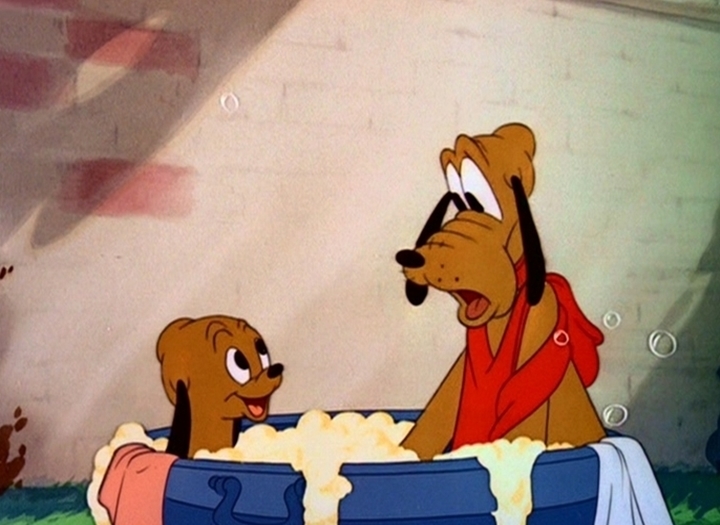 In this cartoon Pluto has only one son (instead of five as in ‘Pluto’s Quin-Puplets’ from 1937).
We watch this pup playing with a ball, a balloon, a caterpillar and a bird, which leads him into a distressful position on a clothes-line. Only then Pluto, who had been asleep all the time, comes into action. Pluto rescues his son and both fall into a wash-tub.
The best sequence of the cartoon involves Pluto’s antics on the clothes-line. It’s clear that he is a far funnier character than his son, which is only cute. Indeed, after this cartoon Pluto jr. was never seen again.
Watch ‘Pluto Junior’ yourself and tell me what you think:
This is Pluto cartoon No. 5
To the previous Pluto cartoon: Pluto’s Playmate
To the next Pluto cartoon: The Army Mascot
Directors: Nathan Greno & Byron Howard
Release Date: November 24, 2010
Rating: ★★★★½
Review:
 With ‘Tangled’ the Walt Disney studio arguably released their first really successful computer animated feature.
Despite the modern techniques with which it has been made, ‘Entangled’ really looks back, even more than the hand-drawn ‘Princess and the Frog’ from one year earlier. First, it’s a musical in the vain of ‘The Little Mermaid’ (1989) and ‘Beauty and the Beast’ (1991), and indeed the songs are by same composer, Alan Menken. Second, it’s based on a classic fairy-tale (Rapunzel), placing it in a tradition looking all the way back to ‘Snow White and the Seven Dwarfs’ (1937) and ‘Cinderella‘ (1950). And third, there’s even an animal sidekick, the chameleon Pascal, something we hadn’t seen since ‘Mulan’ (1998).
Like in all these films the main protagonist is a young female yearning for love. With Ariel from ‘The Little Mermaid’, Rapunzel is the most overtly adolescent of the lot. She displays many behaviors of teenagers: not only is she torn apart between loyalty to her ‘mother’ and the longing for freedom, she also displays the naive and intoxicating excitement typical of her age. It seems like ‘Tangled’ was clearly marketed for this age group.
However, the studio changed the film’s name from ‘Rapunzel’ to ‘Tangled’ to attract other people than teenage girls, and rightly so, for the film has more to offer. However, it’s not necessarily to be found in the male protagonist, Flynn Rider. Flynn is a somewhat cliche overconfident macho, who discovers his softer side, and he is more of interest to young girls than to young men, who may have difficulties relating to him. In fact, I dare say they will more relate to Rapunzel herself.
No, it’s found in a well-told story, in which both the evil witch and Rapunzel’s hair gain new dimensions. Apart from its magical power, it is amazing what Rapunzel can do with her hair. It clearly defines her as a strong, independent and creative character: not submissive and to be won, but active, and with a will of her own.
The story knows plenty of fun, action and romance, but also allows for some deep emotional moments. For example, there is a short scene in which we see Rapunzel’s grieving father, and his emotion is played so well, it breaks your heart. Alan Menken’s songs aren’t the greatest, and can sometimes be missed, but the ‘I have a dream’ sequence in the tavern is acted out with so much bravado, it’s a great fun to watch.
I doubt whether ‘Tangled’ will become a modern classic like e.g. Pixar’s ‘Wall-E’ (2008), ‘Up’ (2009) or Disney’s later ‘Frozen’ (2013), but it seriously showed that the Disney studio still was able to make good animated features, even computer animated ones. That alone was a relief after a series of seriously bad (‘Chicken Little’, 2005), forgettable (‘Meet the Robinsons’, 2007) and average (‘Bolt’, 2008) films.
Watch the trailer for ‘Tangled’ yourself and tell me what you think:
Directors: Clyde Geronimi, Wilfred Jackson & Hamilton Luske
Release Date: July 26, 1951
Rating: ★★★½
Review:
 Of all the classic Walt Disney features, ‘Alice in Wonderland’ had the longest and most troublesome history.
Lewis Carroll’s book had intrigued Walt Disney for years. It had inspired the Alice cartoons, if only in name, and already in 1933 the first ideas appeared to turn the literary classic into an animated feature, starring Mary Pickford as Alice – being Disney’s first feature idea ever. Unfortunately, the idea was dropped because in 1933 Paramount released their version of the classic tale.
More serious work on Alice started in 1939/1940 when illustrator David Hall made numerous, exceptionally beautiful concept drawings. After the failures of ‘Pinocchio‘ and ‘Fantasia’ (both 1940) at the box office, these ideas were shelved, and virtually nothing of Hall’s ideas entered the final film. At one point even novelist Aldous Huxley cooperated, turning in a literary script in 1945, which the Disney studio found useless. Only in 1949 real work on the film began, resulting in Disney’s second feature of the 1950s, after the successful ‘Cinderella‘.
The final film unfortunately was poorly received when it was finally released in 1951. It performed rather badly at the box office, losing the studio almost a million dollars, practically evaporating the profits that ‘Cinderella’ had made the previous year. The film was critisized even by its own animators. Marc Davis said the film “gave us nothing to work it” and called it a “cold film”. Frank Thomas and Ollie Johnston hardly mention the film in their elaborate book ‘The Illusion of Life’. In ‘The Disney Villain’ they reveal why: they felt they “had failed to find the intriguing combination of fantasy, satire and whimsy that made the original book popular”. Even Walt Disney himself denounced the film, saying it lacked heart.
However, ‘Alice in Wonderland’ has aged suprisingly well. In fact, it has turned out to be one of the best adaptations of the book to the screen, its only serious rivals being Jan Švankmajer’s disturbing stop motion film from 1987, and a NBC production from 1999. Certainly not Disney’s feature from 2010, which, although visually stunning, owes very little to the original story.
The film’s most overt weakness, its episodic character (which, of course, it shares with the original book), is also its strong point: none of the Disney story cliches are apparent, and there’s a welcome lack of sentimentality to the film. In fact, the film’s low point is reached when the studio does try to squeak sentimentality into the story: in the Tulgey Wood scene, an invention of the story department and not found in the original book, Alice has enough of nonsense, wants to go home and feels lost. She sings the feature’s weakest and most forgettable song with a sobbing voice, with some fantasy birds sympathizing with her in stereotypical Disney fashion. Despite the inventive bird designs, this scene is wide of the mark.
Luckily, it is one of only two weak scenes (the other one being the flower scene, squeaked in from ‘Through the Looking Glass’) amidst the wonderful series of utter nonsense, which evoke the zany spirit of the book very well. The film is literally stuffed with great characters, most of them voiced by well-known British and American actors: the white rabbit (Bill Thompson, the voice of Droopy), the dodo, Tweedledee and Tweedledum (Pat O’Malley), the caterpillar (Richard Haydn), The Cheshire Cat (Disney favorite Sterling Holloway), The Mad Hatter and the Marc Hare (Ed Wynn & Jerry Colonna), the Queen of Hearts (Verna Felton), and the little king. Eleven year old Kathryn Belmont is a perfect Alice: pleasantly normal, and a little pedantic, just like the one in the book.
Of all Nine Old Men, the Disney animators who worked on the film, Ward Kimball in particular seems in his element, as Lewis Carroll’s work has much in common with his own zany type of humor. Kimball supervised animation on Tweedledee and Tweedledum, the Walrus and the Carpenter, the Mad Tea Party and the Cheshire Cat, and all characters are delightfully loony.
However, the film’s strongest point may be in its design, which is nothing like Sir John Tenniel. In contrast to his gloomy black-and-white engravings, styling artists Mary Blair, John Hench, Claude Coats and Ken Anderson present a vibrant world of colors. The stylized backgrounds are superb with their angular designs and highly original color combinations, evoking a perfect dream world. It’s these designs that give the movie unity. They are matched by the looniest animation within any Disney feature, all bringing the zany Lewis Carroll perfectly to life. Both the animation and the countless visual gags complement the textual madness of the original book. Moreover, the film is surprisingly speedy, and still enjoyable for a 21st century audience.
‘Alice in Wonderland’ may not be Disney’s best or most successful feature, it’s a very pleasant ride through a colorful world, and more of a timeless classic than anyone would have imagined in 1951.
Watch ‘Alice in Wonderland’ yourself and tell me what you think:
Director: Jack Kinney
Release Date: October 21, 1951
Stars: Goofy
Rating: ★★★★
Review:
 This third cartoon of the Mr. Geef-series starts with our hero announcing to his colleagues that he has become a father.
We quickly move to several years later, when his son has become a hyper-active and extremely playful young boy, who troubles his father a lot. Like the other George Geef cartoons the humor of the cartoon stems mostly from its recognisability. Fathers can connect immediately to Mr. Geef’s problems with his son.
Although it’s not brought with great bravado, ‘Fathers are People’ is a milestone within the Disney catalog: for the first time a Disney star becomes a parent. Although it may be debatable whether Mr. Geef really is Goofy, the son is his, he’s not some nephew or whatever, like Huey, Dewey and Louie are. This is a very rare happening in the complete cartoon universe. True, Oswald became a father in ‘Poor Papa’ (1927), but this was a pilot film, and Oswald wasn’t a star, yet. And indeed, Pete was the first Disney cartoon character shown to be a father, having a son in ‘Bellboy Donald‘, 1942, but that cartoon didn’t celebrate a birth.
Anyway, George Geef jr. would return the next year in ‘Father’s Lion’. But in ‘A Goofy Movie’ (1995) Goofy had a very different and older son called Max, so maybe George Geef and Goofy weren’t one and the same, after all…
Watch ‘Fathers are People’ yourself and tell me what you think:
https://www.dailymotion.com/video/x2qvw04
This is Goofy cartoon No. 32
To the previous Goofy cartoon: Get Rich Quick
To the next Goofy cartoon: No Smoking
Director: Jack Kinney
Release Date: June 29, 1951
Stars: Goofy
Rating: ★★★★
Review:
 Several of the Goofy cartoons of the 1950s cover everyday problems like driving and smoking, and, in ‘Tomorrow We Diet!’, dieting. These subjects remain remarkably topical, which makes them enjoyable to watch today.
‘Tomorrow We Diet’ features a particular fat type of Goofy with a weird faint voice. This fat Goofy is encouraged to diet by his rather independent mirror image. This unfortunately leads to hallucinations of food and to sleep-walking. When he finally gives in to his hunger he discovers that ‘the man in the mirror’ has eaten everything.
The highlights of the cartoon are a number of fatness gags, and the nightmarish hallucination sequence with its continuous voices saying “eat!”
Watch ‘Tomorrow We Diet!’ yourself and tell me what you think:
This is Goofy cartoon No. 30
To the previous Goofy cartoon: Cold War
To the next Goofy cartoon: Get Rich Quick
Director: Jack Kinney
Release Date: April 27, 1951
Stars: Goofy
Rating: ★★★
Review:
 ‘Cold War’ introduces a new name for the Goofy character as the average American, as he had already been portrayed in ‘Goofy Gymnastics‘ (1949) and ‘Hold That Pose‘ (1950).
From now on our hero is known as Mr. George G. Geef, who has a characterless, average voice and who is married to a human wife, of whom we only see her arms and legs. Despite these departures, ‘Cold War’ stills uses the voice over from the sports cartoons, putting the cartoon firmly back into a great tradition. Nevertheless, George G. Geef has little to do with the original Goofy from ‘On Ice‘ (1935), and it’s almost inconceivable that it’s still the same character.
As George Geef Goofy would deal with the troubles of the average American man, like diets, children, and cigarettes. And so, in this first entry of the ‘George Geef’ series within the Goofy series, Mr. Geef catches a cold at work, and is nursed to the max by his over-caring wife…
Watch ‘Cold War’ yourself and tell me what you think:
This is Goofy cartoon No. 29
To the previous Goofy cartoon: Home Made Home
To the next Goofy cartoon: Tomorrow We Diet!
Director: Jack Kinney
Release Date: March 23, 1951
Stars: Goofy
Rating: ★★
Review:
 In ‘Home Made Home’ Goofy tries to build his own house.
‘Home Made Home’ features the updated design of Goofy, introduced in ‘Tennis Racquet‘ (1949). Nevertheless, this cartoon has an old-fashioned feel to it. Like the sports cartoons from the 1940s, it uses a pompous narrator, and Goofy’s original voice. Moreover, the cartoon consists of three elongated situation gags in a style we had not seen since the 1930s. In the first Goofy is trapped in a blueprint, in the second he has to deal with a glass panel with a will of his own, recalling the piano from ‘Moving Day‘ (1937), and in the third he has to battle a snake-like paint-gun.
The gags are clever at times. Nevertheless, this short is rather slow and unfunny and only a shadow of the 1930s cartoons, the style of which it seems to try to evoke.
Watch ‘Home Made Home’ yourself and tell me what you think:
This is Goofy cartoon No. 28
To the previous Goofy cartoon: Lion Down
To the next Goofy cartoon: Cold War
Director: George Scribner
Release Date: November 13, 1988
Rating: ★★
Review:
 Oliver and Company’ is the Walt Disney studio’s third film about dogs, after ‘Lady and the Tramp‘ (1955) and ‘One Hundred and One Dalmations’ (1961). Three of the first film’s characters, Peggy, Jock and Trusty, even have a cameo during Dodger’s song.
‘Oliver and Company’ contains some nice and easy looking dog animation, but it is hardly a worthy successor of the two classics. The opening scenes of ‘Oliver & Company’ introduces Oliver, a cute little orange cat to us, in a scene set to an ugly 1980s song. Oliver teams up with a cool dog called Dodger, who appears to be part of a dog gang. Only when the gang’s owner, the poor tramp Fagin (excellently voiced by Dom DeLuise) is visited by the film’s villain, Sykes, some kind of drama begins. By then the film already is 18 minutes underway.
During a totally incomprehensible framing act Oliver is taken sway by a little rich girl called Jenny, much to the dismay of her house’s star dog, poodle Georgette (voiced by Bette Midler). The gang ‘rescues’ Oliver, which leads to the only continuous and songless story part of the complete film. Surprisingly, the upper class world of Jenny and Georgette and the lower class world of Fagin and his dogs don’t seem to clash at all in this film. As soon Jenny is kidnapped, Georgette naturally teams up with the dog gang. The film ends with a wild and totally unbelievable chase, killing Sykes.
Although released five months after ‘Who Framed Roger Rabbit‘ it’s difficult to regard ‘Oliver & Co.’ as part of the Disney renaissance. It’s not as bleak as ‘The Fox and the Hound‘ or as misguided as ‘The Black Cauldron‘, but the film still feels as a continuation of the 1960s and 1970s, instead of something new, making it part of animation’s dark ages.
There are several reasons for this: first, the use of xerox, first used in ‘One Hundred and one Dalmations’ (1961), and defining Disney’s graphic style up to this film. Second, the equally graphic backgrounds, which are uninspired, dull and ugly, as are the all too angular and unappealing cars and machines. Third, the animation, which is erratic and at times downward poor, with the animation of the little girl Jenny, a far cry from the endearing Penny from ‘The Rescuers‘ (1977), being the low point. Fourth, the human designs, which apart from the main characters, look the same as in any generic animated television series from the 1980s. And fifth, the story, which, vaguely based on Charles Dickens’s ‘Oliver Twist’, is ramshackle and formulaic. Moreover, the attempt to ‘modernize’ Disney by moving the setting to contemporary New York is forced, and only a change of setting. There’s no new spirit to the film. And finally, the anonymous 1980s songs have aged the film very quickly.
There are some highlights: the dogs are all good, if not particularly inspired and owing much to ‘Lady and the Tramp’, Jenny’s butler Jenkins is well animated, as is Fagin when he struggles to give Oliver back to Jenny. But overall the film fails to entertain: Oliver himself is not particularly interesting, he is just the straight man, the little girl Jenny is too bland to gain sympathy, the songs are generic and the story (penned by no less than thirteen people) is too erratic to suck the viewer in.
Luckily, ‘Oliver and Company’ was not part of a new era, but the last convulsion of an old one. With its next film, ‘The Little Mermaid’ (1989) Disney would really enter its renaissance.
Watch Dodger’s song from ‘Oliver & Company’ yourself and tell me what you think:
Director: Charles Nichols
Release Date: September 21, 1951
Stars: Pluto, Milton
Rating: ★★★★½
Review:
 ‘Cold Turkey’ was the very last Pluto cartoon, although Pluto would return in Mickey Mouse’s last three cartoons (1952/1953).
The short couples Pluto to Milton, the zany cat who had been introduced in ‘Puss-Cafe‘ the previous year, only to star in three cartoons.
‘Cold Turkey’ opens with some live action footage on a television set featuring a wrestling match. Pluto and Milton sleep right through it, only to awake at an add for hot turkey. The pair first tries to get the turkey out of the television set, then try to find it in the kitchen. When they discover one in the fridge, the companionship turns into rivalry.
‘Cold Turkey’ is less funny than either ‘Puss-Cafe’ or ‘Plutopia‘, the other two cartoons featuring Milton, but it’s still an enjoyable short. The best part may be the pedal bin scene. It’s sad to see the Pluto series ending when its makers had finally made it into a funny one, with its last eleven cartoons being among the best of the entire series.
Watch ‘Cold Turkey’ yourself and tell me what you think:
This is Pluto’s 43rd and last cartoon
To the previous Pluto cartoon: Plutopia
‘Cold Turkey’ has been released on the Walt Disney Treasures DVD-set ‘The Complete Pluto Volume Two’
Director: Charles Nichols
Release Date: May 18, 1951
Stars: Mickey Mouse, Pluto, Milton
Rating: ★★★★★
Review:
 In ‘Plutopia’ Mickey and Pluto reach a cabin in the mountains called Utopia.
The place turns out to be dog-unfriendly however: Pluto has to stay outside and even worse, has to be muzzled. Frustrated, Pluto falls asleep. He dreams he’s in Plutopia where Milton (one of the cats from ‘Puss-Cafe‘, and here the cabin’s cat) is his willing servant, serving him food every time Pluto bites him in his tail.
The dream sequence is a delight to watch: its backgrounds consists of no more than changing monochromes featuring ‘scribbled’ outlines of doors, stairs e.g. With this sequence Pluto enters the ‘cartoon modern’ era. Unfortunately, it would be his only cartoon featuring such modern designs.
‘Plutopia’ is the last of only three Pluto cartoons featuring Mickey Mouse (the other two being ‘Pluto’s Purchase’ from 1948 and ‘Pueblo Pluto‘ from 1949). Normally cartoons featuring Mickey would appear under his own name. Indeed, after ‘Plutopia’ the Pluto series had only one entry left, but Pluto would return in Mickey’s last four cartoons.
Remarkably, ‘Plutopia’ features animation by two of the greatest animators of Mickey and Pluto in the 1930s: Fred Moore and Norm Ferguson. Both animators had been eclipsed by Disney’s Nine Old Men, and ‘Plutopia’ is one of the last films they worked on before their premature deaths in 1952 and 1957, respectively.
Watch ‘Plutopia’ yourself and tell me what you think:
This is Pluto cartoon No. 42
To the previous Pluto cartoon: Cold Storage
To the next Pluto cartoon: Cold Turkey
Director: Jack Kinney
Release Date: February 9, 1951
Stars: Pluto
Rating: ★★★★★
Review:
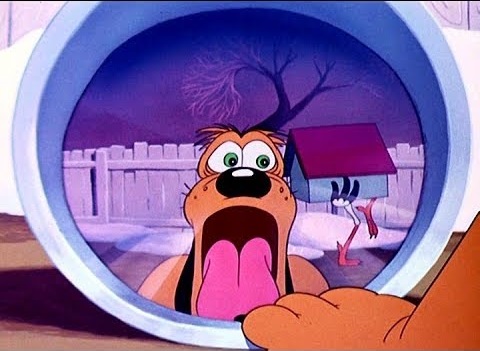 Cold Storage is the second of only two Pluto cartoons directed by Jack Kinney, the other being ‘Bone Trouble‘ from 1940.
Jack Kinney was Disney’s best gag cartoon director, and ‘Cold Storage’ is no exception. The story is set in wintertime. A freezing stork seeks shelter in Pluto’s dog house. When an equally cold Pluto returns home, a battle for the dog house begins.
Highlight of the film is when Pluto discovers his doghouse is moving and flying. Pluto’s facial expressions are priceless in this section. However, throughout the picture the animation of Pluto is expressive and flexible, full of great facial expressions and extreme poses. The interplay between the two characters is excellent and accounts for many gags. In the end the already zany cartoon turns absurd, when winter suddenly gives way to a hot summer day…
Watch ‘Cold Storage’ yourself and tell me what you think:
This is Pluto cartoon No. 41
To the previous Pluto cartoon: Camp Dog
To the next Pluto cartoon: Plutopia
Director: Charles Nichols
Release Date: August 11, 1950
Stars: Pluto, Chip ‘n’ Dale
Rating: ★★★★★
Review:
 Food for Feudin’ is the third of four cartoons coupling Chip ‘n’ Dale to Pluto. It’s also the only Chip ‘n’ Dale cartoon directed by Charles Nichols.
Nichols handles the characters of the two chipmunks very well. Their interplay is better than in many Donald Duck cartoons and a delight to watch. In the opening scene Dale even mocks Donald’s anger dance, and later we hear his version of the Goofy yell.
The story is set in autumn, in a park. Pluto tries to store his bone in Chip ‘n’ Dale’s nut tree. The result is that all Chip ‘n’ Dale’s nuts end up in Pluto’s dog house. In order to get them out they hide themselves in two gloves. This idea leads to some wonderfully comedy.
In all ‘Food for Feudin’ is a delightful cartoon, and one of Chip ‘n’ Dale’s best.
Watch ‘Food for Feudin’’ yourself and tell me what you think:
This is Pluto cartoon No. 39
To the previous Pluto cartoon: Pests of the West
To the next Pluto cartoon: Camp Dog
Director: Charles Nichols
Release Date: July 21, 1950
Stars: Pluto, Bent-Tail & Bent-Tail junior
Rating: ★★★★½
Review:
 ‘Pests of the West’ is the second of three cartoons featuring the coyote Bent-Tail and his dopey son.
In ‘Sheep Dog‘ (1949) they’d tried to steal sheep; this time the hungry duo is after the chickens. Pluto is only the straight man in a cartoon, which is devoted to the delightful interplay between father and son.
Although not as classic as ‘The Legend of Coyote Rock’, ‘Pests of the West’ is a funny cartoon. The short is packed with gags, some being quite Tex Averyan, like the son hanging in mid air until his father knocks him down. However, its highlight is the great scene in which Pluto and Bent-Tail fight for a chicken. The wonderful and jazzy soundtrack enhances all the fun. It was composed by Paul Smith, who had been an arranger for Disney since the late 1930s, and would become a noteworthy composer on the studio’s True-Life Adventures.
Watch ‘Pests of the West’ yourself and tell me what you think:
This is Pluto cartoon No. 38
To the previous Pluto cartoon: Puss-Cafe
To the next Pluto cartoon: Food for Feudin’
Director: Jack Hannah
Release Date: October 13, 1950
Stars: Donald Duck, the bee
Rating: ★★★
Review:
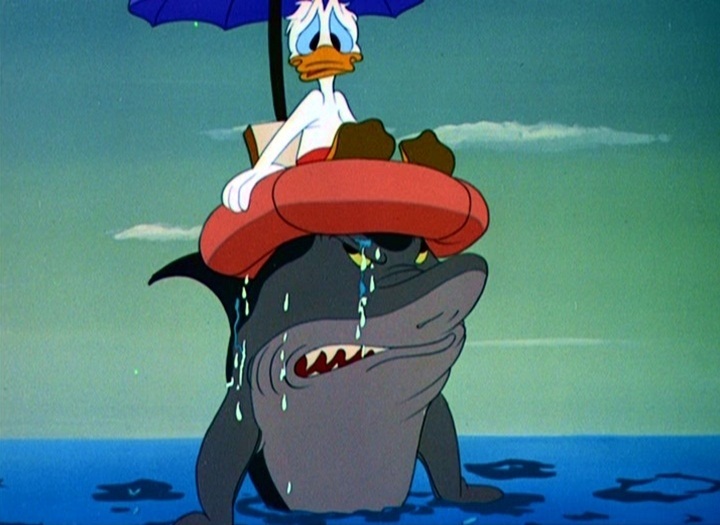 The bee and Donald compete for an empty spot on the beach in an exceptionally violent cartoon.
This short contains some good gags, but because both characters behave very unsympathetically, it is not too enjoyable. The bee, for instance, deliberately feeds Donald to a shoal of hungry sharks, which our poor hero can hardly escape. Even worse, the cartoon ends with Donald swimming into the horizon, with the sharks following after.
The sharks’ design go all the way back to ‘Peculiar Penguins‘ (1934).
Watch ‘Bee at the Beach’ yourself and tell me what you think:
This is Donald Duck cartoon No. 87
To the previous Donald Duck cartoon: Hook, Lion and Sinker
To the next Donald Duck cartoon: Out on a Limb
Director: Jack Hannah
Release Date: September 1, 1950
Stars: Donald Duck, the mountain lion
Rating: ★★★★
Review:
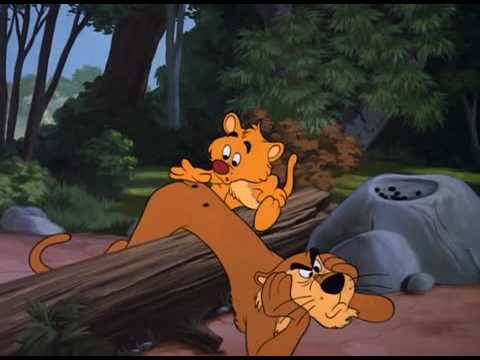 In ‘Hook, Lion and Sinker’ the mountain lion from ‘Lion Around’ from eight months earlier returns.
The big cat now has a son, not unlike Bent-Tail in the Pluto short ‘Sheep Dog‘ from 1949. The comedy between father Lion and son is excellent, even though it’s less funny than that of the two coyotes, as the mountain lion’s son is clearly smarter than Bent-Tail jr.
Nevertheless, ‘Hook, Lion and Sinker’ is the best of the four films featuring the mountain lion. Donald is only the straight man, with all the comedy restricted to the wonderful interplay between father and son. The two mountain lions are after Donald’s newly caught fish, but unfortunately, Donald has a gun, and he is all too glad to shoot the duo with hail…
Watch ‘Hook, Lion and Sinker’ yourself and tell me what you think:
This is Donald Duck cartoon No. 86
To the previous Donald Duck cartoon: Trailer Horn
To the next Donald Duck cartoon: Bee at the Beach
Director: Jack Hannah
Release Date: March 24, 1950
Stars: Donald Duck, Chip ‘n’ Dale, Daisy Duck, cameos by Goofy, Mickey Mouse and Minnie Mouse
Rating: ★★★
Review:
 Despite its name and title song ‘Crazy over Daisy’ is a surprisingly typical Donald Duck vs. Chip ‘n’ Dale cartoon.
In fact, it hardly features Daisy, at all. And when Daisy finally does show up, she takes the chipmunks in, leaving Donald outside. Yet, we do see Donald being crazy over Daisy, cycling to her on his velocipede… Yes, you read this right: Donald is riding a velocipede, because this cartoon is set in the 1890s. Its opening scene even feels like a copy of the opening scene of the 1941 Mickey Mouse cartoon ‘The Nifty Nineties’, complete with cameos of Goofy, and Mickey and Minnie (in the same car as they drove in the earlier cartoon).
Apart from the typical bicycle, it’s unclear why this cartoon is set in this period. The interplay between Donald and the two chipmunks could have taken place in any era. The most interesting fact about ‘Crazy over Daisy’ is that it contains an animated background scene, rarely seen since the early 1930s.
Watch ‘Crazy over Daisy’ yourself and tell me what you think:
This is Donald Duck cartoon No. 84
To the previous Donald Duck cartoon: Lion Around
To the next Donald Duck cartoon: Trailer Horn
Director: Jack Hannah
Release Date: January 20, 1950
Stars: Donald Duck, Huey, Dewey and Louie, the mountain lion
Rating: ★★★
Review:
 In ‘Lion Around’ Huey, Dewey and Louie use a remarkably lifelike mountain lion costume to fool Donald in order to steal a pie. Unfortunately, Donald discovers the deceit, and then, off course, a real mountain lion shows up.
This story line was already formulaic by 1950, and it doesn’t lead to anything particularly funny. In fact, the highlight is the nephews’ costume itself, with its remarkable ability to stretch. This is some funny animation, unmatched by that of the ‘real’ mountain lion. Nevertheless, the real one would return later that year in ‘Hook, Lion and Sinker‘, and in two Goofy shorts: ‘Lion Down‘ (1951) and ‘Father’s Lion’ (1952).
Watch ‘Lion Around’ yourself and tell me what you think:
This is Donald Duck cartoon No. 83
To the previous Donald Duck cartoon: Toy Tinkers
To the next Donald Duck cartoon: Crazy Over Daisy


 Dr. Grob's Animation Review