You are currently browsing the category archive for the ‘Silly Symphonies’ category.
Director: Wilfred Jackson
Release Date: October 31, 1936
Rating: ★★★★★ ♕
Review:
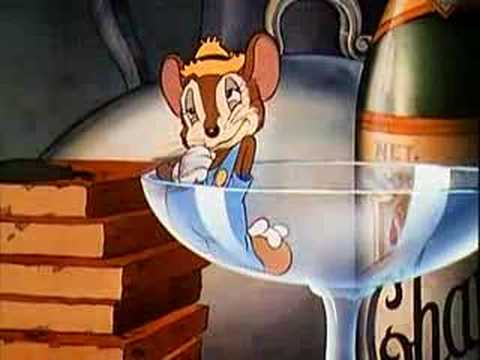 A very beautifully executed rendering of the classic tale, ‘The Country Cousin’ is a gem among the Silly Symphonies.
Its story is lean and economical, its characterization highly effective and its silent acting superb. Particularly noteworthy is the drunken performance of the Country Cousin, animated by Art Babbitt, which belongs to the highlights of animation.
Everyone who wants to know what ‘character animation’ is all about, should go and watch this cartoon. One cannot find a better example of it: the two mice look similar, but are very different in their behavior, attitude, and personality. Moreover, their personalities are played completely in mime, without any help from characteristic voices.
Besides this, ‘The Country Cousin’ contains some very realistic animation of people’s feet walking on the sidewalk. Indeed, the human realism of ‘Snow White and the Seven Dwarfs’ (1937) was not far away anymore.
Thirteen years later, Tex Avery would explore the theme of ‘The Country Cousin’ once again, albeit quite differently and way more ridiculously, in his hilarious short ‘Little Rural Riding Hood’ (1949).
Watch ‘The Country Cousin’ yourself and tell me what you think:
This is Silly Symphony No. 63
To the previous Silly Symphony: Three Blind Mouseketeers
To the next Silly Symphony: Mother Pluto
Director: Wilfred Jackson
Release Date: August 22, 1936
Stars: Max Hare, Toby Tortoise, The Three Little Pigs
Rating: ★★★★★
Review:
 One of the few sequels in Disney’s pre-video era, ‘Toby Tortoise Returns’ features the two stars of ‘The Tortoise and the Hare’ from 1935.
In this cartoon, written by Ward Kimball and featuring his typically zany style of humor, Max Hare (who’s still a bragging bully) and Toby Tortoise combat each other in a boxing match, which – of course – Toby eventually wins, albeit by means of Max’s own trickery.
Apart from Toby Tortoise and Max Hare there are many cameos of other Silly Symphony stars, among them the three little pigs, Dirty Bill (from ‘The Robber Kitten’), Jenny Wren and the Cuckoo from ‘Who Killed Cock Robin?’ and, Elmer Elephant and Tilly Tiger (from ‘Elmer Elephant’), as if all Silly Symphonies were taking place in the same space and time.
This makes ‘Toby Tortoise Returns’ akin to the earlier ‘Mickey’s Polo Team’ from the same year. The whole atmosphere is rather like that of a future Warner Brothers-cartoon, and one can sense the sheer joy the makers had in bringing all these characters together in a cartoon which sole reason of existence seems to be pure fun.
Notice the black bunny and the black turtle that are Max’s and Toby’s helpers, respectively.
Watch ‘Toby Tortoise Returns’ yourself and tell me what you think:
This is Silly Symphony No. 61
To the previous Silly Symphony: Three Little Wolves
To the next Silly Symphony: Three Blind Mouseketeers
Director: Wilfred Jackson
Release Date: May 11, 1935
Rating: ★★★
Review:
 ‘Water Babies’ is sugary cute, contains a lot of repetitive animation and is one of those Silly Symphonies obsessed with babies and their bare behinds (other examples are ‘Lullaby Land’ (1933) and ‘Wynken, Blynken and Nod’ (1938)).
There is not much of a story either: the sexless water babies wake up, make fun and go to bed again (apparently a day only lasts seven minutes in their world).
And yet, this is undoubtedly one of Disney’s most impressive efforts of the era. It feels like a showcase cartoon of the Disney studio, excelling in lush pictures, great effect animation and beautiful theme music by Leigh Harline. Especially the opening scene (dawn) and the last shot (night) are stunningly beautiful. The Disney staff had reached yet another peak, and more was still to come.
‘Water Babies’ itself at least must have been a success, for it was followed by the similar ‘Merbabies’ in 1938, featuring more or less girl characters instead of the boy-like babies in ‘Water Babies’.
Watch ‘Water Babies’ yourself and tell me what you think:
This is Silly Symphony No.52
To the previous Silly Symphony: The Robber Kitten
To the next Silly Symphony: The Cookie Carnival
Director: David Hand
Release Date: November 14, 1936
Stars: Pluto
Rating: ★★★
Review:
 Pluto unwillingly starts a career as a mother to a number of chicks.
When he finally has learned to love them, their real mother returns and together with her husband, a violent rooster, tries to chase Pluto away.
Although introduced as such, ‘Mother Pluto’ is not really a Silly Symphony. It lacks both the obligate music and the fairy tale character typical of the series. It’s actually Pluto’s first solo outing. It seems that at the time Disney didn’t dare to introduce new series besides the Mickey Mouse cartoons and the Silly Symphonies. But with Mickey giving way more and more to his co-stars Goofy, Donald and Pluto, this step would soon be made.
At the end of 1937 Pluto would become the first Mickey Mouse co-star to start his own series with ‘Pluto’s Quin-Puplets’, immediately followed by Donald with ‘Donald’s Ostrich’. Goofy followed one-and-a-half year later, in 1939, with ‘Goofy and Wilbur’. These three stars would be heading most of the Disney shorts of the 1940s and 1950s when the Silly Symphony series had been dropped and the number of Mickey Mouse shorts diminished.
Watch ‘Mother Pluto’ yourself and tell me what you think:
This is Silly Symphony No. 64
To the previous Silly Symphony: The Country Cousin
To the next Silly Symphony: More Kittens
Director: Wilfred Jackson
Release Date: October 5, 1935
Rating: ★★★★★ ♕
Review:
 In ‘Music Land’ a young violin falls in love with a young saxophone, much to the disapproval of their parents, the queen of ‘The Land of Symphony’ and the king of ‘The Isle of Jazz, respectively, whose realms are separated by the ‘Sea of Discord’.
When the young saxophone is imprisoned, the feud between the two very different nations leads to a war, in which the two young lovers are almost killed… The whole story is told through music, even the characters ‘speak’ with the sounds of the instruments they are. The complete score, by Leigh Harline, is a delight to listen to.
This reading of ‘Romeo and Juliette’ is one of the most inspired of all Silly Symphonies. The very idea of musical instruments ‘speaking’ in their own sound is brilliant. But there is much more. For example, when the saxophone prince is locked up, he’s imprisoned in a metronome and when he writes a letter to his father (a caricature of bandleader Paul Whiteman, ‘the king of jazz’) he does this in staff-notation!
The complete design of the cartoon is delightful. The backgrounds are particularly beautiful, rendering a totally convincing fantasy world, in which the cartoon develops as if it were an age-old story. The concept of a battle between classical music and jazz was a topical one in the 1930s, when jazz was still regarded by many as devilish music and a threat to ‘high culture’. Nevertheless, during the second half of the 1930s jazz gradually became a respected genre, as exemplified by Benny Goodman’s concert in Carnegie Hall in 1938.
Watch ‘Music Land’ yourself and tell me what you think:
This is Silly Symphony No. 55
To the previous Silly Symphony: Who Killed Cock Robin?
To the next Silly Symphony: Three Orphan Kittens
Director: Ben Sharpsteen
Release Date: May 25, 1935
Rating: ★★½
Review:
 Of all Silly Symphonies this one is particularly silly. The very idea of a cookie land is as original as it is looney.
Yet, the cartoon is literally sugary, not funny. The story, about a Charlie Chaplin-like tramp (voiced by Pinto Colvig) making a poor lonesome girl queen of the parade, is pure sentimental melodrama. Moreover, the characters speak in operetta-like recitatives and when the girl, having become queen, has to choose a king the cartoon shifts to a tiresome medley of song-and-dance-routines.
Nevertheless, the art direction of this Silly Symphony is stunning and its backgrounds lush and beautiful, making this one of the most impressive cartoons of the era. The girl is quite beautifully animated by Gram Natwick, the man who had created Betty Boop five years earlier, and who had joined Disney in 1934. After her transformation into a carnival queen, the girl doesn’t resemble a cookie at all, but she is pictured and animated as a real girl. Natwick would later be an animator on Snow White in ‘Snow White and the Seven Dwarfs’ (1937), and it’s as if the cookie girl was Natwick’s exercise for the real thing.
Notice the contrast between the sissy Angelic Cakes and the fun-loving Devil Cakes, whose theme music is jazz (the most ‘evil’ music of the era).
Watch ‘The Cookie Carnival’ yourself and tell me what you think:
This is Silly Symphony No. 53
To the previous Silly Symphony: Water Babies
To the next Silly Symphony: Who Killed Cock Robin?
Director: Wilfred Jackson
Release Date: September 1, 1934
Rating: ★★★
Review:
 ‘Peculiar Penguins’ can be summarized as ‘love story in the Antarctic’: a penguin falls in love with a girl, blows it, but saves the day by rescuing her from a terrible shark.
Being one of the weaker entries in the Silly Symphonies, ‘Peculiar Penguins’ nevertheless contains some fine animation, especially in the under water chase, which is literally packed with special effects. Like in ‘Funny Little Bunnies‘, the setting is introduced by a sugary song, accompanying a complex opening shot, with lots of penguins moving and seagulls flying in it.
Ten years later Disney would return to the Antarctic to tell about a particularly peculiar penguin called Pablo in ‘The Three Caballeros‘ (1944).
Watch ‘Peculiar Penguins’ yourself and tell me what you think:
This is Silly Symphony No. 47
To the previous Silly Symphony: The Flying Mouse
To the next Silly Symphony: The Goddess of Spring
Director: David Hand
Release Date: July 14, 1934
Rating: ★★½
Review:
 ‘The Flying Mouse’ is a musical short about a little mouse who wants to fly like the birds.
A blue fairy grants him that wish, giving him bat-like wings, but he soon discovers that these don’t bring him any luck: he is not allowed to join the xenophobic birds, not recognized by his relatives and called ‘a nothing’ by a group of crooked bats. Luckily, the same fairy releases him from his wings and in the end we see our little hero running to his mother in the sunset light.
This cartoon is one of many silly symphonies that seem to aim directly at kids and that are rather moralistic. This seems to be a strong trend in 1934 and it gradually led Disney away from carefree humor towards sugary sanctimony.
This cartoon is quite humorless, yet beautifully drawn. The blue fairy is a good try at the human figure (if not near the humans in ‘Snow White and the Seven Dwarfs’ (1937), let alone the blue fairy in ‘Pinocchio‘, 1940), and the mice, designed by Albert Hurter, are drawn much more realistically than Mickey. Moreover, ‘The Flying Mouse’ is another stunning example of character animation: our main hero acts out his feelings mostly in pantomime. Nevertheless, we can feel his joy, his embarrassment, his fear and his grief. It’s this combination of ambitious designs and great character animation that makes Silly Symphonies like these stand out among the cartoons of the thirties.
Indeed, it was this particular cartoon that prompted Frank Thomas to try to become an animator at Disney’s. Thomas joined Disney on September 24, 1934, only a few months after this cartoon. He would stay with the studio until 1978, becoming one of Walt’s ‘Nine Old Men’. He is especially famous for his emotional animation, e.g. the dwarfs’ grief in ‘Snow White and the Seven Dwarfs’, Pinocchio trapped in the birdcage in ‘Pinocchio’, the romantic diner in ‘Lady and the Tramp‘ (1956), and Baloo trying to tell Mowgli he cannot stay in the jungle in ‘Jungle Book’ (1967).
And it was ‘The Flying Mouse’, which showed him the way…
Watch ‘The Flying Mouse’ yourself and tell me what you think:
This is Silly Symphony No. 46
To the previous Silly Symphony: The Wise Little Hen
To the next Silly Symphony: Peculiar Penguins
Director: Wilfred Jackson
Release Date: April 8, 1933
Rating: ★★★½
Review:
 The biblical story of Noah has been quite popular with the Disney Studio: it has retold the story three times on film .
‘Father Noah’s Ark’ is its first version, the others are a stop motion film from 1959 (‘Noah’s Ark‘) and a sequence from ‘Fantasia 2000’ featuring Donald Duck.
This cartoon belongs to Disney’s operetta phase (see also ‘King Neptune‘) and tells the age old story as a musical, including some gospel singing. The story is quite straightforward and the short contains only a few mild gags, the best of which are in the building sequence, e.g. the wives using an assembly line of porcupines and some monkeys using a rhinoceros to make planks out of a log.
The designs seem to be halfhearted: Father Noah’s sons look ridiculously cartoony, wearing Mickey Mouse type gloves, for instance. His sons’ wives, on the other hand, are designed in art deco fashion.
The animals, too, are in different stages of naturalism, but the cows portrayed are much more realistic than the ones featured in the Mickey Mouse shorts of the same time. Moreover, when the animals flee into the ark, we see some unprecedentedly realistic giraffes, sealions and lions.
The most stunning naturalism is found in the animation of the sea when the ark is at the mercy of the waves. This is a spectacular scene by any standards. The storm part also features a complex scene of several animals rolling from side to side. There’s a good sense of weight in this sequence, with the elephant moving last.
Watch ‘Father Noah’s Ark’ yourself and tell me what you think:
This is Silly Symphony No. 35
To the previous Silly Symphony: Birds in the Spring
To the next Silly Symphony: Three Little Pigs
Director: Wilfred Jackson
Release Date: June 22, 1931
Rating: ★★½
Review:
 This Silly Symphony is a quite uninteresting cartoon about beavers.
The film starts with rather dull gags of beavers building a dam to Frank Churchill’s music. By now the dance routines had vanished from the screen, to make place for rhythmical movement. The beavers are portrayed almost as industrial workers, and this first half simply bursts with animation cycles.
Only after four minutes a ‘story’ develops of a little beaver who saves the whole population from a terrible flood. The beavers completely lack personality and even the spirited little one fails to impress. After such elaborate cartoons as ‘Mother Goose Melodies‘ and ‘The China Plate‘ the cartoon’s uniform, dull designs, and tiresome repetitive animation come as a letdown. The result is one of the weaker Silly Symphonies, although it features some quite spectacular animation of the approaching flood.
Watch ‘The Busy Beavers’ yourself and tell me what you think:
This is Silly Symphony No. 19
To the previous Silly Symphony: The China Plate
To the next Silly Symphony: The Cat’s Out
Director: Wilfred Jackson
Release Date: May 16, 1931
Rating: ★★★★½
Review:
 Although this cartoon is one of those Silly Symphonies from 1931 using the half dance-routine half story formula, it is one of the most beautiful and most entertaining Silly Symphonies of the era.
The film is inspired by a Western view on a mythical ancient China. The film is without any dialogue and makes effective use of Albert Ketèlbey’s musical piece ‘In a Chinese Temple garden’ to create an oriental atmosphere. It tells a simple story of a little fisherman who saves a girl from drowning, falls in love with her and rescues her from an evil mandarin and a large (Western and fire-breathing) dragon.
After ‘Mother Goose Melodies‘ this is the studio’s second take at the human figure. The result is a mixed bag. The heroin’s movements are still cartoony, for example, and she walks with her knees sideways. Even worse, the long-legged China-man has no hint of realism at all. Moreover, the hero’s size is quite inconsistent, suddenly becoming very small when fighting the evil mandarin. On the other hand, the boy and girl are elegantly drawn, especially their hands. The two easily gain the audience’s sympathy and transcend the stereotypes that occupy most of the film.
Together with ‘Mother Goose Melodies’, ‘The China Plate’ is the most elaborate of the early Silly Symphonies. It’s surprisingly fast-paced and full of action. The complete cartoon is one of sheer delight.
Watch ‘The China Plate’ yourself and tell me what you think:
This is Silly Symphony No. 18
To the previous Silly Symphony: Mother Goose Melodies
To the next Silly Symphony: The Busy Beavers
Director: Burt Gillett
Release Date: July 30, 1932
Rating: ★★★★★ ♕
Review:
 ‘Flower and Trees’ was the first film (animated or not) in full technicolor and it’s therefore a milestone of cinema.
Nevertheless, it feels like a transitional film. The colors make it stunningly modern compared to the earlier Silly Symphony entries, but some of the designs still firmly belong to the black-and-white era. The designs of the flowers and the caterpillars, for instance, go all the way back to the third Silly Symphony, ‘Springtime‘ from 1929.
The birds, on the other hand, have lost their cartoony designs they still had in ‘The Bird Store‘ from six months earlier, and the villain tree is probably the most elaborate character to have hit the animated screen thus far.
For contemporary audiences, the film may seem rather silly and a bit old fashioned, but its storytelling is very economical. It contains some original visual gags (flowers brushing their teeth, a pine portrayed as a hen) and fine drama, when the rejected mean old trees sets the wood on fire. The colors are not only used as a novelty, but add to the drama, as do musical quotes from Franz Schubert’s “Erlkönig” and Gioachino Rossini’s overture to William Tell.
Technicolor was a great advancement for the Silly Symphony series. The colors created way more atmosphere and allowed for more complex designs. Because of color, the Silly Symphonies would propel animated art forward like they never did before, making Walt Disney the undisputed leader in the field.
This leadership was greatly aided by the exclusive contract Disney concluded with the Technicolor company, giving him the exclusive rights to use the new technique for animated films for three years. So, when other studios had to stick to black and white, or were obliged to use far less convincing two-color techniques, Walt Disney made the most beautiful and literally most colorful cartoons of the 1930s.
‘Flowers and Trees’ enthralled the critics so much at the time, they installed a special Academy Award for best animated short films, with ‘Flowers and Trees’ naturally being its first winner. During the 1930s Disney would win every Oscar in this category.
Watch ‘Flowers and Trees’ yourself and tell me what you think:
This is Silly Symphony No. 29
To the previous Silly Symphony: Just Dogs
To the next Silly Symphony: King Neptune
Director: Wilfred Jackson
Release Date: June 9, 1934
Stars: Donald Duck
Rating: ★★★★
Review:
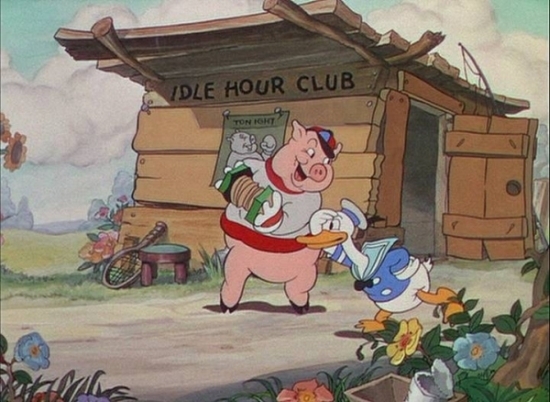 ‘The Wise Little Hen’ is a simple and quite moralistic Silly Symphony carried by a mediocre, yet all too memorable song. I guess it might have fallen into oblivion, were it not for Donald Duck.
In his first appearance Donald Duck is a real sailor, living on a boat and dancing the hornpipe. He’s a strong voice character from the start. When he joyfully shouts ‘oh boy, oh boy, oh boy!’ we all know it’s him, even though his looks are different.
Indeed, like Goofy’s voice, Donald Duck’s voice anticipated the character. When Walt Disney heard Clarence Nash use this particular voice, he really wanted something to do with it. According to animator Bill Cottrell, cited in ‘They Drew As They Pleased’, concept artist Albert Hurter was responsible for the duck’s looks. He gave Donald his trademark sailor suit, which he maintained to the present day.
Besides his typical voice and suit, Donald Duck displays two of his typical character traits: egotism and his tendency to trick others. However, he does not yet display his short temper: when ultimately foiled by the hen he’s not breaking down in anger, but joins Peter Pig in remorseful self-chastisement (a gag reused from an early Oswald the Lucky Rabbit cartoon called ‘Rival Romeos‘, 1928). But Donald would show his temper, in his next cartoon: ‘Orphan’s Benefit‘.
Besides Donald Duck this cartoon is interesting for an appetizing and startlingly realistic animation shot of butter melting on hot corn.
Watch ‘The Wise Little Hen’ yourself and tell me what you think:
This is Silly Symphony No. 45
To the previous Silly Symphony: The Big Bad Wolf
To the next Silly Symphony: The Flying Mouse
Director: Burt Gillett
Release Date: April 14, 1934
Stars: the three little pigs, the big bad wolf
Rating: ★★★½
Review:
 ‘The Big Bad Wolf’ was Disney’s very first sequel.
It was undoubtedly made to satisfy the masses who, after the huge success of ‘Three Little Pigs‘ (1933), demanded for ‘more pigs’. As one can expect, it’s not as great as ‘Three Little Pigs’, but it’s fun to watch.
The title card shows the main characters as if they were playing their parts. The cartoon, however, is named after the wolf, and deservedly so, because not only is he drawn better than in the original cartoon, he’s also the star of this sequel. Clearly being the greatest actor, he not only impersonates grandma, but also “Goldilocks the fairy queen” in a ridiculous and aimless costume, and even Jimmy Durante! Furthermore, he alone shows to be aware of the audience: he often looks into the camera, and even addresses the audience with a Mae West-like “how’m I doing?”.
After this cartoon, the demand for pigs apparently still wasn’t satisfied, for it was followed by even two more sequels: ‘Three Little Wolves‘ in 1936 and ‘The Practical Pig‘ in 1939.
‘The Big Bad Wolf’ might be the first “fairy-tales mixed up” cartoon. It may very well have inspired Tex Avery to make similar, yet more hilarious cartoons like ‘The Bear’s Tale’ (1940) and ‘Swing Shift Cinderella’ (1945), both starring Little Red Riding Hood.
Watch ‘The Big Bad Wolf’ yourself and tell me what you think:
This is Silly Symphony No. 44
To the previous Silly Symphony: Funny Little Bunnies
To the next Silly Symphony: The Wise Little Hen
Director: Wilfred Jackson
Release Date: February 10, 1934
Rating: ★★★★★ ♕
Review:
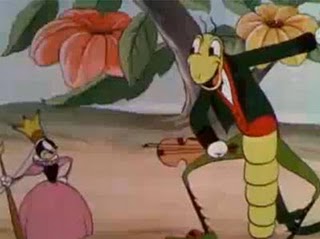 ‘The Grasshopper and the Ants’ is easily one of the best Silly Symphonies: it has a catchy song, great use of color and beautiful effect animation. Notice, for instance, the realism of the leaves blowing away during the autumn scene. One can even recognize which trees they’re from!
The grasshopper, too, is a wonderfully designed character, based on concept art by the great Albert Hurter. In contrast, the design of the ants looks a little primitive, still belonging to the black and white era. But, by now, the Disney staff has fully mastered the idea of character animation. This is best shown in the final dance scene: even in a crowd of lookalikes one easily recognizes the joyful ant the Grasshopper had tempted earlier.
Note that morality notwithstanding, the grasshopper is allowed to do what he does best: singing and playing. An encouragement to view art as an important contribution to society. Even so, the way the queen finally invites him is a real cliff-hanger.
This cartoon’s theme song, ‘the world owes me a living’ was composed by Leigh Harline, who would also compose the catchy songs of ‘Pinocchio‘. the grasshopper’s catchy song would become Goofy’s theme song. No wonder, for he and the Grasshopper share the same voice, by Pinto Colvig.
Watch ‘The Grasshopper and the Ants’ yourself and tell me what you think:
This is Silly Symphony No. 42
To the previous Silly Symphony: The China Shop
To the next Silly Symphony: Funny Little Bunnies
Director: David Hand
Release Date: April 20, 1935
Rating: ★
Review:
 ‘The Robber Kitten’ is one of the more annoying entries in the Silly Symphony series.
Being a Silly Symphony, its animation is top notch, especially the character animation of the little rascal Ambrose (or ‘Butch’ as he prefers to be called) and the experienced robber Dirty Bill. But, the story is slow-paced, childish and dripping with morality.
The setting is vague and pretty unconvincing: Bill is clad in a medieval Robin Hood-like costume, while Ambrose is clad in 17th century fashion. A much sillier world as that of ‘The Cookie Carnival’ was brought with much more bravado.
All too typical for the Silly Symphonies of the mid thirties, ‘The Robber Kitten’ is nothing more than beautifully animated pulp.
Watch ‘The Robber Kitten’ yourself and tell me what you think:
This is Silly Symphony No. 51
To the previous Silly Symphony: The Golden Touch
To the next Silly Symphony: Water Babies
Director: Wilfred Jackson
Release Date: August 19, 1933
Rating: ★★★★½
Review:
 In ‘Lullaby Land’ a baby is lulled to sleep by his mother, singing ‘rock-a-bye baby’. The song takes the baby and his stuffed dog to Lullaby Land, a wonderfully surreal land made of plaids, rattles etc.
There the baby encounters a parade of baby objects, and a forbidden garden, full of sharp things, like knives and scissors. Despite the warnings of the female choir in the soundtrack, the baby enters. He destroys all watches from a watch tree with a hammer, and plays with matches. The smoke evokes three bogey men, which scare the baby away. Finally, the baby meets the Sandman, who puts the baby asleep to the tune of Johannes Brahms’s lullaby.
With cartoons like ‘Lullaby Land’ Disney set new standards for animation that are still thrilling today. Don’t get me wrong, the cartoon is rather patronizing and sugary cute, especially through the soundtrack. But this is compensated by wonderful surrealistic images, beautiful artwork and superb animation. And, hey, this way of warning against sharp things and matches just may work with small children.
Lullaby Land itself is a highly original fantasy world, and especially its first images are stunningly beautiful. The dance of the bogey men contains some striking use of color that anticipates similar surreal images in ‘Dumbo‘ (1941). Moreover, it is the first example of totally unrealistic color use in animated cartoons, and therefore a milestone.
Unfortunately, the cartoon also marks a trend of childishness creeping into the animation world, not only at Disney’s, but at all other studios, as well. For example, ‘Lullaby Land’ is the first of a whole series of Silly Symphonies obsessed with little babies, and their bare behinds in particular, with ‘Wynken, Blynken and Nod‘ from 1938 being the last example.
Anyway, ‘Lullaby Land’ left all competitors far behind. Later, both Walter Lantz (‘Candy Land’, 1934) and Max Fleischer (‘Somewhere in Dreamland‘, 1936) tried to copy the concept with far less convincing results.
Watch ‘Lullaby Land’ yourself and tell me what you think:
This is Silly Symphony No. 38
To the previous Silly Symphony: Old King Cole
To the next Silly Symphony: The Pied Piper
Director: Wilfred Jackson
Release Date: March 24, 1934
Rating: ★★
Review:
 ‘Cute Little Bunnies’ would have been a better title for this easter short, for the bunnies are very cute, not funny.
In fact, “Funny Little Bunnies’ is so cute it can only have been meant for children. It makes one wonder what movies it was supposed to support in the theaters (surely no grim gangster thriller!).
Because everybody copied Disney at that time, other studios were copying this ‘new cuteness’ as well. Especially 1934 saw an explosion of Silly Symphonies imitating series, combining the appeal of color with sugary tales. Former Disney associate Ub Iwerks was the first, releasing his first Comicolor cartoon on December 23, 1933. He was followed by Max Fleischer (Color Classics, August 1934), MGM (Happy Harmonies, September), Van Beuren (Rainbow Parade, September), Columbia (Color Rhapsodies, November), and Walter Lantz (Cartune Classics, December). This resulted in a spread of cute (and severely unfunny) cartoons in the mid-thirties.
One is therefore particularly thankful that in the late thirties Tex Avery restored nonsense, wackiness and absurdism in the animated cartoon. These qualities Disney sometimes seemed to have forgotten during his pursuit for greater naturalism and beauty.
Notice how, for example, ‘Funny Little Bunnies’ uses animation to tell a story that cannot be told in live action, but how it tries to tell this story in the most conventional, ‘live action-like’ way. Especially the opening shot of this short is stunning, with two bunnies hopping realistically and lots of birds and butterflies flying around.
Watch ‘Funny Little Bunnies’ yourself and tell me what you think:
This is Silly Symphony No. 43
To the previous Silly Symphony: The Grasshopper and the Ants
To the next Silly Symphony: The Big Bad Wolf
Director: Burt Gillett
Release Date: July 30, 1932
Stars: Pluto
Rating: ★★★★
Review:
 ‘Just Dogs’ opens with a dog pound, with several dogs howling to the tune of Vernon Dalhart’s 1924 hit ‘The Prisoner’s Song’.
Then a little black dog escapes, and helps Pluto and several other dogs escaping, too. Once outside the little dog repeatedly tries to gain Pluto’s sympathy, to no avail. Not even when it shares a large bone with Pluto. When an annoying little Pekingese warns the other dogs of the bone, trouble starts, but the little dog saves the day with the help of legion of fleas, while Pluto remains busy with an alarm clock. Only then he gains Pluto’s much wanted sympathy.
‘Just Dogs’ is not a particularly funny or beautiful short and its star, Pluto, is most of the time quite unsympathetic, but it does show the advancements in animation Disney was making at the time: we’re not watching ‘just dogs’, we’re watching several recognizable types of dogs, among them a very lifelike St. Bernard.
By now, the Disney animators didn’t need to stick to stereotyped ducks, pigs, cows, horses, or in this case, dogs, but were able to draw and animate real dogs, who looked like dogs, moved like dogs and behaved like dogs. This kind of naturalism is quite unprecedented in earlier films. ‘Just Dogs’ is still a mixed bag: some of the designs are still very primitive, especially during the escape scene, but there are some striking new designs here, not in the least, the small, optimistic black dog, who ‘s the real hero of the short.
The two main protagonists, Pluto and his clever comrade, are two distinct characters, which behave and move differently, a great advancement in character animation. Disney would develop both naturalism and character animation into perfection in the coming seven years.
Two years later the little dog would reappear as Pluto’s rival Terry in Floyd Gottfredson’s Mickey Mouse comics.
Watch ‘Just Dogs’ yourself and tell me what you think:
This is Silly Symphony No. 28
To the previous Silly Symphony: The Bears and the Bees
To the next Silly Symphony: Flowers and Trees
Director: Walt Disney
Release Date: May 10, 1929
Rating: ★★★★★ ♕
Review:
 ‘Skeleton Dance’ is the first of the Silly Symphonies and easily one of the best. It deservedly even ranks among the best cartoons of all time.
It starts spectacularly to begin with: we first watch lightning crack, immediately followed by an extreme close up of huge eyes, which only after the camera zooms out appear to belong to an owl.
The complete film is simple, yet perfect in its timing and its peculiar mix of eerie atmosphere and silly gags. The animation (which includes a remarkable quantity of repetition) is extraordinary fluent and the skeletons are convincing throughout the picture.
More than in any earlier cartoon the animation and music are a perfect match. This cartoon single-handedly puts Walt Disney, animator Ub Iwerks and composer Carl Stalling to the eternal hall of fame. A masterpiece.
‘The Skeleton Dance’ clearly shows Disney’s ambition. From now on Disney would use the Silly Symphony series to propel the art of animation forward, until the series ended 1939, after becoming a little obsolete, because their role had been taken over by the animated features.
Watch ‘The Skeleton Dance’ yourself and tell me what you think:
This is Silly Symphony No. 1
To the next Silly Symphony: El Terrible Toreador


 Dr. Grob's Animation Review