You are currently browsing the category archive for the ‘Warner Bros. films’ category.
Director: Friz Freleng
Release Date: March 28, 1942
Stars: Bugs Bunny, Elmer Fudd
Rating: ★★★★
Review:
 Elmer Fudd will inherit three million dollars from Uncle Louie, if he doesn’t hurt any animal, especially rabbits. Bugs, of course, takes advantage of the situation.
‘The Wabbit Who Came to Supper’ was Friz Freleng’s second Bugs Bunny cartoon, only, but he understood the brassy character completely. The highlight of the cartoon is the scene in which in the middle of a chase a clock chimes and Bugs bursts into a convincing New Year routine… in July. This scene not only shows the fresh character’s overpowering personality, it also shows Bugs Bunny’s ability to produce necessary attributes out of nowhere, this time confetti and streamers.
Bugs’ design, however, is rather unappealing and uncertain in this cartoon. And Elmer Fudd, too, has the less appealing alternate fatty design, which Robert Clampett had introduced in ‘Wabbit Twouble‘ (1941). Luckily, this design was short-lived and lasted only four cartoons.
Two years later Hanna and Barbera would use the same plot idea in the Tom and Jerry cartoon ‘Million Dollar Cat’ (1944) with even better results.
Watch ‘The Wabbit Who Came to Supper’ yourself and tell me what you think:
This is Bugs Bunny cartoon No. 8
To the previous Bugs Bunny cartoon: Wabbit Twouble
To the next Bugs Bunny cartoon: The Wacky Wabbit
Director: Chuck Jones
Release Date: March 2, 1940
Stars: proto-Bugs Bunny, Elmer Fudd
Rating: ★★
Review:
 In this slow and only moderately funny cartoon Elmer tries to photograph nature, but he’s hindered by a predecessor of Bugs Bunny.
This goofy rabbit is not quite Bugs, even though he behaves very calmly and does a Bugs-style death act. His looks and sounds are those of the crazy rabbit in ‘Hare-um Scare-um‘ (1939) and he still has the Woody Woodpecker-style laugh introduced in ‘Porky’s Hare Hunt‘ (1938). Jones has toned this loony fellow down, but it was to Tex Avery to introduce a really cool rabbit in ‘A Wild Hare‘ from four months later.
No, the importance of ‘Elmer’s Candid Camera’ lies in the fact that it marks Elmer’s debut. Although he’s still wearing an Egghead suit (the character from which he evolved), he lacks Egghead’s goofiness, and he has received his distinctive voice provided by Arthur Q. Bryan. Moreover, he utters his famous line “wabbit twacks” for the first time here.
Unfortunately, ‘Elmer’s Candid Camera’ is more historically interesting than entertaining, and outside its historical importance, the cartoon is quite forgettable.
Watch ‘Elmer’s Candid Camera’ yourself and tell me what you think:
http://ulozto.net/live/xzv5WBh/bugs-bunny-elmers-candid-camera-1940-avi
This is the last of four cartoons featuring a Bugs Bunny forerunner
To the first Bugs Bunny cartoon: A Wild Hare
To the previous proto-Bugs Bunny cartoon: Hare-um Scare-um
Director: Friz Freleng
Release Date: December 2, 1961
Stars: Tweety & Sylvester
Rating: ★★★★½
Review:
 ‘The Last Hungry Cat’ must be one of the best entries in the Tweety and Sylvester series.
The short is a parody of the television show ‘Alfred Hitchcock Presents’, which aired from 1955 to 1965. Luckily, you don’t have to be familiar with this program (I’m not) to enjoy this cartoon.
Introduced by an Alfred Hitchcock-like shadow of a pig, the short tells the story of Sylvester, who for once thinks he has actually eaten Tweety and who is then eaten by guilt.
The cartoon makes use of a conscience-like voice-over and very beautifully colored and a surprisingly large amount of well-staged angular backgrounds (staged by Hawley Pratt, who gets co-directing credits, and painted in beautiful blues and yellows by Tom O’Loughlin). The images succeed in evoking an atmosphere that reflects Sylvester’s inner feelings. Especially the staging of Sylvester’s sleeplessness is very well done: still images of Sylvester lying awake are inter-cut with close-ups of his alarm clock, in rapid succession, zooming in all the time. These scenes are accompanied by Milt Franklyn’s ominous music and insistent ticking of the clock, only.
It’s a surprise such a well-made, beautiful and compelling cartoon could be made as late a 1961. The short is a worthy addition to the very small guilt cartoon canon, which also includes ‘Nursery Scandal‘ from 1933, ‘Pudgy Picks a Fight‘ from and ‘Donalds’ Crime’ from 1945.
Watch ‘The Last Hungry Cat’ yourself and tell me what you think:
Director: Frank Tashlin
Release Date: October 30, 1937
Stars: Porky Pig, Petunia Pig
Rating: ★★★★
Review:
 In this cartoon Porky suddenly has three elder brothers (Peter, Portus, and Percy), while Petunia appears to be his sister.
The siblings inherit their estate from their late uncle Solomon (who’s a caricature of Oliver Hardy). Unfortunately, the evil lawyer Goodwill is after them, changing himself into a Dr. Hyde-like character. Strangely enough he insults somebody in the audience, the “guy in the third row”. This to his own regret, for it’s this guy who saves Porky and his siblings in the end! This type of dimension-defying humor was a novelty at the time and would become a Warner Bros. trademark in the late 1930s and early 1940s.
Watch ‘The Case of the Stuttering Pig’ yourself and tell me what you think:
This is Porky Pig cartoon no. 31
To the previous Porky Pig cartoon: Rover’s Rival
To the next Porky Pig cartoon: Porky’s Double Trouble
Director: Frank Tashlin
Release Date: December 19, 1936
Stars: Porky Pig
Rating: ★★★
Review:
 Porky has a game refuge in Canada, in which he defends rather cute animals against an evil hunter.
The hunter is designed like the lieutenant from ‘Little Beau Porky‘, but we only see him appear after 4’30. Before this his threat is shown by his shadow only, a remarkably inventive device for a cartoon of the 1930s.
Like other early Warner Brothers films, ‘Porky in the North Woods’ looks very primitive, and rather Disney-anno-1932/1933-like. Yet it features an extremely fast sequence of a squirrel running a ridiculously long distance through the woods to get help (and back to fetch and apple). Such short and fast sequences of characters crossing ridiculously long distances would become a trademark of Tashlin’s colleague Tex Avery. Like his first two films, Tashlin’s third short at Warner Bros. features a battle sequence: this time we watch an enormous number of animals being called to arms.
Porky hardly talks in this cartoon – it seems Tashlin tried to avoid his tiresome stutter. Indeed, in 1937, the original voice artist would be replaced by Mel Blanc, who was able to make Porky’s stutter funny.
Watch ‘Porky in the North Woods’ yourself and tell me what you think:
http://www.dailymotion.com/video/x2xp64z
This is Porky Pig cartoon no. 17
To the previous Porky Pig cartoon: The Village Smithy
To the next Porky Pig cartoon: Porky the Wrestler
Director: Frank Tashlin
Release Date: October 24, 1936
Stars: Porky Pig
Rating: ★★★½
Review:
 ‘Little Beau Porky’ is Frank Tashlin’s second film at Warner Bros. It’s a more clearly gag-orientated effort than his debut film ‘Porky’s Poultry Plant‘.
Porky (with his old stutter) is a soldier at the foreign legion, being bullied by his lieutenant. However, in the end he manages to single-handedly save the fort and to overthrow an evil Arab and his gang.
Like in ‘Porky’s Poultry Plant’, both design and animation are primitive. But Tashlin unmistakably shows his cinematic talent, especially in the opening sequence and in the preparation for battle.
Watch ‘Little Beau Porky’ yourself and tell me what you think:
http://www.dailymotion.com/video/x2xp5o3
This is Porky Pig cartoon no. 15
To the previous Porky Pig cartoon: Porky’s Moving Day
To the next Porky Pig cartoon: The Village Smithy
Director: Frank Tashlin
Release Date: August 22, 1936
Stars: Porky Pig
Rating: ★★★★
Review:
 Both director Frank Tashlin and composer Carl Stalling make their Warner Bros. debut in this film in which Porky (with his old ugly voice) has a fowl farm, threatened by a bunch of evil buzzards.
‘Porky’s Poultry Plant’ looks primitive when compared to Disney films of the same time, looking more like a Disney film from 1932-1933. Its story is sweet, and not very funny, but Carl Stalling’s music is fresh, and Tashlin’s staging is already very impressive. Especially the air battle sequence (in which Porky, in a small army plane, fights an air fleet of hawks ) is remarkably stunning, showing unparalleled fast montage and original ‘camera’ shots. Both these techniques would become Tashlin trademarks, and would contribute to a faster, more gag-orientated style at Warner Bros. Tashlin had replaced Jack King, who had returned to Disney, and with his first Warner Bros. cartoon he immediately proves to be a more inventive director than his predecessor.
Watch ‘Porky’s Poultry Plant’ yourself and tell me what you think:
http://www.supercartoons.net/cartoon/822/porky-pig-porkys-poultry-plant.html
This is Porky Pig cartoon no. 12
To the previous Porky Pig cartoon: Porky the Rainmaker
To the next Porky Pig cartoon: Milk and Money
Director: Chuck Jones
Release Date: July 25, 1953
Stars: Daffy Duck, Porky Pig, Marvin Martian
Rating: ★★★★★ ♕
Review:
 ‘Duck Dodgers in the 24½th Century’ is a spoof of the popular pulp magazine science fiction series Buck Rogers, which was made into a television series in 1950-1951. This makes this short one of the earliest theatrical cartoons parodying a television series.
Daffy “Duck Dodgers” and his sidekick “the eager young space cadet” Porky have to claim planet X for planet Earth. Unfortunately, Marvin Martian wants to claim the same planet for Mars. This starts a feud, which ends in both blowing up the entire planet.
Although the story of the cartoon is rather similar to the Bugs Bunny cartoon ‘Haredevil Hare‘ (1948), Daffy’s unique performance gives it an entirely different feel, leading to new and great gags. More than being a typical science fiction cartoon, this short can be regarded the second cartoon in a series which pairs Daffy as a misguided hero to Porky as a more sensible straight man (the first being ‘Drip-along Daffy‘ from 1951). ‘Duck Dodgers’ must be the highlight of the series, as well as a peak in both Daffy’s as Chuck Jones’s career.
Unhampered by conventions, Jones, his layout-man Maurice Noble and background painter Phil DeGuard went totally berserk with the science-fiction theme, creating wild and lushly colored backgrounds, which make ‘Duck Dodgers in the 24½th Century’ one of the most beautiful cartoons ever made at Warner Brothers.
Indeed, so great is its fame, it spawned sequels in 1980, 1996 and 2003. From 2003 to 2005 Cartoon Network even broadcasted a Duck Dodgers series.
Watch ‘Duck Dodgers in the 24½th Century’ yourself and tell me what you think:
http://www.220.ro/desene-animate/Looney-Tunes-Duck-Dodgers-In-The-24-5-Century/aTflTNIyAr/
This is Porky Pig cartoon no. 142
To the previous Porky Pig cartoon: Fool Coverage
To the next Porky Pig cartoon: Claws for Alarm
This is Daffy Duck cartoon No. 65
To the previous Daffy Duck cartoon: Muscle Tussle
To the next Daffy Duck cartoon: Duck! Rabbit! Duck!
‘Duck Dodgers in the 24½th Century’ is available on the Blu-Ray ‘Looney Tunes Platinum Collection: Volume 2’ and on the DVD-set ‘Looney Tunes Golden Collection Volume One’
Director: Chuck Jones
Release Date: February 28, 1953
Stars: Daffy Duck, Bugs Bunny (cameo)
Rating: ★★★★★ ♕
Review:
 One of the most self-aware animated cartoons ever made, ‘Duck Amuck’, more than any other cartoon, plays with the conventions of animation and with the frustrations of Daffy Duck.
This cartoon shows how good the character is, because even when drawn awkwardly, even without sound, and even when animated as a small speck in the distance, we know it’s Daffy. His struggles with the off-screen animator (who in the end turns out to be Bugs Bunny) form the zenith of his new frustrated personality, which had replaced his zany personality of the thirties and forties three years earlier. Furthermore he’s the sole character in the entire cartoon, but so strong is his unwilling performance that we become hardly aware of this fact.
The poor Daffy has to deal with disappearing and constantly changing backgrounds, with absent and inappropriate sounds, with deformations of his own body etc. In this cartoon he’s the victim of an omnipotent ‘cartoon god’ whom he cannot escape. In this sense ‘Duck Amuck’ questions the relationship between creator and creation and the responsibility of the creator to the things he created. This makes ‘Duck Amuck’ also one of the most philosophical cartoons ever made. And amazingly, it’s funny, too.
Watch ‘Duck Amuck’ yourself and tell me what you think:
http://www.dailymotion.com/video/x2ofats
This is Daffy Duck cartoon No. 63
To the previous Daffy Duck cartoon: Fool Coverage
To the next Daffy Duck cartoon: Muscle Tussle
‘Drip-along Daffy’ is available on the Blu-Ray ‘Looney Tunes Platinum Collection: Volume 2’ and on the DVD-set ‘Looney Tunes Golden Collection Volume One’
Director: Chuck Jones
Release Date: April 19, 1952
Stars: Bugs Bunny
Rating: ★★★★
Review:
 Six years after ‘Hair-raising Hare’ (1946) Bugs Bunny faces the orange monster in sneakers again.
‘Water, Water Every Hare’ is a horror cartoon featuring almost everything a horror movie should have: an evil scientist, a monster, a mummy and a robot. This story is rather awkwardly framed, however, by a story about the river flooding Bugs’s home and transporting him to and from the castle. Facing the monster Bugs repeats his manicure-tric from the earlier film, although this time he pretends to be a hair dresser. He also makes himself invisible and he makes the monster shrink.
If not as funny as ‘Hair-raising Hare’, ‘Water, Water Every Hare’ is full of clever gags. It moves at a relatively relaxed pace, which only a very confident film maker could use with such effect. In that respect, ‘Water, Water Evey Hare’ shows the mastery director Chuck Jones had achieved. He needn’t be fast and furious to be funny and he knew it.
Watch ‘Water, Water Every Hare’ yourself and tell me what you think:
http://www.metacafe.com/watch/7621186/water_water_every_hare_1952/
‘Water, Water Every Hare’ is available on the DVD set ‘Looney Tunes Golden Collection, Vol. 1’
This is Bugs Bunny cartoon No. 90
To the previous Bugs Bunny cartoon: Foxy Proxy
To the next Bugs Bunny cartoon: Hasty Hare
Director: Friz Freleng
Release Date: May 2, 1953
Stars: Bugs Bunny, Yosemite Sam
Rating: ★★★★
Review:

When his home country looks like a desert and he becomes short of carrots, Bugs migrates to Alabama.
Unfortunately, the ‘Mason Dixie Line’, the border between the North (desert) and the South (beautiful green landscape), is protected by Southerner Sam, who isn’t aware that the civil war has ended ages ago. This preposterous idea leads to great gags involving several impersonations by Bugs, a.o. of Abraham Lincoln.
Watch ‘Southern Fried Rabbit’ yourself and tell me what you think:
http://archive.org/details/SouthernFriedRabbit_35
This is Bugs Bunny cartoon No. 98
To the previous Bugs Bunny cartoon: Upswept Hare
To the next Bugs Bunny cartoon: Hare-Trimmed
‘Southern Fried Rabbit’ is available on the DVD set ‘Looney Tunes Golden Collection Volume Four’
Director: Chuck Jones
Release Date: January 19, 1952
Stars: Bugs Bunny, Wile E. Coyote
Rating: ★★
Review:
 The second appearance of the Coyote after his debut film ‘Fast and Furry-ous‘ (1949) was, surprisingly, not another Road Runner cartoon.
Instead, director Chuck Jones decided to place his still fresh carnivore character against Bugs Bunny, a character increasingly in need of worthy opponents.
in ‘Operation: Rabbit’ Wile E. Coyote gets his name (in the Road Runner cartoons he’s never called that way). Wile E. introduces himself to Bugs as ‘genius’, and suddenly he is a talking character, speaking with an eloquent, vaguely British voice. The experiment is not successful. The coyote’s ability to speak floods the action with a lot of superfluous dialogue, and he almost totally lacks the sympathetic frustration so wonderfully demonstrated in the Road Runner cartoons. Moreover, there’s hardly any chemistry between the two overconfident characters, which leads to remarkably unfunny gags, with only the one involving a flying saucer being able to create a chuckle.
Despite the shortcomings, Jones would make Bugs Bunny and Wile E. Coyote co-star in three more cartoons: ‘To Hare is Human’ (1956), ‘Rabbit’s Feat’ (1960), and ‘Compressed Hare’ (1961). Meanwhile the Coyote would have a much more interesting career in the Road Runner cartoons, with the second one, ‘Beep Beep’, appearing four months after ‘Operation Rabbit’.
Watch ‘Operation: Rabbit’ yourself and tell me what you think:
This is Bugs Bunny cartoon No. 87
To the previous Bugs Bunny cartoon: Big Top Bunny
To the next Bugs Bunny cartoon: 14 Carrot Bunny
Director: Chuck Jones
Release Date: January 3, 1953
Stars: Sam Sheepdog & Ralph Wolf
Rating: ★★★★★
Review:
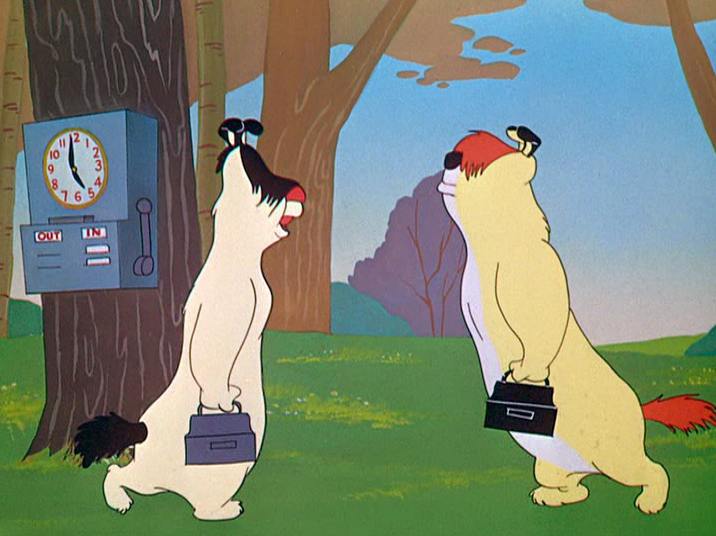 ‘Don’t Give up the Sheep’ is the first cartoon in a series of seven cartoons featuring the excellent duo Sam Sheepdog and Ralph Wolf.
In their first entry Sam Sheepdog is called Ralph, while Ralph remains yet unnamed. Sam goes to work, relieving his colleague Fred in attending the sheep. He has to counter the attacks by Ralph the wolf, who looks like Wile E. Coyote’s scruffy cousin. The cartoon is full of excellent, Road Runner-like blackout cartoons. In his silliest attempt the wolf dresses up as the God Pan to lull the sheepdog to sleep. To no avail, of course.
In this cartoon the backgrounds (by Carlos Manriquez) are becoming more stylized, although they still look like real nature. Sam and Ralph would never become major characters, but their miniseries is a little delight within the Warner Brothers canon.
Watch ‘Don’t Give up the Sheep’ yourself and tell me what you think:
http://www.wimp.com/hilariouscartoon/
‘Don’t Give up the Sheep’ is available on the DVD set ‘Looney Tunes Golden Collection, Vol. 1’
Director: Chuck Jones
Release Date: February 2, 1952
Stars: Marc Anthony
Rating: ★★★★★ ♕
Review:
 Among all the masterpieces of animation, this must be the most inconspicuous one: it’s a seemingly classical dog and cat story, involving quite some dull dialogue (provided by the dog’s mistress, of whom we only see her legs), and its looks are quite traditional, with unremarkable layouts and backgrounds.
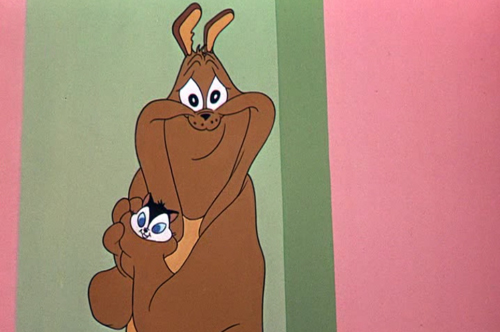
Nevertheless, ‘Feed The Kitty’ is a real masterpiece, and its reputation is entirely due to the acting of its main character, the gentle bulldog Marc Anthony. His facial expressions are so wide ranging, so extreme and so heartfelt that ‘Feed the Kitty’ can almost be regarded as a study in depiction of emotion. Silent acting really reaches its peak here, and director Chuck Jones is without doubt at his all time best in this sweet little cartoon.
In ‘Feed the Kitty’ Marc Anthony adopts a sweet little kitten, but he’s not allowed to bring anything into the house. This leads to various gags with the dog trying to hide the little kitten from his mistress. However, the highlight of the cartoon is the sequence in which Marc Anthony thinks his darling pet is dead. His emotions are both hilarious and heartbreaking. Never before has the anxiety of having lost a dearly beloved been so convincingly put to the animated screen. At this point I often can’t keep my tears from running.
Indeed, this sequence is so popular among animators that it was almost exactly copied in ‘Monsters, Inc.‘ (2001) as a homage to the original. I’d say, if cartoons were shown at funerals (and why not?), ‘Feed the Kitty’ would be a perfect candidate.
Watch ‘Feed the Kitty’ yourself and tell me what you think:
http://www.dailymotion.com/video/xjw9ms_feed-the-kitty_shortfilms
‘Feed the Kitty’ is available on the DVD set ‘Looney Tunes Golden Collection, Vol. 1’
Director: Chuck Jones
Release Date: March 10, 1951
Stars: Bugs Bunny, The Crusher
Rating: ★★
Review:
 Three years after ‘Rabbit Punch‘ (1948) Bugs Bunny faces the Crusher again.
This time Bugs is the mascot of ‘Ravishing Ronald’, a gay looking ballet dancer type of character with a hair net. This guy challenges the Crusher in a wrestling match, but is clobbered immediately.
In order not to lose his job Bugs Bunny challenges the Crusher, too, as the ‘masked terror’. Of course, he wins the game, by strategy in a rather boring and uninspired cartoon, especially when compared to the delightful ‘Rabbit Punch’. The best gags are in the beginning: the Crusher showing his enormous excess of muscles and the extravagant entry of Ravishing Ronald.
Watch ‘Bunny Hugged’ yourself and tell me what you think:
http://www.ebaumsworld.com/video/watch/82493307/
This is Bugs Bunny cartoon No. 80
To the previous Bugs Bunny cartoon: Rabbit Every Monday
To the next Bugs Bunny cartoon: Fair-Haired Hare
Director: Friz Freleng
Release Date: September 22, 1951
Stars: Tweety & Sylvester, Granny
Rating: ★★★
Review:
 Sylvester is down in the dumps and hungry, foraging a harbor, when he discovers Tweety on a ship.
He climbs aboard, and what follows are several gags involving glasses and sea sickness. The best gag is when Sylvester paints Tweety on Granny’s glasses. Most of the other gags, however, are mediocre, and feel routinized. For example, Tweety reuses a sea sickness gag from Tex Avery’s ‘The Screwball Squirrel’ (1944), but much less well executed.
Watch ‘Tweety’s S.O.S.’ yourself and tell me what you think:
http://www.dailymotion.com/video/x1z27d9_sylvester-the-cat-ep-25-tweety-s-s-o-s_fun
‘Tweety’s S.O.S.’ is available on the DVD set ‘Looney Tunes Golden Collection, Vol. 1’
Director: Robert McKimson
Release Date:May 5, 1951
Rating: ★★★½
Review:
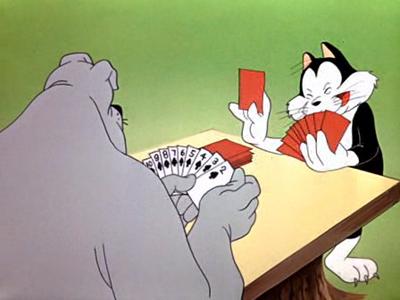 ‘Early to Bet’ introduces the ‘gambling bug’, a bug that makes people want to gamble.
The little insect infects a cat who then starts to play gin rummy for penalties with an over-confident bulldog. The bulldog wins several times, and the cat has to pay the elaborate and rather zany, yet painful penalties. In the end, however, he plays against the bug, and wins, making the bug pay a penalty.
Apart from the original and pretty funny penalties, this is a mediocre cartoon, which lacks stars or even appealing characters.
Watch ‘Early to Bet’ yourself and tell me what you think:
http://www.supercartoons.net/cartoon/681/early-to-bet.html
‘Early to Bet’ is available on the DVD set ‘Looney Tunes Golden Collection, Vol. 1’
Director: Friz Freleng
Release Date: February 24, 1951
Stars: Tweety & Sylvester
Rating: ★★★★
Review:
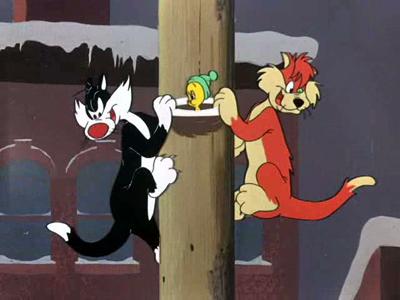 It’s winter and Tweety is troubled by two cats (Sylvester and a red cat with a bad eye), who fight over him. Most of the comedy derives from the feud between the two, and only in the end Tweety himself comes into action, making the two cats fall into an icy pond.
With ‘Putty Tat Trouble’ Freleng returns to Tweety’s first solo films, Bob Clampett’s ‘A Tale of Two Kitties’ (1942) and ‘A Gruesome Twosome‘ (1945), in which also two cats fought for the little bird. Freleng’s humor is different from Bob Clampett’s, but once again, the feud works very well. Apart from Tweety’s talking, all the comedy is silent and brilliantly executed, too. This makes ‘Putty Tat Trouble’ one of the better Tweety and Sylvester cartoons.
In one scene we can see a Friz Freleng portrait in the background.
Watch an excerpt from ‘Putty Tat Trouble’ yourself and tell me what you think:
‘Putty Tat Trouble’ is available on the DVD set ‘Looney Tunes Golden Collection, Vol. 1’
Director: Friz Freleng
Release Date: February 3, 1951
Stars: Sylvester
Rating: ★★★★★
Review:
 In this cartoon Sylvester is the cat of a couple, who go on a holiday to California for two weeks, leaving Sylvester behind and locked indoors.
Sylvester runs into agony when he discovers this, until he finds a kitchen-cupboard full of tins of fish. Unfortunately, a mouse has the can opener. This leads to perfectly timed blackout gags, in which Sylvester makes several attempts to get the can opener. When he finally succeeds, he discovers that the particular cupboard is locked, while the mouse has the key.
Due to its cat-and-mouse-routine ‘Canned Feud’ has similarities to the Tom & Jerry cartoons, although it has a distinct Friz Freleng style. Unlike Jerry, the mouse is completely blank, and its motives remain unclear, but Freleng’s comedy works nonetheless. In fact, this film is better than most contemporary Tweety and Sylvester cartoons.
Watch ‘Canned Feud’ yourself and tell me what you think:
Director: Robert McKimson
Release Date: December 12, 1951
Stars: Bugs Bunny
Rating: ★★★
Review:
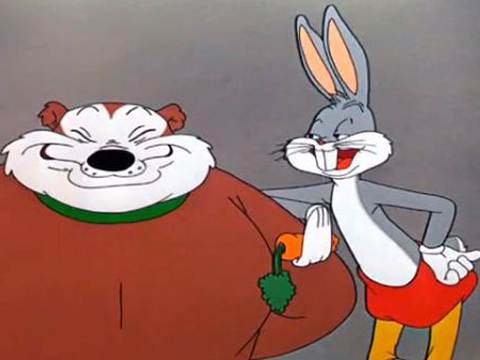 Five years after his first Bugs Bunny cartoon, ‘Acrobatty Bunny‘ (1946), McKimson returns to the circus setting.
This time Bugs is the new acrobat partner of an egotistical star acrobat bear called Bruno. This “Slobokian bear” is not a good sport and tries to get rid of Bugs, but of course, the reverse happens.
‘Big Top Bunny’ is better than ‘Acrobatty Bunny’, but it still suffers: it’s worn down by the high amount of rather unfunny dialogue and its slow pace. Nevertheless, the cartoon builds up nicely, and its best gags come in last: first there’s a great cycling gag, then there’s a superb gag in which Bugs and Bruno compete in the most daring high diving act. This is quickly followed by the frantic finale in which Bugs disposes of the bear once and for all.
Watch ‘Big Top Bunny’ yourself and tell me what you think:
https://www.dailymotion.com/video/x2fg9zb
‘Big Top Bunny’ is available on the DVD set ‘Looney Tunes Golden Collection, Vol. 1’
This is Bugs Bunny cartoon No. 86
To the previous Bugs Bunny cartoon: Ballot Box Bunny
To the next Bugs Bunny cartoon: Operation: Rabbit


 Dr. Grob's Animation Review