You are currently browsing the category archive for the ‘Warner Bros. films’ category.
Director: Chuck Jones
Release Date: May 9, 1951
Stars: Bugs Bunny, Daffy Duck, Elmer Fudd
Rating: ★★★★★
Review:
 ‘Rabbit Fire’ is the first of three cartoons in which writer Michael Maltese and director Chuck Jones play Bugs Bunny, Daffy Duck and Elmer Fudd against each other.
The cartoon introduces a new incarnation of Daffy: as the jealous and treacherous miser who never wins. This transformation works, because Daffy the trickster was already present, as can be seen in films like ‘You Ought to be in Pictures‘ (1940) and ‘The Ducksters‘ (1950). As we could expect Daffy’s tricks, so successful against Porky Pig, fail when tried on Bugs Bunny, and Daffy’s repeated failures add to the duck’s frustration.
However, with this transformation, Daffy would lose his lunacy altogether, and it was this new frustrated, misguided, loser type of Daffy that would prevail to the present day, combined with Daffy-the-misguided-hero, championed in other Chuck Jones cartoons, like ‘Drip-along Daffy‘ (1951) and ‘Duck Dodgers in the 24 ½ Century‘(1953).
In ‘Rabbit Fire’ the contrast between Bugs and Daffy is played out very well: Bugs is the initial victim, but he remains über-cool and in total control, while Daffy is the treacherous actor, trying to harm Bugs, but biting the dust every time. In fact, this character trait makes Daffy rather similar to an earlier incarnation of that other famous duck, Donald, who, by the early 1950s had more or less evolved into the straight guy.
The team’s streak of genius is that Daffy never turns into rage, but remains cool, as well. When confronted with a string of defeats, he just walks up to Bugs and utters: ‘you’re despicable!’. Elmer Fudd, meanwhile, remains the confused instrument of the feud between the two animals.
‘Rabbit Fire’ is a dialogue-rich cartoon, but the dialogue never wears down the action. In fact, two of the film’s highlights involve a lot of talking: the gun-pointing scene, and a scene in which Bugs and Daffy read aloud several recipes (strangely enough Daffy pulls out a book on rabbit recipes out of Bugs’s rabbit hole…). Other highlights are a gag involving an elephant gun, and the short’s finale, in which it’s suddenly Elmer Season.
The success of ‘Rabbit Fire’ was repeated in ‘Rabbit Seasoning’ (1952) and ‘Duck! Rabbit! Duck! (1953). After this classic trio the studio paired Bugs and Daffy, and even Elmer in a bunch of other cartoons, and the antagonism between rabbit and duck remains intact to the present day, as can be seen in the feature film ”Looney Tunes: Back in Action’ (2003).
Watch ‘Rabbit Fire’ yourself and tell me what you think:
This is Daffy Duck cartoon No. 55
To the previous Daffy Duck cartoon: The Ducksters
To the next Daffy Duck cartoon: Drip-along Daffy
This is Bugs Bunny cartoon No. 82
To the previous Bugs Bunny cartoon: Fair-Hared Hare
To the next Bugs Bunny cartoon: French Rarebit
‘Rabbit Fire’ is available on the Blu-Ray ‘Looney Tunes Platinum Collection: Volume 2’ and on the DVD-set ‘Looney Tunes Golden Collection Volume One’
Director: Chuck Jones
Release Date: September 2, 1950
Stars: Daffy Duck, Porky Pig
Rating: ★★
Review:
 Chuck Jones is famous for directing cute characters, but throughout his career he directed some extraordinarily cruel cartoons, like ‘Fresh Airedale’ (1945), ‘Scaredy Cat‘ (1948) and ‘Chow Hound’ (1951). ‘The Ducksters’ is probably the cruelest of the lot, and in this cartoon the cartoon violence feels more painful than funny.
In ‘The Ducksters’ Daffy Duck is a quizmaster and Porky the unlucky contestant in the radio quiz ‘Truth or Aaagh’, an extreme take on the radio (and later television) show ‘Truth or Consequences’, which had been around since 1940. The cartoon violence starts immediately, as the opening shot features a tied-up Porky slowly approaching a sawmill. A few scenes later, Daffy shoots someone in the audience.
Throughout the picture Daffy remains the ultra-violent trickster, until the tables are turned in the end. However, Daffy is neither loony nor misguided, being in the midst of a transition of character, which renders him ‘just cruel’, and very unsympathetic, indeed.
Luckily, Chuck Jones knew a better a use for the duck, using him as a misguided hero (e.g. ‘The Scarlet Pumpernickel‘ (1950) and ‘Drip-along Daffy‘ (1951), or playing him against the cleverer Bugs Bunny (e.g. ‘Rabbit Fire‘, 1951 and ‘Rabbit Seasoning’, 1952). These cartoons are all far funnier than ‘The Ducksters’.
Watch ‘The Ducksters’ yourself and tell me what you think:
http://www.dailymotion.com/video/x1ylkhn_daffy-duck-ep-59-the-ducksters_fun
This is Porky Pig cartoon no. 134
To the previous Porky Pig cartoon: Golden Yeggs
To the next Porky Pig cartoon: The Wearing of the Grin
This is Daffy Duck cartoon No. 54
To the previous Daffy Duck cartoon: Golden Yeggs
To the next Daffy Duck cartoon: Rabbit Fire
‘The Ducksters’ is available on the DVD-set ‘Looney Tunes Golden Collection Volume One’
Director: Friz Freleng
Release Date: August 5, 1950
Stars: Daffy Duck, Porky Pig
Rating: ★★
Review:
 1950 was a transitional year for Daffy Duck: director Robert McKimson still retained Daffy’s old loony self in ‘Boobs in the Woods‘, but Chuck Jones introduced a new version of the character, as the anti-hero in ‘The Scarlet Pumpernickel‘.
However, two other shorts from the same year, ‘Golden Yeggs’ and ‘The Ducksters‘, show that the directors were uncertain where to go with the character. In Friz Freleng’s ‘Golden Yeggs’ a goose lays a golden egg (24 karat solid gold) at Porky’s poultry farm, but she blames Daffy for doing it. Daffy plays along, but the news soon attracts a gang of gangsters, led by Rocky, in his debut*. The gangsters kidnap Daffy, forcing him to lay more eggs.
Daffy Duck is quite an empty character in this cartoon, more a victim than in control. He has lost his loony character traits completely, but his later greed and foul play haven’t entered, yet, leaving the character pretty much in limbo. The result is an erratic cartoon, weak in its comedy, and uncertain in its delivery, despite some great gags, like Daffy opening a ‘door’ which consists of a gangster.
Watch ‘Golden Yeggs’ yourself and tell me what you think:
http://www.b99.tv/video/golden-yeggs/
This is Porky Pig cartoon no. 133
To the previous Porky Pig cartoon: An Egg Scramble
To the next Porky Pig cartoon: The Ducksters
This is Daffy Duck cartoon No. 53
To the previous Daffy Duck cartoon: The Bitter Half
To the next Daffy Duck cartoon: The Ducksters
‘Golden Yeggs’ is available on the DVD-set ‘Looney Tunes Golden Collection Volume One’
* The Rocky in ‘Racketeer Rabbit’ (1946) was a different character, being a caricature of Edward G. Robinson)
Director: Chuck Jones
Release Date: December 16, 1950
Stars: Bugs Bunny, Elmer Fudd
Rating: ★★★★★ ♕
Review:
 ‘Rabbit of Seville’ is the second of three superb Chuck Jones Bugs Bunny cartoons on opera, bridging ‘Long-Haired Hare‘ (1949) and ‘What’s Opera, Doc?‘ (1957).
The cartoon starts with an open air opera theater setting with the Elmer-Bugs chase quickly entering the scene. When Elmer hits the stage, Bugs quickly opens the curtains, prompting the orchestra to play ‘The Barber from Seville’ by Gioachino Rossini. This leads to a wonderful aria by Bugs, and even Elmer joins in.
But the best part of the film is the silent comedy that follows on the music of the opera’s overture. During this sequence Bugs Bunny’s expressions are priceless, and the action is beautifully staged to the music, leading to a great finale in which Elmer and Bugs get married.
Throughout the picture Jones’s timing and staging are perfect. It improves on both Charlie Chaplin’s barber scene in ‘The Great Dictator’ (1940) and on the vaguely similar Woody Woodpecker cartoon ‘Barber of Seville‘ (1944). The result is no less than a masterpiece.
Surprisingly, this cartoon about ‘The Barber of Seville’ does not feature the famous ‘Largo el factotum’ aria from that opera. This is remarkable, for this aria was a staple in cartoons, and used extensively in e.g. ‘Barber of Seville’, the Tex Avery cartoon ‘Magical Maestro’ and Chuck Jones own Tom & Jerry cartoon ‘The Cat Above, The Mouse Below‘ (1964).
Watch ‘Rabbit of Seville’ yourself and tell me what you think:
https://www.dailymotion.com/video/x301k1t
‘Rabbit of Seville’ is available on the DVD set ‘Looney Tunes Golden Collection, Vol. 1’
This is Bugs Bunny cartoon No. 77
To the previous Bugs Bunny cartoon: Bushy Hare
To the next Bugs Bunny cartoon: Hare We Go
Director: Robert McKimson
Release Date: June 17, 1950
Stars: Bugs Bunny, Elmer Fudd
Rating: ★★★★★ ♕
Review:
 ‘What’s Up, Doc?’ starts very much like Friz Freleng’s ‘A Hare Grows in Manhattan‘ from 1947: Bugs Bunny is a Hollywood star, interviewed by the press.
However, Writer Warren Foster and director McKimson’s take is much funnier than Freleng’s: instead of turning to an ordinary chase sequence, the duo retains the idea of Bugs being a real actor throughout the picture. The cartoon shows his erratic career in the vaudeville scene.
The most absurd take is when Bugs Bunny is down in the dumps. We seem him hanging out in the park with actors, who, by 1950, belonged pretty much to the has-beens: Al Jolson, Jack Benny, Eddie Cantor and Bing Crosby. At this point, it is Elmer, “the famous vaudeville star”, who turns Bugs into a star. We watch the duo performing in what must be the most terrible vaudeville act ever put on screen. But when Bugs utters “what’s up, doc” the duo hits the jackpot.
This loony, self-satirizing from-rags-to-riches story is entertaining throughout, and leads to a great finale. It may well have inspired the equally tongue-in-cheek opening sequence of ‘Singin’ in the Rain’ (1952), which shows some similarities to McKimson’s short.
‘What’s Up, Doc?’ is without doubt one of McKimson’s best cartoons. Sadly, the film more or less marks the end of McKimson’s most inspired era, for during the 1950s the quality of his cartoons steadily declined, becoming more and more routine, and less and less funny.
Watch ‘What’s Up, Doc?’ yourself and tell me what you think:
‘What’s Up, Doc?’ is available on the DVD set ‘Looney Tunes Golden Collection, Vol. 1’
This is Bugs Bunny cartoon No. 72
To the previous Bugs Bunny cartoon: Big House Bunny
To the next Bugs Bunny cartoon: 8 Ball Bunny
Director: Friz Freleng
Release Date: April 22, 1950
Stars: Bugs Bunny, Yosemite Sam
Rating: ★★★★★
Review:
 To escape some hunters, Bugs Bunny hides inside a prison, where Sam Schultz (Yosemite Sam) is a prison guard.
What follows is a great series of prison gags, including two morbid ones resulting in Sam hanging on the gallows and being electrified in an electric chair. Throughout the cartoon the warden keeps calling for Schultz, not unlike the Nazi officer in the Ernst Lubitsch feature ‘To Be Or Not To Be’ (1942).
‘Big House Bunny’ is full of excellent gags and Freleng’s timing is superb throughout, making ‘Big House Bunny’ one of those little known masterpieces.
Watch ‘Big House Bunny’ yourself and tell me what you think:
https://www.dailymotion.com/video/x2l293q
‘Big House Bunny’ is available on the DVD set ‘Looney Tunes Golden Collection, Vol. 1’
This is Bugs Bunny cartoon No. 71
To the previous Bugs Bunny cartoon: Homeless Hare
To the next Bugs Bunny cartoon: What’s Up, Doc?
Director: Robert McKimson
Release Date: December 13, 1949
Stars: Goofy Gophers
Rating: ★★★
Review:
 Robert McKimson reuses the Goofy Gophers from the Art Davis cartoons ‘Goofy Gophers’ (1947) and ‘Two Gophers from Texas’ (1948) to play them against an anonymous dog who wants to be a Shakespearean actor.
The dog finds the gophers in his house, where they start to nag him for no reason. The humor comes from the Shakespeare quotes and the apt practical jokes the Gophers play on the dog, echoing his lines. However, it’s the opening scene that is the most remarkable part of the film: directly after the opening titles we watch the dog being hit by a pie, only to get the ‘That’s All Folks’ caption immediately after it. Then we watch the dog leaving ‘the stage’, cartoons and broad comedy in general to follow his Shakespearean dreams. This scene anticipates a similar scene in ‘Who Framed Roger Rabbit‘ (1988).
It’s a pity that the rest of the cartoon doesn’t live up to this great opening, and that McKimson didn’t use a more familiar or appealing character than this dog, which ultimately fails to impress.
Robert McKimson would return to the Gophers only once, in 1958, with ‘Gopher Broke’.
Watch an excerpt from ‘A Ham in a Role’ yourself and tell me what you think:
‘A Ham in a Role’ is available on the DVD-set ‘Looney Tunes Golden Collection Volume Six’
Director: Robert McKimson
Release Date: November 19, 1949
Stars: Sylvester, Hippety Hopper
Rating: ★★
Review:
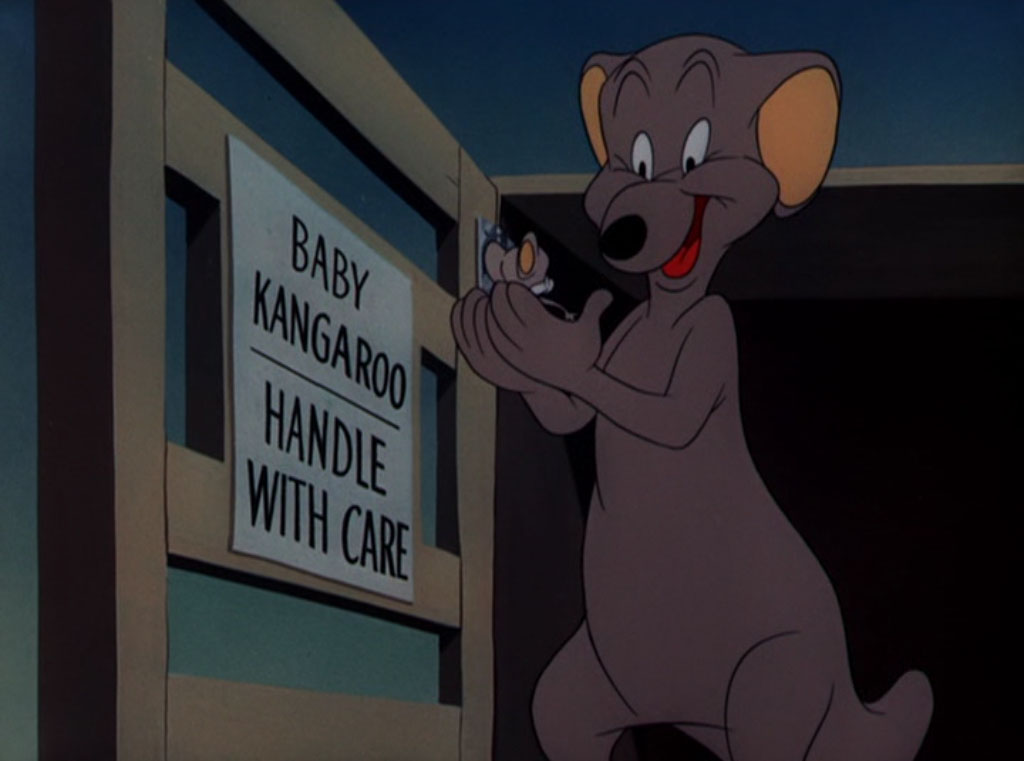 ‘Hippety Hopper’ introduces the kangaroo of the same name, and its only function during its entire career: being mistaken for a mouse.
The cartoon starts gloomily enough, with a misty harbor scene, where a mouse is trying to commit suicide. He’s rescued by Hippety Hopper, however, and together they face the mouse’s terror: Sylvester the cat. The mouse makes Sylvester think he can grow tall, and lets Hippety Hopper beat him out of the house. The best comedy comes from a bulldog who keeps pushing Sylvester back inside.
Hippety Hopper himself is a silent character with a friendly smile and absolutely no personality. He’s easily the least funny recurring star in the Warner Brothers cartoon catalog before the 1960s. Even in this first cartoon his appearance is tiresome. Nevertheless, he would star in twelve other cartoons, lasting even till 1964. The mouse, on the other hand, would disappear after this cartoon. No wonder: he’s designed and animated rather uglily.
Watch ‘Hippety Hopper’ yourself and tell me what you think:
http://www.dailymotion.com/video/x7b04w_merrie-melodies-hippity-hopper-1949_shortfilms
Director: Chuck Jones
Release Date: August 13, 1949
Stars: Charlie Dog, Porky Pig
Rating: ★★★★
Review:
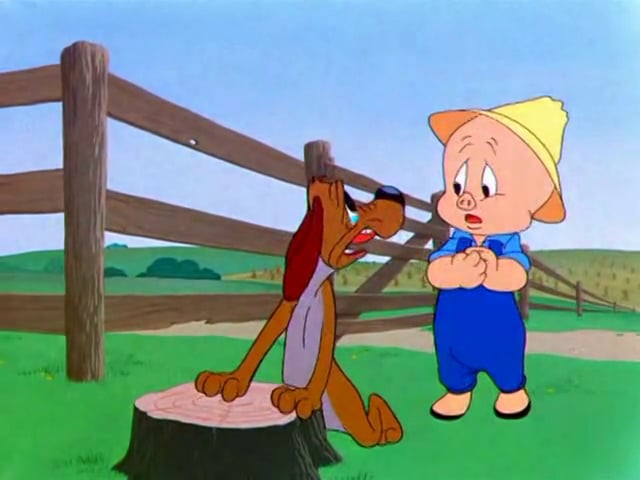 ‘Often an Orphan’ is the third of four cartoons featuring Chuck Jones’s minor cartoon star Charlie Dog.
Of the quartet, this short is probably the best. Left alone at the roadside, Charlie Dog tries to become Porky Pig’s dog again, who now is a farmer in the countryside. At no point Porky is willing to take him in, despite some great acting by the deceitful mutt: highlight of the film is his playing of a weak, sick, nervous wreck, ruined by the terrors of the big city. This is arguably Charlie Dog’s all time best moment. The cartoon ends at the roadside, again, but now it’s Porky who gets left behind.
Watch ‘Often an Orphan’ yourself and tell me what you think:
This is Porky Pig cartoon no. 127
To the previous Porky Pig cartoon: Curtain Raizor
To the next Porky Pig cartoon: Dough for the Do-Do
Directors: Tony Benedict, Gerry Chiniquy, Art Davis, David Detiege & Friz Freleng
Airing Date: April 1, 1980
Stars: Daffy Duck, Foghorn Leghorn, Miss Prissy, Sylvester, Speedy Gonzales
Rating: ★
Review:
 ‘Daffy Duck’s Easter Egg-Citement’ is an Easter-themed Looney Tunes television special produced by DePatie-Freleng.
Unlike Chuck Jones in ‘Bugs Bunny in King Arthur’s Court‘ Friz Freleng doesn’t attempt to tell one long story in the 25 minutes he’s got. Instead, we have three: the first evolves around Miss Prissy, who, in Foghorn Leghorn’s egg farm, lays a golden egg. Daffy and Sylvester find it, and fight eachother for it. This episode contains the only fine piece of animation of the whole special: the depiction of a paranoid Daffy in a car.
In the second episode Daffy is a guard at a chocolate bunny factory, protecting it against Speedy Gonzales, and in the third Daffy tries to go south, trying several options, including a horse. This part reuses the horse from the Pink Panther cartoon ‘Pinto Pink’ (1967) and some of its gags, too.
These stories are framed with Daffy in a very ‘Duck Amuck‘-like setting. Like ‘Bugs Bunny in King Arthur’s Court’ ‘Daffy Duck’s Easter Egg-citement’ suffers from bad designs (especially Foghorn Leghorn, who’s not a Freleng character, is badly drawn), can music, slow timing and excessive dialogue.
Director: Chuck Jones
Airing Date: February 23, 1978
Stars: Bugs Bunny, Daffy Duck, Porky Pig, Elmer Fudd, Yosemite Sam
Rating: ★
Review:
 The Looney Tunes Television Specials were a series of 25 minute long television programs running from 1976 to 1989 and revisiting the classic Warner Brothers characters in all new material. They were produced by either Chuck Jones’ studio or De Patie-Freleng.
‘Bugs Bunny in King Arthur’s Court’ is the fourth within the series, and produced and directed by Chuck Jones. The story is loosely based on Mark Twain’s ‘A Connecticut Yankee in King Arthur’s Court’ from 1889, as Jones readily admits in the opening titles. It features Bugs Bunny as himself, Elmer Fudd as a knight, Daffy Duck as a very unlikely King Arthur, Yosemite Sam as Merlin, and Porky Pig as an anonymous soldier.
Although Jones’s mastery shines through at times, the episode is a sad caricature of the old cartoons. Just nothing seems right. The designs are weak, especially that of Yosemite Sam (not a Jones character), who is too small compared to the others. Moreover, the timing is remarkably slow, and there’s way too much dialogue, slowing down the animation. The gags are further hampered by Dean Elliott’s terrible, partly electronic music. Even Mel Blanc’s voices are poor: his imitation of Arthur Q. Bryan’s voice of Elmer Fudd is nothing like the real thing, and Porky Pig simply stutters too much.
The episode’s trite story is expanded over 24 minutes, while, considering its flaws, it would already have been difficult to remain interesting within seven minutes. The result is a 24 minute long bore. The 1970s were the middle ages of animation, indeed…
Watch ‘Bugs Bunny in King Arthur’s Court’ yourself and tell me what you think:
Director: Friz Freleng
Release date: October 13, 1956
Stars: Sylvester, Elmer Fudd
Rating: ★★★
Review:
 ‘Yankee Dood It’ was the last of three propaganda cartoons Friz Freleng directed for the Alfred P. Sloan Foundation, following the earlier ‘By Word of Mouse‘ (1954) and ‘Heir-Conditioned‘ (1955).
This cartoon is an original take on the famous fable of the shoemaker and the elves. Elve company W is missing, and elven king (Elmer Fudd but smaller and wih pointed ears) is wondering where they are. They turn out to be still helping the old shoemaker.
In order to get the elves back, a little elf and the king tell the old shoemaker how companies work, thus telling the short’s propagandistic message. Unfortunately, the shoemaker’s exclamations of ‘Dear Jehosapath’ turn the elves into mice, much to delight of the cat Sylvester (who appears in all three of these shorts).
‘Yankee Dood It’ is a nice, if rather slow propaganda short that only sees advantages of the capitalistic system: lower prices and higher wages. Possible drawbacks like poverty, monopolization, unemployment and pollution are, of course, wisely left out.
Watch ‘Yankee Dood It’ yourself and tell me what you think:
Director: Friz Freleng
Release date: November 26, 1955
Stars: Sylvester, Elmer Fudd, Tweety (cameo)
Rating: ★★★
Review:
 ‘Heir-Conditioned’ was the second of three propaganda cartoons funded by the Alfred P. Sloan Foundation (the other two being ‘By Word of Mouse‘ from the previous year, and ‘Yankee Dood It‘ from the next year).
In this cartoon Sylvester has inherited a fortune, and all the alley cats try to persuade him to spend it. But Elmer, who’s Sylvester’s financial adviser, persuades Sylvester, and all the listening cats, to invest the money, in a lecture celebrating the capitalistic system, now focusing on the importance of investment. Sylvester remains pretty much the straight man in this cartoon, with most of the comic relief coming from the alley cats.
Watch ‘Heir-Conditioned’ yourself and tell me what you think:
Director: Friz Freleng
Release date: October 2, 1954
Stars: Sylvester
Rating: ★★★
Review:
 In the mid-fifties Friz Freleng directed three propaganda shorts celebrating the American capitalistic system. They were funded by the right wing Alfred P. Sloan Foundation and curiously, they all feature Sylvester the cat.
‘By Word of Mouse’ is the first of the three. In this cartoon we’re taken to the rather backward German town of “Knöckwurst-on-der-Rye”. Here mouse Hans tells his siblings about his trip to America. Cut to his memories: we watch him meeting his cousin Willie at the harbor. Willie takes the astounded Hans to a trip, showing the riches of the Americans. Because Hans doesn’t understand how this can be, Willie takes him to a university mouse, who lectures the two about mass production and mass consumption.
Comic relief is provided by Sylvester, who chases the three mice, interrupting the lectures. But he cannot hide the fact that, although being an ordinary Looney Tune, ‘By Word of Mouse’ is pretty informative, if rather propagandistic by single-mindedly glorifying the wonders of capitalism.
‘By Word of Mouse’ was followed by ‘Heir-Conditioned‘ (1955) and ‘Yankee Dood It‘ (1956), covering similar grounds.
Watch ‘By Word of Mouse’ yourself and tell me what you think:
Director: Chuck Jones
Release date: February 25, 1956
Stars: Bugs Bunny, Witch Hazel
Rating: ★★★
Review:
 ‘Broomstick Bunny’ was the second of three Bugs Bunny cartoons, featuring Witch Hazel, the others being ‘Bewitched Bunny’ (1954) and ‘A Witch’s Tangled Hare’ (1959).
‘Broomstick Bunny’ is a halloween cartoon, in which Bugs Bunny, wearing a witch mask, tries to get trick or treat from Witch Hazel.
Unfortunately, she sees in him a competitor in ugliness. In the end, she drinks her own beautifying potion, turning into a beautiful redhead girl, soon being chased by the genie from her magic mirror. Hazel’s girl image was allegedly modeled after her voice actress, June Foray.
Jones’s animation style becomes close to a mannerism here, with a practically obligatory way to depict Witch Hazel speeding away, leaving numerous hairpins in the air. The cartoon is saved by Ernie Nordli’s extreme layouts and Philip DeGuard’s more than fabulous backgrounds, which belong to the most beautiful of the cartoon modern age.
Watch ‘Broom-stick Bunny’ yourself and tell me what you think:
http://www.ulozto.net/live/x5US9Dz/bugs-bunny-broom-stick-bunny-1956-avi
This is Bugs Bunny cartoon No. 120
To the previous Bugs Bunny cartoon: Bugs’ Bonnets
To the next Bugs Bunny cartoon: Rabbitson Crusoe
Director: Chuck Jones
Release date: August 8, 1955
Stars: Porky Pig, Sylvester
Rating: ★★★★
Review:
 ‘Jumpin’ Jupiter’ was the last of three cartoons in which director Chuck Jones employed Porky Pig, and Sylvester as his frightened cat.
This time they’re camping out when they’re visited by a bird-like alien. The alien takes their complete camping site to outer space. As in the former cartoons, Porky remains completely unaware of what’s happening, while Sylvester sees it all, much to his horror. In the end we see them drive off into the horizon on a strange, strange planet.
‘Jumpin’ Jupiter’ is a beautiful and well animated cartoon, and arguably the most enjoyable of the Porky-Sylvester pairings. The action is helped by Carl Stalling’s particularly inspired music, which matches the science fiction setting perfectly.
Watch ‘Jumpin’ Jupiter’ yourself and tell me what you think:
https://www.dailymotion.com/video/xk2yb4_porky-pig-jumpin-jupiter_tv
This is Porky Pig cartoon no. 145
To the previous Porky Pig cartoon: My Little Duckaroo
To the next Porky Pig cartoon: Dime to Retire
Director: Friz Freleng
Release Date: August 7, 1954
Stars: Tweety & Sylvester
Rating: ★★★★
Review:
 During a chase Sylvester falls down and ceases to be.
He goes straight to hell, where a bulldog-like devil tells him he can return to earth because he has still eight lives left. Unfortunately, back on earth Sylvester loses his lives fast, especially during a chase at a carnival.
‘Satan’s Waitin’ shows some similarities to the Tom & Jerry cartoon ‘Heavenly Puss‘ (1949), including bulldog devils and a heavenly escalator. Nevertheless, it’s one of the most original and most inspired of the Tweety and Sylvester cartoons, on par with the celebrated ‘Birds Anonymous’ from 1957.
Watch ‘Satan’s Waitin’’ yourself and tell me what you think:
http://www.dailymotion.com/video/x1z2hgt_sylvester-the-cat-ep-46-satan-s-waitin_fun
Director: Friz Freleng
Release Date: May 8, 1948
Stars: Bugs Bunny, Yosemite Sam
Rating: ★★★★
Review:
 Already in his third cartoon Yosemite Sam is used outside his original Western setting, and changed into a timeless adversary of Bugs Bunny.
In ‘Buccaneer Bunny’ he’s a 18th century pirate called Seagoin’ Sam. This idea of Sam as a timeless foe was a masterstroke, and in the following years, Sam would be Bugs Bunny’s nemesis in a wide variety of settings, like the American war of independence, the Sahara desert, ancient Rome and the middle ages.
‘Buccaneer Bunny’ is a wonderful start of this series, consisting of wonderful gags, including a beautifully timed multiple door gag. Bugs Bunny also does a great Charles Laughton parody, disguising as captain Bligh, as portrayed by Laughton in ‘Mutiny on the Bounty’ (1935).
Watch ‘Buccaneer Bunny’ yourself and tell me what you think:
https://www.dailymotion.com/video/x5jma78
This is Bugs Bunny cartoon No. 49
To the previous Bugs Bunny cartoon: Rabbit Punch
To the next Bugs Bunny cartoon: Bugs Bunny Rides Again
Director: Robert McKimson
Release Date: July 12, 1947
Stars: Foghorn Leghorn, Henery Hawk, Sylvester
Rating: ★★★½
Review:
 ‘Crowing Pains’ is Foghorn Leghorn’s second cartoon, and it immediately starts where the first (‘Walky Talky Hawky‘, from the previous year) left off: Henery Hawk wants to catch a chicken, and Foghorn Leghorn tricks him by pointing out somebody else as a chicken. This time it’s Sylvester, in an early appearance.
The cartoon is full of Warren Foster-penned nonsense, but the interplay between the four characters (the barnyard dog is also involved) doesn’t develop very well, and seems an early forerunner of the odd pairings of characters of some Warner Brothers cartoons from the 1960s. Unlike those, however, ‘Crowing Pains’ remains an enjoyable cartoon, albeit not among McKimson’s most inspired shorts.
Watch ‘Crowing Pains’ yourself and tell me what you think:
Director: Robert McKimson
Release Date: April 12, 1947
Stars: Daffy Duck
Rating: ★★★
Review:
 Daffy Duck tricks a dog called Leopold with a ‘poisoned bone’ to let him stay at his house during the winter.
Unfortunately, the dog’s owner is an evil scientist (a caricature of Peter Lorre) who happens to be looking for a duck’s wishbone. This leads to a wild chase full of pretty weird gags and off-beat dialogue penned by Warren Foster.
‘Birth of a Nation’ is the second of two Warner Bros. cartoons featuring Peter Lorre as a mad scientist, the other being ‘Hair-Raising Hare’ from 1946. New voice artist Stan Freberg does an excellent job in mimicking and parodying Lorre’s typical voice.
Watch ‘Birth of a Notion’ yourself and tell me what you think:
This is Daffy Duck cartoon No. 36
To the previous Daffy Duck cartoon: The Great Piggy Bank Robbery
To the next Daffy Duck cartoon: Along Came Daffy
‘Birth of a Notion’ is available on the DVD-set ‘Looney Tunes Golden Collection Volume Six’


 Dr. Grob's Animation Review