You are currently browsing the category archive for the ‘Looney Tunes’ category.
Director: Friz Freleng
Release Date: February 24, 1951
Stars: Tweety & Sylvester
Rating: ★★★★
Review:
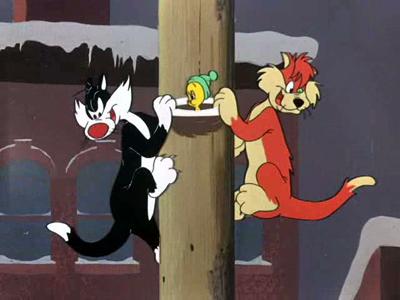 It’s winter and Tweety is troubled by two cats (Sylvester and a red cat with a bad eye), who fight over him. Most of the comedy derives from the feud between the two, and only in the end Tweety himself comes into action, making the two cats fall into an icy pond.
With ‘Putty Tat Trouble’ Freleng returns to Tweety’s first solo films, Bob Clampett’s ‘A Tale of Two Kitties’ (1942) and ‘A Gruesome Twosome‘ (1945), in which also two cats fought for the little bird. Freleng’s humor is different from Bob Clampett’s, but once again, the feud works very well. Apart from Tweety’s talking, all the comedy is silent and brilliantly executed, too. This makes ‘Putty Tat Trouble’ one of the better Tweety and Sylvester cartoons.
In one scene we can see a Friz Freleng portrait in the background.
Watch an excerpt from ‘Putty Tat Trouble’ yourself and tell me what you think:
‘Putty Tat Trouble’ is available on the DVD set ‘Looney Tunes Golden Collection, Vol. 1’
Director: Friz Freleng
Release Date: February 3, 1951
Stars: Sylvester
Rating: ★★★★★
Review:
 In this cartoon Sylvester is the cat of a couple, who go on a holiday to California for two weeks, leaving Sylvester behind and locked indoors.
Sylvester runs into agony when he discovers this, until he finds a kitchen-cupboard full of tins of fish. Unfortunately, a mouse has the can opener. This leads to perfectly timed blackout gags, in which Sylvester makes several attempts to get the can opener. When he finally succeeds, he discovers that the particular cupboard is locked, while the mouse has the key.
Due to its cat-and-mouse-routine ‘Canned Feud’ has similarities to the Tom & Jerry cartoons, although it has a distinct Friz Freleng style. Unlike Jerry, the mouse is completely blank, and its motives remain unclear, but Freleng’s comedy works nonetheless. In fact, this film is better than most contemporary Tweety and Sylvester cartoons.
Watch ‘Canned Feud’ yourself and tell me what you think:
Director: Friz Freleng
Release Date: June 24, 1950
Stars: Tweety & Sylvester
Rating: ★
Review:
 ‘All a Bir-r-r-d’ is Tweety and Sylvester’s fourth cartoon and in this short their chase takes place in the baggage wagon of a train. Sylvester’s pursuit is extra hindered by a train conductor and a vicious bulldog.
‘All Abir-r-rd’ is a rather formulaic chase cartoon, and in no way among Tweety & Sylvester’s best. It is noteworthy however, for introducing Tweety’s theme song, sung, off course, by Tweety himself.
Watch ‘All a Bir-r-r-d’ yourself and tell me what you think:
http://www.dailymotion.com/video/x1z21n9_sylvester-the-cat-ep-18-all-a-bir-r-r-d_fun
Director: Chuck Jones
Release Date: July 8, 1950
Stars: Bugs Bunny, Humphrey Bogart
Rating: ★★½
Review:
 Bugs re-encounters the little penguin form ‘Frigid Hare‘ (1949), complete with the top hat and bow tie he gave him in that cartoon.
He promises the tacit little fellow to bring him home, which Bugs thinks is on the South Pole. This leads to a long voyage across the Americas, including Martinique, Panama and the Amazon. At several places they meet Humphrey Bogart begging for some money, a reference to his role in ‘The Treasure of the Sierra Madre’ (1948). This running gag may be the highlight of an otherwise tiresome and unfunny cartoon.
Watch ‘8 Ball Bunny’ yourself and tell me what you think:
This is Bugs Bunny cartoon No. 73
To the previous Bugs Bunny cartoon: What’s Up, Doc?
To the next Bugs Bunny cartoon: Hillbilly Hare
Director: Robert McKimson
Release Date: August 6, 1949
Stars: Bugs Bunny
Rating: ★★★
Review:
 Bugs Bunny is at the dog races , where he falls in love with the mechanical bunny leading the dogs.
Bugs disposes of the dogs, having a hard time on number seven. But when he can finally kiss his sweetheart, the results are electrifying!
‘The Greyhounded Hare’ shows some of the flaws that were creeping into the McKimson cartoons around this time: there is a lot of excess animation, especially on Bugs Bunny; but worse, there is a surplus of dialogue, even though Bugs Bunny is the only talking character. Unfortunately, this leads to a cartoon in which the idea is sillier than its execution, despite a short Tex Averyan doubletake and another surprisingly Tex Averyan dynamite gag.
Watch ‘The Grey Hounded Hare’ yourself and tell me what you think:
http://www.dailymotion.com/video/x19d399_the-grey-hounded-hare_fun
This is Bugs Bunny cartoon No. 63
To the previous Bugs Bunny cartoon: Knights Must Fall
To the next Bugs Bunny cartoon: The Windblown Hare
Director: Chuck Jones
Release Date: February 26, 1949
Stars: Bugs Bunny
Rating: ★★★★★
Review:
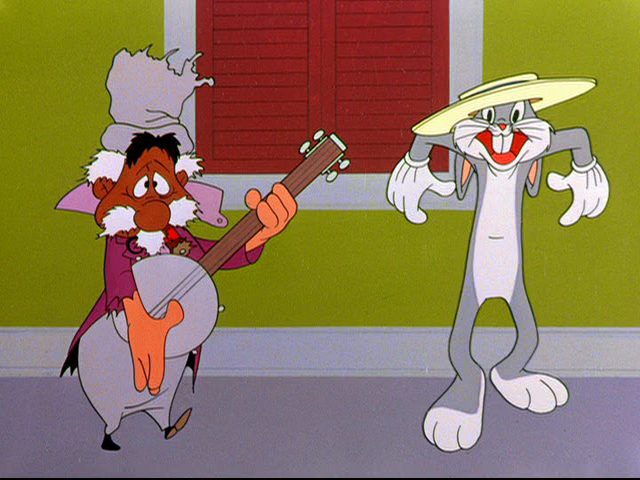 In ‘Mississippi Hare’ Bugs Bunny accidentally ends up at a Mississippi steamer, where he encounters colonel Shuffle, a small moustached Southerner who resembles Friz Freleng’s Yosemite Sam a lot.
Like Yosemite Sam, the colonel keeps taking the plunge, in an excellent series of gags. Bugs Bunny is particularly suave in this cartoon, and so are the backgrounds. But the highlight of the cartoon may be the superb and intoxicating animation of Bugs Bunny dancing with a straw hat.
The colonel would return to the screen the next year in the Charlie Dog cartoon ‘Dog Gone South’.
Watch ‘Mississippi Hare’ yourself and tell me what you think:
http://www.dailymotion.com/video/x2kytjz
This is Bugs Bunny cartoon No. 57
To the previous Bugs Bunny cartoon: Hare Do
To the next Bugs Bunny cartoon: Rebel Rabbit
Director: Robert McKimson
Release Date: March 26, 1949
Stars: Daffy Duck, Porky Pig
Rating: ★★★★★
Review:
 With ‘Daffy Duck Hunt’ Robert McKimson returned to the subject of Daffy’s very first cartoon, ‘Porky’s Duck Hunt’ (1937).
Like in the original cartoon Porky Pig is hunting ducks, and Daffy in particular, to no avail. He’s now accompanied by a dog (a typical McKimson design). To trick Daffy, the dog convinces Daffy that he will be tortured if he doesn’t retrieve a duck, so Daffy allows the Dog to take him to Porky. Porky takes Daffy back home and puts him into a particularly cold fridge. From now on almost all the action takes place around the fridge in a wonderfully loony cartoon (penned by Warren Foster) full of wild gags and zany animation.
‘Daffy Duck Hunt’ is one of those Warren Foster/Robert McKimson cartoons that celebrate Daffy’s looniness perfectly. Highlight is a gag in which Daffy jumps out of the fridge in a Santa suit making Porky and the dog believe it’s Christmas. This gag is a nice and equally hilarious variation on a classic gag from Freleng’s ‘The Wabbit Who Came to Supper’ from 1942, in which Bugs Bunny made Elmer believe it’s new year’s day.
Watch ‘Daffy Duck Hunt’ yourself and tell me what you think:
http://www.dailymotion.com/video/x3tb1w8
This is Porky Pig cartoon no. 125
To the previous Porky Pig cartoon: Paying the Piper
To the next Porky Pig cartoon: Curtain Raizor
This is Daffy Duck cartoon No. 49
To the previous Daffy Duck cartoon: Holiday for Drumsticks
To the next Daffy Duck cartoon: Boobs in the Woods
‘Daffy Duck Hunt’ is available on the DVD-set ‘Looney Tunes Golden Collection Volume One’
Director: Chuck Jones
Release Date: March 4, 1950
Stars: Daffy Duck, Elmer Fudd, Henery Hawk, Mama Bear, Porky Pig, Sylvester
Rating: ★★★★★ ♕
Review:
 ‘The Scarlet Pumpernickel’ starts with Daffy Duck being tired of comedy.
He proposes to one of the Warner Brothers (who remains off-screen) to make an Errol Flynn-like swashbuckler film based on ‘The Scarlet Pumpernickel by Daffy Dumas Duck’, with, of course, himself in the starring role. This leads to an all-star cartoon with roles for Porky Pig, Sylvester, Elmer Fudd (with Mel Blanc’s voice), Henery Hawk and Mama Bear. Never before were so many Warner Bros. cartoon stars seen in one short, and we had to wait until ‘Who Framed Roger Rabbit‘ (1988) to see the exercise repeated.
‘The Scarlet Pumpernickel’ is both an excellent parody on and a faithful homage to the Errol Flynn adventure films. But more importantly, this short is important in the evolution of Daffy Duck, for it marks the birth of Daffy’s final incarnation. In this film Daffy is more of a frustrated and misguided character than downright loony. This new role is still a bit out of Daffy’s element: at times his eyes and behavior are similar to that of Charlie Dog, especially in the opening scene. Nevertheless, in the following years the frustrated Daffy would completely replace the loony one.
‘The Scarlet Pumpernickel’ is also the first of Jones’s Daffy cartoons in which Daffy serves as a misguided hero, starting a great series of shorts, with highlights as ‘Drip-along Daffy‘ (1951) and ‘Duck Dodgers in the 24 ½ Century‘ (1953).
Watch ‘The Scarlet Pumpernickel’ yourself and tell me what you think:
http://www.220.ro/desene-animate/20-Daffy-Duck-Sylvester-The-Scarlet-Pumpernickel-1950/KJRkZjBcaE/
This is Porky Pig cartoon no. 131
To the previous Porky Pig cartoon: Boobs in the Woods
To the next Porky Pig cartoon: An Egg Scramble
This is Daffy Duck cartoon No. 51
To the previous Daffy Duck cartoon: Boobs in the Woods
To the next Daffy Duck cartoon: The Bitter Half
‘Boobs in the Woods’ is available on the DVD-set ‘Looney Tunes Golden Collection Volume One’
Director: Robert McKimson
Release Date: August 7, 1950
Stars: Porky Pig, Daffy Duck
Rating: ★★★★
Review:
 In ‘Boobs in the Woods’ Porky wants to paint in a forest, but he’s bothered by a particularly loony Daffy.
This cartoon is a typical example of Warren Foster-penned zaniness. Daffy makes no mistake about his zany character, which is similar to the one in the Foster/McKimson outings, like ‘Daffy Doodles’ (1946), ‘Daffy Duck Slept Here‘ (1948) and ‘Daffy Duck Hunt‘ (1949): in the opening scene he introduces himself in a loony song.
Nevertheless, ‘Boobs in the Woods’ is one of the last cartoons featuring this loony version of Daffy. Two months later Jones would introduce a different type in ‘The Scarlet Pumpernickel‘.
Apart from the excellent gags, ‘Boobs in the Woods’ is noteworthy for its extremely stylized and surprisingly flat backgrounds by Cornett Wood and Richard H. Thomas.
Watch ‘Boobs in the Woods’ yourself and tell me what you think:
https://www.dailymotion.com/video/x6egzhi
This is Porky Pig cartoon no. 130
To the previous Porky Pig cartoon: Bye, Bye Bluebeard
To the next Porky Pig cartoon: The Scarlet Pumpernickel
This is Daffy Duck cartoon No. 50
To the previous Daffy Duck cartoon: Daffy Duck Hunt
To the next Daffy Duck cartoon: The Scarlet Pumpernickel
‘Boobs in the Woods’ is available on the DVD-set ‘Looney Tunes Golden Collection Volume One’
Director: Art Davis
Release Date: February 12, 1949
Stars: Porky Pig
Rating: ★★½
Review:
 In ‘Porky Chops’ a squirrel from Brooklyn is having a holiday in a forest where Porky is working as a lumberjack.
This outlandish idea creates a rather routinely conflict with loads of dialogue. The result is one of Art Davis’s weaker cartoons, particularly because of the squirrel’s rather unpleasant character. This makes it difficult to sympathize with either protagonist.
The cartoon shows an interesting mixture of styles: the squirrel looks vaguely like a Robert McKimson-character, while Porky is designed and animated in a toned-down Clampettian style.
Watch ‘Porky Chops’ yourself and tell me what you think:
http://www.supercartoons.net/cartoon/650/porky-chops.html#.URQKvKU9R8E
‘Porky Chops’ is available on the DVD set ‘Looney Tunes Golden Collection, Vol. 1’
This is Porky Pig cartoon no. 123
To the previous Porky Pig cartoon: Awful Orphan
To the next Porky Pig cartoon: Paying the Piper
Director: Chuck Jones
Release Date: July 24, 1948
Stars: Bugs Bunny, Marvin the Martian
Rating: ★★★★
Review:
 ‘Haredevil Hare’ Bugs opens with two headlines of the ‘Daily Snooze’: ‘Scientist to Launch First Rocket to the Moon’ and ‘Heroic Rabbit Volunteers to Be First Passenger’.
Cut to Bugs Bunny ‘volunteering’ (he’s literally dragged towards the spaceship by two men). Bugs changes his mind however, when he notices the supply of carrots dumped into the rocket. And so he’s off to the moon.
Bugs has a hard landing on the moon, which destroys his vesssel and leaves him in shock. But just when he’s adjusted to the fact that he’s alone on the moon, Bugs encounters Marvin the Martian (in his first screen appearance) and his green, talking Martian dog, who is designed like a green version of Charlie Dog and who speaks with the dumb voice of Junior Bear, provided by voice actor Stan Freberg.
The two Martians are on the first Mars-Moon expedition and want to blow up the Earth. But it’s Bugs who blows up the two and accidentally half the moon, too. In the end we see the three hanging on the left piece of the moon with bugs screaming to the control room: “Get me outa here!”.
‘Haredevil Hare’ is one of the first science fiction-themed films that flooded the post-war era. It even predates the first post-war live action features set in outer space, ‘Rocketship X-M’ and ‘Destination Moon’ by two years. In the 1950s outer space would become a popular film setting. Indeed, Chuck Jones himself would revisit outer space several times in his cartoons, most notably in ‘Jumpin’ Jupiter‘ (1955), ‘Rocket Squad’ (1956), and the greatest of all science fiction cartoons, ‘Duck Dodgers in the 24½th Century‘ (1953).
The latter cartoon also features Marvin the Martian, who would reappear in three more Bugs Bunny cartoons: ‘The Hasty Hare’ (1951), ‘Hare-Way to the Stars’ (1958) and ‘Mad as a Mars Hare’ (1963). Of all cartoon villains, Marvin the Martian is the most extraordinary. He’s as gentle, polite and mild-mannered as he is destructive. Although he would never become a major star, he’s still popular today.
Apart from introducing Marvin, ‘Haredevil Hare’ is a notable cartoon because of some nice and weird animation by Ben Washam of Bugs being a nervous wreck after his voyage to the moon: we watch him changing from one bizarre pose into the other, almost without any animation in between. The scenes inside the rocket scene are reminiscent of Bob Clampett’s ‘Falling Hare’ (1943).
Watch ‘Haredevil Hare’ yourself and tell me what you think:
http://www.supercartoons.net/cartoon/661/haredevil-hare.html
‘Haredevil Hare’ is available on the DVD set ‘Looney Tunes Golden Collection, Vol. 1’
This is Bugs Bunny cartoon No. 51
To the previous Bugs Bunny cartoon: Bugs Bunny Rides Again
To the next Bugs Bunny cartoon: Hot Cross Bunny
Director: Chuck Jones
Release Date: April 23, 1949
Stars: Claude Cat, Hubie and Bertie
Rating: ★★★★★ ♕
Review:
 Mouse Wreckers’ is one of Chuck Jones’s all time classic cartoons.
Hubie and Bertie have found a new home, which unfortunately is inhabited by a prize-winning mouse chasing cat, Claude (in his debut). But Hubie and Bertie succeed to chase the cat out of the house by turning him into a nervous wreck. Hubie and Bertie angle themselves through the chimney to evoke the cat’s doom. After several gags, ending with one using an upside down room, the cat, who never knew what was going on, flees the house in horror, leaving it for Hubie and Bertie to roast marshmellows at the fire.
‘Mouse Wreckers’ features some minor stars from the Chuck Jones vault, but its character comedy is brilliant nonetheless. The character animation of Claude Cat trying to deal with his supposed hallucinations is wonderfully well done, and his steady decline into madness is both hilarious and chilling to watch.
Fifteen years later Chuck Jones and Michael Maltese would reuse this story idea in their Tom and Jerry cartoon ‘The Year of the Mouse’ (1965).
Watch ‘Mouse Wreckers’ yourself and tell me what you think:
Director: Art Davis
Release Date: October 21, 1949
Stars: Porky Pig
Rating: ★★½
Review:
 Porky tries to get rid of an annoying mouse.
When it’s announced on the radio that brutal killer Bluebeard is in town, the mouse disguises as the criminal. Porky quickly discovers his disguise however, but then the real killer shows up, too. Porky faints on the spot, and is tight to a rocket and put under a guillotine. It’s the little mouse who saves the day by blowing up the killer, and in the end he’s allowed to stay in Porky’s house.
This story is not presented very logically, nor is it very well executed. Therefore, one doesn’t care for the characters, nor is it very funny. Art Davis definitely could do better, but unfortunately this was his last cartoon at Warner Brothers. He would not direct again until 1962, when he directed the Daffy Duck short ‘Quackodile Tears’. In the meantime Davis returned to animating, joining Friz Freleng’s unit.
Watch ‘Bye, Bye Bluebeard’ yourself and tell me what you think:
http://www.220.ro/desene-animate/10-Bye-Bye-Bluebeard/2Z9yE6bPnU/
This is Porky Pig cartoon no. 129
To the previous Porky Pig cartoon: Dough for the Do-Do
To the next Porky Pig cartoon: Boobs in the Woods
Director: Robert McKimson
Release Date: August 27, 1949
Stars: Bugs Bunny
Rating: ★★★★★
Review:
 The three pigs sell their straw and wooden houses to Bugs Bunny, because they’ve read in a book what’s going to happen.
The wolf, who’s reading the same book, indeed blows both houses down, to much dismay of Bugs. Bugs revenges by dressing up like Red Riding Hood. This leads to hilarious sequences, including a perfectly executed light and staircase gag. In the end, Bugs helps the wolf blowing the pigs’ brick house down, by blowing it up.
‘The Windblown Hare’ is a nice example of a fairy tale mix-up cartoon, comparable to ‘The Big Bad Wolf‘ (1934), ‘The Bear’s Tale’ (1940) and ‘Swing Shift Cinderella’ (1945). It is hampered a little by large amounts of dialogue, but it still has plenty of silliness to laugh at.
Watch ‘The Windblown Hare’ yourself and tell me what you think:
http://www.dailymotion.com/video/x2nfts9
This is Bugs Bunny cartoon No. 64
To the previous Bugs Bunny cartoon: The Grey Hounded Hare
To the next Bugs Bunny cartoon: Frigid Hare
Director: Chuck Jones
Release Date: November 12, 1949
Stars: Pepe le Pew
Rating: ★★★★
Review:
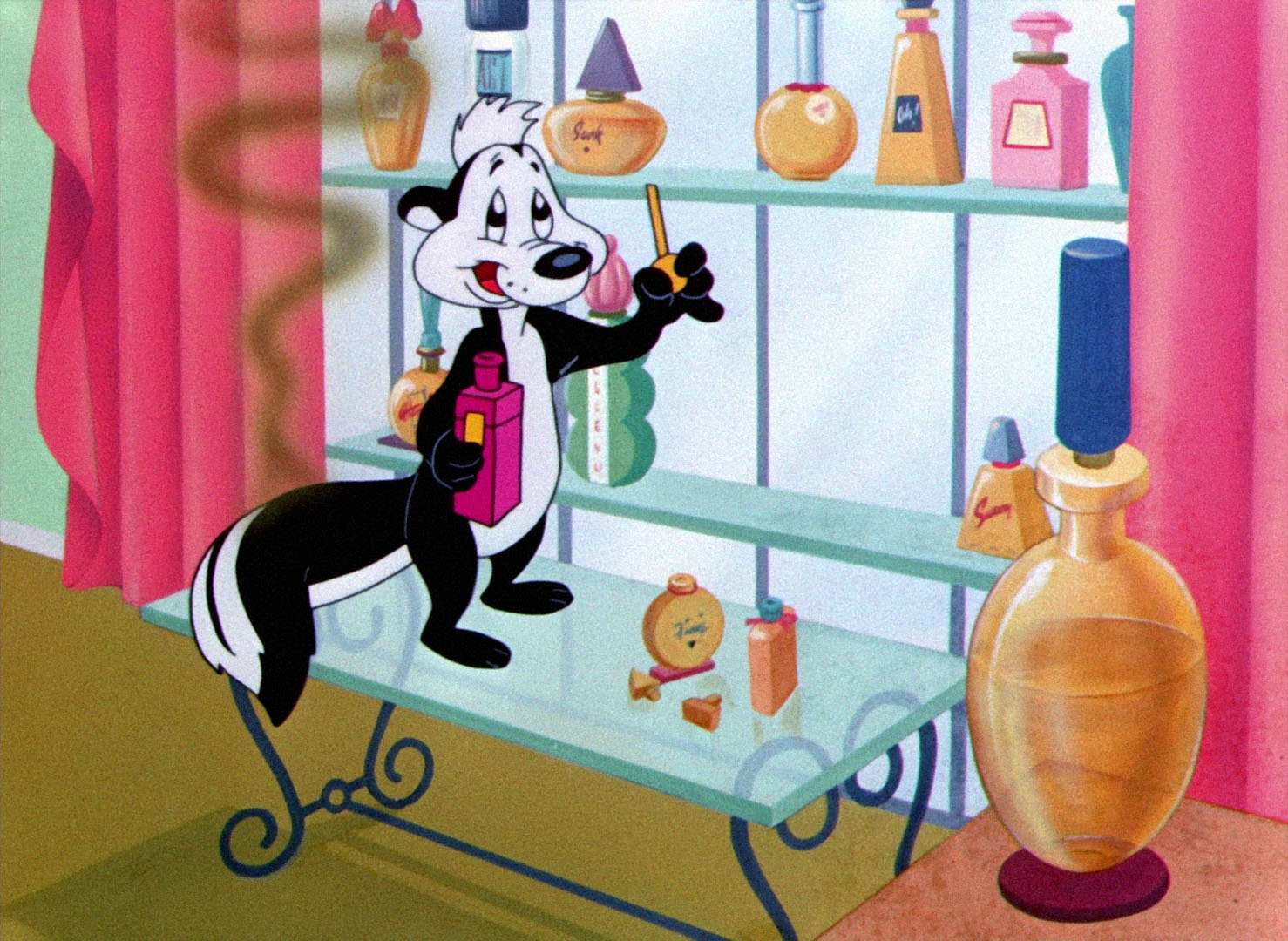 ‘For Scent-imental Reasons’ is the fourth Pepe Le Pew cartoon, and one of his best.
In this short a French perfume shop owner discovers Pepe le Pew in his shop and throws in his female cat to chase away our romantic skunk. Of course, she accidentally gets a white stripe on her back and she’s chased by the smelly Latin lover. But when Pepe accidentally falls into a barrel of blue paint, the tables are turned and he’s chased by the cat.
This short features an excellent scene of Pepe arguing with the cat through a glass window in silent pantomime.
Watch ‘For Scent-imental Reasons’ yourself and tell me what you think:
‘For Scent-imental Reasons’ is available on the DVD set ‘Looney Tunes Golden Collection, Vol. 1’ and ‘Warner Bros. Home Entertainment Academy Awards Animation Collection: 15 winners’
Director: Robert McKimson
Release Date: October 14, 1949
Rating: ★★★★
Review:
 At the San Juan Capistrano mission a cat is waiting for the swallows to return. Unfortunately, the swallows have sent a scout who is too clever for him.
This cartoon contains of several blackout gags, and, unusual for a Robert McKimson cartoon, practically no dialogue. Actually, the cartoon is reminiscent of the silent blackout gag comedy of the Road Runner series, which were introduced only one month earlier. ‘Swallow The Leader’ may be atypical for McKimson, it’s well-directed,with the gags coming in fast and well-timed.
The mission featured does really exists and is indeed famous for its nesting swallows. The cat is a typical McKimson design, and very reminiscent of the Supreem Cat in ‘Paying the Piper’ from earlier that year. Typically, he wears a collar, which makes him look like a forerunner of the standard Hanna-Barbera television studio design.
Director: Chuck Jones
Release Date: June 25, 1949
Stars: Bugs Bunny
Rating: ★★★★★
Review:
 Bugs Bunny is singing nearby a villa, where a huge opera singer, called Giovanni Jones, is practicing.
The singer is heavily disturbed by Bugs’s performance and without arguing destroys our hero’s banjo, his harp and his tuba. Only then Bugs is prompted into war, which he reserves for the opera singer’s concert at the Hollywood Bowl.
What follows are great blackout gags featuring a string of opera tunes, with Bugs as ‘Leopold’ as a major highlight. This impersonation is an obvious reference to star conductor Leopold Stokowski, famous for conducting ‘Fantasia’ (1940). Bugs destroys the conductor’s baton, to direct with his hands only, like Stokowski does. From now on he controls the singer almost like a puppeteer. Bugs finally destroys his opponent by making him sing a ridiculously long high note, which tears the complete bowl down.
With cartoons like ‘Long-Haired Hare’ director Chuck Jones really came into his own: it shows Jones’ attitude to Bugs Bunny, who, in Jones’s cartoons, is only a misschief when provoked. Giovanni Jones is one of Bugs Bunny’s particularly large adversaries, following The Crusher (‘Rabbit Punch‘, 1948), and the warehouse manager in ‘Hare Conditioned‘ (1945).
‘Long-Haired Hare’ also shows Jones’ love for high culture, like opera. For instance, we can clearly detect a painting by Roussau le douanier decorating the opera singer’s villa. Jones’s love for opera would lead to two of his most famous and best cartoons, ‘The Rabbit of Seville‘ (1950) and ‘What’s Opera, doc?‘ (1958), which also feature Bugs Bunny.
In 1950, the Hollywood Bowl would be visited by cartoon characters again, when Tom & Jerry both tried to conduct in ‘Tom and Jerry in the Hollywood Bowl‘.
Watch ‘Long-Haired Hare’ yourself and tell me what you think:
http://www.dailymotion.com/video/x2fdnv1
This is Bugs Bunny cartoon No. 61
To the previous Bugs Bunny cartoon: Bowery Bugs
To the next Bugs Bunny cartoon: Knights Must Fall
Director: Friz Freleng
Release Date: April 30, 1949
Stars: Bugs Bunny, Yosemite Sam
Rating: ★★★★★ ♕
Review:
 Bugs is presenting a vaudeville show in some western town.
Yosemite Sam especially visits his show to see the high diving Fearless Freep. Unfortunately, Freep is delayed by a storm and can’t come to perform. The disappointed Sam urges Bugs to take Freep’s place.
What follows is a masterful series of gags, which all end with Sam falling from the ridiculously high platform. At one point Freleng doesn’t even bother to point out how Bugs makes Sam take the plunge once again. As if it’s a natural law, Sam will fall anyway. Bugs, on the other hand, defies the law of the gravity. But you know, he tells us at the end, he never studied law…
Penned by storyman Tedd Pierce, this wonderfully hilarious cartoon takes a single idea from Freleng’s earlier ‘Stage Door Cartoon‘ (1944) and milks it brilliantly to a superb finale. Freleng’s timing rarely was so effective as in this cartoon, and it must rank among his all time best.
Watch ‘High Diving Hare’ yourself and tell me what you think:
http://www.dailymotion.com/video/x2bdtkf_bugs-bunny-ep-73-high-diving-hare_fun
‘High Diving Hare’ is available on the DVD set ‘Looney Tunes Golden Collection, Vol. 1’
This is Bugs Bunny cartoon No. 59
To the previous Bugs Bunny cartoon: Rebel Rabbit
To the next Bugs Bunny cartoon: Bowery Bugs
Director: Friz Freleng
Release Date: February 2, 1946
Stars: Bugs Bunny
Rating: ★★★★★
Review:
 It seems an almost certain loss for the age-old Tea-Totallers, who get plastered by the tough team of the Gas-House Gorillas…
Bugs Bunny, who’s watching the game, wearing an innocent straw head, boasts that he can beat the Gas-House Gorillas single-handed, so he gets himself a game. Playing in every position he manages to win the ball game in this wild and hilariously funny cartoon, which is noteworthy for its great dialogue, excellent animation, and superb timing. Especially when Bugs Bunny starts batting, the gags role in in a remarkably fast tempo.
Highlight among the many gags may be Bugs’s constant jabbering. Some of it was copied by Jones in ‘Rabbit Punch‘ (1948). ‘Baseball Bugs’ reuses several gags from the Woody Woodpecker cartoon ‘The Screwball’ (1942), but with much better results, making it a classic, where ‘The Screwball’ was not. If the short has one flaw, it’s that it’s over before you know it, with the end coming all too soon.
Notice the advert for ‘Michael Maltese, Ace Dick’ in Bugs Bunny’s first scene.
Watch ‘Baseball Bugs’ yourself and tell me what you think:
https://www.dailymotion.com/video/x6tj0co
‘Baseball Bugs’ is available on the DVD set ‘Looney Tunes Golden Collection, Vol. 1’
This is Bugs Bunny cartoon No. 35
To the previous Bugs Bunny cartoon: Hare Tonic
To the next Bugs Bunny cartoon: Hare Remover
Director: Bob Clampett
Release Date: October 5, 1946
Stars: Bugs Bunny, Elmer Fudd
Rating: ★★★★½
Review:
 ‘The Big Snooze’ (a pun on the Bacall-Bogart vehicle ‘The Big Sleep’) opens with Elmer quitting after a short chase routine involving a tree trunk on a cliff.
He tears his contract with Warner apart and decides to enter a career of fishing only ‘and no more wabbits!’. When he rests at the riverside, Bugs enters his serene dream to create a nightmare. This involves e.g. nightmare paint, rendering Elmer in Adam’s costume, making a girl out of him, followed by wolves and a great fall, which typically ends the nightmare. At the end Elmer returns to the scene, reassembling the contract and ready for another routine with the tree.
‘The Big Snooze’ is one of those great cartoons that play with their characters as being real stars (others being the Mickey Mouse cartoon ‘Mickey’s Gala Premier’ (1933), the Donald Duck cartoon ‘The Autograph Hound‘ (1939) and ‘You Ought to Be in Pictures’ (1940, starring Porky and Daffy).
The opening scene was taken from Tex Avery’s ‘All This and Rabbit Stew’ (1941), with Elmer replacing the original black caricature. The rest of the film has a disjointed feel, and features weird cuts and odd cinematographic choices. For example, when Elmer tears up the contract, this is shown in five different shots, following each other in rapid succession: 1) a medium shot of Elmer tearing up the contract, 2) a close-up of only his hands tearing, 3) a close-up of the paper snippets flying into the air above Elmer’s head, who’s hardly seen in this shot, 4) a very strange perspective shot of Elmer smashing the contract into the camera, and 5) a close-up of his boots stamping on what remains of the paper.
Another noteworthy scene is when Bugs Bunny is ‘multiplying’: in this scene Elmer is the only traditionally looking character, placed on a black canvas, overrun by rabbits, only drawn in red, yellow and pink outlines and mixing with the green outlines of some plants. This short scene is a startling piece of early cartoon modernism, and looks forward to the work of the UPA studio in the 1950s. On the other hand, the gag in which Bugs pulls away a hole harks all the way back to the Mickey Mouse cartoon ‘The Picnic‘ (1930).
Bugs sings excerpts from three songs in this short: ‘Beautiful Dreamer’, ‘Someone’s Rocking My Dreamboat’ and ‘September in the Rain’.
The Big Snooze’ was to be Bob Clampett’s last cartoon at Warner Bros. He was fired before he could finish it, and the short was completed by Art Davis, who succeeded him as a director. The film’s look and feel is still that of the war era, while contemporary cartoons by Chuck Jones and Friz Freleng show the studio was heading into other directions, with milder humor and more sophisticated designs. In contrast, in ‘The Big Snooze’ Clampett’s animation style is extremely flexible, as usual for him, and his backgrounds are as vague as ever.
‘The Big Snooze’ is a hilarious cartoon that marks the end of an era, where the wildest and the zaniest gags were possible. Only Tex Avery at MGM would continue the extreme style. Bob Clampett left Warner Bros. in May 1945 to join the Screen Gems studio. He was succeeded by Art Davis, who would direct some great cartoons until his unit was closed down in 1949.
In the years following Clampett’s leave, his zany style was continued for a while by his master animator Robert McKimson, who had been promoted to director only a few months earlier. However, McKimson soon toned down both animation and humor, and he would never achieve the same level of originality as Bob Clampett did during his Warner Bros. days.
Watch ‘The Big Snooze’ yourself and tell me what you think:
https://www.dailymotion.com/video/x6n3yac
This is Bugs Bunny cartoon No. 40
To the previous Bugs Bunny cartoon: Racketeer Rabbit
To the next Bugs Bunny cartoon: Rhapsody Rabbit
‘The Big Snooze’ is available on the DVD-set ‘Looney Tunes Golden Collection Volume Two’


 Dr. Grob's Animation Review