Director: Dave Fleischer
Release Date: April 7, 1939
Stars: Popeye, Olive Oyl
Rating:  ★★★★
Review:

Aladdin and his Wonderful Lamp © Max Fleischer‘Aladdin and his Wonderful Lamp’ is the last of three Popeye two-reelers in Technicolor.

Like ‘Popeye the Sailor Meets Sindbad the Sailor’ (1936) and ‘Popeye the Sailor meets Ali Baba’s Forty Thieves’ (1937) the short has a clear 1001 Arabian Nights setting. In fact, it’s a rather faithful retelling of the classic fairy tale, until Spinach comes along. Unlike the earlier two-reelers ‘Aladdin and his Wonderful Lamp’ doesn’t either feature Fleischer’s table-top technique, Wimpy or Bluto, with an anonymous villain taking Bluto’s place.

The film is introduced as being a script Olive is writing for ‘Surprise Pictures’, and, of course, she herself stars as the princess. It’s the first scene in which we can hear Margie Hines as Olive Oyl’s voice. Hines had replaced Mae Questel, who didn’t make the move to Miami together with the rest of the Fleischer studio. Margie Hines would remain Olive’s voice until the end of 1943, after which Mae Questel picked it up again.

‘Aladdin and his Wonderful Lamp’ is wonderfully made. Its background art is no less than gorgeous, and some of the animation is outstanding, for example that on Popeye’s horse. The final battle is a delight, when Popeye uses cans of spinach as his own magic against the magic of the lamp, now in the villain’s hands.

The film contains a novelty: in the cave scene and in the scene in which Popeye parades the streets as a prince, he suddenly has eyes with pupils, foreshadowing his design of the Paramount studio years.

Watch ‘Aladdin and his Wonderful Lamp’ yourself and tell me what you think:

This Popeye film No. 69
To the previous Popeye film: Customers Wanted
To the next Popeye film: Leave Well Enough Alone

‘Aladdin and his Wonderful Lamp’ is available on the DVD Set ‘Popeye the Sailor Volume Two’

Director: Dave Fleischer
Release Date: January 27, 1939
Stars: Popeye, Bluto, Wimpy
Rating:  ★★★★
Review:

Customers Wanted © Max FleischerIn 1937 the Fleischer Studio suffered a severe strike. In 1938 they moved their studios to Miami, Florida to break up union activity, and because of the state’s more favorable financial climate.

The new studio opened in October 1938, and devoted a lot of its resources to the Fleischer’s first feature film, ‘Gulliver’, which was released at the end of 1939.

The move to Florida had several consequences for the Popeye series: as the studio’s top animators now worked on ‘Gulliver’, the series was laid in hands of some lesser men, and this shows in many 1939 Popeye cartoons. More importantly, there were some voice changes: Mae Questel and Gus Wickie (Bluto’s voice) had stayed behind in New York, so Olive’s voice was taken over by Margie Hines, who would do her voice until the end of 1943. Bluto’s voice was now done by Pinto Colvig, whom the Fleischers had hired away from Disney. Jack Mercer, Popeye’s voice, got along very well with Margie Hines – in fact the two were married on March 8, 1939.

The move may have had a particular impact on ‘Customers Wanted’, for this cartoon is a ‘cheater’: it only partially features new material, some scenes are reused from two earlier Popeye cartoons, albeit in the most natural way.

‘In ‘Customers Wanted’ Popeye and Bluto as competing arcade owners at a Coney Island-like amusement park. They’re both out of customers, and dive on Wimpy, when he seems interested.

The competing entrepreneurs are so eager to show Wimpy their films on their mutoscopes, they don’t even charge him money. The mutoscope films are excerpts from ‘Let’s Get Movin” (1936) and ‘The Twisker Pitcher’ (1937). Soon, however, Bluto’s and Popeye’s competition turns into a fight, and it’s Wimpy who cashes in by advertising their row as ‘the fight of the century”.

‘Customers Wanted’ is an early compilation cartoon, but a very entertaining one. Bluto’s and Popeye’s tricks to lure Wimpy away from the competition are delightful, and so are the voices. The amusement park itself is beautifully designed, and is reminiscent of the futuristic fair of ‘All’s Fair at the Fair‘ (1938).

Watch ‘Customers Wanted’ yourself and tell me what you think:

This Popeye film No. 68
To the previous Popeye film: Cops Is always Right
To the next Popeye film: Aladdin and His Wonderful Lamp

‘Customers Wanted’ is available on the DVD Set ‘Popeye the Sailor Volume Two’

Gijs Grob with his book Mickey's MoviesMy own copies of my book ‘Mickey’s Movies – The Theatrical Films of Mickey Mouse‘, recently published by Theme Park Press, have arrived this week! I’m very happy to be see the book in reality.

Meanwhile esteemed Disney historian Didier Ghez has written the first review on my book on his Disney History Blog. Ghez writes:

“I just received my personal copy of Mickey’s Movies by Gijs Grob. I absolutely love this book. Gijs discusses all of Mickey’s shorts and his insights are absolutely fascinating.

To be read in small installments. A “must have” for Mickey enthusiasts.”

You can buy the book on Amazon. There is both a paperback and a Kindle edition. I hope you’ll enjoy it! And if you’ve already grabbed a copy: 1) thanks! and 2) I’d love it if you could review the book on Amazon.


Director: Dave Fleischer
Release Date: June 9, 1939
Stars: Betty Boop, Pudgy
Rating:  ★
Review:

The Scared Crows © Max FleischerIn the opening scene of ‘The Scared Crows’ we watch Betty and Pudgy planting seeds, which are immediately eaten by crows.

Betty chases them away using a scarecrow, but one flies against a tree, and Betty takes the poor bird inside to nurse it. However, the crow soon invites all his friends inside, and the flock creates havoc in Betty’s kitchen. Using the scarecrow as a disguise Betty chases them all away, restoring peace.

‘The Scared Crows’ is a slow and tiresome cartoon, and it’s difficult to see anything noteworthy in it, apart from being Pudgy’s last theatrical cartoon. The little cute dog had hardly made an impression during its five year career, never reaching the stardom of its owner, let alone Popeye, Fleischer’s major star, and he wasn’t missed.

Watch ‘The Scared Crows’ yourself and tell me what you think:

This is Betty Boop cartoon No. 82
To the previous Betty Boop cartoon: Musical Mountaineers
To the next Betty Boop cartoon: Rhythm on the Reservation

‘The Scared Crows’ is available on the French DVD Box Set ‘Betty Boop Coffret Collector’

Director: Dave Fleischer
Release Date: January 27, 1939
Stars: Betty Boop, Pudgy
Rating:  ★★
Review:

My Friend the Monkey © Max FleischerBelow Betty Boop’s window there’s an Italian organ grinder with a monkey.

Betty invites the monkey inside to play with Pudgy. But the mischievous little animal immediately aims for her food, and Pudgy has a hard time trying to chase the intruder out of the house. When Pudgy finally succeeds, the monkey returns in Betty’s arms, as she has just bought him from the organ grinder.

‘My Friend The Monkey’ is the closest the Betty Boop series ever came near becoming a chase cartoon, a new genre that was emerging at the time. However, the cartoon is far from a gag rich chase cartoon, being more tiresome than funny. Even the pay off scene is anything but a surprise, as we could watch Betty negotiating with the organ grinder throughout the picture.

The animation of the monkey dancing was reused from Pudgy swinging in ‘The Swing School‘, even using the same music, but now in barrel organ form.

Watch ‘My Friend the Monkey’ yourself and tell me what you think:


This is Betty Boop cartoon No. 79
To the previous Betty Boop cartoon: Pudgy in Thrills and Chills
To the next Betty Boop cartoon: So Does an Automobile

‘Pudgy in Thrills and Chills’ is available on the French DVD Box Set ‘Betty Boop Coffret Collector’

Director: Dave Fleischer
Release Date: December 23, 1938
Stars: Betty Boop, Pudgy
Rating:  ★★
Review:

Pudgy in Thrills and Chills © Max FleischerIn ‘Pudgy in Thrills and Chills’ Betty and Pudgy board on a mountain train for winter sport.

Betty wears a rather sexy winter outfit and goes skating on the frozen lake, in a rotoscoped action to the music of a nice waltz version of ‘Jingle Bells’. Meanwhile a dumb skier wants to kiss her.

However, in the cartoon world, skating often takes place near a waterfall (see also the Popeye cartoon ‘Seasin’s Greetinks!‘ (1933) and the Mickey Mouse short ‘On Ice‘ from 1935), and ‘Pudgy in Thrills and Chills’ is no exception. Thus soon Pudgy and Betty fall off the waterfall, only to be saved by the dumb skier. He returns both Betty and Pudgy into safety, and finally earns the desired kiss… from Pudgy.

There are actually remarkably few thrills and chills in this slow cartoon, as most screen time goes to Betty Boop skating, the antics of the dumb skier, and some boring actions by Pudgy. Most remarkable is the very convincing scene of Betty Boop and Pudgy playing tic-tac-toe on a steamy train window.

Watch ‘Pudgy in Thrills and Chills’ yourself and tell me what you think:


This is Betty Boop cartoon No. 78
To the previous Betty Boop cartoon: On with the New
To the next Betty Boop cartoon: My Friend the Monkey

‘Pudgy in Thrills and Chills’ is available on the French DVD Box Set ‘Betty Boop Coffret Collector’

Director: Bob Clampett
Release Date: March 29, 1941
Rating: ★★★½
Review:

Goofy Groceries © Warner Bros.‘Goofy Groceries’ was the first Merrie Melodie directed by Bob Clampett, and thus his first color film.

In this film Clampett made a follow up to Frank Tashlin’s cartoons, ‘Have You Got any Castles?‘ and ‘You’re and Education‘ (both 1938), in which things come alive at night, featuring Hollywood caricatures. Moreover, he maintains Tashlin’s high production standards and original cinematography. Thus, ‘Goofy Groceries’ is a beautiful and well-made picture, even though it makes little sense.

As the title implies, now things come to life in a grocery store, including caricatures of Ned Sparks, Jack Benny and Leopold Stokowski. The best parts are a Busby Berkeley ballet of some feminine sardines, and Tomato cans dancing a can-can. The musical number is interrupted by a King Kong-like gorilla, which prompts the stock battle scene, until he’s called home by his mother.

‘Goofy Groceries’ is far from a classic, but it shows that the Leon Schlesinger studio was capable to incorporate the innovations by one director, in this case Frank Tashlin, into other directors’ films, making the studio improve with a remarkably speed.

Watch ‘Goofy Groceries’ yourself and tell me what you think:

https://vimeo.com/234207348

‘Goofy Groceries’ is available on the DVD sets ‘Looney Tunes Golden Collection Volume Three’

Director: Bob Clampett
Release Date: December 16, 1939
Stars: Porky Pig
Rating: ★★½
Review:

The Film Fan © Warner Bros.‘The Film Fan’ is one of those cartoons on cinema itself.

In this short Porky Pig is still a kid, sent to the grocery store by his mother. But when he passes a cinema with free admittance for kids, he rushes inside. What follows are some typical cinema annoyances, and advertisements for films like ‘Gone with the Breeze’. However, when an employee interrupts the program to say that “if there’s a little boy in this theater, that was sent to the store by his mother, he’d better go home right away’, Porky leaves the theater, together with all other kids…

There’s little to enjoy in ‘The Film Fan’, which is remarkably low on gags, most of them trite, and the film can’t stand the comparison with the similar ‘She Was An Acrobat’s Daughter‘ (1937).

Watch ‘The Film Fan’ yourself and tell me what you think:

http://www.dailymotion.com/video/x2x8p5g

This is Porky Pig cartoon no. 66
To the previous Porky Pig cartoon: Porky the Giant Killer
To the next Porky Pig cartoon: Porky’s Last Stand

‘The Film Fan’ is available on the DVD sets ‘Looney Tunes Golden Collection Volume Three’ and ‘Porky Pig 101’

Director: Tex Avery
Release Date: May 6, 1939
Rating: ★★★★
Review:

Thugs with Dirty Mugs © Warner Bros.The title ‘Thugs with Dirty Mugs’ is a parody of the 1938 Warner Bros. gangster picture ‘Angels with Dirty Faces’, and the short is indeed a gangster picture itself.

Starring ‘Edward G. Robesome’ as Killer Diller, the cartoon tells the story of a notorious bank robber, mostly by newspaper headlines.

However, much more than a story, ‘Thugs with Dirty Mugs’ is a genuine gag cartoon. Its arguably the first Tex Avery film to show his mature style from start to end. It’s simply packed with the director’s unique gag style: cars can contract like harmonicas, a safe can become a caravan or a radio, and a bank can turn into a slot machine. Meanwhile the police can cross a split screen, and cigars and guns can hang in mid-air only to be picked up again. And finally, the crooks are betrayed by a man in the audience, who has seen the picture twice. With this film Tex Avery definitely proved to be a unique voice in the cartoon world, and his influence can hardly be overstated.

The pin gag was reused by Bob Clampett in ‘The Great Piggy Bank Robbery’ (1946).

Watch ‘Thugs with Dirty Mugs’ yourself and tell me what you think:

‘Thugs with Dirty Mugs’ is available on the DVD set ‘Looney Tunes Golden Collection Volume Three’

Director: Tex Avery
Release Date: December 12, 1938
Stars: Daffy Duck
Rating: ★★½
Review:

Daffy Duck in Hollywood © Warner Bros.In ‘Daffy Duck in Hollywood’ Daffy visits ‘Wonder Pictures’ only to sabotage the shooting of a film by a pig director with an irritating accent.

Halfway Daffy edits a film of his own, which is eventually shown to the studio’s boss, and which consists of unrelated spot gags on live action news reels, with the visuals totally out of tune with the soundtrack.

‘Daffy Duck in Hollywood’ is disappointingly unfunny. Avery’s timing is remarkably sloppy and Daffy Duck is, if anything, utterly annoying. The short’s best gags do not involve the duck, and are the opening shot of Wonder Pictures, with its slogan ‘If it’s a good picture, it’s a wonder‘ and the studio boss’s reaction to Daffy’s film. Indeed, after this film Avery never worked with the duck again, and it was left to other directors to transform the annoying duck into a likable character.

Watch ‘Daffy Duck in Hollywood’ yourself and tell me what you think:

https://vimeo.com/332962396

This is Daffy Duck cartoon no. 5
To the previous Daffy Duck cartoon: The Daffy Doc
To the next Daffy Duck cartoon: Daffy Duck and the Dinosaur

‘Daffy Duck in Hollywood’ is available on the DVD set ‘Looney Tunes Golden Collection Volume Three’

Director: Bob Clampett
Release Date: November 26, 1938
Stars: Daffy Duck, Porky Pig
Rating: ★★★
Review:

The Daffy Doc © Warner Bros.Bob Clampett had animated Daffy Duck in his first appearance in’Porky’s Duck Hunt’ (1937), most notably the duck’s absolutely zany exit scene. Indeed, in Clampett’s view the duck was a real loon, and nowhere such a dangerous one as in ‘The Daffy Doc’.

In his first scene, Daffy is depicted as an absolute nut, comparable with other Clampett lunatics, like the loony goose in ‘Porky’s Party‘. In ‘Porky and Daffy’, Clampett had been the first director to take Daffy out of his natural habitat, and in ‘The Daffy Doc’ Clampett places him in a medical center.

Here Daffy is an assistant to Dr. Quack, but he’s thrown out when he shows some really insane behavior. Because of Dr. Quack’s kick Daffy’s head gets stuck in an iron lung, which leads to a nonsensical gag, in which different body parts inflate in succession. Undaunted, Daffy seeks out to find his own patient, and knocks down Porky Pig in order to ‘treat’ him. When Daffy wants to operate Porky with a saw and without any anesthetics, Porky naturally flees. The chase scene is short, however, and the cartoon ends with the same iron lung gag.

In ‘The Daffy Doc’ Daffy is more strange than really funny, and he suffers from the all too loony design and occasionally primitive animation. For example, there’s no lip synchronization to his dialogue. Worse, the best gag goes to Dr. Quack, whose operation turns out to be the repair of a football, which immediately prompts the operation audience into a game watching one.

Porky would have to stand a loony doctor once again in ‘Patient Porky’ (1940).

Watch ‘The Daffy Doc’ yourself and tell me what you think:


This is Daffy Duck cartoon no. 4
To the previous Daffy Duck cartoon: Porky and Daffy
To the next Daffy Duck cartoon: Daffy Duck in Hollywood

This is Porky Pig cartoon no. 49
To the previous Porky Pig cartoon: Porky in Egypt
To the next Porky Pig cartoon: Porky the Gob

‘The Daffy Doc’ is available on the DVD sets ‘Looney Tunes Golden Collection Volume Five’ and ‘Porky Pig 101’

Mickey's Movies cover artI’ve got some big news: I’ve published my first book!

I interrupt my  steady flow of animation film reviews to announce that Theme Park Press has just released my book ‘Mickey’s Movies – The Theatrical Films of Mickey Mouse‘. This is the first book I’ve ever written, and I am very proud to see it available on Amazon!*

Theme Park Press is an American publishing company specialized in Disney-themed books, and I’ve got several of their publications in my own collection. e.g. by renowned animation historians like Jim Korkis and Ross Care. I feel therefore very flattered that they’ve asked me to write a book for them!

In this book I discuss every theatrical film Mickey has made, more or less in the same line as in this blog, but often in more detail, and in strict chronological order. Moreover, I describe Mickey’s rise and fall, and how he changed through the years. And of course, the birth and evolution of Pluto, Goofy and Donald are discussed, too, as long as they take place inside Mickey’s movie career. Because I’m looking beyond the regular trio of Steamboat Willie, The Band Concert and The Sorcerer’s Apprentice, I’ll show that much of Disney’s innovations can be followed inside Mickey’s films, and that Mickey’s film career has its own unique story to tell.

You can buy the book on amazon. There is both a paperback and a Kindle edition. I hope you’ll enjoy it! And if you’ve already grabbed a copy: 1) thanks! and 2) I’d love it if you could review the book on Amazon.


* I still have to wait for my own hard copies, so I haven’t seen it in print myself, yet 🙂


Director: Dick Rickard
Release Date: November 25, 1938
Rating: ★★★½
Review:

Ferdinand the Bull © Walt Disney

This gentle film is based on the children’s book ‘The Story of Ferdinand’ (1936) by Munro Leaf and Robert Lawson, and tells about Ferdinand, a gentle Spanish bull, who loves to sit quietly and smell the flowers.

One day “five men with funny hats” come along, in search of suitable bull for a bullfight, and because the unfortunate Ferdinand has sat on a bee, his ferocious antics make him the one. However, once inside the arena, Ferdinand refuses to fight, much to the dismay of the matador.

Ferdinand is a really peaceful, pacifistic character, and a remarkable persona in 1938, when war already was around the corner. This character must have been an inspirational one at the time, and the film won an Academy Award. The short has a friendly atmosphere, and the only really funny part is the matador trying to persuade Ferdinand to fight by making faces, a scene animated with gusto by Ward Kimball.

Yet, there’s room for some more fun, as the banderilleros and picadors are caricatures of Disney personnel, drawn by Ward Kimball. We watch Ham Luske, Jack Campbell, Fred Moore, Art Babbitt as banderilleros,  Bill Tytla as the second of the picadores (the other two are probably caricatures, too, but I don’t know of whom), and Ward Kimball himself as the moza de espada, carrying the matador’s sword.  All humans are animated very well, proof that after ‘Snow White and the Seven Dwarfs’, the animators were more confident with the human body than ever.

Nevertheless, the human designs range from from very cartoony, like the Matador, to quite realistic, like the Spanish ladies, who all look like copies of Snow White. No wonder, as they were animated by Jack Campbell, who had been a key assistant to both the two units that animated the title heroine.

‘Ferdinand the Bull’ was the first Disney cartoon not to be part of any series. It could have been a Silly Symphony, as in 1938 that series had not ended, yet, but apparently, the studio chose the film to be no part of that. Perhaps, because in ‘Ferdinand the Bull’, music doesn’t play an important part, belying the series’ origin. Instead, the film uses a voice over to tell the tale, being the first Disney short to do so. The voice over technique is a rather lazy narrative device, but the Disney studio adopted it whole-heartedly. And so, unfortunately, voice overs would be deployed in many non-star Disney shorts and parts of package features of the 1940s and 1950s.

‘Ferdinand the Bull’ is the first of only two Disney shorts directed by Dick Rickard, the other one being ‘The Practical Pig‘ (1939). Rickard had been a story artist, working on a few Silly Symphonies and ‘Snow White and the Seven Dwarfs’ between 1936 and 1939. Otherwise he remains an enigmatic figure, as I cannot find any other information about him…

In December 2017 Blue Sky released their feature length adaptation of ‘Ferdinand the Bull’. I haven’t seen this film, yet, and therefore cannot compare the two films. Can you?

Watch ‘Ferdinand the Bull’ yourself and tell me what you think:

‘Ferdinand the Bull’ is available on the DVD set ‘Disney Rarities – Celebrated Shorts 1920s-1960s’

Director: Chuck Jones
Release Date: November 19, 1938
Rating: ★★½
Review:

In ‘A Night Watchman’ a young kitten has to replace his sick father to be the night watchman in a kitchen.

The kitten soon encounters some large tough mice led by a real gangster type, and they bully him, until the kitten’s conscience gets the better of him, and makes him fighting back. Soon he clobbers all the mice one by one, and back into their hole.

‘The Night Watchman’ was the very first cartoon directed by Chuck Jones, who took over Frank Tashlin’s unit when Tashlin left Schlesinger. In his first short Jones clearly continues the rather Disneyesque style of Frank Tashlin’s Merrie Melodies. The short even contains a clear Tashlin-like montage scene.

Despite the detectable Disney-influence, ‘The Night Watchman’ is a clear Warner Bros. product, thanks to Stallings’ peppy music, Treg Brown’s idiosyncratic sound effects, and a fast gag scene in which we watch the mice eating in ridiculous ways.

Nevertheless, in true mid-1930s fashion, the kitten is cute, not funny, and the action is hold up by a catchy jazz number on the 1905 hit song ‘In the Shade of the Apple Tree’, including a vocal trio and a big band take. This number shows the Merrie Melodies’ raison d’être: to showcase songs from the Warner Bros. publicity catalog.

Jones’s earliest output is often regarded as slow and rather boring. Indeed, it’s hard to call ‘The Night Watchman’ a classic, and nowhere Jones’s signature can be detected. Moreover, when compared to contemporary cartoons by Tex Avery and Bob Clampett, the short seems to belong to another world. Yet, the cartoon is nicely animated, and in fact much more enjoyable than other Disney imitations of the time, e.g. Fleischer’s Color Classics.

Watch ‘The Night Watchman’ yourself and tell me what you think:

http://www.dailymotion.com/video/x415l51

‘The Captain’s Christmas’ is available on the DVD-set ‘Looney Tunes Golden Collection Volume Four’

Director: Jack King
Release Date: April 28, 1939
Stars: Donald Duck, Huey, Dewey and Louie
Rating: ★★★★½
Review:

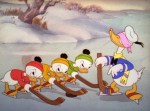
The Hockey Champ © Walt Disney‘The Hockey Champ’ easily is one of the best Donald Duck cartoons of the 1930s.

Unlike ‘Good Scouts‘ or ‘Donald’s Golf Game‘, this short is fast paced, full of gags, speed lines and chase scenes, looking forward to the 1940s, the age of chase cartoons. The cartoon opens wonderfully with Donald Duck performing some impressive figure skating, and imitating Norwegian world champion and movie star Sonja Henie.

His performance is interrupted by Huey, Dewey and Louie playing ice hockey, and Donald Duck challenges the trio to a game. He indeed shows some impressive ice hockey skills, playing all by himself, in a scene recalling Max Hare playing tennis with himself in ‘The Tortoise and the Hare’ (1935). This is a speedy scene for a 1939 cartoon, but when the Huey, Dewey and Louie take revenge, this speed is retained. There’s a wonderfully silly chase scene underneath the snow, with the hockey sticks acting as periscopes, and, needless to say, the haughty Donald is finally defeated by his nephews.

‘The Hockey Champ’ is an important step towards the faster cartoon style of the 1940s, and still a delight to watch, in contrast to contemporary Donald Duck cartoons, which are as beautifully made, but unfortunately less funny.

Watch ‘The Hockey Champ’ yourself and tell me what you think:

This is Donald Duck cartoon no. 8
To the previous Donald Duck cartoon: Donald’s Lucky Day
To the next Donald Duck cartoon: Donald’s Cousin Gus

‘The Hockey Champ’ is available on the DVD set ‘The Chronological Donald Volume 1’

Director: Jack King
Release Date: January 13, 1939
Stars: Donald Duck
Rating: ★★½
Review:

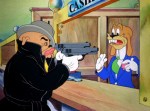
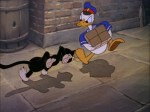
Donald's Lucky Day © Walt Disney‘Donald’s Lucky Day’ starts with the shadows of two gangsters making a time bomb to be delivered by a messenger boy.

The messenger boy in question is Donald Duck. Unfortunately, it’s Friday the 13th, and superstitious Donald desperately tries to avoid a ladder, a mirror and a black cat. In the end the black cat saves him by accident, hence the title.

Donald Duck is the sole star of this cartoon, but apart from his antics with the cat in the harbor, there’s little to enjoy. And because of Jack King’s slow timing, one has ample time to admire the beautiful, realistic background paintings, successfully evoking the atmosphere of a misty harbor quarter by night.

Watch ‘Donald’s Lucky Day’ yourself and tell me what you think:

This is Donald Duck cartoon no. 7
To the previous Donald Duck cartoon: Donald’s Golf Game
To the next Donald Duck cartoon: The Hockey Champ

‘Donald’s Golf Game’ is available on the DVD set ‘The Chronological Donald Volume 1’

Director: Jack King
Release Date: November 4, 1938
Stars: Donald Duck, Huey, Dewey and Louie
Rating: ★★
Review:

Donald's Golf Game © Walt Disney‘Donald’s Golf Game’ is the third film featuring Donald and the nephews.

Donald’s in for a game of golf, and it’s clear he only uses his nephews to be caddies, without granting them anything. Naturally, the nephews take matters in their own hand, with ‘Goofy Golf Clubs’: one changes into a net, another into an umbrella, and a third one into a boomerang. Soon Donald is stuck in a rubber band, while the three brats are playing the field.

‘Donald’s Golf Game’ is a genuine gag cartoon, but once again Jack King’s timing is ridiculously slow, spoiling otherwise fine gags. In the family’s fourth outing, ‘The Hockey Champ‘ (1939), this problem was finally over. Al Taliaferro would set the stage before the film, letting Donald Duck play golf in his daily comic strip from October 24 to November 5.

Watch ‘Donald’s Golf Game’ yourself and tell me what you think:

This is Donald Duck cartoon no. 6
To the previous Donald Duck cartoon: Good Scouts
To the next Donald Duck cartoon: Donald’s Lucky Day

‘Donald’s Golf Game’ is available on the DVD set ‘The Chronological Donald Volume 1’

Director: Ben Sharpsteen
Release Date: July 29, 1938
Stars: Donald Duck, Goofy, cameos by Mickey Mouse, Minnie Mouse, Horace Horsecollar and Clarabelle Cow
Rating: ★★
Review:

The Fox Hunt (1938) © Walt Disney‘The Fox Hunt’ is the second entry in the Donald & Goofy mini-series. In fact, Mickey, Minnie, Horace Horsecollar and Clarabella Cluck are also present, but only shortly, and first only as shadows.

Donald gets most of the screen time, devoted to his antics with five unruly bloodhounds and a sly fox. Goofy gets only one scene, in which his horse refuses to jump. This part shows a novelty: when we watch Goofy and his horse being under water, we’re watching a new technique involving distortion glasses to make the water more convincing. This technique would become very important in the elaborate ocean scenes in Disney’s second feature film ‘Pinocchio‘ (1940), for which these few seconds are only the try-out.

‘The Fox Hunt’ clearly borrows from the early Silly Symhony of the same name. The Donald and Goofy version copies the shot with the hunters being shadows in the distance, and the end gag with the skunk. The Donald and Goofy cartoons were not among Disney’s best, and ‘The Fox Hunt’, too, is only average.

‘The Fox Hunt’ was the last short directed by Ben Sharpsteen, and like Jack King, he favors an all too relaxed timing in this short, hampering the comedy. Sharpsteen had already been a sequence director for ‘Snow White and the Seven Dwarfs’ (1937), and for ‘Pinocchio’ he was promoted to supervising director. From now on he would work on feature films, solely, until the early 1950s, when he moved on to True-Life adventures.

Carl Barks, who was a story man at the time this short was made, revisited the fox hunting theme in his 1948 comic ‘Foxy Relations’, which is much funnier than this film.

Watch ‘The Fox Hunt’ yourself and tell me what you think:

‘The Fox Hunt’ is available on the DVD set ‘The Chronological Donald Volume 1’

Director: Jack King
Release Date: July 8, 1938
Stars: Donald Duck, Huey, Dewey and Louie
Rating: ★★★★½
Review:

Good Scouts © Walt Disney‘Good Scouts’ immediately follows ‘Donald’s Nephews‘, and is the second Donald Duck cartoon featuring Huey, Dewey and Louie. This short shows that the nephews certainly were good gag material.

In ‘Good Scouts’ the four ducks are scouts camping out in Yellowstone Park. When Donald tries to make a tent out of a bent tree, this causes a string of events, which finally leads to him ending on top of a rock on a geyser, followed by a large bear.

‘Good Scouts’ clearly establishes Donald as an unlikely and misguided authority figure. There’s no real antagonism between him and the nephews, however, and when Donald is stuck on top of the geyser the trio seriously tries to save him, only to make matters worse. ‘Good Scouts’ is a great gag cartoon, but like more Donald Duck cartoons from this period it suffers a little from Jack King’s rather relaxed timing. Nevertheless, it provided Donald Duck with his first of no less than eight Academy Award Nominations.

This film’s theme was reused in Al Taliaferro’s daily Donald Duck strip during July 18-30, 1938, shortly after the film’s release. The scout theme was, of course, revisited with gusto by Carl Barks when he made Donald’s nephews into Junior Woodchucks.

Watch ‘Good Scouts’ yourself and tell me what you think:

This is Donald Duck cartoon no. 5
To the previous Donald Duck cartoon: Donald’s Nephews
To the next Donald Duck cartoon: Donald’s Golf Game

‘Good Scouts’ is available on the DVD set ‘The Chronological Donald Volume 1’

Director: Dave Fleischer
Release Date: December 29, 1938
Stars: Popeye, Olive Oyl
Rating:  ★★★½
Review:

Cops Is Always Right © Max FleischerIn ‘Cops Is Always Right’ Popeye gets fined several times: for riding against a policeman, for blowing a horn, for parking near a fire hydrant, for parking in front of a fire station.

Actually, he’s trying to help Olive with her spring cleaning, but he’s constantly hindered by the same police officer. The comedy of this cartoon is flawless. It’s well-timed and makes clever use of a string of running gags, beautifully intertwined into one logical story.

Unfortunately, the short’s finale is disappointing. When Popeye accidentally hits the cop with a flower pot he locks himself in, as he always respects the law. This unfunny and cloying, law-abiding end hampers the cartoon, which otherwise would have been one of Popeye’s best.

‘Cops Is Always Right’ is noteworthy for lacking spinach, and for its unique type of comedy, which in many ways has more in common with Laurel and Hardy than with other Popeye cartoons. The short also shows how goody-goody Popeye had become. Although the cop pictured is far from sympathetic, Popeye remains über-calm, and never even thinks of knocking him down. His superhuman strength is strictly reserved for the cleaning of Olive’s house.

‘Cops Is Always Right’ is the last Popeye cartoon to be staged in the distinct New York environment. In 1938 the Fleischer studio had moved to Miami Florida, opening their new studio in October. From now on, Popeye’s surroundings would be generally spacier and sunnier than ever before.

Watch ‘Cops Is Always Right’ yourself and tell me what you think:

This Popeye film No. 67
To the previous Popeye film: A Date to Skate
To the next Popeye film: Customers Wanted

‘Cops Is Always Right’ is available on the DVD-set ‘Popeye the Sailor Volume Two’
Enter your email address to follow this blog and receive notifications of new posts by email.

Join 905 other subscribers
Bookmark and Share

Categories