Director: Ben Sharpsteen
Release Date: September 12, 1936
Stars: Donald Duck, Pluto
Rating: ★★½
Review:

Donald and Pluto © Walt DisneyWhile Donald is plumbing, Pluto accidentally swallows a magnet, attracting all kinds of metallic objects, like his dish, a pendulum, a watch and eventually Donald’s monkey-wrench.

This short features elaborate gags based on character animation, surely building to a grand finale. One can admire the inevitable ‘logic’ of the film, yet the result is only mildly funny, and neither one of Donald’s or Pluto’s best films.

Although advertised as a Mickey Mouse cartoon, in ‘Donald and Pluto’ Mickey Mouse is not present at all. On the contrary, for both Donald and Pluto this is their first cartoon without Mickey (if we disregard the Silly Symphonies ‘Just Dogs‘ from 1932 and ‘The Wise Little Hen‘  from 1934). After getting more and longer sequences of their own within the Mickey Mouse series, this step was inevitable.

Pluto had come a long way, sharing five years and 33 films with Mickey before standing on his own, but Donald received his independence already within two years, after only twelve films with Mickey.

Both Pluto and Donald would get their own series in 1937. They would appear together in five more films, all within Donald’s series: ‘Beach Picnic‘ (1939), ‘Donald’s Dog Laundry‘, ‘Put-Put Troubles‘, ‘Window Cleaners‘ (all 1940) and finally ‘The Eyes Have It’ (1945).

Watch ‘Donald and Pluto’ yourself and tell me what you think:

This is Mickey Mouse cartoon No. 88
To the previous Mickey Mouse cartoon: Mickey’s Circus
To the next Mickey Mouse cartoon: Mickey’s Elephant

Director: David Hand
Release Date: October 10, 1936
Stars: Mickey Mouse, Pluto
Rating: ★★½
Review:

Mickey's Elephant © Walt Disney‘Mickey’s Elephant’s opens with Mickey receiving a cute young elephant from the Rajah of Ghaboon as a playmate for Pluto. Unfortunately Pluto is not amused, and he thinks ‘Bobo’ is an intruder with intentions to replace him.

‘Mickey’s elephant’ is similar to ‘Mickey’s Pal Pluto‘ (1933) and to ‘Mickey’s Kangaroo‘ (1935), in which Pluto is also jealous of an intruder and which also feature his evil side. Like in ‘Mickey’s Pal Pluto’ Pluto’s evil consciousness has materialized into a little devilish persona, who talks with a strong New York accent and who persuades Pluto to fix Bobo using red pepper. Sneezing along Bobo blows is own new house down, but unfortunately Pluto’s too…

‘Mickey’s Elephant’ is a rare example of a Mickey Mouse film inspired by the Mickey Mouse comic strip. Most of the time the influence was reversed. But in this case Bobo the elephant had made his entrance in Floyd Gottfredson’s strip two years earlier. Bobo is a completely innocent character, and Pluto’s little devil notwithstanding, the cartoon is more cute than funny.

Watch ‘Mickey’s Elephant’ yourself and tell me what you think:

This is Mickey Mouse cartoon No. 89
To the previous Mickey Mouse cartoon: Donald and Pluto
To the next Mickey Mouse cartoon: The Worm Turns

Director: Ben Sharpsteen
Release Date: August 1, 1936
Stars: Donald Duck, Mickey Mouse, the Orphan Mice, the Little Seal
Rating: ★★½
Review:

Mickey's Circus © Walt DisneyIn ‘Mickey’s Circus’ we watch Mickey and Donald perform in a circus for a pack of orphan mice.

Most of the time goes to Donald and his trained seals. Only after six minutes Mickey joins in again, struggling with Donald on the slack-rope, while being troubled by the orphan mice.

‘Mickey’s Circus’ was the last cartoon to feature the Orphan Mice (apart from the remake of ‘Orphan’s Benefit from 1941), until their unexpected return in ‘Pluto’s party‘ from 1952. It’s also the first Disney short featuring a cute little seal. Similar seals would reappear in ‘Pluto’s Playmate‘ (1941), ‘Rescue Dog‘ (1947) and ‘Mickey and the Seal‘ (1948).

Watch ‘Mickey’s Circus’ yourself and tell me what you think:

This is Mickey Mouse cartoon No. 87
To the previous Mickey Mouse cartoon: Alpine Climbers
To the next Mickey Mouse cartoon: Donald and Pluto

Director: Ben Sharpsteen
Release Date:
 June 20, 1936
Stars:
 Mickey Mouse, Donald Duck, Goofy, Pete
Rating:
  ★★★½
Review:

Moving Day © Walt DisneyBecause Mickey, Donald and Goofy can’t pay the rent, evil sheriff Pete will sell their furniture. The boys decide to move before that’s going to happen…

‘Moving Day’ is the this third of the classic trio cartoons featuring Mickey, Donald and Goofy. In this entry Mickey is hardly visible. Most of the cartoon is taken by his co-stars in two all too elaborate sequences: one featuring Goofy in a surreal struggle with a piano with a will of its own, and another featuring Donald’s trouble with a plunger and a fishbowl.

Despite the great animation, one gets the feeling that in this cartoon the artists were too much obsessed with character and less with gags, making this cartoon a bit slow and tiresome, when compared to the previous trio outings ‘Mickey’s Service Station’ and ‘Mickey’s Fire Brigade‘ from 1935. Luckily, in later trio shorts like ‘Moose Hunters’ or ‘Hawaiian Holiday’, the fast pace was found again.

‘Moving Day’ is the first cartoon to feature Pete in color. It was also the last of only three cartoons in which Art Babbitt animated Goofy. After he had done so much for the character in ‘Mickey’s Service Station’ and ‘On Ice‘, one can say that in ‘Moving Day’ he went a little too far in milking the goof’s scenes. Anyhow, Babbitt went over to feature films, but after these three shorts Goofy’s character was established well enough for others to take over with equally inspired results.

Watch ‘Mickey’s Fire Brigade’ yourself and tell me what you think:

This is Mickey Mouse cartoon No. 85
To the previous Mickey Mouse cartoon: Mickey’s Rival
To the next Mickey Mouse cartoon: Alpine Climbers

Director: David Hand
Release Date: October 26, 1935
Rating: ★★★
Review:

Three Orphan Kittens © Walt DisneyOn a winter night three kittens are thrown in a sack into a garden.

Luckily they can escape the cold by entering the house, which they explore. This sweet cartoon contains elaborate gags with a.o. pepper, a bottle of milk, and a pianola.

‘Three Orphan Kittens’ was penned by Joe Grant and Bill Cottrell, and benefited from Fred Moore’s appealing animation. Indeed, it won an Academy Award. Its success made it one of those rare Silly Symphonies to evoke a sequel (‘More Kittens‘ from 1936). Moreover, it clearly inspired other animation film makers: the milk bottle gag was more or less copied by Fleischer in ‘We did it‘ (1936) which also stars three kittens. And, some of the pianola gags may have inspired Hanna and Barbera in their ‘The Cat Concerto‘ (1947).

At least Hanna and Barbera copied the black maid (of whom we only see her arms and legs) for their own Mammy Two-Shoes in the Tom & Jerry series. The black maid would also return in a few Disney shorts: ‘More Kittens‘ (1936), ‘The Pantry Pirate‘ (1940, starring Pluto), and ‘Figaro and Cleo‘ (1943).

Watch ‘Three Orphan Kittens’ yourself and tell me what you think:

This is Silly Symphony No. 56
To the previous Silly Symphony: Music Land
To the next Silly Symphony: Cock o’ the Walk

Director: Ruth Lingford
Release Date: 1997
Rating: ★★★★★ ♕
Review:

Death and the Mother © Ruth LingfordWhen death takes away her child, a mother gives up everything to get her back.

‘Death and the Mother’ is Ruth Lingford’s re-telling of a classic fairy-tale by Hans Christian Andersen. It’s an animation masterpiece: its strong and gritty animation, the beautiful string quartet music by Nigel Broadbent, the subtle sound effects –  all add up to a very strong, dark and emotional film. Lingford makes clever use of the computer to create a very graphic film that looks like an animated woodcut. In an age in which computer animation almost equals 3D animation, this is a refreshing technique, with a stark impact and an imagery unparalleled in the animation field.

Moreover, Lingford captures Andersen’s tale of grief, love and sacrifice very well, without trying to update it. Just by staying true to the essence of the original story she has made a timeless classic. Her wordless film is as universal as it can get, and capable of communicating to audiences worldwide. It’s a welcome antidote to the Disney fairy tale retellings, which get more and more watered down, and which lose a lot of the originals’ charm with it.

Watch ‘Death and the mother’ yourself and tell me what you think:

‘Death and the Mother’ is available on the DVD inside the book ‘Animation Now!’

Director: Chris Wedge
Release Date: 1998
Rating: ★★★★½
Review:

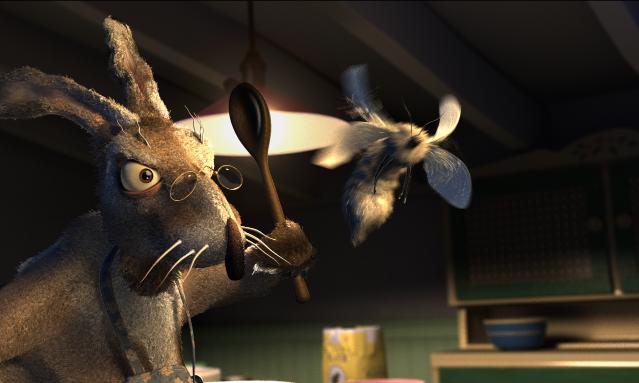
Bunny © Blue SkyAn elderly bunny tries to bake a cake, when she’s being disturbed by a giant moth.

After a wild chase the moth falls into the cake mix and she angrily bakes the insect with it. At this point the film takes a remarkable turn…

With Pixar’s ‘Geri’s Game’ (1997), ‘Bunny’ is one of the first computer animated shorts that make you forget you’re watching a computer animated film. With its quite original story and its beautiful execution, it transcends the medium, and its deservedly won the Oscar for best animated short in 1998.

Chris Wedge and his Blue Sky studio (founded in 1987, by Tron-alumni) later moved on to produce feature length computer-animated films, becoming the fourth American studio to do so, after Pixar, PDI/Dreamworks and DNA Productions. It would be especially successful with its Ice Age films. However, none of the sequential Blue Sky films would reach the emotional depths of this gentle little short.

Watch ‘Bunny’ yourself and tell me what you think:

‘Bunny’ is available on the DVD ‘Ice Age’

Director: Nick Mackie
Release Date: 1999
Rating: ★★
Review:

Minotaur & Little Nerkin © Aardman‘Minotaur & Little Nerkin’ is a curious 2d computer animation, which looks like it is designed for children.

However, its story is rather black. The film features a minotaur who lurks a duck into his home to eat a captivated human hand, only in order to eat the duck himself. Remarkable for its morbid humor and original technique, it is nonetheless an ugly and unfunny film, that fails to entertain, let alone impress the viewer.

Watch ‘Minotaur & Little Nerkin’ yourself and tell me what you think:

‘Minotaur & Little Nerkin’ is available on the DVD ‘Aardman Classics’

Director: Mark Brierley
Release Date: 1998
Rating: ★
Review:

Al dente © Aardman‘Al dente’ is another film by computer animation pioneer at Aardman, Mark Brierley.

This short film looks even more primitive than ‘Owzat’ from the previous year. It doesn’t feature any backgrounds of notice, and the main character, a grumpy waiter who has to serve a vegetarian meal at a meat restaurant, looks primitive and unimaginative. The film is utterly mediocre and, like ‘Owzat’, probably would never have been released were it not an Aardman production.

Watch ‘Al dente’ yourself and tell me what you think:

‘Al dente’ is available on the DVD ‘Aardman Classics’

Director: Mark Brierley
Release Date: 1997
Rating: ★
Review:

Owzat © AardmanIn a graveyard a skeleton plays cricket with some unwilling ghosts.

‘Owzat’ is Aardman’s first endeavor into computer animation and it pales when compared to Pixar films from the same period. The designs look hopelessly primitive, the animation is stiff and the colors are rather ugly. As the film is quite incomprehensible, slow and unfunny, one wonders why it was made in the first place. It looks like a study, and it probably wouldn’t have been released if it had not been an Aardman production.

Watch ‘Owzat’ yourself and tell me what you think:

‘Owzat’ is available on the DVD ‘Aardman Classics’

Director: Boris Kossmehl
Release Date: 1993
Rating: ★★★★
Review:

Not Without My Handbag © AardmanWhen she hasn’t paid her washing machine, a girl’s aunt has to go to hell.

However, she soon returns as a zombie to fetch her handbag. The devil tries to take her once again, this time disguised as the handbag.

Atypical for the Aardman studios, ‘Not Without My Handbag’ features puppet animation and hardly any clay animation. It’s a highly designed film, using stark colors, extreme camera angles and expressionistic decors. Its unique style is somewhat akin to that of Tim Burton, but is even more idiosyncratic. Despite its horror theme, the film is more lighthearted than the earlier Aardman films ‘Adam‘ (1991) or ‘Loves Me, Loves Me Not‘ (1992), because of its zany humor and matter-of-fact dialogue. For example, when her aunt returns as a zombie, the girl suddenly turns to camera and says proudly: “My auntie is a zombie from hell!”.

‘Not Without My Handbag’ is a modest masterpiece: it’s unpretentious, but it combines originality with virtuosity. The animation of the evil handbag is particularly good. Director-animator Boris Kossmehl later moved to 3D computer animation, performing character animation for Dreamworks’ ‘Antz’ and ‘Shrek’.

Watch ‘Not Without My Handbag’ yourself and tell me what you think:


‘Not Without My Handbag’ is available on the DVD ‘Aardman Classics’

Director: Jeff Newitt
Release Date: 1992
Rating: ★★★
Review:

Loves Me, Loves Me Not © AardmanA gentleman uses a flower to determine whether his girl loves him or not.

The contrasts between happiness (she loves him) and pain (she loves him not) get more and more extreme during the film, providing unsettling images of terror.

Like ‘Adam‘, ‘Loves Me, Loves Me Not’ is an example of dark humor, typical for the Aardman Studios at the time. The dark humor is typified by the screams of pain the flower exclaims, when its petals are removed, by the highly disturbing soundtrack and by the images of suicide and threat.

Combining virtuoso clay animation with some cel animation, the film is a technical masterpiece. It also features some great silent comedy, and especially the deft gestures of the Clark Gable-like gentleman are nicely done.

Watch ‘Loves Me, Loves Me Not’ yourself and tell me what you think:

‘Loves Me, Loves Me Not’ is available on the DVD ‘Aardman Classics’

Director: Peter Lord
Release Date: 1991
Rating: ★★★½
Review:

Adam © AardmanA giant hand creates a man on a tiny planet.

His creator orders the man around, but the man soon discovers his barren sphere is too small to do anything, and that he is stuck to it. Luckily, in the end the creator grands him a companion, which turns out to be a penguin (iris out).

‘Adam’ exploits the dark humor typical for the early Aardman films. Its claustrophobia feels real and disturbing, and the film raises inevitable questions about existence and purpose of life. And though ‘Adam’ contains great silent comedy gags, the film is rather unsettling overall. Unfortunately, the film’s comedy is hampered by Stuart Gordon’s rather ugly electronic music. However, Lord’s animation is superb throughout, and a prime example of the more comedy-driven animation style the Aardman studio took from 1989 on.

Watch ‘Adam’ yourself and tell me what you think:

‘Adam’ is available on the DVD ‘Aardman Classics’

Director: Osvaldo Cavandoli
Release Date:
 1991
Stars:
 La Linea
Rating:
 ★★
Review:

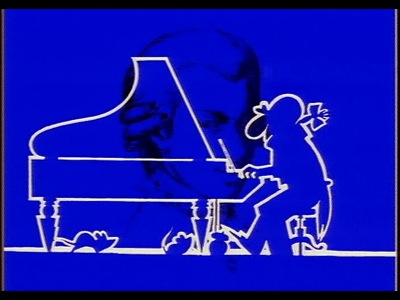
Trazom, A.W. © Oscar CavandoliTrazom, A.W. Is W.A. Mozart spelled backwards and it’s Cavandoli’s hommage to the composer.

We watch La Linea dressed like an 18th century composer playing Mozart’s K545 sonata on the grand piano. Meanwhile he encounters several animals and people.

Unfortunately, the cartoon is slow, repetitive and rather unfunny. La Linea’s irresistible voice is hardly heard and this cartoon lacks the brazen humor of the earlier entries. And it completely pales when compared to classic piano concerto cartoons like ‘Rhapsody Rabbit‘ (1946) or ‘The Cat Concerto‘ (1947).

‘Trazom, A.W.’ is available on the DVD ‘La Linea 3’

Director: René Laloux
Release Date: 1988
Rating: ★★★★½
Review:

La prisonnière © René Laloux‘La Prisonnière’ is a short, rather surrealistic science fiction film about two children.

They visit an extraterrestrial monastery and witness a rescue of a prisoner by naked women who step out of a stranded whale.

The film looks like an animated version of designer Caza’s source comic, Équinoxe (which can be found here), and contains only a limited amount of animation. In his designs Caza’s style is very reminiscent of that of his fellow french comic artist Moebius.

‘La prisonnière’ seems like an etude for Laloux’s and Caza’s much bigger project, the feature film ‘Gandahar‘ (1988). The atmosphere of the short is poetic, if completely incomprehensible.

Watch ‘La Prisonnière’ yourself and tell me what you think:

‘La Prisonnière’ is available on the DVD ‘Gandahar’

Director: Peter Lord
Release Date: 1989
Rating: ★★½
Review:

War Story © AardmanWith ‘War Story’ the Aardman studio returned to their original lip-synch experiments with real dialogue.

This time they use an interview with one Bill Perry, an old man who tells his memories of his life in Bristol during World War II. Unlike the ‘Animated conversations’ series, however, there is room for goofy images exaggerating the tall tales of the voice over, which involve a slant house and lots of coal. The film’s images are very tongue-in-cheek, yet this film once again suffers from a bad soundtrack, and the old man’s mumblings are at times very difficult to follow, indeed.

The blending of real interviews with original and humorous images would be perfected in ‘Creature Comforts’ by Nick Park, who also animated on this film. In this sense ‘War Story’ is an important step towards Aardman’s mature style, which was to become less serious, and more cartoony, and consequently, more commercially successful.

Watch ‘War Story’ yourself and tell me what you think:

‘War Story’ is available on the DVD ‘Aardman Classics’

Director: Richard Goleszowski
Release Date: 1989
Rating: ★★★½
Review:

Ident © Aardman‘Ident’ is a surrealistic film about how we change our identity over the course of a day according to the people we meet.

The film uses highly original and very stylized designs, and jabbering dialogue to an alienating effect. Its claustrophobic labyrinth setting alone is unsettling. The film is not heavy-weighted, however, but keeps a light sense of humor. It also features a flat dog that was to become the direct ancestor of Rex the Runt.

Watch ‘Ident’ yourself and tell me what you think:

‘Ident’ is available on the DVD ‘Aardman Classics’

Director: ?
Release Date: 1987
Rating: ★★★★
Review:

My Baby Just Cares For Me © Aardman‘My Baby Just Cares For Me’ was Aardman Studio’s second video clip, after ‘Sledgehammer’ for Peter Gabriel (1986).

‘My Baby Just Cares For Me’  is not quite as elaborate, however. It’s a sweet little video in mostly black and white. It’s set to Nina Simone’s 1958 recording of the song, which was reissued in 1987 after being used in a successful commercial for Chanel No.5.

The clip features cat characters, including a black female cat singer, and a white cat who’s in love with her. It also features some live action footage showing details of a piano, brushes on a snare drum, and a double bass.

The smoky nightclub atmosphere is captured very well, and the animation, joyful if a little crude, matches the song perfectly. The result is one of the most enjoyable little stop motion films of the 1980s.

Watch ‘My Baby Just Cares For Me’ yourself and tell me what you think:

‘My Baby Just Cares For Me’ is available on the DVD ‘Aardman Classics’

Director: Peter Lord & David Sproxton
Release Date: 1986
Rating: ★★
Review:

Babylon © Aardman‘Babylon’ is an early Aardman film criticizing weapon trade. Unfortunately, despite its sympathetic message, it’s not a successful film.

In it we watch a meeting of weapon dealers. During this gathering one of the guests, a bald Russian-looking guy, is growing in statue to a gargantuan size until it explodes into a flood of blood, destroying all the other guests.

‘Babylon’  impresses with its many detailed human-like plasticine puppets, its virtuoso stop motion animation and its elaborate set. But it suffers from slowness, ugly sound design and a very bad soundtrack, involving an all too long speech by the chairman of the weapon dealers. The end result is too tiresome and too vague to impress.

Watch ‘Babylon’ yourself and tell me what you think:

‘Babylon’ is available on the DVD ‘Aardman Classics’

Director: Paul Driessen
Release Date: 1988
Rating: ★★★★★ ♕
Review:

De schrijver en de dood © Paul DriessenIn an old castle a medieval writer is writing such lively stories, it  attracts Death’s attention.

The writer tells a story about a peddler and his son, who has a touch of magic. All goes well, until Death comes in, and messes with the writer’s stories to ruin them and fill them with death and misery. Nevertheless, he fails to kill the son, who’s the writer’s main protagonist. With his magical powers the young boy escapes certain death several times. However, when in the end, the writer turns out to be same man as the little boy in his stories, Death has the last laugh.

‘De schrijver en de dood’ is one of Paul Driessen’s darkest and gloomiest films. His typical black humor is not absent, and is best visible in the little snapshots, which disrupt the story’s continuity for small morbid gags. But more than in any other of his films death is more disturbing than funny, and the sadness and misery are heartfelt. At the same time, it’s also one of Driessen’s most poetical films. The images are rich and full of fantasy, and in his own way Driessen creates a convincing medieval world to marvel at.

Watch ‘De schrijver en de dood’ yourself and tell me what you think:

‘De schrijver en de dood’ is available on the DVD ‘The Dutch Films of Paul Driessen’

Enter your email address to follow this blog and receive notifications of new posts by email.

Join 907 other subscribers
Bookmark and Share

Categories