Directors: William Hanna & Joseph Barbera
Release Date: June 14, 1947
Stars: Tom & Jerry
Rating: ★★★★★
Review:

Dr. Jekyll and Mr. Mouse © MGMThis cartoon starts with Tom’s attempts to prevent Jerry from lapping his milk.

In ‘Dr. Jekyll and Mr. Mouse’ Jerry has attained a Droopy-like ability to be everywhere, giving Tom a hard time. In order to defeat the omnipresent mouse, Tom mixes a poisonous drink. Unfortunately, it renders the mouse muscular and extremely strong.

Later, Jerry tries to mix the same drink to get strong again, but it’s Tom who drinks it. However, it makes him smaller and in the final shot watch see Jerry chasing a tiny Tom.

‘Dr. Jekyll and Mr. Mouse’ covers similar grounds as the Mickey Mouse cartoon ‘The Worm Turns‘ (1937), but with better results. The highlight of the cartoon is the animation of the effects of Tom’s potion on Jerry. Especially the animation of a threatening, marching muscular Jerry is grandiose, and in this scene Scott Bradley’s outstanding music is particularly powerful.

Watch ‘Dr. Jekyll and Mr. Mouse’ yourself and tell me what you think:

https://www.dailymotion.com/video/x2w9ixb

This is Tom & Jerry cartoon No. 30
To the previous Tom & Jerry cartoon: Part Time Pal
To the next Tom & Jerry cartoon: Salt Water Tabby

Directors: William Hanna & Joseph Barbera
Release Date: March 15, 1947
Stars: Tom & Jerry, Mammy Two-Shoes
Rating: ★★★
Review:

Part Time Pal © MGMMammy threatens Tom he goes out if he doesn’t catch ‘that mouse’.

In the chase Tom accidentally gets drunk, which changes him into Jerry’s best pal and rebellious against Mammy. This can’t go well, and in the end we see Mammy chasing a hiccuping Tom in a moonlit landscape.

The animation of the drunken Tom is very well done and a delight to watch. However, somehow, ‘Part Time Pal’ also seems to be the most inspirational cartoon to the Czech studio Gene Deitch led for his Tom and Jerry cartoons (1961-1962), because Tom’s design in this cartoon is remarkably similar to those later, way more poorly animated cartoons.

Watch ‘Part Time Pal’ yourself and tell me what you think:

http://www.dailymotion.com/video/x2mfpnw

This is Tom & Jerry cartoon No. 28
To the previous Tom & Jerry cartoon: Cat Fishin’
To the next Tom & Jerry cartoon: The Cat Concerto

Directors: William Hanna & Joseph Barbera
Release Date: February 22, 1947
Stars: Tom & Jerry, Spike
Rating: ★★★★★
Review:

Cat Fishin' © MGMTom goes fishing in a no-fishing area, guarded by Spike. He uses Jerry as a live bait to catch an enormous pike.

The humor of this perfectly timed cartoon follows logically from the clever interplay between these four characters, it’s highlight being the sequence where Tom tries to land a big fish, which turns out to be Spike. The result is one of the most perfect Tom & Jerry cartoons ever.

Watch ‘Cat Fishin’’ yourself and tell me what you think:

This is Tom & Jerry cartoon No. 27
To the previous Tom & Jerry cartoon: Solid Serenade
To the next Tom & Jerry cartoon: Part Time Pal

Director: Clyde Geronimi
Release Date: February 6, 1948
Stars: Goofy
Rating: ★★
Review:

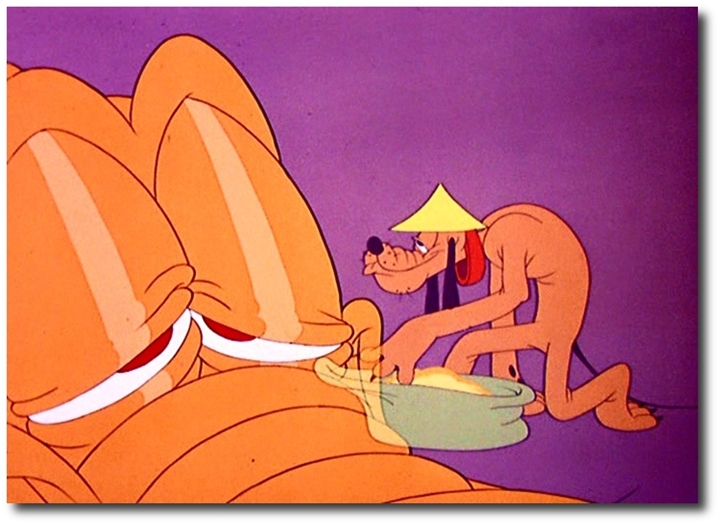
The Big Wash © Walt DisneyIn ‘The Big Wash’ Goofy tries to wash his unwilling circus elephant Dolores (or Dolorious as he calls her).

‘The Big Wash’ was Clyde Geronimi’s last cartoon and his only one in the Goofy series. In the years to follow he would concentrate his directing skills on feature films, with the exception of two short specials, ‘Susie, the Little Blue Coupe’ (1952) and ‘The Story of Anyburg, U.S.A.’ (1957).

‘The Big Wash’ is not really a highlight in Geronimi’s career. Like ‘Foul Hunting‘ from the previous year, it uses the original Goofy character and Pinto Colvig’s voice, and, like in the former cartoon, this results in a slow, boring and remarkably old-fashioned film. The short is cute, but terribly unfunny, especially when compared to most other Goofy cartoons or contemporary entries from other studios.

‘The Big Wash’ was the last cartoon to feature the Goofy character as it was developed in the thirties. In his next cartoon, ‘Tennis Racquet‘, Goofy was not only once again voiceless, he was also redesigned, making him more fitting to the post-war era.

Watch ‘The Big Wash’ yourself and tell me what you think:

This is Goofy cartoon No. 22
To the previous Goofy cartoon: They’re Off
To the next Goofy cartoon: Tennis Racquet

Director: Jack Hannah
Release Date:
 January 23, 1948
Stars: 
Goofy
Rating:
 ★★★★½
Review:

They're Off © Walt DisneyThey’re Off’ was the last of four Goofy cartoons directed by Jack Hannah, and the most Jack Kinney-like of them all.

In this cartoon we follow two Goofy characters who both bet on a horse race. One of them is a typical Hannah-style underdog, and decidedly a gay stereotype. The gay Goofy’s favorite, Old Moe, wins from the other Goofy’s favorite, star horse Snapshot, because the latter just can’t resist the camera.

In one frantic scene ‘They’re off’ uses footage from ‘How to Ride a Horse’ (1941), ‘Fantasia’ (the unicorns from the Pastoral Symphony sequence) and ‘Hockey Homicide‘ (1945).

Watch ‘They’re Off’ yourself and tell me what you think:

This is Goofy cartoon No. 21
To the previous Goofy cartoon: Foul Hunting
To the next Goofy cartoon: The Big Wash

Director: Jack Hannah
Release Date:
 October 31, 1947
Stars: Goofy
Rating:
 ★★
Review:

Foul Hunting © Walt DisneyIn ‘Foul Hunting’ Goofy is hunting ducks, which all resemble Sonja from ‘Peter and the Wolf’ in ‘Make Mine Music’ (1946).

‘Foul Hunting’ is Jack Hannah’s third Goofy cartoon, and it is very different from his first two (‘A Knight for a Day‘ and ‘Double Dribble‘ from 1946)This cartoon returns to the original Goofy character, arguably unseen since ‘Baggage Buster‘ from 1941. More surprisingly, Goofy suddenly has his voice back – apparently, Pinto Colvig had returned to Disney.

Unfortunately, it’s this voice that slows down the action, making the cartoon less funny than the voiceless entries and giving it a painfully old-fashioned appearance. After five years of cartoons with multiple Goofies, this return to the ‘real’ Goofy feels like a retrogression. Pinto Colvig would be Goofy’s voice again in the equally unfunny ‘The Big Wash‘ (1948).

Watch ‘Foul Hunting’ yourself and tell me what you think:

This is Goofy cartoon No. 20
To the previous Goofy cartoon: Double Dribble
To the next Goofy cartoon: They’re Off

Director: Jack Hannah
Release Date:
 December 12, 1946
Stars:
Goofy
Rating: 
★★★★

Double Dribble © Walt DisneyIn ‘Double Dribble’ we’re watching a basketball game between home team U.U. and visiting team P.U. (which has only one fan).

‘Double Dribble’ is Jack Hannah’s second Goofy cartoon, and it uses the same format as his first, ‘A Knight for a Day‘ (1946) with equally fast and funny results. There’s a sports game with a lively narrator, typical for the Goofy shorts of the forties, but there’s also one underdog-like character, whom we can follow throughout the picture, and to whom we can relate. In ‘A Knight for a Day’ it was Cedric, this time it’s a tiny Goofy, called Marathu, who makes the final and deciding score, turning the game in favor of ‘old P.U.’.

Like in ‘Hockey Homicide‘ (1945) the team members share names with Disney employees.

Watch ‘Double Dribble’ yourself and tell me what you think:

This is Goofy cartoon No. 19
To the previous Goofy cartoon: A Knight for a Day
To the next Goofy cartoon: Foul Hunting

Director: Jack Hannah
Release Date:
 March 8, 1946
Stars:
 
Goofy
Rating: ★★★★★
Review:

A Knight For A Day © Walt Disney‘A Knight for a Day’ is one of four Goofy cartoons directed by Jack Hannah, while Goofy’s usual director, Jack Kinney, was busy working on feature films ‘Make Mine Music’ and ‘Fun and Fancy Free‘.

Hannah, who shares Kinney’s love for fast and nonsensical cartoons, adopts the use of a jabbering sports reporter-like voice over, but applies it to a medieval setting, with hilarious results. Unlike Kinney’s Goofy cartoons however, Hannah’s cartoon consists of a real story with identifiable characters, splitting Goofy’s personality into various different ones.

During a medieval tournament, Cedric, a young squire, has to replace his master, Sir Loinsteak, when he falls with his head on an anvil, blocking him out. He has to face the champion, Sir Cumference, an evil opponent, who rides a black horse, smokes cigars and has a shield of bricks. Cedric wins the tournament, however, earning kisses from the ‘beautiful’ princess Esmeralda, who is another Goofy-like character.

‘A Knight for a Day’ is a fast and fervid cartoon, which is over before you know it.

Watch ‘A Knight for a Day’ yourself and tell me what you think:

This is Goofy cartoon No. 18
To the previous Goofy cartoon: Hockey Homicide
To the next Goofy cartoon: Double Dribble

Director: Jack Kinney
Release Date:
 September 21, 1945
Stars:
 Goofy
Rating:
 ★★★★★ ♕
Review:

Hockey Homicide © Walt Disney‘Hockey Homicide’ is an account of a frantic ice hockey game between two teams, of which all players share names with Disney employees (while the referee is named after the cartoon’s director, Jack Kinney).

The cartoon is bursting with cartoon violence. For instance, there’s a hilarious running gag of two star players, Bertino and Ferguson, who, when they leave the penalty box, immediately start beating up each other, only to be send back into the penalty box again.

But the real treat of this fast and furious cartoon is its final sequence, when the crowd takes over and the cartoon runs totally haywire, even using non-related footage from ‘How to Play Football’ (1944), ‘How to Play Baseball‘ (1942), ‘Victory Through Air Power’ (1943) and Monstro the Whale from ‘Pinocchio‘ (1940), to add to the feeling of complete chaos.

‘Hockey Homicide’ must be the wildest, fastest and most violent cartoon Disney ever produced. Like earlier Goofy cartoons by Jack Kinney, it is clearly influenced by contemporary cartoons at Warner Bros. and MGM, and it has a genuine Tex Averyan spirit rarely seen at Dosmey outside the Goofy series.

With ‘Hockey Homicide’ the Goofy series reached its apex. More entertaining films were to follow, but none as wild and extreme as this one. After it Kinney was fully involved in feature films, only to return to the Goofy series again in 1949. By then the humor of Hollywood cartoons had toned down. In the meantime five Goofy cartoons were produced: four directed by Donald Duck-director Jack Hannah, and one by Clyde Geronimi.

Watch ‘Hockey Homicide’ yourself and tell me what you think:

This is Goofy cartoon No. 17
To the previous Goofy cartoon: Californy’er Bust
To the next Goofy cartoon: A Knight for a Day

Director: Friz Freleng
Release Date: 
November 1, 1947
Stars:
 Bugs Bunny, Elmer Fudd
Rating:
 ★★★★★
Review:

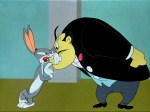
Slick Hare © Warner BrothersIn ‘Slick Hare’ Elmer works as a waiter in a restaurant full of celebrities.

Humphrey Bogart (voiced by Dave Barry) is one of the costumers, and he tells Elmer to bring him a rabbit or else… By chance, Elmer discovers Bugs in his kitchen and what follows is a wild chase involving more celebrities, like The Marx Brothers and Carmen Miranda.

‘Slick Hare’ is a hilarious cartoon. Highlights are a well-timed pie throwing sequence and a a great dance routine by Bugs on an irresistible samba, animated with gusto by Gerry Chiniquy. The cartoon contains some more caricatures of Hollywood stars, like Leopold Stokowski, Frank Sinatra and at the end, Bogart’s wife, Lauren Bacall.

Watch ‘Slick Hare’ yourself and tell me what you think:

http://vimeo.com/69975085

This is Bugs Bunny cartoon No. 45
To the previous Bugs Bunny cartoon: Easter Yeggs
To the next Bugs Bunny cartoon: Gorilla My Dreams

Director: Bob Clampett
Release Date: 
October 5, 1946
Stars:
 Bugs Bunny, Elmer Fudd
Rating:
★★★★½
Review:

‘The Big Snooze’ (a pun on the Bacall-Bogart vehicle ‘The Big Sleep’) opens with Elmer quitting after a short chase routine involving a tree trunk on a cliff.

He tears his contract with Warner apart and decides to enter a career of fishing only ‘and no more wabbits!’. When he rests at the riverside, Bugs enters his serene dream to create a nightmare. This involves e.g. nightmare paint, rendering Elmer in Adam’s costume, making a girl out of him, followed by wolves and a great fall, which typically ends the nightmare. At the end Elmer returns to the scene, reassembling the contract and ready for another routine with the tree.

‘The Big Snooze’ is one of those great cartoons that play with their characters as being real stars (others being the Mickey Mouse cartoon ‘Mickey’s Gala Premier’ (1933), the Donald Duck cartoon ‘The Autograph Hound‘ (1939) and ‘You Ought to Be in Pictures’ (1940, starring Porky and Daffy).

The opening scene was taken from Tex Avery’s ‘All This and Rabbit Stew’ (1941), with Elmer replacing the original black caricature. The rest of the film has a disjointed feel, and features weird cuts and odd cinematographic choices. For example, when Elmer tears up the contract, this is shown in five different shots, following each other in rapid succession: 1) a medium shot of Elmer tearing up the contract, 2) a close-up of only his hands tearing, 3) a close-up of the paper snippets flying into the air above Elmer’s head, who’s hardly seen in this shot, 4) a very strange perspective shot of Elmer smashing the contract into the camera, and 5) a close-up of his boots stamping on what remains of the paper.

Another noteworthy scene is when Bugs Bunny is ‘multiplying’: in this scene Elmer is the only traditionally looking character, placed on a black canvas, overrun by rabbits, only drawn in red, yellow and pink outlines and mixing with the green outlines of some plants. This short scene is a startling piece of early cartoon modernism, and looks forward to the work of the UPA studio in the 1950s. On the other hand, the gag in which Bugs pulls away a hole harks all the way back to the Mickey Mouse cartoon ‘The Picnic‘ (1930).

Bugs sings excerpts from three songs in this short: ‘Beautiful Dreamer’, ‘Someone’s Rocking My Dreamboat’ and ‘September in the Rain’.

The Big Snooze’ was to be Bob Clampett’s last cartoon at Warner Bros. He was fired before he could finish it, and the short was completed by Art Davis, who succeeded him as a director. The film’s look and feel is still that of the war era, while contemporary cartoons by Chuck Jones and Friz Freleng show the studio was heading into other directions, with milder humor and more sophisticated designs. In contrast, in ‘The Big Snooze’ Clampett’s animation style is extremely flexible, as usual for him, and his backgrounds are as vague as ever.

‘The Big Snooze’ is a hilarious cartoon that marks the end of an era, where the wildest and the zaniest gags were possible. Only Tex Avery at MGM would continue the extreme style. Bob Clampett left Warner Bros. in May 1945 to join the Screen Gems studio. He was succeeded by Art Davis, who would direct some great cartoons until his unit was closed down in 1949.

In the years following Clampett’s leave, his zany style was continued for a while by his master animator Robert McKimson, who had been promoted to director only a few months earlier. However, McKimson soon toned down both animation and humor, and he would never achieve the same level of originality as Bob Clampett did during his Warner Bros. days.

Watch ‘The Big Snooze’ yourself and tell me what you think:

https://www.dailymotion.com/video/x6n3yac

This is Bugs Bunny cartoon No. 40
To the previous Bugs Bunny cartoon: Racketeer Rabbit
To the next Bugs Bunny cartoon: Rhapsody Rabbit

‘The Big Snooze’ is available on the DVD-set ‘Looney Tunes Golden Collection Volume Two’
Director: Chuck Jones
Release Date: 
August 11, 1945
Stars:
 Bugs Bunny
Rating:
 ★★★★
Review:

Hare Conditioned © Warner BrothersIn ‘Hare Conditioned’ Bugs Bunny is working in a display at a department store. But the manager has other plans with him and wants our hero stuffed.

‘Hare Conditioned’ is full of director Chuck Jones’ typical sophisticated humor and extreme posing. For example, at the beginning of the chase scene we can see the manager looking for Bugs in three places. His move from one place to another is done in smears only one frame long, leading to extremely fast takes between the poses. Also, the final chase, involving elevators and stairs, is wonderfully timed. One of the short’s best gags, however, is set to a slower pace, and involves Bugs cross-dressing as a female customer and the manager courting him/her by tickling his/her feet.

Unfortunately, the cartoon ends abruptly with a rather trite ending: when the manager has Bugs Bunny cornered on the roof, Bugs convinces his adversary there’s a monster behind him, with himself posing as the monster, making the manager jump off the roof. But then he looks into the mirror himself…

‘Hare Conditioned’ is one of the great entries in the Bugs Bunny canon. The short clearly establishes Jones’s concept of the rabbit, as the director stated in his book ‘Chuck Amuck’:

“Golden Rule. Bugs must always be provoked. In every film, someone must have designs upon his person: gastronomic, as a trophy, as a good-luck piece (…..), as an unwilling participant in a scientific experiment (laboratory rabbit or outer-space creature). Without such threats Bugs is far too capable a rabbit to evoke the necessary sympathy”.

Indeed, Bugs only comes into action in this cartoon when threatened by death. First he tries to flee his foe, but when this proves impossible he takes control of the situation himself. Only then he does serious harm to his opponent. Nevertheless, Bugs remains calm throughout the cartoon.

Jones kept to his golden rule in the rest of his cartoons, giving Bugs other large or powerful adversaries like a giant red monster in ‘Hair-Rasing Hare’ (1946), a large boxer in ‘Rabbit Punch‘ (1948), or a Martian, capable of blowing up the earth, in ‘Haredevil Hare‘ (1948).

Watch ‘Hare Conditioned’ yourself and tell me what you think:

https://www.dailymotion.com/video/x5y67d2

This is Bugs Bunny cartoon No. 33
To the previous Bugs Bunny cartoon: Hare Trigger
To the next Bugs Bunny cartoon: Hare Tonic

‘Hare Conditioned’ is available on the DVD-set ‘Looney Tunes Golden Collection Volume Two’

Director: Robert McKimson
Release Date: 
June 28, 1947
Stars:
 Bugs Bunny, Elmer Fudd
Rating:
 ★★★★★
Review:

Easter Yeggs © Warner BrothersMcKimson’s second Bugs Bunny cartoon is way funnier than his first one, ‘Acrobatty Bunny‘ (1946).

In ‘Easter Yeggs’, Bugs Bunny encounters a lethargic Easter Bunny who makes Bugs replace him, because he has ‘sore feet’. Bugs ends up delivering Easter eggs in some slum, where he’s troubled by an unbelievably annoying little red-haired kid. In his next attempt he encounters Elmer Fudd, who’s only after Easter bunny stew.

Penned by Warren Foster, ‘Easter Yeggs’ is a hilarious cartoon, and without doubt among both Robert McKimson’s and Bugs Bunny’s all time best. Its highlight may be Bugs’ performance as a magician conducting a misguided trick with Elmer’s watch.

Watch ‘Easter Yeggs’ yourself and tell me what you think:

https://vimeo.com/22797123

This is Bugs Bunny cartoon No. 44
To the previous Bugs Bunny cartoon: A Hare Grows in Manhattan
To the next Bugs Bunny cartoon: Slick Hare

Director: Friz Freleng
Release Date: 
May 22, 1947
Stars:
 Bugs Bunny
Rating:
 ★★★
Review:

A Hare Grows in Manhattan © Warner Brothers‘A Hare Grows in Manhattan’ starts with a great premise: Bugs is a Hollywood star who has it made.

He is visited by one “Lola Beverley” (only a voice over) who asks him to tell of his humble origin. Next we watch a youthful Bugs in East-side, New York encountering a group of tough street dogs led by a rather dumb bulldog wearing a bowler hat.

Unfortunately, this section remains an ordinary chase sequence, which does not differ from an ordinary Bugs Bunny cartoon. Three years later, McKimson would reuse the idea of Bugs reminiscing his origins in ‘What’s Up Doc?‘, with much better results.

‘A Hare Grows in Manhattan’ contains a ‘little piggy’ gag which was to be repeated by Tweety in ‘Who Framed Roger Rabbit‘ (1988).

Watch ‘A Hare Grows in Manhattan’ yourself and tell me what you think:

http://www.dailymotion.com/video/x2zql38

This is Bugs Bunny cartoon No. 43
To the previous Bugs Bunny cartoon:  Rabbit Transit
To the next Bugs Bunny cartoon: Easter Yeggs

Director: Robert McKimson
Release date: June 29, 1946
Stars: Bugs Bunny
Rating: ★★
Review:

Acrobatty Bunny © Warner Brothers‘Acrobatty Bunny’ is director Robert McKimson’s first Bugs Bunny cartoon. It’s not his best.

When a circus moves in, it disturbs Bugs Bunny’s quiet home life. When he wants to complain, he encounters a lion and the rest of the cartoon consists of his battle with this animal.

Bugs seems in less control than he normally is and their battle is not very funny. McKimson would bring Bugs back to the circus in the more successful ‘Big Top Bunny‘ (1951).

Watch ‘Acrobatty Bunny’ yourself and tell me what you think:

http://ulozto.net/live/x2MQDJj/bugs-bunny-acrobatty-bunny-1946-avi

This is Bugs Bunny cartoon No. 38
To the previous Bugs Bunny cartoon:  Hair-Raising Hare
To the next Bugs Bunny cartoon: Racketeer Rabbit

Director: Frank Tashlin
Release Date: 
March 23, 1946
Stars:
 Bugs Bunny, Elmer Fudd
Rating:
 ★★
Review:

Hare Remover © Warner BrothersIn ‘Hare Remover’ Elmer Fudd is an unlikely evil scientist developing a potion to change animals into monsters.

He tries it on a dog, but it only makes it eat grass. Because he has run out of test animals, he has to find a rabbit to try the potion on. Enter Bugs Bunny. What follows is a plot in which both characters think they’ve turned the other into a monster, which happens to be a totally confused bear.

‘Hare Remover’ was to be Frank Tashlin’s last Warner Brothers cartoon and the second of only two Bugs Bunny cartoons directed by him. Unfortunately, it’s not a grand finale.

Despite some great gags and a clever story, the director seems at loss with the two personalities. Elmer, who has a slightly altered design, having suddenly received buck-teeth, is awkward enough as a scientist. But watching Bugs being aghast that he really has made his foe into a monster, and trying to revive Elmer’s former self by making a chemical drink of his own, is just out of character.

In September 1944 Frank Tashlin would leave Warner Brothers, to direct puppet films for the Joan Sutherland studio. Then he left animation all together to work at feature films, first as a gag writer and screen writer, then as a director, in 1951.

Robert McKimson would succeed Frank Tashlin as a director. When Bob Clampett left Warner Brothers, too, in May 1945, the studio had entered a new era. The wild days were over.

Watch ‘Hare Remover’ yourself and tell me what you think:

http://www.dailymotion.com/video/x2uvj6k

This is Bugs Bunny cartoon No. 36
To the previous Bugs Bunny cartoon:  Baseball Bugs
To the next Bugs Bunny cartoon: Hair-Raising Hare

Director: Jack Hannah
Release Date:
November 1, 1946
Stars: 
Donald Duck, Goofy
Rating:
 ★★½
Review:

Frank Duck Brings 'Em Back Alive © Walt Disney‘Frank Duck Brings ‘Em Back Alive’ is the fourth of five cartoons starring both Donald and Goofy. The coupling never was really successful, and ‘Frank Duck Brings ‘Em Back Alive’ is no exception. 

In this short Goofy is staged as some Tarzan-like wild man wearing sneakers. Donald Duck is himself as hunter ‘Frank Duck’, trying to capture the wild man. Their endless chase ends when they encounter a lion. The wild man escapes with Donald’s boat, leaving Donald leaping from tree to tree, followed by the lion. Iris out.

The comedy of ‘Frank Duck Brings ‘Em Back Alive’ does not work well, because Goofy is not really himself here. Maybe director Jack Hannah was inspired by the anonymous Goofies that crowded the Goofy films of the era, including some he directed himself. In any case, when the anonymous Goofy suddenly is reduced to one, something apparently goes wrong. Then we probably expect to watch the real Goofy again, something which does not happen in this cartoon. Instead, we watch a Goofy acting silly, but also outsmarting his hunter, just like Daffy Duck does at Warner Brothers. It just doesn’t feel right. It’s so out of character, it ruins the comedy.

‘Frank Duck Brings ‘Em Back Alive’ contains a very late occasion of Donald’s typical dance of anger, made famous by animator Dick Lundy in Donald’s second screen appearance, ‘Orphan’s Benefit‘ (1934). Donald showed this behavior often in his early career, but it had become rare by the 1940s.

Watch ‘Frank Duck Brings ‘Em Back Alive’ yourself and tell me what you think:

Director: Jack Hannah
Release Date: 
September 20, 1946
Stars:
 Donald Duck
Rating:
 ★★★★
Review:

Lighthouse Keeping © Walt DisneyIn ‘Lightouse Keeping’ Donald works at a lighthouse. He nags a pelican by aiming the light on it. What follows is a fast and funny duel between the two birds in switching on/off the light.

This is a hilarious cartoon from the first scene, in which we watch Donald trying to read in the ever-circling lighthouse light, to the last one, where the feud has gotten so fanatical, the two birds even continue it after sunrise.

With his third Donald Duck short Jack Hannah really hit his stride. It’s faster and better timed than his first three shorts, ‘Donald’s Off Day’ (1944), ‘The Eyes Have It’ and ‘No Sail’ (1945). Maybe he was inspired by his work on a Goofy cartoon, ‘A Knight For A Day‘ earlier that year? In any case, while directing both Goofy and Donald (1946-1947), he made some of his best Donald Duck shorts: apart from ‘Lighthouse Keeping’, the 1947 shorts ‘Straight Shooters’, ‘Clown of the Jungle‘ and ‘Chip an’ Dale‘.

Watch an excerpt from ‘Lighthouse Keeping’ yourself and tell me what you think:

This is Donald Duck cartoon No. 59
To the previous Donald Duck cartoon: Dumb Bell of the Yukon
To the next Donald Duck cartoon: Straight Shooters

Director: Charles Nichols
Release Date: 
August 13, 1948
Stars:
 Pluto, Figaro
Rating:
 ★★★★
Review:

Cat Nap Pluto © Walt Disney

In ‘Cat Nap Pluto’ Pluto’s returning home in the morning from a very rough night, but he’s kept out of sleep by a very rise-and-shiny Figaro.

‘Cat Nap Pluto’ is an entertaining short. The funniest gags in this cartoon involve a very, very sleepy miniature Pluto sandman, who puts Pluto to sleep several times. Nevertheless, the cartoon pales when compared to the Tom & Jerry short ‘Sleepy Time Tom‘ (1951), which covers similar grounds.

‘Cat Nap Pluto’ is the second of three cartoons co-starring Pluto and Figaro, the other ones being ‘First Aiders’ from 1944 and ‘Pluto’s Sweater‘ from the next year.

Watch ‘Cat Nap Pluto’ yourself and tell me what you think:

This is Pluto cartoon No. 26
To the previous Pluto cartoon: Pluto’s Purchase
To the next Pluto cartoon: Pluto’s Fledgling

‘Cat Nap Pluto’ is available on the DVD-set ‘The Complete Pluto Volume Two’

Director: Jack Kinney
Release Date:
October 15, 1943
Stars: Figaro, Cleo
Rating: ★★
Review:

Figaro and Cleo © Walt Disney

Figaro and Cleo, the two animal sidekicks from ‘Pinocchio‘ (1940) star in this short, which is Disney’s first spin-off cartoon from a feature film (apart from some propaganda shorts).

As J.B. Kaufman reveals in his insightful book ‘Pinocchio: The Making of the Disney Epic’, this short even features some left over animation that didn’t make into Disney’s second feature film.

In ‘Figaro and Cleo’ the two animals are propelled into 20th century America and live in a mansion that’s kept clean by the Mammy Two-shoes-like character from ‘Three Orphan Kittens‘ (1935) and ‘Pantry Pirate‘ (1940). When Figaro doesn’t get his milk for punishment for his endearing misbehavior, he tries to capture the female fish Cleo, who actually seems to be in love with Figaro.

First Cleo is saved by Mammy from Figaro’s clutches, but at the third attempt Figaro’s rescued by Mammy from drowning. In the end, the two are friends again, and Figaro gets his milk, after all.

It’s surprising that this very cute, but remarkably unfunny cartoon was directed by Jack Kinney, famous for his hilarious Goofy films. The sweet tone is set immediately, as the cartoon starts with a sugary song by Ned Washington and Leigh Harline, reminiscent of some 1930s entries.

This theme song would be used again in the two other Figaro cartoons. Besides these, Figaro would also appear in three Pluto cartoons: ‘First Aiders‘ (1944), ‘Cat Nap Pluto‘ (1948) and ‘Pluto’s Sweater‘ (1949).

Cleo, on the other hand, never appeared in a Disney short, again…

Watch ‘Figaro and Cleo’ yourself and tell me what you think:

Enter your email address to follow this blog and receive notifications of new posts by email.

Join 918 other subscribers
Bookmark and Share

Categories