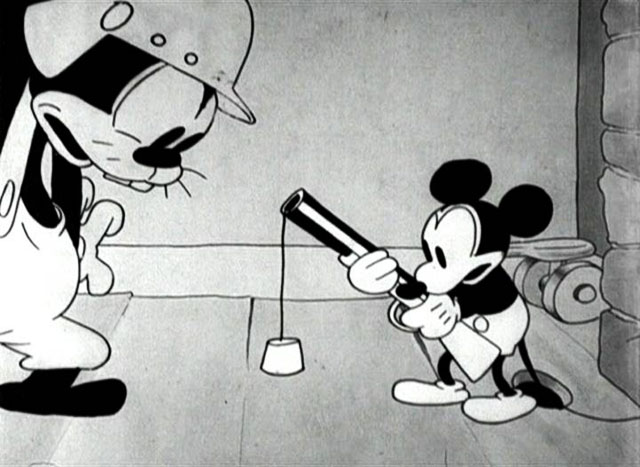
Director: David Hand
Release Date: January 7, 1933
Stars: Mickey Mouse, Minnie Mouse, Pete ,Pluto
Rating: ★★★★
Review:

Building a Building © Walt Disney‘Building a building’ has a grand opening with its close-up of the anthropomorphized excavator.

This fast and gag-rich cartoon can be summarized as ‘Gallopin’ Gaucho‘ at a building site: Mickey is employed as an excavator machinist. When Minnie drops by selling box lunches, Mickey is so struck by love that he ruins the blueprints of foreman Peg Leg Pete three times. Pete is charmed by Minnie, too, and he tries to force her to a kiss. Of course, Mickey comes to the rescue, fleeing with Minnie and leaving Pete behind with the building in complete shambles. Pete just manages to fire Mickey, but Minnie immediately adds him to her business.

‘Building a Building’ reuses several story ideas from the early Oswald cartoon ‘Sky Scrappers‘ (1928). Both feature the hero being an excavator machinist, his love interest bringing box lunches, and Pete trying to abduct the girl. Even the excavator opening shot is a copy of the opening shot of ‘Sky Scrappers’. However, in five years both animation, timing and characterization have much improved. If ‘Sky Scrappers’ was a remarkable achievement for 1928, it was at times still crude. ‘Building a Building’ on the other hand has a refined quality that characterized the Mickey Mouse cartoons of 1933 and beyond.

There’s for example some remarkably flexible animation on Mickey when he rides the elevator. The animators have really put a sense of weight in his body, and exaggerated the effects of the sudden start and stop of the lift on it, with a lovely comic result. The musical score, too, is a delight from beginning to end, becoming particularly silly when Pete’s trousers change into a watering can. Indeed, with ‘Building A Building’ Mickey got his second Academy Award nomination, after ‘Mickey’s Orphans‘ (1931)

‘Building a Building’ is the first of a few 1933 Mickey Mouse cartoons that are introduced and partly played out in Song, following the Silly Symphonies ‘King Neptune‘ and ‘Santa’s Workshop‘ from 1932. Other examples from 1933 are ‘The Mad Doctor‘,  ‘Ye Olden Days‘ and ‘The Mail Pilot‘.

Watch ‘Building a Building’ yourself and tell me what you think:

This is Mickey Mouse cartoon No. 51
To the previous Mickey Mouse cartoon: Mickey’s Good Deed
To the next Mickey Mouse cartoon: The Mad Doctor

Director: Wilfred Jackson
Release Date: April 8, 1933
Rating: ★★★½
Review:

Father Noah's Ark © Walt DisneyThe biblical story of Noah has been quite popular with the Disney Studio: it has retold the story three times on film .

‘Father Noah’s Ark’ is its first version, the others are a stop motion film from 1959 (‘Noah’s Ark‘) and a sequence from ‘Fantasia 2000’ featuring Donald Duck.

This cartoon belongs to Disney’s operetta phase (see also ‘King Neptune‘) and tells the age old story as a musical, including some gospel singing. The story is quite straightforward and the short contains only a few mild gags, the best of which are in the building sequence, e.g. the wives using an assembly line of porcupines and some monkeys using a rhinoceros to make planks out of a log.

The designs seem to be halfhearted: Father Noah’s sons look ridiculously cartoony, wearing Mickey Mouse type gloves, for instance. His sons’ wives, on the other hand, are designed in art deco fashion.

The animals, too, are in different stages of naturalism, but the cows portrayed are much more realistic than the ones featured in the Mickey Mouse shorts of the same time. Moreover, when the animals flee into the ark, we see some unprecedentedly realistic giraffes, sealions and lions.

The most stunning naturalism is found in the animation of the sea when the ark is at the mercy of the waves. This is a spectacular scene by any standards. The storm part also features a complex scene of several animals rolling from side to side. There’s a good sense of weight in this sequence, with the elephant moving last.

Watch ‘Father Noah’s Ark’ yourself and tell me what you think:

This is Silly Symphony No. 35
To the previous Silly Symphony: Birds in the Spring
To the next Silly Symphony: Three Little Pigs

Director: Wilfred Jackson
Release Date: September 17, 1932
Stars: Mickey Mouse, Minnie Mouse, Goofy, Clarabelle Cow, Horace Horsecollar
Rating: ★★★
Review:

The Whoopee Party © Walt DisneyAfter three  years of musical cartoons, consistent story lines where reintroduced to the Mickey cartoons with a remarkable success in 1932 (good examples are ‘Barnyard Olympics‘ and ‘Touchdown Mickey’). In this era the musical cartoon ‘The Whoopee Party’ with its total lack of story seems to be quite old-fashioned.

The short contains numerous elements that were used many times earlier: a public dancing, Minnie singing behind the piano and alive inanimate objects (although the latter feature was much more common practice in the Fleischer and Iwerks cartoons of that time – yet no other Disney cartoon celebrates the secret dancing life of inanimate objects as much as ‘The Whoopee Party’ does). The short also contains some nice effect animation of confetti and flying feathers. Despite being anything but new, the sheer fun with which everything is executed, makes this cartoon a delight to watch.

‘The Whoopee Party’ marks Goofy’s second appearance after his debut in ‘Mickey’s Revue‘ earlier that year. It’s in this cartoon he gets the looks he would maintain until Art Babbitt redesigned him for ‘On Ice’ (1935). He’s more than just a silly laugh now; he now has a rudimentary character of being some kind of silly person, and we hear him speak for the first time. Clearly, he now is one of the gang, making sandwiches with Horace and Mickey, and showing to be a character here to stay. Yet, he’s still more weird than likable – and when he made his debut as ‘Dippy Dawg’ in Floyd Gottfredson’s comic strip in January, 1933, he’s introduced as a pest. In fact, Goofy’s character would remain rather vague until 1935. Only with ‘Mickey’s Service Station’ from that year he would become the likable Goof we know today.

It may be interesting to note that Goofy arguably is the first cartoon character built on a funny voice. His success is proof that, although a unique voice is not necessary (Tom and Jerry for instance could do perfectly without one), it certainly helps to build a character. This must have been an inspiration to later voice-based characters like Donald Duck, Porky Pig and Daffy Duck.

Ironically, Goofy himself would eventually lose his voice in the early forties when voice artist Pinto Colvig left Disney for Fleischer.

Watch ‘The Whoopee Party’ yourself and tell me what you think:

This is Mickey Mouse cartoon No. 46
To the previous Mickey Mouse cartoon: Trader Mickey
To the next Mickey Mouse cartoon: Touchdown Mickey

Director: Burt Gillett
Release Date: December 5, 1931
Stars: Mickey Mouse, Minnie Mouse, Pluto
Rating: ★★★★½
Review:

Mickey's Orphans © Walt DisneyIt’s Christmas and a poor lady drops by Mickey and Minnie’s house to leave a box at their doorstep.

This box contains an endless quantity of little kittens, which are taking over the house within seconds. Soon, the house is near complete destruction. This is partly Mickey’s own fault, because dressed up as Santa he gives the little brats toys like hammers, saws, drills, axes, and even guns and canons.

‘Mickey’s Orphans’ is a real gag cartoon from the outset and the first of several Mickey Mouse shorts in which many brats cause havoc. No musical routine is involved, and as soon as the box of kittens is opened, the gags roll in like they never did before. The kittens even manage to give the ever cheerful Mickey and Minnie a dismayed look, albeit only at the end of the cartoon. The little kittens would cause havoc again in ‘Mickey’s Revue‘ (1932) before being replaced by the little mice in ‘Mickey’s Nightmare‘ later that year. Maybe the idea of giant mice dealing with little kittens was a little too awkward for the makers…

‘Mickey’s Orphans’ is the first of no less than four Mickey Mouse Christmas cartoons, the others being ‘Mickey’s Good Deed‘ (1932), ‘Pluto’s Christmas Tree’ (1952) and ‘Mickey’s Christmas Carol‘ (1983). It was nominated for the very first Academy Award for animated short film, but it understandably lost to the first technicolor short ‘Flowers and Trees‘ (1932), although Walt Disney did get a special Academy Award for the creation of Mickey Mouse.

Watch ‘Mickey’s Orphans’ yourself and tell me what you think:

This is Mickey Mouse cartoon No. 36
To the previous Mickey Mouse cartoon: Mickey Cuts Up
To the next Mickey Mouse cartoon: The Duck Hunt

Director: Burt Gillett
Release Date: November 25, 1931
Stars: Mickey Mouse, Minnie Mouse, Pluto
Rating: ★★★½
Review:

Mickey Cuts Up © Walt Disney‘Mickey Cuts Up’ can be summarized as ‘Mickey Steps Out’ set in a garden.

The first part of the cartoon consists of a quite tiring song-and-dance-routine (with Mickey dancing as a turtle as a minor highlight). Like in ‘Mickey Steps Out’ there’s some whistling with the birds, with Mickey impersonating one. Later the two perform the 1921 hit song ‘Ain’t We Got Fun’ on harmonicas.

Only after five minutes, the second part starts. This hilarious sequence is devoted to Pluto chasing a cat and causing havoc, just like he did in ‘Mickey Steps Out’. The contrast with the first half couldn’t be greater: suddenly the gags come fast and plenty. There’s even an early running gag in which Mickey gets wet in various ways. The second half is of a stunning speed, and a real tour de force in its string of gags leading to other gags, and to the grand finale. This half makes the cartoon a stand out of the era, and one that looks forward to things to come.

Watch ‘Mickey Cuts Up’ yourself and tell me what you think:

This is Mickey Mouse cartoon No. 35
To the previous Mickey Mouse cartoon: The Beach Party
To the next Mickey Mouse cartoon: Mickey’s Orphans

Director: Burt Gillett
Release Date: July 10, 1931
Stars: Mickey Mouse, Minnie Mouse, Pluto
Rating: ★★★½
Review:

Mickey Steps Out © Walt Disney‘Mickey Steps Out’ is the first of a few Mickey Mouse cartoons that are half musical numbers  half story.

This was a plot structure used in many Mickey Mouse cartoons from 1931 to 1933, with ‘The Pet Store‘ being the last example. This half-baked structure was soon replaced by stories filling the complete cartoons.

In ‘Mickey Steps Out’, Mickey visits Minnie, but Pluto, who should have stayed in, is following him, dragging his dog house along to Minnie’s place. First, Mickey and Minnie perform their usual song-and-dance-routine (this time based on ‘Sweet Georgia Brown’), but when Pluto is chasing a cat, their music is interrupted and followed by a fast sequence of gags of Pluto and the cat ruining the house culminating in a blackface gag.

‘Mickey Steps Out’ arguably contains the first well-constructed finale in Disney history. It’s at least the first of a series of cartoons that end in complete destruction. Pluto would again cause havoc in ‘Mickey Cuts Up’ (1931) and ‘The Grocery Boy’ (1932). Later, destruction would be caused by little kittens (a.o. ‘Mickey’s Orphans‘, 1931) and orphan mice (a.o. ‘Mickey’s Nightmare‘, 1932). ‘Mickey Steps Out’ reuses footage of ‘The Birthday Party’ of Mickey with a fishbowl on his head.

Almost secretly, the film introduces another novelty: the first attempt at a realistically drawn animal: Minnie’s canary is in no sense cartoony, behaving like a real bird. It’s a major advance when compared to the Silly Symphony ‘Birds of a Feather‘ from six months earlier. The canary only plays a small part in the cartoon, but is the testimony of Disney’s ultimate ambitions, even at this stage. It’s these innovations, better story arcs and a strive towards better, more realistic animation that propelled the Disney cartoons forward, leaving their contemporaries far behind.

Watch ‘Mickey Steps Out’ yourself and tell me what you think:

This is Mickey Mouse cartoon No. 30
To the previous Mickey Mouse cartoon: The Delivery Boy
To the next Mickey Mouse cartoon: Blue Rhythm

Director: Burt Gillett
Release Date: January 2, 1931
Stars: Clarabelle Cow, Horace Horsecollar, Mickey Mouse, Minnie Mouse
Rating: ★★½
Review:

Mickey visits Minnie who has organized a surprise party for his birthday.

Mickey gets a piano for a present and he and Minnie perform a duet on two pianos, singing the 1928 hit ‘I Can’t Give You Anything But Love, Baby’, popularized by e.g. Annette Hanshaw and Louis Armstrong. When Mickey and Minnie dance themselves to the 1917 classic Darktown Strutters’ Ball, their music-stools take over their playing (as did Mickey’s stool in ‘Mickey’s Follies’ from 1929). The cartoon ends with Mickey playing variations on the 12th Street Rag on a stubborn marimba.

This cartoon is actually one long joyful play-and-dance-routine, but its beginning is quite remarkable: when Mickey and Minnie bashfully ask each other whether they’re fine, this may probably be the first funny dialogue in Disney history. At least, it’s a wonderful example of character animation, elegantly establishing the relationship between the two.

Mickey would celebrate his birthday again in ‘Mickey’s Birthday Party’ (1942), which only superficially resembles this earlier short.

Watch ‘The Birthday Party’ yourself and tell me what you think:


This is Mickey Mouse cartoon No. 25
To the previous Mickey Mouse cartoon: Pioneer Days
To the next Mickey Mouse cartoon: Traffic Troubles

Director: Wilfred Jackson
Release Date: June 22, 1931
Rating: ★★½
Review:

This Silly Symphony is a quite uninteresting cartoon about beavers.

The film starts with rather dull gags of beavers building a dam to Frank Churchill’s music. By now the dance routines had vanished from the screen, to make place for rhythmical movement. The beavers are portrayed almost as industrial workers, and this first half simply bursts with animation cycles.

Only after four minutes a ‘story’ develops of a little beaver who saves the whole population from a terrible flood. The beavers completely lack personality and even the spirited little one fails to impress. After such elaborate cartoons as ‘Mother Goose Melodies‘ and ‘The China Plate‘ the cartoon’s uniform, dull designs, and tiresome repetitive animation come as a letdown. The result is one of the weaker Silly Symphonies, although it features some quite spectacular animation of the approaching flood.

Watch ‘The Busy Beavers’ yourself and tell me what you think:

This is Silly Symphony No. 19
To the previous Silly Symphony: The China Plate
To the next Silly Symphony: The Cat’s Out

Director: Wilfred Jackson
Release Date: May 16, 1931
Rating:  ★★★★½
Review:

Although this cartoon is one of those Silly Symphonies from 1931 using the half dance-routine half story formula, it is one of the most beautiful and most entertaining Silly Symphonies of the era.

The film is inspired by a Western view on a mythical ancient China. The film is without any dialogue and makes effective use of Albert Ketèlbey’s musical piece ‘In a Chinese Temple garden’ to create an oriental atmosphere. It tells a simple story of a little fisherman who saves a girl from drowning, falls in love with her and rescues her from an evil mandarin and a large (Western and fire-breathing) dragon.

After ‘Mother Goose Melodies‘ this is the studio’s second take at the human figure. The result is a mixed bag. The heroin’s movements are still cartoony, for example, and she walks with her knees sideways. Even worse, the long-legged China-man has no hint of realism at all. Moreover, the hero’s size is quite inconsistent, suddenly becoming very small when fighting the evil mandarin. On the other hand, the boy and girl are elegantly drawn, especially their hands. The two easily gain the audience’s sympathy and transcend the stereotypes that occupy most of the film.

Together with ‘Mother Goose Melodies’, ‘The China Plate’ is the most elaborate of the early Silly Symphonies. It’s surprisingly fast-paced and full of action. The complete cartoon is one of sheer delight.

Watch ‘The China Plate’ yourself and tell me what you think:

This is Silly Symphony No. 18
To the previous Silly Symphony: Mother Goose Melodies
To the next Silly Symphony: The Busy Beavers

Director: Burt Gillett
Release Date: September 22, 1930
Stars: Mickey Mouse, Minnie Mouse
Rating: ★★★
Review:

A gruesome gorilla has escaped. Mickey rings Minnie to warn her about it, but she’s not afraid and she plays Mickey a tune* through the telephone, until the gorilla enters and kidnaps her. Of course Mickey rushes to her house to save her.

This cartoon is interesting for the rather extensive dialogue in the beginning of the cartoon. By now the Disney animators had mastered lip-synch, and neither Mickey nor Minnie show any awkward faces anymore while talking.

Even more interesting is the cartoon’s quite elaborately drawn gorilla, which in several scenes is staged originally to show its huge size. The cartoon is a great improvement on Mickey’s earlier horror cartoon, ‘The Haunted House‘ (1929) and cleverly explores the possibilities of suspense by using some spectacular elements of horror: whispers, shadows, darkness and false alarms. It also contains a classic corridor-with-doors-scene, which may very well be the very first in its genre.

Watch ‘The Gorilla Mystery’ yourself and tell me what you think:

This is Mickey Mouse cartoon No. 22
To the previous Mickey Mouse cartoon: The Chain Gang
To the next Mickey Mouse cartoon: The Picnic

* The tune is “All Alone”, a hit song from 1924, which of course still was copyrighted in 1930. The use of a copyrighted tune marks a change in Disney’s musical policy. Apparently by 1930 he could afford it to pay rights. Disney’s use of well-known pop tunes remained sporadical, however. And Disney soon turned to producing hit songs of his own, most notably ‘Who’s Afraid of the Big Bad Wolf’ from ‘Three Little Pigs‘ (1933).

Director: Walt Disney
Release Date: April 25, 1929
Stars: Mickey Mouse
Rating: ★★★★
Review:

The Barnyard Battle © Walt DisneyMickey joins a barnyard army of mice (many of which are Mickey look-a-likes) against an invading army of cats.

We see him naked while he’s treated rather badly by a very rude officer. Mickey’s body is extraordinarily mechanical in this scene: the officer is able to stretch his neck and tongue endlessly, and can even take out Mickey’s heart.

In the next scene another officer shouts “company, forward march!”, making him the first character in a Disney cartoon that actually speaks. Up to this moment characters would only utter single syllable sounds and laughs. Only Minnie could express two syllables with her yoo-hoo, but that was it.

In spite of this step forward, ‘The Barnyard Battle’ remains, in effect, a silent cartoon. The way the inspecting officer asks Mickey to stick out his tongue is a perfect example. The highlight of silent acting, however, is given to Mickey, who, when confronted with a large and mean cat, gives a performance that matches Charlie Chaplin.

Mickey’s size is rather inconsistent in this cartoon. His never as small as in ‘When the Cat’s Away‘, but in some scenes he’s clearly much smaller than usual. The battle has more allusions to the American civil war than to World War I, making it a little more comfortable. Mickey finally defeats the cats by clobbering them with a hammer to Verdi’s anvil chorus from ‘Il Trovatore’. This is probably the first animated scene in which something totally unmusical is done musically. A great cartoon idea, which would be greatly expanded in many cartoons to come.

Watch ‘The Barnyard Battle’ yourself and tell me what you think:

This is Mickey Mouse cartoon No. 7
To the previous Mickey Mouse cartoon: When the Cat’s Away
To the next Mickey Mouse cartoon: The Plow Boy

Director: Walt Disney
Release Date: May 9, 1929
Stars: Mickey Mouse, Minnie Mouse, Horace Horsecollar
Rating: ★★
Review:

The Plow Boy © Walt DisneyIn this weak cartoon (Mickey’s seventh) Mickey and Minnie are farmers.

The most remarkable thing about this cartoon is that it marks the debut of Horace Horsecollar. One might say, it marks the debut of Clarabelle Cow, as well, but the early Mickey Mouse cartoons contain a little too many non-distinct cows to state that clearly, because this cow is not different from the others.

This cartoon is particularly important in the development of Minnie: she now has lost the bra-like circles on her body and she’s singing for the first time. Notice how the animation of the tongue is completely convincing. Although Minnie’s only singing “lalalala” (something she would do in many cartoons to follow), this is an important step in the animation of speech. This was something I guess Disney was eager to master. Indeed, in the next cartoon, ‘The Karnival Kid‘, there’s suddenly a lot of talking and singing.

‘The Plow Boy’ contains a scene where the background moves the wrong way making the cow walk backwards.

Watch ‘The Plow Boy’ yourself and tell me what you think:


This is Mickey Mouse cartoon No. 8
To the previous Mickey Mouse cartoon: 
The Barnyard Battle
To the next Mickey Mouse cartoon: The Karnival Kid

Director: Ben Sharpsteen
Release Date: January 2, 1937
Stars: Mickey Mouse, Pete, Pluto
Rating: ★★½
Review:

The Worm Turns © Walt DisneyIn the opening shot of ‘The Worm Turns’ we watch Mickey looking like an evil scientist, working on a potion that can give courage and power.

He tries it on a fly caught in a spiderweb, on a mouse (the two different designs of mice in this film, with one being twenty times larger, is quite confusing!) who is the victim of a cat, on the cat, who’s chased by Pluto, and on Pluto, who’s threatened by evil dog catcher Pete.

The animation of the opening sequence is quite stunning, but the whole short fails to get funny. Hanna and Barbera would revisit the same idea in the similar ‘Dr. Jekyll and Mr. Mouse‘ (1947) with much better results.

Watch ‘The Worm Turns’ yourself and tell me what you think:

This is Mickey Mouse cartoon No. 90
To the previous Mickey Mouse cartoon: Mickey’s Elephant
To the next Mickey Mouse cartoon: Don Donald

Director: Walt Disney
Release Date: May 3, 1929
Stars: Mickey Mouse, Minnie Mouse
Rating:
Review:

When The Cat's Away © Walt DisneyAwkwardly, in this sixth Mickey Mouse cartoon Mickey and Minnie are portraited as real mice.

They are joined by several look-a-likes in a house party, while the owner, a drunk cat, is gone hunting. There’s still some silent comedy (and no dialogue), but there’s no real story, only an extended musical number. Therefore this cartoon can be regarded as the first of many ‘song-and-dance-routine’-cartoons that would dominate the early 1930s. It even predates the Silly Symphony series, which initial sole raison d’être seems to be song-and-dance-routines.

These cartoons no doubt delighted the audiences at the time. However, I regret their coming, because both story and surreal humor had to give way to the rise of them. ‘When the Cat’s Away’ is a prime example: despite some clever gags, it is easily the dullest of the earliest Mickey Mouse cartoons.

After ‘When the Cat’s Away’ Mickey would never been portrayed as a real mouse again. Like in his first five cartoons, he would just be a boy in the shape of a mouse. The idea of Mickey being a mouse would become negligible compared to the cartoon star he was. Mickey was seen as an actor, not as an animal. This would eventually lead to the awkward situation of Mickey dealing with ‘real’ and very different looking mice in ‘The Worm Turns‘ (1937).

Watch ‘When The Cat’s Away’ yourself and tell me what you think:

This is Mickey Mouse cartoon No. 6
To the previous Mickey Mouse cartoon: The Opry House
To the next Mickey Mouse cartoon: The Barnyard Battle

Director: David Hand
Release Date: November 17, 1934
Stars: Donald Duck, Fifi, Mickey Mouse, Minnie Mouse, Pete
Rating: ★★★★★
Review:

Mickey and Donald (in his third appearance) are policemen hunting Pete who has ‘dognapped’ Minnie’s dog Fifi. The chase, which includes a lot of gunfight, ends in a sawmill where all three have to cope with a runaway circular saw.

The cartoon is outstanding for its fast pace and high content of gags. Mickey and Donald are staged as a duo, but, like in ‘Orphan’s Benefit’, Donald Duck is given the last shot. ‘The Dognapper’ would remain Mickey’s and Donald’s only genuine duo cartoon, but it set the stage for the famous trio outings of the late thirties in which Mickey, Donald and Goofy would fight the odds together. Goofy, the only missing element, would join Mickey and Donald a few months later, in ‘Mickey’s Service Station’ (1935).

Watch ‘The Dognapper’ yourself and tell me what you think:

This is Mickey Mouse cartoon No. 70
To the previous Mickey Mouse cartoon: Mickey Plays Papa
To the next Mickey Mouse cartoon: Two-Gun Mickey

Director: Burt Gillett
Release Date: July 30, 1932
Rating: ★★★★★ ♕
Review:

Flowers and Trees © Walt Disney‘Flower and Trees’ was the first film (animated or not) in full technicolor and it’s therefore a milestone of cinema.

Nevertheless, it feels like a transitional film. The colors make it stunningly modern compared to the earlier Silly Symphony entries, but some of the designs still firmly belong to the black-and-white era. The designs of the flowers and the caterpillars, for instance, go all the way back to the third Silly Symphony, ‘Springtime‘ from 1929.

The birds, on the other hand, have lost their cartoony designs they still had in ‘The Bird Store‘ from six months earlier, and the villain tree is probably the most elaborate character to have hit the animated screen thus far.

For contemporary audiences, the film may seem rather silly and a bit old fashioned, but its storytelling is very economical. It contains some original visual gags (flowers brushing their teeth, a pine portrayed as a hen) and fine drama, when the rejected mean old trees sets the wood on fire. The colors are not only used as a novelty, but add to the drama, as do musical quotes from Franz Schubert’s “Erlkönig” and Gioachino Rossini’s overture to William Tell.

Technicolor was a great advancement for the Silly Symphony series. The colors created way more atmosphere and allowed for more complex designs. Because of color, the Silly Symphonies would propel animated art forward like they never did before, making Walt Disney the undisputed leader in the field.

This leadership was greatly aided by the exclusive contract Disney concluded with the Technicolor company, giving him the exclusive rights to use the new technique for animated films for three years. So, when other studios had to stick to black and white, or were obliged to use far less convincing two-color techniques, Walt Disney made the most beautiful and literally most colorful cartoons of the 1930s.

‘Flowers and Trees’ enthralled  the critics so much at the time, they installed a special Academy Award for best animated short films, with ‘Flowers and Trees’ naturally being its first winner. During the 1930s Disney would win every Oscar in this category.

Watch ‘Flowers and Trees’ yourself and tell me what you think:

This is Silly Symphony No. 29
To the previous Silly Symphony: Just Dogs
To the next Silly Symphony: King Neptune

Director: Wilfred Jackson
Release Date: February 23, 1935
Stars: Clarabelle Cow, Donald Duck, Horace Horsecollar, Mickey Mouse
Rating: ★★★★★ ♕
Review:

The Band Concert © Walt DisneyAlmost three years after ‘Flowers and Trees’ Mickey finally made the step to color, and it’s probably because of this that ‘The Band Concert’ has such a Silly Symphony-like feel to it.

In 1935 the concept of a concert cartoon was already an old one (Mickey’s first was the ‘Barnyard Concert’ from 1930), but it finds the peak of perfection in this one.

Likewise, the use of Gioachino Rossini’s ‘overture Wilhelm Tell’ and ‘Turkey in the Straw’ in cartoons was far from new, but who would have thought that the two tunes would fit together so perfectly? The overture is played inside-out culminating in the storm sequence which brings forth a tornado. That’s how it feels, Mickey is not only conducting the storm music but even the real storm itself!

Notwithstanding the cartoon being a Mickey Mouse showcase, it’s Donald Duck who is stealing the show, like he did in the two previous Mickey Mouse cartoons he appeared in: ‘Orphan’s Benefit‘ and ‘The Dognapper‘. Being the only character in the cartoon born in color, Donald makes the transition from black-and-white to color naturally. Mickey and the other characters, on the other hand, still have a strong black-and-white feeling in their design and are less fitting in the bright world of color.

During Mickey’s concert, Donald produces an unending supply of flutes out of nothing, playing ‘Turkey in the Straw’ right through Rossini’s music (this ability of bringing forth material from out of nowhere was a capability that Donald would soon lose, but it would become a trademark of Bugs Bunny several years later). It’s a bitter irony that it’s this tune, ‘Turkey in the Straw’, which signals Mickey’s demise, because it was the same tune that made Mickey a star in the first place.

Nevertheless, ‘The Band Concert’ is without doubt Mickey’s best concert cartoon, arguably his best cartoon since ‘Steamboat Willie‘ and certainly one of the most perfect animated cartoons ever made.

Watch ‘The Band Concert’ yourself and tell me what you think:

This is Mickey Mouse cartoon No. 73
To the previous Mickey Mouse cartoon: Mickey’s Man Friday
To the next Mickey Mouse cartoon: Mickey’s Service Station

Directors: William Hanna & Joseph Barbera
Release Date: April 26, 1947
Stars: Tom & Jerry
Rating: ★★★★★ ♕
Review:

The Cat Concerto © MGMIn ‘The Cat Concerto’ Tom unexpectedly appears to be a star pianist, playing Franz Liszt’s second rhapsody in concert, and doing it with enjoyable flair.

Unfortunately his playing awakes Jerry, who sleeps inside the grand piano. This leads to a hilarious chase in and around the piano, while the playing of the music continues.

‘The Cat Concerto’ almost looks like a remake of Friz Freleng’s ‘Rhapsody Rabbit‘ from 1946. However, it shares only two gags with the earlier film: that of the mouse suddenly interjecting a boogie-woogie theme and the final gag in which the mouse steals the show. The main difference between the two films is The Cat Concerto’s higher sense of realism and its integrated story, in which every gag follows from the one preceding it in almost continuous action.

‘Rhapsody Rabbit’, in contrast, is more absurd and contains more totally unrelated black-out gags. In the end, ‘The Cat Concerto’ is the better cartoon, because of its great characterization, its outstanding animation, its perfect timing. Indeed, it won an Academy Award, and together with ‘The Band Concert‘ (1935) it can be considered the best concert cartoon of all time.

Nevertheless, there seems to be something fishy about ‘The Cat Concerto’, when compared with ‘Rhapsody Rabbit’. For more on the controversy about these two all too similar cartoons, see Thad Komorowski’s excellent blogpost on the issue.

Watch ‘The Cat Concerto’ yourself and tell me what you think:

https://vimeo.com/161359411

This is Tom & Jerry cartoon No. 29
To the previous Tom & Jerry cartoon: Part Time Pal
To the next Tom & Jerry cartoon: Dr. Jekyll and Mr. Mouse

Director: Friz Freleng
Release Date: November 11, 1946
Stars: Bugs Bunny
Rating: ★★★★
Review:

Rhapsody_Rabbit © Warner BrosA very deft Bugs Bunny plays Franz Liszt’s second Hungarian rhapsody on a piano. This classical piece was director Friz Freleng’s all-time favorite, and it appears in several of his films.

In ‘Rhapsody Rabbit’ it is played out full. The cartoon consists of spot gags and it has a small story about Bugs having problems with a mouse. This story element is not well-developed and dropped halfway the cartoon, only to return at the end.

The idea of a battle between the pianist and a mouse was perfected by Hanna & Barbera only five months later in their Tom & Jerry cartoon ‘The Cat Concerto‘, which has exactly the same subject, and which uses exactly the same music by Liszt. Unlike Freleng however, the duo swept the Oscar… There seems to be something fishy about this fact, which is analyzed in detail by Thad Komorowski in his excellent blogpost on the issue.

Compared to the latter cartoon, ‘Rhapsody Rabbit’ is less consistent, but more absurd. The gag in which the mouse makes Bugs play an infectious boogie-woogie may be the highlight of the film.

Watch ‘Rhapsody Rabbit’ yourself and tell me what you think:

http://www.220.ro/desene-animate/Rhapsody-Rabbit/RnRu8v7HIK/

This is Bugs Bunny cartoon No. 41
To the previous Bugs Bunny cartoon: The Big Snooze
To the next Bugs Bunny cartoon: Rabbit Transit

Director: Walt Disney
Release Date: March 28, 1929
Stars: Mickey Mouse
Rating: ★★★½
Review:

The Opry House © Walt DisneyUnlike its predecessor, ‘The Barn Dance‘, ‘The Opry House’ relies heavily on sound and music.

Mickey is the sole performer in a local theater where he dances and plays music. He even dresses up as a female belly dancer, dancing the hoochie coochie dance.

With its many musical gags, this cartoon is the first step in the development of the ‘concert cartoon’. An orchestra plays George Bizet’s Carmen way out of tune, and Mickey performs the Hungarian Rhapsody by Franz Liszt on the piano. This sequence is particularly important for two reasons: first, Mickey here gains his famous gloves, and second, this is the first time that Liszt’s famous work is featured in an animated cartoon. It would remain a cartoon classic and many years later, Bugs Bunny would perform the same piece on the piano in ‘Rhapsody Rabbit‘ (1946), and Tom and Jerry in ‘The Cat Concerto‘ (1947). Already in this cartoon, Liszt’s piece is the source of several musical gags, as Mickey plays the piano in the most original ways, even clobbering it with his fists, until his stool kicks him.

Watch ‘The Opry House’ yourself and tell me what you think:

This is Mickey Mouse cartoon No. 5
To the previous Mickey Mouse cartoon: The Barn Dance
To the next Mickey Mouse cartoon: When The Cat’s Away

Enter your email address to follow this blog and receive notifications of new posts by email.

Join 918 other subscribers
Bookmark and Share

Categories