
You are currently browsing the tag archive for the ‘1932’ tag.
Director: Dave Fleischer
Release Date: March 25, 1932
Stars: Betty Boop, Bimbo
Rating: ★★½
Review:
 In ‘Crazy Town’ Betty Boop and Bimbo take a streetcar to Crazy Town, where everything is the other way round.
Unfortunately, this great idea doesn’t really lead to a funny cartoon. We’re watching e.g. fish in the sky and birds in the water, an elephant with a real trunk and a fish fishing for a person. In a lengthy sequence Bimbo is a barber adding hair to his customers. None of these scenes even raise a chuckle. In fact, the cartoon’s only interesting part is it’s opening, because the story unfolds like a real book.
It’s weird to realize that as soon as the Fleischers deliberately tried to show a surreal world, they failed, while their ‘normal’ shorts were full of mesmerizing surrealism (e.g. the earlier ‘Mask-a-raid‘ and ‘Chess Nuts‘ or ‘Betty Boop’s Bamboo Isle‘ from later that year). The theme song of this cartoon is the 1931 hit ‘Foolish Facts’.
Watch ‘Crazy Town’ yourself and tell me what you think:
This is Talkartoon No. 35
To the previous Talkartoon: S.O.S.
To the next Talkartoon: The Dancing Fool
‘Crazy Town’ is available on the French DVD Box Set ‘Betty Boop Coffret Collector’
Director: Dave Fleischer
Release Date: February 5, 1932
Stars: Bimbo, Betty Boop
Rating: ★
Review:
 Even though ‘The Robot’ was released half a year after ‘The Herring Murder Case’ (1931) it features Bimbo in his design before his make-over in that film.
In this film Bimbo is courting a female character, who only wants to marry him, when he can lick ‘One Round Mike’ in a boxing match. Bimbo accepts, but when it’s his turn he builds a robot out of his car to win the game.
Betty Boop has a small cameo in this cartoon when she rushes outside to revive Bimbo’s car-robot (or is she Bimbo’s girlfriend but in a different design? The Fleischers were inconsistent enough to be unclear on this). Apart from this short scene, there’s little to enjoy in ‘The Robot’. The most interesting part maybe Bimbo’s way of courting his sweetheart, which he does by ‘television’, a sort of Skype avant la lettre.
Strangely enough, the idea of a boxing robot was reused in ‘Mickey’s Mechanical Man‘ from 1933, with equally weak results. There was something going on in 1932 with boxing robots anyway, for also Popeye socks a robot in the ring in the Popeye Sunday comic strip of April, 24 and May 1, 1932. In any case, to most people in the Great Depression robots were the ultimate terror, as unemployment already was a major problem. Luckily, no robot would be used in any factory until the 1960s. And boxing robots still haven’t seen the light of day, yet.

Spread from the April 1934 issue of Modern Mechanix and Inventions
More on the robot craze of the early 1930s can be found here and here.
Watch ‘The Robot’ yourself and tell me what you think:
This is Talkartoon No. 32
To the previous Talkartoon: Boop-Oop-a-Doop
To the next Talkartoon: Minnie the Moocher
‘The Robot’ is available on the French DVD Box Set ‘Betty Boop Coffret Collector’
Directors: John Foster & George Stallings
Release Date: April 23, 1932
Stars: Tom and Jerry
Rating: ★
Review:
 In ‘Joint Wipers’ Tom and Jerry are plumbers who desperately try to fix a large leak in a woman’s house.
The duo only manages to drain the lady of her own house, together with her pets, and followed by several other animals. Meanwhile the apartment gets flooded, and at one point the whole building washes away.
Like other Tom and Jerry cartoons ‘Joint Wipers’ suffers from bad animation and an absence of timing. The cartoon’s highlight, if there is any, is when Tom & Jerry celebrate their profession in song, while drops of water play the piano.
Watch ‘Joint Wipers’ yourself and tell me what you think:
This is Tom & Jerry cartoon No. 9
To the previous Tom & Jerry cartoon: In the Bag
To the next Tom & Jerry cartoon: Pots and Pans
‘Joint Wipers’ is available on the DVD ‘The Complete Animated Adventures of Van Beuren Studio’s Tom and Jerry’
Directors: John Foster & George Rufle
Release Date: March 26, 1932
Stars: Tom and Jerry
Rating: ★
Review:
 ‘In the Bag’ opens the same way as the Waffles and Don short ‘The Haunted Ship‘ (1930): with the two main protagonists flying a plane that soon crashes.
This time the plane crashes into some Western setting, where Tom and Jerry meet a villain. We can also watch Jerry performing some impossible lasso tricks. Then the two go to a saloon where they perform a Mills Brothers-like song. Unfortunately, the villain appears, robbing everybody, but Jerry saves the day, bringing him back and earning a $1000 reward. Tom then steals the money, or does he?
From beginning to end, ‘In the Bag’ makes little sense at all. The film is surprisingly low on gags, and the action is devoid of any timing. The result is one of the weakest of Van Beuren’s Tom and Jerry films.
Watch ‘In the Bag’ yourself and tell me what you think:
This is Tom & Jerry cartoon No. 8
To the previous Tom & Jerry cartoon: Rabid Hunters
To the next Tom & Jerry cartoon: Joint Wipers
‘In the Bag’ is available on the DVD ‘The Complete Animated Adventures of Van Beuren Studio’s Tom and Jerry’
Directors: John Foster & George Stallings
Release Date: February 27, 1932
Stars: Tom and Jerry
Rating: ★★½
Review:
 In ‘Rabid Hunters’ Tom and Jerry are hunters, who try to catch a rabbit with their semi-anthropomorphized dog and horse.
The rabbit appears to be an early forerunner of Bugs Bunny, outwitting all four characters to a jazzy upbeat score. This soundtrack, by Gene Rodemich, is the absolute highlight of this otherwise erratic, boring and terribly poorly animated short. Also noteworthy is a hallucinatory scene at a tree branch that has to be seen to be believed. Like the Silly Symphony ‘The Fox Hunt‘ from a year earlier, the cartoon ends with a skunk.
Watch ‘Rabid Hunters’ yourself and tell me what you think:
This is Tom & Jerry cartoon No. 7
To the previous Tom & Jerry cartoon: Rocketeers
To the next Tom & Jerry cartoon: In the Bag
‘Rabid Hunters’ is available on the DVD ‘The Complete Animated Adventures of Van Beuren Studio’s Tom and Jerry’
Directors: John Foster & George Rufle
Release Date: January 30, 1932
Stars: Tom and Jerry
Rating: ★★½
Review:
 While Van Beuren’s Aesop’s Fables gained some quality, the Tom and Jerry series remained downright poor in terms of storytelling, staging and animation.
For example, the opening scenes of ‘Rocketeers’ are so deeply drenched in the 1920’s comic tradition that the scene’s silent acting feels terribly old-fashioned. In it, Tom and Jerry are members of the Royal Experimental Society, firing themselves to the moon in an over-sized sky-rocket. Then the cartoon takes quite an unexpected turn: instead of flying to the moon, the rocket plummets immediately and falls into the ocean, reaching the sea floor, where Tom and Jerry encounter some sea monsters and some skeletons (looking back to the Waffles and Don cartoon ‘The Haunted Ship‘ from 1930). But just when one starts to prepare for yet another horror-inspired cartoon, the duo hits on some sexy mermaids. Tom & Jerry perform a song, while the mermaids dance.
The designs of the mermaids are halfway those of Fleischer’s ‘Barnacle Bill‘ (1930) and Disney’s later ‘King Neptune‘ from September 1932. Their stylized, pretty human designs contrast greatly with Tom & Jerry’s own primitive features, and are without doubt the highlight of the cartoon.
Tom and Jerry would fly a rocket again in their last cartoon ‘The Phantom Rocket‘ (1933), which also plummets into the sea.
Watch ‘Rocketeers’ yourself and tell me what you think:
This is Tom & Jerry cartoon No. 6
To the previous Tom & Jerry cartoon: A Swiss Trick
To the next Tom & Jerry cartoon: Rabid Hunters
‘Rocketeers’ is available on the DVD ‘The Complete Animated Adventures of Van Beuren Studio’s Tom and Jerry’
Director: unknown
Release Date: May 13, 1932
Stars: Flip the Frog
Rating: ★
Review:
 In most of his films Flip the Frog, like Mickey Mouse, is somewhat of a young adult. Yet, in ‘School Days’ Flip suddenly is young enough to have to attend school, where he gets music lessons among human kids.
Unfortunately, Flip’s dog (introduced in the previous cartoon, ‘Puppy Love’) has followed him to school, and battles with a skunk, which has popped out of nowhere, making all people, including the desks, flee the building.
‘School Days’ is a very weak and terribly unfunny cartoon, anticipating many childish cartoon of the later 1930s. Its story is less consistent, but also less sentimental than that of ‘The Milkman‘ or ‘What a Life‘ from earlier that year. Unfortunately, it doesn’t exchange the sentimentality for anything, rendering a bland, forgettable cartoon. To illustrate this: the ‘best gag’ is when the teacher accidentally picks up an erotic magazine instead of a schoolbook.
Watch ‘School Days’ yourself and tell me what you think:
This is Flip the Frog cartoon No. 21
To the previous Flip the Frog cartoon: Puppy Love
To the next Flip the Frog cartoon: The Bully
‘School Days’ is available on the DVD ‘Cartoons that Time Forgot – The Ub Iwerks Collection Vol. 2’
Director: unknown
Release Date: March 26, 1932
Stars: Flip the Frog
Rating: ★★★
Review:
 ‘What a Life’ is a genuine cartoon from the Great Depression era.
In the opening scene Flip and the little brat from ‘The Milkman‘ are poor musicians performing on the street to no avail. Being hungry, they pawn their instruments, only to lose their money to a swindler. Later they have to flee for a cop, and find food and shelter at a house, whose owner turns out to be the cop’s wife.
‘What A Life’ is a sentimental film, akin to the Laurel & Hardy film ‘Below Zero’ (1930), and ‘Mickey’s Good Deed‘ from later that year. Even more than ‘The Milkman’ it plays at sentiments more than laughs, and it looks ahead to the sentimentality that would dominate the years 1934-1938. Nevertheless, because it’s so typical of the darkest days of the Great Depression, it’s more interesting than most of those films. Moreover, it features a remarkably sexy and adulterous woman in the cop’s wife.
One of the spectators in the opening scene is a clear caricature of someone, but of whom?
Watch ‘What a Life’ yourself and tell me what you think:
This is Flip the Frog cartoon No. 19
To the previous Flip the Frog cartoon: Fire! Fire!
To the next Flip the Frog cartoon: Puppy Love
‘What a Life’ is available on the DVD ‘Cartoons that Time Forgot – The Ub Iwerks Collection Vol. 2’
Director: unknown
Release Date: February 20, 1932
Stars: Flip the Frog
Rating: ★★
Review:
 In ‘The Milkman’ Flip is both a farmer with a dairy farm and a milkman.
The cartoon features an extraordinary scene of Flip delivering milk, which uses an animated background, with an original curved perspective. Unfortunately, most of the screen time is devoted to Flip trying to deal with an annoying little brat he finds in a trashcan. The brat causes Flip quite some trouble, but at the end of the cartoon Flip and the brat become friends. Indeed, one month later we watch them together in the sentimental ‘What A Life‘.
The antics of Flip and the boy anticipate similar cartoons of ca. 1934-1938, when the Hays code had hit Hollywood hard, and most studios turned out remarkably childish, goody-goody cartoons. ‘The Milkman’ is an early example, playing on sentiments instead of laughs.
Watch ‘The Milkman’ yourself and tell me what you think:
This is Flip the Frog cartoon No. 17
To the previous Flip the Frog cartoon: Spooks
To the next Flip the Frog cartoon: Fire! Fire!
‘The Milkman’ is available on the DVD ‘Cartoons that Time Forgot – The Ub Iwerks Collection Vol. 2’
Director: Burt Gillett
Release Date: October 1, 1932
Rating: ★★★
Review:
 ‘Bugs in love’ was the very last of the black and white Silly Symphonies, being even released after the technicolor films ‘Flowers and Trees‘ and ‘King Neptune‘.
The short’s story is almost a copy of that of ‘The Spider and the Fly‘ (1931) and features two bugs in love, who are threatened by a mean crow. Luckily their fellow flies come to the rescue, in an elaborate battle scene, in which the flies use e.g. ink, false teeth, shoe polish, an eggbeater, a mousetrap and castor oil to defeat the crow.
The ingenuity of this particular battle scene is intriguing, but unfortunately it follows all too similar scenes in films like ‘The Spider and the Fly’, ‘The Bird Store‘ and ‘The Bears and the Bees‘. The result is a rather traditional Silly Symphony, with its repetitious animation and rhythmical sequences. Luckily, with its two color Silly Symphonies Disney had demonstrated it could do much better, and the studio did not return to this formula, until the elaborate ‘The Moth and the Flame’ from 1938.
‘Bugs in love’ is clearly related to the successful comic strip ‘Bucky Bug’, begun earlier the same year. However, it’s not entirely clear to me whether the hero bug in ‘Bugs in Love’ is Bucky himself, or not.
Watch ‘Bugs in Love’ yourself and tell me what you think:
This is Silly Symphony No. 31
To the previous Silly Symphony: King Neptune
To the next Silly Symphony: Babes in the Woods
‘Bugs in Love’ is available on the DVD ‘Walt Disney Treasures: More Silly Symphonies’
Director: Wilfred Jackson
Release Date: July 9, 1932
Rating: ★
Review:
 ‘The Bears and the Bees’ follows the adventures of two little bear cubs, who encounter a large mean bear and a bee colony.
The two cubs eat the bees’ honey, but luckily it’s the old mean bear who gets all the stings, in an elaborate battle scene, comparable to those in ‘The Spider and the Fly‘ (1931) and ‘Bugs in Love‘ (1932).
The story of ‘The Bears and the Bees’ is consistent, but remarkably boring. The two little bears look like early forerunners of Mickey’s nephews Morty and Ferdy, who would make their screen debut two years later in ‘Mickey’s Steamroller‘ (1934). It’s interesting to see how the animators tried to render these two cubs partly as animals and partly as little brats. This way of animating animals halfway anthropomorphism would become a Disney specialty, leading to masterpieces like ‘Bambi‘ (1942) and ‘Lady and the Tramp‘ (1956). In this short it can be watched in its embryonic form.
Watch ‘The Bears and the Bees’ yourself and tell me what you think:
This is Silly Symphony No. 27
To the previous Silly Symphony: The Bird Store
To the next Silly Symphony: Just Dogs
‘The Bears and the Bees’ is available on the DVD ‘Walt Disney Treasures: More Silly Symphonies’
Director: Wilfred Jackson
Release Date: January 5, 1932
Rating: ★★★
Review:
 ‘The Bird Store’ follows earlier Mickey Mouse films and Silly Symphonies in presenting half a song-and-dance routine and half a story.
This short starts quite boringly with endless bird song routines, but after 4 minutes of this a cat enters, which leads to a small story when the cat captures a small canary and all other birds free the canary and chase the cat away to a city dog pound.
The bird designs are still pretty primitive, and much more akin to those in ‘Birds of a Feather‘ from one year earlier than to ‘Birds in the Spring‘ from one year later. Most birds are clearly drawn from fantasy, and make no sense at all. The provisional realism of the canary in ‘Mickey Steps Out‘ hardly gets any follow-up here. A small highlight form the four ‘Marx Birds’, which mark the earliest instance of Hollywood caricatures in a Disney film.
Watch ‘The Bird Store’ yourself and tell me what you think:
This is Silly Symphony No. 26
To the previous Silly Symphony: The Ugly Duckling
To the next Silly Symphony: The Bears and the Bees
‘The Bird Store’ is available on the DVD ‘Walt Disney Treasures: More Silly Symphonies’
Director: Walter Lantz or Bill Nolan
Release Date: January 18, 1932
Stars: Oswald the Rabbit
Rating: ★★
Review:
 By 1932 Oswald had changed into a cute little boy. And yet, in the opening scene of ‘Grandma’s Pet’ he’s shown reading the fairy tale of Little Red Riding Hood to his three nephews(?).
Soon Oswald falls asleep himself and he dreams that he’s inside the fairy tale himself. Apart from Oswald’s presence, the cartoon quite faithfully follows the fairy tale until the wolf kidnaps Little Red Riding Hood, and out of nowhere produces a magic wand, which changes the complete scenery several times. In the end, Oswald uses the magic wand to change the wolf into a roast.
‘Grandma’s Pet’ is one of the Lantz films in which Tex Avery is billed as an animator. It may have inspired his own mix-up fairy tale films, like ‘Little Red Walking Hood’ (1937) and ‘The Bear’s Tale‘ (1940). It pales when compared to those latter cartoons, however, suffering from erratic animation and sloppy timing.
Watch ‘Grandma’s Pet’ yourself and tell me what you think:
‘Grandma’s Pet’ is available on the DVD ‘The Woody Woodpecker and Friends Classic Cartoon Collection’
Directors: John Foster & Mannie Davis
Release Date: March 26, 1932
Rating: ★★
Review:
 In ‘The Cat’s Canary’ we watch a cat swallowing a bird. Surprisingly the bird remains alive, and makes the cat produce chirping sounds.
The cat goes to a doctor, to no avail, he then joins a quartet of alley cats serenading a kitten. He joins in chirping. But when he gets hit with a cage, the bird escapes. The bird takes revenge on the cat with help from some fellow birds, including a pelican.
After watching such ambitious films by Van Beuren as ‘The Family Shoe‘, ‘Toy Time‘ and ‘Fly Frolic‘, the Aesop Fable ‘The Cat’s Canary’ feels pretty backward. The designs of the cat are highly inconsistent and primitive, looking back to the Waffles and Don films from 1930. The complete short lacks the Silly Symphony-like quality of the preceding Aesop Fables. Moreover, it’s storytelling is weak and inconsistent: there’s a complete throwaway scene, in which the cat is visited by sympathizing birds, and although the cat is the main protagonist throughout the whole film, he suddenly changes into a villain in the end.
The final scene is clearly inspired by the finale of Disney’s ‘Birds of a Feather‘ (1931), and perhaps ‘The Bird Store‘ (1932), but it adds nothing of its own.
Watch ‘The Cat’s Canary’ yourself and tell me what you think:
‘The Cat’s Canary’ is available on the DVD ‘Aesop’s Fables – Cartoon Classics from the Van Beuren Studio’
Directors: John Foster & Harry Bailey
Release Date: March 5, 1932
Rating: ★★★★½
Review:
 ‘Fly Frolic’ quite shamelessly puts its inspiration from films like Fleischer’s ‘Wise Flies‘ (1930) and Disney’s ‘The Spider and the Fly‘ (1931), visiting exactly the same theme of the spider and the fly.
In Van Beuren’s version, two flies go to the ‘Coffee Pot Cabaret’ for a night out. At one point an old spider enters, scaring the flies to death. He goes into a Cab Calloway routine, singing the bandleader’s 1931 hit ‘Kickin’ The Gong Around’, Calloway’s second song about Minnie the Moocher. Interestingly, this film was released a week before Cab Calloway himself appeared in an animation film in Fleischer’s ‘Minnie the Moocher‘.
After some scatting the spider kidnaps the female fly and takes her to his secret laboratory. At this point the film suddenly changes into a parody of the 1931 horror film ‘Dr. Jekyll and Mr. Hyde’, with the spider changing into a handsome dandy. This doesn’t fool anyone, however, and the hero fly beats him, joined by his fellow flies.
‘Fly Frolic’ is a quite consistent film with a lot of melodrama. The designs are pretty primitive, however, and the spider changes completely from the nightclub scene to the laboratory scene, even before drinking his potion!
Watch ‘Fly Frolic’ yourself and tell me what you think:
‘Fly Frolic’ is available on the DVD ‘Aesop’s Fables – Cartoon Classics from the Van Beuren Studio’
Directors: John Foster & Harry Bailey
Release Date: January 27, 1932
Rating: ★★★½
Review:
 ‘Toy Time’ is another typical Silly Symphony-like short by Van Beuren, trying to beat Disney at his own game.
The cartoon features two mice, Oscar and his girlfriend, who resemble Mickey and Minnie less than Van Beuren’s ill-fated stars Milton and Rita had done (see e.g. ‘Circus Capers‘ and ‘The Office Boy‘).
In fact, the two are portrayed as real mice, having fun in the toy shop at night. This premise comes directly from the Silly Symphony ‘Midnight in a Toy Shop‘, but the Van Beuren studio adds some drama, when a cat appears, and the two mice battle him with help of several toys. Strangely enough the cartoon doesn’t end at that point, but also features a scene in which Oscar serenades his girlfriend on the piano. Only then he earns his sweetheart’s kiss.
Like ‘The Family Shoe‘ (1931), ‘Toy Time’ is highly ambitious. For example, it features a splendid score by Gene Rodemich, and elaborate and quite beautifully painted backgrounds. Unfortunately, the animation is still pretty awkward, and the designs of the two mice primitive and bland. Nevertheless, it shows that the Van Beuren Studio was trying very hard.
Four months later, Warner Bros. would cover similar grounds in ‘It’s Got Me Again!‘, but with much more satisfying results.
Watch ‘Toy Time’ yourself and tell me what you think:
‘Toy Time’ is available on the DVD ‘Aesop’s Fables – Cartoon Classics from the Van Beuren Studio’
Director: Burt Gillett
Release Date: January 21, 1932
Stars: Mickey Mouse, Pluto
Rating: ★★½
Review:
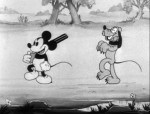 In ‘The Duck Hunt’ Mickey and Pluto are hunting ducks.
Their attempts are quite circumstantial and fail due to the inferior quality of Mickey’s gun. When the ducks discover that the female duck is only Pluto in disguise, they take revenge by taking Pluto by the ears and drag him and Mickey, who has gripped Pluto’s tail, into the air.
‘The Duck Hunt’ is a gag cartoon similar to ‘The Moose Hunt‘. Unfortunately it isn’t very funny. A lot of screen time is devoted to Mickey and Pluto marching to civil war tunes, and Pluto’s and Mickey’s flight through the air fails to become the intended great finale, because of a lack of great gags, although I liked the gag of Pluto’s flees leaving his fall by parachuting from his behind.
‘The Duck Hunt’ shows that not every Disney cartoon was a winner, despite the studio’s obvious efforts.
Watch ‘The Duck Hunt’ yourself and tell me what you think:
This is Mickey Mouse cartoon No. 37
To the previous Mickey Mouse cartoon: Mickey’s Orphans
To the next Mickey Mouse cartoon: The Grocery Boy
‘Blue Rhythm’ is available on the DVD ‘Walt Disney Treasures: Mickey Mouse in black and white’
Director: Dave Fleischer
Release Date: January 16, 1932
Stars: Betty Boop, Koko, Bimbo
Rating: ★★★★½
Review:
 In ‘Boop-Oop-a-Doop’ Betty Boop works at the circus as a lion-tamer and as a rope-dancer.
We watch her in a sexy performance on the slack-rope. During this performance we can see the circus-master growing with lust, and back in her dressing room he tries to harass her. Luckily, Koko saves here, so he “couldn’t take her boop-oop-a-doop away“.
This is the first short to co-star Koko and Betty. Koko had returned to the animated screen in ‘The Herring Murder Case’, and he’s clearly comfortable in the circus setting of this short. Interestingly, it’s Koko who is Betty’s lover in this cartoon, not Bimbo. Bimbo’s role is reduced to being a peanut seller in a running gag. Koko’s career in the sound era was short-lived, however, and was to end already two years later with ‘Ha! Ha! Ha!‘ (1934).
‘Boop-oop-a-doop’ is an entertaining short, full of catchy music. For example, on the slack-rope Betty sings ‘Do Something’, a song associated by the singer who inspired her character, Helen Kane, who had recorded it in 1929. The two versions are indeed surprisingly similar, and it is not hard to see why Kane, whose own career had been in a steady decline, sued the Fleischer company on May 4, 1932.
It may very well be that this cartoon alone triggered that event. It at least should have been quite some evidence for Fleischer’s piracy, but after a case of two years, judge McGoldrick saw it otherwise. It’s rather difficult to understand now how the Fleischers could have won. Not only does Betty Boop sound like Kane, her looks are also strikingly similar. Indeed, according to her animator and creator Gram Natwick she was modeled after Helen Kane when conceived for ‘Dizzy Dishes‘ (1930). However, Betty’s grotesque, and rather ugly appearance in her earliest cartoons must hardly have given that fact away. Moreover, in her following films both Betty’s voice and looks were both subject to change. Only by the time of ‘Boop-Oop-a-Doop’ Betty really started to look like her source of inspiration…
Anyway, for a detailed account of the trial, see Trafalz’s excellent blog post on the subject.
Watch ‘Boop-Oop-a-Doop’ yourself and tell me what you think:
‘Boop-Oop-a-Doop’ is available on the French DVD Box Set ‘Betty Boop Coffret Collector’
This is Talkartoon No. 31
To the previous Talkartoon: Any Rags
To the next Talkartoon: The Robot
Director: Burt Gillett
Release Date: September 10, 1932
Rating: ★★★★★
Review:
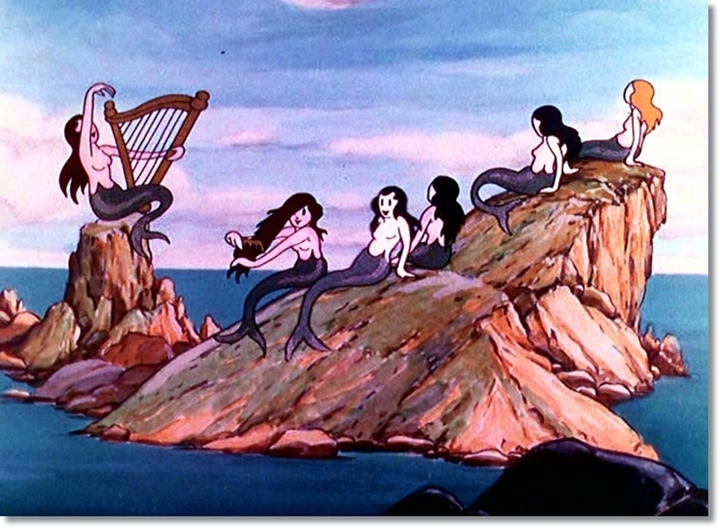
King Neptune is a merry sea giant, who gets angry when a bunch of horny pirates capture one of his topless(!) art deco mermaids. This leads to a war at sea, complete with an aircraft carrier whale and sea creature dive bombers.
‘King Neptune’ introduces a new concept to the Silly Symphonies, that of operetta. No longer the characters act silently to music, now they actually sing in operatic fashion. In the mid-thirties operetta was very popular in Hollywood, and in 1933 the operetta format would spread through the series, and it even shortly invaded Mickey Mouse films, like ‘The Mad Doctor‘, ‘Ye Olden Days‘ and ‘The Mail Pilot‘ (all 1933).
This trend led to curious mini-musicals, like ‘Father Noah’s Ark‘ and ‘The Pied Piper‘ (both 1933). The style reached its apex with ‘The Goddess of Spring’ (1934), in which the singing in all its seriousness became downright ridiculous. The operetta style survived into 1935, after which it disappeared from the Disney cartoons. However, Walt Disney’s first feature, ‘Snow White and the Seven Dwarfs’ (1937), clearly uses the operetta-style, probably because it already had been conceived at the end of 1933.
King Neptune is kind of a stock character. In many ways he’s just Old King Cole from ‘Mother Goose Melodies‘ (1931) in an updated form – rather awkwardly still wearing gloves. This character would resurface as Santa in the next Silly Symphony ‘Santa’s Workshop‘ (1932), as Noah in ‘Father Noah’s Ark‘ (1933), and as King Midas in ‘The Golden Touch’ (1935).
The pirates and mermaids are nowhere near realism, yet they’re designed and animated much better than the hunters in ‘The Fox Hunt‘ (1931), showing that Disney was making fast strides to realistic human designs already at this stage .
‘King Neptune’ is only the second Silly Symphony in color, yet unlike the first, ‘Flowers and Trees‘, it was made with color in mind from the start, and it shows. What a lush, elaborate, colorful and stunningly beautiful short this is! The cartoon simply bursts with color. Nevertheless, at several points the artists were still struggling with the new language of color. For example, one fighting scene on deck is almost rendered in reds only, in another scene the turtles have almost the same color as their background rock, failing to stand out. However, two color Silly Symphonies later, in ‘Santa’s Workshop‘, these problems appeared to have been solved, for that cartoon juxtaposes the most vibrant colors in all its scenes.
Apart from the use of color, ‘King Neptune’ is astounding because of its astonishingly elaborate animation. It’s packed with special effects, and complex and beautiful animation. The opening shots alone, in which King Neptune introduces himself, contain excessive, complex cycles of bubbles and fish. But the short’s highlight is the epic battle, which contains scenes of unprecedented complexity.
More impressive Silly Symphonies were soon to follow, but ‘King Neptune’ itself already is no less than a masterpiece. All previous Silly Symphonies literally pale compared to this one, let alone contemporary cartoons of other studios.
Watch ‘King Neptune’ yourself and tell me what you think:
This is Silly Symphony No. 30
To the previous Silly Symphony: Flowers and Trees
To the next Silly Symphony: Bugs in Love
Director: Burt Gillett
Release Date: November 12, 1932
Stars: Mickey Mouse, Minnie Mouse, Pluto
Rating: ★★½
Review:
 The Wayward Canary’ follows the same story line as ‘The Barnyard Broadcast‘ (1931) and ‘Mickey’s Revue‘ (1932). Like in these films, a song-and-dance routine is interrupted by numerous animals causing havoc.
This time, Mickey gives Minnie a canary for a present. It appears to have numerous offspring. These little birds escape and fly all over the house. Before they’re all caught, the complete house is wrecked.
Among the numerous gags there’s a surreal one when Pluto and a cat run through a wringer, which renders them flat. By 1932 such extreme body deformities had become extremely rare in Disney cartoons, and soon they would vanish altogether, as they were not in tune with Disney’s search for the ‘plausible impossible’. It was up to Tex Avery at Warner Brothers to revive gags like these in the late 1930s.
Among Minnie’s household there is a lighter with a swastika on it [update: see animation historian David Gerstein’s comment below for an explanation]. She also has signed portraits of Douglas Fairbanks and Mary Pickford. Together with Charlie Chaplin and D.W. Griffith, these two actors were the co-founders of United Artists, the company Disney had joined in 1932.
These portraits are the first caricatures of real people in a Mickey Mouse film. Although Mickey and Minnie were only slowly shedding their barnyard background, these signed portraits are not too surprising accessories, considering Mickey’s enormous popularity in the early 1930s. Moreover, they suggest that Mickey and Minnie, although being cartoon characters, live in the real world, among other Hollywood stars. This concept would be developed further in the next year, in the superb ‘Mickey’s Gala Premier‘.
Watch ‘The Wayward Canary’ yourself and tell me what you think:
This is Mickey Mouse cartoon No. 48
To the previous Mickey Mouse cartoon: Touchdown Mickey
To the next Mickey Mouse cartoon: The Klondike Kid


 Dr. Grob's Animation Review