
You are currently browsing the tag archive for the ‘2008’ tag.
Director: Nina Paley
Release date: February 11, 2008
Rating: ★★★★★
Review:
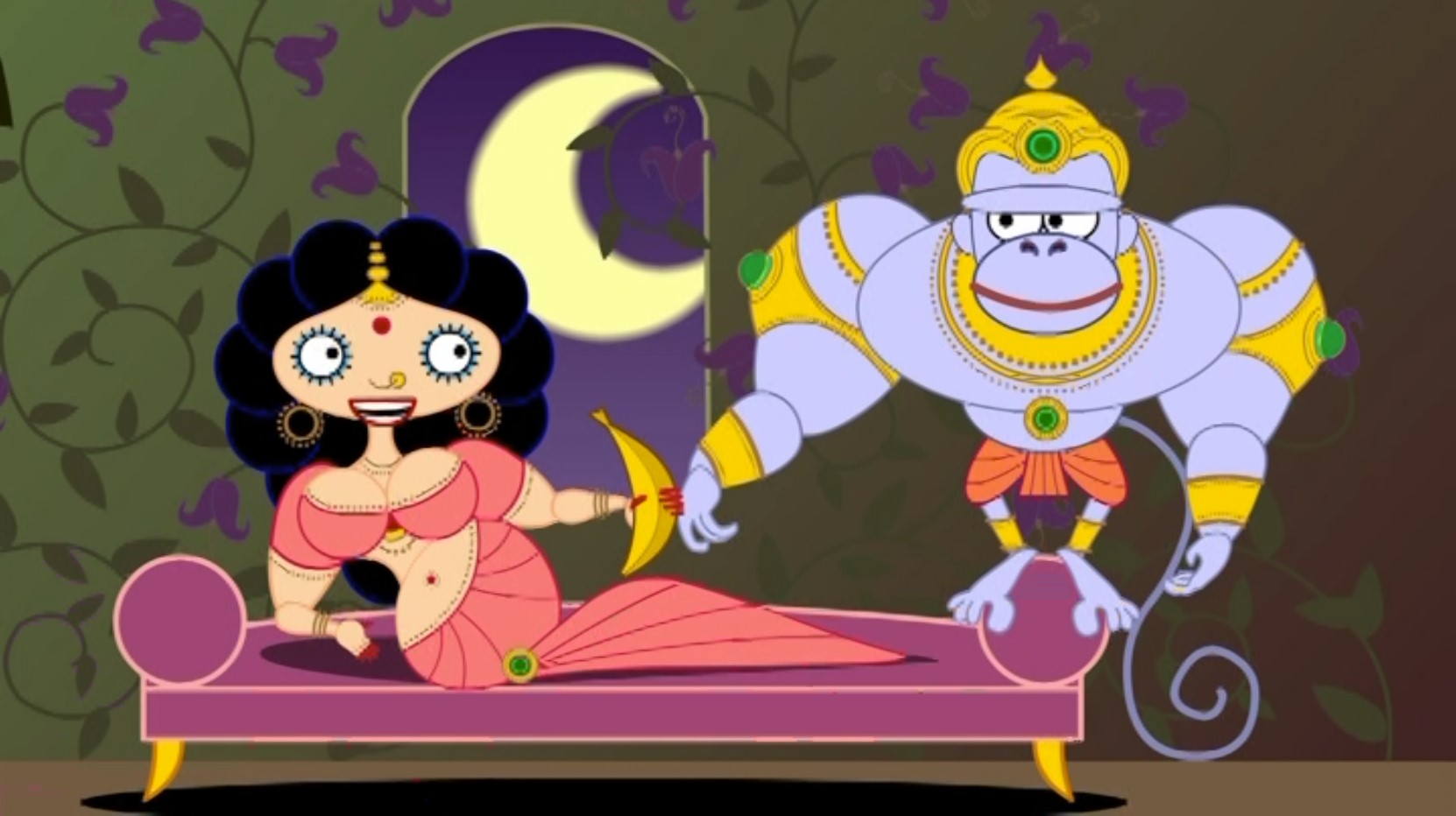
Unlike the European and Japanese animation field, the American animation studio system is unkind to author films. Walt Disney’s ‘Lilo & Stitch’ (Chris Sanders, 2002) probably comes closest, apart from several feature films based on animated television series. Thankfully, some individual artists have filled this gap, most notably Bill Plympton, releasing no less than seven features. Other notable artists are Don Hertzfeldt (‘It’s Such a Beautiful Day’ from 2012), and Nina Paley. Amazingly, all these artists mostly work totally alone, which makes their accomplishments even more stunning.
Nina Paley ‘Sita Sings the Blues’ for example, is written, directed and produced by Paley alone, which took her five to six years, and which could only be finished with help from crowd-funding, being one of the first animated projects to use this type of fund raising.
‘Sita Sings the Blues’ retells the Indian epic ‘The Ramayana’, but it’s also a personal film, in which Paley links her own situation to that of Sita, the perfect wife to the hero Rama. The most incongruous element are the eleven songs by 1920s jazz singer Annette Hanshaw, an artist sadly almost forgotten, whom Paley had discovered prior to the film making. The linking of these sweet and gentle tin pan alley songs to the Ramayana is as odd as it is effective, and the pairing certainly contributes to the uniqueness of the film.
The film uses several different animation styles: Nina Paley’s own personal story is told in a traditional scribbly animation style, with sets based on photographic material. These parts are the least attractive of the lot, even though Paley shows to be a very able animator in this classic cartoon style. The Ramayana is retold by three Indians (Aseem Chhabra, Bhavana Nagulapally and Manish Acharya) who are depicted as traditional shadow puppets of Hanuman, Sita, and Rama, respectively. The story they are telling together is shown in tongue-in-cheek cut-out animation.
The ‘official’ story is also told in cut-out animation, using very attractive recreations of traditional Indian paintings. But the best parts to look at are the songs, which are done in a most attractive cartoon modern design. In these song parts Paley reuses a lot of animation cycles, but actually she makes excellent use of the flash medium, and she makes the most of her limited animation.
Apart from these five alternating styles, there’s also a short sequence using rotoscope and a much more pop-art influenced videoclip-like filming style. All these are apparently done in Macromedia flash.
As said, ‘Sita Sings the Blues’ retells the Ramayana, reducing the huge epic to its barest elements. For example, Lakshmana is hardly mentioned, and the monkey king Sugriva not at all. Moreover, unlike the traditional poem, the focus is on Sita, not Rama, and Paley highlights the questionable parts from the original poem (one at the end of the Yuddha Kanda, and another in the Uttara Kanda), in which Rama treats Sita very unfairly indeed, just like Paley’s own partner does in real life. This makes ‘Sita Sings the Blues’ a feminist film, which sheds a welcome critical light on the traditional depiction and treatment of women, then and now.
As the story is told by three people, who remember the story differently and interpret it in different ways, this leads to some very funny moments. But Paley adds some humor, too, in the ‘official’ story part, for example when the female rakshasa (a sort of demon) Shurpanakha tells her brother Ravana about the beauty of Sita, comparing all her body parts with lotuses.
As said, the Annette Hanshaw songs boast the most attractive designs, and like traditional opera arias, they shed an emotional light on the events. However, Paley cleverly propels the story forward even during these sequences. Yet, as the songs are featured in their entirety, typically lasting ca. 3 minutes, they also drag the film down. As there are eleven of them, one tends to grow a little weary of them as the film progresses. Nevertheless, ‘Sita Sings the Blues’ does a great job in restoring interest in this almost forgotten singer. Unfortunately, the Hanshaw songs were not free from copyright, causing Paley a lot of trouble, and eventually causing her to release the film completely free from copyright.
The Annette Hanshaw songs are juxtaposed to some Indian pop music, mostly by artist Masaladosa. Particularly strong is the angry song which follows the scene in which Paley gets dumped by email. The complete soundtrack is as attractive as the film’s visual designs, and the two complement each other very well.
In all, ‘Sita Sings the Blues’ is not without its flaws, but as it is made by a single woman, it’s no less than a tour-de-force, and the result is a very interesting personal film, which makes one think. Moreover, the film shows the great power and endless possibilities of animation, and single-handedly puts Paley into the pantheon of the medium’s greats. In 2018 Paley made yet another feature called ‘Seder-Masochism’, which unfortunately has attracted much less attention.
Watch the trailer for ‘Sita Sings the Blues’ yourself and tell me what you think:
‘Sita Sings the Blues’ is available on DVD
Director: Maarten Koopman
Release Date: 2008
Rating: ★★★★
Review:
 ‘Theatre Patouffe’ features a performance of lifeless objects, mostly of things on wheels, but also of some furniture performing acrobatics, and of three flying machines.
The objects and theater settings are beautifully made, and evoke a very surreal atmosphere, reminiscent of Jan Švankmajer’s films. Moreover, the film is full of clever ideas, and at one point one of the contraption even shows films of other contraptions performing, creating quite a Droste effect.
Unfortunately, the film suffers from the lack of a story arc. This renders the short unsatisfying, despite the intriguing images, and unique atmosphere
‘Theatre Patouffe’ is available on the DVD ‘Animazing! – Mindblowing Animation Films Supportes by the Netherlands Film Fund 1998-2008’
Directors: Paul Driessen & Kaj Driessen
Release Date: 2008
Rating: ★★★★½
Review:
 With ‘The 7 Brothers’ Dutch director Paul Driessen elaborates on the fairy tale ideas he had explored in ‘3 Misses’ (1988).
‘The 7 Brothers’ tells the tale of no less than seven old writers, and their stories, all Driessen’s own idiosyncratic variations on classic fairy tales, featuring a mixture of Cinderella, Rapunzel, Little Red Riding Hood, The Wolf and the Seven Young Goats, Snow White, Puss in Boots and Hansel and Gretel. There are seven short gags, all rather cruel takes on the familiar tales.
The film is unique within Driessen’s oeuvre, for its use of live action: the seven gag segments are bridged by shots of the old men wandering on a cobbled street at night. These surreal live action images were directed by his son, Kaj Driessen. The result is a beautiful and funny, if rather unassuming film.
Watch ‘The 7 Brothers’ yourself and tell me what you think:
‘The 7 Brothers’ is available on the DVD ‘Animazing! – Mindblowing Animation Films Supportes by the Netherlands Film Fund 1998-2008’
Director: Kunio Katō
Release Date: June 10, 2008
Rating: ★★★★★ ♕
Review:
 In ‘The House of Small Cubes’ (better known by its french title ‘La maison en petits cubes’) an old man lives in an almost abandoned town, flooded by an ever rising sea level.
Each time the level reaches his doorstep, he builds another level on top of the former one. One day his pipe falls down into a former home. The man dives to retrieve his pipe, but also into his own memories. By diving into ever deeper levels the old man remembers his deceased wife, his former family, and even the times before the flood began.
‘The House of Small Cubes’ is a gentle and sweet little movie on memory and loss. Despite being made in Japan, nothing in the film looks Japanese, and the short’s surreal but moving story is by all means universal. The film thus rightfully won the 2008 Academy Award for best animated short film.
Watch ‘The House of Small Cubes’ yourself and tell me what you think:
‘The House of Small Cubes’ is available on the DVD Box ‘The Animation Show of Shows Box Set 9’ and on the French DVD box set ‘Annecy – Le coffret du 50e anniversaire’


 Dr. Grob's Animation Review