
You are currently browsing the tag archive for the ‘communism’ tag.
Director: Daniel Szczechura
Release date: 1963
Rating: ★★★
Review:

‘The Chair’ is another film subtly criticizing communist society as it was imposed on Poland at the time. Apart from the intro, the film is completely filmed from above, and features a conference.
At one point one of the conference leader’s chairs remains unoccupied, and members from the audience are invited to fill the spot. But the other audience members don’t allow each other to get to the stage, and the volunteers are hindered and blocked everywhere. Yet, one does make it, and is accepted due to his clever entrance.
The idea of ‘The Chair’ is as simple as it is well executed. Again, I am surprised the film got past the censors, as it clearly criticizes the oppressive system.
Watch ‘The Chair’ yourself and tell me what you think:
‘The Chair’ is available on the DVD-set ‘Anthology of Polish Animated Film’
Director: Denis Do
Release date: June 11, 2018
Rating: ★★★½
Review:
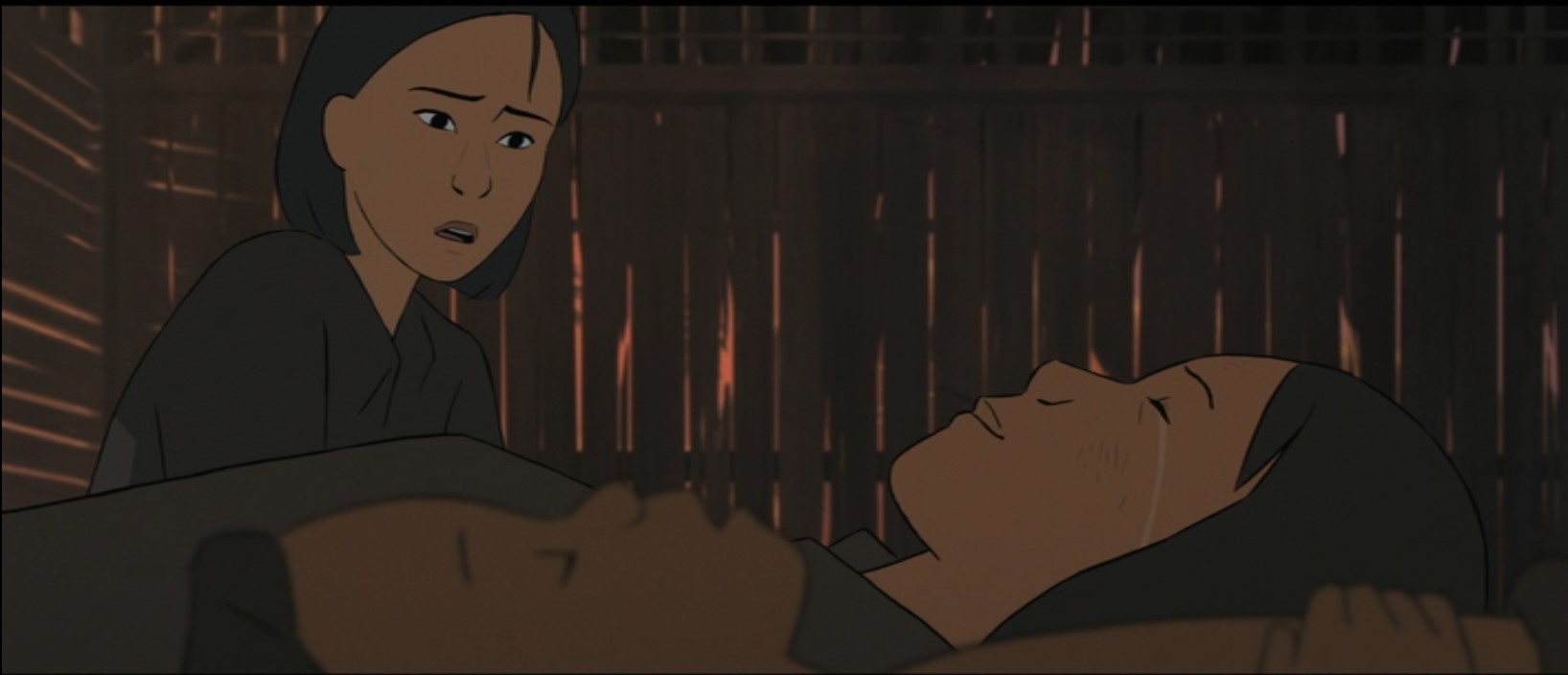
‘Funan’ is a film by Denis Do, a French film maker of Cambodian descent, and the film is partly based on the memories of his own mother.
‘Funan’ means ‘the new people’ in the Khmer language, and this is an apt description of the radical ideology of the Khmer Rouge, an extreme communist movement that took power in Cambodia from 1975 to 1979, only to plunge the nation in one of the severest mass killings in human history, with the ultimate goal to rise as a ‘new nation’ of autarkic, non-intellectual people.
‘Funan’ thus tells about Cambodia’s darkest years, and does so by following one family from Phnom Penh, which almost immediately falls apart, and which succumbs one by one to various aspects of the terror, be it brutal murder, forced labor, famine or rape. We especially follow a couple, Chou and Khuon, and their son Sovanh, who gets separated from his parents near the start of the film.
Luckily, the film eschews gross images, keeping the watch tolerable, but strangely enough, this also means one feels the hardship and sorrow less than one should. The film’s rather episodic nature certainly doesn’t help, and one has a little trouble relating to these people, perhaps because they aren’t introduced very well (the happy bliss of pre-Khmer rouge existence is shown all too shortly), and because the film is told in a plethora of very short scenes, instead of a few well-chosen longer ones. Especially Sovanh’s story is too fragmentary to follow, and his experiences are only hinted at, although it’s clear that the young boy sees a lot of cruelty and death.
The 2D animation is fair, with the human character designs rooted in the French ligne claire tradition, while the background is painted and lineless. Both coloring and lighting are clearly digitally done, and to be frank, rather uninteresting.
I suspect the film could be more daring and more idiosyncratic in its designs and storytelling, especially when compared to Elsa Duhamel’s similar, but far more interesting short ‘Bach-Hong’, which tells of the coming of the communists to Saigon, Vietnam. Duhamel cleverly sticks to a single story, illustrating the regime’s cruelty by one, ostensibly minor detail in the nation’s history.
Do, on the other hand, seems to want to tell everything, and indeed he succeeds in painting a picture of these black years, but I suspect he had better chosen less scenes, and less characters, for now, unfortunately, the film remains at an emotional distance, and that can hardly be the film maker’s purpose. Yet, I am glad personal films like this are being made, for films like ‘Funan’ save tragedies like that of Cambodia from oblivion, and remind us that peace and safety aren’t guaranteed, at all.
Watch the trailer for ‘Funan’ yourself and tell me what you think:
‘Funan’ is available on Blu-Ray and DVD
Director: Berthold Bartosch
Production Date: 1930-1932
Rating: ★★★★★
Review:
 While the cartoon industry flourished in the United States, animation film was developed as an art form in Europe.
In the 1920s Germany had lead the way, with films by Lotte Reiniger, Walter Ruttman and Oskar Fischinger, but by the early 1930’s France had taken over, albeit almost exclusively by foreigners, with great films like ‘Le roman de Renard’ (1929-1930) by Russian animator Władysław Starewicz, ‘Une nuit sur le mont chauve‘ (1933) by his compatriot Alexandre Alexeïeff, ‘La joie de vivre’ (1934) by British artist Anthony Gross and American artist Hector Hoppin, and ‘L’idée’ (1930-1932) by Austro-Hungarian animator Berthold Bartosch (1893-1968).
‘L’idée’ was based on a wordless novel of the same name by Belgian woodcut-artist Frank Masereel (1889-1972), who initially co-operated on the film, until he discovered how laborious animating really was. Masereel’s groundbreaking work has a strong expressionistic quality, which is also very present in Bartosch’s film.
Both the international character and the mood of the wordless film are greatly enhanced by the beautiful musical score by Swiss composer Arthur Honegger, who used the whooping sounds of the Ondes Martenot, an early electronic instrument invented in 1928, to great effects. According to Wikipedia, this makes Honegger’s score for ‘L’idée’ the first film music to employ and electronic instrument.
The film tells how an idea can originate and grow, despite dejection, oppression and censorship by the establishment. In practice, Bartosch’s idea has a strong socialist character, becoming an idea of the working class, and being oppressed by clear capitalistic forces. The idea itself is presented as a naked woman, symbol of innocence and purity, and she grows, accompanying the people who become victim of the oppression to the very end. The emotional highlight of the film is when she visits the very person who had invented her the night before his death sentence.
Bartosch had previously worked on Lotte Reiniger’s films, and used her cut-out technique on Frank Masereel’s stark cut-outs to a great effect. The imagery of Bartosch’s film is much more poetic, however, than Masereel’s own work, with a lot of soft-focus, and milky effects, especially on the idea itself, which Bartosch created with the help of soap. The film is also noteworthy for its great sense of depth in some scenes, which can reach a stunning level of complexity. There is for example a scene showing crowds and cars passing by a window, and another with numbers of soldiers marching. Bartosch achieved this sense of depth with a multi-plane camera of his own design, using several glass plates below each other. It’s interesting to note that his device predated Disney’s multiplane camera by five years. True, these soap- and multiplane techniques at times blur the images too much, rendering them too murky to understand what’s happening on the screen, but mostly the film is an excellent example of expressionistic storytelling, and what animation can do.
Unfortunately, the film itself suffered from censorship, delaying its release, which often only happened with an altered, less provocative intro text, and Bartosch never gained any money from it. Nevertheless, it was released in 1934, creating a sensation in Europe, with exception, of course, of Nazi Germany, where it was banned. Bartosch’s second film, ‘Saint Francis: Dreams and Nightmares’ (1933-1938), apparently an anti-war film, was destroyed by the Nazis in World War II. After that Bartosch tried to work on a third film about the Cosmos, but because of his deteriorating health work was abandoned. He devoted the rest of his life to painting. Thus ‘L’idée’ sadly remains his only surviving film, but it’s a great testimony of Bartosch’s art, and without doubt it single-handedly places him in the pantheon of great animation film makers.
Watch ‘L’idée’ yourself and tell me what you think:
‘L’idée’ is available on the Re:Voir DVD ‘Berthold Bartosch – l’idée’
Director: Priit Pärn
Release Date: 1992
Rating: ★★★★★ ♕
Review:
 If ‘Breakfast on the Grass‘ was a dark and disturbing portrait of life in the Soviet Union, Priit Pärn’s next film, ‘Hotel E’, took off the mask from the former Soviet state like no other film.
Released shortly after Estonia’s declaration of independence on 20 August 1991, it’s the film on the fall of the iron curtain, seen from an Eastern European perspective. Pärn paints Eastern and Western Europe in the most extreme contrasts, and with different animation styles.
The film starts with two short legends: the legend of the traitor. Told in cut out animation, it tells the story of a young man who looks, when a door opens to a more colorful world…
The second legend is called ‘The legend of the redeemer’. This is set in a rather renaissance sunny landscape, and tells of an outcast who can bridge the missing parts in an otherwise perfect society. This part features virtuoso painted rotoscope animation in the style of Paul Rubens and Frans Hals. Both legends are worked out in detail in the rest of the film, which forms ‘Hotel E’ proper.
‘Hotel E’ (Hotel Europe) starts with a depiction of Western Europe (named ‘The American Dream’) as a lethargic dream room, filled with rich, lazy, and spoiled people, filling their empty, purposeless lives with petty problems, and hardly capable of communicating with each other. This world is filmed in slow, rotoscoped movements in the most colorful pop-art style.
Meanwhile, next door, in the Eastern European room, things are very different indeed. This world is depicted in Pärn’s crude scratchy animation style, and accompanied by nervous, dissonant music. Here it’s dark, it’s filthy, it’s full of flies, and life there is extremely stressful. The inhabitants all sit around a round table, and their presence is constantly checked by a moving clock hand. The room is frequently illuminated by search lights, and if one fails to stay in place for whatever reason, he’s executed immediately. Paranoia and secrecy reign. Moreover, chances can change randomly, and someone who was in favor first, can be out of luck next time.
One of the inhabitants of this cruel world manages to break free and he’s capable to visit the other world next door. He repeats his visits, despite the fact that he has to leave his concerned wife behind, and despite the fact he’s increasingly seen as a traitor by his fellow citizens. Even worse, he seemingly has little to add to the luxurious world of the West, and his longings there are hardly answered, let alone his problems understood. Only in the end he manages to find his place in this society, when only he turns out to be able to restore the inhabitants’ happiness. At that point we watch the wall between the two rooms collapsing, exposing the rotten world of the East and its eager inhabitants, and we hear one Western woman exclaim ‘o, shit…’.
‘Hotel E’ is Pärn’s most openly political film. It must be regarded as one of his masterpieces, and because of its historical significance, the most important film by the Estonian master. Pärn’s visual language is at its most extreme here, and the film is very difficult to decipher. In fact, much of what is happening is hard to comprehend. But anyone who takes the plunge, is rewarded by a most moving, and impressive film, indeed, the message of which still rings today.
Watch ‘Hotel E’ yourself and tell me what you think:
Director: Priit Pärn
Release Date: 1987
Rating: ★★★★★
Review:
 Made directly after ‘Time Out’, ‘Breakfast on the Grass’ is one of Priit Pärn’s most powerful films.
It’s also one of his most difficult, and its message is at times hard to decipher. Pärn doesn’t tell straightforward stories, and much remains unexplained. Most importantly, it’s one of the few films showing insight in Eastern European life under the communist oppression. Its atmosphere is gloomy, its graphic style crude and scratchy, its humor dark, and its surrealism disturbing.
In ‘Breakfast on the Grass’ we follow four people, two men and two women, who struggle in their daily life. The first, Anna, strongly feels she’s an outcast in the society. She’s not really part of the system, and misses out on its benefits, as exemplified by her search for rare apples. The second, Georg, imagines himself a playboy, but reality is harder. In pursuit of a suit, with which he can fulfill his playboy dreams he has to go through a grind of corruption. Everyone wants something rare in exchange for offered service. Berta has lost her face as soon she became a mother. She only regains it when she finds the attention of a man. And finally, Eduard shrinks when he needs a paper signed from a very high official. Luckily he gets help from a female friend…
Also starring in these stories is an anonymous artist, who is constantly followed by a flock of crows or dragged around by two state officials. A clearer statement of oppression is hard to find in any Soviet film.
In the end, the four people succeed in their aim, and together they go to a park, where they form a life tableau of Edouard’s Manet’s painting ‘Déjeuner sur l’herbe‘ (1863) which lends its name to the film’s title. This hopeful statement of beauty, freedom and art is as quickly dismantled, however, and the final shot is for the artist, whose arm is smacked by a steam roller…
Like few other films ‘Breakfast on the Grass’ shows what life is like in an oppressed state, where food is scarce, where bureaucracy and corruption run freely, and where the role you play is more important than your personal preferences. Even though the Glasnost was in full flight in 1987, it’s a wonder such a dark accusation was possible in the Soviet Union, of which Estonia was then still part.
Watch ‘Breakfast on the Grass’ yourself and tell me what you think:
Director: Vyacheslav Kotyonochkin
Release Date: 1967
Rating: ★★★
Review:
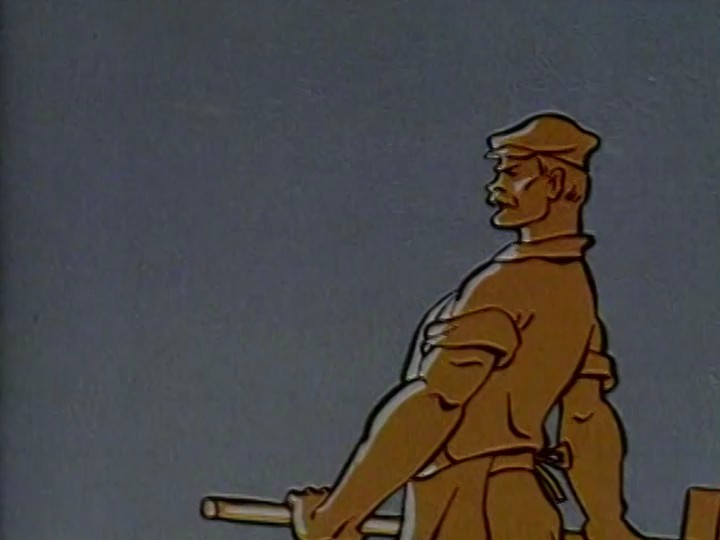 ‘Prophets and Lessons’ is a Soviet propaganda film. It tells us how every time the Western world predicted the Soviet Union to fail, but that these predictions never came true.
Its chapters are all conceived in the same order: first we see animated capitalist predict something, then we see a giant Soviet blacksmith strike his mighty hammer and finally we see live action footage of the Soviet Union’s successes.
The separate chapters are the Soviet revolution, the civil war, the five year plans, the Second World War, the reconstruction after the war and the Soviet space program. The action is silent, and the imagery rather outdated (more like that of the 1920s than of the 1960s).
‘Prophets and Lessons’ is one of the most obviously propagandistic animation films ever made in the Soviet Union. Its overtly propagandistic message, its repetitive character, and its outdated symbolism make it rather tiresome to watch.
Surprisingly, two years later, the director of this humorless film, Vyacheslav Kotyonochkin, would launch a successful series of comic cartoons, called ‘Ну, Погоди!’ (‘Just Wait!’), featuring a very cartoony wolf.
Watch ‘Prophets and Lessons’ yourself and tell me what you think:
‘Prophets and Lessons’ is available on the DVD box set ‘Animated Soviet Propaganda’
Director: Vitold Bordzilovsky
Release Date: 1966
Rating: ★★★½
Review:
 ‘Proud Little Ship’ is a Soviet propaganda film, which is clearly directed to children.
Three little boys make a small red ship as a copy of the famous cruiser ‘The Aurora’. This little ship sails the seas and is greeted with enthusiasm among all the people of the world.
There are some mean militarists who try to destroy the little ship, but they do not succeed. These militarists are drawn extremely silly, while the rest of the people are drawn rather realistically and appear as noble and gentle. Nevertheless, these drawing styles blend surprisingly well. Moreover the design and choreography of movement is often gorgeous.
All the action is silent, while the story is told by a narrator, who provides the clearest propagandistic message of the film: “the proud little ship sailed as a messenger of a happy life, which, as spring after winter, would certainly come to all people”.
Although ‘Proud Little Ship’ is overtly propagandistic, it’s also an enjoyable and beautiful film. One almost forgets that the message is not concerning world peace, but the ‘glorious’ communist revolution…
Watch ‘Proud Little Ship’ yourself and tell me what you think:
‘Proud Little Ship’ is available on the DVD box set ‘Animated Soviet Propaganda’
Director: Jiří Trnka
Release Date: 1965
Rating: ★★★★★ ♕
Review:
 In a self-contained world, seemingly outside space and time, an harlequin lives happily in his home.
The harlequin is an artist, a ceramist and a sculptor, making pots for his beloved plant. Unfortunately, his domestic peace is disturbed by a giant gloved hand, which orders him to sculpt a statue of a hand. As the harlequin keeps refusing, the hand uses praise, money, indoctrination, brutal force and erotics to persuade the artist to do what he’s ordered.
In the end the harlequin is caught, his hands are attached to strings worked by the hand, and he has to sculpt a giant hand in a cage. But, after finishing his works, the artist escapes and returns to his beloved home. It sadly is his own beloved plant that kills him by falling on his head, while he’s barricading the entrances to his room. The hand gives the artist a state funeral, making him posthumously part of the system.
‘The Hand’ was Czech puppet animator Jiří Trnka’s last film, and it was to be his masterpiece. Instead of diving into classic tales, he made one of his own, resulting in a most personal film and one that stands as the classic animated tale on totalitarianism.
Trnka manages to tell his tale without any dialogue. Although the puppet of the harlequin knows only one expression, his emotions are well-felt through his animation. There’s no doubt he’s symbolic for artists working in totalitarian regimes in general. The glove is a masterstroke. In its facelessness it is as scary as it is symbolic for the invisible hand of totalitarian power. The result is an equally sad and disturbing film, which shows both Trnka’s genius and the power of animation in general.
It’s no small surprise that this highly symbolic film was forbidden in communist Czechoslovakia.
‘The Hand’s message is still topical, being symbolic for artists working in oppressive regimes all over the world.
Watch ‘The Hand’ yourself and tell me what you think:
‘The Hand’ is available on the DVD ‘The Puppet Films of Jiri Trnka’


 Dr. Grob's Animation Review