You are currently browsing the tag archive for the ‘easter’ tag.
Director: Phil Roman
Airing date: April 9, 1974
Stars: Charlie Brown, Linus, Lucy, Marcie, Peppermint Patty, Sally, Schroeder, Snoopy, Woodstock
Rating: ★★★
Review:

The twelfth Peanuts special was another holiday special, this time celebrating Easter. As with all Peanuts specials the story evolves at a leisurely speed, this time mixing ca. three stories into very short cross-cutting scenes.
The first and most entertaining story is about Peppermint Patty trying to teach Marcie how to paint eggs, but this goes haywire, because Marcie has absolutely no clue on how to prepare the eggs. The second story is about Snoopy buying a birdhouse for Woodstock, who initially shivers in the cold rain. Then there’s a story arc in which Linus tells the gospel of the Easter Bunny, just like he did on the Great Pumpkin.
Several scenes take place in a department store, and some of them are charming, if totally independent of the main story material, like Peppermint Patty, Marcie and Snoopy dancing to some Christmas-themed music boxes. This gives the episode a rather disjointed, almost improvisatory feel.
Vince Guaraldi’s soundtrack is great throughout, giving Snoopy and Woodstock an especially groovy soul-jazz theme, while the Easter Beagle is accompanied by a jazzy version of Beethoven’s seventh symphony.
Watch ‘It’s the Easter Beagle, Charlie Brown’ yourself and tell me what you think:
It’s the Easter Beagle, Charlie Brown’ is available on the DVD-set ‘Peanuts 1970’s Collection Vol. 1’
Directors: William Hanna & Joseph Barbera
Release Date: January 3, 1958
Stars: Tom & Jerry, Little Quacker
Rating: ★★★½
Review:
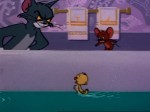 ‘Happy Go Ducky’ starts with the Easter bunny delivering an Easter egg to Tom & Jerry.
The two fight over the egg, which soon breaks, hatching into Little Quacker, which immediately goes swimming in whatever fluid containing device he sees, being it Tom’s milk bowl, a fish tank, a water tank or a bath. Tom & Jerry try to get rid of the little duck, even putting it back into the egg shell and sending it back to the Easter bunny, but to no avail. In the end, the whole room is flooded, and Tom and Jerry have to watch Little Quacker swimming around with his four duckling friends from the local public park pond.
‘Happy Go Ducky’ is remarkable for lack of conflict between Tom and Jerry. As soon as Little Quacker enters the scene, the two work together to get the intruder out. This hampers the comedy, which remains mild and friendly. Part of the humor stems from Little Quacker exclaiming ‘Happy Easter!’ enthusiastically every time he has found a place to swim. The best gag however is when Tom tries to shut a shower door, which Little Quacker has filled to the max with water.
Watch ‘Happy Go Ducky’ yourself and tell me what you think:
https://www.dailymotion.com/video/x3xxdrv
This is Tom & Jerry cartoon No. 110
To the previous Tom & Jerry cartoon: Tom’s Photo Finish
To the next Tom & Jerry cartoon: Royal Cat Nap
‘Happy Go Ducky’ is available on the European DVD Box set ‘Tom and Jerry Collection’
Directors: Tony Benedict, Gerry Chiniquy, Art Davis, David Detiege & Friz Freleng
Airing Date: April 1, 1980
Stars: Daffy Duck, Foghorn Leghorn, Miss Prissy, Sylvester, Speedy Gonzales
Rating: ★
Review:
 ‘Daffy Duck’s Easter Egg-Citement’ is an Easter-themed Looney Tunes television special produced by DePatie-Freleng.
Unlike Chuck Jones in ‘Bugs Bunny in King Arthur’s Court‘ Friz Freleng doesn’t attempt to tell one long story in the 25 minutes he’s got. Instead, we have three: the first evolves around Miss Prissy, who, in Foghorn Leghorn’s egg farm, lays a golden egg. Daffy and Sylvester find it, and fight eachother for it. This episode contains the only fine piece of animation of the whole special: the depiction of a paranoid Daffy in a car.
In the second episode Daffy is a guard at a chocolate bunny factory, protecting it against Speedy Gonzales, and in the third Daffy tries to go south, trying several options, including a horse. This part reuses the horse from the Pink Panther cartoon ‘Pinto Pink’ (1967) and some of its gags, too.
These stories are framed with Daffy in a very ‘Duck Amuck‘-like setting. Like ‘Bugs Bunny in King Arthur’s Court’ ‘Daffy Duck’s Easter Egg-citement’ suffers from bad designs (especially Foghorn Leghorn, who’s not a Freleng character, is badly drawn), can music, slow timing and excessive dialogue.
Director: Robert McKimson
Release Date: June 28, 1947
Stars: Bugs Bunny, Elmer Fudd
Rating: ★★★★★
Review:
 McKimson’s second Bugs Bunny cartoon is way funnier than his first one, ‘Acrobatty Bunny‘ (1946).
In ‘Easter Yeggs’, Bugs Bunny encounters a lethargic Easter Bunny who makes Bugs replace him, because he has ‘sore feet’. Bugs ends up delivering Easter eggs in some slum, where he’s troubled by an unbelievably annoying little red-haired kid. In his next attempt he encounters Elmer Fudd, who’s only after Easter bunny stew.
Penned by Warren Foster, ‘Easter Yeggs’ is a hilarious cartoon, and without doubt among both Robert McKimson’s and Bugs Bunny’s all time best. Its highlight may be Bugs’ performance as a magician conducting a misguided trick with Elmer’s watch.
Watch ‘Easter Yeggs’ yourself and tell me what you think:
This is Bugs Bunny cartoon No. 44
To the previous Bugs Bunny cartoon: A Hare Grows in Manhattan
To the next Bugs Bunny cartoon: Slick Hare
Director: Wilfred Jackson
Release Date: March 24, 1934
Rating: ★★
Review:
 ‘Cute Little Bunnies’ would have been a better title for this easter short, for the bunnies are very cute, not funny.
In fact, “Funny Little Bunnies’ is so cute it can only have been meant for children. It makes one wonder what movies it was supposed to support in the theaters (surely no grim gangster thriller!).
Because everybody copied Disney at that time, other studios were copying this ‘new cuteness’ as well. Especially 1934 saw an explosion of Silly Symphonies imitating series, combining the appeal of color with sugary tales. Former Disney associate Ub Iwerks was the first, releasing his first Comicolor cartoon on December 23, 1933. He was followed by Max Fleischer (Color Classics, August 1934), MGM (Happy Harmonies, September), Van Beuren (Rainbow Parade, September), Columbia (Color Rhapsodies, November), and Walter Lantz (Cartune Classics, December). This resulted in a spread of cute (and severely unfunny) cartoons in the mid-thirties.
One is therefore particularly thankful that in the late thirties Tex Avery restored nonsense, wackiness and absurdism in the animated cartoon. These qualities Disney sometimes seemed to have forgotten during his pursuit for greater naturalism and beauty.
Notice how, for example, ‘Funny Little Bunnies’ uses animation to tell a story that cannot be told in live action, but how it tries to tell this story in the most conventional, ‘live action-like’ way. Especially the opening shot of this short is stunning, with two bunnies hopping realistically and lots of birds and butterflies flying around.
Watch ‘Funny Little Bunnies’ yourself and tell me what you think:
This is Silly Symphony No. 43
To the previous Silly Symphony: The Grasshopper and the Ants
To the next Silly Symphony: The Big Bad Wolf


 Dr. Grob's Animation Review