
You are currently browsing the tag archive for the ‘Eiichi Yamamoto’ tag.
Director: Eiichi Yamamoto
Release date: September 15, 1970
Rating: ★★½
Review:

The most important development in animation of the late 1960s and 1970s was the coming of animated feature films aimed at adults, instead of children/families. Heralding the new era was George Dunning’s 1968 film ‘Yellow Submarine’, but the two most important film makers pioneering in this new field were Ralph Bakshi in America (with e.g., ‘Fritz the Cat’ from 1972 and ‘Heavy Traffic’ from 1973) and Osamu Tezuka in Japan.
The three adult oriented anime films Tezuka made at his own Mushi Productions studio are called the Animerama trilogy and consist of ‘A Thousand and One Nights’ (1969), ‘Cleopatra’ (1970) and ‘Belladonna of Sadness’ (1973). The three show that Tezuka, like Bakshi, confuses adult oriented with a rather juvenile focus on sex and violence, making the films adult in content indeed, but otherwise rather immature and even exploitative products.
More than its adult orientation, ‘Cleopatra’ stands out for its highly eclectic style. The film tackles a variety of designs and animation styles, none weirder than the opening sequence, which takes place in the future year of 2001, and which starts live action actors with animated faces, an experiment luckily not repeated, for the results are pretty ridiculous, especially because there’s absolutely no lip synchronization, at all.
The film’s plot revolves around an alien planet called Pasatorine, which has a secret plan to wipe out mankind called ‘Cleopatra’. In order to find out the plans a trio of humans, naturally, goes back into time by “psycho-teleportation”, taking the souls of ancient characters in Cleopatra’s time.
Thus, the three main protagonists change identity: Jirov becomes Ionius, a powerful slave, Maria becomes Libya, an Egyptian city girl, and Hal turns into Lupa, a close companion of Cleopatra, who turns out to be a leopard, much to Hal’s chagrin. His character is the most annoying of the film, for the leopard is sex crazed and tries to get laid all the time, despite its animal features.
After ten minutes we’re in Egypt where Tezaku depicts the Roman conquest of the ancient kingdom in a very silly style, accompanied by some attractive space funk music. When we first see Libya, the adult orientation immediately becomes clear, for she’s bare breasted the whole time. The Egyptian plot is bizarre, too, with an ugly freckled girl changing into the sex goddess of Cleopatra with the sole reason to seduce Caesar and to kill him. Adding to the weirdness is the coloring, for Libya is rendered bright red, while Caesar is depicted as a green man.
Stylistically, the film is all over the place, anyhow, altering tiresome silliness and cheap rotoscoping with quite some beautiful graphic imagery, like the stylized fighting of the Romans and the Egyptian conspirators. The animation, too, is a mixed bag, from non-animation and cheating jump takes from pose to pose, without any animation in between, to far more interesting animation done in watercolors. The animation of the horse ride, and the struggle between Ionius and an Egyptian warrior are actually quite good, and even the first two sex scenes are interesting in their semi-abstract and even poetical stylization, while the third is depicted as a broken-down film. At one point the imagery reminds one of UPA or the Zagreb school, and at another point there’s even a cut-out sequence featuring variations on classic paintings.
What the film completely lacks, is character animation. Emotions are just indicated, not felt, and there’s only broad caricature, not character development. The potentially dramatic story is further hampered by random gags, often strange and out of place. Likewise, the story is sloppy and meandering, with the film makers having difficulty on whom to focus. For great chunks of screen time, the three protagonists from the opening sequence aren’t anywhere to be seen, and after the events in ancient Egypt have ended tragically (in that respect the film does follow Cleopatra’s real life), the film ends abruptly, leaving the viewer wondering why the whole ‘psycho-teleportic’ excursion, and thus most of the movie, was needed in the first place.
It must be said: ‘Cleopatra’ is not a good movie. It is more of an experiment than a success, more of a product of its time than a timeless movie, and rather a curio than an essential watch. It is a product of a more experimental era, but after watching the film, one can hardly wonder why this short age of adult oriented experimentalism stopped.
Watch the trailer for ‘Cleopatra’ yourself and tell me what you think:
‘Cleopatra’ has been released on Blu-Ray
Director: Eiichi Yamamoto
Airing date: June 27, 1973
Rating: ★★★½
Review:
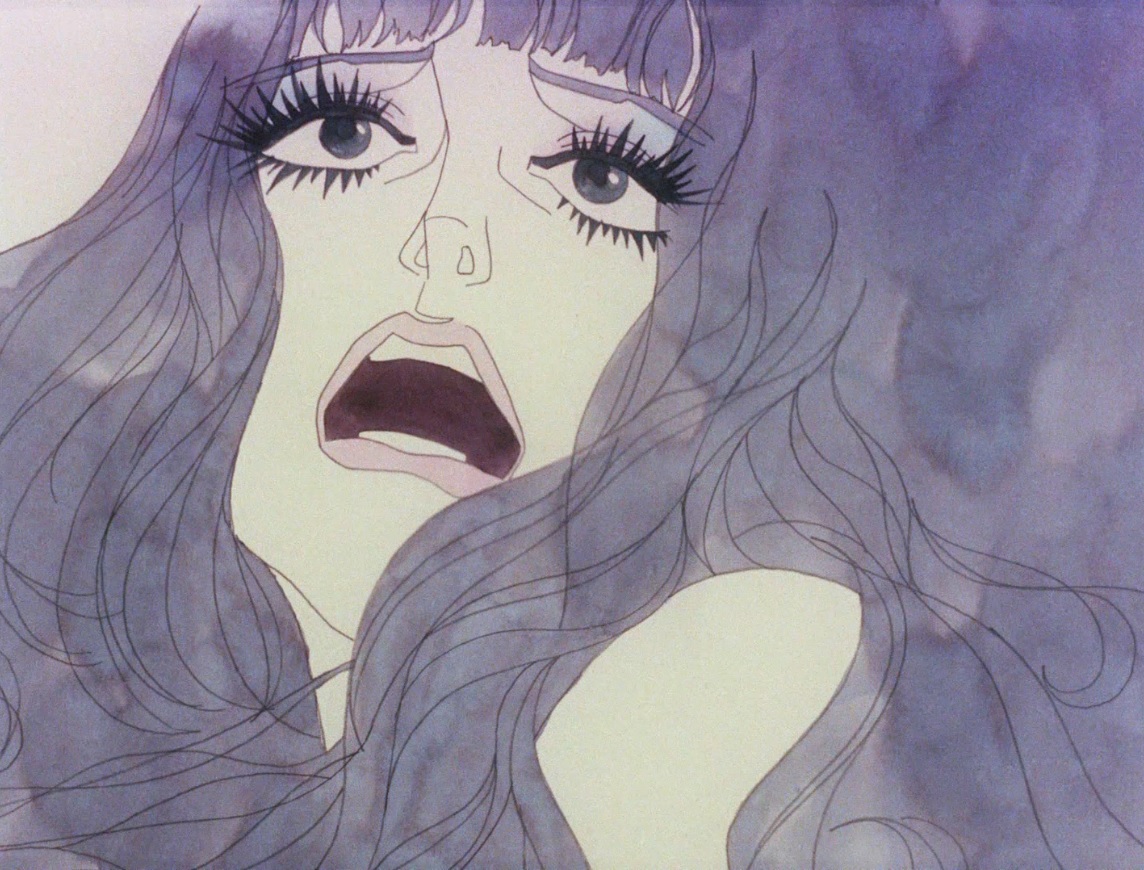
The late sixties and early seventies saw some striking experiments in the animated feature film. These films left the tried paths of family film and aimed at a more adult audience. In Europe Walerian Borowczyk arguably made the first experimental animated feature with ‘Théâtre de Monsieur & Madame Kabal (Theatre of Mr & Mrs Kabal)’ (1967), René Laloux made quite an impact with ‘La planète sauvage’ (1973), while in the UK George Dunning’s ‘Yellow Submarine’ (1968) caused a revolution, inspiring for example ‘János Vitéz’ (Johnny Corncob) in Hungary. Meanwhile in the US Ralph Bakshi experimented with more adult themes in ‘Fritz the Cat’ (1972) and ‘Heavy Traffic’ (1973).
In Japan, Osamu Tezuka led the way with his Mushi Productions studio, releasing three more adult themed feature films: first ‘A Thousand and One Nights’ in 1969, followed by ‘Cleopatra’ (1970) and ‘Belladonna of Sadness’ from 1973.
All three were directed by Eiichi Yamamoto, but in contrast to the earlier two features Tezuka had no direct involvement in ‘Belladonna of Sadness’. Even more striking, the great master left his own studio halfway production. Thus, ‘Belladonna of Sadness’ is very, very different from Tezuka’s own rather cartoony creations.
According to Yamamoto he wanted his film to be a Japanese answer to ‘Yellow Submarine’, and to make it one the drew inspiration from the artwork by Kuni Fukai. However, Kunai’s dark and disturbing artwork is quite the opposite from Dunning’s cheerful fantasies. On the Blu-ray Fukai calls his own work from the early seventies ‘decadent’, and that certainly is an apt description. Fukai’s drawings are baroque, graphical, lush, and highly erotic. They have a distinct neo-art-nouveau character, which is both very psychedelic and very seventies. For Belladonna of Sadness’ Fukai functioned as the art director, and his drawings form the base of the complete film, which uses animation only sparingly, often leaving the camera tracking over the static artwork.
And what artwork! ‘Belladonna of Sadness’ sure is a marvel to look at. The watercolor-and-pen drawings are all interesting and of a high artistic quality. Fukai almost always uses a white canvas, in which the drawings more or less disappear, and there’s ample and expressive ornamentation to accentuate the feeling of the scene. There are some odd design choices, however. For example, the villain looks like he has no eyes and as if three bones are stuck into his skull, making him rather grotesque and unbelievable.
Animation, as said, is only used only sparingly. There is no lip-synchronization, whatsoever, and some of the animation is crude and simple. The most interesting animation occurs when the events are not shown directly, but only suggested. For example, in the best erotic scenes more is hinted at than shown, and when the world is struck with the plague, we watch the landscape melt. There are certainly some trippy scenes, full of metamorphosis, which form the best parts of the movie. The undisputed highlight of the film comes when the baroque images are suddenly changed for a rapid-fire delivery of much more cartoony designs in bold seventies colors. This frenzy of animated images is followed by beautiful glass painted animation full of metamorphosis.
The psychedelic images are further enhanced by the soundtrack, which mixes psychedelica, spacefunk and rock into a very seventies-like mix, akin to Alain Goraguer’s soundtrack for ‘La planète sauvage’ from the same year, albeit of a lesser quality. There are even a few songs to enhance the mood.
In contrast to the beautiful art the story of ‘Belladonna of Sadness’ is subpar, and even objectionable. The film is based on ‘La sorcière’ (1862) by Jules Michelet, a non-fiction book on witchcraft, and the film’s story is set in a fictive oppressive kingdom in which a peasant girl becomes a witch. However, Yamamoto’s and Yoshiyuki Fukuda’s screenplay apparently only uses the book as a source of inspiration, as their own tale is as predictable as it is boring.
Yamamoto apparently instructed Fukai that his film was ‘porn but make it a love story’. Well, the movie is certainly porn, but hardly a love story. The two lovers Jean and Jeanne are more vignettes than characters, and if anything, Jean is a weak and will-less coward. Worse, the porn is exploitive, featuring several rapes and a lot of violence. As can be expected, there is a lot of female nudity, but hardly any male one, although penises are omnipresent, especially as the devil takes the shape of a penis himself. Jeanne’s best moment comes when she reveals herself as a full-blown witch, which provides one of the film’s most iconic moments. But during most of the film she’s used and abused by powers beyond her control. The ending, too, is unsatisfying, and all too abrupt, forcingly trying to make the porn story into something political.
Thus, ‘Belladonna of Sadness’ may transcend normal porn (it’s certainly weird and original enough to do so), but not that of a cheap comic. There’s no depth to the story, at all, and the film’s exploitive character gives a bad taste in the mouth. Nevertheless, the movie is a feast of the eye and stands as a great example of the sheer experimentation that were the seventies.
Watch the trailer for ‘Belladonna of Sadness’ yourself yourself and tell me what you think:
‘Belladonna of Sadness’ has been released on Blu-Ray, but this is currently out of print


 Dr. Grob's Animation Review