
You are currently browsing the tag archive for the ‘India’ tag.
Director: Nina Paley
Release date: February 11, 2008
Rating: ★★★★★
Review:
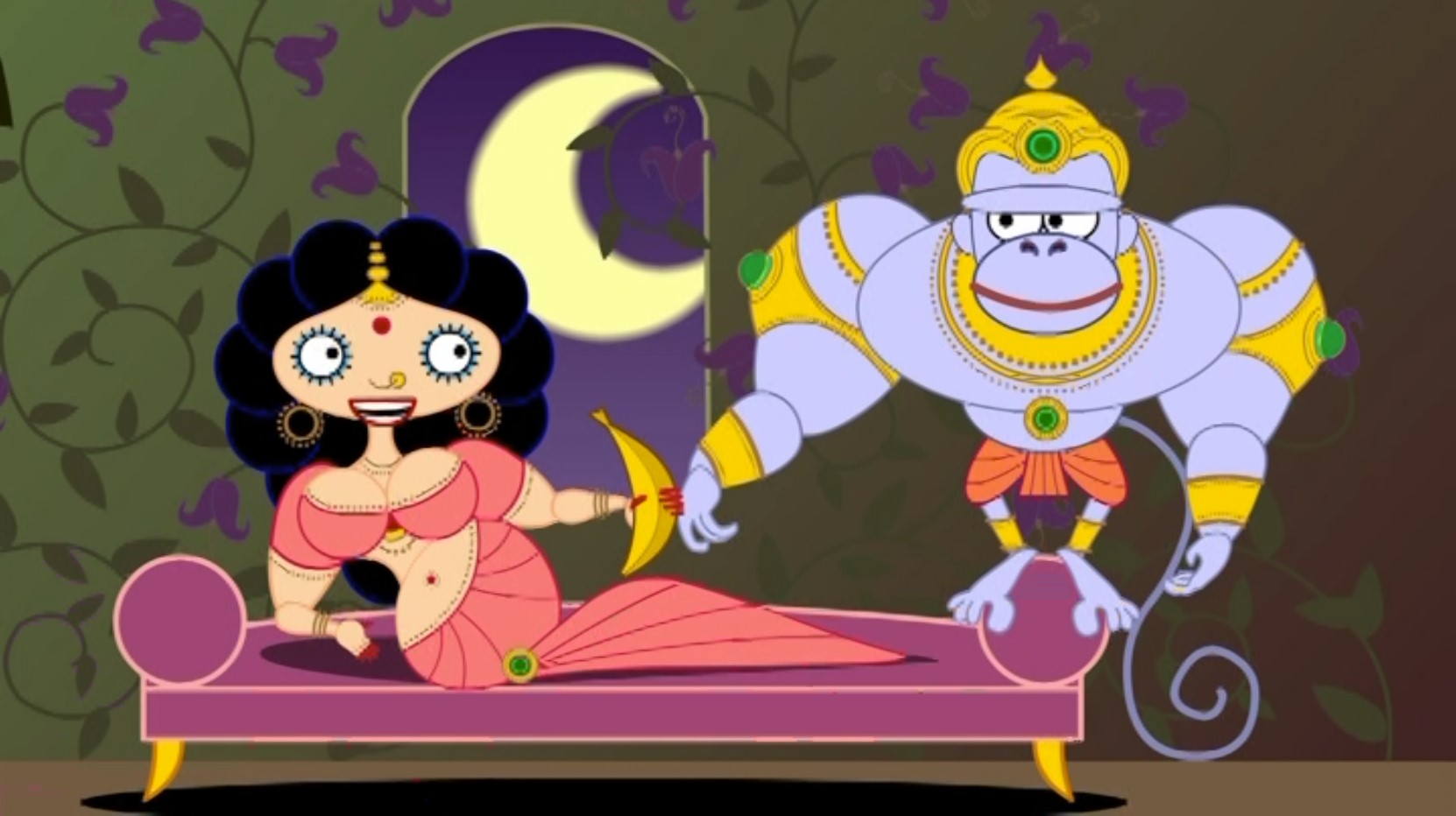
Unlike the European and Japanese animation field, the American animation studio system is unkind to author films. Walt Disney’s ‘Lilo & Stitch’ (Chris Sanders, 2002) probably comes closest, apart from several feature films based on animated television series. Thankfully, some individual artists have filled this gap, most notably Bill Plympton, releasing no less than seven features. Other notable artists are Don Hertzfeldt (‘It’s Such a Beautiful Day’ from 2012), and Nina Paley. Amazingly, all these artists mostly work totally alone, which makes their accomplishments even more stunning.
Nina Paley ‘Sita Sings the Blues’ for example, is written, directed and produced by Paley alone, which took her five to six years, and which could only be finished with help from crowd-funding, being one of the first animated projects to use this type of fund raising.
‘Sita Sings the Blues’ retells the Indian epic ‘The Ramayana’, but it’s also a personal film, in which Paley links her own situation to that of Sita, the perfect wife to the hero Rama. The most incongruous element are the eleven songs by 1920s jazz singer Annette Hanshaw, an artist sadly almost forgotten, whom Paley had discovered prior to the film making. The linking of these sweet and gentle tin pan alley songs to the Ramayana is as odd as it is effective, and the pairing certainly contributes to the uniqueness of the film.
The film uses several different animation styles: Nina Paley’s own personal story is told in a traditional scribbly animation style, with sets based on photographic material. These parts are the least attractive of the lot, even though Paley shows to be a very able animator in this classic cartoon style. The Ramayana is retold by three Indians (Aseem Chhabra, Bhavana Nagulapally and Manish Acharya) who are depicted as traditional shadow puppets of Hanuman, Sita, and Rama, respectively. The story they are telling together is shown in tongue-in-cheek cut-out animation.
The ‘official’ story is also told in cut-out animation, using very attractive recreations of traditional Indian paintings. But the best parts to look at are the songs, which are done in a most attractive cartoon modern design. In these song parts Paley reuses a lot of animation cycles, but actually she makes excellent use of the flash medium, and she makes the most of her limited animation.
Apart from these five alternating styles, there’s also a short sequence using rotoscope and a much more pop-art influenced videoclip-like filming style. All these are apparently done in Macromedia flash.
As said, ‘Sita Sings the Blues’ retells the Ramayana, reducing the huge epic to its barest elements. For example, Lakshmana is hardly mentioned, and the monkey king Sugriva not at all. Moreover, unlike the traditional poem, the focus is on Sita, not Rama, and Paley highlights the questionable parts from the original poem (one at the end of the Yuddha Kanda, and another in the Uttara Kanda), in which Rama treats Sita very unfairly indeed, just like Paley’s own partner does in real life. This makes ‘Sita Sings the Blues’ a feminist film, which sheds a welcome critical light on the traditional depiction and treatment of women, then and now.
As the story is told by three people, who remember the story differently and interpret it in different ways, this leads to some very funny moments. But Paley adds some humor, too, in the ‘official’ story part, for example when the female rakshasa (a sort of demon) Shurpanakha tells her brother Ravana about the beauty of Sita, comparing all her body parts with lotuses.
As said, the Annette Hanshaw songs boast the most attractive designs, and like traditional opera arias, they shed an emotional light on the events. However, Paley cleverly propels the story forward even during these sequences. Yet, as the songs are featured in their entirety, typically lasting ca. 3 minutes, they also drag the film down. As there are eleven of them, one tends to grow a little weary of them as the film progresses. Nevertheless, ‘Sita Sings the Blues’ does a great job in restoring interest in this almost forgotten singer. Unfortunately, the Hanshaw songs were not free from copyright, causing Paley a lot of trouble, and eventually causing her to release the film completely free from copyright.
The Annette Hanshaw songs are juxtaposed to some Indian pop music, mostly by artist Masaladosa. Particularly strong is the angry song which follows the scene in which Paley gets dumped by email. The complete soundtrack is as attractive as the film’s visual designs, and the two complement each other very well.
In all, ‘Sita Sings the Blues’ is not without its flaws, but as it is made by a single woman, it’s no less than a tour-de-force, and the result is a very interesting personal film, which makes one think. Moreover, the film shows the great power and endless possibilities of animation, and single-handedly puts Paley into the pantheon of the medium’s greats. In 2018 Paley made yet another feature called ‘Seder-Masochism’, which unfortunately has attracted much less attention.
Watch the trailer for ‘Sita Sings the Blues’ yourself and tell me what you think:
‘Sita Sings the Blues’ is available on DVD
Director: Marcell Jankovics
Release date: 1968
Rating: ★★★★
Review:

‘Dreams on Wings’ is an advertising film, but a most beautiful at that.
All the animation is done in watercolor paintings in very bold colors. Moreover, there’s a lot of metamorphosis, with images hardly staying static for more than a few frames. In one sequence, for example, an image of a galloping centaur changes into an arrow, which changes into a jet, which morphs into an airplane, which form the words Air India, etc.
Also the countries Air India flies to are depicted in the most poetic fashion. For example, Switzerland is depicted by mountains made of chocolate, and Egypt by a camel with a pyramid hump. The colorful images never seize to amaze, and the fun is enhanced further by a lively soundtrack by János Gyulai Gaál.
‘Dreams on Wings’ is available on the Blu-Ray of ‘Son of the White Mare’
Director: Sanjay Patel
Release Date: June 15, 2015
Rating: ★★★
Review:

‘Sanjay’s Super Team’ is animator Sanjay Patel’s semi-autobiographical dive into his own childhood.
The film stars a small Indian boy who just loves superheroes, greatly disturbing his praying father. When he joins his father’s praying, he accidentally blows out the candle for the Hindu Gods. This prompts a dream sequence in which the smoke brings forth a large demon, battled by the three Gods in his father’s little shrine: Hanuman, Durga and Vishnu. These become Sanjay’s new superheroes.
This short is cute and clearly made with love. Moreover, the film is a welcome foray into the world of other cultures. But the cartoon is hampered by the extreme designs on little Sanjay and his father (both are extremely large headed and wide eyed), and the rather cheap-looking computer effects during the dream scene. Moreover, the battle scene in itself is typical for superhero films, and of no particular interest, and in the end the film is too short to engage with little Sanjay and his emotional bond to his father. Of course, this is hinted at during the final scene, but one whishes Patel had spent more time on father and son rather than on the generic superhero battle scene.
‘Sanjay’s Super Team’ was played in theaters before ‘The Good Dinosaur‘ and was nominated for the 2015 Academy Award, which eventually went to ‘Bear Story’ from Chili.
Watch ‘Sanjay’s Super Team’ yourself and tell me what you think:
‘Sanjay’s Super Team’ is available on the Blu-Ray’s and DVD’s ‘The Good Dinosaur’ and ‘Pixar Short Films Collection 3’
Director: Gitanjali Rao
Release Date: May 2006
Rating: ★★★★
Review:
 An old woman lives in a little flat and uses her collection of matchboxes to dream away to more adventurous lives.
In this film Rao contrasts the dull and lonely reality (in grey tones) with the colorful matchbox-based fantasies. The mood is poetic, and the film progresses at a gentle speed. Rao’s designs are sometimes naive, but her animation skills are splendid. She’s absolutely one of the masters of painted animation. Especially noteworthy is her animation of the cat. Also important is Rajivan Ayyappan’s sound design, which is spot on.
‘Printed Rainbow’ is by all means a mature work. Rao’s work is even more impressive, when one considers that she wrote, animated, directed and produced the film on her own in India, a country with a rather short animation history. Although India has made some strides in commercial animation, independent animation is still very rare. Thus Rao’s work is all the more wonderful. Luckily, more people saw it that way and Rao’s film won no less than 22 awards.
Watch ‘Printed Rainbow’ yourself and tell me what you think:
‘Printed Rainbow’ is available on the DVD ‘International Animation: Modern Classics’


 Dr. Grob's Animation Review