You are currently browsing the tag archive for the ‘Jack Kinney’ tag.
Director: Jack Kinney
Release Date: June 30, 1950
Stars: Goofy
Rating: ★★★★★ ♕
Review:
 In this cartoon a particularly civilized type of Goofy, an “average man” called Mr. Walker, changes into a Mr. Hyde-like wildman called Mr. Wheeler, once he sits behind the wheel of his car.
‘Motor mania’ is a quite disturbing film about road manners, it even becomes nightmarish when we watch cars bark at a helpless pedestrian. It is as moralistic as it is funny. And it remains somehow strikingly relevant today, making it an original classic within the Goofy series.
‘Motor Mania’ is the only Goofy cartoon in which our hero is depicted as an unsympathetic and even evil character. But by now Goofy had lost all his former persona. He had changed into a random citizen, so it works very well.
‘Motor Mania’ forms another step in the evolution of Goofy into the American everyman. By now Goofy had replaced Donald Duck as a representative of the American citizen. Donald Duck had been the average citizen in the 1940s, but at the end of the decade his role had been diminished, evolving into a straight man for the antics of Chip ‘n Dale, the little bee and such. Jack Kinney’s Goofy took over, cumulating in the typical 1950s everyman, George Geef, in ‘Cold War‘ from the next year.
Watch ‘Motor Mania’ yourself and tell me what you think:
This is Goofy cartoon No. 25
To the previous Goofy cartoon: Goofy Gymnastics
To the next Goofy cartoon: Hold That Pose
Director: Jack Kinney
Release Date: September 23, 1949
Stars: Goofy
Rating: ★★★½
Review:
 In this short Goofy orders some home training devices to improve his condition. All his attempts fail, of course, sometimes in surprisingly long and elaborate gags, involving great situation comedy. It’s this cartoon Roger Rabbit watches in the cinema in ‘Who Framed Roger Rabbit‘ from 1988.
Together with the previous ‘Tennis Racquet‘, Goofy Gymnastics’ is a transitional Goofy cartoon: it’s the first cartoon showing the restyled Goofy as an average American citizen. Unlike ‘Tennis Racquet’, however, there’s only one Goofy in this cartoon, who even sings his own theme song ‘The world owes me a living’ again. ‘Goofy Gymnastics’ marks the last time we see Goofy in his original hat, which he only puts on after changing into his gym costume. It’s also the last of the Goofy sports cartoons. The next year, the same tired Goofy is advised to get a hobby, in ‘Hold That Pose‘.
Like the earlier great sports cartoons it uses a posh voice over, who’s completely out of tune with Goofy’s antics with his home training gear. The action is a bit slow, however, and the animators make no attempts to synchronize their character’s lip movements with the now obligate Goofy vocalizations.
Watch ‘Goofy Gymnastics’ yourself and tell me what you think:
This is Goofy cartoon No. 24
To the previous Goofy cartoon: Tennis Racquet
To the next Goofy cartoon: Motor Mania
Director: Jack Kinney
Release Date: August 26, 1949
Stars: Goofy
Rating: ★★★★
Review:
 After four years of working on feature films, Jack Kinney returns as a director of Goofy shorts to remain Goofy’s sole director until the series’ end in 1953.
Kinney’s first Goofy film in four years, ‘Tennis Racquet’ is a transitional film: together with the next Goofy short, ‘Goofy Gymnastics‘, it’s firmly rooted in the 1940s Goofy tradition, being a sports cartoon, similar in content to ‘How to Play Football‘ (1944) and ‘Hockey Homicide‘ (1945). Moreover, in the first scene we hear one of the Goofy characters (the cartoon contains several of them) singing Goofy’s own theme song “the world owes me a living”, and in the end we can hear the typical Goofy yell, introduced in ‘The Art of Skiing‘ (1941). The short even features a slow motion gag, not seen since ‘How to swim‘ (1942).
On the other hand, it can also be seen as the first entry of Goofy’s second series, for the character has been completely redesigned. The next year this new, redesigned Goofy would turn into Mr. Geef, the everyman.
Like ‘How to Play Football’ and ‘Hockey Homicide’, ‘Tennis Racquet’ has no educational value: the cartoon consists of one frantic tennis match between two Goofy characters. It’s a fast and funny cartoon, full of silly gags. The highlight may be the running gag of the stoic gardener, who enters the game at several points, undisturbed by the frantic action around him.
Watch ‘Tennis Racquet’ yourself and tell me what you think:
This is Goofy cartoon No. 23
To the previous Goofy cartoon: The Big Wash
To the next Goofy cartoon: Goofy Gymnastics
Directors: James Algar, Clyde Geronimi, Jack Kinney
Release Date: October 5, 1949
Rating: ★★★½
Review:
 The Legend of Sleepy Hollow, told and sung by Bing Crosby, quite faithfully retells the story by Washington Irving.
The story tells us about the skinny schoolmaster Ichabod Crane who tries to court Katrina van Tassel, the most beautiful girl in town, while ignoring his rival Brom Bones. At Halloween Bones tells a spooky story about a headless horseman, scaring the schoolmaster to death. And when on the way home he really encounters a headless horseman, he’s never seen again…
The animation of Ichabod Crane and Katrina van Tassel both show how familiar the animators had become with the human figure. Ichabod Crane is an awkward, slender figure, but human, nonetheless. Katrina both has a sexy, graceful charm, as well as stylized moves, which make her a little abstract, like an all too beautiful woman can be in the hearts of men. Certainly, in the next feature, ‘Cinderella‘ (1950) the animators were confident enough to let human characters star a feature for the first time since ‘Pinocchio‘ (1940).
This film’s highlight, however, are the wonderful backgrounds, which were lacking in the first story, ‘The Wind in the Willows‘. In ‘The legend of Sleepy Hollow’ the backgrounds are stylized, with striking colors, and most of the times clearly inspired by Mary Blair. The background artists’ art reaches its peak in the stunning scary forest scene, an elaboration on the scary forest in ‘Snow White and the Seven Dwarfs’ (1937). This climatic scene, in which Ichabod Crane is confronted with the headless horseman, makes effective use of expressionistic coloring, like the best parts in ‘Fantasia’ (1940) and ‘Bambi‘ (1942).
These positive aspects, however, cannot rescue this film, which is rather slow, and totally devoid of sympathetic characters. In the end one has to conclude that this second part of the feature, like the first, is not particularly interesting or memorable.
Watch ‘The Adventures of Ichabod and Mr Toad’ yourself and tell me what you think:
http://www.dailymotion.com/video/x28oc6j_the-legend-of-sleepy-hollow-1949-cartoon_shortfilms
Directors: James Algar, Clyde Geronimi, Jack Kinney
Release Date: October 5, 1949
Rating: ★★★
Review:
 ‘The Wind in the Willows’ is the first of the two stories that make up the compilation feature ‘The Adventures of Ichabod and Mr Toad‘.
This story had originally been conceived in 1938 as a possible feature film, before it was shelved in 1942. The 1949 version is clearly truncated, and it shows. This story tells only an episode from ‘The wind in the Willows’ starring the enthusiastic Toad, whose love for chariots and cars causes a lot of trouble for himself and his quiet, all too British friends Water rat, Mole and Badger. The story is quite unfaithful to the book, giving a large role to one Cyril the horse and containing both a long scene at the court and a long sequence in which our four friends try to steal a document from a gang of weasels.
Although the English feel is retained, this version of ‘The Wind in the Willows’ completely lacks the poetry so typical for the book. Sure, Toad’s intoxicating character has been transferred to the screen very well, but the characters beside him never really come off. Moreover, the story is told too unevenly to be either exciting or endearing, and the interplay between animals and humans remains unconvincing. The backgrounds are uninspired, especially when compared to those in ‘The Legend of Sleepy Hollow‘, except for those in the winter train sequence. The weasels, which are animated excellently with broad comedy, anticipate those in ‘Who Framed Roger Rabbit?‘ (1988).
Watch the trailer for ‘The Adventures of Ichabod and Mr Toad’ yourself and tell me what you think:
‘The Adventures of Ichabod and Mr Toad’ is available on DVD
Directors: James Algar, Clyde Geronimi, Jack Kinney
Release Date: October 5, 1949
Rating: ★★★
Review:
 The adventures of ‘Ichabod and Mr. Toad’ was the last of the Disney compilation features so typical of the 1940s.
Like ‘Fun and Fancy Free‘ (1947) it consists of only two stories, this time both drawn from literature. Both use a narrator, which gives the films a feeling of moving illustrations. Neither of the stories is particularly endearing: the story of Mr. Toad lacks the poetry of the original story, the story of Sleepy Hollow lacks speed. It would be a happy return to direct story telling (opposed to using voice overs) in ‘Cinderella‘, the next year.
The six directing animators of this feature all belong to the group of ‘nine old men’.
‘The Adventures of Ichabod and Mr Toad’ consists of the following two episodes, which I will discuss in more detail elsewhere:
1. The Wind in the Willows
2. The Legend of Sleepy Hollow
Watch ‘The Adventures of Ichabod and Mr Toad’ yourself and tell me what you think:
Directors: Clyde Geronimi, Wilfred Jackson, Jack Kinney, Hamilton Luske
Release Date: May 27, 1948
Stars: Donald Duck, Joe Carioca, The Aracuan Bird
Rating: ★★
Review:
 Melody Time’ is a compilation film in the same vein as ‘Make Mine Music’ (1946).
It consists of seven unrelated episodes, connected by a voice over and an animated brush. The songs of these sequences are sung by popular artists, who, except for the Andrews Sisters and Roy Rogers, are all but forgotten today. Even more obviously than in ‘Make Mine Music’, these songs are clearly designed for the cartoons, instead of the other way round, like in ‘Fantasia’ (1940). In any sense ‘Melody Time’ is a far cry from that latter film, and the most interesting feature of this film is not the animation, but the film’s beautifully stylized backgrounds, especially in ‘Once upon a Wintertime‘ and ‘The Legend of Johnny Appleseed‘.
The sequences themselves are mediocre, often slow and only moderately funny at best. Luckily, Disney would soon return to real features, for ‘Melody Time’ shows that the studio’s compilation features had outstayed their welcome.
Melody Time consists of the following episodes, which I will discuss in more detail, elsewhere:
Directors: Jack Kinney, Hamilton Luske & Bill Roberts
Release Date: September 27, 1947
Stars: Jiminy Cricket, Mickey Mouse, Donald Duck, Goofy, Edgar Bergen, Luana Patton
Rating: ★★★★
Review:
 Fun and Fancy Free’ was the fourth of six package features Disney released in the 1940s.
It consists of two unrelated stories, which were both originally conceived as feature films in 1940/1941. The two stories, ‘Bongo’ and ‘Mickey and the Beanstalk’ are loosely linked by Jiminy Cricket, who sings the happy-go-lucky theme song.
He plays a record to a sad doll and a gloomy bear which features Dinah Shore telling the story of Bongo in rhyme and song. This cute, if unassuming and forgettable little film (after a story by Sinclair Lewis) tells about Bongo the circus bear, who breaks free from the circus, falls in love with a cute female bear called Lulubelle, and combats a large brutal bear called Lumpjack.
Immediately after this story has ended, we follow Jiminy Cricket to a live action setting: a private party with a little girl (Luana Patton), Edgar Bergen and his two ventriloquist sidekicks, the cynical Charlie and the dumb, but gentle Mortimer.
Bergen tells a version of ‘Jack and the Beanstalk’, starring ‘famished farmers’ Mickey, Donald and Goofy in their last classic trio outing. This part had a long genesis, the early drafts of this film go back to 1940. Apparently Pinto Colvig had returned to the Disney studio, because Goofy has his voice back after having been silenced for eight years. Pinto Colvig would do Goofy’s voice in two subsequent shorts, ‘Foul Hunting‘ (1947) and ‘The Big Wash‘ (1948), before leaving again, leaving Goofy voiceless, once more. This sequence is also the last theatrical film in which Walt Disney does Mickey’s voice. Halfway the production Jimmy MacDonald took over.
This second episode of ‘Fun and Fancy Free’ is a delight, if a little bit slow. Its humor derives mostly from Charlie’s sarcastic interruptions. Nevertheless, the animation of the growing beanstalk and of Willie the giant is stunning.
Willie would be the last giant Mickey defeated, after having done with giants in ‘Giantland‘ (1933) and ‘Brave Little Tailor’ (1938). Unlike the other giants, Willie is an instantly likeable character, and he was revived as the ghost of Christmas Present in ‘Mickey’s Christmas Carol‘ (1983).
‘Fun and Fancy Free’ is a lighthearted film. Like Disney’s other package features, it is not too bad, but it is certainly not among the ranks of masterpieces.
Watch the opening scene of ‘Fun and Fancy Free’ yourself and tell me what you think:
Director: Jack Kinney
Release Date: September 21, 1945
Stars: Goofy
Rating: ★★★★★ ♕
Review:
 ‘Hockey Homicide’ is an account of a frantic ice hockey game between two teams, of which all players share names with Disney employees (while the referee is named after the cartoon’s director, Jack Kinney).
The cartoon is bursting with cartoon violence. For instance, there’s a hilarious running gag of two star players, Bertino and Ferguson, who, when they leave the penalty box, immediately start beating up each other, only to be send back into the penalty box again.
But the real treat of this fast and furious cartoon is its final sequence, when the crowd takes over and the cartoon runs totally haywire, even using non-related footage from ‘How to Play Football’ (1944), ‘How to Play Baseball‘ (1942), ‘Victory Through Air Power’ (1943) and Monstro the Whale from ‘Pinocchio‘ (1940), to add to the feeling of complete chaos.
‘Hockey Homicide’ must be the wildest, fastest and most violent cartoon Disney ever produced. Like earlier Goofy cartoons by Jack Kinney, it is clearly influenced by contemporary cartoons at Warner Bros. and MGM, and it has a genuine Tex Averyan spirit rarely seen at Dosmey outside the Goofy series.
With ‘Hockey Homicide’ the Goofy series reached its apex. More entertaining films were to follow, but none as wild and extreme as this one. After it Kinney was fully involved in feature films, only to return to the Goofy series again in 1949. By then the humor of Hollywood cartoons had toned down. In the meantime five Goofy cartoons were produced: four directed by Donald Duck-director Jack Hannah, and one by Clyde Geronimi.
Watch ‘Hockey Homicide’ yourself and tell me what you think:
This is Goofy cartoon No. 17
To the previous Goofy cartoon: Californy’er Bust
To the next Goofy cartoon: A Knight for a Day
Director: Jack Kinney
Release Date: October 15, 1943
Stars: Figaro, Cleo
Rating: ★★
Review:

Figaro and Cleo, the two animal sidekicks from ‘Pinocchio‘ (1940) star in this short, which is Disney’s first spin-off cartoon from a feature film (apart from some propaganda shorts).
As J.B. Kaufman reveals in his insightful book ‘Pinocchio: The Making of the Disney Epic’, this short even features some left over animation that didn’t make into Disney’s second feature film.
In ‘Figaro and Cleo’ the two animals are propelled into 20th century America and live in a mansion that’s kept clean by the Mammy Two-shoes-like character from ‘Three Orphan Kittens‘ (1935) and ‘Pantry Pirate‘ (1940). When Figaro doesn’t get his milk for punishment for his endearing misbehavior, he tries to capture the female fish Cleo, who actually seems to be in love with Figaro.
First Cleo is saved by Mammy from Figaro’s clutches, but at the third attempt Figaro’s rescued by Mammy from drowning. In the end, the two are friends again, and Figaro gets his milk, after all.
It’s surprising that this very cute, but remarkably unfunny cartoon was directed by Jack Kinney, famous for his hilarious Goofy films. The sweet tone is set immediately, as the cartoon starts with a sugary song by Ned Washington and Leigh Harline, reminiscent of some 1930s entries.
This theme song would be used again in the two other Figaro cartoons. Besides these, Figaro would also appear in three Pluto cartoons: ‘First Aiders‘ (1944), ‘Cat Nap Pluto‘ (1948) and ‘Pluto’s Sweater‘ (1949).
Cleo, on the other hand, never appeared in a Disney short, again…
Watch ‘Figaro and Cleo’ yourself and tell me what you think:
Director: Jack Kinney
Release Date: July 30, 1943
Stars: Goofy, Pluto (cameo)
Rating: ★★★★★
Review:
 ‘Victory Vehicles’ is the only entirely war-themed Goofy short (although the end of ‘How to be a Sailor’ (1944) refers to the war, too). It’s no army cartoon, however. Instead, the cartoon parodies propagandistic shorts of the time, using a patriotic voice over and dealing with the (real) problem of rubber shortage.
‘Victory Vehicles’ introduces various silly inventions that should replace the car as a form of transportation. The solution finally settles on the pogo-stick: “the answer to a nation’s needs”.
‘Victory Vehicles’ is a very enjoyable cartoon in its silly satire. It’s also a nice window to the shortage problems of World War II America. The film contains a very catchy theme song called ‘Hop on your Pogo Stick’, and a short cameo by Pluto.
‘Victory Vehicles’ is an important landmark in the Goofy series, because it marks Goofy’s graduation from single character to the prototypical everyman. In this short various types of Goofies can be seen, including women and children. They are provided with different voice overs, emphasizing that every Goofy we see is a different one.
Of all evolutions of a cartoon star, this is the most remarkable one. The thirties Goof, with his all too recognizable character traits has been transformed into an everyman who could be anybody, and, at the same time, still be Goofy.
Other directors would return to the original Goofy in cartoons like ‘Foul Hunting‘ (Jack Hannah, 1947) and ‘The Big Wash‘ (Clyde Geronimi, 1948), but Jack Kinney would stick to the everyman Goofy, making the most hilarious cartoons with this character.
This is Goofy cartoon No. 10
To the previous Goofy cartoon: How to Fish
To the next Goofy cartoon: How to be a Sailor
Director: Jack Kinney
Release Date: December 4, 1942
Stars: Goofy
Rating: ★★★½
Review:

‘How to fish’ kicks off nonsensically when the narrator explains how astrology gives ‘man’ (Goofy) an urge to fish.
The cartoon consists of blackout gags involving various types of fishing, like angling and lake fishing. In the end Goofy manages to capture one fish, which turns out to be his own outboard motor.
‘How to Fish’ is one of Goofy’s less inspired sports cartoons, even though it’s pretty enjoyable. It is the first Goofy short to use oil background paintings. It contains one discontinuity incident: when he fishes himself into a tree, he shortly wears his socks again.
Watch ‘How To Fish’ yourself and tell me what you think:
This is Goofy cartoon No. 9
To the previous Goofy cartoon: How to Swim
To the next Goofy cartoon: Victory Vehicles
Director: Jack Kinney
Release Date: October 23, 1942
Stars: Goofy
Rating: ★★★★★
Review:

With ‘How To Swim’ director Jack Kinney really hit his stride. The film perfectly blends educational information with total nonsense.
The result is one of the best of Goofy’s ‘how to’ shorts, ‘How to swim’ starts off hilariously, when Goofy practices various strokes on a piano stool, unknowingly crossing the street while doing so. Other gags involve Goofy trying to change in a remarkably small beach locker and his attempts to bath in the surf.
The best part, however, is the diving sequence. Here, a great story device is introduced: the chart-like figure, borrowed from the educational shorts Disney made for the war effort at that time. The diving sequence also features the use of the ‘slow motion camera’, which was introduced in the ‘How to ride a horse’ sequence within ‘The reluctant Dragon‘ (1941). The combination of the slow motion camera’s ridiculously elaborate animation and the perfection of the chart figure is deadly funny.
It’s characteristic for the high quality standards at the Disney Studio that even regular gag cartoons contain beautiful and convincing effect animation, like the tidal waves in ‘How to Swim’.
Watch ‘How To Swim’ yourself and tell me what you think:
This is Goofy cartoon No. 8
To the previous Goofy cartoon: The Olympic Champ
To the next Goofy cartoon: How to Fish
Director: Jack Kinney
Release Date: October 9, 1942
Stars: Goofy
Rating: ★★★½
Review:
 ‘The Olympic Champ’ is Goofy’s fourth sports cartoon. Here, Goofy demonstrates the athletic sports of the Olympics: running, hurdles, pole vault jumping, hammer drawing and the decathlon.
Goofy has particular problems with the narrator in this short: he’s almost burned by the eternal flame while the narrator pompously chatters away, and he has to try to balance on a pole, while the narrator is reciting a poem.
‘The Olympic Champ’ is not the best of Goofy’s sports cartoons, but it is enjoyable in its successful blend of blackout gags and great animation.
Watch ‘The Olympic Champ’ yourself and tell me what you think:
This is Goofy cartoon No. 7
To the previous Goofy cartoon: How to Play Baseball
To the next Goofy cartoon: How to Swim
Director: Jack Kinney
Release Date: September 4, 1942
Stars: Goofy
Rating: ★★★
Review:
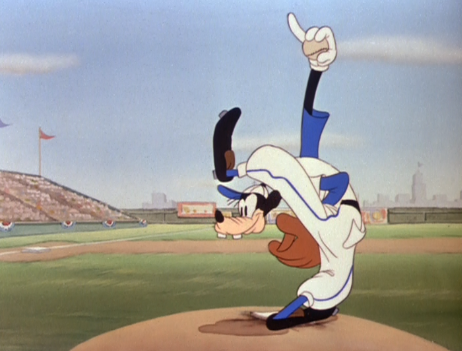 ‘How to Play Baseball’ is the third of Goofy’s sport cartoons, and the first with a title beginning with ‘How to’ (following the ‘How to Ride a Horse’ sequence in ‘The Reluctant Dragon‘ (1941).
The short forms the next and final step in Goofy’s evolution after the duplication of Goofies in the previous cartoon, ‘The Art of Self Defense‘: now multiple Goofies are together the stars of the cartoon. The character remains unique in the cartoon canon in this ability to duplicate himself and remain Goofy throughout, nonetheless.
The short has a highly entertaining way to explain baseball, ending with an exciting finale of the World championship. The gags come fast and plenty, depicting a lot of nonsense. Nevertheless, the cartoon is not only funny, it’s also surprisingly educational.
In the years following ‘How to Play Baseball’ baseball would return to the animated screen in the Woody Woodpecker cartoon ‘The Screwball’ (1943) and in the Bugs Bunny cartoon ‘Baseball Bugs‘ (1944).
Watch ‘How To Play Baseball’ yourself and tell me what you think:
This is Goofy cartoon No. 6
To the previous Goofy cartoon: The Art of Self Defence
To the next Goofy cartoon: The Olympic Champ
Director: Jack Kinney
Release Date: January 1, 1943
Stars: Donald Duck
Rating: ★★★★★ ♕
Review:
 In ‘Der Fuehrer’s Face’ Donald is apparently a citizen of ‘Nutziland’, a fascist country where even trees and clouds are swastika-shaped.
Donald is awoken by a silly march band singing the sarcastic title song (penned by Disney composer Oliver Wallace and sung with gusto by Spike Jones). Then he has breakfast that consists of only one coffee bean, ‘aroma de bacon & eggs’ and a slice of wooden bread. All too soon he has to work at the assembly line, making shells and saluting to images of Adolf Hitler.
In the end, it appears that it was all just a dream, and Donald, in his Stars and Striped-colored room, sighs, embracing a golden copy of the statue of liberty: “Am I glad to be a citizen of the United States of America”. This closing scene is rather corny and the satire of the film misses some points: most of the (German) citizens of Nazi Germany were not poor and did not have to work like slaves, as is suggested here. Instead, the Nazis used forced labor forces from their occupied territories.
Nevertheless, ‘Der Fuehrer’s Face’ was both artistically and commercially the most successful of the Disney war time propaganda films. It even won an academy award for being the best animated short of 1943. It’s so successful, because, unlike most other propaganda shorts, it’s outrageously funny: its satire is so zany, its depiction of ‘Nutzi land’ so wacky, and the scene at the assembly line so out-to-lunch, that one cannot stop laughing. When Donald goes mad, these segments are even topped by a brightly colored, rather avantgardistic and very surrealistic stream-of-consciousness-like scene, which resembles similar dream sequences in ‘Dumbo‘ (1941) and ‘The three Caballeros‘ (1944).
This short was not directed by any of the two regular Donald Duck directors of the time, Dick Lundy and Jack King, who both preferred a more unassuming type of humor, but by Jack Kinney, who is most famous for directing Goofy, and who was undoubtedly the wackiest of the Disney directors, of which this film certainly is proof.
Watch ‘Der Fuehrer’s Face’ yourself and tell me what you think:
This is Donald Duck cartoon No. 38
To the previous Donald Duck cartoon: Bellboy Donald
To the next Donald Duck cartoon: Donald’s Tire Trouble


 Dr. Grob's Animation Review