
You are currently browsing the tag archive for the ‘mythology’ tag.
Director: Karey Kickpatrick
Release date: September 28, 2018
Rating: ★★½
Review:
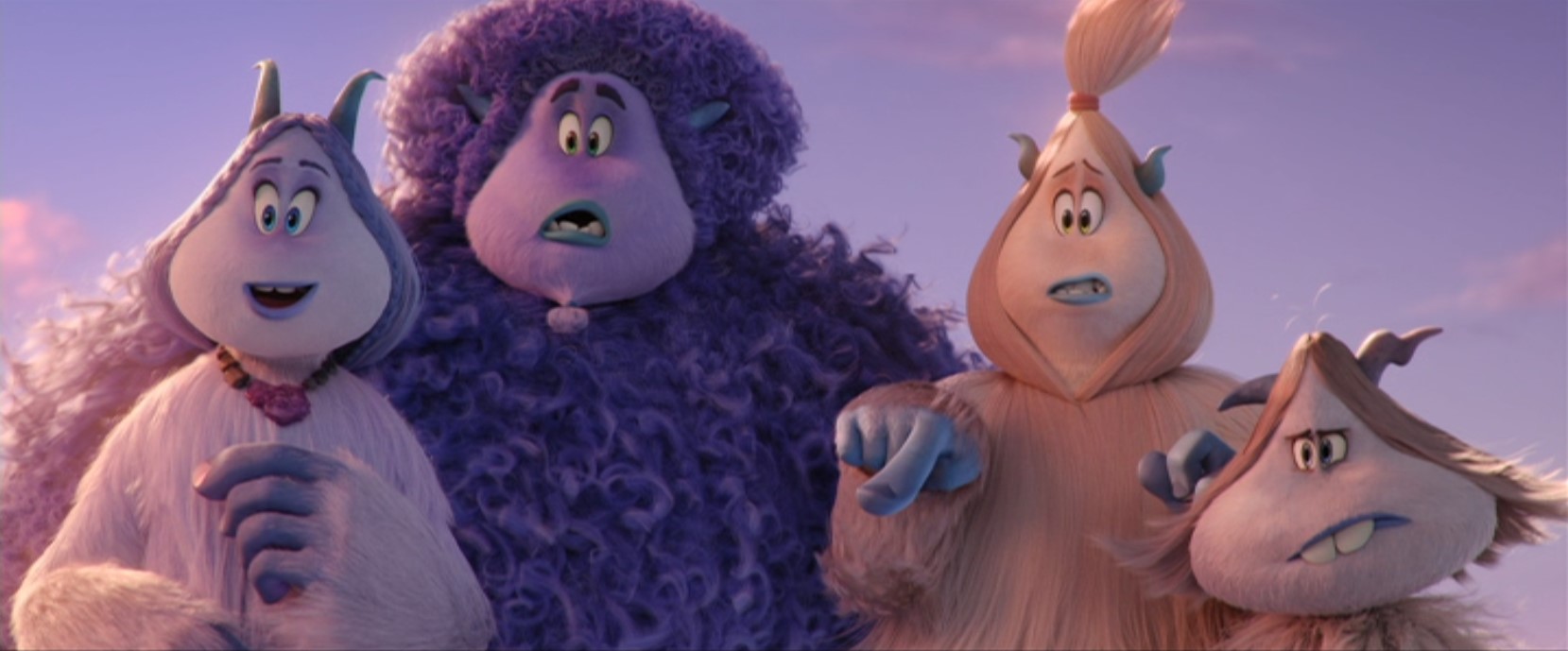
In the strange world of American computer animated feature films, movies with the same story subjects are released at the same time. This phenomenon was particularly striking in the industry’s earliest years, but in 2018-2019 it struck again. This was apparently the year of yetis, with Warner Bros.’ releasing ‘Smallfoot’ in September 2018, Laika ‘Missing Link’ in April and Dreamworks ‘Abominable’ in September 2019.
Of these three ‘Smallfoot’ was thus released first. The film was made by Warner Bros. Pictures Animation, a rather late addition to the American computer animation studio scene, debuting in 2014 with the excellent ‘The Lego Movie’. Since then, the studio has failed to get its own signature (the Lego movies are like a brand of their own, feeling more like Lego movies than Warner Bros. ones), and ‘Smallfoot’ certainly does nothing to change that.
In fact, animation, design, story, and style are all so incredibly generic the film could have been made by any studio save Walt Disney and Pixar, the only studios with a distinct style. The only surprise element of ‘Smallfoot’ is the fact that it’s a musical. And although I’m no musical fan, I must say the songs are rather good. Even better, ‘Smallfoot’ is the first musical with a genuine hip hop number, with alternative rapper Common voicing the Stonekeeper (rappers had voiced animation characters before, like Tone-Lōc voicing the goanna in ‘FernGully: The Last Rainforest’ (1992), but he doesn’t rap there).
‘Smallfoot’ starts with the voice-over of Migo (Channing Tatum), a cheerful young yeti introducing his own village and its rather silly mythology. Immediately thereafter Migo sings a happy song about how perfect his world is, and we know for sure that this character is set up for a major disappointment. And indeed, when Migo is accidentally catapulted outside the village, he sees a supposedly mythical ‘smallfoot’ (a.k.a. human) and from then his world view starts to tilt.
Interestingly, the naive Migo is joined by a group of dissidents, led by a young female yeti called Meechee (voiced by Zendaia), who’s way ahead of our hero. Meechee is such an independent, curious and powerful character that when Meechee sings ‘Wonderful Life’ to Migo this is practically ‘A Whole New World’ from ‘Aladdin’ in reverse. In fact, Meechee is a much more interesting character than Migo and it’s a pity ‘Smallfoot’ isn’t her film.
The third main character is Percy Patterson, a film maker of wildlife documentaries, who apparently has reached a low point in his career. Of all the film’s characters Percy is the most annoying and the least developed. Percy’s story arc is very poor: he remains such a jerk in most of his scenes that his final redemption is utterly unbelievable. Likewise, how Percy manages altitude sickness is beyond any believability.
Unfortunately, Migo’s progress also pushes boundaries of believability. As the filmmakers seem willing to tick all the familiar boxes, Migo undergoes the obligatory breakup scene – but this is an extreme one, with Migo denying his friends and his own views in public. We know why he does it, but the motivation is in fact rather weak, and it’s an enormous breach of character. Likewise, the following reconciliation feels forced and way too easy, given this severe betrayal. And don’t start me on the glorious rainbow finale that defies all we had learned before.
‘Smallfoot’ has a strong message that one should not believe everything, but that one should investigate oneself. But the film also features a ‘deep state’ or ‘fake news’-scheme of epic proportions, so the message is a rather confusing one. If anything, I’d say the film is anti-religion, but I wonder if that is according to the film makers’ intentions.
No, apart from the songs the film’s power is in its humor. Despite all its flaws and cliches ‘Smallfoot’ is an entertaining and funny film. The roasting scene is a particular highlight in that respect. I also like the idea that humans and yetis can’t understand each other at all, and their voices mutually sound like puny squeeks and fearsome growls, respectively. So the film is not a drag, on the contrary. Nevertheless, to carve out its own niche in the crowded feature animation world, Warner Bros. animation certainly will have to do better.
Watch the trailer for ‘Smallfoot’ yourself and tell me what you think:
‘Smallfoot’ is available on Blu-Ray and DVD
Director: Nina Paley
Release date: February 11, 2008
Rating: ★★★★★
Review:
Unlike the European and Japanese animation field, the American animation studio system is unkind to author films. Walt Disney’s ‘Lilo & Stitch’ (Chris Sanders, 2002) probably comes closest, apart from several feature films based on animated television series. Thankfully, some individual artists have filled this gap, most notably Bill Plympton, releasing no less than seven features. Other notable artists are Don Hertzfeldt (‘It’s Such a Beautiful Day’ from 2012), and Nina Paley. Amazingly, all these artists mostly work totally alone, which makes their accomplishments even more stunning.
Nina Paley ‘Sita Sings the Blues’ for example, is written, directed and produced by Paley alone, which took her five to six years, and which could only be finished with help from crowd-funding, being one of the first animated projects to use this type of fund raising.
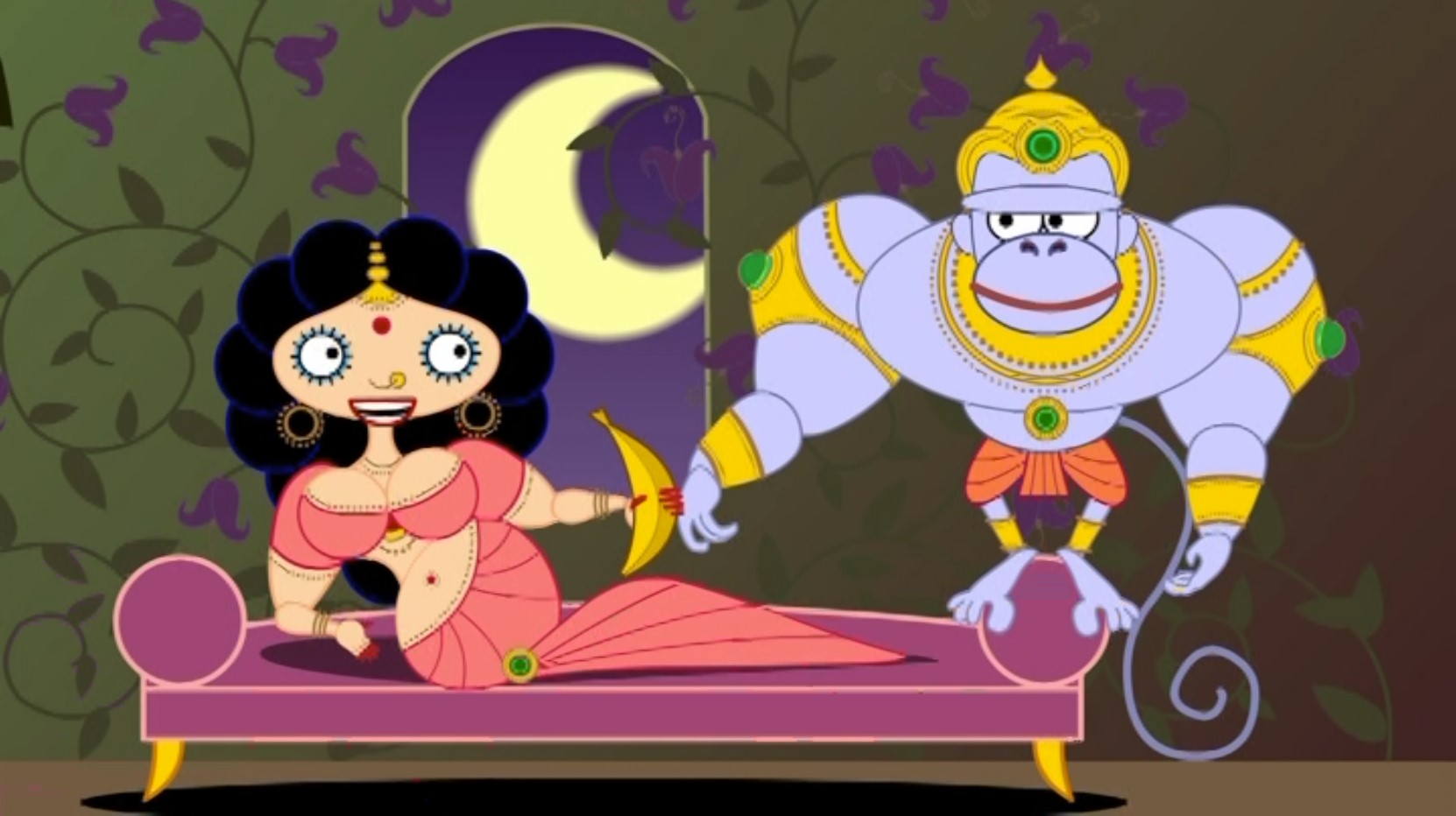
‘Sita Sings the Blues’ retells the Indian epic ‘The Ramayana’, but it’s also a personal film, in which Paley links her own situation to that of Sita, the perfect wife to the hero Rama. The most incongruous element are the eleven songs by 1920s jazz singer Annette Hanshaw, an artist sadly almost forgotten, whom Paley had discovered prior to the film making. The linking of these sweet and gentle tin pan alley songs to the Ramayana is as odd as it is effective, and the pairing certainly contributes to the uniqueness of the film.
The film uses several different animation styles: Nina Paley’s own personal story is told in a traditional scribbly animation style, with sets based on photographic material. These parts are the least attractive of the lot, even though Paley shows to be a very able animator in this classic cartoon style. The Ramayana is retold by three Indians (Aseem Chhabra, Bhavana Nagulapally and Manish Acharya) who are depicted as traditional shadow puppets of Hanuman, Sita, and Rama, respectively. The story they are telling together is shown in tongue-in-cheek cut-out animation.
The ‘official’ story is also told in cut-out animation, using very attractive recreations of traditional Indian paintings. But the best parts to look at are the songs, which are done in a most attractive cartoon modern design. In these song parts Paley reuses a lot of animation cycles, but actually she makes excellent use of the flash medium, and she makes the most of her limited animation.
Apart from these five alternating styles, there’s also a short sequence using rotoscope and a much more pop-art influenced videoclip-like filming style. All these are apparently done in Macromedia flash.
As said, ‘Sita Sings the Blues’ retells the Ramayana, reducing the huge epic to its barest elements. For example, Lakshmana is hardly mentioned, and the monkey king Sugriva not at all. Moreover, unlike the traditional poem, the focus is on Sita, not Rama, and Paley highlights the questionable parts from the original poem (one at the end of the Yuddha Kanda, and another in the Uttara Kanda), in which Rama treats Sita very unfairly indeed, just like Paley’s own partner does in real life. This makes ‘Sita Sings the Blues’ a feminist film, which sheds a welcome critical light on the traditional depiction and treatment of women, then and now.
As the story is told by three people, who remember the story differently and interpret it in different ways, this leads to some very funny moments. But Paley adds some humor, too, in the ‘official’ story part, for example when the female rakshasa (a sort of demon) Shurpanakha tells her brother Ravana about the beauty of Sita, comparing all her body parts with lotuses.
As said, the Annette Hanshaw songs boast the most attractive designs, and like traditional opera arias, they shed an emotional light on the events. However, Paley cleverly propels the story forward even during these sequences. Yet, as the songs are featured in their entirety, typically lasting ca. 3 minutes, they also drag the film down. As there are eleven of them, one tends to grow a little weary of them as the film progresses. Nevertheless, ‘Sita Sings the Blues’ does a great job in restoring interest in this almost forgotten singer. Unfortunately, the Hanshaw songs were not free from copyright, causing Paley a lot of trouble, and eventually causing her to release the film completely free from copyright.
The Annette Hanshaw songs are juxtaposed to some Indian pop music, mostly by artist Masaladosa. Particularly strong is the angry song which follows the scene in which Paley gets dumped by email. The complete soundtrack is as attractive as the film’s visual designs, and the two complement each other very well.
In all, ‘Sita Sings the Blues’ is not without its flaws, but as it is made by a single woman, it’s no less than a tour-de-force, and the result is a very interesting personal film, which makes one think. Moreover, the film shows the great power and endless possibilities of animation, and single-handedly puts Paley into the pantheon of the medium’s greats. In 2018 Paley made yet another feature called ‘Seder-Masochism’, which unfortunately has attracted much less attention.
Watch the trailer for ‘Sita Sings the Blues’ yourself and tell me what you think:
‘Sita Sings the Blues’ is available on DVD
Directors: Faith Hubley & Emily Hubley
Release Date: 1995
Rating: ★★★½
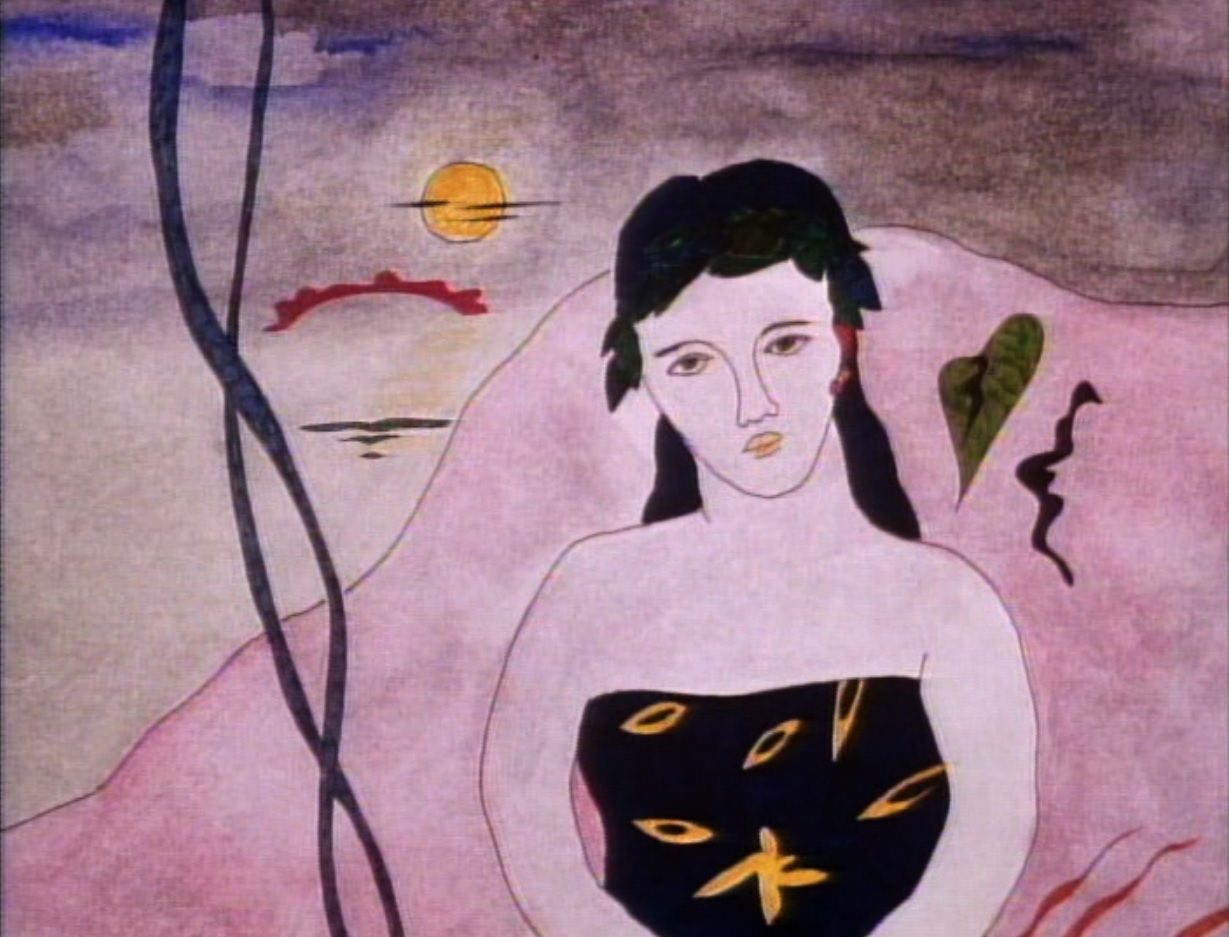
In ‘Rainbows of Hawai’i’ director Faith Hubley, ever thirsty for mythology, turns her attention to the isles of Hawaii. She retells four Hawaiian stories, in her own idiosyncratic way, using a lot of repetitive animation cycles, dancing figures, and semi-abstract, yet vibrant images.
In terms of animation most interesting is the first story, ‘Hisaka Asks the Dragon’s Permission to Enter the Forest – They Do Battle’, in which the animation of the dragon is surprisingly traditional. Most intriguing is the second story, in which a woman gives birth to a friendly green shark. The four stories are followed by a last section, titled ‘All Children Are Sacred and the Dance of Life and Death Goes on and on’, which reshuffles images from all four previous stories with images of dancing figures.
According to the titles, Hubley took inspiration from Oceanic art, but frankly, this is not really visible, as the images in ‘Rainbows of Hawai’i’ aren’t very different from those in her earlier films.
‘Rainbows of Hawai’i’ is available on the DVD ‘The Hubley Collection Volume 2’
Director: Faith Hubley
Release Date: 1994
Rating: ★★★★½
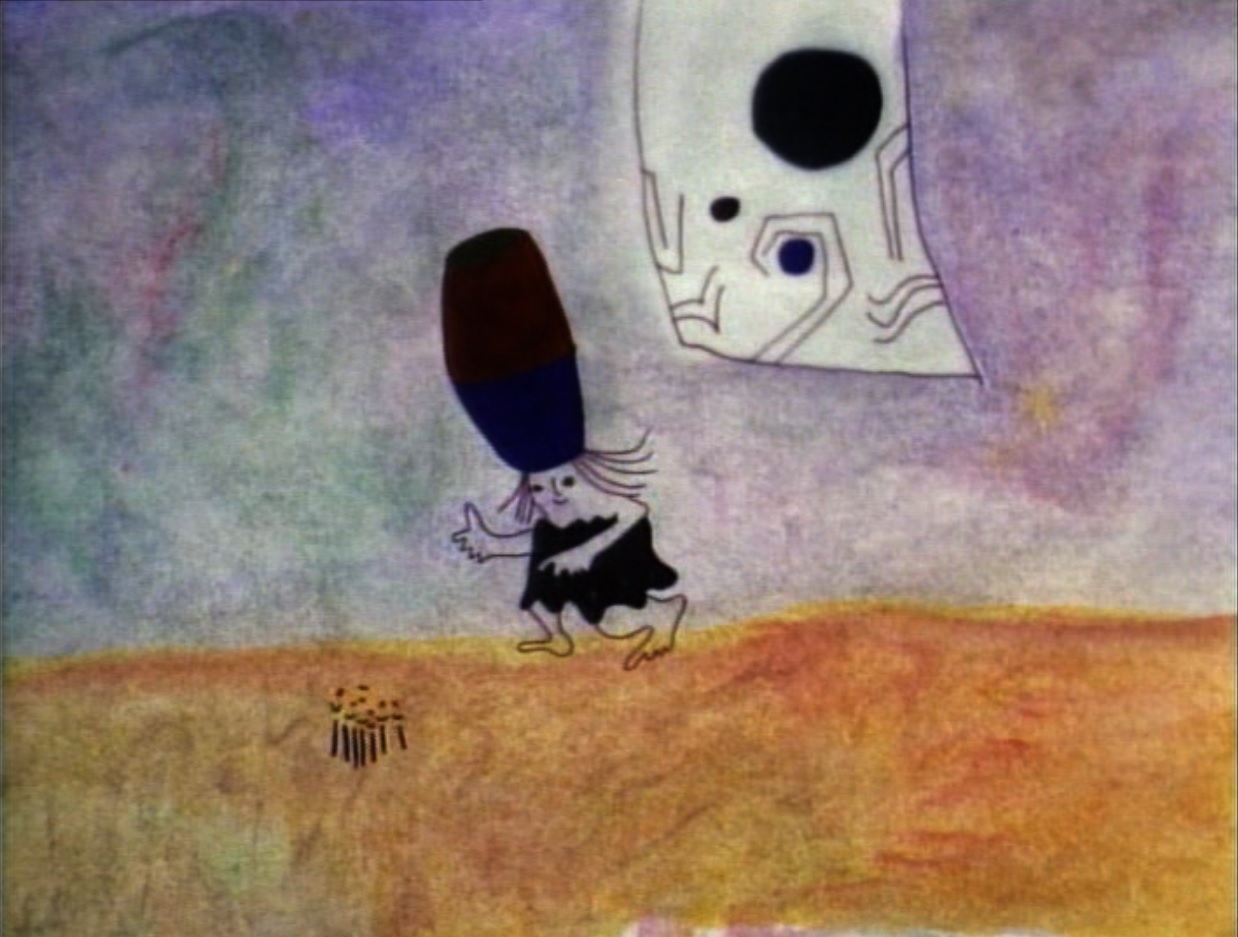
‘Seers and Clowns’ is one of Faith Hubley’s less comprehensible films. Like many of her other works, the short is drenched in mythology.
The film consists of five very short chapters, and uses citations from Chief Seattle, Lao Tse and Kabir. Throughout the film Hubley’s Joan Miró-like imagery remains beautiful, poetic and intriguing, but as most images consist of short animation cycles of semi-abstract figures dancing with joy, any story is hard to follow.
Most interesting is when Hubley’s enriches her style with Eastern influences (in ‘A Chinese Seer Divines Change’) or from Ancient Greece (in ‘Cybele’s Dream’). The mythological atmosphere is greatly enhanced by Don Christensen’s quasi-ethnic music.
Watch ‘Seers and Clowns’ yourself and tell me what you think:
‘Seers and Clowns’ is available on the DVD ‘The Hubley Collection Volume 2’
Director: Faith Hubley
Release Date: 1993
Rating: ★★★★
Review:
 In ‘Tall Time Tales’ Hubley had illustrated ‘dream time’, a concept from aboriginal mythology.
In ‘Cloudland’ she returns to the aboriginal mythology, illustrating three more concepts: 1. a creation myth, in which the sun woman wakes up the earth, 2. the story of hunger at the land of plenty, and 3. Gifts from the ancestors. Like in ‘Upside down‘ and ‘Tall Time Tales‘ the episodes are announced by a voice over (this time her daughter Emily’s) telling their titles.
Hubley’s style is particularly fit for mythology, and this film doesn’t disappoint. Especially, the creation myth is wonderfully done, yet the best part is the story of hunger, with its remarkably straightforward story. This part also features the most elaborate animation, on a bird, a kangaroo and a turtle. Most of the film, however, is filled with Faith Hubley’s characteristic primitive-looking things and beings, which vibrate, move, morph and dance in short and simple animation cycles.
Watch ‘Cloudland’ yourself and tell me what you think:
‘Cloudland’ is available on the DVD ‘The Hubley Collection Volume 1’


 Dr. Grob's Animation Review