You are currently browsing the tag archive for the ‘Pete Docter’ tag.
Director: Pete Docter
Release date: October 11, 2020
Rating: ★★★★★
Review:
From the 2010s on Pixar’s output became very erratic. Excellent films became rarer, and too much of their output was just okay or even subpar. That said, the studio’s summits were still higher than anything in American studio animation around it, as ‘Soul’ for example proves.
What sets Pixar apart from all other American animation studios is its will to tackle more profound life questions, and not just the tired ‘importance of family’ trope that floods Disney films or the ‘believe in yourself’ message that has become the stale message of almost any American animation film around. No, ‘Soul’ ticks nothing less than the question of what it means to be alive and does so in a surprisingly subtle way, never laying the moral too thick.
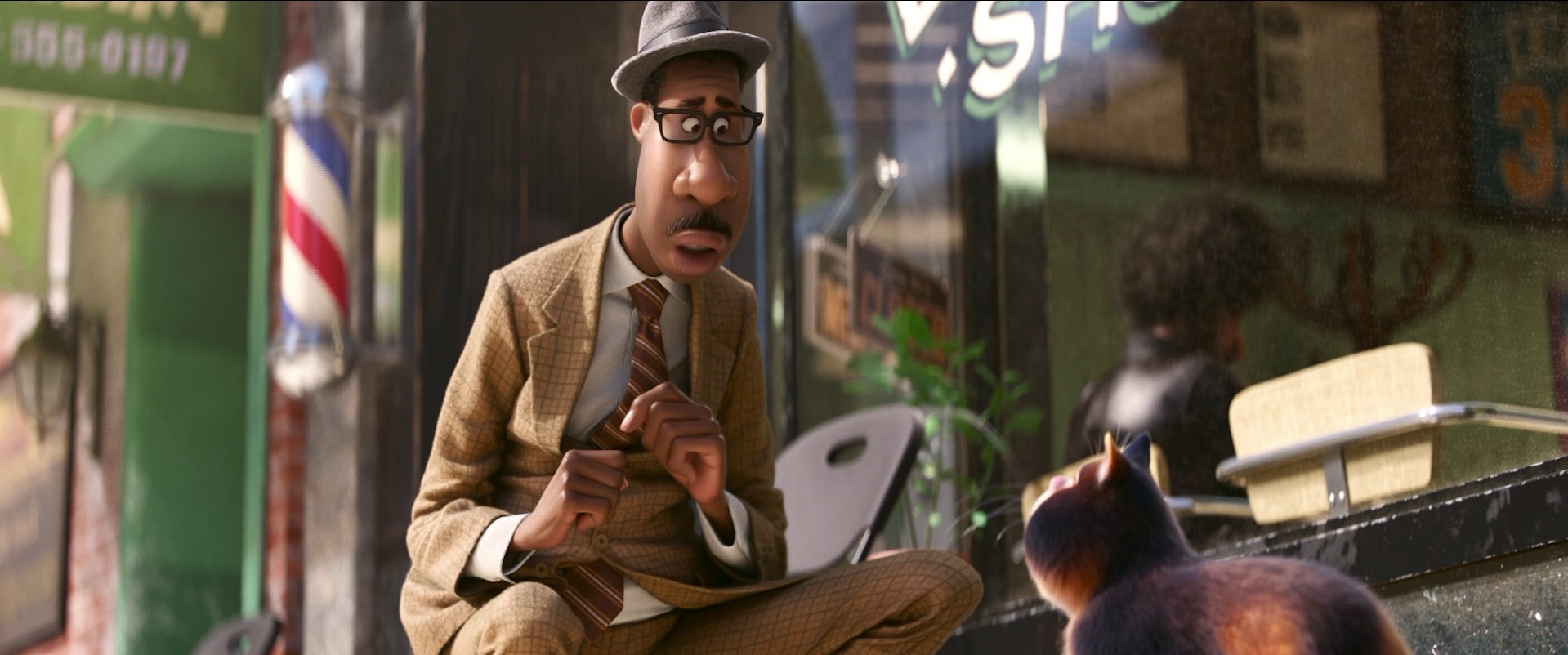
‘Soul’ tells about Joe Gardner (a wonderful Jamie Foxx), an aspiring jazz pianist in New York, who finds himself teaching jazz to untalented school children and still depending on his mother, while he still longs for a breakthrough, despite being past his prime. Then opportunity knocks…
‘Soul’ is one of those extremely rare animation films starring African American people, and like the great predecessor in this respect, ‘The Princess and the Frog’ (2009), we see the black protagonist change into another shape for quite a while, because for a substantial part of the movie we watch ‘Joe Gardner’ wander ‘the great before’ in his spirit form. One almost starts to wonder if the American studios don’t dare to make their audiences watch black characters for too long. But luckily, we quite quickly return to New York and to its black community. I love how the film is about blacks without being about being black. The film also stars a very strong (and not totally sympathetic) female star saxophone player called Dorothea Williams, and jazz indeed plays an important part in the feature, even if the film isn’t about jazz, or music, at all.
For in ‘the great before’ Joe meets ‘22’, a soul terrified of life, and dodging being born for centuries. ‘22’ (greatly voiced by Tina Fey) simply refuses being born, and she isn’t able either, because she hasn’t found her spark, yet. It’s up to Joe to find it with her, otherwise he’ll never return to Earth.
The before-life scenes belong to the great world building sequences of any fantasy film. The new souls, for example, are guided by weird two-dimensional beings, all called ‘Jerry’, who look like they’ve walked away from a Picasso painting. There’s nothing of ‘this world is actually like contemporary America’, like that of ‘Monsters, Inc.’, ‘Cars’ or ‘Onward’. Even the colorful afterlife in ‘Coco’ looks rather mundane compared to this place, with its clear 1950s cartoon modern designs and strange surroundings.
‘Soul’ knows a wonderful plot with many surprise turns and unexpected twists and certainly entertains to the very end. The only very weak spot is Joe’s all too easy return to the other world in the end. This return was clearly needed for the plot, but the sequence feels forced and fails to convince, unfortunately breaking the suspense of disbelief. Nonetheless, the film certainly shows what it means to be alive, and there are sequences of great beauty and deep emotion, given to us in subtle doses and understated character animation. In all, ‘Soul’ belongs to the best animation film can offer, and it is arguably the first animated masterpiece of the new decade.
Watch the trailer for ‘Soul’ yourself and tell me what you think:
‘Soul’ is available on Blu-Ray and DVD
Director: Pete Docter
Release Date: May 18, 2015
Rating: ★★★★★
Review:
In the first decade of the new millennium the Pixar Studio had been the king of animation, virtually topping each film with a better and more original one. But the 2010s were a completely different matter: of the eleven feature films released by the studio in the 2010s only four were no sequels.
But even worse, suddenly the average quality of the films dropped from excellent to a mere okay, with ‘Cars 2’, ‘Brave’, ‘Monsters University’ and ‘The Good Dinosaur’ being particularly disappointing. The only three bright lights in this unsatisfying decade were ‘Toy Story 3’ (2010, arguably the best animated sequel ever made), ‘Inside Out’ (2015) and ‘Coco’ (2017).
Of these three films, ‘Inside Out’ is by far the most original. In fact, it’s one of the most original mainstream feature animation films ever. The whole premise of making someone’s emotions the stars of the film is as daring as possible. True, the idea of showing emotions itself as little persons was far from new, after all, Disney’s own ‘Reason and Emotion’ (1943) was an obvious forerunner, as were more or less the Christian angels and devils aiding Pluto and Donald in ‘Mickey’s Pal Pluto’ (1933) and ‘Donald’s Better Self’ (1938), respectively. But as you may notice, there never were more than two, contrasting each other.
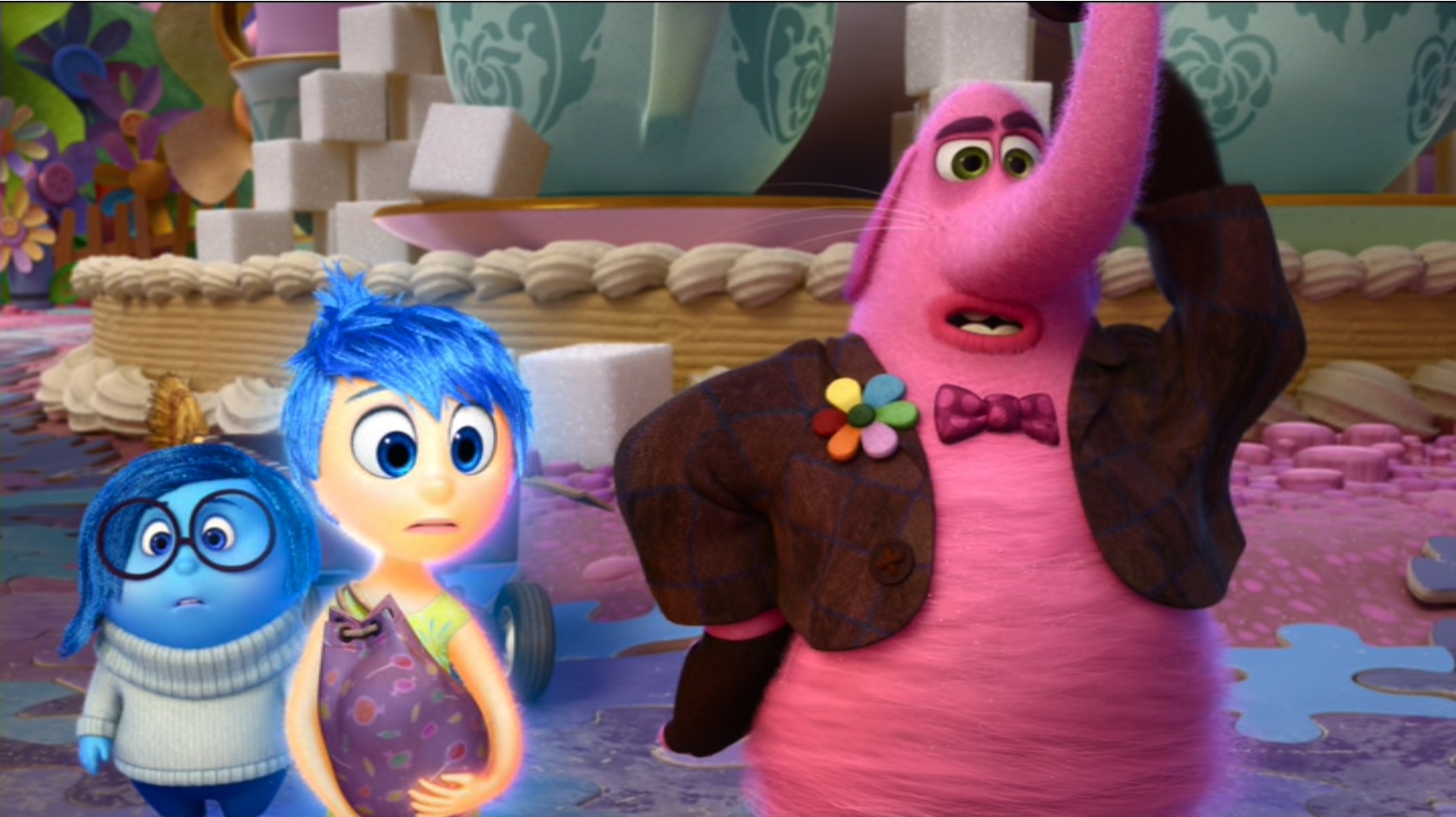
‘Inside Out’, on the other hand, features five, based on work by psychologist Paul Ekman, omitting his sixth primary emotion surprise. The five, Joy, Sadness, Fear, Anger and Disgust, are being shown to be in control in the brain. We watch the emotions of one eleven year old girl called Riley in particular, collecting memories, and coloring them with their particular flavor (bright yellow for joy, blue for sadness, and so on) – following scientific knowledge, in which is acknowledged that emotions affect and change memories. Now, the depiction of the inside of Riley’s brain is a wonderful piece of imaginative world-making, but still surprisingly well-rooted in science, although the idea of ‘core memories’ seems to be an invention of the film-makers alone. In the world of ‘Inside Out’ these core memories build islands of personality, in Riley’s case e.g. goofball island, hockey island, honesty island, and family island.
The film focuses on Joy, and her appreciation of her opposite, Sadness. Together with Joy we learn that sadness strengthens relationships (an idea based on the work of Dacher Keltner, another psychologist), and that sadness is a part of life. We also learn that it can be difficult to grow up, and that it’s okay to be sad about it. These are surprisingly mature messages to come from a mainstream animation film directed to the whole family, and because they’re brought so well, they make the film extra impressive.
The film starts with an introduction, narrated by Joy (Amy Poehler), in which Riley gets born and gets her first experiences, introducing the five emotions in succession. After the introduction, the main plot of the film is set in motion when eleven year old Riley moves with her parents from Minnesota to San Francisco, changing her whole life.
Meanwhile, inside her head, Joy and Sadness get lost inside Riley’s head, and have to try to find their way back home. In this sequence the two cross several sections of the brain, like the memory, imagination land, the dream factory (with film posters like ‘‘I’m Falling for a very long time in a pit’, ‘I Can Fly’, and ‘Something’s Chasing Me!’), and Riley’s subconsciousness. Highlight of this road-trip inside Riley’s head must be abstract thought, in which the characters undergo the four stages of abstraction, rendering them abstract, deconstructed, two-dimensional, and finally non-figurative. During their journey they meet Riley’s imaginary friend Bing-Bong from when she’s was only very little.
While Joy and Sadness are lost, the other three emotions try to direct Riley like Joy would do. Their funny antics correspond surprisingly well with Riley’s conflicting reactions to her new life, which leads to frustration and anger, and finally, depression.
Riley’s emotions are a mix of female (Joy, Sadness, Disgust) and male (Fear, Anger) characters, but when we take a look inside the heads of her mom, they are all female, while inside her father’s head there are only mustached male characters. Interesting is that while Riley is mainly steered by Joy, in her mother’s head Sadness is in full control, while Anger has taken the lead inside her father’s head, making one wonder what made these two adults so. At the end of the film and during the titles the emotions of several other people are shown, even including a dog and a cat.
All the settings inside Riley’s head are depicted in the most colorful and fantastic way. This is a very convincing fantasy world, indeed. The character designs, too, are inspired. The five emotions are depicted as little people, but also as bundles of energy: especially Joy’s edges are bubbly and undefined, and she has a permanent glow around her. This is an incredible tour de force of effect animation, but luckily never distracts from the well-defined characters the five emotions are. The depiction of the real world is also top notch, and seems effortless, convincingly bringing Riley’s new home of San Francisco to life, from her empty bedroom to her new ice hockey stadium. The soundtrack too, by Pixar regular Michael Gioacchino, is very inspired, and the composer gives Joy a theme song that almost matches the theme from ‘Up’ in evoking an emotional response from the audience.
The films has one major flaw, however. By focusing on Joy, this emotion must be a round character, capable of more than one emotion. Indeed, we watch Joy being fearful, and even sad. Joy being sad is such an absurd concept that at that point the suspension of disbelief is breached. Nevertheless, when Joy finally lets Sadness do her thing, this a beautiful moment in the film.
In all, ‘Inside Out’ is a very fine film, one of Pixar’s best, and certainly one of the most interesting animation films to come out of the United States in the 2010s, which can hardly be called the best decade for the medium.
Watch the trailer for ‘Inside Out’ yourself and tell me what you think:
‘Inside Out’ is available on Blu-Ray and DVD


 Dr. Grob's Animation Review