
You are currently browsing the tag archive for the ‘science fiction’ tag.
Director: Albert Barillé
Airing date: January 29?, 1983
Rating: ★★★
Review:
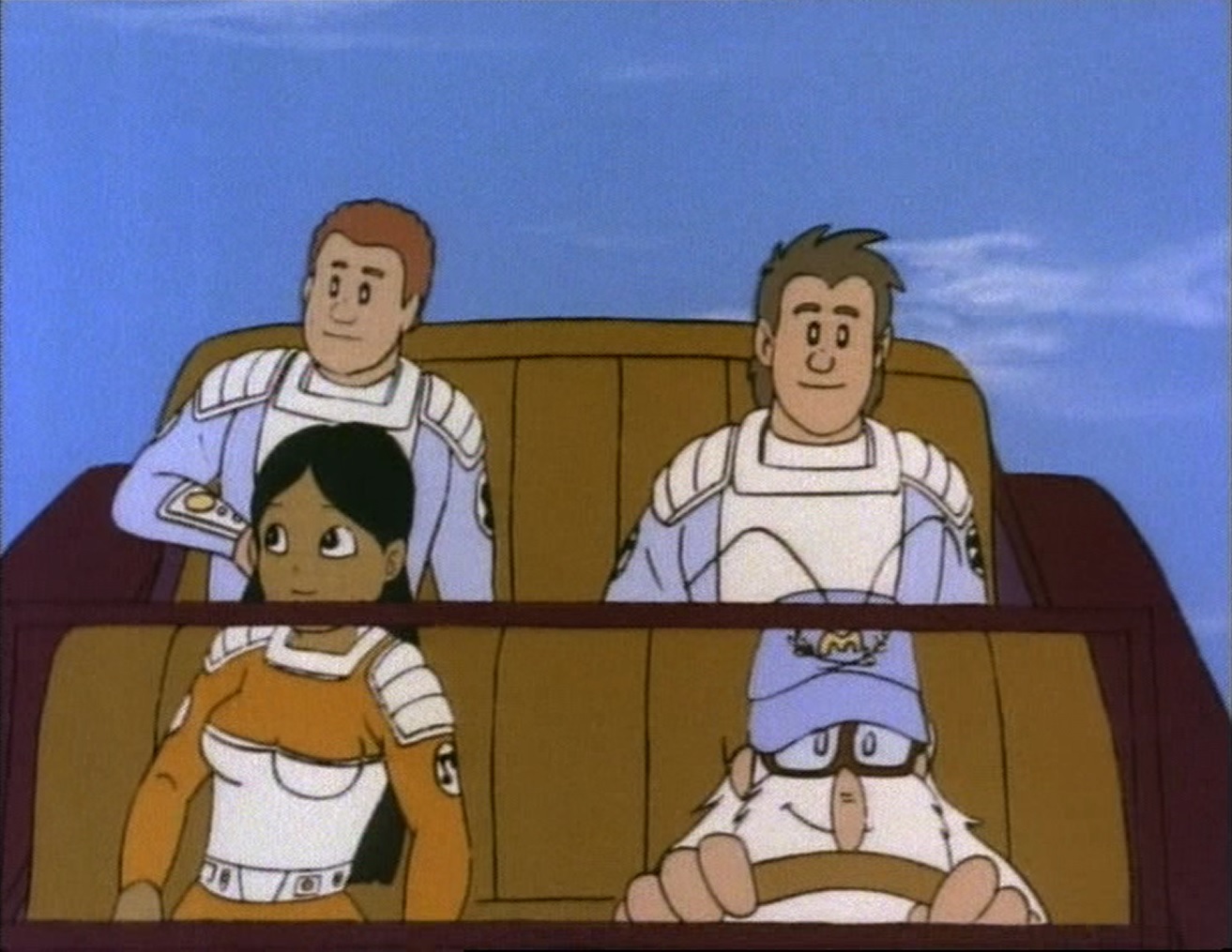 Because they have saved earth from an impending doom in ‘L’imparable menace‘, Pierrot, Psi and Petit Gros are allowed to go on holiday on earth, where they’re received as heroes.
On earth, Maestro’s ancestor (from ‘Le long voyage‘) is their guide, and he takes our heroes to the countryside. Here he tells our heroes the history of earth from the 21st century onward. Barillé’s vision of the earth’s future contains some rather somber views on genetics, war, informatics and the climate.
In the second half of this episode, the old Maestro takes Pierrot and Petit Gros into space, showing a solar ring, a cemetery of spaceships, and even an amusement park called ‘Barillé’s Land’.
Because of its holiday theme, this short moves at a leisurely speed, and it is rather boring compared to the two episodes preceding it. However, even in this relaxed episode, there’s some conflict, when our heroes encounter a saboteur from Cassiopeia.
Inconsistent design have always tortured the Il était une fois… series. And in this episode, in certain scenes the drawings of our heroes are no less than terrible.
Watch ‘Terre!’ yourself and tell me what you think:
This is the 17th episode of ‘Il était une fois… l’espace’ (Once Upon a Time… Space)
To the 16th episode: L’imparable menace (The Unstoppable Menace)
To the 18th episode: L’Atlantide (Atlantis)
Director: Albert Barillé
Airing date: January 22?, 1983
Rating: ★★★★★
Review:
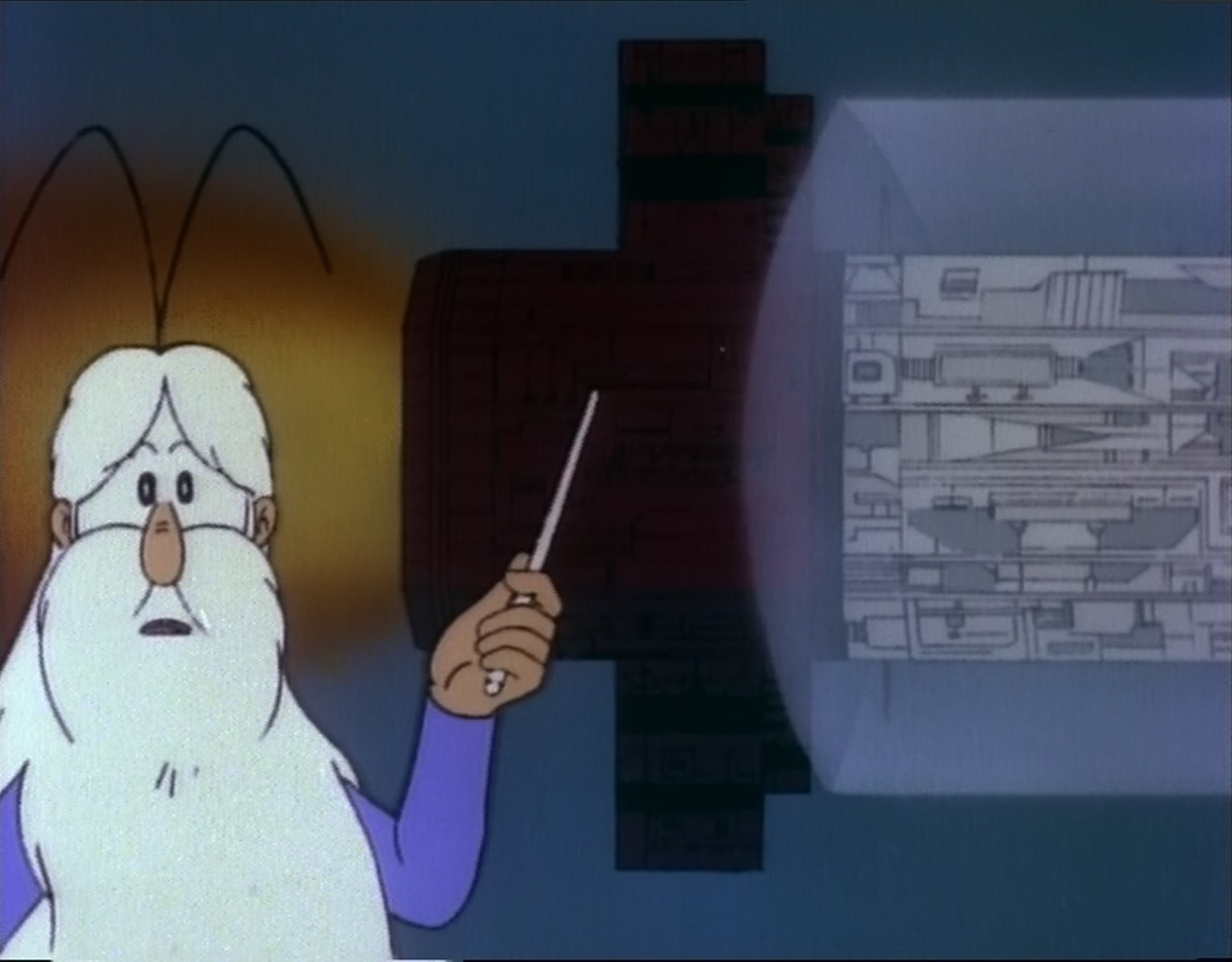 In ‘À Cassiopée‘ the hostile constellation of Cassiopeia had made plans to invade the earth. In ‘L’imparable menace’ it has become clear their plans have changed…
This episode starts with Cassiopeia firing a deadly rocket to Earth in order to make Omega surrender to Cassiopeia unconditionally. So now Omega itself is at stake, with Earth as a hapless pawn in interstellar politics.
Luckily for Omega, our heroes Pierrot, Petit Gros and Psi are still in the neighborhood of Jupiter, and they are the only ones who can stop the doomsday rocket in time. In fact, it’s the androids Psi encountered in ‘Les anneaux de Saturne‘ who had fired the rocket in the first place.
The whole episode is one race against time, which makes it one of the most exciting episodes of the entire series.
Watch ‘L’imparable menace’ yourself and tell me what you think:
This is the 16th episode of ‘Il était une fois… l’espace’ (Once Upon a Time… Space)
To the 15th episode: Les anneaux de Saturne (The Rings of Saturn)
To the 17th episode: Terre! (Earth)
Director: Albert Barillé
Airing date: January 8?, 1983
Rating: ★
Review:
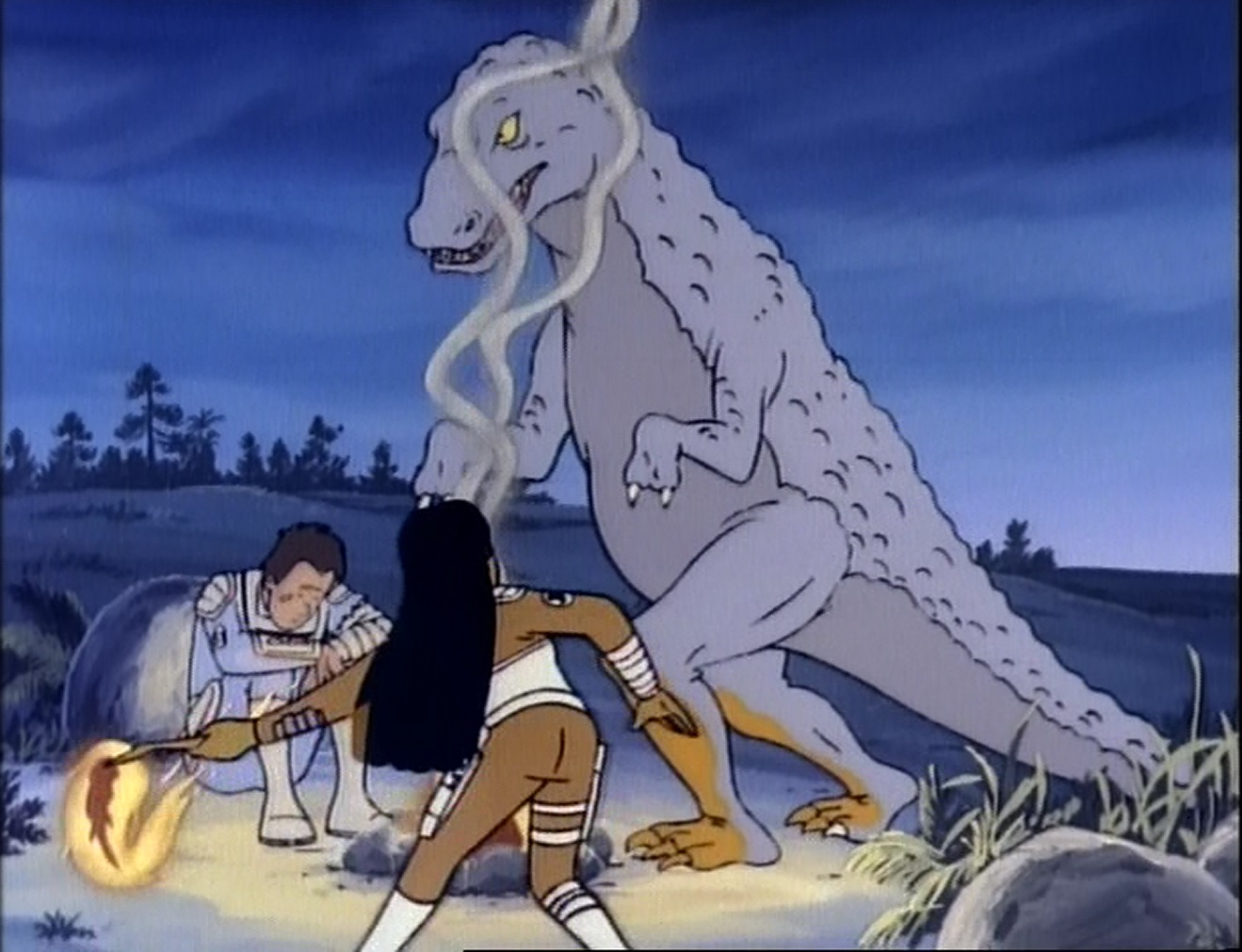 ‘Chez les dinosaures’ is the last of three vaguely educational episodes. It’s also one of the weakest episodes in the series.
Pierrot, Psi and Metro now visit a planet inhabited by dinosaurs from the Jurassic period. Its educational value, however, is doubtful: Barillé’s theories on the end of the dinosaurs are no less than ridiculous, and the dinosaurs are designed and animated terribly.
Furthermore, one grows tired of all these earth-like planets, populated by the same creatures that have roamed the earth, too (such planets occur also in ‘La Planète verte‘, ‘Les Cro-Magnons‘, ‘La planète Mytho‘, ‘Les géants‘ and ‘Les Incas‘). As if everywhere in space the same history occurs over and over again.
Luckily, this was the last so-called ‘educational’ episode. With the next episode, Barillé would go back to the main story without leaving it again. Indeed, even ‘Chez les dinosaures’ contributes to it, as Pierrot gets injured during this episode, leaving Psi on her own in the next one, with dramatic results…
Watch ‘Chez les dinosaures’ yourself and tell me what you think:
This is the 14th episode of ‘Il était une fois… l’espace’ (Once Upon a Time… Space)
To the 13th episode: Les Incas (The Incas)
To the 15th episode: Les anneaux de Saturne (The Rings of Saturn)
Director: Albert Barillé
Airing date: January1?, 1983
Rating: ★★
Review:
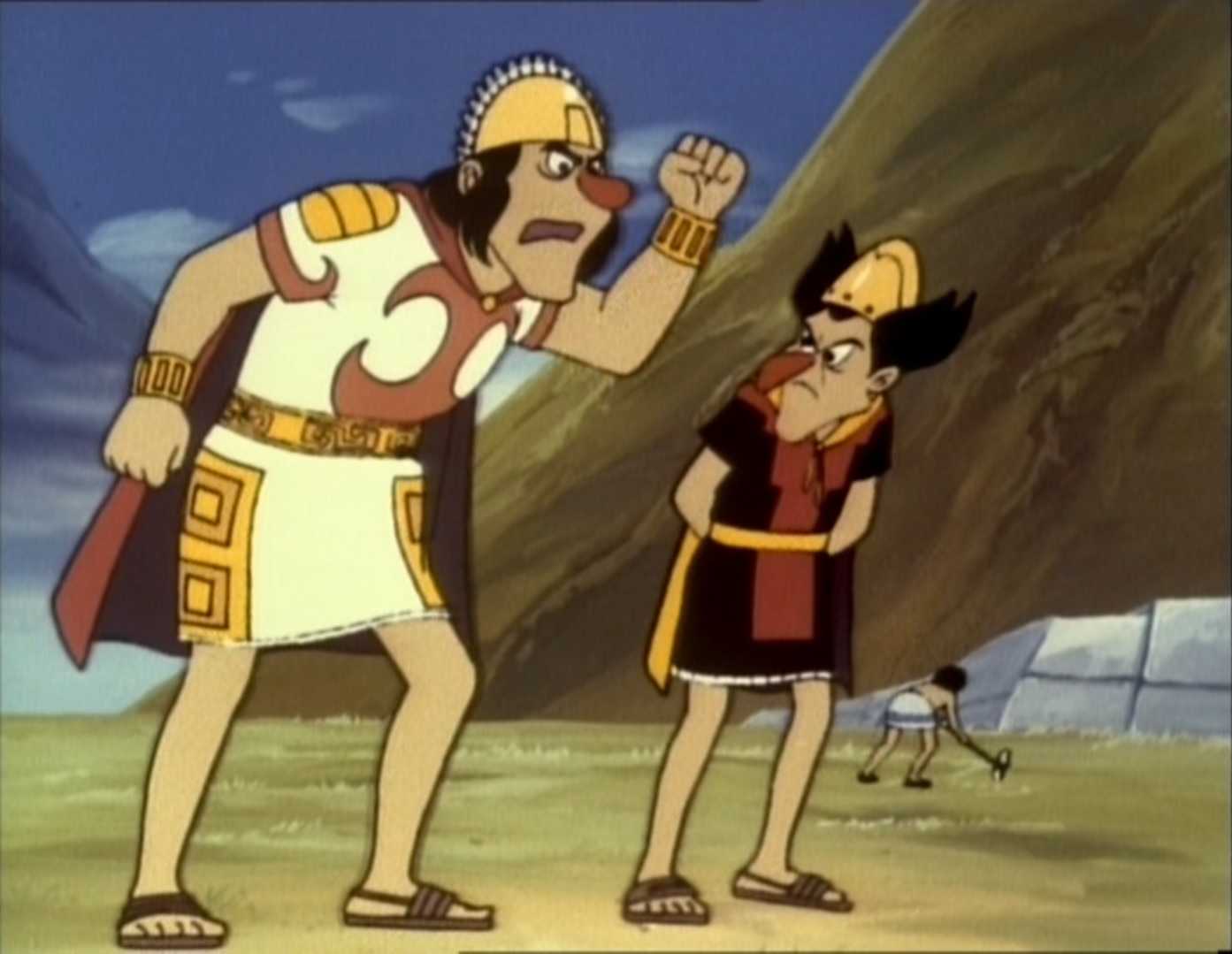 ‘Les Incas’ is the second of three adjacent episodes from ‘Il était une fois… l’espace’ that are more educational than entertaining, and which have nothing to do with the main story.
This time, Pierrot, Psi, Metro, Legros and Maestro visit a planet on which the people live like Incas. Thus Barillé is able to tell us about the Inca society, which he does at great lengths. Only after three-fifths a story kicks in, when the friendly Inca society is about to be attacked by an unseen neighboring people, and our heroes refuse to help them in the battle. The Inca’s own Teigneux and Nabot trick our heroes to get hold of their weapons, but Metro once again saves the day.
This slow and tiresome episode also features an Erich von Däniken-like story about earlier visitors, Astronauts, who turned into Gods, just like in ‘La planète Mytho‘.
Watch ‘Les Incas’ yourself and tell me what you think:
This is the 13th episode of ‘Il était une fois… l’espace’ (Once Upon a Time… Space)
To the 12th episode: Les géants (The Giants)
To the 14th episode: Chez les dinosaures (In the Land of the Dinosaurs)
Director: Albert Barillé
Airing date: December 25?, 1982
Rating: ★
Review:
 ‘Les géants’ is the first of three adjacent and vaguely education episodes that have nothing to do with the main story.
In ‘Les géants’ Pierrot, Psi and Metro visit a huge planet, which, like almost every other planet in the Barillé universe, is an exact copy of earth, this time only bigger. On this planet our heroes encounter huge animals, like a giant caterpillar, a monstrous spider and a very cartoony rat.
Most of the episode, however, they are trapped in a termite colony. Thus, Barillé is able to tell us more about these little insects, which he does mostly through a lecturing Metro. There’s practically no story, and most of the time Pierrot and Psi are trying to get out of the colony. This fact and the lectures render one of the most boring episodes of Il était une fois… L’espace.
It seems this and the following two episodes were made to sell the series as an educational one. However, ‘Il était une fois… l’espace’ remains far less educational than the previous ‘Il était une fois… l’homme’ or indeed, the subsequent ‘Il était une fois… la vie’, and its charm lies mainly in Barillés story. Unfortunately, ‘Les géants’, ‘Les Incas‘ and ‘Chez les dinosaurs‘ are no part of that and form the low point of the entire series.
Watch ‘Les géants’ yourself and tell me what you think:
This is the 12th episode of ‘Il était une fois… l’espace’ (Once Upon a Time… Space)
To the 11th episode: Les naufragés de l’espace (Shipwrecked in Space)
To the 13th episode: Les Incas (The Incas)
Director: Albert Barillé
Airing date: December 18?, 1982
Rating: ★★★
Review:
 This episode starts immediately where ‘La planète déchiquetée‘ has left off: the space vessel ‘Ursus’ has crashed on, luckily, an earth-like planet.
Unfortunately, its captain is ill, and our heroes have difficulties with the second in command, the skeptical and cowardly lieutenant Sanders. While Metro is used for all kinds of reparations, Pierrot and Psi go on two expeditions.
On the first they encounter strange lifeforms, like walking trees, spider-like aliens, green gorillas, and friendly little black people called Ptax. Like the lizards in ‘Les Sauriens‘, the Ptax are telepathic and they help our heroes against the green gorilla creatures.
On the second expedition, our heroes go searching for metal, but what they find is a military ship from Cassiopeia… Aware of the threat, Pierrot and Psi hurry back to the camp, only to learn the captain has died. Only when a riot breaks out between Pierrot and Sanders, Omega comes to the rescue.
The animation is painstakingly slow in this episode, and there’s more urge in the dialogue than in the action. Because of these shortcomings the episode is only half as captivating as it could have been.
Watch ‘Les naufragés de l’espace’ yourself and tell me what you think:
This is the 11th episode of ‘Il était une fois… l’espace’ (Once Upon a Time… Space)
To the 10th episode: La planète déchiquetée (A Planet Blown to Pieces)
To the 12th episode: Les géants (The Giants)
Director: Albert Barillé
Airing date: December 11?, 1982
Rating: ★★★★★
Review:
 The exciting episode ‘La planète déchiquetée’ undoubtedly is one of the highlights of ‘Il était une fois… l’espace’.
It starts immediately where ‘À Cassiopée’ had left off. In this episode Cassiopeia leaves the galactic union, an act reminiscent of Japan’s resignation from The League of Nations in 1933. Like ‘À Cassiopée’ this episode starts with politics, with the absent-minded Maestro as a comic relief. Maestro also tells us how a sun explodes at the end of its life, thus adding a small educational touch to this episode.
A dying sun plays a major part in the political scheme of things, threatening a military base Cassiopeia is building nearby. When the sun does explode, Cassiopeia tries to save the material, leaving its own slave-like people behind, leaving them to be rescued by the allies.
Only after 20 minutes we meet our heroes, trying to save the last Cassiopeian people from the threatened planet. The time element and the contrasting goals of Cassopeia and Omega make this episode particularly thrilling. The suspense is supported by Michel Legrand’s exciting score.
At the end, the rescuing vessel The Ursus, with our heroes on board, crashes into another planet, leading to the first real cliffhanger in the series.
Watch ‘La planète déchiquetée’ yourself and tell me what you think:
This is the 10th episode of ‘Il était une fois… l’espace’ (Once Upon a Time… Space)
To the 9th episode: À Cassiopée (In Cassiopeia)
To the 10th episode: Les naufragés de l’espace (Shipwrecked in Space)
Director: Albert Barillé
Airing date: December 4?, 1982
Rating: ★★★★
Review:
 Episode 9 of ‘Il était une fois… l’espace’ is closely tied to episode 10 and 11, constituting the first episode-exceeding story within the series.
It’s also one of the more political episodes. Indeed, its first half is about politics only. It starts with general Teigneux (Pest) reflecting on the past, how he failed to colonize planets because of Omega, referring to the events in episodes 2-6. Then consul Le Nabot (Dwarf) shows him the tapes from earth he had stolen in the previous episode.
The images of earth shows Barillé’s cynical view on the earth’s future: 30 billion people, many of which overfed, a lot of pollution, age-long traffic jams (reminiscent of those from Halas & Batchelor’s cartoon ‘Automania 2000’ from 1963), and a pride in producing weapons. After watching these images, Cassiopeia plans to invade earth.
After this long introduction, our heroes are sent to Cassiopeia to find out what their plans are, but they’re immediately captured and sent into prison. The second half of this episode consists therefore of a classic prison break, with a starring role for the rather matter-of-factly Metro. Our heroes eventually escape using the same meteor trick the Millennium Falcon did in ‘The Emperor Strikes Back’ (1980), one of the numerous influences of George Lucas’ films on Barillé’s series.
Watch ‘À Cassiopée’ yourself and tell me what you think:
This is the 9th episode of ‘Il était une fois… l’espace’ (Once Upon a Time… Space)
To the 8th episode: Le long voyage (The Long Voyage)
To the 10th episode: La planète déchiquetée (A Planet Blown to Pieces)
Director: Albert Barillé
Airing date: November 27?, 1982
Rating: ★★★★★
Review:
 ‘Le long voyage’ is a nice episode about space travel.
Star of the episode is an ancient forefather of Maestro who, after a journey of more than a 1,000 years, awakes near Omega, only to be greeted by descendants of humans who had made the trip after him, with better, larger and faster spaceships.
This episode excels in beautiful backgrounds and designs, especially of the spaceships. Highlight, however, are the ancient Maestro’s fantasies about extraterrestrial life, just before he encounters the all too familiar inhabitants of Omega.
With ‘Le long voyage’ we firmly return to the main story of ‘Il était une fois… l’espace’. The strange incident from episode 1 is mentioned again, and in this episode we learn that earth still exists, ultimately leading to our heroes visiting their mother planet in episode 17. It also contains an unclear mystery about a hijacked ‘train’, indicating more troubles to come. Moreover, this episode shows Psi’s psychic powers in full, saving Pierrot who has become adrift in space.
Maestro’s ancestor is a great character and he would return to the screen in episodes 17 (‘Terre!‘) and 18 (‘L’Atlantide‘).
Watch ‘Le long voyage’ yourself and tell me what you think:
This is the 8th episode of ‘Il était une fois… l’espace’ (Once Upon a Time… Space)
To the 7th episode: La planète Mytho (The Planet Mytho)
To the 9th episode: À Cassiopée (In Cassiopeia)
Director: Albert Barillé
Airing date: November 20?, 1982
Rating: ★★
Review:
 In this seventh episode of ‘Il était une fois… l’espace’ our heroes Pierrot, Psi and Metro land on a planet, where the survivors of a stranded spaceship play Gods.
This episode toys with Erich von Däniken’s ideas about the gods having been astronauts (Barillé would revisit that idea in ‘Les Incas‘). The stranded people are like the gods of the ancient Greek, sharing their names and habits.
The commander of the ship, Zeus, is a strong and valiant man, but he is also selfish, autocratic, and paternalistic. He keeps the mortals, the original humans populating the planet, ignorant and miserable. Pierrot and Psi disagree with the commander’s choice, and secretly give the humans bricks, the wheel, the sail, music and fire, thus turning them into some Prometheus and Athena, and showing Barillé’s personal political view.
Unlike its predecessor, ‘La révolte de robots‘, ‘La planète Mytho’ is more or less a stand-alone episode. It is also vaguely educational, telling kids a little about Greek mythology, although this is much easier to understand and to enjoy by the educated viewer than by the intended audience.
Apart from the Gods, Barillé shows us three Greek myths: Peleus and Thetys, Pan and Syrinx, and Eris’s apple of discord. The bronze giant Talos is transformed into a robot.
Because of the use of Greek mythology, the overall episode is inconsistent, hard to follow and slow. One wonders what Barillé’s aim was with this entry: did he want to educate or did he want to tell about political ethics?
Watch ‘La planète Mytho’ yourself and tell me what you think:
This is the 7th episode of ‘Il était une fois… l’espace’ (Once Upon a Time… Space)
To the 6th episode: La révolte des robots (The Revolt of the Robots)
To the 8th episode: Le long voyage (The Long Voyage)
Director: Vladimir Tarasov
Release date: 1988
Rating: ★★★½
Review:
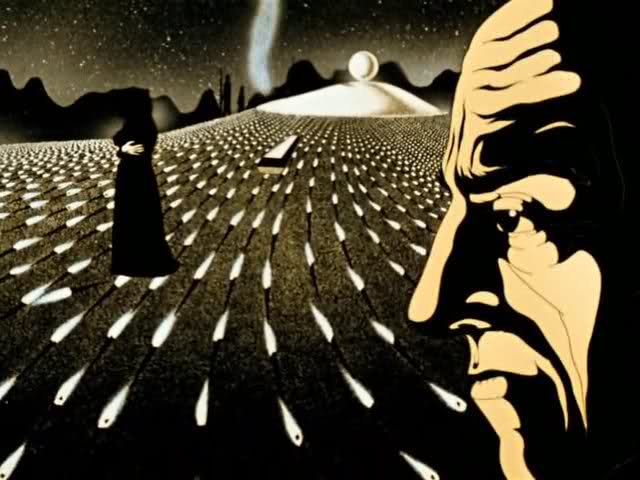 ‘Pereval’ (The Pass) is a science fiction film from the Soviet Union about three youngsters, descendants of some astronauts stranded on a strange, alien planet, who make a quest to the original spaceship.
The film is dark and moody and the atmosphere contemplative, even in the action scenes. Nevertheless, there is a weak comic relief in the form of an eight-eyed, elephant-like creature, which the youngsters encounter on their way to the ship.
In this film Tarasov uses a bold, realistic style with sharp contrasts: he juxtaposes stark shadows with monochrome yellows and reds to create a unique graphic atmosphere, reminiscent of the work by Frank Miller. The planet is portrayed as barren, disturbing and threatening. The images are often very surreal, and no attemption is made to give the backgrounds any sense of realism. This makes this film comparable to Laloux’s ‘La Planète sauvage‘, despite its difference in style. The spaceship, for example, looks more like an alien temple, and one gets the idea that the journey of the three is more symbolical than real. The mood is enhanced by a Dio-like hard rock song.
‘Pereval’ was the last animation film Tarasov made during the Soviet era. See the modest Wikipedia article to learn what happened to him after the fall of the Soviet Union.
Director: Roman Kachanov
Release date: 1981
Rating: ★★★★
Review:
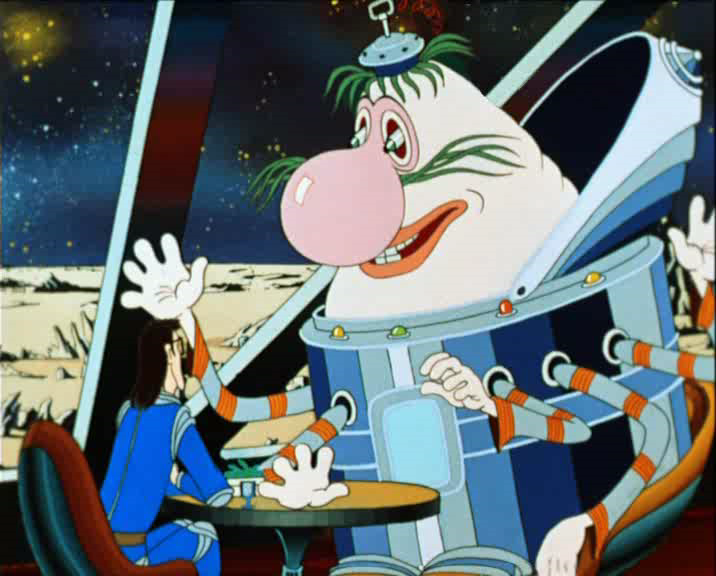 ‘Tayna Tretyei Planeti’ (‘The Mystery of the Third Planet’, also ‘[Alice and] The Secret of the Third Planet’) is a delightful science-fiction film for children about the little girl Alice, who accompanies her father, a bespectacled scientist, and the melancholy captain Green on their trips to collect alien animals for the Moscow zoo.
On their way they encounter a mysterious professor, and learn about the illegal slaughter of ‘chatterers’, some kind of alien bird species. The one surviving chatterer provides the key to the mystery, leading our heroes to two heroic astronauts, who have been captured by pirates.
Despite the mystery plot, the overall mood of the film is optimistic, unhurried and relaxed. At no point there’s is any real danger or violence. Even when the villain commits suicide at the end, it turns out to be fake. The film’s delight is not as much found in its story as in its gorgeous designs, its alien images, its surreal backgrounds, Aleksandr Zatsepin’s wonderful soundtrack, full of electronic space-funk, and in its exuberant animation. Alice, for example, has the habit to pull back her hair continuously, while her dad keeps putting his glasses straight. Also featured is a comical alien creature, called Gromozeka, who possesses no less than six arms, which are all animated separately.
It seems that there were no budget problems at Soyuzmultfilm at that time, if animators could indulge that much in excessive animation. The results are gorgeous, but sometimes the elaborate animation slows down the action, especially during the action scenes, which are anything but fast. Nevertheless, ‘Tayna Tretyei Planeti’ is a gem of an animation film, and a feature that definitely deserves to be more well-known, even though it’s a short one, clocking only 45 minutes.
Watch ‘The Mystery of the Third Planet’ yourself and tell me what you think:
Director: Vladimir Tarasov
Release date: 1978
Rating: ★★★
Review:
 ‘Contact’ is a good-humored short film in which a pipe-smoking, nature-loving hippie encounters a multicolored alien, capable of morphing.
First the man flees in horror, but then the two make contact through music, and in the end we can see them walking into the distance, singing together.
This Soviet film is surprisingly Western-looking and is drawn in a bold seventies style. In contrast with Tarasov’s earlier ‘Forward March, Time!‘ any Soviet association is lacking, and there seems to be some vague message about freedom. Tarasov shows his directing skills and is not afraid to use bold angles and extreme perspectives. The short contains a typical cartoon chase, accompanied by lively jazz music.
In 1979 Tarasov returned with the graphical equally original, but much more propagandistic film ‘Shooting Range’, proving that he was one of the most interesting Russian animators of his generation.
Watch ‘Contact’ yourself and tell me what you think:
Director: Albert Barillé
Airing date: November 13?, 1982
Rating: ★★★★★
Review:
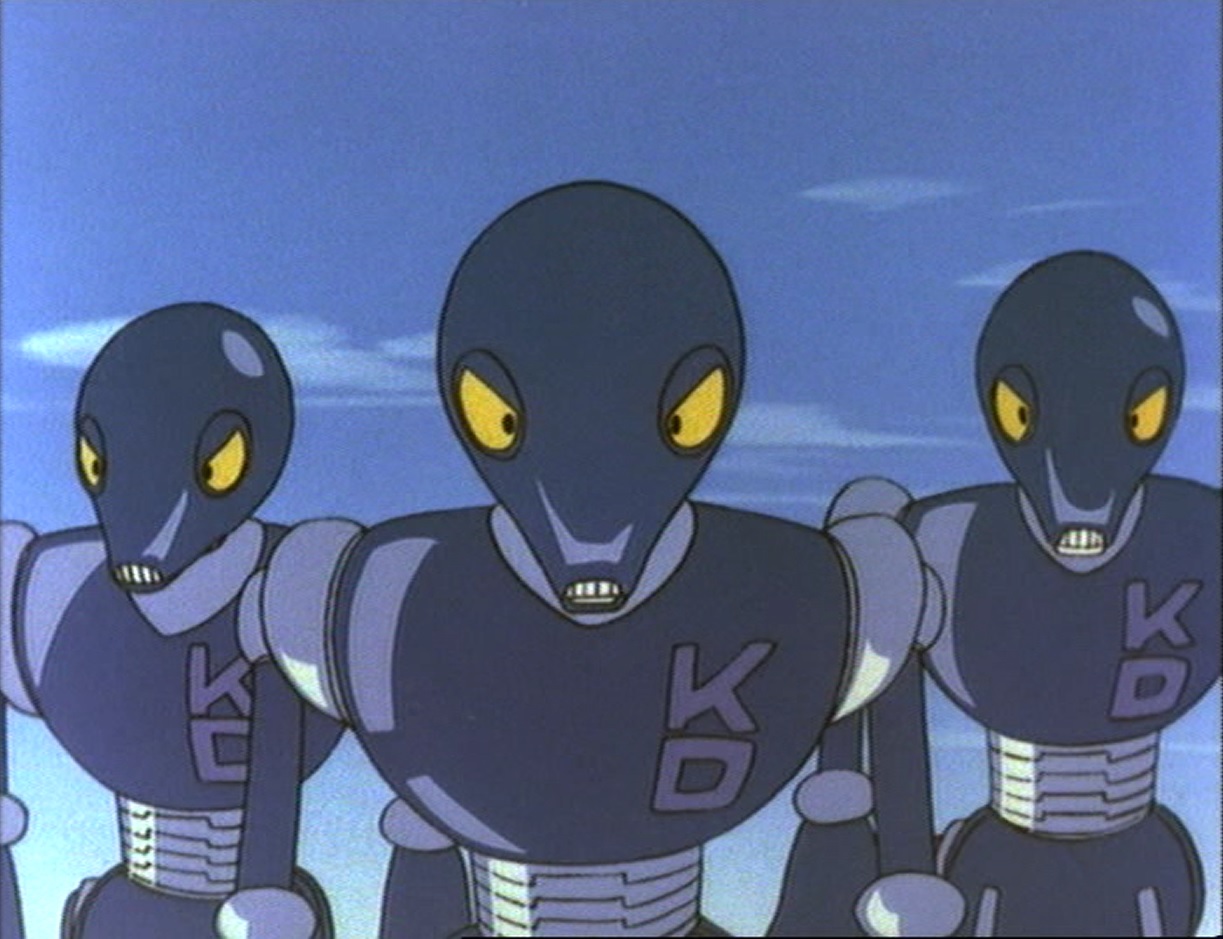 La révolte de robots’ is the first highlight in the ‘Il était une fois… l’espace’ series.
Unlike the earlier episodes the threat does not come from stock villain Cassiopeia, but from a rebelling robot planet called Leto. We’re introduced to this planet first, with our heroes only entering the scene after twelve minutes. Our heroes save the day, especially the little robot Metro, who battles a large robot, which looks like a copy from Grendizer (Goldorak), the famous robot from the Japanese 1970s series of the same name.
However, who is really responsible for the robots’ rebellion remains unknown. This would grow into the series’ most important story element, dominating its great last third. If anything, this episode shows the risks of man’s dependency on technology, but Barillé clearly states that humans are superior to robots, something he tries to illustrate rather unconvincingly in this episode. The whole argument of humans vs. machines would come back with a vengeance in the 23rd episode, ‘Le grand ordinateur‘.
Watch ‘La révolte des robots’ yourself and tell me what you think:
This is the 6th episode of ‘Il était une fois… l’espace’ (Once Upon a Time… Space)
To the 5th episode: Les Cro-Magnons (The Cro-Magnons)
To the 7th episode: La planète Mytho (The Planet Mytho)
Director: Albert Barillé
Airing date: November 6?, 1982
Rating: ★★★½
Review:
 This is the fourth episode of ‘Il était une fois… l’espace’ in which the evil constellation of Cassiopeia threatens a green and primitive planet in the Andromeda galaxy.
This time it’s the planet Diane, which is inhabited by humans, who apparently have descended from humans from earth. Against the regulations, Pierot and Psi visit the small population, who, like the title suggests, live like Cro-Magnons.
Like in ‘Il était une fois… l’homme’ this population knows its own versions of our main protagonists, so they have their own Pierrette, Maestro, le Teigneux and le Nabot. In the end, the visit by the people from Omega induces tales of Gods within the Cro-Magnon population, echoing the ideas of Erich von Däniken.
This episode opens in a neighborhood and a bar on Omega that is very similar to Mos Eisley in ‘Star Wars’ (1977), one of quite a few influences of that film on Barillé’s series. The most interesting part, however, is the computer search for the planet Cassiopeia probably wants to invade, showing several planets inhabited by weird alien creatures.
Watch ‘Les Cro-Magnons’ yourself and tell me what you think:
This is the 5th episode of ‘Il était une fois… l’espace’ (Once Upon a Time… Space)
To the 4th episode: Du côté d’Andromède (Towards Andromeda)
To the 5th episode: La révolte des robots (The Revolt of the Robots)
Director: Albert Barillé
Airing date: October 30?, 1982
Rating: ★★★
Review:
 ‘Du côte d’Andromède’ is the first episode of Il était une fois… l’espace in which Pierrot, his love Psi, and the little robot Metro are presented as a team.
Psi replaces Pierrot’s former co-pilot, Petit Gros, whose star would soon fade away. The trio’s routine inspection flight turns into a disaster when they crash into the planet Clarus, which orbits a dying star. In search of fresh air, our heroes meet a people called Terks, who are outcasts from Andromeda.
They also discover that the Terks are secretly armed by the evil constellation of Cassiopeia in order to invade Andromeda, making Clarus the third of four planets in the Andromeda Galaxy Cassiopeia is trying to use for an invasion. Naturally, the Terks aren’t fond of spies, and our heroes are about to get executed, when their friends from Omega come to the rescue.
Like ‘La planète verte‘, ‘Du côte d’Andromède’ shows Barillé’s love to show and explain political manipulations to children. This episode also introduces the vague, angel-like creature who visits Psi and tells her that evil will never win.
Watch ‘Du côté d’Andromède’ yourself and tell me what you think:
This is the 4th episode of ‘Il était une fois… l’espace’ (Once Upon a Time… Space)
To the 3rd episode: La planète verte (The Green Planet)
To the 5th episode: Les Cro-Magnons (The Cro-Magnons)
Director: Albert Barillé
Airing date: October 23?, 1982
Rating: ★★★
Review:
 Unlike the majority of the episodes of ‘Il était une fois… l’espace’, ‘La planète verte’ starts with politics: we witness a political conflict between Omega and Cassiopeia.
Like in ‘Les Sauriens‘, Cassiopeia tries to invade a green, primitive planet in the Andromeda section (something they would also try to do in the fifth episode). Only after more than eight minutes our heroes Pierrot and Petit Gros enter the stage. They check the planet, which turns out to be inhabited by intelligent plants, who have captured their invaders, including general Teigneux (The Pest) and ambassador Nabot (Dwarf) themselves.
This episode show us more of Cassiopeia than the two previous episodes. This society turns out to be very militaristic with Nazi-like characteristics. Because of Cassiopeia’s more prominent role, ‘La planète verte’ is more interesting than the previous two episodes, if not too exciting.
Watch ‘La planète verte’ yourself and tell me what you think:
This is the 3rd episode of ‘Il était une fois… l’espace’ (Once Upon a Time… Space)
To the 2nd episode: Les Sauriens (The Saurians)
To the 4th episode: Du côté d’Andromède (Towards Andromeda)
Director: Albert Barillé
Airing date: October 16?, 1982
Rating: ★
Review:
 In this second episode of ‘Il était une fois… l’espace’ the feisty little robot Metro gets his name.
Metro joins Pierrot and Petit Gros on their first mission. The trio explores a Jurassic planet inhabited by large iguana-like people who communicate by telepathy.
If anything, this episode shows how differences between cultures can lead to aversions and misunderstandings. Nevertheless, it is one of the slowest and weakest episodes of the series.
Watch ‘Les Sauriens’ yourself and tell me what you think:
This is the 2nd episode of ‘Il était une fois… l’espace’ (Once Upon a Time… Space)
To the 1st episode: La planète Omega (The Planet Omega)
To the 3rd episode: la planète verte (The Green Planet)
Director: Albert Barillé
Airing date: October 9, 1982
Rating: ★★½
Review:
 After the success of ‘Il était une fois… l’homme’ (Once upon a Time… Man) Albert Barillé returned with the boldest and most artistic children series of his entire career.
Largely abandoning education, the raison d’être of his last series, he embarked on a fictional and after a while remarkably integrated story, set in the far future, telling about a United Nations-like intergalactic union, and its problems.
Even more than the previous series, ‘Il était une fois… l’espace’ (Once upon a Time… Space) is a vehicle of Barillé’s highly personal views on the world and mankind. The series expresses a strong love for nature and mutual understanding, and an aversion to imperialism, war and, to a certain extent, technology.
New is a strong spirituality, embodied by the mild, and vaguely South American-looking girl Psi, who possesses psychic powers. Unlike the other main characters, she had not been in the original series, and she is less stereotypical than the rest of the cast. Her role in this first episode (in which she’s introduced as ‘Mercedes’, but everyone calls her ‘Psi’) is still minor, but soon she would become as important as Pierrot (Peter), the series’ main hero.
Pierrot, like all other good guys from ‘Il était une fois… l’homme’ has been redesigned and fixed into a single role. Pierrot now is a guy in his early twenties. Petit Gros (Jumbo), too, has changed. He is less dim, less strong and less obese than in the original series. In fact, he’s only recognizable by his red hair. His dad is equally slender and has grown a blonde mustache, while a stern-looking Pierre, head of the intergalactic police, is fixed at an older age (say 50).
The most surprising transformation may be that of Pierrette, who is head of the Union, and who has received a modern hairdo and some fancy glasses. By placing her as head of the union Barillé makes a strong feminist statement that was still pretty bold in the early 1980s. The only characters to remain the same are Maestro, and the two villains Le Nabot (The Dwarf) and Le Teigneux (The Pest). Remarkably, children are totally absent from the series.
In this first episode of ‘Il était une fois… l’espace’ Maestro conceives the little robot Metro, who would play a major part in the series, eclipsing his master, while Le Teigneux and le Nabot are introduced as the ambassador and general of Cassiopeia, a galaxy with militaristic ambitions, but which is part of the Union nonetheless. Taking time in introducing all these characters, there is very little action in ‘La planète Omega’. Nevertheless, the stage is set when the Union is confronted by an unknown spaceship of some supreme alien race…
Apart from Barillé’s original story and its classic characters, ‘Il était une fois… l’espace’ is a highlight of television animation because of its great music by Michel Legrand and its superb backgrounds by Philippe Bouchet, Manchu and Afrula Hadjiyanakis. This trio clearly draws inspiration from contemporary science fiction illustrators like Lukas Foss, Colin Hay, Angus McKie and Tony Roberts.
The animation itself, by the Japanese Eiken studio, is better than in ‘Il était une fois… l’homme’, but it’s still mediocre and uneven, and especially the designs of Psi are far from consistent. This would remain a problem throughout the series, together with a sometimes terribly slow narration. These drawbacks, however, do not overcome the series’ merits, and ‘Il était une fois… l’espace’ may be praised as Barillé’s masterpiece.
Watch an excerpt from ‘La planète Omega’ yourself and tell me what you think:
This is the 1st episode of ‘Il était une fois… l’espace’ (Once Upon a Time… Space)
To the 2nd episode: Les Sauriens (The Saurians)
Director: René Laloux
Release date: March 24, 1981
Rating: ★★★★
Review:
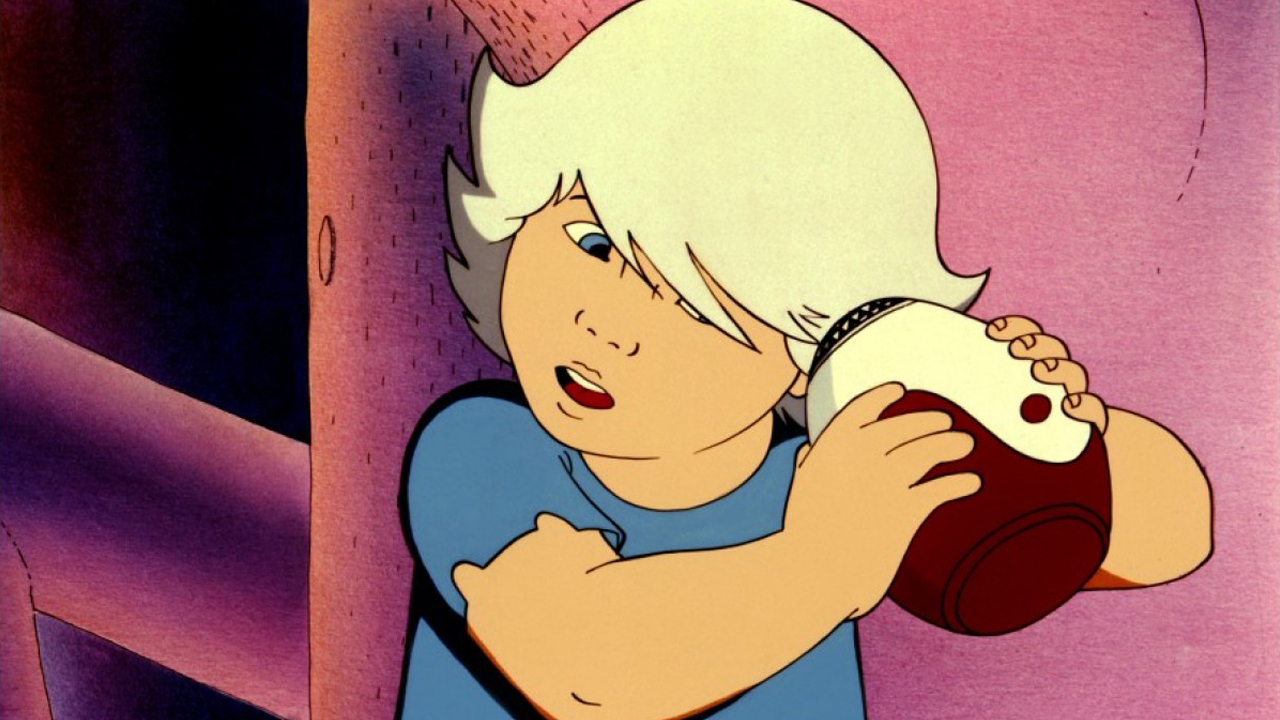 In the science fiction film ‘Les maîtres du temps’ Jaffar, the muscular pilot of a spaceship, tries to rescue the little orphan Piel, who is the sole survivor of a massacre on the dangerous planet Perdide.
Jaffar’s only means of contact with the little boy is through an egg-shaped microphone which Piel calls ‘Mike’. Jaffar is aided by a jolly old man called Silbad, and two little telepathic creatures Silbad rescued from a flower, called Jad and Yula. His only passenger, however, the evil prince Matton, on escape with a treasure, tries to kill Piel in order to get sooner to Aldebaran…
‘Les maîtres du temps’ was René Laloux’ second animated feature film and it shares many characteristics with his first, ‘Le planète sauvage‘: it’s a science fiction film based on a novel by Stefan Wul and using designs by a famous french illustrator, this time comic artist Moebius (Jean Giraud). ‘Les maîtres du temps’ nevertheless is less outlandish than ‘Le planète sauvage’: it’s an ‘ordinary’ cel animation film and Moebius’s drawings are less surreal than Topor’s. Yet, they still manage to give the film an otherworldly quality. Especially his designs of Perdide are disturbing, rendering it an uncanny, dangerous planet, indeed.
Moebius’s style is very visible throughout the picture, except for the humans, who are drawn pretty uglily and fail to live up to Moebius’s own high standards. Only the little orphan Piel and the jolly old man Silbad are true to Moebius’s designs. Consequently, they are both very believable and likeable characters, where the others remain flat cardboard examples of ‘the hero’, ‘the beautiful woman’ and ‘the villain’. Their animation, too, remains stiff and unconvincing In contrast, the funny little gnomes Jad and Yula are rendered very flexible and are responsible for some of the most beautiful animation in the film, which was practically all done by the Hungarian Pannonia Film Studio.
‘Les maîtres du temps’ is far from perfect, but mainly thanks to Piel’s character, with whom we can identify immediately, it’s a film with a heart. This, combined with some impressive science fiction images, especially of Perdide and of the planet Gamma 10, make the film one to return to over and over again.
After ‘Les maîtres du temps’ Laloux would make yet another Science fiction feature, now based on drawings by French comic artist Caza: ‘Gandahar‘. Unfortunately, it would prove to be the weakest of the trio.
Watch the trailer for ‘Les maîtres du temps’ yourself and tell me what you think:


 Dr. Grob's Animation Review