
You are currently browsing the tag archive for the ‘Tex Avery’ tag.
Directors: William Hanna & Joseph Barbera
Release Date: December 11, 1948
Stars: Tom & Jerry, Mammy Two-Shoes
Rating: ★★★★★
Review:
 By chasing Jerry into the house, Tom dirts the kitchen floor, which just has been painstakingly cleaned by Mammy.
She leaves shortly after, but not before warning him that if she’ll see one speck of dirt when she returns, she will throw him out. Jerry of course uses this threat to his advantage.
The plot of ‘Mouse Cleaning’ is very similar to that of ‘Puss Gets the Boot‘ (1940), Tom and Jerry’s very first cartoon, but the execution is much faster and funnier. Tom & Jerry had come a long way since, as is shown by a particularly Tex Averyan doubletake, in which Tom produces multiple eyes and a drops his jaw unto the floor in surprise.
Watch ‘Mouse Cleaning’ yourself and tell me what you think:
This is Tom & Jerry cartoon No. 38
To the previous Tom & Jerry cartoon: Professor Tom
To the next Tom & Jerry cartoon: Polka Dot Puss
Director: Tex Avery
Release Date: March 15, 1941
Stars: Bugs Bunny, Cecil Turtle
Rating: ★★★½
Review:
 ‘Tortoise Beats Hare’ starts with one of the greatest openings of all Warner Brothers cartoons: Bugs walks along the title card, reading it aloud, mispronouncing all the names (Fred a-VEry).
When he reads the title, he gets angry, tears the title card apart and immediately looks up Cecil Turtle to make a bet. Cecil Turtle accepts, but when they’ve started off, he phones all his friends and relations to be his duplicate. This trick make the humble turtle seem to appear everywhere, driving Bugs mad.
‘Tortoise Beats Hare’ is Tex Avery’s first Bugs Bunny cartoon after Bugs Bunny’s debut in ‘A Wild Hare‘ (1940). In it Tex Avery immediately does a surprising experiment to his beloved character by letting him play the role of the straight guy. In ‘Tortoise Beats Hare’ it’s the humble Cecil Turtle who gets all Bugs’s routines, like kissing the rabbit at unexpected moments and addressing the audience with a “we do this kind of stuff to him all through the picture”. As Chuck Jones writes in his book ‘Chuck Amuck’:
‘The Tortoise in fact becomes Bugs, and Bugs becomes Elmer Fudd, outwitted and outacted, thereby losing control both of the tortoise-hare race and of the picture itself’.
This experiment is not a success: watching Bugs Bunny being humiliated gives the viewer an uncomfortable feeling, and outside the Cecil Turtle cartoons it was rarely repeated. Nevertheless, Bugs’ first double take is a delight, and so is the animation on the slow hopping Cecil.
”Tortoise Beats Hare’ was only Bugs Bunny’s third screen appearance, and it shows: his design is still somewhat unsteady, and so is his voice. When Bugs addresses Cecil for the first time, it sounds like we hear many Mel Blanc voices after another.
At MGM Avery would reuse the idea of a guy popping up everywhere driving his opponent mad to greater effect, in two Droopy cartoons, ‘Dumb-Hounded‘ (1943) and ‘The Northwest Hounded Police‘ (1946). In both cartoons Avery skips the explanation how the guy could be everywhere, making the result way funnier.
Meanwhile, Cecil Turtle would return in the Bob Clampett cartoon ‘Tortoise wins by a Hare’ (1942) and in the Friz Freleng cartoon ‘Rabbit Transit’ (1947).
Watch ‘Tortoise Beats Hare’ yourself and tell me what you think:
http://www.dailymotion.com/video/x2ox5qu
This is Bugs Bunny cartoon No. 3
To the previous Bugs Bunny cartoon: Elmer’s Pet Rabbit
To the next Bugs Bunny cartoon: Hiawatha’s Rabbit Hunt
Director: Chuck Jones
Release Date: February 25, 1964
Stars: Tom & Jerry
Rating: ★★★★
Review:
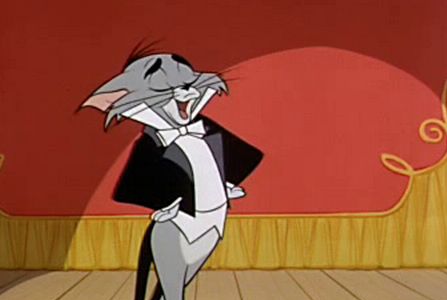 In ‘The Cat Above, The Mouse Below’ Tom is a successful opera singer performing Figaro’s famous aria ‘Largo el factotum’ from Gioachino Rossini’s ‘Il barbiere de Sevilla’ (what else?) at a grand theater, but awakening Jerry by doing so.
In this short Tom displays some fantastic facial expressions, director Chuck Jones’ trademark. It’s also probably the best of all Chuck Jones’s Tom & Jerry cartoons, albeit not as funny as Jones’ earlier ‘Long-haired Hare‘ (1949) or Tex Avery’s ‘Magical Maestro’ (1952), which both use the same theme.
Watch ‘The Cat Above, The Mouse Below’ yourself and tell me what you think:
https://www.dailymotion.com/video/x6eg8vi
This is Tom & Jerry cartoon No. 129
To the previous Tom & Jerry cartoon: Penthouse Mouse
To the next Tom & Jerry cartoon: Is There a Doctor in the Mouse?
Director: Burt Gillett
Release Date: April 30, 1931
Stars: Mickey Mouse, Pluto
Rating: ★★★½
Review:
 In ‘The Moose Hunt’ Mickey and Pluto are hunting moose.
They finally find a moose (or more exactly, the moose finds them). Unfortunately, in front of the moose, Mickey’s gun fails and soon the moose hunts both Mickey and Pluto. The chase ends with Mickey escaping on a flying Pluto.
‘The Moose Hunt’ is Mickey’s third gag only short, after ‘The Fire Fighters‘ (1930) and ‘Traffic Troubles‘ from earlier that year. It’s hardly as good as those earlier entries, though. Its pace is slow, and it contains some awkward gags, like the flying Pluto finale. It also contains a rare gag breaking the fourth dimension: when Mickey accidentally shoots Pluto, he suddenly addresses the audience with a “Is there a doctor in the house?”. Then, when Mickey begs Pluto to speak to him, Pluto actually speaks!
The self-conscious audience gag would remain a rarity at Disney, but it would become a staple gag at Warner Bros. when Tex Avery joined that studio. The two Pluto gags are totally out of character, and have nothing to do with him being a dog. After ‘The Moose Hunt’ we would never see Pluto flying or speaking again (apart from a short ‘Mammy’ at the end of ‘Mickey Steps Out‘), and after watching ‘The Moose Hunt’ it is easily understandable why not.
Luckily, there are other scenes that are more inspired, and in which Pluto behaves like a dog throughout. Indeed, in his very first solo scene, which reuses a little animation from ‘The Chain Gang‘ (1930), Pluto’s character as a little dumb and a little cowardly dog is pretty well established. Pluto’s looks are still unstable, but he’s excellently animated, throughout.
In ‘The Moose Hunt’ Pluto also gets his name (he was called ‘Rover’ in his first appearance in ‘The Picnic‘ from six months earlier). He now clearly is Mickey’s dog, not Minnie’s, like in the earlier film. It’s clear that the Mickey Mouse films could use an extra character, and after this film Pluto would appear in almost all succeeding Mickey Mouse films, stealing more and more screen time from Mickey.
Mickey would go hunting moose again in the way funnier ‘Moose Hunters’ from 1937, which, incidentally, doesn’t star Pluto.
Watch ‘The Moose Hunt’ yourself and tell me what you think:
This is Mickey Mouse cartoon No. 28
To the previous Mickey Mouse cartoon: The Castaway
To the next Mickey Mouse cartoon: The Delivery Boy
Director: Burt Gillett
Release Date: October 9, 1930
Stars: Mickey Mouse, Minnie Mouse, Pluto (as Rover)
Rating: ★★★
Review:
 Mickey’s driving to Minnie’s house singing his own theme song. They both are going on a picnic. While Mickey and Minnie are singing and dancing across the field to the tune of ‘In the Good Old Summertime’, hundreds of wild animals take their food away. The picnic ends in rain.
‘The Picnic’ is a rather plotless and unremarkable cartoon. It nevertheless contains a nice surreal gag in which a rabbit pulls away a hole. This kind of surrealism was rare at Disney’s at that time, but later, Tex Avery would reuse this gag many times at Warner Brothers and MGM.
‘The Picnic’ would have been forgettable, did it not mark the debut of Pluto. He is called Rover in this cartoon, and appears to be Minnie’s dog rather than Mickey’s, but he’s Pluto alright. At this point there’s no reason to believe that Disney intended to make the dog a regular character. Floyd Gottfredson’s Mickey Mouse comics of January 1931 cover similar grounds, but feature a very large dog called “Tiny”.
Nevertheless, in April 1931 Pluto would return in ‘The Moose Hunt‘. This time to stay*. In fact Pluto would become a more and more important character in the Mickey Mouse cartoons, at times stealing most of the screen time from Mickey, who would become more and more a ‘straight man’. Eventually, Pluto would be given his own series, in 1937.
Watch ‘The Picnic’ yourself and tell me what you think:
This is Mickey Mouse cartoon No. 23
To the previous Mickey Mouse cartoon: The Gorilla Mystery
To the next Mickey Mouse cartoon: Pioneer Days
* Gottfredson’s Mickey Mouse comics followed three months later, introducing Pluto on July the 8th.
Director: Friz Freleng
Release Date: April 10, 1937
Rating: ★★★½
Review:
 ‘She Was an Acrobat’s Daughter’ is a cartoon about an evening at the cinema.
It makes very clear that in the 1930s the experience of going to the movies was way more elaborate than nowadays: we watch newsreels, the audience singing to the title song and a feature, ‘The Petrified Florist’, a satire of the Warner Brothers film ‘The Petrified Forest’ (1936), with caricatures of its stars Leslie Howard and Bette Davis. During the cartoon we’re confronted with several movie theater annoyances, like people changing seats, people passing by in the middle of a film, popcorn sellers and bad front row seats.
In this cartoon, Friz Freleng really caught up with the new spirit at Warner Brothers induced by the coming of Tex Avery and Frank Tashlin in 1936. Gone is any resemblance to cuteness or children stars. Instead, there is an annoying duckling asking questions in an irritable voice, and causing havoc in the cinema. There’s no story, just gags, and the film ends rather unexpectedly. But the whole film is a sheer delight, aimed at laughs, and succeeding in it, too. Also featured is an early caricature of Adolf Hitler.
Watch ‘She Was an Acrobat’s Daughter’ yourself and tell me what you think:
http://www.supercartoons.net/cartoon/757/she-was-an-acrobats-daughter.html
Director: Wilfred Jackson
Release Date: October 31, 1936
Rating: ★★★★★ ♕
Review:
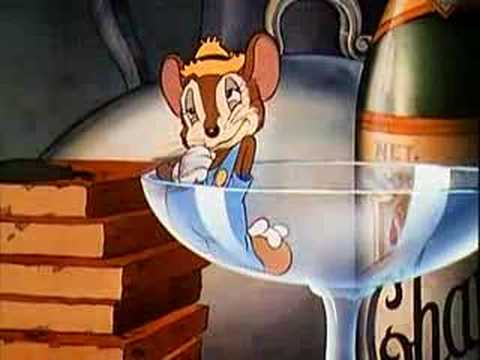 A very beautifully executed rendering of the classic tale, ‘The Country Cousin’ is a gem among the Silly Symphonies.
Its story is lean and economical, its characterization highly effective and its silent acting superb. Particularly noteworthy is the drunken performance of the Country Cousin, animated by Art Babbitt, which belongs to the highlights of animation.
Everyone who wants to know what ‘character animation’ is all about, should go and watch this cartoon. One cannot find a better example of it: the two mice look similar, but are very different in their behavior, attitude, and personality. Moreover, their personalities are played completely in mime, without any help from characteristic voices.
Besides this, ‘The Country Cousin’ contains some very realistic animation of people’s feet walking on the sidewalk. Indeed, the human realism of ‘Snow White and the Seven Dwarfs’ (1937) was not far away anymore.
Thirteen years later, Tex Avery would explore the theme of ‘The Country Cousin’ once again, albeit quite differently and way more ridiculously, in his hilarious short ‘Little Rural Riding Hood’ (1949).
Watch ‘The Country Cousin’ yourself and tell me what you think:
This is Silly Symphony No. 63
To the previous Silly Symphony: Three Blind Mouseketeers
To the next Silly Symphony: Mother Pluto
Director: Burt Gillett
Release Date: April 14, 1934
Stars: the three little pigs, the big bad wolf
Rating: ★★★½
Review:
 ‘The Big Bad Wolf’ was Disney’s very first sequel.
It was undoubtedly made to satisfy the masses who, after the huge success of ‘Three Little Pigs‘ (1933), demanded for ‘more pigs’. As one can expect, it’s not as great as ‘Three Little Pigs’, but it’s fun to watch.
The title card shows the main characters as if they were playing their parts. The cartoon, however, is named after the wolf, and deservedly so, because not only is he drawn better than in the original cartoon, he’s also the star of this sequel. Clearly being the greatest actor, he not only impersonates grandma, but also “Goldilocks the fairy queen” in a ridiculous and aimless costume, and even Jimmy Durante! Furthermore, he alone shows to be aware of the audience: he often looks into the camera, and even addresses the audience with a Mae West-like “how’m I doing?”.
After this cartoon, the demand for pigs apparently still wasn’t satisfied, for it was followed by even two more sequels: ‘Three Little Wolves‘ in 1936 and ‘The Practical Pig‘ in 1939.
‘The Big Bad Wolf’ might be the first “fairy-tales mixed up” cartoon. It may very well have inspired Tex Avery to make similar, yet more hilarious cartoons like ‘The Bear’s Tale’ (1940) and ‘Swing Shift Cinderella’ (1945), both starring Little Red Riding Hood.
Watch ‘The Big Bad Wolf’ yourself and tell me what you think:
This is Silly Symphony No. 44
To the previous Silly Symphony: Funny Little Bunnies
To the next Silly Symphony: The Wise Little Hen
Director: Wilfred Jackson
Release Date: March 24, 1934
Rating: ★★
Review:
 ‘Cute Little Bunnies’ would have been a better title for this easter short, for the bunnies are very cute, not funny.
In fact, “Funny Little Bunnies’ is so cute it can only have been meant for children. It makes one wonder what movies it was supposed to support in the theaters (surely no grim gangster thriller!).
Because everybody copied Disney at that time, other studios were copying this ‘new cuteness’ as well. Especially 1934 saw an explosion of Silly Symphonies imitating series, combining the appeal of color with sugary tales. Former Disney associate Ub Iwerks was the first, releasing his first Comicolor cartoon on December 23, 1933. He was followed by Max Fleischer (Color Classics, August 1934), MGM (Happy Harmonies, September), Van Beuren (Rainbow Parade, September), Columbia (Color Rhapsodies, November), and Walter Lantz (Cartune Classics, December). This resulted in a spread of cute (and severely unfunny) cartoons in the mid-thirties.
One is therefore particularly thankful that in the late thirties Tex Avery restored nonsense, wackiness and absurdism in the animated cartoon. These qualities Disney sometimes seemed to have forgotten during his pursuit for greater naturalism and beauty.
Notice how, for example, ‘Funny Little Bunnies’ uses animation to tell a story that cannot be told in live action, but how it tries to tell this story in the most conventional, ‘live action-like’ way. Especially the opening shot of this short is stunning, with two bunnies hopping realistically and lots of birds and butterflies flying around.
Watch ‘Funny Little Bunnies’ yourself and tell me what you think:
This is Silly Symphony No. 43
To the previous Silly Symphony: The Grasshopper and the Ants
To the next Silly Symphony: The Big Bad Wolf


 Dr. Grob's Animation Review