
You are currently browsing the category archive for the ‘Black and White Films’ category.
Director: Unknown
Release Date: November 14, 1927
Stars: Oswald the Lucky Rabbit, Peg Leg Pete
Rating: ★★★½
Review:
 Oswald joins a plane race from New York to Paris (inspired by Charles Lindbergh’s flight on May 20-21 that year).
Oswald is introduced as the dark horse and enters the race disguised as a pantomime horse. One of his competitors is an early version of Peg Leg Pete. Pete is the obvious villain, gluing Oswald’s plane to the ground with chewing gum. Luckily, Oswald manages to make a new, rather improbable plane out of a dachshund and two balloons.
Meanwhile, Pete misleads all the other competitors by turning an absurdly high direction indicator. Somehow, Oswald isn’t misled and he and Pete compete to be the first. Pete shoots Oswald out of the air, but it’s Oswald who wins the day. What became of the falling dachshund, however, we’ll never know… [UPDATE: Thanks to David Gerstein we do know: see his comment for the cartoon’s lost end gag]
‘The Ocean Hop’ is a clear forerunner of ‘Plane Crazy‘ (1928), Mickey Mouse’s debut cartoon. Both were inspired by Charles Lindbergh’s historical transatlantic flight. Oswald’s cartoon is not as consistent as Mickey’s, however, and features less spectacular scenes. In one way the differences between the two cartoons show that Walt Disney and Ub Iwerks were constantly improving themselves even at this early stage of their careers.
Watch ‘The Ocean Hop’ yourself and tell me what you think:
This is Oswald the Lucky Rabbit cartoon No. 6
To the previous Oswald the Lucky Rabbit cartoon: All Wet
To the next surviving Oswald the Lucky Rabbit cartoon: Empty Socks
Director: Unknown
Release Date: October 31, 1927
Stars: Oswald the Lucky Rabbit
Rating: ★★★★
Review:
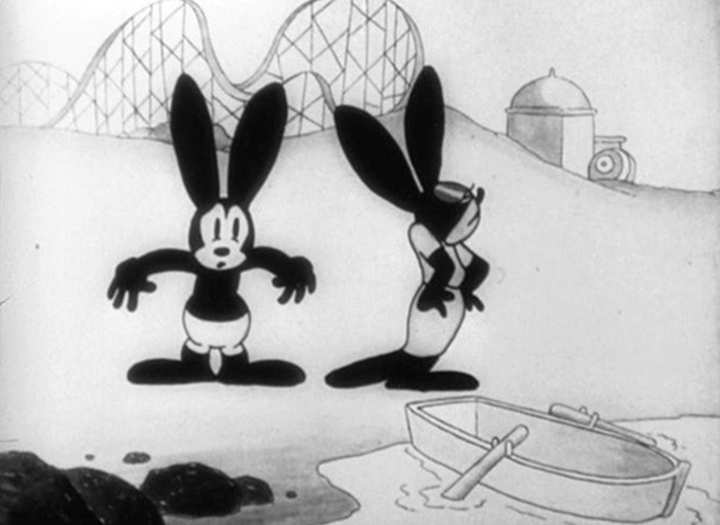 In his fifth film Oswald is a hot dog vendor at the beach.
At one point his girlfriend drops by, only to give him the cold shoulder, so Oswald pretends to be a lifeguard. The girl in turn pretends to drown, but then she really get suck into the ocean by a giant fish. Oswald comes to the rescue and earns a passionate kiss.
Although this film still contains some stiff animation and designs from the early 1920s (for example the dog customer), most of the animation is very flexible and lively, especially that of Oswald and the sea. Many of the hot dog gags were reused in the Mickey short ‘The Karnival Kid‘ (1929).
Watch ‘All Wet’ yourself and tell me what you think:
This is Oswald the Lucky Rabbit cartoon No. 5
To the previous Oswald the Lucky Rabbit cartoon: Great Guns
To the next Oswald the Lucky Rabbit cartoon: The Ocean Hop
Director: Unknown
Release Date: October 17, 1927
Stars: Oswald the Lucky Rabbit
Rating: ★★★
Review:
 War has broken out. This leads to a surprisingly cheerful crowd of people happily volunteering to be a soldier. As if The Great War had never happened.
Oswald volunteers too, after a long goodbye to his girlfriend. In the trenches, he’s still kissing her portrait, until it is bombed by a mouse. This leads to an air battle between Oswald and the little rodent, which ends with Oswald beating up the mice, until he’s confronted by an angry officer. Oswald and the officer get into a bombing duel, in which Oswald uses an elephant, which explodes. In the end even Oswald himself is literally blown to pieces, but he’s revived by his girlfriend who’s a red cross nurse.
The depiction of war in this cartoon is surprisingly positive, and there are a lot of gags. Real danger is never felt, but the cartoon does feature some startling images of huge cannons swooping into the camera. Four years later Hugh Harman, who did some of the animation, would reuse elements of ‘Great Guns’ in his own World War I film ‘Bosko the Doughboy‘ (1931).
Watch ‘Great Guns’ yourself and tell me what you think:
This is Oswald the Lucky Rabbit cartoon No. 4
To the previous Oswald the Lucky Rabbit cartoon: The Mechanical Cow
To the next Oswald the Lucky Rabbit cartoon: All Wet
Director: Unknown
Release Date: October 3, 1927
Stars: Oswald the Lucky Rabbit
Rating: ★★★
Review:
 In his fifth film Oswald has a mechanical cow to deliver milk with.
When his girlfriend gets kidnapped by a mob of gangsters, the cow helps him to rescue her. The gangsters come to a surprisingly cruel end, when they fall off a cliff and are eaten by sharks.
The cow behaves anything but mechanical. On the contrary, it is very rubbery, and even lazy and sleepy in the first scene, and its animation is not different from that of any of the other characters.
Watch ‘The Mechanical Cow’ yourself and tell me what you think:
This is Oswald the Lucky Rabbit cartoon No. 3
To the previous Oswald the Lucky Rabbit cartoon: Oh, Teacher
To the next Oswald the Lucky Rabbit cartoon: Great Guns
Director: Leonid Amalrik & Olga Khodataeva
Release Date: 1942
Rating: ★★★★
Review:
 ‘Kino-Circus’ (also called Cinema Circus) is the most inspired of the anti-fascist war propaganda cartoons made in the Soviet Union.
The short is called ‘a cartoon satire in three acts’ and features a Charlie Chaplin-like character, who introduces us to three staged satires, all featuring Adolf Hitler:
In the first, ‘Adolf the dog trainer and his pooches’, Hitler throws a bone at his three dogs, Benito Mussolini, Miklós Horthy and Ion Antonescu, the leaders of his allies Italy, Hungary and Romania, respectively.
In the second, ‘Hitler visits Napoleon’, Hitler asks Napoleon’s tomb for advice, but the deceased drags him into the tomb. It’s the most prophetic of the three, for indeed both Napoleon and Hitler were defeated in Russia.
In the third, ‘Adolf the juggler on powder kegs’, Hitler juggles with several burning torches on a pile of powder-barrels, representing the countries he has occupied. When he accidentally drops one of the torches, the barrels explode. The animation is particularly silly in this sequence and a delight to watch.
After the grim political posters from 1941, ‘Kino-Circus’ is more lighthearted. The film ridicules Hitler more than it makes him threatening. Quite surprising since in1942 Nazi Germany was still a serious threat to the Soviet Union: Leningrad suffered under a long siege, and the Soviet Union had only just begun its counter-attack.
Interestingly, both directors of ‘Kino-Circus’ later became famous for their sweet fairy tale films.
Watch ‘Kino-Circus’ yourself and tell me what you think:
‘Kino-Circus’ is available on the DVD box set ‘Animated Soviet Propaganda’
Director: Panteleimon Sasonov
Release Date: 1941
Rating: ★★½
Review:
 ‘The Vultures’, like ‘4 newsreels‘ and ‘Fascist Boots on our Homeland‘ is a so-called political poster. Like the other two films from 1941 it is soviet propaganda at its most aggressive.
‘The Vultures’ is the least interesting of the set. Its opening shot is its best part: opening with two eyes in the dark, just like ‘The Skeleton Dance‘ (1929). These eyes appear to belong to a fascist vulture. he and the other fascist vultures (battle planes) are chased away and destroyed by the Soviet airfleet in a rather silly and playful-looking air battle, accompanied by heroic march music.
About the director of ‘The Vultures’, Panteleimon Sasonov (1895-1950), little can be found. Giannalberto Bendazzi tells us in his excellent book ‘Cartoons – one hundred years of cinema animation’ that he made an animation film called ‘The Tale of the Pope and Baldo his Servant’ in 1939.
Watch ‘The Vultures’ yourself and tell me what you think:
‘The Vultures’ is available on the DVD box set ‘Animated Soviet Propaganda’
Directors: Aleksandr Ivanov & I. Vano
Release Date: 1941
Rating: ★★★½
Review:
 Like ‘4 Newsreels‘, ‘Fascist Boots on our Homeland’ is a so-called ‘political poster’, a short propaganda film that knows no competition in its vicious imagery.
In ‘Fascist Boots on our Homeland’ a horrific fascist pig marches on, trembling several European countries until he gets beaten by the Red Army. The film also contains a very patriotic song and rather associative imagery, including that of Russian soldiers riding horseback, a heroic image from the Russian civil war (1917-1923).
It’s interesting to compare the Soviet images of Nazis with that of American propaganda films from the same era. Whereas in American propaganda, like ‘Der Fuehrer’s Face‘ fascist leaders were caricatured and ridiculed, in the Soviet Union they were depicted as monsters and swines. The whole difference may be that the Soviet Union was invaded, while the United States were not.
Indeed, the US were less kind to the Japanese, who did stain American soil: they were all portrayed as silly, but treacherous Untermenschen, whom one could easily kill without remorse (e.g. in ‘Bugs Bunny nips the Nips’ from 1944 and the Popeye film ‘You’re a sap, Mr. Jap‘ from 1942).
Watch ‘Fascist Boots on our Homeland’ yourself and tell me what you think:
‘Fascist Boots on our Homeland’ is available on the DVD box set ‘Animated Soviet Propaganda’
Directors: Valentina Brumberg, Zinaida Brumberg, Aleksandr Ivanov, Olga Khodataeva and Ivan Ivanov-Vano
Release Date: 1941
Rating: ★★★
Review:
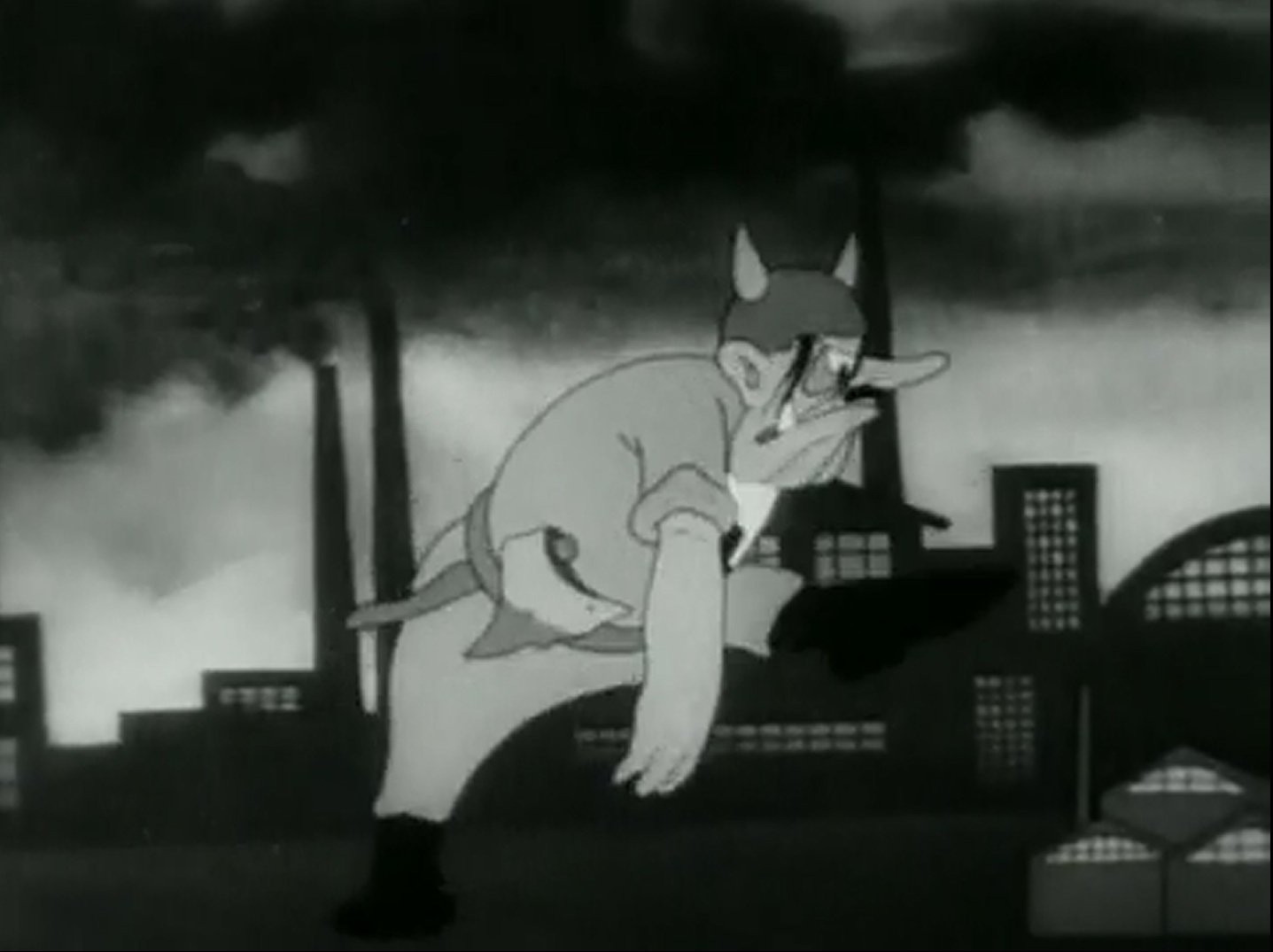 The Soviet propaganda film ‘4 Newsreels’ consists of four so-called ‘political posters’, which are as blatant as propaganda can get.
The first, ‘What Hitler wants’, shows us an extremely ugly and vicious caricature of Hitler marching towards the Soviet Union until he is pierced by the Soviet bayonet.
In the second, ‘Beat the fascist pirates’, sea serpent-like German submarines are defeated by the Soviet fleet.
The third, ‘Strike the Enemy on the front and at home’, is typical for the paranoid society Stalinist Russia was, warning against treacherous fascist spies, foreign agents and saboteurs: “Be vigilant! Remember, our enemy is cunning!”.
The fourth, ‘A mighty handshake’, tells us about the union between England and the Soviet Union against Nazi Germany, showing two mighty giant soldiers shaking hands and crushing a tiny rat-like Hitler in doing so.
Obviously, Germany’s invasion of the Soviet Union left no room for subtleties.
‘4 Newsreels’ was directed by five veterans of animated Soviet propaganda. All had made animated films since the 1920s. Of the five, Ivan Ivanov-Vano (1900-1987) would become the most successful, directing animated films up to the 1970s. Luckily, he and Olga Khodataeva would be able to show a gentler side in numerous animated fairy tale films for children.
Watch ‘4 Newsreels’ yourself and tell me what you think:
‘4 Newsreels’ is available on the DVD box set ‘Animated Soviet Propaganda’
Director: Władysław Starewicz
Release Date: 1922
Rating: ★★★★★
Review:
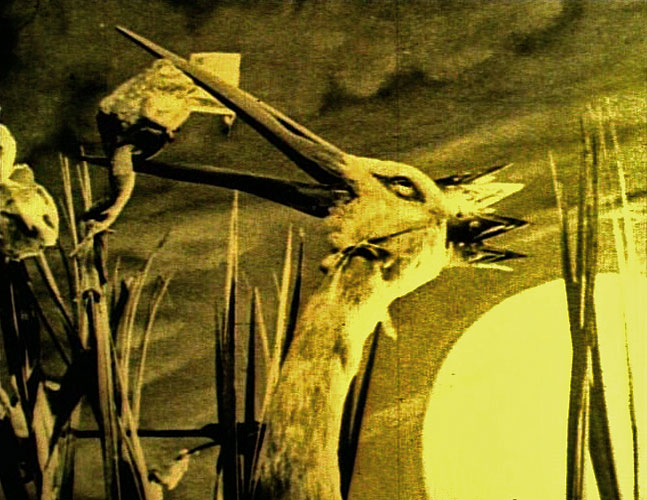 After the October revolution, Władysław Starewicz fled to France, where he continued to make stop motion films until his death in 1965. ‘The Frogs Who Wanted a King’ is the fourth film he made in France, and probably his most political.
The film is based on one of Aesop’s fables. Some frogs ask Jupiter for a king. Jupiter sends them one, but the king looks like a tree and does nothing at all. The frogs don’t like him, so Jupiter sends them a stork, who, naturally, eats the unfortunate amphibians.
The message may be that it’s better to have a dull government than one that kills you, a message Starewicz could certainly relate to, being forced to exile by the oppressing communist regime in Russia.
Once again, Starewicz’ animation is top notch. The film has a particularly fable-like character, taking place in its own, very convincing universe.
Watch ‘The Frogs Who Wanted a King’ yourself and tell me what you think:
Director: Władysław Starewicz
Release Date: 1913
Rating: ★★★½
Review:
 ‘The Insects’ Christmas’ is Starewicz’s next film after his masterpiece ‘The Cameraman’s Revenge‘.
Although the short uses insects again, it’s a whole different film, turning to the sweet subject of Christmas. It’s probably the first animated film about Christmas ever made.
The plot is surprisingly simple: Father Christmas climbs down a Christmas tree, awakes some insects and a frog, who are hibernating underground, and he invites them to a Christmas party. He gives them presents and they all go skiing and skating.
This film’s story cannot be compared to the mature plot of ‘The Cameraman’s revenge‘. It’s more like a child’s dream of Christmas. The film reuses puppets from ‘The Cameraman’s Revenge’ and others, and even though the animation is less engaging than in Starewicz’s earlier film, it is still of a stunning virtuosity, making the result still a delight to watch. Note, for example, the illusion of wind in the animation of Father Christmas’s coat.
Watch ‘The Insects’ Christmas’ yourself and tell me what you think:
‘The Insects’ Christmas’ is available on the DVD ‘The Cameraman’s Revenge & other Fantastic Tales’
Director: Władysław Starewicz
Release Date: November 9, 1912
Rating: ★★★★★ ♕
Review:
 ‘The Cameraman’s Revenge’ is one of the earliest animation films ever made, and a very early masterpiece (it predates ‘Gertie the Dinosaur‘ by two years). Surprisingly, it’s a film about adultery involving insects.
The plot of this stop motion film is as follows: Mr. Beetle commits adultery with a dragonfly, who is a dancer at a nightclub. Unbeknownst to him his secret behavior is filmed by a rival grasshopper who happens to be a cameraman. Meanwhile, Mrs. Beetle also commits adultery, with a beetle who is also a painter. But they’re discovered by Mr. Beetle on his arrival home. Mr. Beetle chases the painter out of his house. Nevertheless he forgives his wife and takes her to the cinema. However, the film that is shown reveals his infidelity, which creates a riot and the married couple ends in jail for destroying the movie box.
‘The Cameraman’s Revenge’ is an extraordinary film, and without doubt one of the first masterpieces of animation. Unlike Émile Cohl’s stop motion, Starewicz’s animation is stunning and very convincing. The insects are very lifelike, and move surprisingly realistically. The insects’ gestures are subtle, clearly evoking their emotions. For example, there’s a beautiful and very lifelike little scene of a beetle servant lighting the fireplace, animated without any hint of overacting. On the other hand, Mr. Beetle clearly is a brute, but we can also watch him in a seductive mood.
Throughout, Starewicz’s storytelling is economical and mature. The film’s subject is highly original for an animation film, even today. It’s almost unbelievable that such a modern film was made in Czarist Russia.
Watch ‘The Cameraman’s Revenge’ yourself and tell me what you think:
‘The Cameraman’s Revenge’ is available on the DVD ‘The Cameraman’s Revenge & other Fantastic Tales’
Director: David Hand
Release Date: April 13, 1935
Stars: Mickey Mouse, Pluto
Rating: ★★½
Review:
 In ‘Mickey’s Kangaroo’ Mickey receives a kangaroo for a present.
Pluto grows jealous of the intruder and its little kid, which is expressed with side glances at the audience in extreme close ups, and through a tough and sneaky voice over by Don Brodie. This is a rather weak device to overcome Pluto’s silent character. While Pluto tries to get rid of the little kangaroo, Mickey gets beaten up by mama kangaroo, but he keeps laughing.
As Jim Korkis reveals in ‘The Book of Mouse‘, ‘Mickey’s Kangaroo’ surprisingly is a film based on a true story. In 1934 Walt Disney got two wallabies as a present from Australian wine maker Leo Buring. By the time they arrived at the studio, the two marsupials had given birth to a child. The three wallabies were kept in a pen outside the studio department.
‘Mickey’s Kangaroo’ became Mickey’s last cartoon in black and white, being released even after ‘The Band Concert‘, Mickey’s first one in color. Unfortunately, it’s not a very funny goodbye to the black and white era. Nevertheless, its story line would be reused in ‘Mickey’s Elephant‘ (1936).
Watch ‘Mickey’s Kangaroo’ yourself and tell me what you think:
This is Mickey Mouse cartoon No. 75
To the previous Mickey Mouse cartoon: Mickey’s Service Station
To the next Mickey Mouse cartoon: Mickey’s Garden
Director: David Hand
Release Date: January 19, 1935
Stars: Mickey Mouse
Rating: ★
Review:
 Like in ‘The Castaway‘ (1932), Mickey has been shipwrecked, and he’s washed ashore at a tropical island full of cannibals.
When the cannibals try to cook a young native, Mickey scares them away in order to rescue the poor fellow. He then adopts this young native and they build a fort together, which they finish just in time, before the cannibals return to attack them. These eventually manage to overrun Mickey’s defense, and Mickey and the native flee on a self made ‘ship’.
Even when compared to Disney’s two other embarrassing cartoons about cannibals (the Silly Symphony ‘Cannibal Capers‘ (1930) and ‘Trader Mickey‘ (1932, curiously also directed by David Hand), the depiction of natives in ‘Mickey’s Man Friday’ is backward and humiliating. Mickey’s man Friday uses his feet more than his hands and appears to be more closely related to apes than to man. This is so sickening to watch that this is one of the very rare cartoons of which I feel that they could have remained under the rug, despite the fast and clever ‘invention gags’ featured in this cartoon, which foreshadow comparable gags in ‘The Flintstones’.
Watch ‘Mickey’s Man Friday’ yourself and tell me what you think:
This is Mickey Mouse cartoon No. 72
To the previous Mickey Mouse cartoon: Two-Gun Mickey
To the next Mickey Mouse cartoon: The Band Concert
Director: Burt Gillett
Release Date: September 29, 1934
Stars: Mickey Mouse, Pluto
Rating: ★
Review:
 Mickey Plays Papa’ reuses the concept of Mickey receiving orphans from ‘Mickey’s Orphans‘ from 1931. But this time he has to deal with only one orphan mouse, called Elmer.
The film is particularly noteworthy for its scary opening: while Mickey’s reading a scary novel titled “the cry in the night” in bed, someone’s laying the orphan on his doorstep, whose cries startle Mickey and Pluto. When Mickey and Pluto discover that these cries are caused by a cute little baby, they both try to comfort him. These attempts include a nice Charlie Chaplin imitation by Mickey. This cartoon also contains a gag in which Mickey’s being attacked by numerous kitchen tools, which was copied in ‘Who Framed Roger Rabbit‘ (1988).
But most importantly, the cartoon contains long character-based solo sequences, like Mickey’s trouble with a rubber nipple and Pluto’s antics with a toy bunny and a fishbowl. This type of elongated solo scenes, alternating between the two characters, appear for the first time in this cartoon, but unfortunately they’re not very funny here. Nevertheless, they would become a dominant style element of the Mickey Mouse cartoons of the rest of the 1930s, especially in the Mickey, Donald and Goofy trio outings, luckily often with way more hilarious results.
‘Mickey Plays Papa’ ends when Mickey’s released from the rubber nipple and he finally succeeds in making the baby laugh, by doing a Jimmy Durante imitation with his elongated nose. It would be the last cartoon directed by Burt Gillett before he left Disney in March 1934 for the Van Beuren Studios, only to return in 1937 to direct two other cartoons, the excellent ‘Lonesome Ghosts’ (1937) and ‘The Moth and the Flame’ (1938).
Watch ‘Mickey Plays Papa’ yourself and tell me what you think:
This is Mickey Mouse cartoon No. 69
To the previous Mickey Mouse cartoon: Orphan’s Benefit
To the next Mickey Mouse cartoon: The Dognapper
Director: David Hand
Release Date: June 16, 1934
Stars: Mickey Mouse, Minnie Mouse, the orphan mice
Rating: ★★★
Review:
 Two of the orphan mice used in ‘Giantland‘ (1933) and ‘Gulliver Mickey’ (1934) appear in this cartoon.
It’s unclear whether these two brats are Mickey’s nephews Morty and Ferdy, who were created by Floyd Gottfredson in the Mickey Mouse comic in 1932, as they’re not named in this short. If they are, this film marks their only screen appearance, for, unlike Donald’s nephews, they don’t appear in any other film. Anyway, as in the comic strip, these two brats are full of mischief.
This time they steal Mickey’s anthropomorphized steam roller, while Mickey’s flirting with Minnie. The two kids manage to destroy a bridge, a streetcar, a complete hotel and the steamroller itself, but in the end Mickey’s not mad at them, just laughing.
‘Mickey’s Steamroller’ is a real gag-cartoon. Yet, it is not particularly funny and it has an old-fashioned feel to it, especially after such elaborate entries in the Mickey Mouse series, as ‘Mickey’s Gala Premier‘ and ‘Giantland‘.
Watch ‘Mickey’s Steamroller’ yourself and tell me what you think:
This is Mickey Mouse cartoon No. 67
To the previous Mickey Mouse cartoon: Gulliver Mickey
To the next Mickey Mouse cartoon: Orphan’s Benefit
Director: Burt Gillett
Release Date: March 3, 1934
Stars: Mickey Mouse, Pluto
Rating: ★★★★
Review:
 Playful Pluto consists of several loose gags around Mickey and Pluto in a garden. It contains Mickey’s first encounter with a little whirlwind, which he manages better than his second one in ‘The Little Whirlwind’ from 1941.
But ‘Playful Pluto’ is most notable for the now famous flypaper sequence, in which Pluto gets caught in flypaper. This is an important scene in animation history, because it’s the first time Pluto is seen as a thinking character. Not only that, it is arguably the first believable animation of thought processes. This illusion of thought is achieved solely by pantomime animation.
The flypaper scene elevated its animator, Norm Ferguson, to the eternal hall of animation fame and it showed how laughs could originate in character animation alone. This sequence not only raised the standards of animation of Pluto, but of character animation in general. As to celebrate its success, this scene was remade in color for the Donald Duck short ‘Beach Picnic‘ (1939).
At the same time, this cartoon shows how character-based gags could slow down the pace. This was an unfortunate side-effect, for this high pace had been painstakingly achieved in the Mickey Mouse cartoons during the previous years.
Watch ‘Playful Pluto’ yourself and tell me what you think:
This is Mickey Mouse cartoon No. 65
To the previous Mickey Mouse cartoon: Camping Out
To the next Mickey Mouse cartoon: Gulliver Mickey
Director: Burt Gillett
Release Date: September 30, 1933
Stars: Mickey Mouse, Minnie Mouse
Rating: ★★★
Review:
 Mickey is a jockey in a horse race.
Unfortunately, his horse Thunderbolt gets drunk just before the race starts. So he rides a pantomime horse, with his two black stable boys in it, instead. Remarkably, they win, due to a colony of angry and determined wasps, who chase the two poor black boys to the finish and into the distance, while Mickey receives all the glory.
‘The Steeple Chase’ is one of those ‘adventure type stories’ Mickey began having in 1932, and which were undoubtedly inspired by Floyd Gottfredson’s comic strip. ‘The Steeple Chase’ is a prime example: it shows clear similarities to ‘Mickey Mouse and his horse Tanglefoot‘, which ran about the same time (from June to October 1933). The colonel from ‘The Steeple Chase’ returns in that comic strip as a grumpy judge.
The early scenes firmly state why Mickey should win the race, e.g. when Minnie tells him “you gotta win, Mickey, or you’ll break the colonel’s heart”. Thus we are more involved in the horse race then in Mickey’s boxing game in ‘Mickey’s Mechanical Man‘ from earlier that year. Nevertheless, it remains a fact that Mickey’s actually cheating in both these cartoons, and misusing the two black stable boys while doing so. This makes it rather difficult to sympathize with Mickey. Moreover, the race is hardly as exciting as the one in ‘Barnyard Olympics‘ (1932), and the cartoon is by all means inferior to Gottfredson’s classic comic strip. The best gags come from the numerous ways in which the wasps attack Mickey and his fake horse.
Watch ‘The Steeple Chase’ yourself and tell me what you think:
This is Mickey Mouse cartoon No. 60
To the previous Mickey Mouse cartoon: Puppy Love
To the next Mickey Mouse cartoon: The Pet Store
Director: Wilfred Jackson
Release Date: June 17, 1933
Stars: Mickey Mouse, Minnie Mouse
Rating: ★
Review:
 Mickey has build a robot to fight a gorilla in a boxing match, which is called “the battle of the century: machine vs. beast”.
Mickey’s robot has one disadvantage: he runs wild when he hears Minnie’s car horn. Luckily, this fact helps him in the end: when he’s clobbered by the gorilla (on the tune of Franz Liszt’s second Hungarian rhapsody), he seems almost lost. But then Minnie fetches her car horn, revitalizing the robot. From that point he actually cheats, using multiple boxing gloves, a hammer and hits below the belt.
Despite its clear story and high quality animation, ‘Mickey’s Mechanical Man’ is a very weak short, and a low point in the otherwise outstanding Mickey Mouse year of 1933. The cartoon is surprisingly low on gags and it’s difficult to sympathize with the robot character, as it’s mechanical after all, while the gorilla is a living being. Moreover, Mickey’s motives remain unclear and we’re not invited to care about the match.
The cartoon most interesting feat. are the robot’s jerky movements, which are clearly mechanical and based on wind-up toys, but which become rather frantic and ridiculously elaborate when the robot goes wild. Nevertheless, there are some traces of Stan Laurel’s boxing moves from ‘Any Old Port’ (1932).
‘Mickey’s Mechanical Man’ is reminiscent of the Fleischer Studio’s equally weak ‘The Robot‘ (1932). Both films were inspired by rather hysterical stories about robots taking over jobs, which circulated in the early 1930s, and which struck a chord in an era of vast unemployment.
Watch ‘Mickey’s Mechanical Man’ yourself and tell me what you think:
This is Mickey Mouse cartoon No. 57
To the previous Mickey Mouse cartoon: The Mail Pilot
To the next Mickey Mouse cartoon: Mickey’s Gala Premier
Director: Burt Gillett
Release Date: February 28, 1933
Stars: Mickey Mouse, Minnie Mouse, Pluto
Rating: ★★★½
Review:
 ‘Mickey’s Pal Pluto’ shows how important Pluto had become by 1933.
It’s the first cartoon having the sympathetic mutt in its title, and it’s he, not Mickey or Minnie, who’s the real star of this short, arguably making ‘Mickey’s Pal Pluto’ Pluto’s first own cartoon.
In ‘Mickey’s Pal Pluto’ Pluto saves a few little kittens from drowning. Mickey and Minnie take them home, but there Pluto grows jealous of the intruders, exemplified by a conflict between his devilish and angelic sides, who materialize outside him, and who speak in rhyme. Unfortunately, when Pluto listens to his little devil, this leads to Mickey putting him outside. Nevertheless, when the kittens fall into a well, Pluto rescues the kittens from drowning again, almost drowning himself in the act. In the end he’s rewarded for this unselfish behavior with a roast chicken.
The moral clearly is that being good will be rewarded, as Pluto’s angel character clearly states in the end. So some of the childish sentimentality that had entered the Silly Symphonies in 1933 sneaks in to the Mickey Mouse series, as well.
‘Mickey’s Pal Pluto’ marks the first appearance of Pluto’s imaginary little devil and angel, symbolizing his inner conflict. This cartoon was more or less remade in color in 1941, titled ‘Lend a Paw’. Pluto’s little devil would reappear in ‘Mickey’s Elephant‘ (1936).
Watch ‘Mickey’s Pal Pluto’ yourself and tell me what you think:
This is Mickey Mouse cartoon No. 53
To the previous Mickey Mouse cartoon: The Mad Doctor
To the next Mickey Mouse cartoon: Mickey’s Mellerdrammer
Director: Burt Gillett
Release Date: November 12, 1932
Stars: Mickey Mouse, Minnie Mouse, Pluto
Rating: ★★½
Review:
 The Wayward Canary’ follows the same story line as ‘The Barnyard Broadcast‘ (1931) and ‘Mickey’s Revue‘ (1932). Like in these films, a song-and-dance routine is interrupted by numerous animals causing havoc.
This time, Mickey gives Minnie a canary for a present. It appears to have numerous offspring. These little birds escape and fly all over the house. Before they’re all caught, the complete house is wrecked.
Among the numerous gags there’s a surreal one when Pluto and a cat run through a wringer, which renders them flat. By 1932 such extreme body deformities had become extremely rare in Disney cartoons, and soon they would vanish altogether, as they were not in tune with Disney’s search for the ‘plausible impossible’. It was up to Tex Avery at Warner Brothers to revive gags like these in the late 1930s.
Among Minnie’s household there is a lighter with a swastika on it [update: see animation historian David Gerstein’s comment below for an explanation]. She also has signed portraits of Douglas Fairbanks and Mary Pickford. Together with Charlie Chaplin and D.W. Griffith, these two actors were the co-founders of United Artists, the company Disney had joined in 1932.
These portraits are the first caricatures of real people in a Mickey Mouse film. Although Mickey and Minnie were only slowly shedding their barnyard background, these signed portraits are not too surprising accessories, considering Mickey’s enormous popularity in the early 1930s. Moreover, they suggest that Mickey and Minnie, although being cartoon characters, live in the real world, among other Hollywood stars. This concept would be developed further in the next year, in the superb ‘Mickey’s Gala Premier‘.
Watch ‘The Wayward Canary’ yourself and tell me what you think:
This is Mickey Mouse cartoon No. 48
To the previous Mickey Mouse cartoon: Touchdown Mickey
To the next Mickey Mouse cartoon: The Klondike Kid


 Dr. Grob's Animation Review