
You are currently browsing the category archive for the ‘France’ category.
Director: Albert Barillé
Airing date: October 9, 1982
Rating: ★★½
Review:
 After the success of ‘Il était une fois… l’homme’ (Once upon a Time… Man) Albert Barillé returned with the boldest and most artistic children series of his entire career.
Largely abandoning education, the raison d’être of his last series, he embarked on a fictional and after a while remarkably integrated story, set in the far future, telling about a United Nations-like intergalactic union, and its problems.
Even more than the previous series, ‘Il était une fois… l’espace’ (Once upon a Time… Space) is a vehicle of Barillé’s highly personal views on the world and mankind. The series expresses a strong love for nature and mutual understanding, and an aversion to imperialism, war and, to a certain extent, technology.
New is a strong spirituality, embodied by the mild, and vaguely South American-looking girl Psi, who possesses psychic powers. Unlike the other main characters, she had not been in the original series, and she is less stereotypical than the rest of the cast. Her role in this first episode (in which she’s introduced as ‘Mercedes’, but everyone calls her ‘Psi’) is still minor, but soon she would become as important as Pierrot (Peter), the series’ main hero.
Pierrot, like all other good guys from ‘Il était une fois… l’homme’ has been redesigned and fixed into a single role. Pierrot now is a guy in his early twenties. Petit Gros (Jumbo), too, has changed. He is less dim, less strong and less obese than in the original series. In fact, he’s only recognizable by his red hair. His dad is equally slender and has grown a blonde mustache, while a stern-looking Pierre, head of the intergalactic police, is fixed at an older age (say 50).
The most surprising transformation may be that of Pierrette, who is head of the Union, and who has received a modern hairdo and some fancy glasses. By placing her as head of the union Barillé makes a strong feminist statement that was still pretty bold in the early 1980s. The only characters to remain the same are Maestro, and the two villains Le Nabot (The Dwarf) and Le Teigneux (The Pest). Remarkably, children are totally absent from the series.
In this first episode of ‘Il était une fois… l’espace’ Maestro conceives the little robot Metro, who would play a major part in the series, eclipsing his master, while Le Teigneux and le Nabot are introduced as the ambassador and general of Cassiopeia, a galaxy with militaristic ambitions, but which is part of the Union nonetheless. Taking time in introducing all these characters, there is very little action in ‘La planète Omega’. Nevertheless, the stage is set when the Union is confronted by an unknown spaceship of some supreme alien race…
Apart from Barillé’s original story and its classic characters, ‘Il était une fois… l’espace’ is a highlight of television animation because of its great music by Michel Legrand and its superb backgrounds by Philippe Bouchet, Manchu and Afrula Hadjiyanakis. This trio clearly draws inspiration from contemporary science fiction illustrators like Lukas Foss, Colin Hay, Angus McKie and Tony Roberts.
The animation itself, by the Japanese Eiken studio, is better than in ‘Il était une fois… l’homme’, but it’s still mediocre and uneven, and especially the designs of Psi are far from consistent. This would remain a problem throughout the series, together with a sometimes terribly slow narration. These drawbacks, however, do not overcome the series’ merits, and ‘Il était une fois… l’espace’ may be praised as Barillé’s masterpiece.
Watch an excerpt from ‘La planète Omega’ yourself and tell me what you think:
This is the 1st episode of ‘Il était une fois… l’espace’ (Once Upon a Time… Space)
To the 2nd episode: Les Sauriens (The Saurians)
Director: Michel Ocelot
Release date: 1982
Rating: ★★★★
Review:
 Three years after ‘Les trois inventeurs‘, Michel Ocelot returns with another disturbing film contemplating mankind’s narrow-mindedness and cruelty.
Using beautiful designs inspired by medieval woodcuts, little animation and no dialogue, Ocelot tells about a young hunchback who tries to win the heart of a beautiful princess, but who’s maltreated by the nobility and ridiculed by the crowds. When he’s stabbed in the back, he becomes an angel carrying the princess off into heaven.
Despite the paucity of animation, the film is beautiful and moving, if not as impressive as ‘Les trois inventeurs’.
Watch ‘La légende du pauvre Bossu’ yourself and tell me what you think:
‘La légende du pauvre Bossu’ is available on the DVD ‘Les trésors cachés de Michel Ocelot’
Director: Michel Ocelot
Release date: 1979
Rating: ★★★★★
Review:
 With this animation film Michel Ocelot made his name in the world of animation.
In this film he uses elegant cut-out designs with a stunning virtuosity to evoke the gallant world of the late 18th century. The elaborate and graceful cut-outs recall the works by Lotte Reiniger from the 1920s, although Ocelot uses white laced paper on monochrome backgrounds, opposed to Reiniger’s black shapes.
The story is told with a little voice over, and a small amount of dialogue. The narrator introduces to us a family of inventors, a man, a woman and a little girl whose inventions (a balloon, a knitting machine and an automatic bird, respectively) are misunderstood and destroyed by the fearful, jealous and narrow-minded townspeople. When they try to show a steam engine to their neighbors, things go particularly awry.
True enough, the film suffers from bad sound designs and rather ugly harpsichord music. Yet, the film is not only beautiful to look at, Ocelot succeeds in evoking real emotions of disappointment, loss and fear. Its ending is disturbing enough, making it a true classic from the late 1970s. Indeed, the film won several prizes. Later, Ocelot would become an even greater voice in the animation world, especially with his feature film ‘Kirikou et la sorcière’ (1998).
Watch ‘Les trois inventeurs’ yourself and tell me what you think:
‘Les trois inventeurs’ is available on the DVD ‘Les trésors cachés de Michel Ocelot’
Director: René Laloux
Release date: March 24, 1981
Rating: ★★★★
Review:
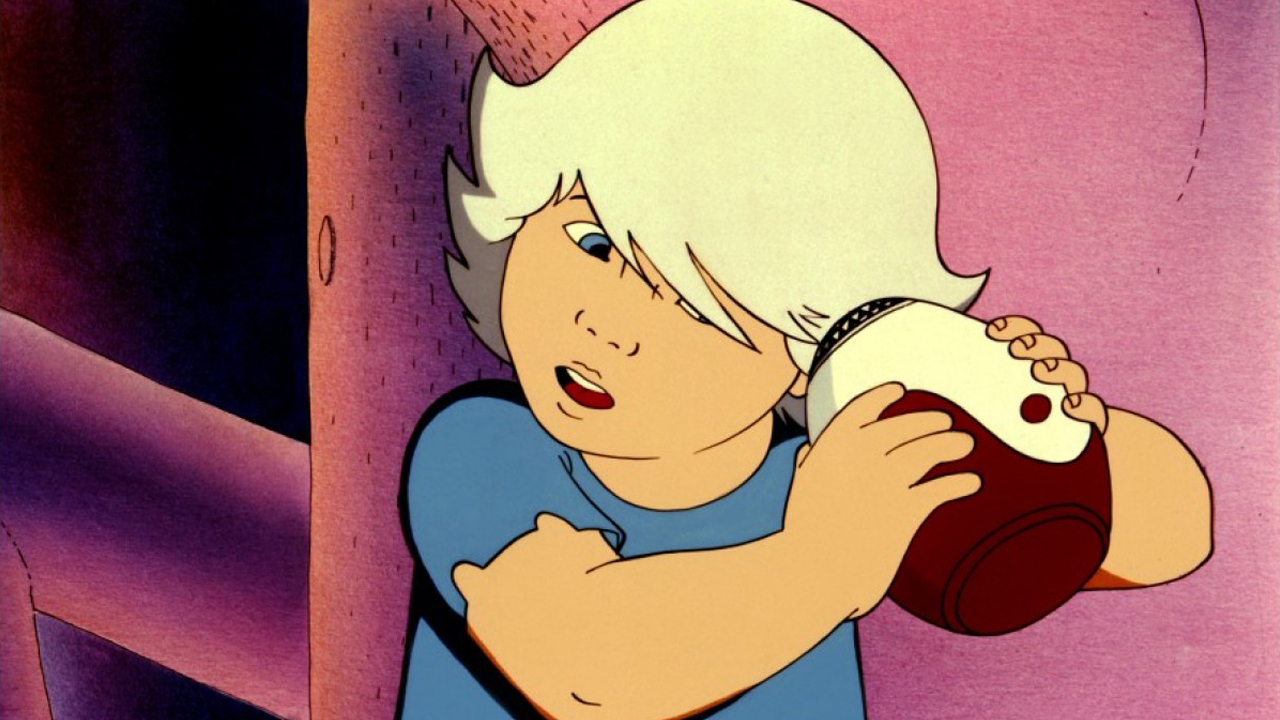 In the science fiction film ‘Les maîtres du temps’ Jaffar, the muscular pilot of a spaceship, tries to rescue the little orphan Piel, who is the sole survivor of a massacre on the dangerous planet Perdide.
Jaffar’s only means of contact with the little boy is through an egg-shaped microphone which Piel calls ‘Mike’. Jaffar is aided by a jolly old man called Silbad, and two little telepathic creatures Silbad rescued from a flower, called Jad and Yula. His only passenger, however, the evil prince Matton, on escape with a treasure, tries to kill Piel in order to get sooner to Aldebaran…
‘Les maîtres du temps’ was René Laloux’ second animated feature film and it shares many characteristics with his first, ‘Le planète sauvage‘: it’s a science fiction film based on a novel by Stefan Wul and using designs by a famous french illustrator, this time comic artist Moebius (Jean Giraud). ‘Les maîtres du temps’ nevertheless is less outlandish than ‘Le planète sauvage’: it’s an ‘ordinary’ cel animation film and Moebius’s drawings are less surreal than Topor’s. Yet, they still manage to give the film an otherworldly quality. Especially his designs of Perdide are disturbing, rendering it an uncanny, dangerous planet, indeed.
Moebius’s style is very visible throughout the picture, except for the humans, who are drawn pretty uglily and fail to live up to Moebius’s own high standards. Only the little orphan Piel and the jolly old man Silbad are true to Moebius’s designs. Consequently, they are both very believable and likeable characters, where the others remain flat cardboard examples of ‘the hero’, ‘the beautiful woman’ and ‘the villain’. Their animation, too, remains stiff and unconvincing In contrast, the funny little gnomes Jad and Yula are rendered very flexible and are responsible for some of the most beautiful animation in the film, which was practically all done by the Hungarian Pannonia Film Studio.
‘Les maîtres du temps’ is far from perfect, but mainly thanks to Piel’s character, with whom we can identify immediately, it’s a film with a heart. This, combined with some impressive science fiction images, especially of Perdide and of the planet Gamma 10, make the film one to return to over and over again.
After ‘Les maîtres du temps’ Laloux would make yet another Science fiction feature, now based on drawings by French comic artist Caza: ‘Gandahar‘. Unfortunately, it would prove to be the weakest of the trio.
Watch the trailer for ‘Les maîtres du temps’ yourself and tell me what you think:
Director: Paul Grimault
Release Date: 1947
Rating: ★★★★★ ♕
Review:
 One of the most poetic animation films ever made, ‘le petit soldat’ is a very inspired re-telling of Hans Christian Andersen’s classic fairy tale of the steadfast tin soldier.
In this version, written by poet Jacques Prévert and undoubtedly inspired by the recent experiences of World War II, the soldier is actually an acrobat doll who gets drafted by a humming-top into an unexplained war.
In his absence, Jack-in-the-box tries to seduce his love, a ballerina doll. And when our little soldier finally returns from the battlefield, injured, Jack tries to kill him by taking his heart-shaped winding key away and by trying to drown him into an icy river. Fortunately, in a dramatic climax, the ballerina saves her love from drowning, while the villain gets stuck in a gin-trap.
‘Le petit soldat’ is entirely told in pantomime and a great improvement upon ‘La flûte magique‘, Grimault’s film from the previous year: its storytelling is better, its settings more dramatic, its characterization more convincing, and its animation more sophisticated. Indeed, this beautiful short about triumphant love arguably is Grimault’s masterpiece, even topping his beautiful, but uneven feature film ‘Le roi et l’oiseau’ (1952/1980), which is also based on a Jacques Prévert story.
Watch ‘Le petit soldat’ yourself and tell me what you think:
http://www.dailymotion.com/video/x3qi9b_le-petit-soldat-grimault-prevert-19_shortfilms
‘Le petit soldat’ is available on the DVD ‘Le roi et l’oiseau’
Director: Paul Grimault
Release Date: 1946
Rating: ★★★
Review:

In this sweet little film, a boy-like minstrel and his misshapen dog disturb a nobleman in a castle.
The nobleman destroys the minstrel’s lute, whereupon a little bird gives the boy a magical flute, which makes alle people dance, including the evil nobleman and his birdlike soldiers.
This pantomime story is elaborately animated, but its designs belong more to the thirties than to the forties, and its story is hampered by uneven timing.
The idea of a flute making people dance was reused twelve years later by Belgian comic artist Peyo in his ‘La flûte à six schtroumpfs’ introducing his famous creations, the smurfs. This was also made into an animation film in 1976.
‘La flûte magique’ is available on the DVD ‘Le roi et l’oiseau’
Director: Alain Ughetto
Release Date: June 10, 2013
Rating: ★★½
Review:
 After ‘Persepolis’ (2007) ‘Jasmine’ is the second animation film about the Iranian revolution of 1979.
In his strongly autobiographical film Ughetto rediscovers his love relationship with Jasmine, a young woman from Iran, whom he visited during the turmoils of 1978/1979, and whom he left behind, to return to France, alone.
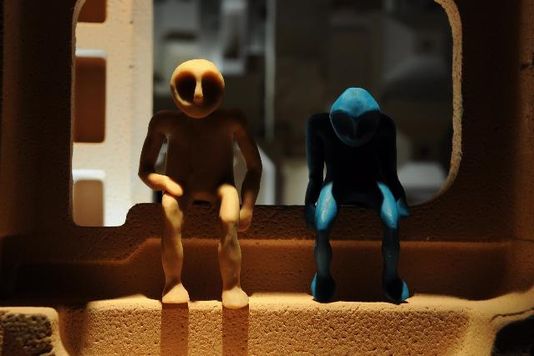
Ughetto doesn’t spare himself, and realizes leaving her was a big mistake on his part. To tell his story he uses love letters from the time, 8mm film images he shot during the Iran revolution and clay animation. He also shows the clay animation process, his elaborate sets made from styrofoam packaging material and collections of clay figures.
Unfortunately, Ughetto’s clay animation is very limited. His plasticine figures are devoid of any facial expression, and they all look the same. The only difference between the Alain and Jasmine puppets is their color (caramel vs. blue – reflecting the color of her eyes). There’s only a limited amount of animation, and little of it is expressive.
Because of this, the film relies heavily on the voice overs, Alain telling his story, a woman reading Jasmine’s love letters. Without the soundtrack the film becomes utterly incomprehensible. Only at one point in the film, the animation images leave a strong impression themselves: when the oppressive forces of the new Islamic regime strike down and kill the former revolutionaries. This is shown by giant floating turbans suddenly falling down and crushing discussing people.
‘Jasmine’ is an intimate, very personal and honest film, and the story of the Iranian revolution and its effects on the everyday lives of people remains moving. But ‘Jasmine’ is no ‘Persepolis’ and in the end falls short as an animation film. It could easily have been a live action film, a documentary, or even a novel, instead.
Watch the trailer for ‘Jasmine’ and tell me what you think:
Director: Alexandre Alexeieff
Release Date: 1933
Rating: ★★★½
Review:
 Predating Disney’s film to the same classical piece by seven years, this ‘video clip’ to the music of ‘Night on Bald Mountain’ by Modest Mussorgsky is an impressive mood piece.
The Russian-French artist Alexeieff animated ‘Une nuit sur le mont chauve’ on a so-called pinscreen, a device he invented himself , and which consists of a screen with numerous pins, which can be pushed further in or out, to produce a shadowy image together. This technique is highly original, and the images produced are totally unique.The film’s imagery has more in common with surreal paintings from the era than with any other animation film from the 1930s. ‘Une nuit sur le mont chauve’ was Alexeieff’s first film on the pinscreen. Together with his wife Claire Parker he would animate five more, of which ‘The Nose’ (1963) is arguably the best.
The film does not tell a story, but shows us a string of expressionistic images of animal and human forms, floating through air, and morphing into disturbing creatures. The animation is sometimes excellent (with a human figure circling through the air as a particular standout), but at times primitive, too, and the film suffers a little from the crude montage. Both shortcomings are a direct result of the limitations of the pinscreen. However, Alexeieff’s vision overcomes the film’s drawbacks, and ‘Une nuit sur le mont chauve’ is rightly considered an animation classic.
Watch ‘Une nuit sur le mont chauve’ yourself and tell me what you think:
‘Une nuit sur le mont chauve’ is available on the DVD ‘Alexeïeff – le cinéma épinglé’
Director: René Laloux
Release Date: 1988
Rating: ★★★★½
Review:
 ‘La Prisonnière’ is a short, rather surrealistic science fiction film about two children.
They visit an extraterrestrial monastery and witness a rescue of a prisoner by naked women who step out of a stranded whale.
The film looks like an animated version of designer Caza’s source comic, Équinoxe (which can be found here), and contains only a limited amount of animation. In his designs Caza’s style is very reminiscent of that of his fellow french comic artist Moebius.
‘La prisonnière’ seems like an etude for Laloux’s and Caza’s much bigger project, the feature film ‘Gandahar‘ (1988). The atmosphere of the short is poetic, if completely incomprehensible.
Watch ‘La Prisonnière’ yourself and tell me what you think:
‘La Prisonnière’ is available on the DVD ‘Gandahar’
Director: René Laloux
Release Date: May 11, 1973
Rating: ★★★★★ ♕
Review:
‘La planète sauvage’ is an old love of mine. I first watched it when I was ca. six or seven. It took me fifteen years before I learned which film I had actually watched, and it would take me another ten years before I could watch it again. However, all the time the film’s powerful images never left me.
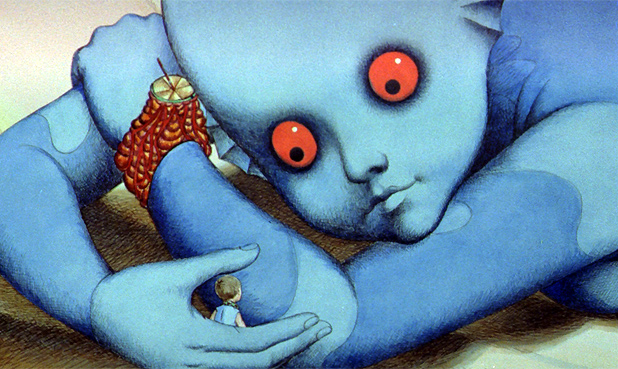
‘La planète sauvage’ is a science-fiction feature, which tells about the life of humans (‘Oms’, which sounds like the french word for humans, ‘hommes’) on a strange planet occupied by story-block-high humanoid giants, called Draags. To them humans are no more than pets and pests. By accident, a pet Om, Terr (symbolically named after the French word for Earth, terre), learns the Draags’ knowledge and he leads his fellow humans into an uprising.
However, ‘La planète sauvage’ is not particularly famous for its straightforward and rather cliche plot. Its strength lies in its effective use of Roland Topor’s very surrealistic designs, which makes the depicted planet incomprehensible, foreign and scary. For example, the Draag’s behavior is so strange, that despite their humanoid form they feel very alien, indeed. The film’s original technique of combining drawn animation with cut-out adds to the surreal atmosphere. Even the space funk music accompanying the action sounds outlandish.
Even though the animation sometimes is rather stiff and at times even ridiculously poor, the graphic imaginary is so strong that these shortcomings never spoil the enjoyment of the film. On the contrary, the film’s totally unique and disturbing atmosphere and its philosophical questions about what makes man human make watching ‘La planète sauvage’ a very rewarding experience.
Together with Bruno Bozzetto’s ‘Allegro non troppo’ (1976) and Martin Rosen’s ‘Watership Down’ (1978) Laloux’s film must be counted among the most outstanding features of the seventies. René Laloux would make two other science fiction features, ‘Les maîtres du temps‘ (1981) and ‘Gandahar‘ (1988), but these do not reach the stunning originality of the visuals in this film.
Watch the trailer for ‘La Planète sauvage’:
Director: Władysław Starewicz
Release Date: 1922
Rating: ★★★★★
Review:
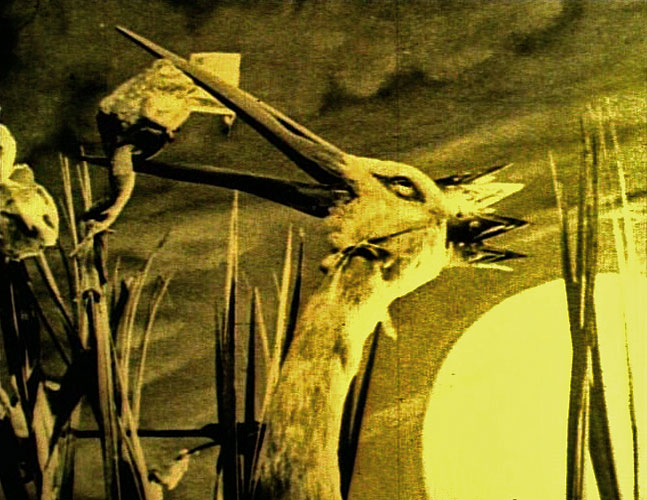 After the October revolution, Władysław Starewicz fled to France, where he continued to make stop motion films until his death in 1965. ‘The Frogs Who Wanted a King’ is the fourth film he made in France, and probably his most political.
The film is based on one of Aesop’s fables. Some frogs ask Jupiter for a king. Jupiter sends them one, but the king looks like a tree and does nothing at all. The frogs don’t like him, so Jupiter sends them a stork, who, naturally, eats the unfortunate amphibians.
The message may be that it’s better to have a dull government than one that kills you, a message Starewicz could certainly relate to, being forced to exile by the oppressing communist regime in Russia.
Once again, Starewicz’ animation is top notch. The film has a particularly fable-like character, taking place in its own, very convincing universe.
Watch ‘The Frogs Who Wanted a King’ yourself and tell me what you think:


 Dr. Grob's Animation Review