You are currently browsing the category archive for the ‘European films’ category.
Director: Jan Švankmajer
Release Date: 1988
Rating: ★★★★½
Review:
 Švankmajer’s films in the communist years preceding the velvet revolution of 1989 show a lighter tone than his earlier films. It’s like one can breath some of the thawing atmosphere in Czechoslovakia during the Perestroika years.
‘Virile games’ is a typical example. Although the film contains some very graphic violence, the film remains a rather cartoony atmosphere, and its end is rather tongue-in-cheek.
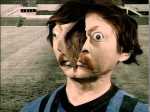
In ‘Virile Games’ we follow a mustached man watching a football match on the television. It’s a very weird soccer match, however: all players have the spectator’s face, and scoring happens by killing the opponents. These killings occur in the most bizarre ways, all deforming the opponent’s head till the player drops dead. One opponent for example is killed with cake forms, another by toy train….
In the second half the football match moves to the spectator’s own home, and the killing continues with the man’s own kitchen tools. However, tied to his screen, the man keeps watching the television set, not noticing that the violence occurs just around him.
In this film Švankmajer blends live action, stop motion, rather Terry Gilliam-like cut-out animation and pixilation with the stunning self-assurance of a mature film maker. Especially the clay-animation is top-notch. Like Georges Schwizgebel’s ‘Hors-jeu‘ (1977) the film directly couples soccer to violence, a clear indication of the author’s worries about growing football hooliganism. Apart from that, the film shows the maker’s trademark ingredients, like his obsession with food.
Watch ‘Virile Games’ yourself and tell me what you think:
‘Virile Games’ is available on the DVD ‘Jan Svankmajer – The Complete Short Films’
Director: Mark Baker
Release Date: 1988
Rating: ★★★★★
Review:
 ‘The Hill Farm’ is a long animation film exploring man’s relation to nature.
First we watch the inhabitants of the hill farm themselves: simple farmers, who know the dangers and hardships of nature, and who treat their livestock without romanticism (as exemplified by the farmer’s wife killing chicken without ado).
At one point the hill farm is visited by tourists, who are completely alienated from nature. One of them faints at the sight of the farmer’s wife killing a chicken. When confronted by nature’s dangers (as embodied by a gigantic bear-like beast) they don’t recognize the danger at all. To them nature is something to visit, something to make snapshots from. The third party is a group of huntsmen, who (try to) kill everything in sight, including even the farmer’s bees.
The whole film takes place at a leisurely speed, without dialogue. Mark Baker’s visual style is simple, but very effective. His angular designs and graphic backgrounds are beautiful, and his animation has a unique timing, which is as comical as it is to the point. The narration is very open, leaving the interpretation to the viewer. The end result is one of the most beautiful animation films of the 1980’s.
Watch ‘The Hill Farm’ yourself and tell me what you think:
‘The Hill Farm’ is available on the DVD Box Set ‘Annecy – Le coffret du 50e Anniversaire’
Director: René Laloux
Release Date: January 28, 1988
Rating: ★★½
Review:
 ‘Gandahar’ was to be René Laloux’s last feature, and like his former two feature films, ‘La planète sauvage‘ (1973) and ‘Les maîtres du temps‘ (1982), it’s a science fiction film set on a strange planet.
The film is especially related to ‘Les maîtres du temps’. Not only in visual style, but also with its story line involving mindless oppressors and time travelling. This time we’re on the paradise-like planet Gandahar, which is suddenly attacked by a powerful, yet unknown force. Soldier Sylvain is send away to find out who these enemies are…
‘Gandahar’ is the least successful of Laloux’s features. Its story, based on a 1969 novel by Jean-Pierre Andrevon, is entertaining enough, but the film’s narrative style is terrible. Practically everything that’s happening is explained by the main characters to us, even when we as viewers had come to our own conclusions. This is most preposterous in an early scene in which Sylvain finds his love interest Airelle, who immediately exclaims she’s falling in love with our hero. This must be one of the worst love scenes ever put to the animated screen.
The film’s ultimate villain is rather surprising, as is his downfall, even though he’s killed off ridiculously easily. Strangely enough the creature is given a long death scene, before the film abruptly ends. We don’t even watch Sylvain reunite with his love interest! Not that we did care, anyway, for the film’s main protagonists are as characterless as possible.
It’s a pity, for the film’s aesthetics are quite okay for a 1980s film. The animation, by a North-Korean studio, is fair, if not remarkable, and the designs by French comic book artist Philippe Caza are adequately otherwordly. Sure, he’s no Moebius, let alone a Roland Topor, and he never reaches the strangeness of the latter’s fantastic planet from 1973. In fact the film rarely succeeds in escaping the particularly profane visual style of the 1980s (e.g. ‘Heavy Metal’). Most interesting are the backgrounds, and Gabriel Yared’s musical score, which is inspired and which elevates the film to a higher level.
Watch ‘Gandahar’ yourself and tell me what you think:
Director: Nicole van Goethem
Release Date: 1985
Rating: ★
Review:
 ‘A Greek Tragedy’ won an Academy Award and the first prize at the Annecy Inernational Film Festival. I remain puzzled why.
‘A Greek Tragedy’ was Van Goethem’s first own film. It’s a classic gag cartoon featuring three living, scarcely clad female caryatids supporting an old ruin. When the ruin crumbles, and they’re finally free, we watch them dancing into the distance.
The designs are trite, the synthesizer music is ugly, the humor is poor, and the story forgettable. If this short has a hidden, perhaps feminist message, it’s lost on me. And then to imagine, that one of the short’s competitors for the Oscars was ‘Luxo jr.’, a far more convincing and rewarding film in every respect!
Watch ‘Een Griekse tragedie’ yourself and tell me what you think:
‘Een Griekse tragedie’ is available on the DVD Box Set ‘Annecy – Le coffret du 50e Anniversaire’
Director: Jan Švankmajer
Release Date: August 3, 1988
Rating: ★★★★★ ♕
Review:
 Of all classic literature, Lewis Carroll’s ‘Alice in Wonderland’ is certainly the most dreamlike, and it’s no wonder that it came to the attention of Czech master surrealist Jan Švankmajer.
Already in 1971 he had made a film on Carroll’s poem Jabberwocky, but arguably, this film has little to do with the poem. ‘Alice’ continues the surreal atmosphere of his earlier film and remains faithful to the book.
‘Alice’ was Jan Švankmajer’s first feature length film, and it really shows his craft and strikingly original vision. It is one of the best, probably the most original, and certainly the most disturbing film adaptation of Lewis Carroll’s world famous book. In any case, it’s among the best animated features of all time.
Where the Walt Disney version focused on the loony, fantastic parts of the story, Švankmajer emphasizes its irrational, surreal character. Švankmajer puts the story in a setting completely his own. Although the film opens with the classic opening near the brook, after the titles, the action takes place mostly indoors, creating a claustrophobic atmosphere typical for this film, only matched by Švankmajer’s second feature film, ‘Faust’ (1994). In Švankmajer’s film ‘wonderland’ consists of an endless string of dirty old rooms, connected by many doors and desks with drawers, all of which the knob comes off. Even the lovely garden is no more than a stage with props.
The drawer knobs form the running gag in a movie which is low on humor, but high on unsettling and impressive images, starting with the stuffed rabbit suddenly coming to life and smashing the glass of its glass display with its scissors. Other highly memorable scenes are the stuffed rabbit eating sawdust, which falls out again its open belly; the mouse cooking on Alice’s head, the room of hole-digging socks; and the mindless and mechanical repetition of the mad tea-party scene, timed to perfection.
Švankmajer’s wonderland is a morbid world. Its inhabitants are stuffed animals, dolls, playing cards, and even a bunch of macabre fantasy creatures, oddly joined together from body parts from different animals and lifeless objects, and which form a real threat to the little girl. In this world, anything can become alive, as demonstrated by e.g. Alice’s own socks. At the same time, Alice remains the only really living thing, and even she turns into a doll three times. Death, too, is near: at one point in the film we see the mouse, still in his clothes, caught by a mousetrap, dead. And in Švankmajer’s wonderland, the queen of heart’s orders are executed, and several characters are decapitated, including the mad hatter and the march hare…
‘Alice’ uses a perfect blend of stop motion and live action, and has an excellent protagonist in young actor Kristýna Kohoutová. If the film has one flaw, it must be the girl’s voice, which provides all the dialogue and narration. It’s often unwelcome and out of place, and it doesn’t really work well in dialogue-rich scenes, like the mad tea scene or the trial scene.
Švankmajer is at his best when the action is silent and the images speak for themselves. These scenes are greatly added by superb sound design, provided by Ivo Špalj and Robert Jansa, which add to the creepy, wretched atmosphere of the film. ‘Alice’ is certainly not your average family film, but the viewer who dares to enter this film’s unique world, will not be disappointed.
Watch the trailer for ‘Alice’ yourself and tell me what you think:
‘Alice’ is available on DVD and Blu-Ray
Director: Fyodor Khitruk
Release Date: 1983
Rating: ★★★★
Review:
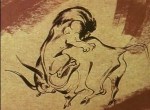 ‘Lion and Ox’ is one of Fyodor Khitruk’s most serious films. It’s a very beautiful short about an ox who befriends a lion. Unfortunately, a devious little fox sets the two against each other, with fatal results.
This simple fable is told without words. They’re not necessary, for the animation is stunning. Apart from the fox, the animals are animated very reallistically, but they still retain a strong sense of emotion, telling the tale in expressions. The designs are very graphic, with beautiful ink lines. The backgrounds, too, are gorgeous, and reminiscent of Chinese paintings in their suggestions of the savanna by using a few powerful paintbrushes.
Watch ‘Lion and Ox’ yourself and tell me what you think:
Director: Jan Švankmajer
Release Date: 1983
Rating: ★★★★½
Review:
 After his not all too successful adaptation of ‘The Fall of the House of Usher‘ (1980), Czech film maker Jan Švankmajer returns to Edgar Allen Poe with ‘The Pendulum, the Pit and Hope’, with much better results.
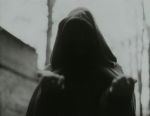
In ‘The Pendulum, the Pit and Hope’ Švankmajer tries to visualize Edgar Allen Poe’s most sensory and scariest story, ‘The Pit and the Pendulum’. He succeeds masterfully, merging the viewer with the protagonist, and retaining the horror of the discoveries of the torture chamber.
The story is told very straightforward, in black and white, without dialogue, voice over or music, giving it a raw and uncanny sense of realism. Švankmajer rejects Poe’s deus ex machina, however, but takes the story to a better, if more depressing conclusion.
‘The Pendulum, the Pit and Hope’ is essentially a live action movie, and contains little animation. However, in its disturbing take on Poe it is one of Švankmajer’s masterpieces, and definitely deserves to be better known.
Watch ‘The Pendulum, the Pit and Hope’ yourself and tell me what you think:
https://vk.com/video101655_142703210?list=141142ca159bb76093
‘The Pendulum, the Pit and Hope’ is available on the DVD ‘Jan Svankmajer – The Complete Short Films’
Director: Jan Švankmajer
Release Date: 1983
Rating: ★★★★★
Review:
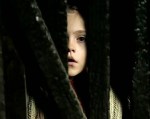 In ‘Down to the Cellar’ Jan Švankmajer explores the fears of a child.
The film’s story is pretty straightforward: we watch a little girl (engagingly played by young Monika Belo-Cabanová) descending the stairs. She has to fetch some potatoes in a deep, dark cellar. However, her task will not be an easy one. Already her way down the stairs to the cellar is frightening, when she’s hindered by two adults who regard her all too knowlingly.
In the cellar, the girl sees strange things happening, like old shoes fighting over her croissant, and a cat growing to gigantic proportions. Even the potatoes won’t cooperate, rolling back into the case she picked them from. Worse, the cellar appears to be inhabited by the same two adults, who perform strange rites for her very eyes. Their invitations to the girl are dubious, and luckily the girl declines. Unfortunately, at the end of the short, she has to face her fears, once again.
‘Down to the Cellar’ contains a hard to define, but strong and disturbing threat of child abuse. The short is mostly shot in live action, and contains only a little stop motion animation. However, it’s arguably Švankmajer’s most moving film. Švankmajer keeps the child’s perspective throughout the movie, and we immediately sympathize with the little girl and her plight, sharing her state of wonder, fear and despair.
Švankmajer would explore the film’s theme again in his fourth feature film, ‘Otesánek’ (2000).
Watch ‘Down the Cellar’ yourself and tell me what you think:
https://vk.com/video5061134_164400011
‘Down the Cellar’ is available on the DVD ‘Jan Svankmajer – The Complete Short Films’
Director: Jan Švankmajer
Release Date: 1982
Rating: ★★★★★ ♕
Review:
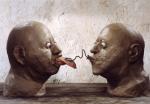 Together with ‘Jabberwocky‘ (1971), ‘Dimensions of a Dialogue’ can be considered Švankmajer’s masterpiece. It mixes excellent design with virtuoso animation and astonishingly original story material.
With ‘Dimensions of a Dialogue’ Švankmajer defined a style he would maintain into the early 1990s, resulting in most of his best films, including the feature lengths ‘Alice‘ (1987) and ‘Faust‘ (1994). ‘Dimensions of a Dialogue’ contains three different ‘dialogues’, without using any real dialogue in the soundtrack. These three dialogues are pure visual encounters, making this film very universal.
Like in all his films, Švankmajer’s visual language is highly surreal. Yet, the three dialogues follow their own inescapable inner logic, with disturbing results. The film does not as much feature dialogue as well as rather violent clashes. It seems to show the inability of humans to communicate.
The first, ‘Factual dialogue’, is the most violent of the three episodes. It shows three heads moving in a 2-dimensional space. The three heads are clearly inspired by renaissance painter Giuseppe Arcimboldo and consist of food, household tools and office equipment, respectively. The heads devour eachother, destroying their parts more and more before spitting them out. Like ‘Et Cetera‘ (1966) there is a sense of pointlessness in this endless string of violence, which tells something about humanity.
The second part, ‘A passionate dialogue’, is the most virtuoso episode of the three. ‘In this part Švankmajer and his animating collaborator Vlasta Pospíšilová introduce a new level in claymation. The film features a stunningly realistic human couple made out of clay. The man and woman are animated beautifully when they embrace passionately, until they become one moving lump of clay of pure desire. When they part again, however, there’s some leftover: a little lump of formless clay yearning for affection. Unfortunately, neither of the two lovers accepts this petty piece of clay, and the innocent leftover brings the couple to rage. In their conflict they once again become a clay lump, but now one of utter destruction…
The third part, ‘An exhausting dialogue’, is the most comical one, and seems to portray a discussion going haywire. It features two realistic heads on a table, producing a toothbrush and toothpaste, bread and butter, a shoe and a shoelace and a pencil and a sharper in more and more absurd combinations to the exhaustion of both. The soundtrack is perfect throughout the picture, but exceptionally so in this third part in its combination of Jan Klusák’s music and train sounds.
‘Dimensions of a Dialogue’ is inexplicable, but communicates on a subconscious level, like all great surreal art. It perfectly shows the power of animation in showing the human condition using the very outskirts of imagination. The result is no less than one of best animation films ever.
Watch ‘Dimensions of Dialogue’ yourself and tell me what you think:
‘Dimensions of Dialogue’ is available on the DVD ‘Jan Svankmajer – The Complete Short Films’ and on the DVD ‘Annecy – Le coffret du 50e Anniversaire’
Director: Jan Švankmajer
Release Date: 1980
Rating: ★★
Review:
 Jan Švankmajer retells this famous story by Edgar Allen Poe using a narrating voice over and black and white images of several different objects.
The images, some of which are animated, are sometimes quite disturbing, and are at points even able to evoke the horror of the story. However, most of the time they seem totally unrelated to the narration, and their visual power in fact often distracts from the voice over, making the story very hard to follow, indeed.
‘The House of Usher’ is a daring experiment in cinematographic storytelling, but not really a successful one, and Švankmajer would not repeat it. Nevertheless, three years later, the Czech film maker would return to Edgar Allen Poe, in ‘The Pendulum, the Pit and Hope‘, with much better results.
Watch ‘The Fall of the House of Usher’ yourself and tell me what you think:
‘The Fall of the House of Usher’ is available on the DVD ‘Jan Svankmajer – The Complete Short Films’
Director: Henk Kabos
Release Date: 1943
Rating: ★★
Review:
 ‘Das musikalische Auto’ is a Toonder studio film commissioned by Nazi Germany.
It’s a strange little tale of a man who ‘improves’ an old car into a musical instrument. He tours around the countryside, until his car crashes against a tree.
The soundtrack of this film has been lost, so we don’t know how the musical car sounds, but the film feels uninspired: the story lacks any logic, and the animation is primitive and raw. It contains some elements both 1930s Fleischer and Disney, without reaching either peaks.
In his autobiography Marten Toonder states that the idea of this cartoon had its origins in the German UFA studio, who wanted a story on a tumble toy. Toonder soon gave the tumble toy arms and legs, but he and his studio only halfheartedly worked on this ill-conceived idea, and it shows. Nevertheless, some of the designs are quite charming: the backgrounds have an unmistakable Toonder-touch, and the animals in the cartoon do look good.
‘Das musikalische Auto’ is available on the DVD inside the Dutch book ‘De Toonder Animatiefilms’
Director: Joop Geesink?
Release Date: 1943
Rating: ★★★
Review:
 ‘Serenata nocturna‘, Marten Toonder’s and Joop Geesink’s first stop motion film, did raise interest of Philips, and the Dutch electronics company commissioned another short to advertise the Philishave, an electronic razor. This resulted in ‘Phi-garo in het woud’.
in ‘Phi-garo in het woud’ a bearded gnome tries to impress a female elf, but she rejects him. The gnome gets a shave at the local barber, but the elf still rejects him. Then a witch shows him the Philips Philishave, which does the trick.
‘Phi-Garo in het woud’ is less entertaining than ‘Serenata nocturna’, its story less logical, and its designs more generic than in the earlier cartoon. The animation, however, is a little more assured. More commissions were now to follow.
Watch ‘Phi-garo in het woud’ yourself and tell me what you think:
‘Phi-garo in het woud’ is available on the DVD inside the Dutch book ‘De Toonder Animatiefilms’
Director: Joop Geesink
Production Date: September 1942
Rating: ★★★★
Review:
 ‘Serenata nocturna’ is the first collaboration between two Dutch animation film pioneers, Marten Toonder and Joop Geesink.
The collaboration results in a charming little advertising film about a Mexican who tries to serenade his love, to no avail. He tries several instruments, without success. But then he magically produces a Philips Radio, and finally his love is impressed.
The puppet animation in this short is very reminiscent of that of George Pal, the Hungarian animator, who had an important puppet film studio in Eindhoven in the late 1930s, and who had made several films for Dutch electronics company Philips himself. Pal, however, had exchanged The Netherlands for the United Kingdom, and finally emigrated to the United States in December 1939, leaving The Netherlands without any animation studio of importance. Now, Toonder and Geesink tried to fill this gap. Perhaps, Philips would be interested to commission films from them.
However, the inexperience of both animators shows: the animation still looks primitive, with a lot of excessive movement. The short’s story, however, is funny and still entertaining today. Indeed, Philips saw potential, and would become an important commissioner to both film makers.
Toonder would soon abandon stop motion, but Geesink would continue in the field, creating one of the most successful stop motion animation studios of the post-war era.
Watch ‘Serenata nocturna’ yourself and tell me what you think:
‘Serenata nocturna’ is available on the DVD inside the Dutch book ‘De Toonder Animatiefilms’
Director: Grigori Lomidze
Release Date: 1947
Rating: ★★★
Review:
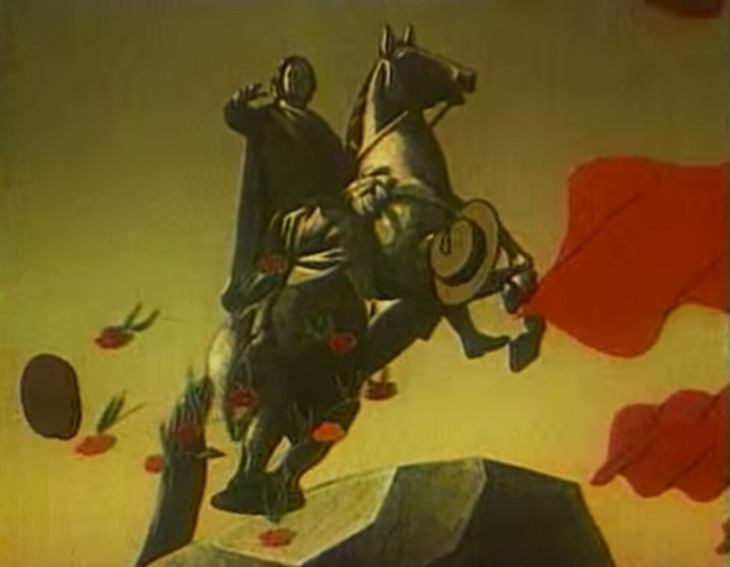 ‘To You, Moscow’ is a long and slow Soviet propaganda film celebrating Moscow’s 800th birthday by depicting its turbulent history.
During the film we watch Moscow’s settlement, the victory of Ivan III over the Tartars (15th century), the revolt against Polish occupation (17th century), the defeat of Napoleon’s army in 1812, the 1905 revolution, the 1917 socialist revolution (‘led by Lenin and Stalin’) and the 1941 defeat of the fascist army to the present day.
The socialist revolution section leads to live-action footage of Moscow, a happy child, flowers, some buildings and street scenes and statues of Lenin and Stalin. The last section, the celebration, shows photographs of heroic inhabitants of the Soviet Union, and not only glorifies Moscow as “our youth, our glory”, “our dear mother” and “our birthday girl”, but also as a “glory to Stalin”.
The different sections are bridged by letters and postcards to comrade Stalin. The sections themselves focus on strives and battles, and are accompanied by alternately realistic and symbolic images. For example, the 1917 revolution is depicted by the czarist double-headed eagle struggling and falling to pieces, while the most impressive part may be that of 1812, with its realistic images of fire.
It may be clear that this film is propaganda at its worst. The film is saved from becoming totally unwatchable by the beautiful animation, the stark images, and the lively patriotic music.
Watch ‘To You, Moscow’ yourself and tell me what you think:
‘To You, Moscow’ is available on the DVD box set ‘Animated Soviet Propaganda’
Director: Harold Mack
Release Date: August 1, 1952
Rating: ★★★★★
Review:
 By 1952 the Dutch Toonder studios had been producing animation films for ten years, and now they were ready to produce a ‘free film’, not commissioned, but out of their own ideas.
The first of these free films was ‘De gouden vis’ (The Golden Fish). It was Marten Toonder’s old wish to produce a free film, and the result is clearly a work of love. ‘De gouden vis’ is an astonishing achievement for the Dutch studio: all elements of animation film have matured in this film: its storytelling is original, its designs are gorgeous, the animation is excellent, the effects are convincing and its atmosphere is unique. The result is arguably one of the most beautiful films ever made in The Netherlands.
Based on a story by Marten Toonder’s brother, Jan Gerhard Toonder, the film tells about the Chinese prince Li Pai, who repeatedly asks an old wise fish how to live. The fish tells the prince that his eyes know the answer, but Li Pai misinterprets what he sees, and only in old age he discovers the truth…
The film has a genuinely Chinese atmosphere, thanks to designs by Pamela & Harold Mack and backgrounds by Cees van de Weert and Ling Nan Lung. The film hasn’t aged a bit, except for Nell Knoop’s Dutch narration, which has an unmistakable 1950s diction.
Unfortunately, ‘De gouden vis’, in spite of praise on several film festivals around the world, only returned a mere thousand guilders, while its production had costed about 40,000 guilders. So, during the rest of its existence, the Toonder studios produced only a handful of other ‘free films’, most notably ‘Moonglow’ (1955).
‘De gouden vis’ is available on the DVD inside the Dutch book ‘De Toonder Animatiefilms’
Director: Mikhail Kamenetsky
Release Date: 1984
Rating: ★★
Review:
 Mikhail Kamenetsky (1924-2006) was a director of numerous puppet films made between 1965 to 1995, almost all featuring animals.
In his ‘Wolf and Calf’ an old wolf steals a calf to eat, but he starts to like it and raises it like his own son. In the end, when a hungry bear, a vixen and a boar try to steal his loot, he is saved by the calf itself, which has turned into a strong bull.
‘Wolf and Calf’ is a fable-like children’s film with an old-fashioned look. The designs of the protagonists look like they have come from a 1950’s toy shop. Kamenetsky’s puppet animation is elaborate, and actually quite good, if erratic, but the film suffers from an excess of dialogue, which not always seems to correspond with the animated characters themselves.
Moreover, the film’s world is rather inconsistent, stretching its believability: the wolf, like all other animals, is highly anthropomorphic and even lives in a house, alongside humans, who are afraid of him nonetheless. The calf, on the other hand, remains on all fours, and stays an animal, even though it is able to speak.
Watch ‘Wolf and Calf’ yourself and tell me what you think:
Director: Ideya Garanina
Release Date: 1981
Rating: ★★½
Review:
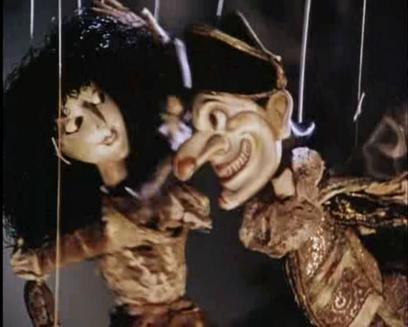 Based on plays by Federico García Lorca, Cabaret (a better translation would be ‘farce’) is a puppet animation film, using puppets in a puppet theater.
The film is something of a musical and tells about the love between Donna Rosita and Don Cristobál. The music, by world famous composer Sofia Gubaidulina is odd and rather unconvincing in its avant-garde version of the musical genre.
The film falls into two parts: the first part looks most like an ordinary puppet play: it’s fast, hectic, humorous, and even vulgar, with a strong sense of eroticism. Halfway the film, however, the mood changes drastically. Don Cristobál gets rid of his strings and tears off his grotesque mask to reveal a more noble face. With that the film enters the second part, a dreamlike, lyrical one. Unfortunately, the narrative gets lost in this part, and in the end the film suffers from its length, from its meandering music and beautiful, but vague imagery.
‘Cabaret’ was Garanina’s Fourth film, and her third after she had joined Soyuzmultfilm in 1976. In 1988 Garanina and Gubaidulina would work together again on “The Cat That Walked by Itself”, a feature film based on Rudyard Kipling’s ‘Just So Stories’. Unfortunately she came to a tragic end, as she was murdered in her own house in 2010.
Watch ‘Cabaret’ yourself and tell me what you think:
http://www.dailymotion.com/video/x27btal_08-ideya-garanina-1981-cabaret_shortfilms
Director: Michel Ocelot
Airing Date: December 21, 1983 – ?
Rating: ★★★½
Review:
 After the artistic successes of ‘Les trois inventeurs‘ (1979) and ‘La légende du pauvre bossu‘ (1982) Ocelot turned his skills to a gentle and entertaining television series for children.
The series, called ‘La princesse insensible’ (the insensitive princess), consists of thirteen episodes and has a very simple story line: a princess is so bored that nothing can amuse her. The king declares that when a prince manages to amuse the princess nonetheless, he will win her. In the 4 minute long episodes we watch several young princes, sorcerers in fact, trying to amuse her in her own theater, all in vain.
‘La princesse insensible’ uses a mixture of traditional and cut-out animation. Ocelot’s animation may be simple, no doubt due to a limited budget, but it’s very effective in its pantomimed action. The series’ design is elegant in its recreation of an 18th century atmosphere. The framing story is told in silhouettes, reminiscent of the work by Lotte Reiniger, but the theater scenes are in bright colors. The atmosphere is fairy-like and surreal throughout, helped by Christian Maire’s otherworldly music. In all, ‘La princesse insensible’ is a little charming series, which shows Ocelot’s delicate and unique voice in the animation world.
The separate episodes of ‘La princesse insensible’ are listed below:
1. Le Prince dompteur (The Tamer Prince)
This episode tells the framing story and shows us the first prince. He has a menagerie of trained fairy tale animals: a unicorn, a three-headed dog, a Chinese dragon and a phoenix.
2. Le Prince jardinier (The Gardener Prince)
The second episode, like all following episodes of ‘La princesse insensible’, starts without the framing story. Instead the story is told in the title song. After the intro, we watch the second prince performing right away. He’s a garden prince, able to make plants and flowers grow on the bare floors and pillars of the princess’s theater. When he fails to impress the princess, he disappears on an ever-growing tree.
3. Le Prince à transformations (The Transforming Prince)
The third prince trying to impress the insensible princess is the most interesting to animation fans. Being called the metamorphosis prince, he’s able to transform himself into all kinds of people and things. Ocelot uses some beautiful metamorphosis animation in doing so. The prince’s performance builds up to a great finale, in which the prince transforms himself into seemingly hundreds of things, which is depicted by the rapid showing of random pictures. This simple device works because we’ve seen the process of transformation just before that. It also adds a humorous touch to the fairy-like atmosphere, because many of the objects are anachronisms in the 18th century setting.
4. Le Prince sourcier (The Dowser Prince)
The fourth prince, the ‘diviner prince’, is able to sprout water everywhere, using a divining-rod, turning the princess’s theater into a fountain. One of the more fairy-like episodes of ‘la princesse insensible’, ‘Le prince sourcier’ is less impressive than the first three episodes. After these three, the diviner prince even fails to impress we viewers.
5. Le Prince qui fait semblant (The Pretender Prince)
The fifth prince trying to impress the princess is almost typically french: he’s a mime artist, miming (among others) that he plays the piano, rides a bicycle and even a motorcycle inside the princess’s theater. When he fails to impress the princess he even mimes that he commits suicide. Like ‘le prince à transformation’ this episode has an extra touch because of the anachronisms.
6. Le Prince météorologue (The Meteorologist Prince)
The sixth prince is called the weather prince, and he’s able to make clouds dancing within the princess’s theater. He also makes rain, lightning and a rainbow. When he leaves the princess unimpressed, he covers himself in snow. One of the lesser episodes of ‘la princesse insensible’, ‘le prince météorologue’ nevertheless shows Ocelot’s fantasy. When one doesn’t expect any more meteorological wonders, the prince transforms the rainbow into numbers and patterns.
7. Le Prince sous-marin (The Underwater Prince)
The seventh prince arrives in a fish-like submarine inside an enormous fish-tank. Compared to the other princes, his antics are relatively believable, although he seems to have the ability to make fish forming patterns. This episode is one of the lesser entries in the series, despite the beautiful old-fashioned design of the princes’ submarine.
8. Le Prince volant (The Flying Prince)
The eight prince, the flying prince, looks like a Japanese superhero with wings. During his flight, we see more of the theater than in any other episode. Apparently there’s more public than the princess alone.
9. Le Prince décorateur (The Decorator Prince)
The decorator prince is able to turn the complete theater upside-down, to change its colors by clever lighting. When the princess is unimpressed as ever, he descends into the basements.
10. Le Prince magicien (The Magician Prince)
This prince is called the ‘magician prince’, even though many of the other princess were skilled magicians as well. The prince enters on a flying carpet and turns the pillars of the theater into palm trees, the chandelier into a beach ball and the stone ornaments into butterflies. Then he turns his own hat into a zeppelin and the furniture into a train. Enraged by the princess’s non-reaction, the prince makes everything disappear again, including the theater and himself.
11. Le Prince peintre (The Painter Prince)
The Painter prince episode, unlike the other episodes, has some false starts, as the prince repeatedly forgets something he needs to paint his enormous canvas. The painter exactly copies the theater on his canvas, then paints a happy portrait of the princess. But when she remains unimpressed, he violates his own drawings. It’s charming to see the shadows of Ocelot’s paper figure of the painter, while he’s painting the enormous canvas. It gives the series its handicraft appeal.
12. Le Prince artificier (The Artificer Prince)
The fireworks prince, like the painter prince, knows some false starts, when he has troubles preparing the fireworks in the dark. The fireworks effects are created nicely with kaleidoscope effects into beautiful abstract patterns. The prince also illuminates the theater with neon lights. In the end the prince disappears on a rocket, after which the complete theater explodes.
13. Le Prince écolier (The Schoolboy Prince)
The last prince, ‘the schoolboy prince’, is much less skilled than the other princes, but he immediately solves the princess’s problem: she appears to be terribly nearsighted, and he helps her with his glasses. They are married, and the other princes perform for the princess once again, which leads to a sequence with highlights from the previous episodes.
‘La princesse insensible’ is available on the DVD ‘Les trésors cachés de Michel Ocelot’
Director: Yuri Norstein
Release Date: 1979
Rating: ★★½
Review:
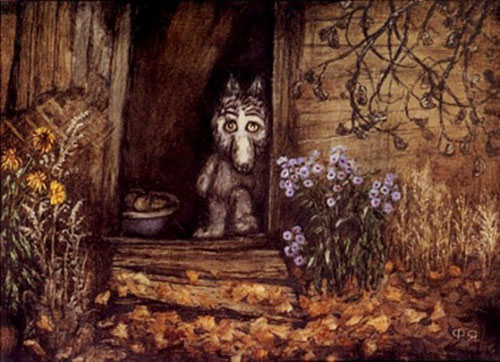 In ‘Tale of Tales’ we’re watching a wolf cub trying to survive his loneliness in an old house, relying on his memories.
These images are altered with images of a river scene with a.o. a fisherman, his wife and his children, and a giant Picasso-like minotaur skipping rope. Two other recurring images are that of dancing wives losing their men to war, and that of a little boy eating apples in the snow.
‘Tale of Tale’s is regarded as Yuri Norstein’s masterpiece and as one of the best animation films of all time. This does not mean it is the most accessible of all films, on the contrary. ‘Tale of Tales’ is a poetic film, but a confusing one. The nostalgic images seem unrelated, and are shown in a non-linear fashion. In fact, it is very difficult to render a ‘tale’ out of the images, which are intrinsically very strong, especially those of the melancholy wolf cub and of the iconic river scene.
Most of the film is made of muddy images in sepia-tones, rendering a dreamy atmosphere. Many images return, bridged by the wolf cub character, who, alone, seems to live in the present, outside of the images of a childhood long past. There’s some vague sense of a happy childhood being shattered by war and being lost in time.
The film uses no dialogue, and even the music is timid in its evocation of mood. Some of the cut-out animation is superb, however, and the overall imagery one of great virtuosity. The end result is as beautiful as it is overlong and frustratingly incomprehensible.
Watch ‘Tale of Tales’ yourself and tell me what you think:
Director: Eduard Nazarov
Release Date: 1979
Rating: ★★
Review:
 This Soviet animation film starts when a boy enters a hunting shop.
When he looks at a photo of a hunter on top of a dead lion, his imagination starts to wander. He imagines himself in a forest, and on a Savannah, full of wildlife. When encountering the lion, he prevents the hunter from shooting. Unfortunately, he’s awoken by the shop owner.
‘Hunt’ is a silent film, told with realistic images, strong 1970s designs, and dated electronic music. The film’s opening is probably its best: we’re watching images of busy and indifferent city life, before zooming in on the boy. The film clearly celebrates life, especially in the Savannah scenes, which form a rich contrast to the dull city life images. Nevertheless, the film feels traditional and naive, and more as a product of its time than as a timeless classic.
Watch ‘Hunt’ yourself and tell me what you think:


 Dr. Grob's Animation Review