
You are currently browsing the category archive for the ‘Pixilation films’ category.
Director: Walerian Borowczyk
Release date: 1959
Rating: ★★★
Review:
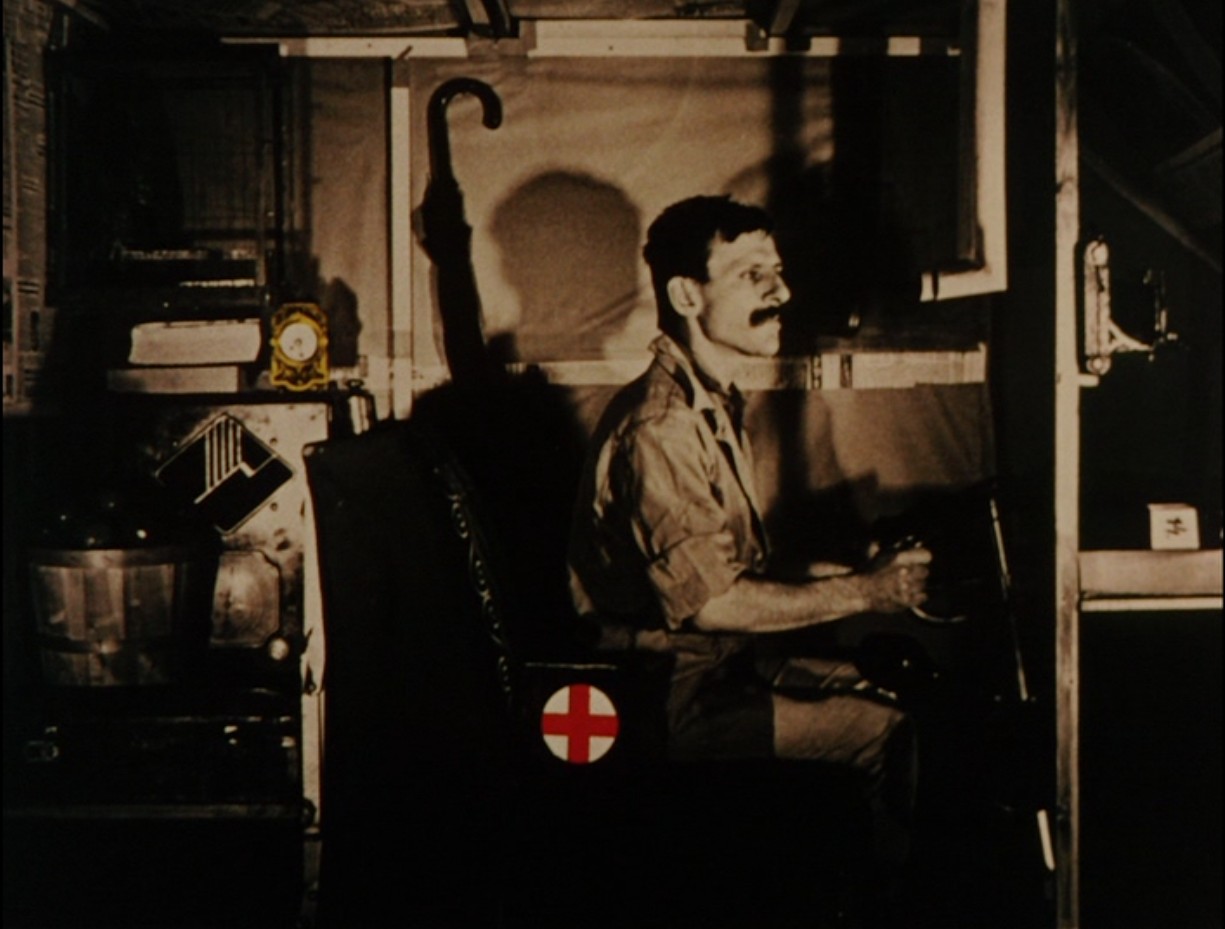
‘Les Astronautes’ was the first film the Polish film maker Walerian Borowczyk made in France. In this short a mustached inventor with a pipe builds his own spaceship.
This film is as surreal as it is silly and it consist of several hardly related gags. For example, the first thing the man does with his spaceship is spying on a woman dressing. Throughout, Borowczyk combines pixilation and cut-out animation of hand-colored photographs to a great effect. The surreal atmosphere is enhanced by Andrzej Markowski’s electronic score and sounds.
‘Les Astronautes’ may be of little substance, it’s an entertaining film, nonetheless.
Watch ‘Les Astronautes’ yourself and tell me what you think:
‘Les Astronautes’ is available on the Blu-Ray/DVD set ‘Walerian Borowczyk: Short Films and Animation’
Directors: André Leduc & Bernard Longpré
Release date: 1974
Rating: ★
Review:

Monsieur Pointu is a clown played by Paul Cormier, who also provides the short’s fiddle soundtrack. The clown tries to play the fiddle, but this turns out harder than it seems.
‘Monsieur Pointu’ consists of general clown routines, exaggerated and augmented by animation. André Leduc’s and Bernard Longpré’s pixilation animation is quite impressive, although the black screen also helps with all the tricks.
Unfortunately, their command of pixilation is much better than their comic timing, and literally none of the antics is funny. In fact, the action is very tiresome, and with its twelve minutes the short overstays its welcome extensively, especially if you don’t like clowns anyway, like me.
Watch ‘Monsieur Pointu’ yourself and tell me what you think:
‘Monsieur Pointu’ is available on the DVD ‘Best of the Best – Especially for Kids!’
Director: Zbginiew Rybczyński
Release date: 1974
Rating: ★★★
Review:

In ‘Soup’ avant-garde film maker Zbigniew Rybczyński shows his fondness of repetitive use of live action material to create startling new images.
Rybczyński would perfect this technique in 1980 with the Academy Award winning short ‘Tango’, but ‘Soup’ already is intriguing and hard to describe. Rybczyński has tinted his source material in stark, contrasting colors, with reds, greens, yellows and blues really popping out of the screen.
The images show the daily routines of a married couple, until it is suggested that the man dies in a train crash. At that point the film burns down. The daily routines are strangely juxtaposed to each other, and there are some very odd touches, like a fork taking a bite out of cheek.
The alienating effect is greatly enhanced by the soundtrack. For sound designer Mieczysław Janik and composer Eugeniusz Rudnik have provided a highly disturbing score full of ordinary sounds amplified to a grotesque effect. For example, when the man brushes his teeth, this rather sounds like a fork scratching on a plate.
I don’t think ‘Soup’ is for everyone, but this intriguing film shows both Rybczyński’s unique approach to film making and the sheer creativity that Communist Poland was in the graphic arts in the 1960s and 1970s.
Watch ‘Soup’ yourself and tell me what you think:
‘Soup’ is available on the DVD-set ‘Anthology of Polish Animated Film’
Director: Zbginiew Rybczyński
Release date: 1976
Rating: ★★★★
Review:

Avant-garde animator Zbginiew Rybczyński, of later ‘Tango’ fame, brings us a fun little children’s film based on a poem by Julian Tuwim on trains.
The poem is set to lively jazz music by Janusz Hajdan, which Rybczyński accompanies with images of anything but trains. The lyrics are illustrated associatively, with animated pictures of a baby, a dog, an elephant. etc.
The most common element is a fat moustached man, done in pixilation. The pixilated photos are rendered in monochromes, mostly on a monochrome green canvas, which give the film a unique and very avant-garde look. Apart from the pixilation there’s a little, rather cartoony cel animation that convinces less.
‘Locomotive’ may be much less compelling than ‘Tango’, this children’s short already show that Rybczyński was a very original and idiosyncratic film maker.
Watch ‘Locomotive’ yourself and tell me what you think:
‘Locomotive’ is available on the DVD-set ‘Anthology of Polish Children’s Animation’
Director: Juan Pablo Zaramella
Release date: June 6, 2011
Rating: ★★★★½
Review:

‘Luminaris’ is a charming and original pixilation film by the JPZtudio from Argentina. The short tells about a man working at a factory that produces light bulbs in a very original way. But the man has plans of his own.
The film evokes a very original, surreal world with gusto. Its sets, costumes and overall design all help to create this parallel world, but special mention must go to the film makers’ superb use of sunlight. They let their personas move with the sun, which looks absolutely convincing on the screen, but must have been a labor of outrageous patience in reality.
The result is a modest but magical little short that connects without any dialogue, greatly helped by the attractive music by Osmar Maderna.
Watch ‘Luminaris’ yourself and tell me what you think:
‘Luminaris’ is available on The Animation Show of Shows DVD Box Set 8
Director: Jan Švankmajer
Release Date: August 1996
Rating: ★★★½
Review:
Although the move from animation to live action clearly was a gradual one (after all, ‘Alice‘ contained quite a bit of live action, while ‘Faust‘ was a live action film augmented with puppetry and animation), ‘Spiklenci slasti’ (Conspirators of Pleasure) can be regarded Jan Švankmajer’s first non-animated film, even if it stills contains a few bits of stop-motion and pixilation.
The change of technique doesn’t mean a change of style, however. The film is 100% Švankmajer throughout, with its complete lack of dialogue, its sound design (which is very reminiscent of that of animated films, indeed, with its emphatic sounds – we even hear the nonexistent sound of blinking of eyes), its idiosyncratic use of music (each individual has his/her own accompanying piece of music), its extreme close-ups, its sets of old buildings in a state of decay, and of course, a high dose of surrealism.
‘Spiklenci slasti (Conspirators of Pleasure)’ is an erotic film without sex. The titles are shown on a background of 18th century pornography, but the movie itself contains very little nudity, which is male only.
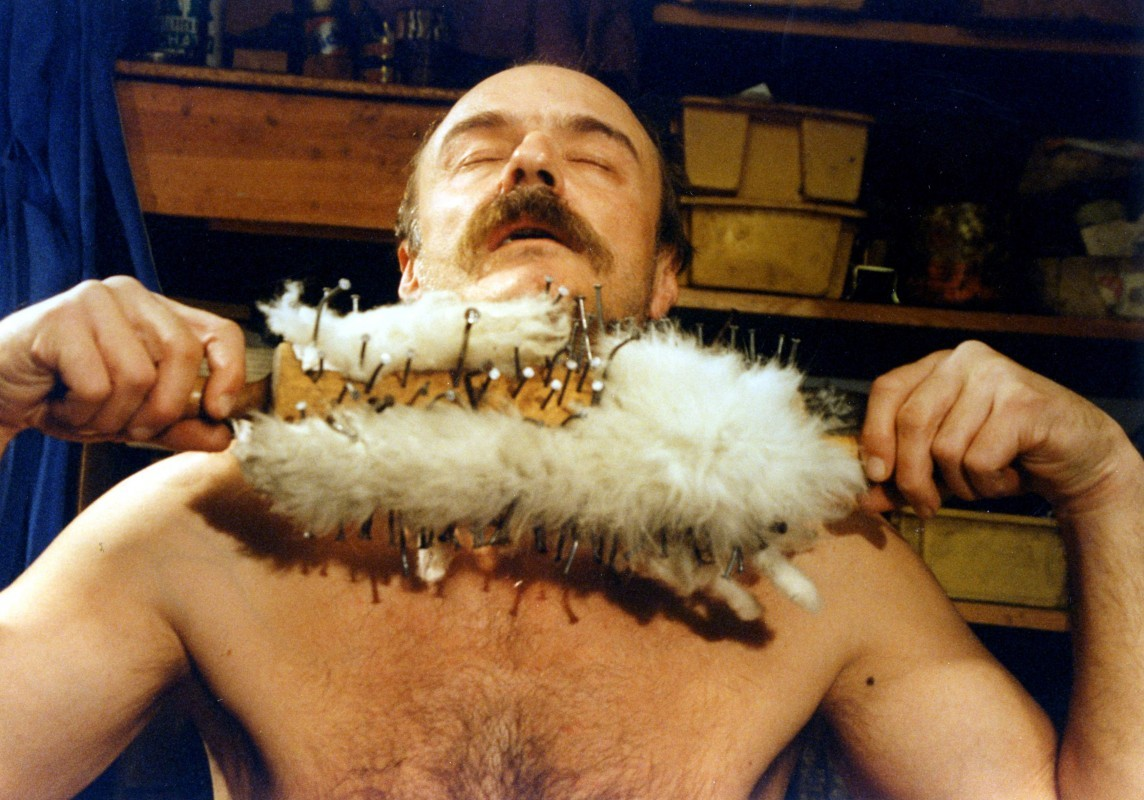
Main protagonist of the film is an unnamed bearded bachelor (played by Petr Meissel and identified as Mr. Pivoňka by Švankmajer). The film starts with him buying a sex magazine, but soon the magazine makes way for far more disturbing and puzzling acts of pleasure, involving a cupboard and a chicken. Mr. Pivoňka’s antics are interlaced with that of a postwoman, a mustached man, his lonely and abandoned wife, who’s a newsreader (Anna Wetlinská, who really was a newsreader), and the shop owner from the first scene, who’s secretly in love with Anna Wetlinská, and who builds an elaborate contraption around the television set she appears on.
The first 45 minutes are one big build-up to the pleasure acts themselves, and this is the most satisfying part of the film, because Švankmajer keeps the viewer puzzled where all the efforts of these people go to. Unfortunately, the acts of pleasure themselves are less compelling, as they’re not necessarily perverse as well as weird, and maybe this section is a bit overlong.
The shopkeeper’s machine is the absolute highlight, but the postwoman’s actions are absolutely grotesque, and that of Mr. Pivoňka and his neighbor, Mrs. Loubalová, sadomachistic, very violent and even morbid. Their acts involve the most animation, as their acts involve animated stuff dolls coming to life. But by now one could argue that the animation is more of a special effect than an element of style, although the pixilation still is used as a mean of surrealist story telling.
As the film comes to a finale, the boundary between reality and fantasy gets crossed. Anna Wetlinská seemingly takes over the shopkeeper’s machine, and comes to a climax herself. In the end the people’s fetishes get mixed, while Mr. Pivoňka’s mysterious ritual appears to have severe real life consequences indeed…
Nevertheless, one would like to know more about the postwoman and her incomprehensible rituals, as she seems to be some kind of facilitator of the desires of others. Also Anna Wetlinská’s bad marriage deserved a little bit more attention.
‘Conspirators of Pleasure’ is a very original and entertaining movie, but the film remains on the shallow side and lacks the layered surrealism of ‘Alice’ or ‘Faust’.
Watch the trailer for ‘Conspirators of Pleasure’ yourself and tell me what you think:
‘Conspirators of Pleasure’ is available on Blu-Ray and DVD
Director: Craig Welch
Release Date: 1996
Rating: ★★★½
Review:
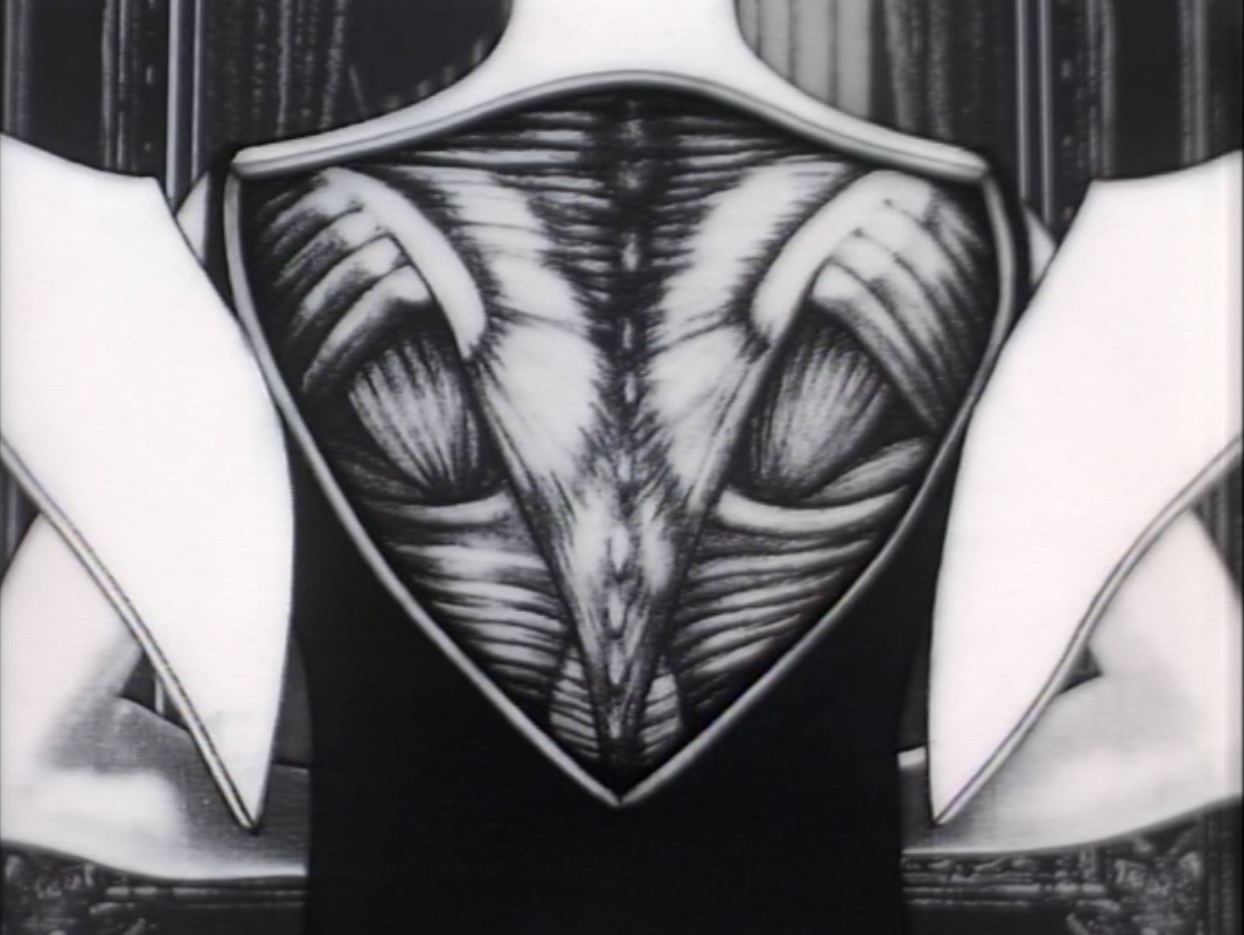
In ‘How Wings Are Attached to the Backs of Angels’ Craig Welch combines traditional animation, cut-out animation and pixilation to tell a puzzling but ominous tale about a man obsessed with contraptions and redesigning humans into angels. In one of his contraptions he attaches wing bones to a skeleton, but then a real woman (the pixilated actress Louise Leroux) appears…
Most disturbing is the scene in which the man caresses the woman’s shoulder blades, imaging their inner workings. The discomfort is enhanced by the use of a real woman. Welch’s cinematic style seems to be influenced by that of Raoul Servais and Terry Gilliam, and shares a high level of surrealism with these celebrated film makers. The animator certainly knows how to show and don’t tell; his film retains a morbid atmosphere throughout, all by suggestion and by clever cutting.
Watch ‘How Wings Are Attached to the Backs of Angels’ yourself and tell me what you think:
‘How Wings Are Attached to the Backs of Angels’ is available on the DVD ‘Desire & Sexuality – Animating the Unconscious Vol.2’
Director: Dave Borthwick
Release Date: December 10, 1993
Rating: ★★★
 1993 was a great year for stop-motion animation: it saw the screening of the groundbreaking feature film ‘The Nightmare Before Christmas‘, as well as the Wallace & Gromit short ‘The Wrong Trousers‘, which also covered new grounds.
Much less well known is the stop-motion feature film ‘The Secret Adventures of Tom Thumb’, also released that year. Made by Dave Borthwick at the British Bolexbrothers studio the film is a much rougher affair than the smooth stop-motion efforts of Disney and Aardman. In fact, it stands firmly in a tradition of gritty and disturbing stop-motion films that via Jan Švankmajer harks all the way back to Władysław Starewicz.
To begin with the film takes place in a dark and disturbing world, where large insects crawl and violence roams. In this gloomy world a poor couple gives birth to a child the size of a small fetus, whom they call Tom Thumb (in one of ca. three lines of dialogue in the entire film).
But Tom soon is kidnapped and taken to a sinister laboratory populated by several chimeral creatures tortured by insane experiments. A two-legged lizard-like creature helps Tom escape. Outside Tom meets a human tribe his own size, who unfortunately kill his chimeral companion. Jack, the leader of the tribe and a master of weapons, takes Tom back to the laboratory, where they eventually apparently destroy the laboratory’s power…
Much of what’s happening in this film is rather incomprehensible, and the plot could do with some cleaning. For example, it remains utterly unclear why Tom is kidnapped, and what the origin of the little people is. Throughout Tom remains a silent and innocent character, not unlike Pinocchio or Dumbo, and he hardly acts.
In the end the film is more interesting because of its disturbing images and for its unique artwork than for its story. The creators made especially well use of pixillation (the animation of people), giving all actors a grotesque appearance and ditto movement.
The best scenes remain the ones inside the laboratory, where Tom sees some pathetic creatures. Especially the one in which one of the creatures asks Tom to shut down the power that sustains them, is a moving piece of animation.
The Secret Adventures of Tom Thumb’ may never get the classic status of a ‘The Nightmare Before Christmas’ or a ‘The Wrong Trousers’, it still is a film that shows the limitless power of animation in the hands of creators with a lot of imagination.
Watch ‘The Secret Adventures of Tom Thumb’ yourself and tell me what you think:
‘The Secret Adventures of Tom Thumb’ is available on DVD
‘
Director: Walerian Borowczyk
Release Date: 1958
Stars: Borisław Stefanik
Rating: ★★★
Review:
 ‘The School’ is a pixillation film starring Borisław Stefanik as a soldier in training.
We watch the private practicing, being tantalized by a fly, trying to hoot, and going to sleep, where he dreams he’s a general commanding marching women’s legs. Apart from the dream scene, the film is shot in sepia tones, giving it a timeless feel. The story never gets too serious, and the absurd atmosphere is enhanced by Andrzej Makowski’s overtly enthusiastic military music, completed with whistles and duck calls.
Watch ‘Szkoła’ yourself and tell me what you think:
‘Szkoła’ is available on the DVD-set ‘Anthology of Polish Animated Film’
Directors: Walerian Borowczyk & Jan Lenica
Release Date: 1958
Rating: ★★½
Review:
 ‘Dom’ is an avant-garde film with strong surrealistic images. The film consists of six unrelated ‘scenes’ connected by the image of a woman looking into the camera.
It’s as if Borowczyk and Lenica explored the possibilities of experimental cinema, trying out several techniques in a row. Thus we watch cut-out images of a strange contraption, a pixillated scene of two men fighting, an octopus-like wig destroying a still life setting, a man repeatedly hanging his hat on a coat rack, a sequence of old family pictures and postcards, and a live action scene in which a woman caresses a plaster male head.The film’s weird atmosphere is greatly enhanced by Włodzimierz Kotoński’s modern music, which uses electronics and percussion only.
It’s hard to make sense of it all, but it’s clear that with this film Borowczyk and Lenica proved to be strong new voices in avant-garde cinema.
Watch ‘Dom’ yourself and tell me what you think:
‘Dom’ is available on the DVD-set ‘Anthology of Polish Animated Film’


 Dr. Grob's Animation Review