You are currently browsing the category archive for the ‘★★★’ category.
Director: Walter Lantz or Bill Nolan
Release Date: May 27, 1931
Stars: Oswald the Rabbit
Rating: ★★★
Review:
 In ‘The Bandmaster’ Oswald is the leader of a three-piece brass band.
This idea is dropped after three minutes, however, and after that there’s some kind of story with Oswald trying to comfort a crying hippo baby with music. This part features dancing flowers, rag dolls, and musical notes. The latter dance to the song ‘Happy Feet’, a huge hit for Paul Whiteman in 1930. The cartoon ends with the mother hippo hitting Oswald hard, and the baby hippo laughing.
Several animators worked on ‘The bandmaster’ who would later become famous in the field, like Clyde Geronimi, Tex Avery and Pinto Colvig. Could it be possible that the baby hippo’s laugh was provided by Tex Avery himself?
The cartoon contains some lovely flexible animation in a style also fashioned at Walt Disney and Warner Bros. The cartoon doesn’t make any sense, however, and the gags pop in almost randomly. Thus the Walter Lantz cartoon falls short in matching the quality of those other studios.
Watch ‘The Bandmaster’ yourself and tell me what you think:
‘The Bandmaster’ is available on the Blu-Ray ‘Technicolor Dreams and Black & White Nightmares’ and the DVD ‘Lantz Studio Treasures Starring Oswald’
Director: Rudolf Ising
Release Date: September 5, 1931
Stars: Foxy
Rating: ★★★
Review:
 ‘Smile, Darn Ya, Smile!’, the second of the Merrie Melodies, is also the second to feature that short-lived early star of Warner Bros., Foxy.
The film is practically a remake of Oswald’s first cartoon, ‘Trolley Troubles’ (1927), on which Harman and Ising had worked themselves: Foxy rides a trolley, inviting his very, very Minnie Mouse-like girlfriend along. Like in the former Oswald film, the ride ends with Foxy losing control of the trolley, which leads to some spectacular perspective animation. Unlike the earlier film, however, ‘Smile, Darn ya, Smile!’ ends rather cornily, when it’s revealed it was all a dream.
The title song is sung several times during the cartoon, e.g. by four hobos. It was revived more than fifty years later in ‘Who Framed Roger Rabbit‘ (1988), when Eddie Valiant enters Toontown.
Watch ‘Smile, Darn Ya, Smile’ yourself and tell me what you think:
‘Smile, Darn Ya, Smile’ is available on the DVD ‘Looney Tunes Golden Collection Volume Six’
Director: Hugh Harman
Release Date: October 17, 1931
Stars: Bosko
Rating: ★★★
Review:
 In ‘Bosko the Doughboy’ Bosko is a soldier during World War one.
The cartoon opens spectacularly with several war scenes, including an enemy soldier firing his automatic gun at the audience. The cartoon is completely plotless, and Bosko actually only does three things:
- trying to cook a meal and kissing the picture of his sweetheart, before both are bombed (echoing the Oswald cartoon ‘Great Guns‘ from 1927 on which Hugh Harman had worked as an animator);
- helping an officer to get rid of his flees;
- saving a hippo, who has swallowed a bomb, by zipping its body open.
The cartoon is remarkably violent, and there’s a lot of killing going on. For example, we watch literally a dog being shot to pieces. Because all the animals involved still have mechanical bodies (a legacy of Harman and Ising’s work on Oswald the Lucky Rabbit), pain is never suggested, and the violence remains cartoony. For example, the dog, after being shot, just walks away much shorter, while a bird with a hole in his body only collapses because he’s supposed to, not because he’s in pain.
Nevertheless, there’s little to enjoy in Bosko’s World War I cartoon, and even when fought out by practically invulnerable animals, it remains a disturbing event.
Watch ‘Bosko the Doughboy’ yourself and tell me what you think:
‘Bosko the Doughboy’ is available on the DVD ‘Looney Tunes Golden Collection Volume Six’
Director: Dave Fleischer
Release Date: November 7, 1931
Stars: Betty Boop, Rudy Vallee
Rating: ★★★
Review:
 ‘Kitty from Kansas City’ is a Screen Song in which Rudy Valley sings his famous hit from 1930 about his dumb girlfriend Kitty.
This short starts with Kitty (whom we can recognize as Betty Boop) waiting for the train, until she’s picked up by a mail hook. Enter Rudy Vallee in bowler hat and with old-fashioned mustache, singing the title tune, accompanied by the bouncing ball. The cartoon ends with a particular fat Kitty involved in random events.
‘Kitty from Kansas City’ is important for two reasons: it’s the first cartoon in which Betty Boop is completely human, and second, it introduces a new story element, which was to be used frequently in the years to come: that of an old man fancying her. This time it’s an old station master.
Watch ‘Kitty from Kansas City’ yourself and tell me what you think:
‘Kitty from Kansas City’ is available on the French DVD Box Set ‘Betty Boop Coffret Collector’
Director: Ub Iwerks
Release Date: August 29, 1931
Stars: Flip the Frog
Rating: ★★★
Review:
 ‘Movie Mad’ starts with Flip the Frog reading a book titled ‘How to be a Movie Actor’ and imitating Charlie Chaplin.
With his newfound talent he tries to enter a film studio, but he’s thrown out again and again by the guard. Flip even reuses an Oswald trick from ‘Bright Lights‘ (1928), trying to sneak in under a man’s shadow. When he finally’s inside, the cartoon actually fails to deliver its premise. Flip gets caught in a Western, in some 1001 Arabian Nights setting, and in a Russian drama, but that’s pretty much it. The Russian drama scene is undoubtedly inspired by the 1915 Charlie Chaplin comedy ‘His New Job’.
Although the cartoon fails to make full use of its Hollywood setting, it contains a great corridor scene. This scene expands on the one in the Mickey Mouse cartoon ‘The Gorilla Mystery‘ (1930), adding more zaniness to it. It is a direct ancestor to the marvelous corridor scene in Tex Avery’s ‘Lonesome Lenny’ (1946). Besides this there are some great caricatures of Laurel and Hardy, depicted as dogs. These may very well be the first animated caricatures of Laurel and Hardy ever put on screen. They would return in the very last Flip the Frog cartoon, ‘Soda Squirt‘ (1933), along with several other Hollywood caricatures.
‘Movie Mad’ may turn out to be rather disappointing, it does feature great music by Carl Stalling, and it lays out the story plan for both the Donald Duck cartoon ‘The Autograph Hound‘ (1939) and the Looney Tune ‘You Ought To Be in Pictures‘ (1940).
Watch ‘Movie Mad’ yourself and tell me what you think:
This is Flip the Frog cartoon No. 12
To the previous Flip the Frog cartoon: The New Car
To the next Flip the Frog cartoon: The Village Specialist
‘Movie Mad’ is available on the DVD ‘Cartoons That Time Forgot – The Ub Iwerks Collection Vol. 2’
Director: Ub Iwerks
Release Date: May 2, 1931
Stars: Flip the Frog, Honey
Rating: ★★★
Review:
 ‘Ragtime Romeo’ initially seems to revisit a theme that Ub Iwerks had explored before with Walt Disney in the Oswald the Lucky Rabbit film ‘Rival Romeos‘ and the Mickey Mouse short ‘The Barn Dance‘ (both 1928), when we watch both Flip and a Pete-like character ride their anthropomorphized cars to Honey’s house.
But when Flip starts to serenade Honey, events take a different turn. Flip serenades her on a guitar, while yodeling and whistling, and on a piano, waking up all the neighbors. Surprisingly, they all respond enthusiastically, urging Flip to play more, except for one, who desperately tries to block out the noise. In the end she calls the police, which arrests the still performing Flip and Honey.
This short contains a piquant scene, in which Flip’s portrait watches Honey undressing. Later, the real Flip watches her naked silhouette through the window curtains. Iwerks’s studio would add more of these risque moments in future shorts, like ‘What a Life‘, ‘The Office Boy‘ and most notably ‘Room Runners‘ (all from 1932).
Watch ‘Ragtime Romeo’ yourself and tell me what you think:
This is Flip the Frog cartoon No. 10
To the previous Flip the Frog cartoon: Laughing Gas
To the next Flip the Frog cartoon: The New Car
‘Ragtime Romeo’ is available on the DVD ‘Cartoons That Time Forgot – The Ub Iwerks Collection Vol. 2’
Director: Hugh Harman
Release Date: September 19, 1931
Stars: Bosko
Rating: ★★★
Review:
 ‘Bosko Shipwrecked!’ opens with a great cartoon gag, in which the title card is washed away to show us a stormy scene, with Bosko at the rudder.
In the next scene Bosko is washed ashore a tropical island. When fleeing from a lion, Bosko enters a cannibal settlement. Luckily our hero can escape certain death by climbing on a rhino in a lake.
‘Bosko Shipwrecked!’ is hampered by long scenes, which are surprisingly low on gags. The animation, on the other hand, is fluent, and at times no less than outstanding, with the lion chase scene as a particular highlight. The film’s best gag is when out of the cooking pot a skeleton appears to shake hands with Bosko: “Come on in, the water is fine!“.
Watch ‘Bosko Shipwrecked!’ yourself and tell me what you think:
‘Bosko Shipwrecked!’ is available on the DVD ‘Uncensored Animation 2: Cannibals!’
Directors: Harry Bailey & John Foster
Release Date: July 6, 1930
Stars: Waffles and Don
Rating: ★★★
Review:
 ‘Jungle Jazz’ features that unsung duo, Waffles and Don, introduced three months earlier in ‘The Haunted Ship‘. This time we watch the tall cat and the small dog walking through a jungle.
In this cartoon the duo’s ‘personalities’ are well-established: Waffles is continually scared, while Don remains unimpressed. The film’s highlight is an early scene in which Waffles and Don encounter all kinds of bizarre, psychedelic animals. Waffles and Don hide from these in a cabin, where they find an organ, which Waffles starts to play immediately. This prompts the cartoon’s obligate dance routine, with all kinds of (normal African) animals dancing.
Then, suddenly, they’re surrounded by cannibals! Don even helps them lighting the fire under their cooking pot. But he also somehow manages to scare them away, and the last scene is for four animals forming a barbershop quartet.
‘Jungle Jazz’ is a loosely jointed and erratic short, and it’s a pity the animators didn’t elaborate on the psychedelic animals in the beginning of the cartoon.
Watch ‘Jungle Jazz’ yourself and tell me what you think:
‘Jungle Jazz’ is available on the DVDs ‘Uncensored Animation 2: Cannibals!’ and ‘The Complete Animated Adventures of Van Beuren Studio’s Tom and Jerry’
Directors: Harry Bailey & John Foster
Release Date: July 5, 1931
Rating: ★★★
Review:
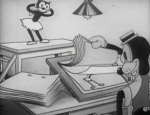 ‘Making ‘Em Move’ is a surprisingly original cartoon, being about animation itself. It’s astonishing that this early cartoon about its own industry comes from the Van Beuren studio, the least developed American animation studio in business those days.
The film is a strange mix of accuracy and nonsense. We watch a fat lady visiting an animated cartoon studio, where several animals are animating ridiculously fast and as if in an assembly line. Among the less accurate scenes are an animator animating a dancing cat who’s dancing right in front of him, and a humanized camera filming the flip-books animators are running in front of it. Meanwhile a jazz band is playing, whose sound is recorded directly on film.
In the second half of the film we watch a public cartoon screening: “Fable Animals present Little Nell’, a crude animation of a classic melodrama with stick figures, predating Tex Avery’s similar ‘Porky’s Preview’ by eleven years(!).
‘Making ’em Move’ is a remarkable cartoon, being about the cartoon industry itself, which remained a rare feat. Unfortunately, the film is neither very educational nor funny. It’s in fact rather directionless, making it to fall short as a classic.
Watch ‘Making ‘Em Move’ yourself and tell me what you think:
‘Making ‘Em Move’ is available on the DVD ‘Aesop’s Fables – Cartoon Classics from the Van Beuren Studio’
Director: Dave Fleischer
Release Date: March 21, 1931
Rating: ★★★
Review:
 ‘In My Merry Oldsmobile’ is a rather odd commercial for Oldsmobile, done in Screen Song fashion. The cartoon will be familiar of readers of Leonard Maltin’s ‘Of Mice and Magic’, for his book features several stills from this film.
The film starts weird to begin with. We watch an evil male character sneak upon a woman undressing(!). Luckily she reveals countless dresses under each other. The creepy guy sneaks into her home and asks the terrified woman for a ride, which she unsurprisingly refuses. Then suddenly a little guy arrives offering her a ride in his Oldsmobile outside. This section uses a lot of dialogue, but no lip synch whatsoever.
The little guy’s invitation for a ride prompts the barbershop title song (a hit song from 1905) and the bouncing ball, so typical of Fleischer’s Screen Songs. The song is accompanied by images of a couple riding an Oldsmobile Curved Dash from 1904, the car celebrated in the song. Then we watch the cartoon characters riding this car, and suddenly there’s a lot of metamorphosis of words into the car etc. The film ends as oddly as it started: when the couple gets married, they’re immediately in a boxing match, indicating that marriage is one long fight.
One wonders how such a story would help Oldsmobile selling more cars. Moreover, none of their latest models is featured in the cartoon, only their first model, which by 1931 was of course extremely outdated.
Watch ‘In My Merry Oldsmobile’ yourself and tell me what you think:
‘In My Merry Oldsmobile’ is available on the DVD ‘Fleischer Classics featuring Gulliver’s Travels’
Director: Dave Fleischer
Release Date: May 23, 1931
Stars: Bimbo, Betty Boop
Rating: ★★★
Review:
 In ‘Silly Scandals’ Bimbo wants to visit a theater, where Betty Boop performs.
Unfortunately he’s broke, but he finally succeeds in sneaking into the theater by walking backwards along the leaving crowd. Inside we watch Betty singing the 1930 hit song ‘You’re driving me crazy’. Like in ‘Mysterious Mose‘ her sexiness is well explored, as her dress falls off during the performance, revealing her bra.
After Betty’s performance, Bimbo ends up being hypnotized by a magician, who makes our unfortunate hero dance against his will. The cartoon ends in a short, but zany and nightmarish dream sequence.
‘Silly Scandals’ is a transitional cartoon that shows the potential of Fleischer’s fledgling cartoon star Betty Boop, but failing to explore it to the max, still focusing on the rather bland Bimbo. We hear her name for the very first time. Yet, Bimbo is still the only billed star of the cartoon. But the Fleischers were quick learners, and with almost every subsequent Talkartoon Betty’s star would rise, and her screen time increase.
Watch ‘Silly Scandals’ yourself and tell me what you think:
This is Talkartoon No. 21
To the previous Talkartoon: Twenty Legs under the Sea
To the next Talkartoon: The Herring Murder Case
‘Silly Scandals’ is available on the French DVD Box Set ‘Betty Boop Coffret Collector’
Director: Ub Iwerks
Release Date: September 27, 1930
Stars: Flip the Frog
Rating: ★★★
Review:
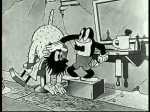 After two films Flip the Frog was redesigned to be a sort of a young man, living in town. Thus in his fourth cartoon Flip is a barber.
This cartoon contains only two scenes: in the first scene we watch Flip polishing his barber pole, which is then stolen and replaced by Flip out of a cat’s tail. In the second scene Flip cuts a hairy dog customer, accompanied by a nail polisher and a shoe polisher. The four of them sing a song together, with which the cartoon ends.
‘The Village Barber’ is typical for the early Ub Iwerks cartoons, in which everything is sparked with life. Even the chair, the razor, and the furnace are autonomous beings, dancing to the musical beat. The Ub Iwerks shorts lack the metamorphosis and spontaneous generation so typical of contemporary Fleischer Talkartoons (e.g. ‘Barnacle Bill‘ and ‘Mysterious Mose‘). Yet, together with the rhythmical Disney-like animation, the abundance of life give the Flip the Frog cartoons a very distinct character. Unfortunately, ‘The Village Barber’ is as low on gags as other Flip the Frog cartoons, and a little boring.
Nevertheless, it’s cartoons like these that ultimately sold the Flip the Frog series to MGM, making it the lion studio’s first venture in cartoon business. Iwerks’s contract with MGM lasted until 1934, when the company exchanged Ub Iwerks for Harman & Ising.
Watch ‘The Village Barber’ yourself and tell me what you think:
This is Flip the Frog cartoon No. 4
To the previous Flip the Frog cartoon: Flying Fists
To the next Flip the Frog cartoon: The Cuckoo Murder Case
‘The Village Barber’ is available on the DVD ‘Cartoons That Time Forgot – The Ub Iwerks Collection Vol. 1’
Directors: Harry Bailey & John Foster
Release Date: September 28, 1930
Stars: Milton Mouse, Rita Mouse
Rating: ★★★
Review:
 ‘Circus Capers’ features Milton Mouse and Rita Mouse, Van Beuren’s Mickey and Minnie-like mice, whose resemblance to Disney’s originals is so striking, it’s pure plagiarism.
The Van Beuren Studio comes nowhere near Walt Disney’s high quality standards, however, and ‘Circus Capers’ can be used as a good counter-example to show how good contemporary Mickey Mouse cartoons (e.g. ‘The Shindig‘, ‘The Chain Gang‘ and ‘The Gorilla Mystery‘) actually were.
In ‘Circus Capers’ Milton (pseudo-Mickey) is a clown, while Rita (pseudo-Minnie) is an acrobat riding a horse. An evil circus master shoots Milton away as a human cannonball, meanwhile courting an all too willing Rita. When Milton discovers this, he’s heartbroken, and sings “Laugh Clown Laugh” from the 1928 musical of the same name. However, when the circus master becomes too insistent, Rita flees from him, back to Milton, who gives her the raspberry, making her pass out.
‘Circus Capers’ is hampered by primitive, crude animation, unsteady designs, and odd staging. Its curious story is enjoyable, however, for the real Mickey and Minnie would never behave like Milton and Rita, who seem to be their cruder cousins.
Watch ‘Circus Capers’ yourself and tell me what you think:
‘Circus Capers’ is available on the DVD ‘Uncensored Animation from the Van Beuren Studio’
Directors: Mannie Davis & John Foster
Release Date: June 22, 1930
Rating: ★★★
Review:
 ‘A Romeo Robin’ is a rather disjointed Silly Symphony-like cartoon, predating Disney’s Silly Symphony ‘Birds of a Feather’ (1931) by half a year.
Like the latter cartoon, its subject is birds. The short opens with birds whistling, and one yodeling. Then we cut to two birds dancing, while metamorphosing to their deaths in a bizarre scene that should be seen to be believed.
After this mind-blowing scene we’re introduced to an evil one-eyed cat who’s after the birds, and later to a bird who catches a worm to offer to his girlfriend. Together they go for a trip in a plane. When the plane falls down, the evil cat accidentally swallows the plane instead of its inhabitants.
‘A Romeo Robin’ looks like a crude parody of a Silly Symphony. It’s remarkable that at one point some story sets in, even if that remains rather pointless. But then again, around this time even the Silly Symphonies themselves made little sense.
Watch ‘A Romeo Robin’ yourself and tell me what you think:
‘A Romeo Robin’ is available on the DVD ‘Aesop’s Fables – Cartoon Classics from the Van Beuren Studio’
Directors: Mannie Davis & John Foster
Release Date: May 25, 1930
Rating: ★★★
Review:
 This short starts with a scene in which we watch Noah, who is dressed like a sailor, dancing to music a chimp plays on an elephant’s toes.
When Noah’s corns warn him rain is coming, all animals flee into his ark, including a dinosaur. Only the skunks are placed in a separate little boat (a gag more or less repeated in Disney’s ‘Father Noah’s Ark‘ from 1933). On the ship itself it’s suddenly dry and the animals start a very, very Silly Symphony-like dance routine, with dancing storks, monkeys, elephants, hippos, etc. Then they all sing ‘It ain’t gonna rain no mo”. But when the skunks enter the ark, all animals abandon ship. Iris out.
Like ‘The Haunted Ship‘, ‘Noah Knew His Ark’ shows a huge Disney influence. The cartoon is a Silly Symphony but in a name. In this stage Disney’s own cartoons were not really sophisticated themselves, and the Van Beuren Studio at times reaches the same level of animation. However, they bring little of their own, and ‘Noah Knew His Ark’ can hardly be called a classic.
Watch ‘Noah Knew His Ark’ yourself and tell me what you think:
‘Noah Knew His Ark’ is available on the DVD ‘Aesop’s Fables – Cartoon Classics from the Van Beuren Studio’
Director: Walt Disney
Release Date: October 1, 1929
Stars: Mickey Mouse, Minnie Mouse
Rating: ★★★
Review:
 In ‘Mickey’s Choo-Choo’ Mickey drives an outrageously flexible anthropomorphized locomotive, which is an early ancestor of Casey Junior from ‘Dumbo‘ (1941).
He sings ‘I’m working on the railroad‘ and even plays the spaghetti he’s eating, treating it like a harp. Minnie comes along, playing the violin. At this point the cartoon harks back to Mickey’s success cartoon ‘Steamboat Willie‘ (1928), with Mickey playing music on some ducks and a dog.
After this sequence, Minnie rides Mickey’s train to the tune of Yankee Doodle, but on a very steep hill the wagon gets loose and falls backwards with Minnie on it. This sequence contains some wonderful rollercoaster-like perspective gags, reminiscent of the early Oswald the Lucky Rabbit cartoon ‘Trolley Troubles’ (1927).
‘Mickey’s Choo-Choo’ is remarkably fast and full of action. Moreover, it’s the first Disney cartoon to feature real dialogue. However, there’s hardly any plot and Mickey’s and Minnie’s designs are extraordinarily inconsistent, ranging from very sophisticated (with an extra facial line) to downright poor. The result is unfortunately only an average entry in the Mickey Mouse canon.
Watch ‘Mickey’s Choo-Choo’ yourself and tell me what you think:
This is Mickey Mouse cartoon No. 11
To the previous Mickey Mouse cartoon: Mickey’s Follies
To the next Mickey Mouse cartoon: The Jazz Fool
Director: Ub Iwerks
Release Date: November 11, 1929
Rating: ★★★
Review:
 With its fourth Silly Symphony, ‘Hells Bells’, the Disney studio returned to the macabre that inspired the series’ very first entry.
Set in hell itself, it starts with a fire, bats and a spider swooping into the camera, and images of the three-headed dog Cerberus and some dragons. The main part however is devoted to a large devil, surrounded by numerous smaller ones playing music and dancing to it.
This section involves endless animation cycles. Luckily, there’s one great shot with a devil casting a huge shadow (looking forward to a similar, if much more elaborate scene in ‘The Goddess of Spring’ (1934). There’s also a great gag involving a crooked devil, and a weird one in which we watch devils milking a dragon-cow(?!). Despite its evil scenery, the whole atmosphere is remarkably merry.
‘Hells Bells’ is most noteworthy for its last part, in which the dance routine makes place for a tiny story, in which the large devil demands a smaller one to offer itself as dog food to Cerberus. The little devil refuses and flees, and finally manages to kick the large one into the fires of hell. Over the coming years, stories like these would overtake the song and dance routines of the Silly Symphonies, finally replacing them altogether.
Watch ‘Hell’s Bells’ yourself and tell me what you think:
This is Silly Symphony No. 4
To the previous Silly Symphony: Springtime
To the next Silly Symphony: The Merry Dwarfs
Directors: Max Fleischer & F. Lyle Goldman
Production Date: June 21, 1929
Rating: ★★★
Review:
 Well, here’s a real treat: an educational/promotional film directed by Max Fleischer & F. Lyle Goldman to explain sound film, right from the era in which this new feat. was introduced.
The film starts with a sound film role changing into a cartoon figure. The sound film takes a silent film to a professor, who explains how sound film works. The film is most interesting, for it clearly shows the tremendous amount of changes that had to be made to make sound film work.
For example, in live action films the camera was now placed inside a box to prevent the primitive sound recording microphone from catching up the sound of the camera itself. And theaters, too, had to invest in the change. The screen had to be porous to let the sound through produced by giant loudspeakers behind the screen.
The designs and animation of this little film is still firmly rooted in the 1920s, and the animation is remarkably stiff, especially when compared to contemporary Disney cartoons. And although the characters talk a lot, lip synchronization is only suggested, but not really there. In fact, Fleischer would mostly neglect lip synchronization way until the end of the 1930s, only using it minimally. The voice over, too, is a little bit dull and hesitating in explaining the processes, but in the end this film is too unique a document of its time not to enjoy.
Watch ‘Finding his Voice’ yourself and tell me what you think:
‘Finding his Voice’ is available on the DVD ‘Cultoons! Rare, Lost and Strange Cartoons! Volume 2: Animated Education’ and on the DVD box set ‘Popeye the Sailor 1941-1943’
Directors: Hugh Harman & Rudolf Ising
Production Date: May 1929
Stars: Bosko, Rudolf Ising
Rating: ★★★
Review:
 In 1928 Charles Mintz had hired away virtually Walt Disney’s complete staff and main cartoon character, Oswald the Lucky Rabbit. These animators now came to work for a studio, set up by George and Margaret Winkler to produce more Oswald cartoons. However, ca. one year later Universal, who owned Oswald, broke with the Winklers, gave Oswald to Walter Lantz, and left the former Disney animators out of work.
Hugh Harman and Rudolph Ising now tried to set up a studio of their own, and following the overnight success of ‘Steamboat Willie‘, they knew they had to come up with a character fit for sound. This new star was Bosko, a little negro, who, in his first appearance, had a remarkably low voice, provided by animator Max Maxwell. Bosko is introduced in ‘Bosko the Talk-ink Kid’, Harman and Ising’s pilot film, made to sell their new studio.
The film starts with Rudolf Ising drawing Bosko and talking with him. Then Bosko performs a little dance, imitates a stereotypical Jew, and plays the piano. He then starts to sing ‘Sonny Boy’, but unfortunately with an awful voice, which prompts Ising to put the cartoon character back into the pen and the ink pot. But Bosko returns from the inkwell to say the very first version of that famous Warner Bros. line: “So long folks!“.
Bosko is not really an endearing character and the film is a little bit slow, yet it’s easy to see why this pilot film sold: the interplay between the animator and the cartoon character, although by 1929 far from new, still looks fresh, and the dialogue adds a new dimension to the trick. This dialogue is way more sophisticated than anything made at Disney at the time. Bosko jabbers along, with a lot of lip-synchronization, which is not always perfect, but mesmerizing, nonetheless. Mickey would go lip-synch only two months later, in ‘The Karnival Kid‘, but even then his facial expressions were to be less natural than Bosko’s in this little short. Thus ‘Bosko the Talk-ink Kid’ is an absolute milestone in animation history, and a rare film in which Harman and Ising were in fact ahead of their former employer.
The animation on Bosko, on the other hand, looks very, very Disney-like and is almost an exact copy of Ub Iwerks’s animation style. This would become a Harman-Ising trademark: combining sophistication with copycatting. This unfortunately would often prevent their films from being entirely new or original.
Anyhow, ‘Bosko the Talk-ink Kid’ raised the interest of Leon Schlesinger, a newcomer in the animation field, who sold the idea of a new cartoon series to Warner Bros., with the argument that the animated shorts could be used to promote Warner Bros. songs. Thus, the famous Warner Bros. animation studio was born!
Watch ‘Bosko the Talk-ink Kid’ yourself and tell me what you think:
‘Bosko the Talk-ink Kid’ is available on the DVD set ‘Looney Tunes Golden Collection, Vol. 1’ and the Blu-Ray ‘Looney Tunes Platinum Collection: Volume 2’
Director: John Lasseter
Release Date: July 25, 1984
Rating: ★★★
Review:
 ‘The Adventures of André and Wally B.’ is a rather pompous title for this very short film, which only lasts eighty seconds, and features ca. one gag.
Made for ‘The Lucasfilm Computer Graphics Project’, two years before the birth of Pixar, it is clearly made to showcase two computer animation techniques above anything else. Most impressive is the quasi-realistic, almost pointillist forest background. Much more primitive, but ultimately much more important is the animation of the two characters, for which young animator John Lasseter was brought in from the Walt Disney studios. Lasseter animates André and the bee Wally B self-consciously cartoony, as if they had walked in straight from the 1930s. They don’t blend at all with the quasi-realistic backgrounds, and they look appallingly primitive to modern eyes, but they’re the very first computer graphics to show character animation, even at its most rudimentary.
‘The Adventures of André and Wally B.’ will never become a classic, for it’s too uneven and too shallow for that, but it is one of animation’s milestone films.
Watch ‘The Adventures of André and Wally B’ yourself and tell me what you think:


 Dr. Grob's Animation Review