You are currently browsing the category archive for the ‘Merrie Melodies’ category.
Director: Bob Clampett
Release Date: June 28, 1945
Stars: Porky Pig
Rating: ★★★★★
Review:
 ‘Wagon Heels’ is one of the least known of Bob Clampett’s masterpieces.
In this short Porky is as a scout of a ‘wagon train’ (a weird mix of a caravan and a train). He has to face ‘Injun Joe the Superchief’, an enormously powerful Indian. In this he’s helped by a very silly blue Hillbilly character called Sloppy Moe.
‘Wagon Heels’ is a remake of the already very funny ‘Injun Trouble’ (1938), but it’s weirder, zanier, wilder and much better timed than the original. ‘The film is extremely rich in nonsensical gags, the highlight being the demonstrations of Injun Joe’s indestructible power. The result is an utterly hilarious film, and an indisputed highlight in the Bob Clampett canon.
Watch ‘Wagon Heels’ yourself and tell me what you think:
https://www.dailymotion.com/video/x2yhp06
This is Porky Pig cartoon no. 110
To the previous Porky Pig cartoon: Trap Happy Porky
To the next Porky Pig cartoon: Baby Bottleneck
Director: Chuck Jones
Release Date: July 3, 1943
Stars: Bugs Bunny
Rating: ★★★★★
Review:
 Two castaways on a raft are so hungry they are ready to eat each other.
Then they land on a tropical, quasi-Hawaiian island, which strangely enough is inhabited by Bugs Bunny, and the two hungry men immediately try to catch and eat our hero. Of course they don’t manage to do so, and in a hilarious end scene, it’s Bugs, not they, who sails off on an ocean stormer into the distance.
The two castaways were modeled on the cartoon’s story men, Tedd Pierce (the tall one) and Michael Maltese (the short one), and the two men actually voiced their cartoon counterparts themselves.
The cartoon’s real stars however, are its outrageous backgrounds. Designed by Bernyce Polifka and painted by her husband, Gene Fleury, they are arguably the boldest backgrounds in any cartoon from the pre-UPA-era. The island is depicted in brassy, strangely colored, semi-abstract to abstract images, with no sense of three-dimensionality, whatsoever. Nevertheless, the clearly three-dimensional characters read surprisingly well against the outlandish backgrounds.
Polifka had replaced John McGrew, who had worked with Fleury on experimental backgrounds for Chuck Jones cartoons like ‘Conrad the Sailor‘ (1942) and ‘The Aristo-Cat‘ (1943), but who had joined the navy in 1942. The couple shared McGrew’s boldness, and worked with Jones on ‘Hell-Bent for Election’ (1944), one of UPA’s earliest films. But apparently they left Warner Bros. somewhere in 1943-1944. In 1949 they worked for Lou Bunin’s part live action part stop motion feature ‘Alice in Wonderland’, but after this job, they seemingly disappeared from the animation world. So, ‘Wackiki Wabbit’ remains their most famous and greatest legacy. The backgrounds themselves can be admired on the late Michael Sporn’s excellent blogpost on this cartoon.
Watch ‘Wackiki Wabbit’ yourself and tell me what you think:
This is Bugs Bunny cartoon No. 18
To the previous Bugs Bunny cartoon: Jack Rabbit and the Beanstalk
To the next Bugs Bunny cartoon: A Corny Concerto
Director: Chuck Jones
Release Date: December 12, 1942
Stars: Bugs Bunny
Rating: ★★★★
Review:
 Bugs Bunny is bullied by a large magician, leading to his catch phrase “Of course you realize this means war”. In the second part of the film Bugs Bunny wrecks the magician’s show, and finally the magician himself.
Bugs’s catch phrase was borrowed from Groucho Marx, an important inspiration on Bugs Bunny’s character anyhow. The line would become typical for Bugs as directed by Chuck Jones. Unlike Bob Clampett, Jones would treat the rabbit not as intrinsically mischievous, but as reacting to injustice placed on him.
The large magician in ‘Case of the Missing Hare’ is the first of many particularly large adversaries Jones gave to Bugs, all bullying the rabbit into action. Thus, the magician is the direct forerunner of e.g. the warehouse keeper in ‘Hare Conditioned‘ (1945), the crusher in ‘Rabbit Punch‘ (1948) and Giovanni Jones in ‘Long-Haired Hare‘ (1949).
‘Case of the Missing Hare’ shows that by the end of 1942 Chuck Jones’s mastery over material had become fully realized. The cartoon features his typical character designs, extravagant key poses, original camera angles and sense of design. The latter is exemplified by background artists Gene Fleury and John McGrew’s very unnatural backgrounds. In the first part we watch pink trees and yellow skies. In the second part they got even bolder, reducing the backgrounds to abstract forms in two colors, only.
In its typical and original design and cinematography ‘Case of the Missing Hare’ looks forward to Jones’ mature work of the late forties and fifties.
Watch ‘Case of the Missing Hare’ yourself and tell me what you think:
This is Bugs Bunny cartoon No. 14
To the previous Bugs Bunny cartoon: The Hare-Brained Hypnotist
To the next Bugs Bunny cartoon: Tortoise Wins by a Hare
Director: Friz Freleng
Release Date: March 28, 1942
Stars: Bugs Bunny, Elmer Fudd
Rating: ★★★★
Review:
 Elmer Fudd will inherit three million dollars from Uncle Louie, if he doesn’t hurt any animal, especially rabbits. Bugs, of course, takes advantage of the situation.
‘The Wabbit Who Came to Supper’ was Friz Freleng’s second Bugs Bunny cartoon, only, but he understood the brassy character completely. The highlight of the cartoon is the scene in which in the middle of a chase a clock chimes and Bugs bursts into a convincing New Year routine… in July. This scene not only shows the fresh character’s overpowering personality, it also shows Bugs Bunny’s ability to produce necessary attributes out of nowhere, this time confetti and streamers.
Bugs’ design, however, is rather unappealing and uncertain in this cartoon. And Elmer Fudd, too, has the less appealing alternate fatty design, which Robert Clampett had introduced in ‘Wabbit Twouble‘ (1941). Luckily, this design was short-lived and lasted only four cartoons.
Two years later Hanna and Barbera would use the same plot idea in the Tom and Jerry cartoon ‘Million Dollar Cat’ (1944) with even better results.
Watch ‘The Wabbit Who Came to Supper’ yourself and tell me what you think:
This is Bugs Bunny cartoon No. 8
To the previous Bugs Bunny cartoon: Wabbit Twouble
To the next Bugs Bunny cartoon: The Wacky Wabbit
Director: Chuck Jones
Release Date: March 2, 1940
Stars: proto-Bugs Bunny, Elmer Fudd
Rating: ★★
Review:
 In this slow and only moderately funny cartoon Elmer tries to photograph nature, but he’s hindered by a predecessor of Bugs Bunny.
This goofy rabbit is not quite Bugs, even though he behaves very calmly and does a Bugs-style death act. His looks and sounds are those of the crazy rabbit in ‘Hare-um Scare-um‘ (1939) and he still has the Woody Woodpecker-style laugh introduced in ‘Porky’s Hare Hunt‘ (1938). Jones has toned this loony fellow down, but it was to Tex Avery to introduce a really cool rabbit in ‘A Wild Hare‘ from four months later.
No, the importance of ‘Elmer’s Candid Camera’ lies in the fact that it marks Elmer’s debut. Although he’s still wearing an Egghead suit (the character from which he evolved), he lacks Egghead’s goofiness, and he has received his distinctive voice provided by Arthur Q. Bryan. Moreover, he utters his famous line “wabbit twacks” for the first time here.
Unfortunately, ‘Elmer’s Candid Camera’ is more historically interesting than entertaining, and outside its historical importance, the cartoon is quite forgettable.
Watch ‘Elmer’s Candid Camera’ yourself and tell me what you think:
http://ulozto.net/live/xzv5WBh/bugs-bunny-elmers-candid-camera-1940-avi
This is the last of four cartoons featuring a Bugs Bunny forerunner
To the first Bugs Bunny cartoon: A Wild Hare
To the previous proto-Bugs Bunny cartoon: Hare-um Scare-um
Director: Friz Freleng
Release Date: December 2, 1961
Stars: Tweety & Sylvester
Rating: ★★★★½
Review:
 ‘The Last Hungry Cat’ must be one of the best entries in the Tweety and Sylvester series.
The short is a parody of the television show ‘Alfred Hitchcock Presents’, which aired from 1955 to 1965. Luckily, you don’t have to be familiar with this program (I’m not) to enjoy this cartoon.
Introduced by an Alfred Hitchcock-like shadow of a pig, the short tells the story of Sylvester, who for once thinks he has actually eaten Tweety and who is then eaten by guilt.
The cartoon makes use of a conscience-like voice-over and very beautifully colored and a surprisingly large amount of well-staged angular backgrounds (staged by Hawley Pratt, who gets co-directing credits, and painted in beautiful blues and yellows by Tom O’Loughlin). The images succeed in evoking an atmosphere that reflects Sylvester’s inner feelings. Especially the staging of Sylvester’s sleeplessness is very well done: still images of Sylvester lying awake are inter-cut with close-ups of his alarm clock, in rapid succession, zooming in all the time. These scenes are accompanied by Milt Franklyn’s ominous music and insistent ticking of the clock, only.
It’s a surprise such a well-made, beautiful and compelling cartoon could be made as late a 1961. The short is a worthy addition to the very small guilt cartoon canon, which also includes ‘Nursery Scandal‘ from 1933, ‘Pudgy Picks a Fight‘ from and ‘Donalds’ Crime’ from 1945.
Watch ‘The Last Hungry Cat’ yourself and tell me what you think:
Director: Chuck Jones
Release Date: July 25, 1953
Stars: Daffy Duck, Porky Pig, Marvin Martian
Rating: ★★★★★ ♕
Review:
 ‘Duck Dodgers in the 24½th Century’ is a spoof of the popular pulp magazine science fiction series Buck Rogers, which was made into a television series in 1950-1951. This makes this short one of the earliest theatrical cartoons parodying a television series.
Daffy “Duck Dodgers” and his sidekick “the eager young space cadet” Porky have to claim planet X for planet Earth. Unfortunately, Marvin Martian wants to claim the same planet for Mars. This starts a feud, which ends in both blowing up the entire planet.
Although the story of the cartoon is rather similar to the Bugs Bunny cartoon ‘Haredevil Hare‘ (1948), Daffy’s unique performance gives it an entirely different feel, leading to new and great gags. More than being a typical science fiction cartoon, this short can be regarded the second cartoon in a series which pairs Daffy as a misguided hero to Porky as a more sensible straight man (the first being ‘Drip-along Daffy‘ from 1951). ‘Duck Dodgers’ must be the highlight of the series, as well as a peak in both Daffy’s as Chuck Jones’s career.
Unhampered by conventions, Jones, his layout-man Maurice Noble and background painter Phil DeGuard went totally berserk with the science-fiction theme, creating wild and lushly colored backgrounds, which make ‘Duck Dodgers in the 24½th Century’ one of the most beautiful cartoons ever made at Warner Brothers.
Indeed, so great is its fame, it spawned sequels in 1980, 1996 and 2003. From 2003 to 2005 Cartoon Network even broadcasted a Duck Dodgers series.
Watch ‘Duck Dodgers in the 24½th Century’ yourself and tell me what you think:
http://www.220.ro/desene-animate/Looney-Tunes-Duck-Dodgers-In-The-24-5-Century/aTflTNIyAr/
This is Porky Pig cartoon no. 142
To the previous Porky Pig cartoon: Fool Coverage
To the next Porky Pig cartoon: Claws for Alarm
This is Daffy Duck cartoon No. 65
To the previous Daffy Duck cartoon: Muscle Tussle
To the next Daffy Duck cartoon: Duck! Rabbit! Duck!
‘Duck Dodgers in the 24½th Century’ is available on the Blu-Ray ‘Looney Tunes Platinum Collection: Volume 2’ and on the DVD-set ‘Looney Tunes Golden Collection Volume One’
Director: Chuck Jones
Release Date: February 28, 1953
Stars: Daffy Duck, Bugs Bunny (cameo)
Rating: ★★★★★ ♕
Review:
 One of the most self-aware animated cartoons ever made, ‘Duck Amuck’, more than any other cartoon, plays with the conventions of animation and with the frustrations of Daffy Duck.
This cartoon shows how good the character is, because even when drawn awkwardly, even without sound, and even when animated as a small speck in the distance, we know it’s Daffy. His struggles with the off-screen animator (who in the end turns out to be Bugs Bunny) form the zenith of his new frustrated personality, which had replaced his zany personality of the thirties and forties three years earlier. Furthermore he’s the sole character in the entire cartoon, but so strong is his unwilling performance that we become hardly aware of this fact.
The poor Daffy has to deal with disappearing and constantly changing backgrounds, with absent and inappropriate sounds, with deformations of his own body etc. In this cartoon he’s the victim of an omnipotent ‘cartoon god’ whom he cannot escape. In this sense ‘Duck Amuck’ questions the relationship between creator and creation and the responsibility of the creator to the things he created. This makes ‘Duck Amuck’ also one of the most philosophical cartoons ever made. And amazingly, it’s funny, too.
Watch ‘Duck Amuck’ yourself and tell me what you think:
http://www.dailymotion.com/video/x2ofats
This is Daffy Duck cartoon No. 63
To the previous Daffy Duck cartoon: Fool Coverage
To the next Daffy Duck cartoon: Muscle Tussle
‘Drip-along Daffy’ is available on the Blu-Ray ‘Looney Tunes Platinum Collection: Volume 2’ and on the DVD-set ‘Looney Tunes Golden Collection Volume One’
Director: Chuck Jones
Release Date: February 2, 1952
Stars: Marc Anthony
Rating: ★★★★★ ♕
Review:
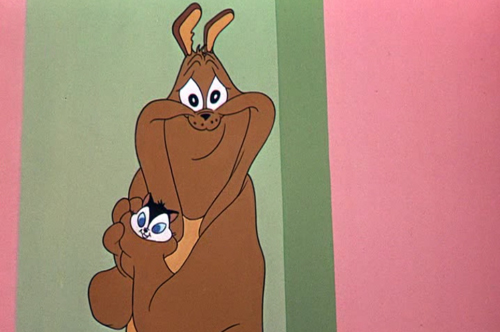 Among all the masterpieces of animation, this must be the most inconspicuous one: it’s a seemingly classical dog and cat story, involving quite some dull dialogue (provided by the dog’s mistress, of whom we only see her legs), and its looks are quite traditional, with unremarkable layouts and backgrounds.
Nevertheless, ‘Feed The Kitty’ is a real masterpiece, and its reputation is entirely due to the acting of its main character, the gentle bulldog Marc Anthony. His facial expressions are so wide ranging, so extreme and so heartfelt that ‘Feed the Kitty’ can almost be regarded as a study in depiction of emotion. Silent acting really reaches its peak here, and director Chuck Jones is without doubt at his all time best in this sweet little cartoon.
In ‘Feed the Kitty’ Marc Anthony adopts a sweet little kitten, but he’s not allowed to bring anything into the house. This leads to various gags with the dog trying to hide the little kitten from his mistress. However, the highlight of the cartoon is the sequence in which Marc Anthony thinks his darling pet is dead. His emotions are both hilarious and heartbreaking. Never before has the anxiety of having lost a dearly beloved been so convincingly put to the animated screen. At this point I often can’t keep my tears from running.
Indeed, this sequence is so popular among animators that it was almost exactly copied in ‘Monsters, Inc.‘ (2001) as a homage to the original. I’d say, if cartoons were shown at funerals (and why not?), ‘Feed the Kitty’ would be a perfect candidate.
Watch ‘Feed the Kitty’ yourself and tell me what you think:
http://www.dailymotion.com/video/xjw9ms_feed-the-kitty_shortfilms
‘Feed the Kitty’ is available on the DVD set ‘Looney Tunes Golden Collection, Vol. 1’
Director: Chuck Jones
Release Date: March 10, 1951
Stars: Bugs Bunny, The Crusher
Rating: ★★
Review:
 Three years after ‘Rabbit Punch‘ (1948) Bugs Bunny faces the Crusher again.
This time Bugs is the mascot of ‘Ravishing Ronald’, a gay looking ballet dancer type of character with a hair net. This guy challenges the Crusher in a wrestling match, but is clobbered immediately.
In order not to lose his job Bugs Bunny challenges the Crusher, too, as the ‘masked terror’. Of course, he wins the game, by strategy in a rather boring and uninspired cartoon, especially when compared to the delightful ‘Rabbit Punch’. The best gags are in the beginning: the Crusher showing his enormous excess of muscles and the extravagant entry of Ravishing Ronald.
Watch ‘Bunny Hugged’ yourself and tell me what you think:
http://www.ebaumsworld.com/video/watch/82493307/
This is Bugs Bunny cartoon No. 80
To the previous Bugs Bunny cartoon: Rabbit Every Monday
To the next Bugs Bunny cartoon: Fair-Haired Hare
Director: Friz Freleng
Release Date: September 22, 1951
Stars: Tweety & Sylvester, Granny
Rating: ★★★
Review:
 Sylvester is down in the dumps and hungry, foraging a harbor, when he discovers Tweety on a ship.
He climbs aboard, and what follows are several gags involving glasses and sea sickness. The best gag is when Sylvester paints Tweety on Granny’s glasses. Most of the other gags, however, are mediocre, and feel routinized. For example, Tweety reuses a sea sickness gag from Tex Avery’s ‘The Screwball Squirrel’ (1944), but much less well executed.
Watch ‘Tweety’s S.O.S.’ yourself and tell me what you think:
http://www.dailymotion.com/video/x1z27d9_sylvester-the-cat-ep-25-tweety-s-s-o-s_fun
‘Tweety’s S.O.S.’ is available on the DVD set ‘Looney Tunes Golden Collection, Vol. 1’
Director: Robert McKimson
Release Date:May 5, 1951
Rating: ★★★½
Review:
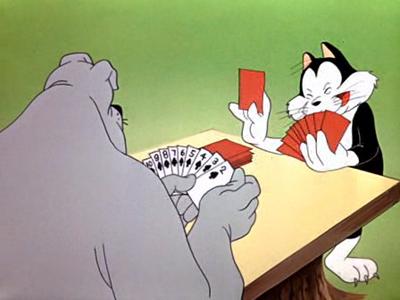 ‘Early to Bet’ introduces the ‘gambling bug’, a bug that makes people want to gamble.
The little insect infects a cat who then starts to play gin rummy for penalties with an over-confident bulldog. The bulldog wins several times, and the cat has to pay the elaborate and rather zany, yet painful penalties. In the end, however, he plays against the bug, and wins, making the bug pay a penalty.
Apart from the original and pretty funny penalties, this is a mediocre cartoon, which lacks stars or even appealing characters.
Watch ‘Early to Bet’ yourself and tell me what you think:
http://www.supercartoons.net/cartoon/681/early-to-bet.html
‘Early to Bet’ is available on the DVD set ‘Looney Tunes Golden Collection, Vol. 1’
Director: Robert McKimson
Release Date: December 12, 1951
Stars: Bugs Bunny
Rating: ★★★
Review:
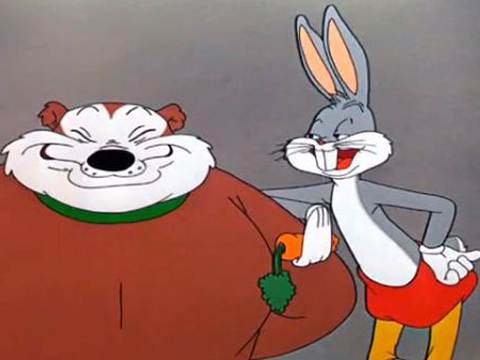 Five years after his first Bugs Bunny cartoon, ‘Acrobatty Bunny‘ (1946), McKimson returns to the circus setting.
This time Bugs is the new acrobat partner of an egotistical star acrobat bear called Bruno. This “Slobokian bear” is not a good sport and tries to get rid of Bugs, but of course, the reverse happens.
‘Big Top Bunny’ is better than ‘Acrobatty Bunny’, but it still suffers: it’s worn down by the high amount of rather unfunny dialogue and its slow pace. Nevertheless, the cartoon builds up nicely, and its best gags come in last: first there’s a great cycling gag, then there’s a superb gag in which Bugs and Bruno compete in the most daring high diving act. This is quickly followed by the frantic finale in which Bugs disposes of the bear once and for all.
Watch ‘Big Top Bunny’ yourself and tell me what you think:
https://www.dailymotion.com/video/x2fg9zb
‘Big Top Bunny’ is available on the DVD set ‘Looney Tunes Golden Collection, Vol. 1’
This is Bugs Bunny cartoon No. 86
To the previous Bugs Bunny cartoon: Ballot Box Bunny
To the next Bugs Bunny cartoon: Operation: Rabbit
Director: Friz Freleng
Release Date: October 6, 1951
Stars: Bugs Bunny, Yosemite Sam
Rating: ★★★★½
Review:
 Sam is running for mayor. One of his election promises is “to rip the country of every last rabbit”. This prompts Bugs to fight Sam with his own weapons, running for mayor, too.
Their election campaigns are far from fair and lead to a string of blackout gags. At one point we watch Bugs imitating Theodore Roosevelt, and there’s a great ant gag, which is accompanied by ridiculously sounding sped-up classical music. But the short’s highlight may be the piano gag, in which Bugs has to play a tune to ignite a bomb. However, Bugs repeatedly plays the wrong note, so Sam plays it for him… In the end of the cartoon the two rivals discover that the citizens have elected a “mare”. This prompts them into playing Russian roulette…
‘Ballot Box Bunny’ is an inspired and funny cartoon, even if it does not belong to either Bugs’s or Freleng’s greatest.
Watch ‘Ballot Box Bunny’ yourself and tell me what you think:
http://www.220.ro/desene-animate/13-Ballot-Box-Bunny/tJrHLV31Kl/
‘Ballot Box Bunny’ is available on the DVD set ‘Looney Tunes Golden Collection, Vol. 1’
This is Bugs Bunny cartoon No. 85
To the previous Bugs Bunny cartoon: His Hare Raising Tale
To the next Bugs Bunny cartoon: Big Top Bunny
Director: Friz Freleng
Release Date: June 2, 1951
Stars: Tweety & Sylvester, Granny
Rating: ★★★
Review:
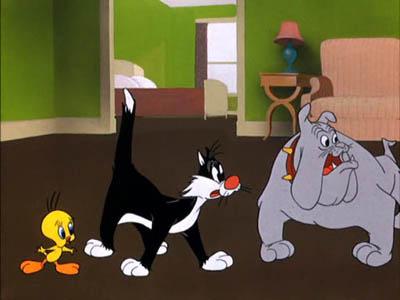 Granny sneaks Tweety into a hotel where no pets are allowed.
Another old lady sneaks Sylvester in, who inhabits the room next to Tweety. Like in ‘All a bir-r-r-d‘ Sylvester encounters a vicious bulldog, too. The cartoon contains a classic corridor-with-doors-gag, but the cartoon’s greatest joy is its great twist on the chase routine, provided by a pet inspector who at times interrupts the chase of the three animals.
‘Room and bird’ is the first of four 1951 Warner Brothers cartoons featuring music by Eugene Poddany instead of Carl Stalling.
Watch ‘Room and Bird’ yourself and tell me what you think:
http://www.dailymotion.com/video/x1z26hv_sylvester-the-cat-ep-24-room-and-bird_fun
Director: Friz Freleng
Release Date: July 23, 1949
Stars: Tweety & Sylvester
Rating: ★★★
Review:
 ‘Bad Ol’ Putty Tat’ is only the third of the Tweety and Sylvester shorts, but it already feels routine.
The short opens with Tweety’s birdhouse all wrapped in barbed wire and a wrecked Sylvester sitting below, thinking how to reach the bird. Friz Freleng and his team waste no time and immediately start with Sylvester’s attempts in blackout gags involving a fake female bird and a badminton game.
In this short Sylvester does manage to swallow Tweety, but the little bird takes control of his head, steering the cat like a train into a stone wall.
Watch ‘Bad ol’ Putty Tat’ yourself and tell me what you think:
http://www.dailymotion.com/video/x1z1w1q_sylvester-the-cat-ep-14-bad-ol-putty-tat_fun
Director: Robert McKimson
Release Date: January 21, 1950
Stars: Bugs Bunny
Rating: ★★½
Review:
 In this cartoon Bugs Bunny apparently lives in Central Park, New York.
He buys a hurdy-gurdy with a monkey in order to become rich. But when the monkey betrays Bugs, Bugs fires him and goes fetching the money at the apartment block himself. The monkey then fetches his big brother (a gorilla) to fix Bugs. But in the end it’s the gorilla who collects money for Bugs.
‘Hurdy-gurdy Hare’ is an inconsistent and rather weak cartoon, which nevertheless contains a great ladder gag, in which Bugs quotes Groucho Marx. At the end, Bugs makes a reference to James Petrillo, leader of the American Federation of Musicians at the time.
Watch ‘Hurdy-gurdy Hare’ yourself and tell me what you think:
http://www.ulozto.net/live/xPiUKTr/bugs-bunny-hurdy-gurdy-hare-1950-avi
This is Bugs Bunny cartoon No. 68
To the previous Bugs Bunny cartoon: Rabbit Hood
To the next Bugs Bunny cartoon: Mutiny on the Bunny
Director: Chuck Jones
Release Date: December 24, 1949
Stars: Bugs Bunny, Errol Flynn
Rating: ★★★★★
Review:
 We’re suddenly in medieval England, where Bugs Bunny tries to “poach” one of the king’s carrots and is arrested by the Sheriff of Nottingham.
This leads to several very funny encounters between Bugs and the Sheriff. The action is at times interrupted by a particularly dopey Little John who repeatedly announces the coming of Robin Hood. When Robin Hood finally does arrive, he appears to be Errol Flynn (live action footage from the 1938 feature ‘The Adventures of Robin Hood’ ).
The best gag however, is when Bugs sells the King’s Royal garden to the sheriff as the perfect site to build a house. The poor sheriff only discovers he’s fooled after he has built half the house. It’s gags like these which make ‘Rabbit Hood’ an unassuming and probably underrated highlight in the Bugs Bunny catalog.
Watch ‘Rabbit Hood’ yourself and tell me what you think:
https://www.dailymotion.com/video/x2fe9y1
This is Bugs Bunny cartoon No. 67
To the previous Bugs Bunny cartoon: Which is Witch?
To the next Bugs Bunny cartoon: Hurdy-gurdy Hare
Director: Friz Freleng
Release Date: October 7, 1950
Stars: Tweety & Sylvester, Granny
Rating: ★★★
Review:
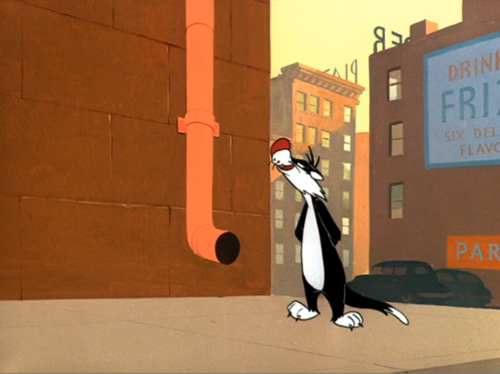 ‘Canary Row’ has absolutely nothing to do with John Steinbeck’s novel ‘Cannery Row’.
Instead, it is the sixth Tweety and Sylvester cartoon, and the first to feature Granny as Tweety’s owner. In this short Sylvester tries to capture Tweety, who lives in on a top floor in a hotel in which no cats are allowed. But Tweety and his owner Granny give Sylvester a hard time.
The takes on Sylvester are superb: he’s well animated and his gags are excellently timed, showing Freleng’s craftsmanship. However, Tweety and Granny are hardly as funny, and their appearances wear the comedy down.
If not necessarily for its comedy,’Canary Row’ is noteworthy for its beautiful urban backgrounds, painted by Paul Julian, who would soon join UPA to elevate his background art to even greater heights.
Watch ‘Canary Row’ yourself and tell me what you think:
http://www.dailymotion.com/video/x1z226r_sylvester-the-cat-ep-19-canary-row_fun
‘Canary Row’ is available on the DVD set ‘Looney Tunes Golden Collection, Vol. 1’
Director: Friz Freleng
Release Date: September 9, 1950
Stars: Bugs Bunny, Yosemite Sam
Rating: ★★★★★
Review:
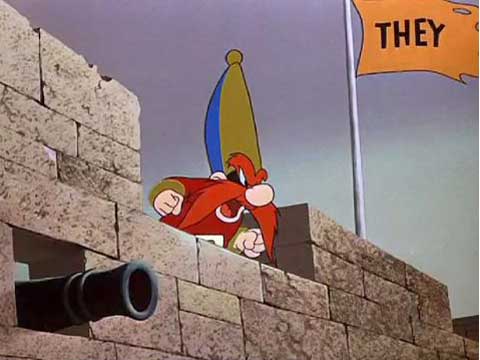 In ‘Bunker Hill Bunny’ Bugs Bunny and Yosemite Sam (as Sam von Schamm, the Hessian) enact the war of independence of 1776 with only the two of them, stuck in two fortresses.
With this simple premise Friz Freleng shows how one can make great comedy out of a very limited setting. The result is a cartoon full of excellent blackout gags, which are simply hilarious because of Friz Freleng’s superb comic timing. Again and again Sam hits the dust. It even contains a gag in which Bugs has no part in Sam’s self-destruction at all!
Watch ‘Bunker Hill Bunny’ yourself and tell me what you think:
http://www.liveleak.com/view?i=38f_1284015420
‘Bunker Hill Bunny’ is available on the DVD set ‘Looney Tunes Golden Collection, Vol. 1’
This is Bugs Bunny cartoon No. 75
To the previous Bugs Bunny cartoon: Hilbilly Hare
To the next Bugs Bunny cartoon: Bushy Hare


 Dr. Grob's Animation Review