You are currently browsing the category archive for the ‘Merrie Melodies’ category.
Director: Robert McKimson
Release Date: August 12, 1950
Stars: Bugs Bunny
Rating: ★★★★★
Review:
 Bugs Bunny is on holiday in the Ozarks, Arkansas, where he meets two dumb and bearded Hillbilly brothers with ridiculously long guns.
When they both chase him, Bugs dresses as a country girl and invites them into a square dance. Soon, Bugs takes the fiddle himself, making the two brothers hurting each other while dancing in a long, catchy and funny square dance sequence.
‘Hillbilly Hare’ is one of McKimson’ all-time best Bugs Bunny cartoons, and certainly his most musical one. Throughout the picture, the animation is delightfully silly and over-the-top.
Watch an excerpt from ‘Hillbilly Hare’ yourself and tell me what you think:
This is Bugs Bunny cartoon No. 74
To the previous Bugs Bunny cartoon: 8 Ball Bunny
To the next Bugs Bunny cartoon: Bunker Hill Bunny
Director: Chuck Jones
Release Date: March 11, 1950
Stars: Bugs Bunny
Rating: ★★★★
Review:
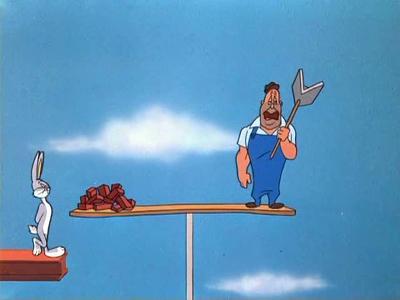 In ‘Homeless Hare’ Bugs’s home happens to be in a construction site.
When the excavator driver ignores Bugs’s pleas for leaving his home alone, Bugs nags him until the bully can’t take no more.
This film contains a gag of a half conscious Bugs walking at great heights without falling, a scene that is clearly borrowed from earlier shorts, like the Popeye cartoon ‘A Dream Walking’ from 1934 and the classic Disney short ‘Clock Cleaners’ from 1937. It also contains an elaborate final gag with a hot rivet, a type of gag Chuck Jones invented. It anticipates similar gags in the Road Runner series and Jones’s Tom and Jerry films from the 1960s. The Highlight of the cartoon, however, is a gag with the bully balancing on a plank with a bunch of bricks, which Bugs slowly withdraws…
Watch ‘Homeless Hare’ yourself and tell me what you think:
This is Bugs Bunny cartoon No. 70
To the previous Bugs Bunny cartoon: Mutiny on the Bunny
To the next Bugs Bunny cartoon: Big House Bunny
Director: Art Davis
Release Date: June 4, 1949
Stars: Bugs Bunny
Rating: ★★½
Review:
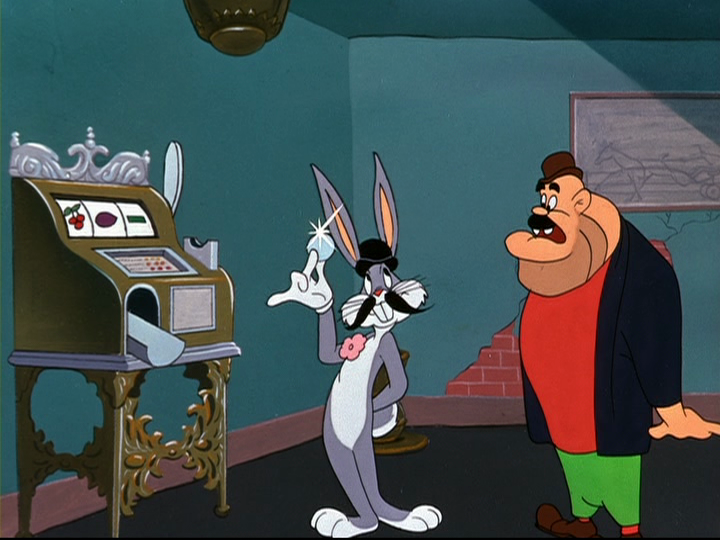 In the opening scene of ‘Bowery Bugs’ Bugs Bunny is a tour guide talking about Brooklyn Bridge and why Steve Brody (a historical character) jumped from it in 1886.
A flashback shows Steve Brody, pictured as a typical bully, being out of luck and looking for a rabbit foot as a lucky charm. He encounters Bugs who then drives Brody mad, making him jump from Brooklyn Bridge in the end.
‘Bowery Bugs’ was the only Bugs Bunny cartoon directed by Art Davis. He does a fair job, although the cartoon suffers from erratic timing. His designs on Bugs Bunny are very reminiscent of those by Robert McKimson.
Watch a clip from ‘Bowery Bugs’ yourself and tell me what you think:
This is Bugs Bunny cartoon No. 60
To the previous Bugs Bunny cartoon: High Diving Hare
To the next Bugs Bunny cartoon: Long-Haired Hare
Director: Robert McKimson
Release Date: April 9, 1949
Stars: Bugs Bunny
Rating: ★★★★★ ♕
Review:
 To his nuisance Bugs Bunny discovers that rabbits (2 cts.) are less worth than foxes ($50) and bears ($75).
He mails himself to Washington, where the game commissioner (“I’m game”) explains to him that rabbits are harmless and therefore worthless for hunters. Bugs decides to be harmful to increase his value. And harmful indeed he gets!
A few of his hilarious actions include painting the obelisk at Washington like a barber’s pole, returning Manhattan to the Indians, cutting off Florida, and filling the grand canyon with sand. He manages to raise the prize on his head to a million dollars, but he ends in Alcatraz prison, too, wondering whether he has carried things too far…
‘Rebel Rabbit’ is full of the zany spirit of the early Warren Foster/Robert McKimson cartoons, and, together with ‘Easter Yeggs‘ (1947) and ‘Hillbilly Hare‘ from a year later, probably the best of all Robert McKimson Bugs Bunny cartoons.
This wonderfully zany cartoon features live army footage.
Watch an excerpt from ‘Rebel Rabbit’ yourself and tell me what you think:
This is Bugs Bunny cartoon No. 58
To the previous Bugs Bunny cartoon: Mississippi Hare
To the next Bugs Bunny cartoon: High Diving Hare
Director: Friz Freleng
Release Date: January 15, 1949
Stars: Bugs Bunny, Elmer Fudd
Rating: ★★★★
Review:
 This Bugs Bunny short starts with Elmer Fudd hunting our hero with a “wabbit detector”.
Like Freleng’s quite similar ‘Stage Door Cartoon‘ (1944), the action soon shifts into a theater, with wonderful comedy with Bugs’s and Elmer’s repeatedly passing past sitting people, continuously using the phrases ‘pardon me’ and ‘excuse me’ as a major highlight. Other great gags are Bugs’s playing with the intermission switch (which immediately causes the public to rush outside to smoke) and the finale, in which Bugs manages to get a blinded Elmer into a lion’s beak.
Despite the wonderful comedy, the film nevertheless fails to reach the heights of ‘Stage Door Cartoon’, falling short, due to some bad designs of Elmer and to a sense of routine.
Watch ‘Hare Do’ yourself and tell me what you think:
This is Bugs Bunny cartoon No. 56
To the previous Bugs Bunny cartoon: My Bunny Lies over the Sea
To the next Bugs Bunny cartoon: Mississippi Hare
Director: Robert McKimson
Release Date: October 9, 1948
Stars: Foghorn Leghorn, Henery Hawk
Rating: ★★★★
Review:
 Henery Hawk’s cowardly dad forbids his little son to chase chickens, but Henery does it anyway.
Unfortunately, he doesn’t know what a chicken looks like, and he repeatedly ends up catching the barnyard dog, while the Foghorn Leghorn makes feeble attempts in convincing the little chicken hawk, that he‘s a chicken.
This premise is a great twist on the stories of the first two Henery Hawk/Foghorn Leghorn cartoons (‘Walky Talky Hawky‘ from 1946 and ‘Crowing Pains‘ from 1947). It’s clear from the title that by now Foghorn Leghorn had become the real star of the Henery Hawk cartoons, and deservedly so, because in his third appearance, this broad gesturing and talkative rooster is stealing the show.
At the same time, this is a transitional cartoon, in which the original looniness of McKimson’s first cartoons gradually makes way for a more dialogue-driven approach, as is perfectly illustrated by Foghorn Leghorn’s endless jabbering.
Watch ‘The Foghorn Leghorn’ yourself and tell me what you think:
https://www.dailymotion.com/video/x6ecxr1
‘The Foghorn Leghorn’ is available on the Blu-Ray-set ‘Looney Tunes Platinum Collection: Volume 2’ and on the DVD-box ‘Looney Tunes Golden Collection Volume 1’
Director: Friz Freleng
Release Date: September 2, 1949
Stars: Porky Pig
Rating: ★★★★½
Review:
 ‘Dough for the Do-Do’ is a remake of Bob Clampett’s ‘Porky in Wackyland‘ (1938) in color.
The cartoon is more than a recoloring, however. Porky is reanimated throughout, and several scenes are different from the original. Scenes that are omitted are the paperboy appearing on the title card, Porky showing us a picture of the dodo, and the cat-dog attacking itself. Two scenes are altered: the way the guide ‘leads’ Porky to the dodo, and the finale: in the original Porky dresses as a paperboy announcing that Porky has captured the dodo, in ‘Dough for the Do-Do’, Porky dresses like a do-do, making the bird itself think he has caught the last of the do-dos.
The most conspicious difference between ‘Dough for the Do-Do’ and ”Porky in Wackyland’, however, is found in the backgrounds: where the original had rather undefined, a little George Herriman-like backgrounds, the remake uses clearly Salvador Dalí-inspired settings, full of typical Dalí-rocks, sticks and eyes. The title card even shows Dalí’s melted watches, linking cartoon surrealism to high art surrealism. Dalí-inspired scenery would return two years later in the Porky Pig cartoon ‘Wearing of the Grin’ from 1951.
It is striking to see how different this cartoon is from its contemporaries. ‘Porky in Wackyland’ was a milestone in surrealism, a move forward in wackiness, an innovative cartoon stirring up the childish make-belief world of the 1930s cartoons. However, eleven years later its remake ‘Dough for the Do-do’ feels old-fashioned: its animation is crude, its characters are unrefined, and its zaniness seems to come from another era.
And it does: in the late 1940s, the wild surrealism of the early Warner Bros. cartoons had toned down. It survived in cartoon conventions, which always contained a twist of surrealism, but the outlandishness had disappeared. Now, more emphasis was played on character humor and dialogue, something the Warner Bros. studio excelled at with its numerous stars. Only at MGM and Walter Lantz some of the original zany vibe was retained, but at large the wild era of studio cartoons was clearly over.
Watch ‘Dough for the Do-Do’ yourself and tell me what you think:
http://www.220.ro/desene-animate/16-Porky-Dough-For-The-Do-Do-1949/mL0EVmznKK/
‘Dough for the Do-Do’ is available on the DVD set ‘Looney Tunes Golden Collection, Vol. 1’
This is Porky Pig cartoon no. 128
To the previous Porky Pig cartoon: Often an Orphan
To the next Porky Pig cartoon: Bye, Bye Bluebeard
Director: Chuck Jones
Release Date: December 18, 1948
Stars: Porky Pig, Sylvester
Rating: ★★★
Review:
 Chuck Jones was the only director to pair Porky Pig with Sylvester.
His Sylvester is very different from the one in Freleng’s Tweety cartoons. In Jones’s shorts he’s a cowardly cat that cannot speak. In all Porky-Sylvester cartoons Porky tries to stay asleep unaware of the real dangers around him. Sylvester, on the other hand, sees them all, but fails completely in convincing his master of the dangers.
The aptly titled ‘Sacredy Cat’ was the first of a series of three. In this cartoon Porky and his cat Sylvester enter their new mansion, which has genuine horror allure, scaring Sylvester to death. And for a good reason, because this mansion is inhabited by homocidal Hubie and Bertie-like mice who make several attempts to murder Sylvester and Porky.
Only when Porky discovers the mice, too, who lead him to a certain death, Sylvester rediscovers his courage and chases all the mice out of the house, except for the headsman mouse, who knocks the cat down, and reveals to be a caricature of comedian Lew Lehr (1895-1950), exclaiming a twist on the comedian’s catchphrase: “pussycats is the craziest people!”. An odd ending to a sometimes rather unsettling cartoon.
Porky and Sylvester would reunite six years later in an all too similar cartoon called ‘Claws for Alarm’ (1954), and again in ‘Jumpin’ Jupiter‘ (1955).
Watch ‘Scaredy Cat’ yourself and tell me what you think:
http://www.dailymotion.com/video/x1z1upl_sylvester-the-cat-ep-12-scaredy-cat_fun
‘Scaredy Cat’ is available on the DVD set ‘Looney Tunes Golden Collection, Vol. 1’
This is Porky Pig cartoon no. 121
To the previous Porky Pig cartoon: Riff Raffy Daffy
To the next Porky Pig cartoon: Awful Orphan
Director: Chuck Jones
Release Date: January 29, 1949
Stars: Porky Pig, Charlie Dog
Rating: ★★½
Review:
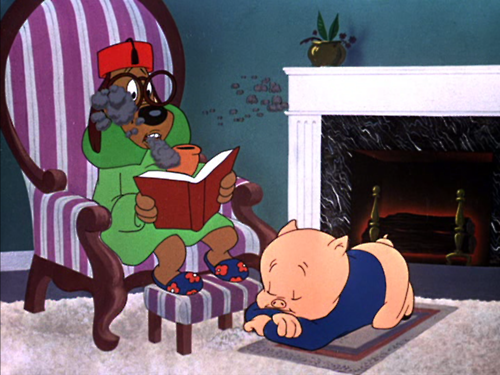 ‘Awful Orphan’ is the second cartoon of five starring that delightfully annoying mutt, Charlie Dog.
In this short Charlie Dog sneaks into Porky’s apartment ‘disguised’ as a canary. He then tries to persuade an unwilling Porky Pig to let him stay as a pet. In the end Porky even forces him to stay, as a master with Porky being his dog.
‘Awful Orphan’ is hampered by Porky’s untypical behavior, being rather nasty at several points. The animation, however, is top notch, and full of excellent poses and smears. On Porky’s wall we can see a rather fauvist painting of two naked ladies, one of the smaller signs of Jones’ interest in more classical arts.
Watch ‘Awful Orphan’ yourself and tell me what you think:
https://www.dailymotion.com/video/x6ecxen
‘Awful Orphan’ is available on the DVD set ‘Looney Tunes Golden Collection, Vol. 1’
This is Porky Pig cartoon no. 122
To the previous Porky Pig cartoon: Scaredy Cat
To the next Porky Pig cartoon: Porky Chops
Director: Robert McKimson
Release Date: May 27, 1950
Stars: Porky Pig
Rating: ★
Review:
 ‘An Egg Scramble’ introduces the feeble hen Miss Prissy, who would star in several Foghorn Leghorn cartoons.
In this short, however, she’s owned by Porky, who scowls her for failing to lay eggs. Shes tricked by the other hens, who make her believe she’s laid an egg. But when Porky takes it from her to sell, she follows it into town, where she accidentally teams up with a huge gangster.
The story of ‘An Egg Scramble’ is rather odd and never really convinces. It features a dog-like criminal and a very lifelike human woman, for instance. It’s also hampered by way too much dialogue, something that would become sadly characteristic of the McKimson cartoons.
Watch ‘An Egg Scramble’ yourself and tell me what you think:
http://www.b99.tv/video/egg-scramble/
This is Porky Pig cartoon no. 132
To the previous Porky Pig cartoon: The Scarlet Pumpernickel
To the next Porky Pig cartoon: Golden Yeggs
Director: Robert McKimson
Release Date: March 6, 1948
Stars: Daffy Duck, Porky Pig
Rating: ★★★★★
Review:
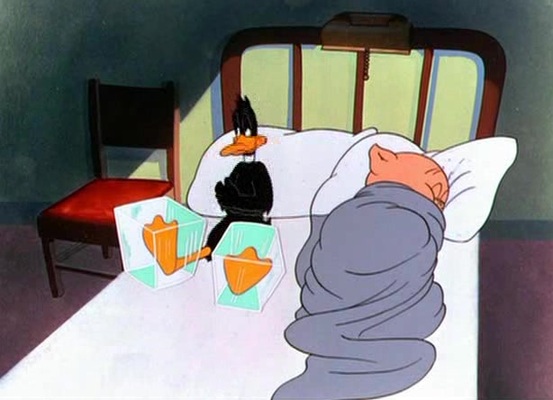 Porky Pig tries to find a room in a town in which all hotels are full due to a convention.
When he finally finds one, he has to share it with a room mate, which turns out to be Daffy at his looniest. Daffy certainly is your worst nightmare of a room mate: he arrives singing loudly, talks to an invisible kangaroo, awakes Porky just out of curiosity, hiccups, steals blankets, puts his cold feet against Porky’s back and spills his glass of water over him. Porky, naturally, throws the looney duck out, but Daffy returns and makes Porky believe it’s morning already, and that he has to catch a train, which Porky eventually does, defying all logic.
This zany Warren Foster-penned story undoubtedly is one of Robert McKimson’s finest cartoons. The gags come fast and plenty, and are as insane as they are familiar. ‘Daffy Duck Slept Here’ is one of the last Warner Brothers cartoons to feature the looney Daffy. The result is a cartoon to laugh your head off.
On a side note: The elevator gag in this cartoon was reused in ‘Who Framed Roger Rabbit‘ (1988) starring Droopy as the lift boy.
Watch ‘Daffy Duck Slept Here’ yourself and tell me what you think:
https://www.dailymotion.com/video/x7kee7v
This is Porky Pig cartoon no. 117
To the previous Porky Pig cartoon: Little Orphan Airedale
To the next Porky Pig cartoon: Nothing But the Tooth
This is Daffy Duck cartoon No. 42
To the previous Daffy Duck cartoon: What Makes Daffy Duck?
To the next Daffy Duck cartoon: You Were Never Duckier
‘Daffy Duck Slept Here’ is available on the DVD-set ‘Looney Tunes Golden Collection Volume Three’
Director: Chuck Jones
Release Date: October 7, 1949
Stars: Bugs Bunny
Rating: ★★½
Review:
 On the way to Miami Beach Bugs misses a left turn at Albuquerque again and reaches the South Pole, where’s confronted with a little penguin chased by an Eskimo, who is as mean as he is out of place. Although Bugs wants to go to the beach, he saves the little fellow.
This is one of the weaker Bugs Bunny cartoons, mainly because of the rather inactive penguin, whose cuteness softens Bugs’s character and because of the large amount of dialogue, provided by Bugs alone. The short’s best scene is when Bugs dresses as a female Eskimo to rescue his waddling little friend. Jones would reuse the little penguin the next year in ‘8 Ball Bunny‘ with moderately better results.
Watch ‘Frigid Hare’ yourself and tell me what you think:
http://www.supercartoons.net/cartoon/663/bugs-bunny-frigid-hare.html
‘Frigid Hare’ is available on the DVD set ‘Looney Tunes Golden Collection, Vol. 1’
This is Bugs Bunny cartoon No. 65
To the previous Bugs Bunny cartoon: The Windblown Hare
To the next Bugs Bunny cartoon: Which is Witch?
Director: Art Davis
Release Date: August 14, 1948
Rating: ★★★★
Review:
Art Davis is one of the unsung heroes of Warner Brothers animation. His unit existed for only three years, but in this short time period he released many fine cartoons, with a distinct and recognizable style.
‘Dough Ray Me-Ow’ is one of his best cartoons, and a rather macabre one, too. This short features a cat, called Heathcliff, who is even too dumb to breathe. Heathcliff, without knowing it, inherits an enormous sum of money. When his ‘pal’ Louie, a cynical parrot, discovers that if Heathcliff dies, this fortune will come to him, he tries to kill Louie in great, funny gags. Surprisingly, in the end he even succeeds, but when he tells the dying Heathcliff his secret, the cat’s nine lives simply refuse to go to heaven!
Apart from the main story, the cartoon contains a small running gag in which we see Heatcliff cracking nuts in ridiculously elaborate ways, always involving his own head.
‘Dough Ray Me-Ow’ features watercolor backgrounds, very unusual for Warner Brothers at the time.
Watch an excerpt from ‘Dough Ray Me-ow’ yourself and tell me what you think:
‘Dough Ray Me-Ow’ is available on the Blu-Ray-set ‘Looney Tunes Platinum Collection: Volume 2’ and on the DVD-set ‘Looney Tunes Golden Collection Volume Four’
Director: Chuck Jones
Release Date: December 14, 1948
Stars: Bugs Bunny
Rating: ★★½
Review:
 Bugs misses a turn at Albuquerque and ends up in Scotland.
When he mistakes a Scotchman’s bagpipes for a monster attacking an old lady, he ends up playing golf against the angered Scotchman. Of course, Bugs wins the game, which consists of several blackout gags, and he even manages to defeat the kilted guy at playing the pipes.
The Scotchman looks like a cross between Elmer Fudd and Yosemite Sam, but who hasn’t got anything near the personality of either of the two. Therefore the interplay between our hero and the villain never really come to live, despite some nice facial expressions on Bugs’ adversary.
Peter Alvarado’s backgrounds do not help: they are too vivid to ignore, but have none of the beauty of either Jones early 1940s cartoons or his cartoons from the 1950s. Instead they express a strange mix of realistic and more stylized patterns. The result is a rather mediocre entry in the Bugs Bunny catalog.
Watch ‘My Bunny Lies over the Sea’ yourself and tell me what you think:
‘My Bunny Lies over the Sea’ is available on the DVD set ‘Looney Tunes Golden Collection, Vol. 1’
This is Bugs Bunny cartoon No. 55
To the previous Bugs Bunny cartoon: A Lad in his Lamp
To the next Bugs Bunny cartoon: Hare Do
Director: Chuck Jones
Release Date: April 10, 1948
Stars: Bugs Bunny, The Crusher
Rating: ★★★½
Review:
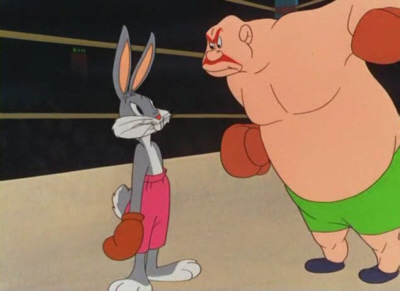 When Bugs jeers at the champion of a boxing game, he’s suddenly ‘invited’ to be in it.
The boxing game soon changes into a wrestling match with blackout gags, in which we only see round 37, 49, 73, 98 and 110. These blackout gags foreshadow the complete Road Runner series. In the last one the champ uses a train in order to ride over Bugs, but then the film abruptly breaks, a revival of a gag Jones used in ‘My Favorite Duck‘ (1942).
‘Rabbit Punch’ is one of the earliest cartoons in what we can call Chuck Jones’ mature style, which consolidated in 1949. Like in his earlier Bugs Bunny cartoons ‘Case of the Missing Hare‘ (1942) and ‘Hare Conditioned‘ (1945), Jones uses his sense of grace and deftness to portray a particularly large, human opponent to Bugs. And like in those cartoons he does that with stunning ‘camera angles’ and a cinematic approach. Bugs is pretty suave in this cartoon, acting out complete terror in the final scene, only to appear in full control, after all.
Watch ‘Rabbit Punch’ yourself and tell me what you think:
http://www.dailymotion.com/video/x2fby3f
This is Bugs Bunny cartoon No. 48
To the previous Bugs Bunny cartoon: A Feather in his Hare
To the next Bugs Bunny cartoon: Buccaneer Bunny
Director:Friz Freleng
Release Date: June 12, 1948
Stars: Bugs Bunny, Yosemite Sam
Rating: ★★★★★ ♕
Review:
 Bugs Bunny dares to resist Yosemite Sam in this Western entry, which is both delightfully classic and totally absurd.
For example, when Yosemite Sam exclaims that ‘The town is not big enough for the two of us’, Bugs responds by building an enormous block of skyscrapers in a few seconds! Its finale, too, is hilarious. When Bugs tries to board an unwilling Sam on a train leaving town, they discover this train’s going to Miami and is full of dames in bathing suits. Then they both want to board it! Needless to say our hero wins the day.
‘Bugs Bunny Rides Again’ is a brilliantly hilarious cartoon full of great and flexible animation, and undoubtedly one of Bugs Bunny’s finest entries. The short reuses some footage of a dancing Bugs from ‘Stage Door Cartoon‘ (1944).
Watch ‘Bugs Bunny Rides Again’ yourself and tell me what you think:
http://ulozto.net/live/xvYBg55/bugs-bunny-bugs-bunny-rides-again-1948-avi
This is Bugs Bunny cartoon No. 50
To the previous Bugs Bunny cartoon: Buccaneer Bunny
To the next Bugs Bunny cartoon: Haredevil Hare
Director: Friz Freleng
Release Date: November 1, 1947
Stars: Bugs Bunny, Elmer Fudd
Rating: ★★★★★
Review:
 In ‘Slick Hare’ Elmer works as a waiter in a restaurant full of celebrities.
Humphrey Bogart (voiced by Dave Barry) is one of the costumers, and he tells Elmer to bring him a rabbit or else… By chance, Elmer discovers Bugs in his kitchen and what follows is a wild chase involving more celebrities, like The Marx Brothers and Carmen Miranda.
‘Slick Hare’ is a hilarious cartoon. Highlights are a well-timed pie throwing sequence and a a great dance routine by Bugs on an irresistible samba, animated with gusto by Gerry Chiniquy. The cartoon contains some more caricatures of Hollywood stars, like Leopold Stokowski, Frank Sinatra and at the end, Bogart’s wife, Lauren Bacall.
Watch ‘Slick Hare’ yourself and tell me what you think:
This is Bugs Bunny cartoon No. 45
To the previous Bugs Bunny cartoon: Easter Yeggs
To the next Bugs Bunny cartoon: Gorilla My Dreams
Director: Friz Freleng
Release Date: May 22, 1947
Stars: Bugs Bunny
Rating: ★★★
Review:
 ‘A Hare Grows in Manhattan’ starts with a great premise: Bugs is a Hollywood star who has it made.
He is visited by one “Lola Beverley” (only a voice over) who asks him to tell of his humble origin. Next we watch a youthful Bugs in East-side, New York encountering a group of tough street dogs led by a rather dumb bulldog wearing a bowler hat.
Unfortunately, this section remains an ordinary chase sequence, which does not differ from an ordinary Bugs Bunny cartoon. Three years later, McKimson would reuse the idea of Bugs reminiscing his origins in ‘What’s Up Doc?‘, with much better results.
‘A Hare Grows in Manhattan’ contains a ‘little piggy’ gag which was to be repeated by Tweety in ‘Who Framed Roger Rabbit‘ (1988).
Watch ‘A Hare Grows in Manhattan’ yourself and tell me what you think:
http://www.dailymotion.com/video/x2zql38
This is Bugs Bunny cartoon No. 43
To the previous Bugs Bunny cartoon: Rabbit Transit
To the next Bugs Bunny cartoon: Easter Yeggs
Director: Frank Tashlin
Release Date: March 23, 1946
Stars: Bugs Bunny, Elmer Fudd
Rating: ★★
Review:
 In ‘Hare Remover’ Elmer Fudd is an unlikely evil scientist developing a potion to change animals into monsters.
He tries it on a dog, but it only makes it eat grass. Because he has run out of test animals, he has to find a rabbit to try the potion on. Enter Bugs Bunny. What follows is a plot in which both characters think they’ve turned the other into a monster, which happens to be a totally confused bear.
‘Hare Remover’ was to be Frank Tashlin’s last Warner Brothers cartoon and the second of only two Bugs Bunny cartoons directed by him. Unfortunately, it’s not a grand finale.
Despite some great gags and a clever story, the director seems at loss with the two personalities. Elmer, who has a slightly altered design, having suddenly received buck-teeth, is awkward enough as a scientist. But watching Bugs being aghast that he really has made his foe into a monster, and trying to revive Elmer’s former self by making a chemical drink of his own, is just out of character.
In September 1944 Frank Tashlin would leave Warner Brothers, to direct puppet films for the Joan Sutherland studio. Then he left animation all together to work at feature films, first as a gag writer and screen writer, then as a director, in 1951.
Robert McKimson would succeed Frank Tashlin as a director. When Bob Clampett left Warner Brothers, too, in May 1945, the studio had entered a new era. The wild days were over.
Watch ‘Hare Remover’ yourself and tell me what you think:
http://www.dailymotion.com/video/x2uvj6k
This is Bugs Bunny cartoon No. 36
To the previous Bugs Bunny cartoon: Baseball Bugs
To the next Bugs Bunny cartoon: Hair-Raising Hare
Director: Friz Freleng
Release Date: March 27, 1948
Stars: Elmer Fudd, Sylvester
Rating: ★★★★★
Review:
 In ‘Back Alley Oproar’ a sleepy Elmer Fudd is kept awake by Sylvester’s singing in his back alley.
Sylvester turns out to be a rather talented alley cat. His performance is quite infectious, and includes the famous Largo al factotum aria from Gioachino Rossini’s ‘Il barbiero di Seviglia’, Liszt’s second Hungarian Rhapsody (which he performs by stamping with heavy boots on the staircase), “You Never Know Where You’re Goin’ Till You Get There” and “Moonlight Bay”.
At last, Elmer tries to blow Sylvester to smithereens, but they are both killed, and on his way to heaven, Elmer is disturbed by Sylvester’s nine lives singing the Sextet from Gaetano Donizetti’s ‘Lucia di Lammermoor’.
‘Back Alley Oproar’ is one of director Friz Freleng’s cartoons in which he spreads his own love for music. He does so in a very entertaining way.
The cartoon was the first of only four Elmer Fudd-Sylvester pairings. Only Freleng coupled these two characters, although they did co-star in Chuck Jones’ ensemble film ‘The Scarlet Pumpernickel‘ (1950).
Watch an excerpt from ‘Back Alley Oproar’ yourself and tell me what you think:


 Dr. Grob's Animation Review