You are currently browsing the category archive for the ‘Warner Bros. films’ category.
Director: Bob Clampett
Release Date: January 15, 1938
Stars: Porky Pig
Rating: ★★★★
Review:
 ‘Porky’s Poppa’ starts with a close harmony group singing a variation on ‘Old MacDonald had a Farm’, ‘Porky’s Poppa has a farm’.
On his farm Poppa also has a mortgage, and his prize cow, Bessie, is ill. So he orders a mechanical cow. Porky, however, revives Bessie, and makes her compete against the mechanical cow.
For his cartoons Clampett had redesigned Porky Pig, making him more boyish and more appealing than he was in Freleng’s, Avery’s and Tashlin’s shorts. Porky is still a child character in this cartoon, but the cartoon humor is not. Despite the sentimental Great Depression theme, this cartoon is delightfully silly and nonsensical.
‘Porky’s Poppa’ is only director Bob Clampett’s fifth film, and the short simply bursts with energy. The cartoon already shows what Clampett had in store for the world: nonsensical gags, zany animation and sheer fun.
Watch ‘Porky’s Poppa’ yourself and tell me what you think:
http://www.dailymotion.com/video/x51lt3j
This is Porky Pig cartoon no. 34
To the previous Porky Pig cartoon: Porky’s Hero Agency
To the next Porky Pig cartoon: Porky at the Crocadero
‘Porky’s Double Trouble’ is available on the DVD-sets ‘Looney Tunes Golden Collection Volume Five’ and ‘Porky Pig 101’
Director: Frank Tashlin
Release Date: November 13, 1937
Stars: Porky Pig, Petunia Pig
Rating: ★★★½
Review:
 ‘Porky’s Double Trouble’ is a comical crime cartoon, in which Tashlin plays the classic doppelgänger motif with gusto.
The short starts immediately with a shadow creeping behind the titles, followed by a great cinematic opening, setting the premise of the story: a dangerous killer has escaped Alcarazz prison. When the killer reads the newspaper, he discovers he looks just like the new bank teller of the Worst National Bank: Porky Pig.
The killer kidnaps Porky, and kisses Porky’s colleague, Petunia. She rings the alarm, and the police soon finds both Porky and the convict, who both claim to be Porky. However, Petunia identifies the right one immediately, and yet she runs off with the killer, exclaiming: ‘Boy, can he kiss!’.
‘Porky’s Double Trouble’ plays nicely with the immature Porky and his doomed relationship with Petunia Pig. However, the short’s opening scenes are the most impressive aspect of the cartoon. In these Tashlin unleashes many cinematic devices to create an exciting atmosphere.
Watch ‘Porky’s Double Trouble’ yourself and tell me what you think:
http://www.dailymotion.com/video/x430jlr
This is Porky Pig cartoon no. 32
To the previous Porky Pig cartoon: The Case of the Stuttering Pig
To the next Porky Pig cartoon: Porky’s Hero Agency
‘Porky’s Double Trouble’ is available on the DVD-sets ‘Looney Tunes Golden Collection Volume Five’ and ‘Porky Pig 101’
Director: Tex Avery
Release Date: July 23, 1938
Stars: Egghead
Rating: ★★★½
Review:
 ‘Cinderella meets Fella’ is Tex Avery’s second take at a classic fairy tale after ‘Little Red Walking Hood’ (1937).
The cartoon’s opening scenes are one string of nonsensical gags, from the invitation card with which it starts to Cinderella’s arrival at the ball. For example, to get warm, Cinderella just adjusts her candle to get more flames. And when the fairy godmother is late, Cinderella calls the police to look for her. To get mice for the couch, the fairy godmother plays a slot machine, which incomprehensibly is built in the wall. Gags like these were completely unique at the time and could only be found in Warner Bros. films, and in Avery’s films in particular.
Prince Charming turns out to be Egghead, Tex Avery’s second cartoon star, after Daffy Duck. Egghead unfortunately is just too odd and too unsympathetic to carry the rest of the cartoon. So the short deflates a little after his entrance.
But the cartoon is revived by the extraordinary end gag: Egghead finds out that Cinderella got tired of waiting and has gone to a Warner Bros. show. Egghead is heartbroken, until he’s called by his love from the audience. We watch a silhouette standing up, and within seconds she’s back on the screen.
It’s great gags like these that made Tex Avery the undisputed innovator of cartoon comedy. ‘Cinderella meets Fella’ is undoubtedly one of the funnier cartoons of 1938, but when Avery would revisit this particular fairy tale seven years later, with ‘Swing Shift Cinderella’, the results would even be much, much better.
Watch ‘Cinderella Meets Fella’ yourself and tell me what you think:
https://www.dailymotion.com/video/x7tychp
‘Cinderella Meets Fella’ is available on the DVD-set ‘The Busby Berkeley Collection’
Directors: Ben Hardaway & Cal Dalton
Release Date: July 9, 1938
Rating: ★★½
Review:
 Love and Curses’ is set during the gay nineties and is a spoof of the classic melodrama, complete with mustached villain, a train track and a sawmill.
Unfortunately, the cartoon is hampered by the stiff melodramatic dialogue and the slow timing. Most of the ‘humor’ comes from the invincible hero Harold reciting proverbs all the time, but his appearances are tiresome, not funny. There are also a couple of throwaway gags, but these are mildly amusing at best.
This is one of those rather rare cartoons (not counting Popeye) featuring adult human designs, and the results are pretty unsteady. The animation of the girl singing at the nightclub is the most elaborate, but none of the animation is convincing.
Chuck Jones would visit the same kind of material four years later with ‘The Dover Boys‘, which seems light-years ahead of this cartoon.
Watch ‘Love and Curses’ yourself and tell me what you think:
http://www.dailymotion.com/video/xu5lrc
‘Love and Curses’ is available on the DVD-set ‘The Busby Berkeley Collection’
Director: Friz Freleng
Release Date: February 29, 1938
Rating: ★★½
Review:
 ‘Jungle Jitters’ is a cartoon about cannibals.
We watch them drumming, dancing and trying to cook a Goofy-like travelling salesman. Their white, bird-like queen sees a Clark Gable or Robert Taylor in him and wants to marry the salesman, but he prefers the cooking pot.
‘Jungle Jitters’ is an unsure mix of musical gags, spot gags and a rudimentary gag story. The voices of both the salesman and the queen are weak [see Yowp’s comment below for their origin], and the weird mix of human cannibals and these two animal-like characters is very unconvincing. And let’s not get started on the racist aspect of the movie. Besides, the scenes with the salesman are irritatingly slow, and the gags mostly trite. The best gag is when some cannibals dancing around a hut suddenly change into a merry-go-round.
On the positive side, Carl Stalling’s music is superb throughout, and enhances the action, even if it’s not much to look at.
Watch ‘Jungle Jitters’ yourself and tell me what you think:
‘Jungle Jitters’ is available on the DVD ‘Uncensored Animation 2: Cannibals!’
Directors: Ben Hardaway & Cal Dalton
Release Date: May 1, 1939
Stars: Porky Pig
Rating: ★★★½
Review:
 In ‘Porky and Teabiscuit’ Porky is the son of a farmer.
Porky’s father sends him away to the race track to sell hay. By accident Porky buys a sick horse, called ‘Tea Biscuit’, a salute to Seabiscuit, the most famous race horse of its time. Despite the horse’s illness, Porky enters a steeple chase with it, end even wins the race.
‘Porky and Teabiscuit’ pays tribute to Floyd Gottfredson’s classic Mickey Mouse comic ‘Mickey Mouse and Tanglefoot’ (1933). Where Tanglefoot won by his fear of wasps, Tea Biscuit wins by being startled by blows. Unfortunately, Hardaway & Dalton add nothing to this premise, and the result is a rather mediocre cartoon, albeit a quite entertaining one.
Watch ‘Porky and Teabiscuit’ yourself and tell me what you think:
This is Porky Pig cartoon no. 55
To the previous Porky Pig cartoon: Chicken Jitters
To the next Porky Pig cartoon: Kristopher Kolumbus, jr.
‘Porky and Teabiscuit’ is available on the DVD-set ‘Looney Tunes Golden Collection Volume Three’
Director: Bob Clampett
Release Date: June 25, 1938
Stars: Porky Pig
Rating: ★★★★
Review:
 By 1938, the Warner Bros. Studio really started to hit its stride. ‘Porky’s Party’ is a good example of the studio’s new, confident and unique style, which owed virtually nothing to the Disney convention.
In ‘Porky’s Party’, Porky celebrates his own birthday. His party is hindered by a silk worm he gets as a present from uncle Phineas Pig. When one exclaims ‘sew’, the worm immediately starts sewing clothes out of nowhere, including a bra. It may be clear that once Porky says ‘So!’, the worm does the same thing. Another problem is Porky’s dog, who gets drunk on his hair tonic, and who’s mistaken of being mad. Porky’s guests aren’t helping either: one is a penguin who eats all his food, the other a particularly loony duck goose.
‘Porky’s Party’ is rather disjointed, but its atmosphere is strikingly silly, and the gags come in fast and plenty. Only the gag in which the penguin swallows a worm-produced silk hat, is milked too long. But mostly, ‘Porky’s Party’ is an early testimony of Warner Bros.’ unique, wacky style, which would dominate the war years.
Watch ‘Porky’s Party’ yourself and tell me what you think:
This is Porky Pig cartoon no. 42
To the previous Porky Pig cartoon: Porky the Fireman
To the next Porky Pig cartoon: Porky’s Spring Planting
‘Porky’s Party’ is available on the DVD-set ‘Looney Tunes Golden Collection Volume Three’
Director: Frank Tashlin
Release Date: April 17, 1937
Stars: Porky Pig, Petunia Pig
Rating: ★★★
Review:
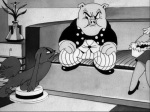
In ‘Porky’s Romance’ Porky tries to court Petunia Pig, but she remains indifferent.
Porky then attempts to commit suicide by hanging himself on a tree. The attempt fails, but it knocks him unconscious, and leads him into a dream sequence which shows what would become of a possible marriage with Petunia. This turns out to be a bachelor’s nightmare: Porky has to do all the housework and is bullied by an enormously fat Petunia. When he’s awake, Petunia is at his sight, now ready for marriage, but Porky rushes off into the distance, only to return to kick Petunia’s obnoxious dog.
‘Porky’s Romance’ is still from a transitional period for the Warner Bros. studio. It’s most probably inspired by the Mickey Mouse cartoons ‘Puppy Love’ (1933) and ‘Mickey’s Nightmare‘ from 1932. ‘Puppy Love’ uses the same setting, including a Pekingese dog, while ‘Mickey’s Nightmare’ shares a dream sequence that quickly becomes bachelor’s nightmare. In this way the cartoon still looks back. Moreover, both Porky’s design and voice are still rather unappealing, and the design of Petunia’s pesky Pekingese is primitive and awkward.
On the other hand, this cartoon features remarkably modern backgrounds, which show very streamlined and rather futuristic architecture. And as Leonard Maltin shows in ‘Of Mice and Magic’, Frank Tashlin experiments with remarkably rapid cutting, speeding up storytelling at Warner Bros., and in cartoons in general.
However, the film’s most striking feature is it opening sequence in which Petunia Pig is pompously introduced as the new Warner Bros. star. We then watch her nervously trying to give say to the radio audience that she hopes that they’ll like her picture. When an off-screen voice whispers to her not to get excite, she explodes and yells into the camera: “Who’s excited!!!”. Only then the opening titles appear!
More than anything this kind of self-conscious gags would become a hallmark of Warner Bros.’ own brand of humor.
Watch ‘Porky’s Romance’ yourself and tell me what you think:
http://www.dailymotion.com/video/x41ct72
This is Porky Pig cartoon no. 21
To the previous Porky Pig cartoon: Picador Porky
To the next Porky Pig cartoon: Porky’s Duck Hunt
‘Porky’s Romance’ is available on the DVD-set ‘Looney Tunes Golden Collection Volume Three’
Director: Friz Freleng
Release Date: January 30, 1937
Rating: ★★★
Review:
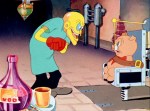 In ‘Pigs is Pigs’ a fat little pig thinks of food all the time.
At night the pig dreams he’s being fed by a machine of an evil scientist with a hic-cough. He eats so much, he explodes. He awakes in a fright, but when his mother invites him to breakfast, it’s clear he hasn’t learned anything.
With its quasi-moralistic tale, its family-setting, its child star, and its Silly Symphony-like backgrounds, ‘Pigs is Pigs’ is still firmly rooted in the goody-goody world of the mid-1930s. However, an early ‘Hold the onions’-gag (the first of a long series), the fast machine-scenes, and the surprisingly non-moralistic finale look forward to a more individual Warner Bros. style.
‘Pigs is Pigs’ is far from a classic, but it’s surprisingly well animated, and shows that by 1937 the Schlesinger studio could use the Disney influence to their own ends.
Watch an excerpt from ‘Pigs is Pigs’ yourself and tell me what you think:
‘Pigs is Pigs’ is available on the DVD-set ‘Looney Tunes Golden Collection Volume Three’
Director: Tom Palmer
Release Date: September 23, 1933
Rating: ★★★
Review:
 ‘I’ve Got to Sing a Torch Song’ was the first Merrie Melodie of Leon Schlesinger’s erratic fledgling studio after Harman & Ising quit making cartoons for him.
The short is the second of only two cartoons directed by Tom Palmer, the other being ‘Buddy’s Day Out‘. Like in ‘Buddy’s Day Out’ Palmer is completely at loss as a director, delivering a completely aimless and meandering cartoon. So, soon Schlesinger fired him. Palmer went to Van Beuren where he (co-)directed eighteen more cartoons.
‘Ive Got to Sing a Torch Song’ is a blackout gag cartoon on radio. It features numerous caricatures of radio and movie stars, like Bing Crosby, Ed Wynn, Joan Blondell, James Cagney, and even of Benedetto Mussolini and George Bernard Shaw. The title song only kicks in after five minutes, introduced by the Boswell sisters, and sung by Greta Garbo, Zasu Pitts and Mae West. Garbo even says ‘That’s All Folks!’ at the very end of the cartoon. This last gag undoubtedly is the funniest of the complete short, despite the presence of some typical Warner Bros. gags, like a conductor conducting a phonograph. The complete film makes no sense, but at least it’s well animated, thanks to Jack King, whom Schlesinger had hired away from Walt Disney.
Watch ‘I’ve Got to Sing a Torch Song’ yourself and tell me what you think:
http://www.dailymotion.com/video/x2fbb11
‘I’ve Got to Sing a Torch Song’ is available on the DVD-set ‘Looney Tunes Golden Collection Volume Five’
Director: Rudolf Ising
Release Date: September 24, 1933
Rating: ★★★★½
Review:
 ‘The Dish ran Away with the Spoon’ was the last Merrie Melody Harman & Ising made for Leon Schlesinger, before they quit over a dispute on money.
Like other later Merrie Melodies it shows how Harman and Ising could imitate Disney, compete with Disney, but at the same time produce films that Disney somehow would never make. It opens with a very Disneyesque rain scene, which brings us through a window into a kitchen. There we watch kitchen tools frolicking and dancing.
In tune to earlier Silly Symphonies like ‘The Bird Store‘ and ‘Bugs in Love‘ (both 1932) halfway a ‘story’ develops, when a dough monster kidnaps a female dish, but is destroyed by a hero spoon and the rest of the kitchen tools.
The designs in this cartoon are elaborate and elegant, of a high quality and unmistakeably Warner Bros. Of special notice is the convincing animation on the dough villain.
After Harman & Ising’s quit, it would take Schlesinger’s own fledgling studio quite some time to match Harman & Ising’s quality, and only with help from some of their former animators, like Bob Clampett, Robert McKimson and Friz Freleng.
Watch ‘The Dish ran Away with the Spoon’ yourself and tell me what you think:
http://www.dailymotion.com/video/xvdf85
‘The Dish ran Away with the Spoon’ is available on the DVD-set ‘Looney Tunes Golden Collection Volume Six’
Director: Hugh Harman
Release Date: September 18, 1933
Rating: ★★½
Review:
 ‘Bosko’s Picture Show’ was one of the last Bosko cartoons Harman & Ising made for Leon Schlesinger.
The short nicely parodies a typical cinema evening of the time. Bosko himself plays the organ in a cinema, inviting the audience to join him in singing ‘We’re in the Money’ from the Warner Bros. musical ‘Gold Diggers of 1933’ . Then we watch some nonsensical news items.
The most disturbing of these is about Jimmy Durante being on holiday in Germany: we watch a scene of Adolf Hitler chasing the comedian with an ax, supposedly because the actor’s big nose makes him look Jewish. This gag wasn’t really innocent in 1933, but nowadays is appallingly shocking. It does show, however, that already in 1933 the fierce antisemitism of the freshly installed dictator was widely known. In any case, it might very well be the earliest caricature of Hitler in animated cinema.
Then we watch a Laurel and Hardy short (sort of) called ‘In Spite of Everything’. Somehow Laurel and Hardy are dressed as little boys, trying to steal a pie, but the caricatures are neither convincing, nor really funny.
Then we can watch the main picture ‘He Done Her Dirt (And How!)’, an obvious take on the Mae West vehicle ‘He Done Her Wrong’ from earlier that year. The feature stars Honey, who’s dressed like West in that picture, but that’s it. No other reference to the great comedienne is shown. Instead we’re treated on pure melodrama, with Bosko making a rather unconvincing end to it.
‘Bosko’s Picture Show’ somehow painfully shows the lack of appeal Bosko actually has. Unlike Harman & Ising’s last Merrie Melodies, which show a Disney-like quality, the Bosko cartoons were disappointingly devoid of ambition. Bosko just ‘does’ things. He lacks either motivation or purpose, and belongs to an era that by the end of 1933 had pretty much ended.
However, Schlesinger’s answer to Bosko, Buddy, would become anything but an improvement. Luckily, in 1936 Warner Bros. finally found its own style, and so, in 1937 could cover similar grounds in ‘She was an Acrobat’s Daughter‘ (1937) with much funnier results.
Watch ‘Bosko’s Picture Show’ yourself and tell me what you think:
http://www.dailymotion.com/video/xvd5xl
‘Bosko’s Picture Show’ is available on the DVD-set ‘Looney Tunes Golden Collection Volume Six’
Director: Tom Palmer
Release Date: September 9, 1933
Rating: ★★
Review:
 Early 1933 Hugh Harman demanded more money for their cartoons, but Leon Schlesinger refused it. This led to a break between the two, and Harman & Ising quit in June 1933.
This event left Schlesinger with a contract with Warner Bros. to deliver cartoons, but without a studio to make them. Moreover, he was without a cartoon star, as Harman & Ising had taken Bosko with them. Schlesinger quickly set up a studio of his own, at the old Warner Bros. lot at Sunset BLvd. He quickly signed several people to man his brand new studio, including Jack King from Disney, and Bob Clampett from Harman & Ising.
However, somehow he first trusted his new studio into the hands of a guy called Tom Palmer, tipped by his sound engineer, Bernard Brown. Palmer and his associate quickly came up with a brand new star called Buddy, whom Bob Clampett described as “Bosko in whiteface”. This is not entirely true, however, for where Bosko was devoid of personality, he was at least cheerful, and nicely drawn. Buddy, on the other hand, had an ugly design, and was bland as hell.
In ‘Buddy’s Day Out’, Buddy’s first film, even his makers were not sure what to make of him. He’s obviously drawn like a boy, but he drives a car, and has an all too clearly erotic relationship with his girlfriend Cookie. Added to these ‘stars’ are a little baby brother called Elmer and a dog called Happy, which is almost a copy of Terry from Disney’s ‘Just Dogs‘ (1932). As you may notice Buddy, Cookie and even Elmer follow a trend that had existed since the dawn of the sound era of creating a star and giving him a girlfriend. Obnoxious baby brothers are nothing new either, and appear in e.g. Fleischer’s ‘Let Me Call You Sweetheart‘ (1932), Van Beuren’s ‘In the Park‘ (1932), and in Columbia’s complete Scrappy series.
In their very first adventure the quartet go on a picnic, but problems soon start when Elmer runs away with the car. This part is absolutely action rich, but the complete cartoon lacks anything that resembles a gag. Palmer was not much of a gag man, let alone a director, and after ‘Buddy’s Day Out’ he directed only one more cartoon (‘I’ve Got To Sing A Torch Song‘) before Schlesinger fired him.
‘Buddy’s Day Out’ thus was the first cartoon of Leon Schlesinger’s very own studio, and it shows. Compared to the Harman & Ising Looney Tunes and Merrie Melodies, ‘Buddy’s Day Out’ is clearly of a lesser quality. Especially the thin lining of the characters is subpar, as is the rather erratic animation on them. That said, the animation on ‘Buddy’s Day Out’ is still far better than practically any animation at Paul Terry or Van Beuren, and the short at least showcases a nicely animated train. However, the cliched blandness of Buddy and friends, and the lack of anything resembling humor make ‘Buddy’s Day Out’ a far from promising start for Schlesinger’s new star.
Nevertheless, Buddy was a child of his time, for in 1933/1934 cartoons moved away from the world of sex, booze and horror to a more childish world of fairy tales, nursery rhymes etc. It was Disney who had made the first move, but also Iwerks and Van Beuren had already drifted into that direction. Thus at Warner Bros. the supposedly black, somehow mature Bosko was replaced by the white, somewhat childish Buddy. The Hays code sealed the trend by banning sex, drugs etc. By 1934 cinema had entered its most infantile stage. And it was Buddy who would be Warner Brother’s epitome of this low point in early cartoon history, which would last until the end of 1935, when a guy called Tex Avery came along…
Watch ‘Buddy’s Day Out’ yourself and tell me what you think:
http://www.dailymotion.com/video/x2e9slx
‘Buddy’s Day Out’ is available on the DVD-set ‘Looney Tunes Golden Collection Volume Six’
Director: Bernard Brown
Release Date: January 27, 1934
Rating: ★★
Review:
 Mid-1933 Harman and Ising had quit with Leon Schlesinger after a dispute over money, leaving Schlesinger without a studio.
So Schlesinger quickly set up one at Sunset Boulevard, initially with help from sound engineer Bernard Brown and his friends. Brown even himself directed two cartoons during the studio’s chaotic starting months, of which ‘Pettin’ in the Park’ is the first.
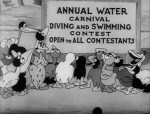
Brown was no animator himself, and judging from this cartoon he was not much of a director, either: ‘Pettin’ in the Park’ just makes no sense. The first half is just an illustration of the song from the Warner Bros. musical ‘Gold Diggers from 1933’, featuring the familiar theme of a cop courting a babysitter (see also Fleischer’s ‘Let Me Call You Sweetheart‘ and Van Beuren’s ‘In the Park‘ (1933). The second half suddenly reports a diving contest and a swimming race between birds. Bridging the action is a cheeky little penguin – what he does in a park no-one will ever know.
There’s a surprising lack of continuity and consistency rarely seen outside the Van Beuren studio output, and the cartoon is of an appalling low quality, especially when compared to the earlier Harman and Ising output. Even worse, few of the gags come off, and none is anything near funny.
Nevertheless, even a terrible film like ‘Pettin’ in the Park’ shows that the typical Warner Bros. animation style, developed at Harman & Ising, had not been lost. It certainly helped that Schlesinger had managed to hire away some crew from his former associates. Bob Clampett, for example, who gets his first billing as an animator here. Clampett and Jack King (hired away from Disney) are clearly trying to put some pepper into the hopeless scenes. Thus despite its story atrocities, even ‘Pettin’in the Park’ displays Warner Bros. own distinct animation style, which, in 1933 was second to Disney only in quality.
Watch ‘Pettin’ in the Park’ yourself and tell me what you think:
‘Pettin’ in the Park’ is available on the DVD-set ‘The Busby Berkeley Collection’
Director: Rudolf Ising
Release Date: August 26, 1933
Rating: ★★★★
Review:
 ‘We’re in the Money’ is entirely built around the catchy opening tune of the Warner Bros. musical ‘Gold Diggers of 1933’.
The joyous song, with its anti-Great Depression theme is entertaining enough to carry the whole cartoon. It is played and sung by toys and dolls in an apartment store at night. Even coins from a cashier join in, singing ‘we are the money’. There’s also a doll doing a Mae West imitation.
Composer Frank Marsales is on the loose here, and plays endless variations on the title song. There’s absolutely no story, whatsoever, but the cheerful mood is captivating, and despite the lack of real action, the cartoon will leave you with a smile.
Watch ‘We’re in the Money’ yourself and tell me what you think:
http://www.dailymotion.com/video/xvd22z_we-re-in-the-money-1933_shortfilms
‘We’re in the Money’ is available on the DVD-set ‘Looney Tunes Golden Collection Volume Six’ and the DVD-set ‘The Busby Berkeley Collection’
Director: Rudolf Ising
Release Date: Jul 8, 1933
Rating: ★★★★★
Review:
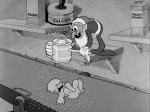 Even though Harman and Ising would never surpass Walt Disney, partly because of a lack of vision, partly because of lack of budget, there’s no denying that by 1933 their films had become the best-looking cartoons of the era, except for Disney’s.
‘Shuffle off to Buffalo’ is a prime example. Based on the hit song from the Warner Bros. musical ’42nd Street’ from three months earlier, the short shows how babies are distributed all over the world. It includes a long assembly line sequence with gnomes washing, drying, powdering and feeding babies. This scene resembles a similar one in Disney’s ‘Santa’s Workshop‘ (1932) and can compete with it in its inventiveness and rhythmic action.
The title song is sung by the babies themselves, including a Maurice Chevalier one, and a Joe E. Brown one. Later an Eddie Cantor gnome recaptures the song, and also does an Ed Wynn impersonation. There’s absolutely no story, but there’s constant action, the animation is top notch throughout, and the joyous atmosphere is undeniably catchy.
‘Shuffle off to Buffalo’ is a cartoon of great quality, and shows that the Disney style of animation could be copied quite successfully.
Watch ‘Shuffle off to Buffalo’ yourself and tell me what you think:
‘Shuffle off to Buffalo’ is available on the DVD-set ‘Looney Tunes Golden Collection Volume Six’ and the DVD-set ‘The Busby Berkeley Collection’
Director: Rudolf Ising
Release Date: June 10, 1933
Rating: ★★★★
Review:
 It’s midnight in the magazine shop, and the magazine come to life, starting with a few cowboys singing the title tune.
‘I Like Mountain Music’ is not the first of books-come-to-life cartoons, that was ‘Three’s a Crowd’ from 1932. But ‘I Like Mountain Music’ takes the concept a little further, stuffing the film with many caricatures of Hollywood stars, like Eddie Cantor, Ed Wynn, Edward G. Robinson, Jean Harlow, King Kong (Hollywood’s latest star), and even Benito Mussolini. Also featured is a remarkably realistic skater. I wonder who she is. It’s not likely Sonia Henie, who started her film career only in 1936.
The book-come-to-life concept was unique to Warner Bros. and was reused in many more, and more enjoyable cartoons like ‘Speaking of the Weather’ (1937), ‘Have You Got any Castles?‘ (1938) and ‘Book Revue‘ (1946). This early short proves that the unique Warner Bros. style had a firm root in the Hugh-Harman era, even though it was to Frank Tashlin and Tex Avery to push it to its later heights.
Watch ‘I Like Mountain Music’ yourself and tell me what you think:
http://www.dailymotion.com/video/xvd0l1_i-like-mountain-music-1933_shortfilms
‘I Like Mountain Music’ is available on the DVD ‘Looney Tunes Golden Collection: Volume Six’
Director: Hugh Harman
Release Date: April 10, 1933
Stars: Bosko, Honey
Rating: ★★½
Review:
 ‘Bosko in Person’ is to Bosko what ‘Just Mickey‘ (1930) was to Mickey: a cartoon devoted solely to the star performing on stage.
Where Mickey was completely alone, Bosko gets help from Honey in an extraordinary song-and-dance extravaganza, including Bosko playing the piano, Honey dancing, Bosko tap-dancing, Bosko’s glove(!) reciting ‘Mary had a Little Lamb’, Honey singing a blues and doing a Greta Garbo imitation, and Bosko imitating both Maurice Chevalier and Jimmy Durante. The cartoon ends with a celebration of the end of the prohibition, which after 13 years ended in effect when on March 22, low alcohol beer and wine were legalized again.
Unfortunately, ‘Bosko in person’ is over-the-top, trying much too hard to make Bosko an appealing personality, which he isn’t. Indeed, when turning into Maurice Chevalier and Jimmy Durante he loses himself completely. Moreover, the cartoon is stuffed with repetition as some gags appear not once, but twice. The result is tiresome and desperately unfunny. In the end, the short is only noteworthy because of the caricatures of Hollywood stars.
Watch ‘Bosko in Person’ yourself and tell me what you think:
http://www.dailymotion.com/video/x2aytm7_bosko-in-person-1933_shortfilms
‘Bosko in Person’ is available on the DVD ‘Looney Tunes Golden Collection: Volume Six’
Director: Hugh Harman
Release Date: January 16, 1933
Stars: Bosko, Honey, Rudolf Ising
Rating: ★★★
Review:
 This Looney Tune has a Western setting with Bosko starring as a singing cowboy, a new type of Hollywood star that has risen during the early 1930’s.
Bosko enters a saloon in Red Gulch, immediately starts a dance and goes on playing the piano. Meanwhile his girlfriend Honey rides a stagecoach, which is chased by three vicious bandits. This chase scene is simply stuffed with animation cycles. As Bosko is busy entertaining, it takes quite a while before Bosko rides off to rescue his sweetheart.
The complete cartoon is rich in action, but surprisingly low on gags (there’s one about a homosexual). Nevertheless, the short ends quite unusually: suddenly we cut back to three animators. Rudolph Ising asks “Say, how does Bosko save the girl?”, an animator replies: “I don’t know.”, and another: “Let’s go home”, leaving Bosko on his sheet of paper. This gag is pretty unconventional, but one cannot but feel a bit of laziness and disinterest in this scene, as if the animators didn’t care much for their own star themselves. Even so, Bosko would star fourteen more Warner Brothers films, before Hugh Harman and Rudolph Ising took him with them to MGM.
Watch ‘Ride Him, Bosko!’ yourself and tell me what you think:
http://www.dailymotion.com/video/x2fbb1s
‘Ride Him, Bosko!’ is available on the DVD ‘Looney Tunes Golden Collection: Volume Six’
Director: Rudolf Ising
Release Date: May 14, 1932
Rating: ★★★
Review:
 ‘It’s Got Me Again!’ finds Harman and Ising at their most Disney-like. This Merrie Melodie is very similar to contemporary Silly Symphonies.
The short features a mouse entering a musical instrument shop at night. The music starts when the mouse accidentally starts the title song on a gramophone. This invites several other mice to join in. After four minutes of musical frolicking a mean cat appears who gets one mouse cornered, prompting the rodent to sing the title track. The other mice, however, come to the rescue and together they get rid of the cat.
The story of ‘It’s Got Me Again!’ is very similar to that of contemporary Disney shorts ‘The Spider and the Fly‘ or ‘The Bird Store‘, but the short’s premise is most akin to the Van Beuren short ‘Toy Time‘ from four months earlier. ‘It’s Got Me Again!’ is much more sophisticated than the Van Beuren short, though. The animation, by Friz Freleng and Tom McKimson, is excellent throughout, and second only to the Disney studio itself.
The mice are Mickey Mouse but in size, only, and the musical routine involves a French Apache dance, as can also be found in ‘Mickey’s Follies‘ (1929) and the later ‘Woodland Cafe‘ (1937). Harman & Ising’s mimicking paid off, as ‘It’s Got Me Again!’ was among the three very first animated shorts to get an Academy Award nomination. Yet, it’s no surprise it lost to Walt Disney’s landmark cartoon ‘Flowers and Trees‘.
Watch ‘It’s Got Me Again!’ yourself and tell me what you think:
‘It’s Got Me Again!’ is available on the Blu-Ray ‘Looney Tunes Platinum Collection: Volume 2’ and the DVD ‘Looney Tunes Golden Collection Volume Three’


 Dr. Grob's Animation Review