Director: Genndy Tartakovsky
Airing Date: February 26, 1995 & May 19, 1996
Stars: Dexter, Dee Dee
Rating: ★★★★
Review:

‘Changes’ is the very first Dexter’s Laboratory episode. The short first appeared on Cartoon Network’s ‘World Premiere Toons’ on February 26, 1995, although it would reappear as the third part of the fourth episode.

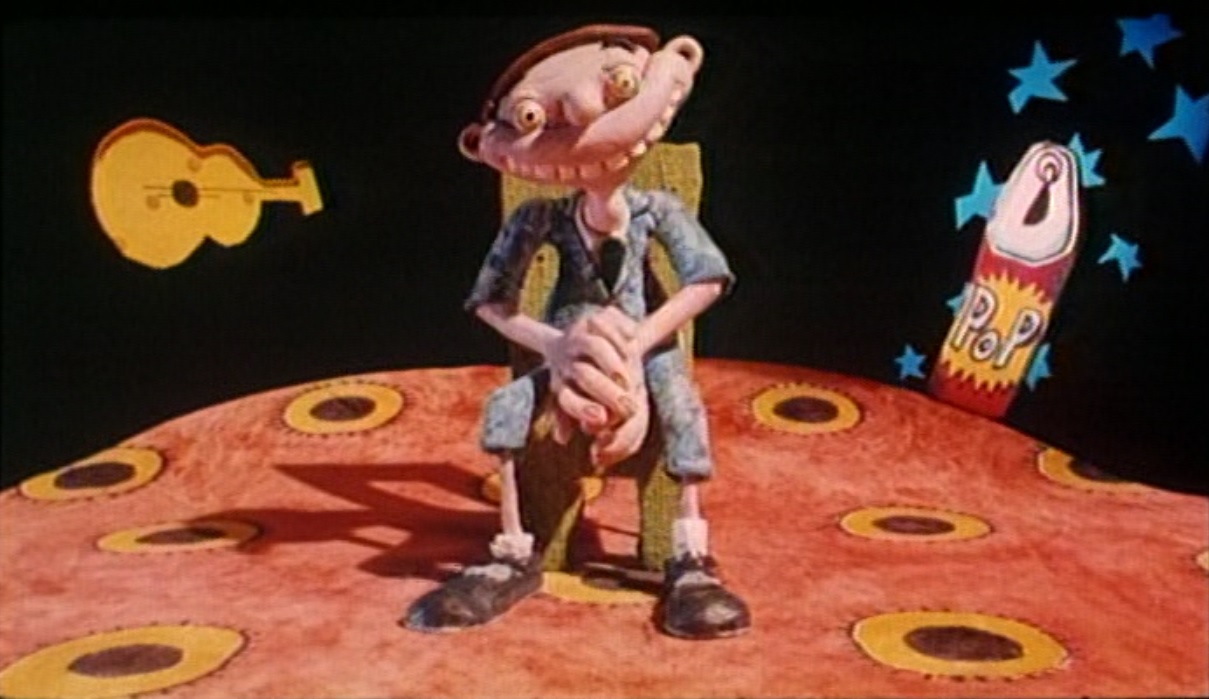
‘Changes’ already contains all elements that make Dexter’s Laboratory such a striking and refreshing addition to animated television: first a strong 1950s influence in design, particularly emulating the work of UPA and John Hubley’s early Storyboard studio work, with the bold line work and highly stylized characters, emphasizing primary forms, like triangles and ovals. Second, the equally stylized animation, with its often unnatural movement, strong emphasis on poses, and striking alterations between fast and slow actions. This, too, harks back to the cartoon modern era (a third element, a cinematic approach with elements of anime, would appear in the second installment, ‘The Big Sister‘). Fourth, the unnatural sound effects, often accompanying silent action, like eye movement or stretching arms. Fifth, the musical soundtrack, which follows the action closely, and remains interesting throughout.

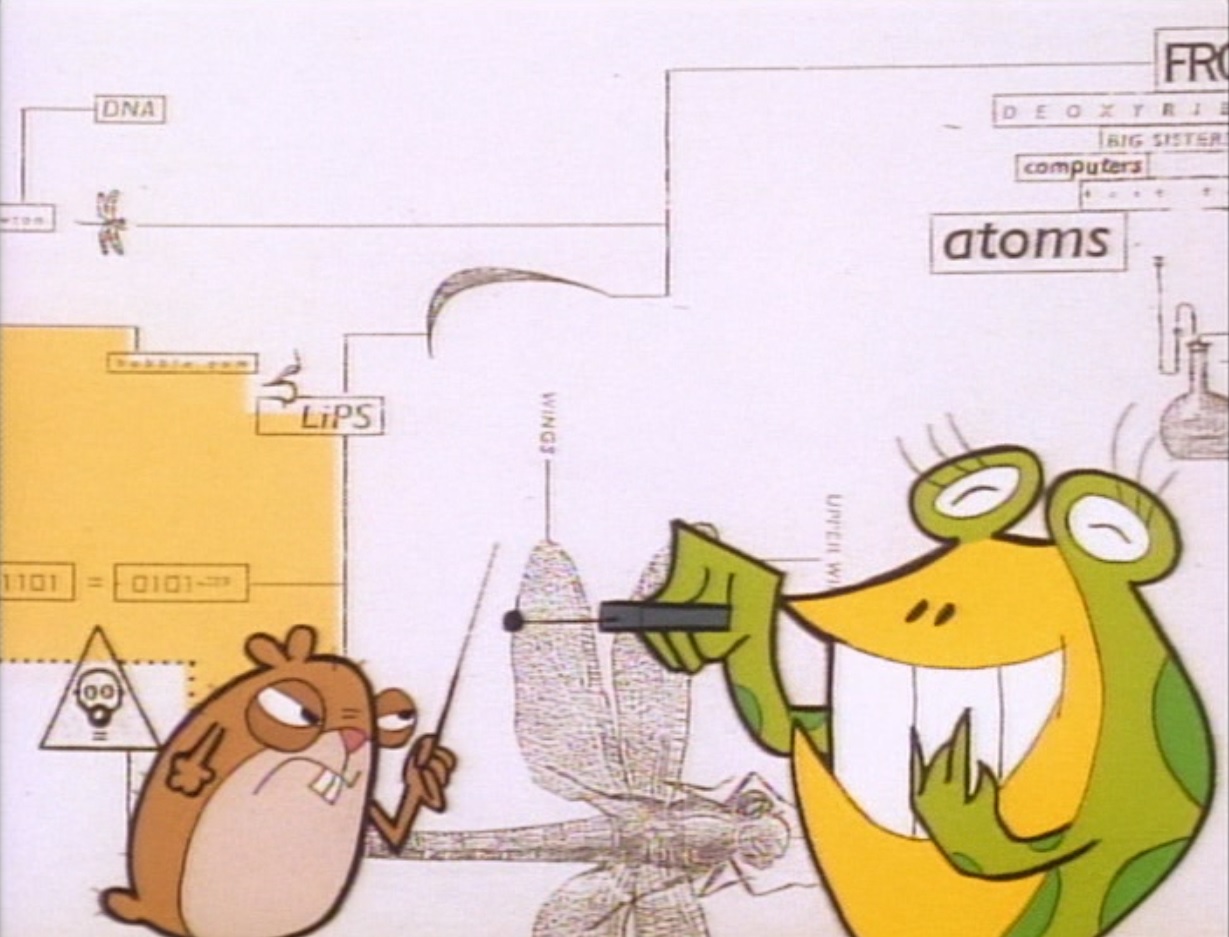
The premise is that Dexter is a hyper-intelligent kid who somehow has an enormous secret lab somehow stowed away in his room, while his big and not so bright sister Dee Dee is a pest to him. ‘Changes’ contains some material that would return in the opening credits, as the episode opens with Dexter finishing his latest invention, which looks like a remote control with only one red button. Of course, Dee Dee grabs the remote and it turns out it changes the other into an animal. Both children turn into a wide range of animals, one more outlandish than the other, in a fast sequence of events. However, highlight may be Dee Dee’s expressions upon entering her brother’s forbidden room.

With ‘Dexter’s Laboratory’ both Hanna-Barbera and Cartoon Network joined the American animation renaissance. The network contributed greatly to the revival, with beautifully stylized and idiosyncratic series like ‘Cow and Chicken’ (1997-1999), ‘The Powerpuff Girls’ (by Craig McCracken, who also worked on Dexter’s Laboratory, 1998-2005) and ‘Samurai Jack’ (again by Tartakovsky, 2001-2004), and to a lesser extent ‘Ed, Edd & Eddy’ (1999-2009) and ‘Courage the Cowardly Dog’ (1999-2001).

Watch ‘Changes’ yourself and tell me what you think:

‘Changes’ is available on the DVD ‘Dexter’s Laboratory Season One: All 13 Episodes’

Director: Jeff McGrath
Airing Date: April 6, 1996
Stars: Duckman
Rating: ★★★½
Review:

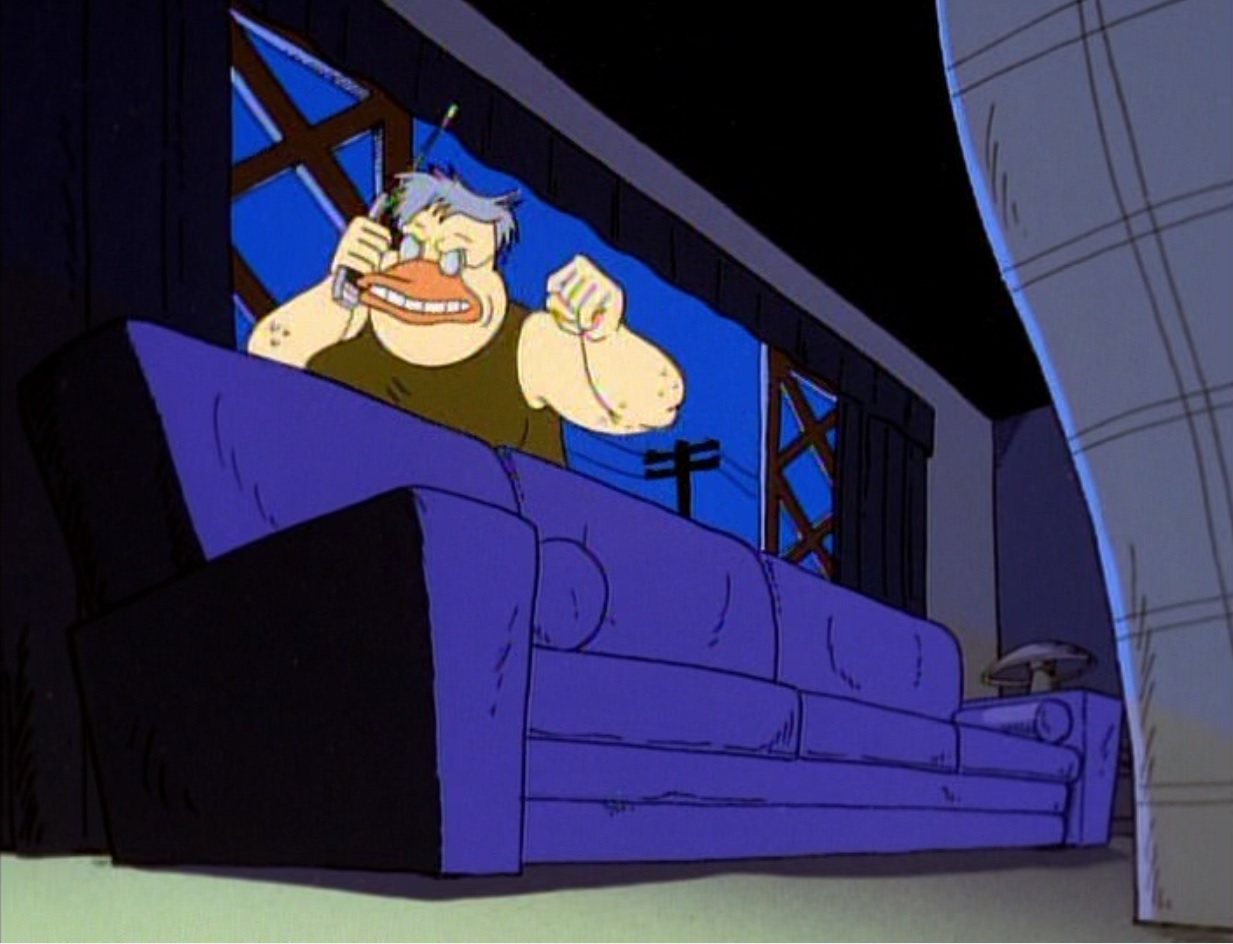
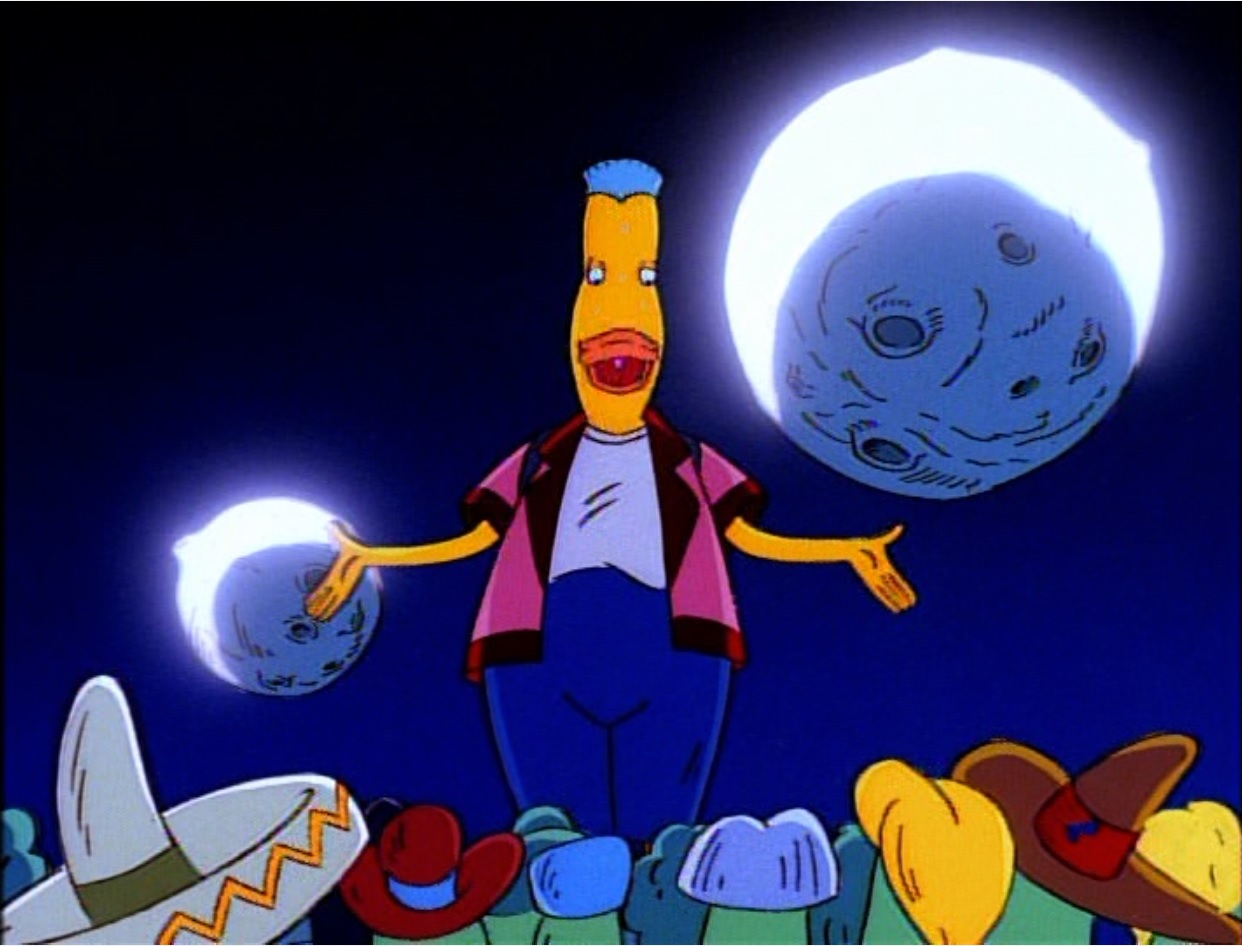
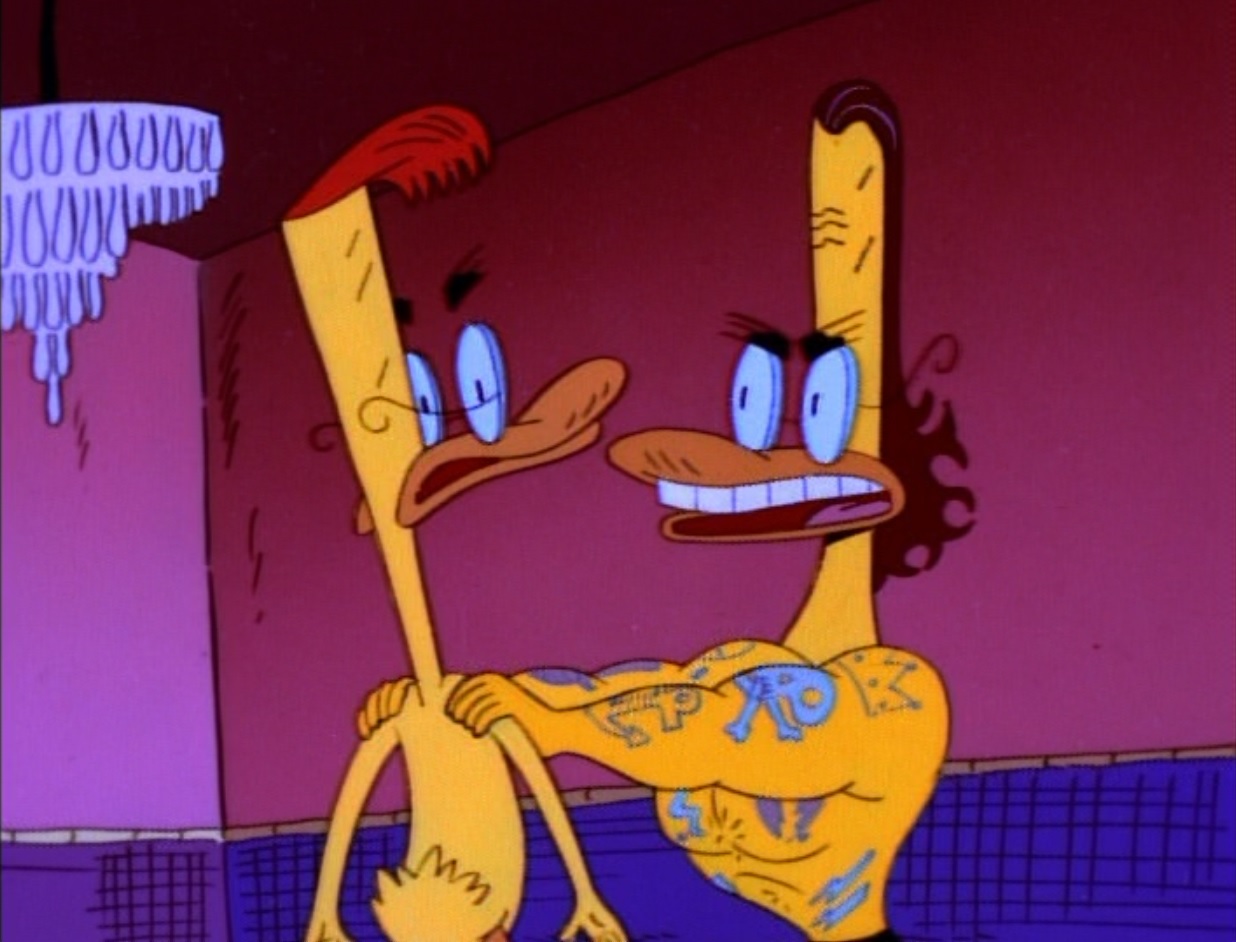
Pig Amok’ starts at a funeral, where Duckman gives a highly inappropriate speech. But this is topped by the late-arriving Cornfed, whose behavior is puzzling, to say the least. More or less forced by his family Duckman sets out to help his friend…

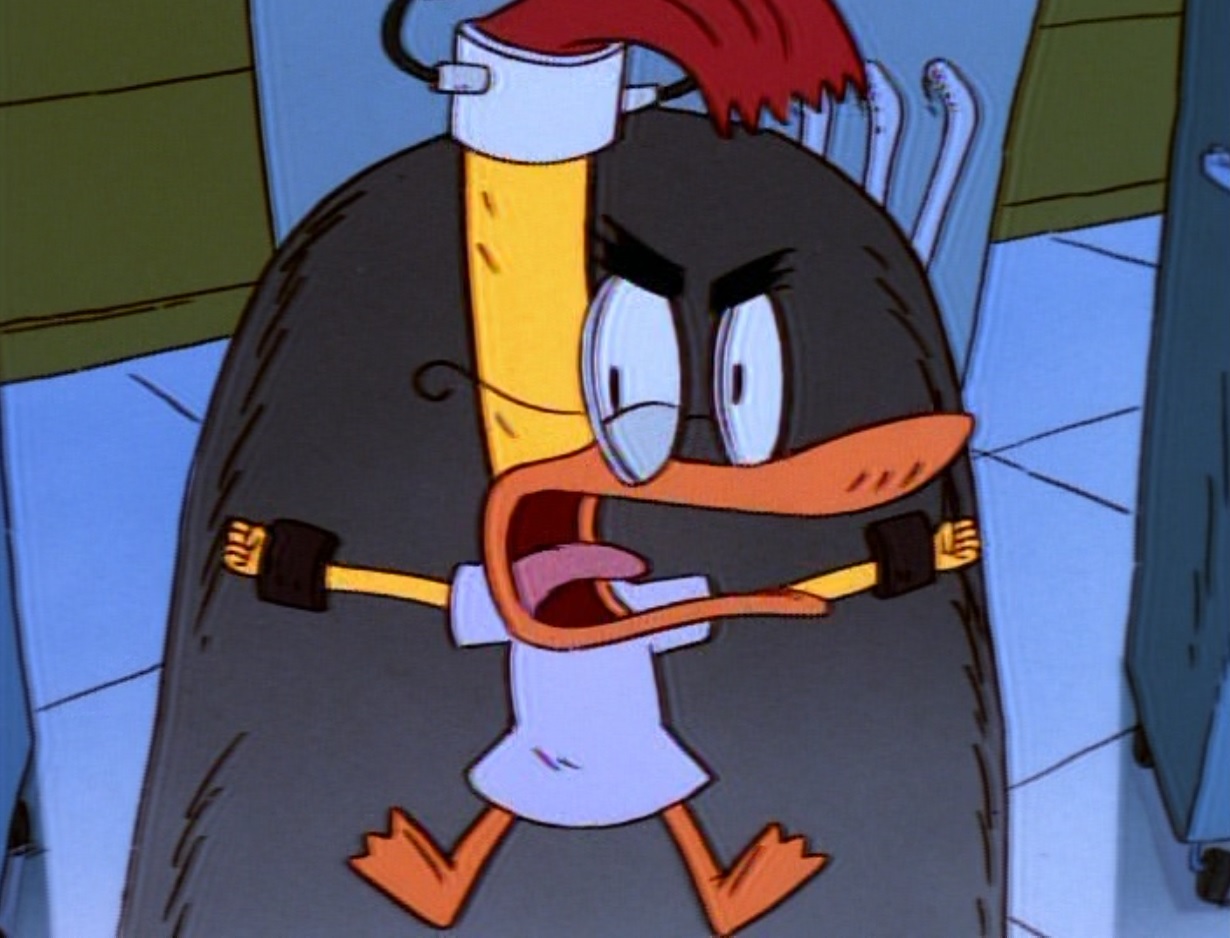
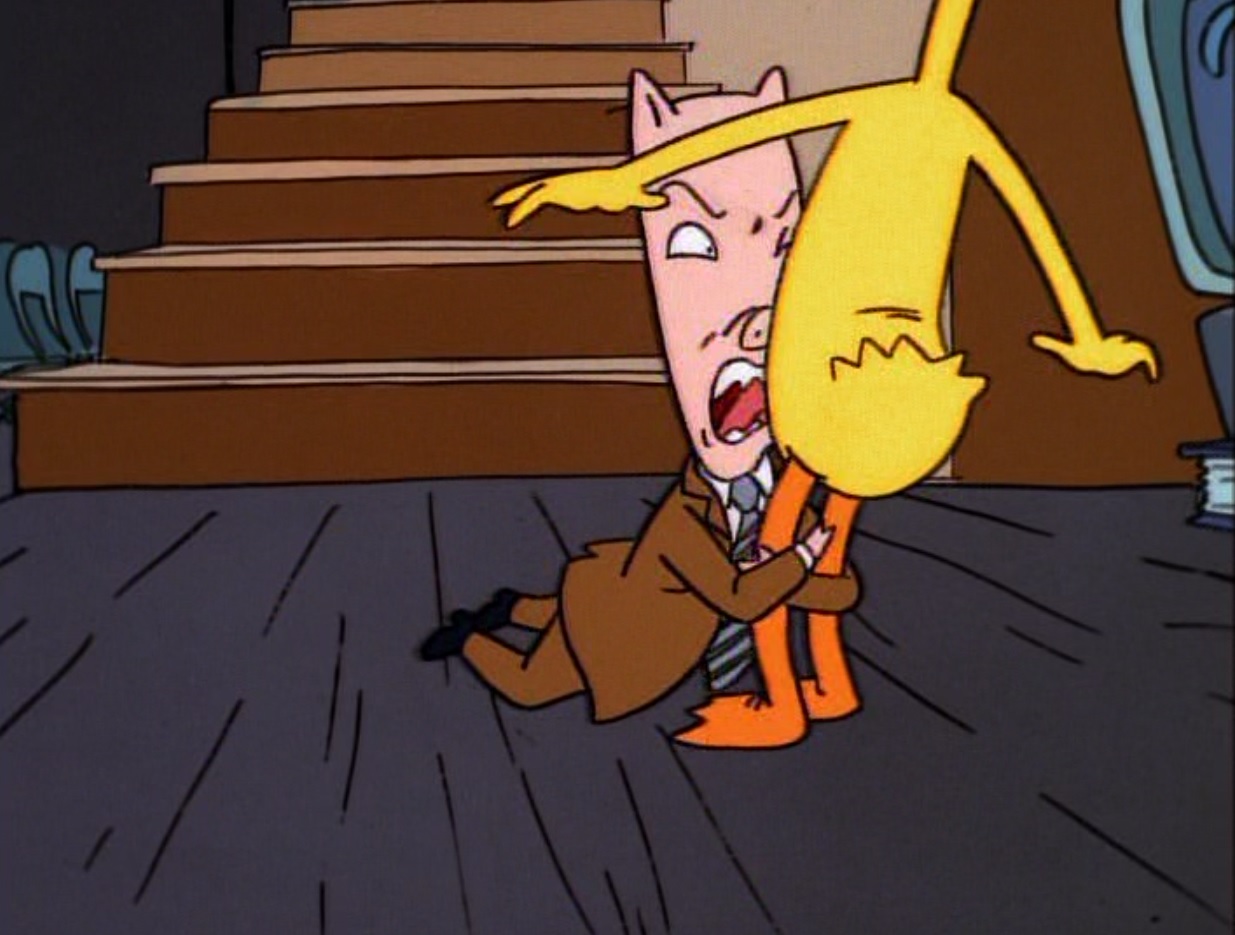
For animation lovers ‘Pig Amok’ has much to offer: this episode contains some wild takes on Cornfed when he bursts into wild convulsions, as well as a beautiful piece of surprisingly independent looking metamorphosis animation when Cornfed swoons. Also entertaining is ‘Cornfed’s Problem’, the documentary Cornfed shows on VHS, which shows his ancestors inserted in black and white photographs.

Watch ‘Pig Amok’ yourself and tell me what you think:

This is Duckman episode no. 33
To the previous Duckman episode: The Mallardian Candidate
To the next Duckman episode: The Once and Future Duck

‘Pig Amok’ is available on the DVD-box ‘Duckman – The Complete Series’

Director: Tyron Montgomery
Release Date: April 1996
Rating: ★★½
Review:

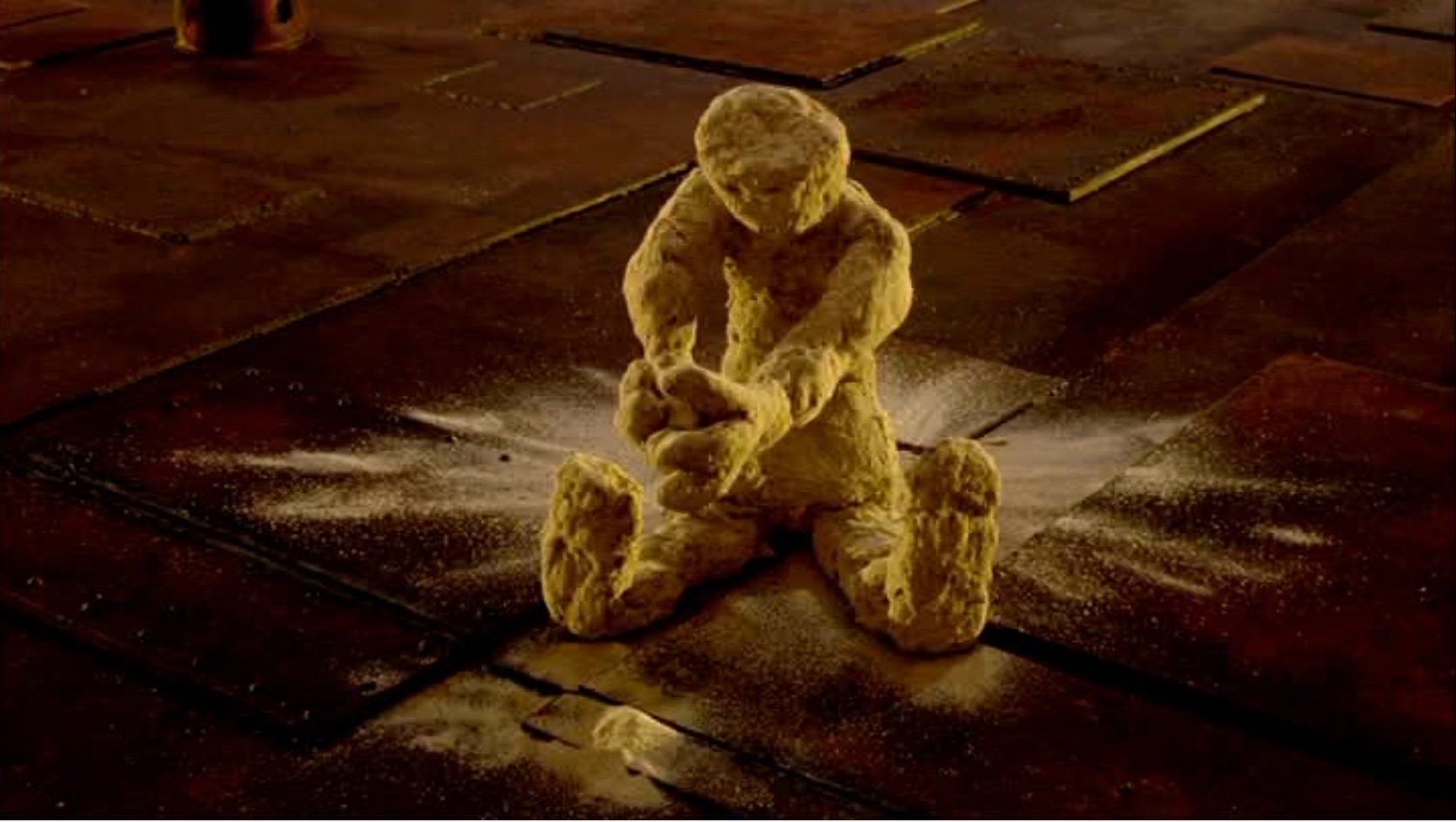
A sand man lies in the desert with his water bottle, empty. When he hears the sound of water he starts digging and before soon falls into another world…

Made by Tyron Montgomery (direction, photography & screenplay) and Thomas Stellmach (production, animation & story) at the University of Kassel, Germany, ‘Quest’ is a gloomy stop-motion film, depicting worlds of sand, paper, stone and metal. Especially the metal world is well-done, both frightening and fascinating.

There are some comic elements in the acting of the sand man, but the film is neither as funny nor as disturbing as it could be. Part of the problem is the mediocre acting: the sand man’s feelings and thoughts are acted out schematically, more like Fritz the Cat than like post-Disney character animation.

‘Quest’ certainly is interesting, and a very accomplished film for a student film, but in the end Montgomery’s and Stellmach’s tale is too shallow to become a real classic. But that’s only my opinion, because this German short won many prizes, including the Academy Award for best animated short in 1997.

Watch ‘Quest’ yourself and tell me what you think:

‘Quest’ is available on the The Animation Show of Shows Box Set 5

Director: Peter Shin
Airing Date: March 16, 1996
Stars: Duckman
Rating: ★★★
Review:

With a title as ‘The Mallardian Candidate’ (a nudge to the 1962 film ‘The Manchurian Candidate’) one needn’t wonder that this episode is about conspiracies.

This episode starts with the comedian Iggy Catalpa (see ‘Joking the Chicken‘ and ‘Color of Naught‘) asking Duckman for help in solving a conspiracy theory. Duckman is as clueless as ever, failing to identify criminals even when they surround them dropping clues all over the place. Soon he gets brainwashed and is turned into an automaton with a single killing purpose…

‘The Mallardian Candidate’ fails to play out the conspiracy concept very well. The best parts are Catalpa’s explanation of how his world domination organization works, and the very end of the episode, which in a few seconds shows what’s fundamentally wrong with the concept of conspiracy theories in the first place.

But mostly, the episode plays on Duckman’s mindlessness and uselessness. The parts involving his family are especially painful in that respect. In ‘The Mallardian Candidate’ Duckman is just a caricature, not the more complex persona he can be in other, better episodes.

Watch ‘The Mallardian Candidate’ yourself and tell me what you think:

This is Duckman episode no. 32
To the previous Duckman episode: The Girls of Route Canal
To the next Duckman episode: Pig Amok

‘The Mallardian Candidate’ is available on the DVD-box ‘Duckman – The Complete Series’

Directors: Donovan Cook & Raymie Muzquiz
Airing Date: March 9, 1996
Stars: Duckman
Rating: ★★★★½
Review:

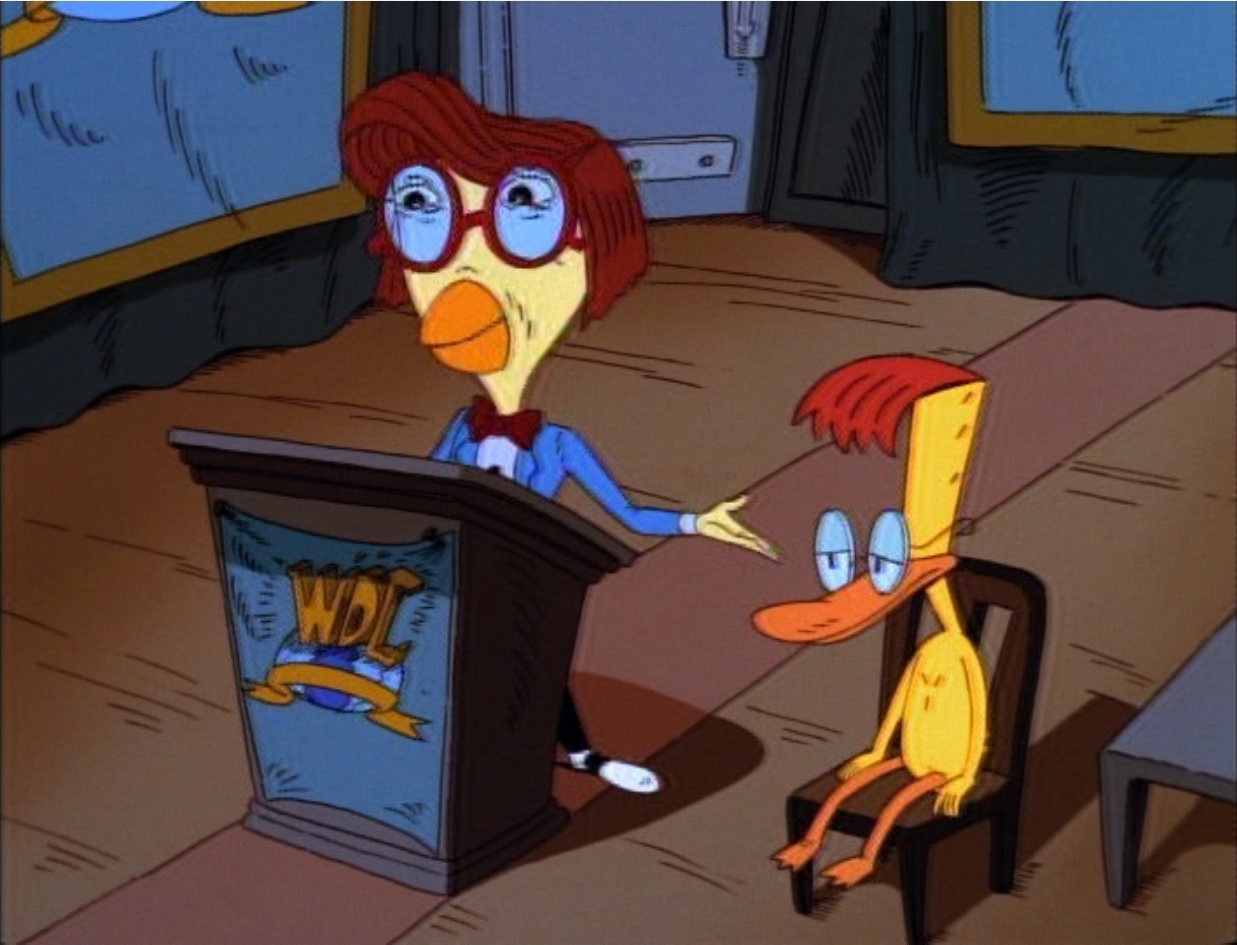
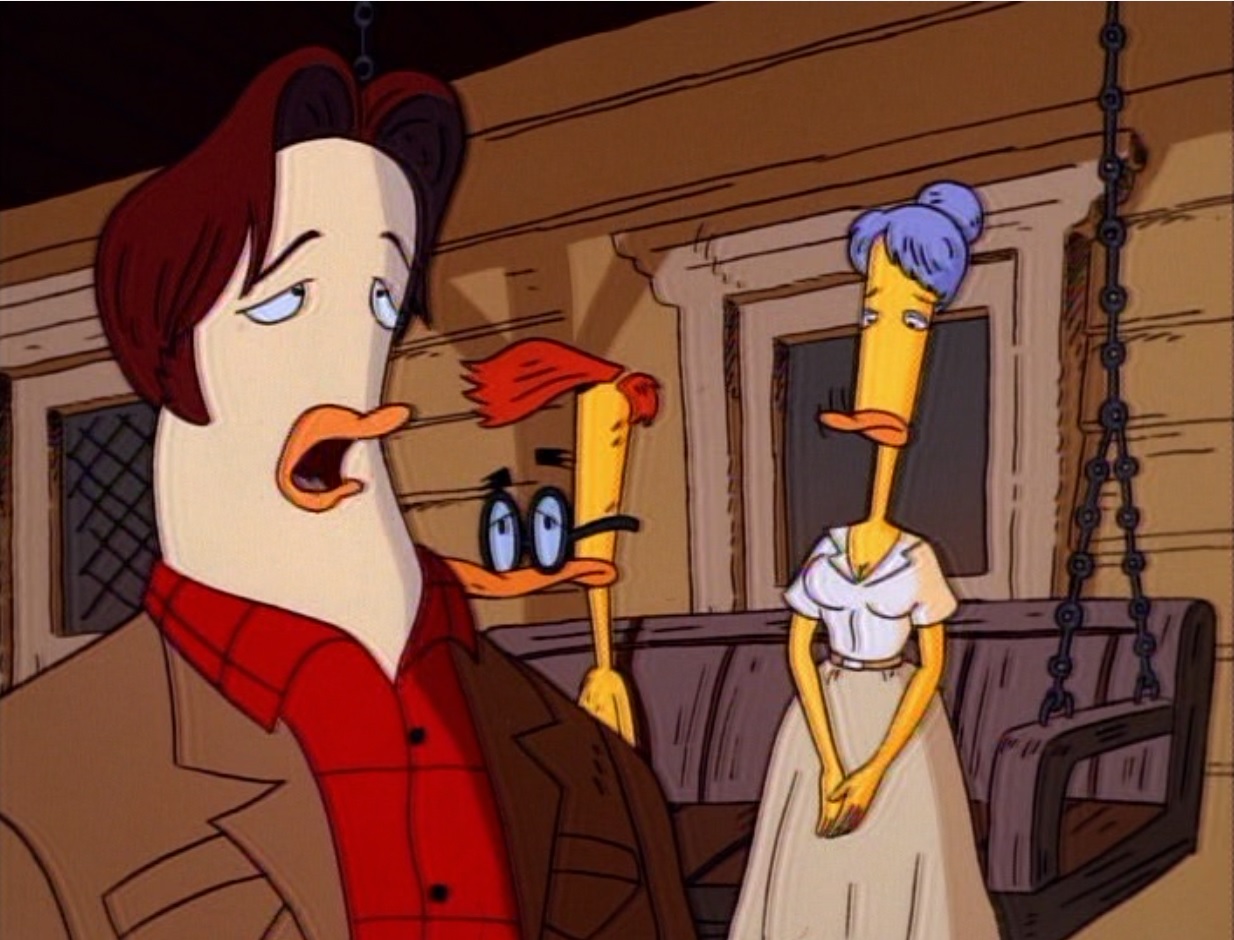
‘The Girls of Route Canal’ finally reveals how Duckman met Beatrice, the mother of Ajax, Mambo and Charles.

It’s the latter two who prompt Duckman to reminisce about how he found the love of his life. They have girl problems of their own, wanting to woe Amanda and Alexis, who are taken by two bullies.

‘The Girls of Route Canal’ is certainly not devoid of comedy, far from it; priceless, for example, is Mambo’s and Charles’ wondering why they like Amanda and Alexis so much. Also great is Cornfed’s short cameo. But overall this is a gentle and surprisingly genuinely romantic episode. This makes ‘The Girls of Route Canal’ one of those scarce episodes in which Duckman is actually more than a completely ignorant, selfish beast. This makes ‘The Girls of Route Canal’ a welcome diversion from more one-dimensional episodes like ‘Apocalypse Not‘ and ‘Clear and Presidente Danger‘.

Watch ‘The Girls of Route Canal’ yourself and tell me what you think:

This is Duckman episode no. 31
To the previous Duckman episode: Clear and Presidente Danger
To the next Duckman episode: The Mallardian Candidate

‘The Girls of Route Canal’ is available on the DVD-box ‘Duckman – The Complete Series’

Director: John Eng
Airing Date: March 2, 1996
Stars: Duckman
Rating: ★★★★
Review:

This episode starts with Duckman blackmailing an employee of the ‘McJaggers’ fastfood chain, so he gets to win a vacation to some third world paradise, called Puerto Guano.

This turns out to be quite a hell-hole (there’s even a reference to the Exxon Valdez oil spill from 1989), and Duckman’s rant about it starts no small revolution, turning him into the country’s dictator. As Duckman himself says, when he gets unlimited power, what can possibly go wrong?

‘Clear and Presidente Danger’ does little with the characters’ personalities, and works better as a satire than as a Duckman episode per se. Much more fun than Duckman’s rather predictable government style is the depiction of Cornfed as some sort of Rambo-like rebel. The sequence in which he trains his rebel group is accompanied by some nice steel drum music, while Ajax provides the comedy. Cornfed’s moralistic end speech is also a delight, but the episode’s sting lies in its depiction of the United States as helper of South American dictators.

Watch ‘Clear and Presidente Danger’ yourself and tell me what you think:

This is Duckman episode no. 30
To the previous Duckman episode: Apocalypse Not
To the next Duckman episode: The Girls of Route Canal

‘Clear and Presidente Danger’ is available on the DVD-box ‘Duckman – The Complete Series’

Director: Raymie Muzquiz
Airing Date: February 24, 1996
Stars: Duckman
Rating: ★★
Review:

‘Apocalypse Not’ is an obvious spoof of disaster and monster movies.

When the whole town goes for an emergency drill led by Aunt Bernice, Duckman remains the only person behind, thinking he is the sole survivor of some apocalyptic event.

Many movie tropes can be found in this episode, including the killing of auxiliary personas and Duckman spraining his ankle. Unfortunately, on the way Duckman’s persona becomes practically a caricature of itself, behaving rather over-the-top. And thus the episode’s highlight remains it opening credits, in which something big causes havoc in the city…

Watch ‘Apocalypse Not’ yourself and tell me what you think:

This is Duckman episode no. 29
To the previous Duckman episode: A Room with a Bellevue
To the next Duckman episode: Clear and Presidente Danger

‘Apocalypse Not’ is available on the DVD-box ‘Duckman – The Complete Series’

Director: Peter Avanzino
Airing Date: February 17, 1996
Stars: Duckman
Rating: ★★★½
Review:

In ‘A Room with a Bellevue’ Duckman suffers from the daily annoyances, like traffic jams and unhelpful services, making this episode akin to the live action feature ‘Falling Down’ from 1993. But instead of going rampant, Duckman ends up in an asylum, which turns out to be an oasis of peace and relaxation for him.

‘A Room with a Bellevue’ is a particularly talkative Duckman episode, containing two very long rants by Duckman himself. However, there’s also a rare occasion of an animated background when Duckman wanders through the asylum. Highlight, however, are Cornfed’s bizarre escape plan and Duckman’s transformation after electroshock treatment.

Watch ‘A Room with a Bellevue’ yourself and tell me what you think:

This is Duckman episode no. 28
To the previous Duckman episode: Sperms of Endearment
To the next Duckman episode: Apocalypse Not

‘Sperms of Endearment’ is available on the DVD-box ‘Duckman – The Complete Series’

Director: Jeff McGrath
Airing Date: February 10, 1996
Stars: Duckman
Rating: ★★★½
Review:

‘Sperms of Endearment’ is one of the deeper Duckman episodes, this time revolving around Aunt Bernice, instead of Duckman. Cornfed’s presence is even reduced to just a short cameo, and only because, as he tells us, it says in his contract he should appear in every episode.

In ‘Sperms of Endearment’ a little girl triggers Aunt Bernice’s child wish, and after some bad dating experiences, she turns to a sperm bank, run by Terry Duke Tetzloff, the sleezy salesman from ‘Cellar Beware‘ and ‘Grandma-ma’s Flatulent Adventure‘. But with whose sperm will she be inseminated?

Highlights of this episode include little Suzie, Tezloff’s supposed daughter, and Aunt Bernice’s romantic daydreams of her with the insemination tube.

Watch ‘Sperms of Endearment’ yourself and tell me what you think:

This is Duckman episode no. 27
To the previous Duckman episode: Color of Naught
To the next Duckman episode: A Room with a Bellevue

‘Sperms of Endearment’ is available on the DVD-box ‘Duckman – The Complete Series’

Director: John Eng
Airing Date: January 27, 1996
Stars: Duckman
Rating: ★★
Review:

‘Color of Naught’ is one of those episodes revolving around an evil plot by Duckman’s arch nemesis King Chicken. These don’t belong to the series’ best, and ‘Color of Naught’ suffers from sloppy story telling, with its rather random plot twists, and obligatory finale.

Iggy Catalpa (from ‘Joking the Chicken‘) returns for a short cameo, but more interestingly is the return of Angela, Duckman’s love interest from ‘About Face‘. Her interactions with Duckman install some interesting moments in an otherwise disappointing episode. The cameo of three guys from the ‘Weird Sciene’ television show (1994-1998) has aged less well, as this series has fallen into oblivion.

‘Color of Naught’ is noteworthy for the outlandish animation on the Beautex Salesman, and for King Chicken’s rather original way of destroying Duckman’s world, reducing characters and background art to black and white sketches, before turning into nothingness.

Watch ‘Color of Naught’ yourself and tell me what you think:

This is Duckman episode no. 26
To the previous Duckman episode: Grandma-ma’s Flatulent Adventure
To the next Duckman episode: Sperms of Endearment

‘Color of Naught’ is available on the DVD-box ‘Duckman – The Complete Series’

Director: Norton Virgien
Airing Date: January 20, 1996
Stars: Duckman
Rating: ★★½
Review:

‘Grandma-ma’s Flatulent Adventure’ for once centers on grandma-ma, the only taciturn member of the family.

After Duckman’s doomed day of caring duty for her, the family decides to take her to a nursing room. Duckman is taking her, but loses his car, with grandma-ma in it, on the way…

‘Grandma-ma’s Flatulent Adventure’ isn’t a very focused episode, and ties different story ideas rather loosely together. It seems to want to say something about our treatment of the elderly, but this is immediately diluted by the rather random nonsense filling the episode. In that respect Grandma-ma’s own adventure is a particular series of nonsensical events.

Highlight, however, is the brief episode in which the family visits three nursing homes, one all too conspicuously called ‘Soylent Green’. Nevertheless, the episode is more interesting for its outlandish staging, with its extreme camera angles and close-ups than for its content. All who are more interested in Duckman’s personal life are treated on some images of his wedding day with the currently deceased Beatrice.

Watch ‘Grandma-ma’s Flatulent Adventure’ yourself and tell me what you think:

This is Duckman episode no. 25
To the previous Duckman episode: Forbidden Fruit
To the next Duckman episode: Color of Naught

‘Grandma-ma’s Flatulent Adventure’ is available on the DVD-box ‘Duckman – The Complete Series’

Director: Paul Demeyer
Airing Date: January 13, 1996
Stars: Duckman
Rating: ★★★★
Review:

The best Duckman episodes contain an element of satire, and the best satire still rings today. And this certainly applies to the ‘Forbidden Fruit’ episode.

This episode starts with a VHS tape of a school psychiatrist recommending a tutor for Ajax, Charles and Mambo. After some mishaps (e.g. Michael Jackson) a sexy young French nanny called Régine Poulet applies. Bernice forbids Duckman to make one single sexual remark to the girl, but he gets sued for sexual harassment nonetheless. At this point the episode spoofs an all too sensitive reaction to an otherwise condemnable crime, and political correctness carried too far, complete with changing of names, like Hebrew to Webrew.

This episode’s satire can easily translate to the #metoo movement and to the cancel culture of this day and age. However, highlight of the episode is Duckman’s visit to Fluffy and Uranus’s gingerbread house-like home, which inside is stuffed with cutesy material like rainbows and unicorns.

Watch ‘Forbidden Fruit’ yourself and tell me what you think:

This is Duckman episode no. 24
To the previous Duckman episode: Noir Gang
To the next Duckman episode: Grandma-ma’s Flatulent Adventure

‘Forbidden Fruit’ is available on the DVD-box ‘Duckman – The Complete Series’

Director: Raymie Muzquiz
Airing Date: January 6, 1996
Stars: Duckman
Rating: ★★★½
Review:

The third season of Duckman opens with an obvious film noir parody filmed in black and white.

It starts with a shot of a drunken Cornfed walking the rainy streets followed by Cornfed’s voice over in a confession to a priest. Cornfed’s voice over alone is full of film noir tropes.

Cornfed’s story involves a Veronica Lake-like “dame” called Tamara La Boinque, who turns the two partners Duckman and Cornfed into rivals. Duckman and Cornfed (in trenchcoats) visit the Casablanca-like nightclub in which she works, where they encounter caricatures of Peter Lorre, Sydney Greenstreet and Humphrey Bogart in their roles in that particular film. When Cornfed unmasks Tamara he throws in references to several other film noir titles.

This episode only features regular stars Duckman and Cornfed. Unfortunately, the comedy relies too heavily on parody, and the episode’s story in itself is hardly interesting. One even gets the feeling the studio could have done more with the film noir theme.

Watch ‘Noir Gang’ yourself and tell me what you think:

This is Duckman episode no. 23
To the previous Duckman episode: Clip Job
To the next Duckman episode: Forbidden Fruit

‘Noir Gang’ is available on the DVD-box ‘Duckman – The Complete Series’

Directors: Max Lang & Jan Lachauer
Release Date:
December 25, 2012
Rating:
 ★★★½
Review:

One of the most interesting series to emerge in the 21st century were the BBC half hour specials based on children’s books by Julia Donaldson and Axel Scheffler. This series was produced by Magic Light Pictures and mostly animated by Studio Soi in Germany.

Starting with the extraordinarily succesful ‘The Gruffalo’ (2009) these films prove not only to be very faithful to the source material, but to bring an unsurpassed plasticity to the computer animation, giving the characters the solidity of stop-motion. This is partly done by the animation itself, which practically never goes beyond what’s possible with stop motion puppets (for example there’s practically no squashing and stretching), and partly by giving them a clay-like texture.

But the makers’ secret ingredient is their use of real sets, thus placing the computer-created characters in fitting stop-motion worlds. This is so well-done you keep on wondering whether what you see is stop-motion or computer animated. This unique blend gives the film their specific and utterly charming character.

‘Room on the Broom’, the third entry in the series, is an excellent example. The story tells about a friendly witch who flies on a broom with her cat, but at times she drops something on the ground. This is then found by an animal who asks for a place on the broom. The repetition and rhyme no doubt work excellently for small children, but elder viewers will delight in the cat’s wordless reactions to his mistress’s enthusiastic invitations. His body language and facial expressions form the pinnacle of pantomime animation, but there are touches of wordless comedy on all the characters. In the end a ‘Town Musicians of Bremen’-like story twist is introduced.

Even if ‘Room on the Broom’ isn’t the undisputed classic ‘The Gruffalo’ certainly is, it’s still a delightful film, able to enchant both the young and old alike.

Watch the trailer for ‘Room on the Broom’ yourself and tell me what you think:

‘Room on the Broom’ is avalaible on DVD

Director: Brian Larsen
Release Date:
November 13, 2012
Rating:
 ★★
Review:

In ‘The Legend of Mor’du’ the witch from ‘Brave‘ tells the viewer the background story of the feature film, and the origin of the bear Mor’du.

The witch is animated in 3D, just like the feature film, but her story is animated in 2D, featuring angular designs, strong color schemes, and very little animation. In fact, the story itself is little more than an animatic. Unfortunately, the story is of little interest, and the attempts of humor only disturb the narrative, instead of enhancing it. ‘Brave’ wasn’t a very strong film to begin with, and ‘The Legend of Mor’du’ only succeeds in proving that many of the feature’s story problems already start at its foundation.

Watch an excerpt from ‘The Legend of Mor’du’ yourself and tell me what you think:

‘The Legend of Mor’du’ is available on the Blu-Ray and DVD of ‘Brave’

Director: John Kahrs
Release Date:
November 2, 2012
Rating:
 ★★★½
Review:

It’s nice to see the Walt Disney studio does not completely forget about traditional animation, and deploys it once and a while, albeit it a short only six minutes long. ‘Paperman’ clearly is made with a computer, but mixes 3D animation with 2D for once (in a novel technique called ‘final line advection’), and tells a charming love story.

A young office worker meets a girl at an underground platform in 1940s New York, but loses her again. When he sees her again from his office, in a building across the street, he tries to grab her attention by throwing paper planes into the direction of her open window, to no avail. But then something magical happens.

‘Paperman’ is told without dialogue, letting the facial expressions and body language of the characters speak for themselves, thus giving the animators plenty to work with. They succeed in making the girl friendly and lovable and the man clumsy, but determinant. They’re both likable enough to make the viewer yearn for their reunion. Unfortunately, the animation of the ‘magic planes’ is less convincing, and this magical scene overstretches the plausible believable quite a bit.

The film is shot in black-and-white, except for the girl’s lips and lipstick, whose reds stand out. The shades of grey especially succeed in enhancing the dull atmosphere of the man’s office.

In all ‘Paperman’ is quite delightful, and it managed to win the Academy Award for Best Animated Short Film, the first Disney short to win an Oscar in that category since ‘It’s Tough to be a Bird’ from 1969.

Watch ‘Paperman’ yourself and tell me what you think:

‘Paperman’ is available on the Blu-Ray and DVD of ‘Wreck-it Ralph

Directors: Sam Fell & Chris Butler
Release Date:
August 3, 2012
Rating:
 ★★★★★
Review:

Laika’s ‘ParaNorman’ is the first of no less than three horror-themed American animated features released in 2012. It was followed in September by Disney’s ‘Frankenweenie’ and Sony’s ‘Hotel Transylvania’. For the Laika Studios this was familiar terrain, as both the earlier ‘Corpse Bride’ (2005) and ‘Coraline’ (2009) had been horror themed.

For a while the studio even seemed to be a sort of one-trick pony in that respect (but this notion was ultimately defied by the very different ‘Kubo and the Two Strings’ from 2016 and especially the surprisingly colorful ‘Missing Link’ from 2019).

‘ParaNorman’ plays with horror tropes from the start, beginning with opening credits, rendered in a 1950s horror movie style. And in the first scene we see Norman watching a cheap horror movie on television. We soon learn that Norman shares an ability with Cole from ‘The Sixth Sense’ (1999): he can see dead people. Perhaps this ability explains the boy’s preoccupation with horror and science fiction, which is exemplified by ca. all objects in his room.

But then we learn that the fictional Massachusetts town in which he lives, Blithe Hollow (a clear reference to ‘Sleepy Hollow’ of the early horror story by Washington Irving), has its own preoccupation with witchcraft. Its city slogan is ‘a great place to hang’ and features a stunningly morbid picture of a witch hanging from a gallows pole. It’s this hanging of a witch and the witch’s curse that becomes central to the film’s story.

The film is very well-told and pleasantly concise, taking place over a period of only two days. As soon as some zombies appear that everybody can see the film becomes a rollercoaster ride that remains exciting to the very end. A deadline (no pun intended) adds to the suspense. The only dud is a rather forced break-up scene around 55 minutes of a type that seemed to be almost obligatory in animated studio cinema of the time (see e.g., ‘Up’ from 2009, ‘The Pirates! In an Adventure with Scientists!’ from 2012 or ‘The Secret Life of Pets’ from 2016).

There’s some pretty morbid humor involved (e.g., when Norman tries to retrieve a book from his dead uncle), but the film makers manage to keep the horror light to permeate every scary scene with some goofiness. But the witch is genuinely scary, with help of added computer animation. Despite the horror and the excitement, the film’s message is surprisingly profound and mature, and its finale very moving. It’s very refreshing to watch the whole distinction between good and bad, between heroes and villains, being quite blurred in this movie.

‘ParaNorman’ is by all means a film made at the highest artistic level. The art, the handicraft, the animation, the cinematography – they’re all extremely virtuoso, and awe-inspiring. Most importantly ‘ParaNorman’ can boast the most original art design we’ve seen in ages in an American animated studio feature. Especially Heidi Smith’s character design should be mentioned. The puppets have a very distinct and surprisingly asymmetrical design that is both daring and refreshing, but still communicating and appealing. Especially stunning are the lips, with have a certain watery gloss, and the ears, which are a little translucent, just like real lips and ears. The sets and props, too, are angular and crooked, and are the perfect backgrounds for the idiosyncratic dolls to move in. Especially the family’s car is a delight to watch in that respect. And I’d like to add that even the end credits are very appealing.

‘ParaNorman’ is not the best animated feature of 2012, that distinction must go to Don Hertzfeldt’s ‘It’s Such a Beautiful Day’, but of all American studio productions the film is certainly the most satisfying, and must be counted among Laika’s best works, together with ‘Coraline’ (2009) and ‘Missing Link’ (2019).

Watch the trailer for ‘ParaNorman’ yourself and tell me what you think:

‘ParaNorman’ is available on Blu-Ray and DVD

Director: Gisaburō Sugii
Release Date:
July 7, 2012
Rating:
 ★
Review:

‘The Life of Budori Gusuko’ is a film adaption of the novel of the same name by Kenji Miyazawa from 1932. Earlier director Gisaburō Sugii had filmed ‘Night on the Galactic Railroad’ (1985) by the same writer. Strangely, in both films, the characters are inexplicably depicted as cats. The reason of this goes completely beyond me, as Sugii does nothing with the idea of the characters being cats. They’re just humans in a cat shape.

I haven’t seen ‘Night on the Galactic Railroad’, yet, but I understand this film is some kind of classic. I wish I could say the same of ‘The life of Budori Gusuko’, but not so. This film is very disappointing in almost every aspect.

The story tells about Budori Gusuko, a blue cat, and the son of a lumberjack somewhere in the mountains. One year summer never comes, and famine comes to the land. Gusuko’s family disappears, and during the film he keeps on looking for his lost younger sister Neri. Starvation and loss presses Gusuko to leave the mountains…

The story takes place in some parallel world, but Sugii’s world building is annoyingly sloppy. The mountains in which Gusuko grows up are unmistakably European in character, but when Gusuko descends into the valley, we suddenly see very Asian rice paddies. Once we’re in the city, the setting becomes some sort of steampunk, with fantastical flying machines, while Gusuko’s second and third dream take place in some undeniably Japanese fantasy world. The volcano team, too, is typically Japanese.

But worse than that is the story itself. The film is frustratingly episodic, with things just happening on the screen, with little mutual relationship or any detectable story arc. A voice over is used much too much, and there are three very long dream sequences that add very little to the story, and the inclusion of which is more irksome than welcome.

The main problem is that Gusuko’s life story is not particularly interesting. The character himself is frustratingly passive and devoid of character. And worse, after the dire straits in the mountains, he hardly suffers any setbacks. Down in the valley he gets help and work immediately from a friendly but rather reckless farmer called Red Beard. Only when bad harvests hit the valley, too, Gusuko is forced to leave him, too, to descend once more to the city.

Likewise, in the city, Gusuko immediately reaches his goal. There’s some vague climate theme, but Gusuko’s proposed solution is questionable to say the least. Because we learn so little about Gusuko’s motives and inner world (the three dream sequences don’t help a bit) Gusuko’s last act comes out of nowhere. Nor do we care, because Gusuko never gained our sympathy in the first place. The resulting film is appallingly boring.

It must be said that ‘The Life of Budori Gusuko’ can boast some lush and outlandish background art, qualitative if unremarkable animation, adequate effect animation, and a modest dose of apt computer animation when depicting moving doors, lamps, factory parts, flying machines and of Gusuko ascending the stairs. There’s even some puppet animation during the second dream scene. Moreover, the sparse chamber music score is pleasant and effective. Composer Ryōta Komatsu makes clever use of strings, harpsichord, accordion, and percussion. But all these positive aspects cannot rescue a film whose central story is a bad choice to start with.

Surprisingly, this was not the first animated adaptation of the novel. In 1994 the Japanese Animal-ya studio had made another adaptation. It puzzles me what the Japanese see in this terribly boring tale with its questionable message.

Watch the trailer for ‘The Life of Budori Gusuko’ yourself and tell me what you think:

‘The Life of Budori Gusuko’ is available on Blu-Ray and DVD

Director: Rich Moore
Release Date:
October 29, 2012
Rating:
 ★★★★★
Review:

2012 was the year in which Disney computer animation surpassed Pixar computer animation. Sure, Disney’s ‘Tangled’ from 2010 already was a good film, but Pixar’s ‘Toy Story 3’ from the same year happened to be outrageously good. Pixar’s 2012 film ‘Brave’ on the other hand was a disappointment, while Disney delivered the excellent ‘Wreck-It Ralph’. It seemed executive producer John Lasseter had transferred the magic from his former studio to Disney’s counterpart.

As it turns out ‘Wreck-It Ralph’ is a pretty un-Disney-like movie: it’s not a fairytale, it’s not a musical, there’s no talk of family values, and although there’s a sense of nostalgia, it’s one to the fairly recent dawn of computer games of the early 1980s. Because ‘Wreck-It Ralph’ is a delightful ode to the classic Arcade computer game, in the same way ‘Who Framed Roger Rabbit’ (1988) an ode was to classic cartoons. Thus, Roger-Rabbit-style, there are many cameos from classic video games, like Pac-Man, Super Mario (the dragon Bowser), Frogger, Streetfighter, as well as Sonic the Hedgehog and his nemesis Doctor Eggman. I’ve never played many games myself, so have to admit I missed many of the cameos, and was actually surprised to learn that ‘Tapper’ had been a real game back in 1983.

None of these cameos contribute to the story, however, except for Q*Bert (1982), who directs Fix-it Felix Jr. and Sergeant Calhoun to Wreck-It Ralph’s whereabouts. For the main story the studio designed three totally believable new games: ‘Fix-it Felix jr.’, which is clearly modelled on Nintendo’s ‘Donkey Kong’ (1981), ‘Hero’s Duty’, a first-person shooter game reminiscent of ‘Halo’ and ‘Call of Duty’, and ‘Sugar Rush’, a candy-themed racing game starring little girls. Especially the latter game is excellently designed, with marvelous world building and great characters and scenery based on sugars and sweets.

These arcade games, and others, are connected to each other by the electricity cables, which come together in a central power strip, which is shown as some sort of train terminal for the game characters. ‘Wreck-It Ralph’ further borrows the concept of ‘Toy Story’ that the characters are alive and behaving independently when no humans are around. Thus, when the arcade closes, the game characters’ workday is over and they go and visit each other.

Star of the film is Wreck-It Ralph, the bad guy of the game ‘Fix-it Felix jr.’. He opens and closes the film with his voice over (which appears to be his monologue for ‘Bad-anon’, an ‘Alcoholics Anonymous’-like support group for bad guys in computer games. Ralph is fed-up being a bad guy, and when his fellow game-mates celebrate their game’s 30th anniversary without him, he sets out to become a hero, too, and win a medal, thus seriously jeopardizing his own and other games. He accidentally ends up in the game ‘Sugar Rush’ where he meets the bratty little girl, “glitch” and fellow outcast Vanellope von Schweetz. Despite Ralph’s initial dislike for this kid, the two must team up to get what they want, thus adding a surprising buddy element to the film.

‘Wreck-It Ralph’ is a remarkably well-told film: the pacing is excellent, the story unpredictable, the characters must fight no less than two enemies, cleverly intertwining several story elements. Even the obligate break-up scene, which invades so many American feature animation films from this era, actually works for once, because the two don’t break up because Ralph is behaving selfishly, but because he actually tries to protect Vanellope. Indeed, when he does what he does this leads to a particularly heartbreaking scene, which forms the emotional highlight of the movie.

Moreover, the comedy comes directly from the characters themselves, and doesn’t rely on cultural references or fart jokes. And what great characters! Ralph (aptly voiced by John C. Reilly) is a pretty straight guy, lovable as an outcast in search for recognition and acceptation, Vanellope von Schweetz (excellently voiced by comedian Sarah Silverman) is delightfully bratty, annoying and adorable. Sergeant Tamora Jean Calhoun (Jane Lynch) only talks in heavy-handed, overblown sentences like “Doomsday and Armageddon just had a baby and it… is… ugly!”, in which she keeps true to the genre of her game. But my favorite character is Fix-it Felix jr. (Jack McBrayer), a character so goody-goody his speech is of the prissiest character. His interaction with the super-tough Calhoun is a delight to watch. The only letdown is King Candy (Alan Tudyk), whose voice and mannerisms are too obviously based on Ed Wynn as the Mad Hatter in Disney’s ‘Alice in Wonderland’ (1951). Why the character couldn’t get a voice or mannerisms of his own is a mystery to me.

The animation, too, is also excellent. The animators have managed to mix character animation with the typical jumpy animation of the earliest games, especially in animating the other characters within Ralph’s game, but at times also Ralph and Felix are animated this way. The story is so captivating, and the quality of the animation, design, background art and cinematography is so high, one all forgets about these technical aspects, allowing one to get totally submerged into the film. ‘Wreck-It Ralph’ feels effortless, which is the highest degree an animated feature can obtain. Especially when considering this is a film with a surprisingly complex plot, set in several, mostly totally original worlds. The film is not the best animated feature of 2012, that distinction must go to Don Hertzfeld’s ‘It’s Such a Beautiful Day’, and it must allow Laika’s ‘ParaNorman‘ getting second place, but of all computer animated features premiered that year, it’s the absolute winner.

Watch the trailer for ‘Wreck-It Ralph’ yourself and tell me what you think:

’Wreck-It Ralph’ is available on Blu-Ray and DVD

Director: Genndy Tartakovsky
Release Date:
October 26, 2012
Rating:
 ★★★
Review:

This short is set in Hotel Transylvania from the film of the same name and features Bigfoot trying to sleep, while being hindered by a green witch, who in fact tries to keep him sleeping.

Surprisingly, Tartakovsky’s crew animated this cartoon in 2D, not 3D, and the short features Tartakovsky’s comedy style as we know it from his television series ‘Dexter’s Laboratory’. Thus we watch strong poses, outrageous takes and jumpy animation.

Unfortunately, the film is too short to build up some great comedy. The witch essentially wakes Bigfoot only twice. If you compare this to say Tex Avery’s ‘The Legend of Rockabye Point’ it’s easy to see where this film remains stuck in being a nice attempt, while Tex Avery’s is the pinnacle of comedy. Funny animation alone isn’t enough, a film needs gags, too.

Watch ‘Goodnight Mr. Foot’ yourself and tell me what you think:

‘Goodnight Mr. Foot is available on Blu-Ray and DVD ‘Hotel Transylvania’

Enter your email address to follow this blog and receive notifications of new posts by email.

Join 915 other subscribers
Bookmark and Share

Categories