Director: Nick Park
Release Date:
December 24, 1995
Stars: Wallace & Gromit, Shaun the Sheep
Rating:
★★★½

Like the ground-breaking ‘The Wrong Trousers‘, ‘A Close Shave’ has a mystery plot featuring an evil genius framing Gromit. This time the premise is a wool shortage.

Wallace and Gromit are window cleaners, accidentally harboring an escaped sheep, and later meeting the villain, a bulldog called Preston, themselves. Things get complicated when Wallace gets romantically involved with Preston’s owner, wool shop owner Wendolene Ramsbottom, and Preston turns Wallace’s knit-o-matic into a killer machine, turning sheep into dog food.

As with ‘The Wrong Trousers’ the film knows a spectacular finale, first with an exciting car chase (also involving a little plane), and then in Preston’s dog food factory. As with the earlier film the suggestion of speed is flawless, and one forgets immediately that the original clay puppets didn’t move at all. The animation and the elaborate sets are even more spectacular than in the earlier film.

And yet, ‘A Close Shave’ is less gripping than ‘The Wrong Trousers’ was. The plot is more predictable, the car chase more conventional, and Preston less creepy than the penguin was in the earlier film, despite being indestructible in a rather Terminator-like manner. It’s a pity Nick Park and his team didn’t come with a more different plot, because now ‘A Close Shave’ demands too much comparison to the earlier film.

Nevertheless, the film is very important in Aardman history, for it introduces Shaun the Sheep, since 2007 hero of his own series, and star of no less than two feature length films. Already in his first short the little sheep shows to be a brave and inventive little fellow, and he literally has the last laugh.

Watch the opening of ‘A Close Shave’ yourself and tell me what you think:

‘A Close Shave’ is available on the DVD ‘Wallace & Gromit – The Complete Collection’

Director: John Lasseter
Release Date: November 22, 1995
Rating: ★★★★★ ♕
Review:

‘Toy Story’ is one of the milestones of cinema, a triumph of technique, born out of a vision that originated when computer animation itself was in its infancy, and made by a studio that had taken the lead in advancement of character driven computer animation throughout the 1980s.

Being the first completely computer animated feature film, ‘Toy Story’ heralds a new era, even if the age of computer animation would only start in earnest after the turn of the century. Ironically, it’s the technique itself that has become the most dated. The whole film has a rather plastic look, and it’s no wonder the film makers chose plastic toys as their story subject. Some of the rendering is downright poor; for example the shot of the lawn between the grass (on which Andy’s guests walk towards the house) looks terribly unreal.

On the other hand, some of the rare outdoor shots, like the bird shot of the Dinoco gas station, Sid’s sandbox, or the shot of the street during the final chase scene still look like convincing background scenery. The lighting in general is very convincing. For example, in the opening shot, the light reflects in the polished wooden floor, but not on the cardboard boxes. And some of the textures are excellent. For example, we believe that Bo is made from porcelain, Slinky’s ears really appear to be leathery, and the wooden door of Andy’s room shows visible dents and scratches. I remember in 1995 I found the structure of Sid’s workbench and the crate in which Woody is imprisoned most impressive in that respect. These still hold very well, despite all the advancements in computer animation.

Of course, in terms of design the non-toy protagonists fare worst of all: the humans are all ugly, and slightly uncanny. Both Andy’s and Sid’s little sisters, Molly and Hannah, even look a little frightening. Also very unconvincing is Scud, Sid’s dog. He has an all too plastic body, with only the vaguest suggestion of hair, and his eyes are placed badly into his face, never really gaining any sense of reality.

Nevertheless, because the Pixar studio has taken heed of all rules of character animation that Disney had laid out ages ago, even more poorly designed characters like Andy, Sid or Scud absolutely feel as real characters. And this is part of Toy Story’s real triumph: the film is not only a technical tour-de-force, it’s also a very well told film, featuring great characters and a highly entertaining story, which make one quickly forget any defect in rendering, as one is engrossed in the events on the screen.

It’s important to note that ‘Toy Story’ was a game changer in animated feature film storytelling as well. ‘Toy Story’ is a buddy film, the first of its kind in the animated world, and essentially stars two adults, no children or teens. Of course, the film is still interesting to children, but the story is much more clearly directed at adults, as well. Moreover, ‘Toy Story’ marks a very welcome break with the number one rule of the animated feature film world of the late 1980’s and early 1990’s: that an animated feature film should be a musical. In contrast, ‘Toy Story’ features only two songs, which are sung by an off screen Randy Newman, and not by any of the characters. Moreover, these two songs are mood pieces, not stopping the action to break out into song. Both the more adult approach and the discarding of the obligate musical formula were as refreshing in 1995 as the computer animation itself. When the computer animation revolution really took off around 2000, other studios took heed. The best examples are arguably Dreamworks’s first two computer-animated features, ‘Antz’ (1998) and ‘Shrek’ (2001).

The idea of ‘Toy Story’ is actually an expansion of Pixar’s earlier short ‘Tin Toy’ (1988): toys are alive, and their sole purpose in life is to serve the little kids that own them and play with them. Throughout the film we watch the events from the toys’ perspective: we share their fears, their needs, and their wishes. The film starts with Andy’s birthday: an important day for the toys, because it heralds the possible arrival of newcomers. Another story idea that sets things in motion is the upcoming move of Andy’s family. And finally, there’s a neighbor kid called Sid who tortures toys. These three ideas mark the unfolding of the events.

To make the toy world more believable, the studio included some recognizable trademark toys, like a Troll Doll, Etch A Sketch, and of course, Mr. Potato Head. The film also starts a long tradition of self-reference, starting with the ball from ‘Luxo, Jr.’ (1986) returning in Andy’s house. Later in the movie a television ad shows ‘Al’s toy barn’, which would make an important location for ‘Toy Story 2’.

But it’s of course, the leading characters Woody and Buzz Lightyear who steal the show. Voiced by Tom Hanks and Tim Allen, respectively, the dialogues between the two forced pals is delightful throughout the picture. Both characters have their own interesting story arcs: Woody has to deal with an intruder who replaces him as Andy’s favorite toy, making him jealous of the intruder, and Buzz Lightyear has to face the fact he is not the space ranger he imagines to be, but ‘just’ an action figure. Buzz Lightyear not only provides the film’s timeless quote ‘to infinity and beyond’, his delusional acting is a great source of comedy in the first half of the film. The best line may be Buzz’s reaction to Sid’s surgery scene: “I don’t believe this man has ever been to medical school”. Woody, meanwhile, verges on the brink of being a jerk, and it takes quite some time before he redeems himself. All this leads to an excellent finale, a speedy chase, with all the excitement of an action film (the only unconvincing part of this finale is when Buzz Lightyear is suddenly able to free himself from the rocket tied to him).

The most impressive shot is that of Buzz Lightyear listening to Woody’s monologue, on Sid’s workbench. The inner thinking suggested by the animation is of the highest level possible, and should be an example to all students of character animation. Tim Allen ranked it as his finest acting for the film before realizing that his character wasn’t speaking, so he had no involvement in this scene, at all.

Despite having much less screen time, other characters come off as rounded as well: insecure Rex, loving Bo, loyal dog Slinky, more cynical Ham, and assertive Mr. Potato Head. Their characters are quickly established during the opening scenes, so they can be played out during the rest of the film. Sid is an interesting villain: despite being cruel, he’s also a kid with a remarkably fantasy, and like Andy, places his toys in stories of his own creation. Even Sid’s toys gain some character, despite being unable to speak (why this is so is never revealed).

The excellent story, the great characters, and superb animation are also helped by Pixar’s pleasant color design, a quality the studio has retained throughout their existence. The colors are rooted in realism, but clearly reflect the mood of the story, with the bright browns, yellows and blues of Andy’s room contrasting highly with the sickly greens, purples and blacks of Sid’s room.

In all, ‘Toy Story’ is not only a technical milestone, with its lean storytelling and great characters, it’s an excellent film by any standard, and it’s the story and the characters that secure the film’s place in cinema canon. Even if all subsequent progress in computer animation will eventually make the film look primitive and dated, the story and its characters will remain a delight to watch. The film heralded the Pixar studio as a major force in the animation world, comparable to that of Disney in the 1930s. Indeed, during the coming years, the studio was to be on the very front of animation film development, creating feature films of a surprising quality and diversity, a position that only started to waver at the dawn of the 2010s.

Watch the trailer for ‘Toy Story’ yourself and tell me what you think:

‘Toy Story’ is available on Blu-Ray and DVD
Director: Emily Hubley
Release Date:
1995
Rating:
★★★

‘Her Grandmother’s Gift’ is directed and animated by Emily Hubley, and narrated by her mother, Faith Hubley.

Faith Hubley recalls her own first period, and the unhealthy attitude her own mother had towards this natural phenomenon. Emily Hubley illustrates this remarkably frank and autobiographical tale with images that are related to but different from her own mother’s art. The younger Hubley relies much less on animation cycles than her mother, and pimps her images with collage art, photographs and the use of bits of cut-out animation. Her style is less poetic than her mother’s, but her images support her mother’s narrative very well.

Watch ‘Her Grandmother’s Gift’ yourself and tell me what you think:

https://vimeo.com/89536021

‘Her Grandmother’s Gift’ is available on the DVD ‘The Hubley Collection Volume 2’

Directors: Faith Hubley & Emily Hubley
Release Date:
1995
Rating:
★★★½

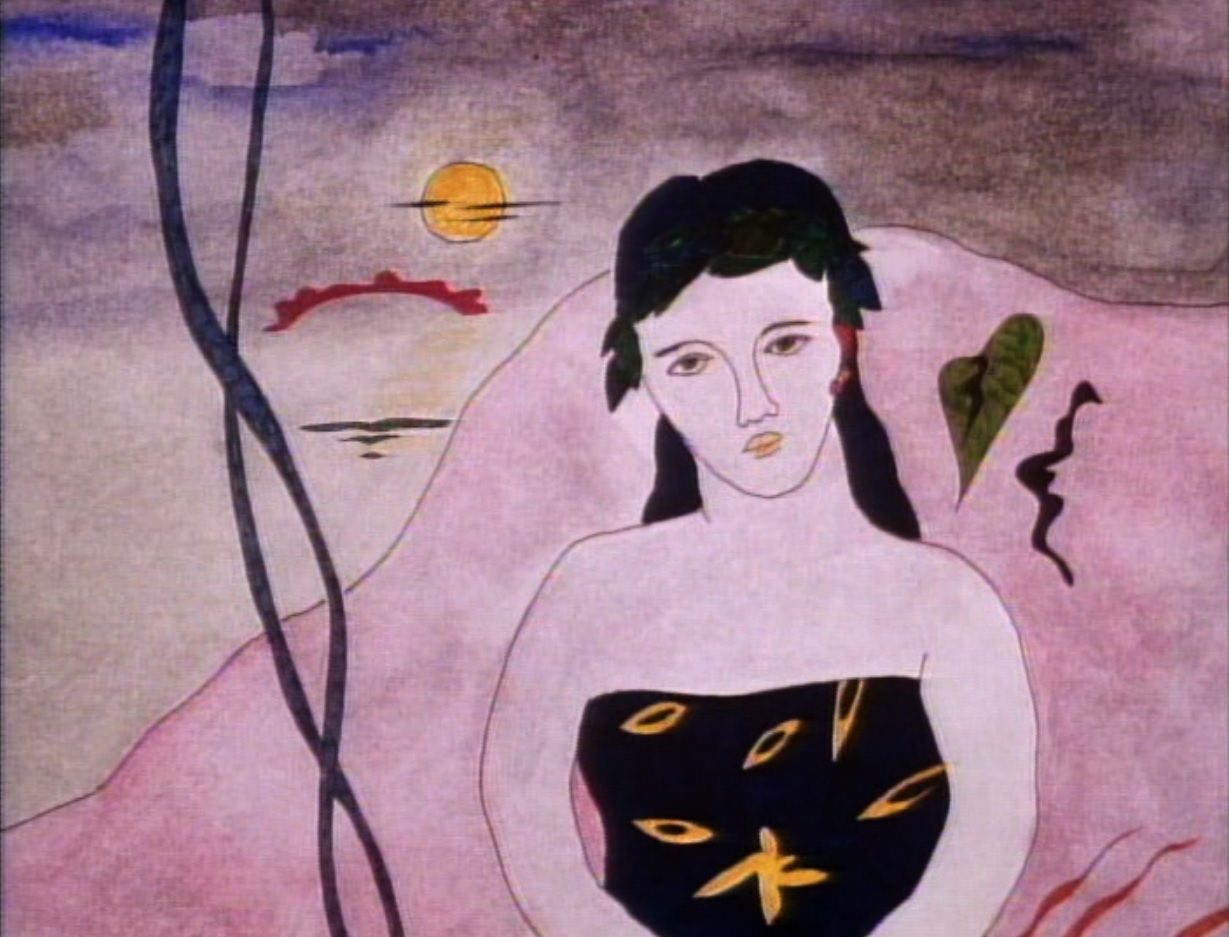
In ‘Rainbows of Hawai’i’ director Faith Hubley, ever thirsty for mythology, turns her attention to the isles of Hawaii. She retells four Hawaiian stories, in her own idiosyncratic way, using a lot of repetitive animation cycles, dancing figures, and semi-abstract, yet vibrant images.

In terms of animation most interesting is the first story, ‘Hisaka Asks the Dragon’s Permission to Enter the Forest – They Do Battle’, in which the animation of the dragon is surprisingly traditional. Most intriguing is the second story, in which a woman gives birth to a friendly green shark. The four stories are followed by a last section, titled ‘All Children Are Sacred and the Dance of Life and Death Goes on and on’, which reshuffles images from all four previous stories with images of dancing figures.

According to the titles, Hubley took inspiration from Oceanic art, but frankly, this is not really visible, as the images in ‘Rainbows of Hawai’i’ aren’t very different from those in her earlier films.

‘Rainbows of Hawai’i’ is available on the DVD ‘The Hubley Collection Volume 2’

Director: Faith Hubley
Release Date:
1994
Rating:
★★★★½

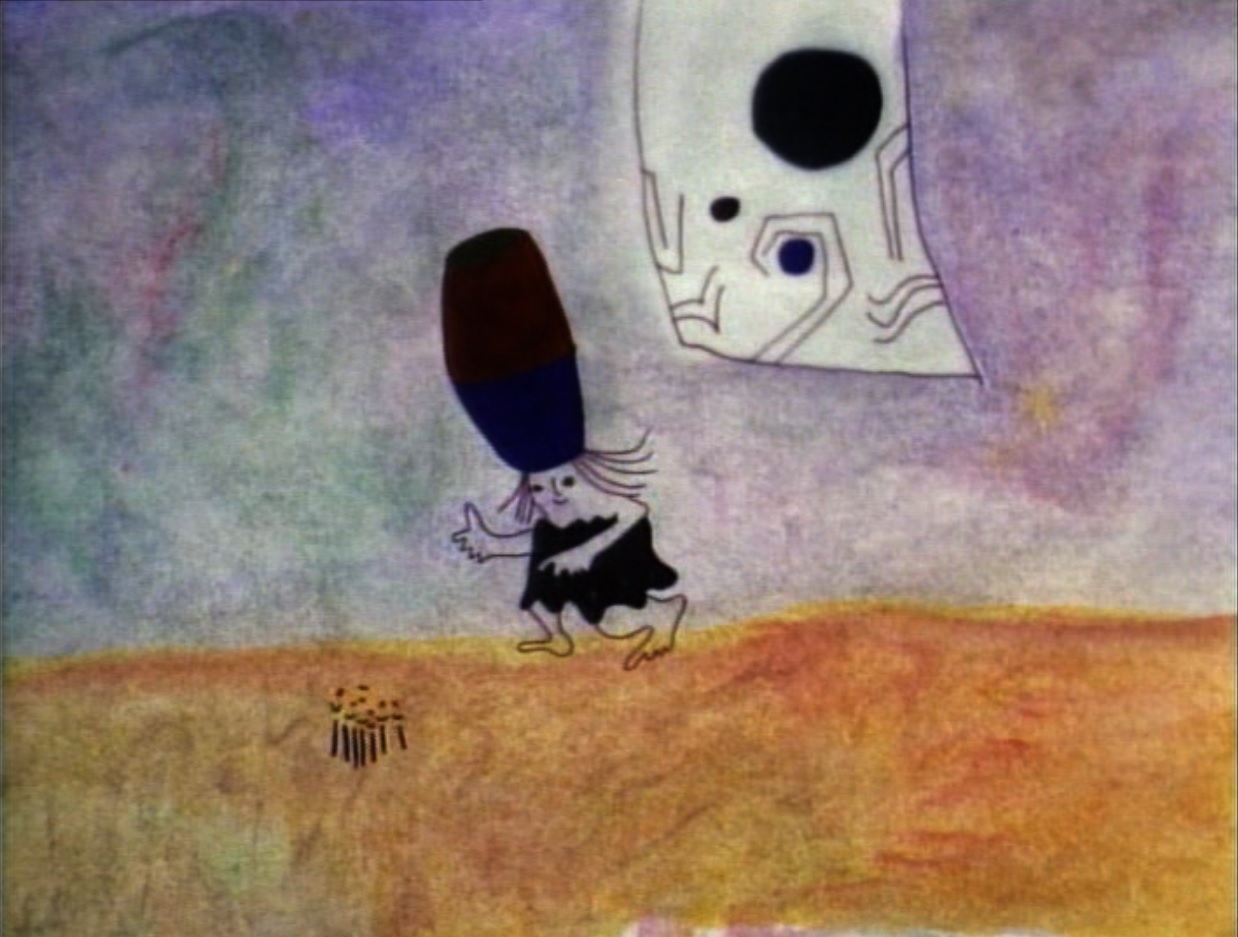
‘Seers and Clowns’ is one of Faith Hubley’s less comprehensible films. Like many of her other works, the short is drenched in mythology.

The film consists of five very short chapters, and uses citations from Chief Seattle, Lao Tse and Kabir. Throughout the film Hubley’s Joan Miró-like imagery remains beautiful, poetic and intriguing, but as most images consist of short animation cycles of semi-abstract figures dancing with joy, any story is hard to follow.

Most interesting is when Hubley’s enriches her style with Eastern influences (in ‘A Chinese Seer Divines Change’) or from Ancient Greece (in ‘Cybele’s Dream’). The mythological atmosphere is greatly enhanced by Don Christensen’s quasi-ethnic music.

Watch ‘Seers and Clowns’ yourself and tell me what you think:

‘Seers and Clowns’ is available on the DVD ‘The Hubley Collection Volume 2’

Director: Mamoru Oshii
Release Date: November 18, 1995
Rating: ★★★½
Review:

‘Ghost in the Shell’ was the best known anime film in the West between ‘Akira’ (1988) and ‘Spirited Away’ (2001). This was of course mainly because it was one of the very few Japanese features being released in the West in the first place. But what also helped was that the film merges science fiction, action thriller and philosophy into an entertaining melting pot, which a sexy cyborg as its main star.

‘Ghost in the Shell’ is based on a manga by Masamune Shirow and tells about major Motoko Kusanagi, a female cyborg, who has to track down a dangerous hacker called the ‘Puppet Master’. But when the true identity of the Puppet Master is revealed, things take a whole different turn…

The plot of ‘Ghost in the Shell’ is complex and very hard to follow. It doesn’t help that the future world in which it takes place is introduced with a minimum of background story, thus the viewer has to grab the relevant information along the way. For example, only gradually it became clear to me that practically every citizen in this future world has augmented brains, and is therefore hackable. Or that Kusanagi wasn’t an android, as I thought, but a cyborg, although we don’t see any biological tissue on her. In fact, already within the first two minutes we see her naked, with clearly defined breasts, but no genitals whatsoever, looking strangely like a Barbie doll instead.

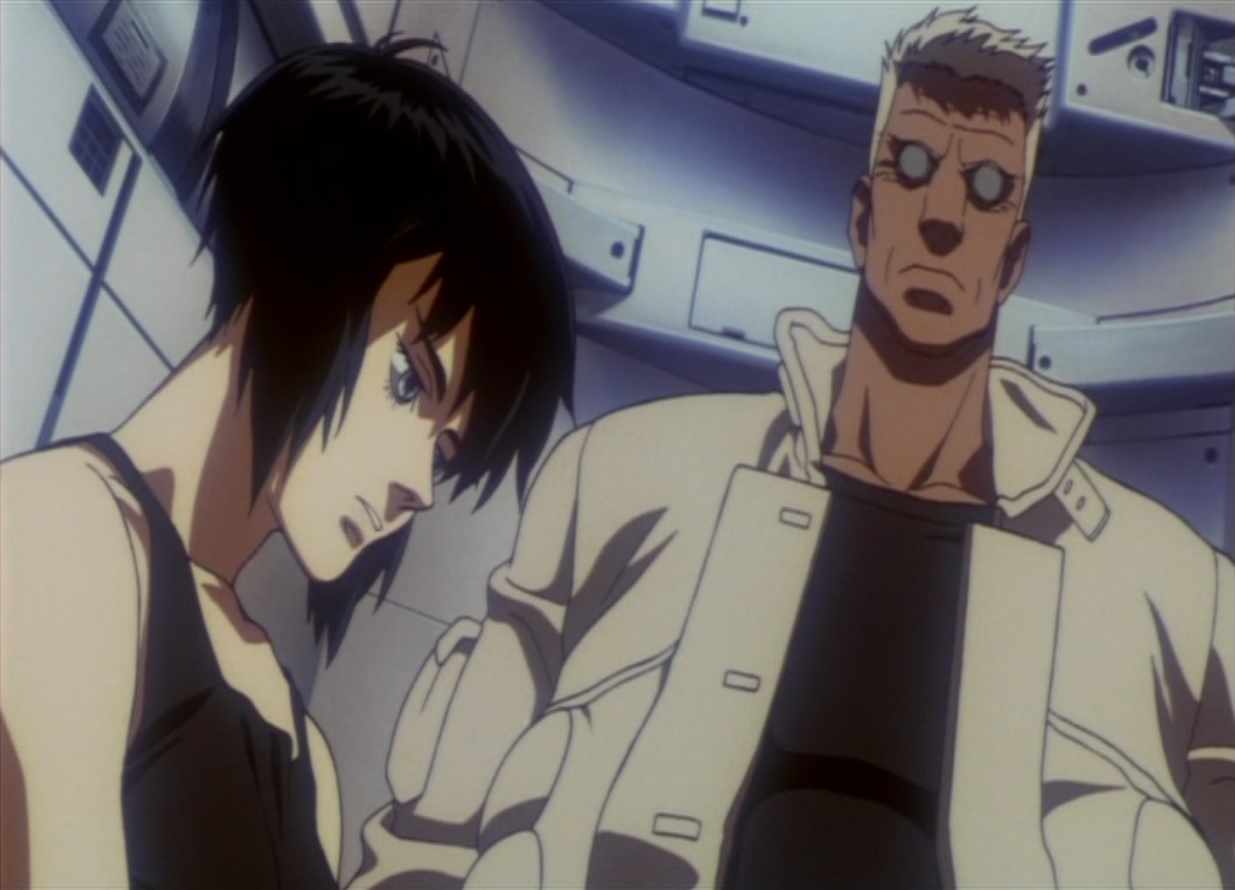
‘Ghost in the Shell’ is a true cyberpunk film, and revolves around the idea of artificial intelligence and what it means to be human or to be alive. Not only does the main plot focuses on those ideas, there are several, often rather pompous dialogues between Kusanagi and her partner, the muscular fellow cyborg Bateau, in which the two ponder the meaning of their own existence. A lot of attention goes to the mysterious ‘ghost’ within the wired neural networks, a word that the Japanese use untranslated, and which points directly to Arthur Koestler’s ‘the ghost in the machine’ (1967). The Japanese ‘Ghost’ is translated back into ‘soul’ in the subtitles, but its precise concept remains vague, and in the end both the story and these bits of dialogue are much too thin to call ‘Ghost in the Shell’ a philosophical masterpiece, for despite all the philosophical implications the film is an action thriller first and foremost.

Nevertheless, I suspect the feature was an influence on the makers of ‘The Matrix’, for it foreshadows some of the latter film’s themes, and ‘The Matrix’ quite clearly stole both the connection to the network by neck and the theme of green numbers filling the screen from ‘Ghost in the Shell’.

As a thriller the film delivers, featuring spectacular manhunts, several shootings and fights, a few bits of gross violence, and an exciting finale in an abandoned natural history museum, a setting deliberately chosen to enhance the movie’s theme of new developments within human and non-human evolution. The action is greatly helped by excellent staging and by solid background art, supervised by Takashi Watabe, evoking a partly drowned, and partly abandoned metropolis containing many different nationalities, not unlike the world of ‘Blade Runner’ (1982).

Also strong is Kenji Kawai’s musical soundtrack, which uses electronics, percussion and haunting choirs to a unique and unsettling effect. Around 35 minutes there’s even a more than a minute long gorgeous mood piece, consisting of townscapes and music only, which is pure atmosphere, and completely unnecessary to the plot.

Much less impressive is the animation, supervised by Hiroyuki Okiura. Compared to ‘Akira’ or contemporary output by the Ghibli studio, the animation in ‘Ghost in the Shell’ looks cheap and low-budget. There are many scenes in which there’s hardly to no animation at all, especially during the dialogue scenes, and talking is suggested by a bare minimum of means. For example, there’s a shot of Kusanagi talking that uses only two drawings in rapid succession. Even worse, the cyborgs can talk to each other without speaking, leaving several scenes totally unanimated. This is too bad, for when there’s more effort placed into the animation, it’s actually quite good. Especially a complex scene in a crowded market place stands out as a great piece of animated action, as does the final battle between the colonel and a robot tank. The 2d animation is often combined with rather primitive computer animation, which may have looked quite cool then, but which hasn’t aged very well. Most impressive is the use of CGI in the camouflage suits.

The character designs, too, also by Okiura, leave much to be desired. The characters are very generic, and rather angular, and lack the appeal of those in contemporary Ghibli or Otomo films. Kusanagi is hardly the sexy heroine she’s supposed to be, and often looks uncannily masculine. At least the Western characters are distinguishable from the Asian ones, a rather rare feat in anime.

Thus ‘Ghost in the Shell’ may disappoint the pure animation lovers, but will delight those interested in Japanese science fiction and cyborg themes. As such it’s a film that has aged surprisingly well. Even better, the feature’s relevance has only grown since then, as the real world has been rapidly moving towards the future depicted in the film.

In 2004 ‘Ghost in the Shell’ was followed by a sequel, ‘Ghost in the Shell 2: Innocence, and in 2017 by a live action version, starring Scarlett Johansson as the major.

Watch the trailer for ‘Ghost in the Shell’ yourself and tell me what you think:

‘Ghost in the Shell’ is available on Blu-Ray and DVD

Director: Phil Mulloy
Release Date: 1995
Rating: ★★

‘Thou Shalt Not Bear False Witness’ tells about farmer Nathan and his wife Emmylou, who have been married since they were eighteen, but who are secretly dreaming of another life.

It’s a bit unclear what the subject of ‘Thou Shalt Not Bear False Witness’ has to do with this particular commandment, and the film feels rather pointless, resulting in possible the weakest of Mulloy’s The Ten Commandment films.

Like most of the other Ten Commandments episodes the short is narrated by Joel Cutrara and takes place in Joesville.

‘Thou Shalt Not Bear False Witness’ is available on the BFI DVD ‘Phil Mulloy – Extreme Animation’

Director: Phil Mulloy
Release Date:
1995
Rating:
★★

‘Honour Thy Father and Thy Mother’ is the fourth entry in Phil Mulloy’s puzzling Ten Commandments series.

This short tells the story of Little Tucker, who is forced by his parents to run a county race, only to arrive last. This film takes place full of oil fields, and Mulloy not only uses his characteristic stark black and whites, but also some bright reds and yellows for a fire.

The short, narrated by Joel Cutrara, is rather simple and straightforward, and doesn’t really deliver its promise. Nevertheless, it contains a nice jazzy score by Dave King.

‘Honour Thy Father and Thy Mother’ is available on the BFI DVD ‘Phil Mulloy – Extreme Animation’

Director: Phil Mulloy
Release Date:
1995
Rating:
★★★

‘Remember to Keep the Holy Sabbath Day’ is the most absurd and arguably the funniest of Phil Mulloy’s ‘The Ten Commandments’ films.

The short tells the strange (and rather silly) tale of Ezechiel Mittenbender, a citizen of Joesville, Mulloys mythical town, which he had introduced in ‘Thou Shalt Not Steal‘. When Ezechiel witnesses the landing of a flying teacup, he gets abducted by evil aliens called Zogs. The Zogs want to destroy the earth, but Ezechiel saves the day by reminding the Zogs that it’s Sunday…

The Zogs have genitalia where our heads would have been and vice versa. Mulloy clearly delighted in these creatures, because they would return in his ‘Intolerance’ double bill of 2000/2001.

‘Remember to Keep the Holy Sabbath Day’ is available on the BFI DVD ‘Phil Mulloy – Extreme Animation’

Director: Phil Mulloy
Release Date:
1995
Rating:
★★½

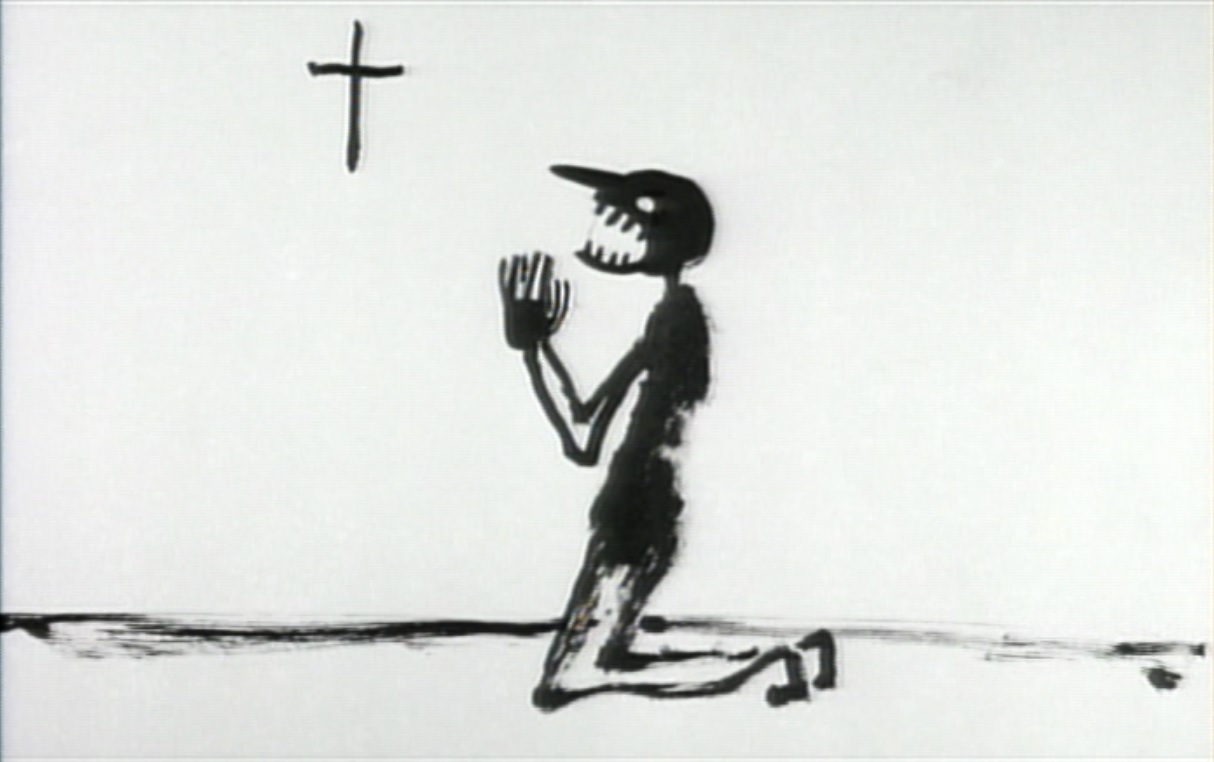
‘Thou Shalt Not Commit Blasphemy’ is Phil Mulloy’s personal take on the Noah story. The result is a rather puzzling film with an unclear message.

The story tells about a man who steals a cross from a church and replaces it with a toy boat. He’s caught by his fellow villagers, and condemned to death by being burnt at a stake. But God intervenes, causing a flood, only rescuing the man and his family.

Unlike most of the Ten Commandments films ‘Thou Shalt Not Commit Blasphemy’ does not feature a voice over, but contains a little dialogue instead, in sped-up voice tracks. Like ‘Thou Shalt Not Adore False Gods‘ and ‘Thou Shalt Not Bear False Witness‘ this short features an active and visible God. But Mulloy’s depiction of God is pretty blasphemous by all means…

‘Thou Shalt Not Commit Blasphemy’ is available on the BFI DVD ‘Phil Mulloy – Extreme Animation’

Director: Phil Mulloy
Release Date: 1995
Rating: ★★½

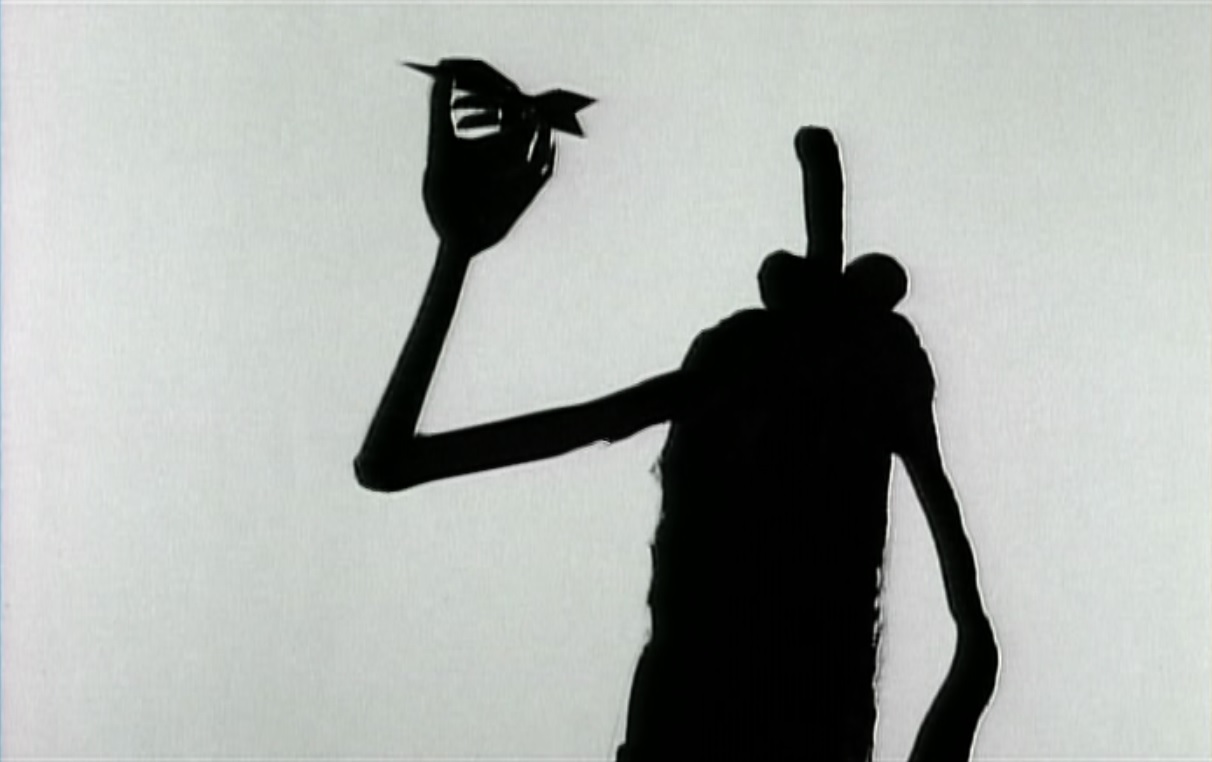
‘Thou Shalt Not Adore False Gods’ is number one of Phil Mulloy’s Ten Commandments films, even though it was not the first one made. This episode has a particularly bizarre story that makes little sense.

The short features one of Mulloy’s standard cowboys, who’s robbed by a burglar, and tied to chair in front of his piano. No-one ever releases him, but over the years he learns to play the piano with his nose.

Unlike most of the Ten Commandment films this short contains neither a voice over nor dialogue, apart from a few short cries. God himself is visible in this cartoon, being portrayed as a selfish and vain creature.

‘Thou Shalt Not Adore False Gods’ is available on the BFI DVD ‘Phil Mulloy – Extreme Animation’

Director: Douglas McCarthy
Release Date: August 25, 1995
Stars: Bugs Bunny, Daffy Duck, Yosemite Sam, Tweety, Laszlo, Penelope Pussycat, Pepe le Pew a.o.
Rating: ★★★
Review:

‘Carrotblanca’, as the title implies, is a parody on the classic feature ‘Casablanca’ (1942) and appears on several DVD releases of that film.

The short, however, originally was shown theatrically, accompanying the live action feature ‘The Amazing Panda Adventure’ in North America and the animated feature ‘The Pebble and the Penguin’ internationally. Thus, the film is a clear product of the cartoon renaissance, reviving many characters from the classic Looney Tunes and Merrie Melodies.

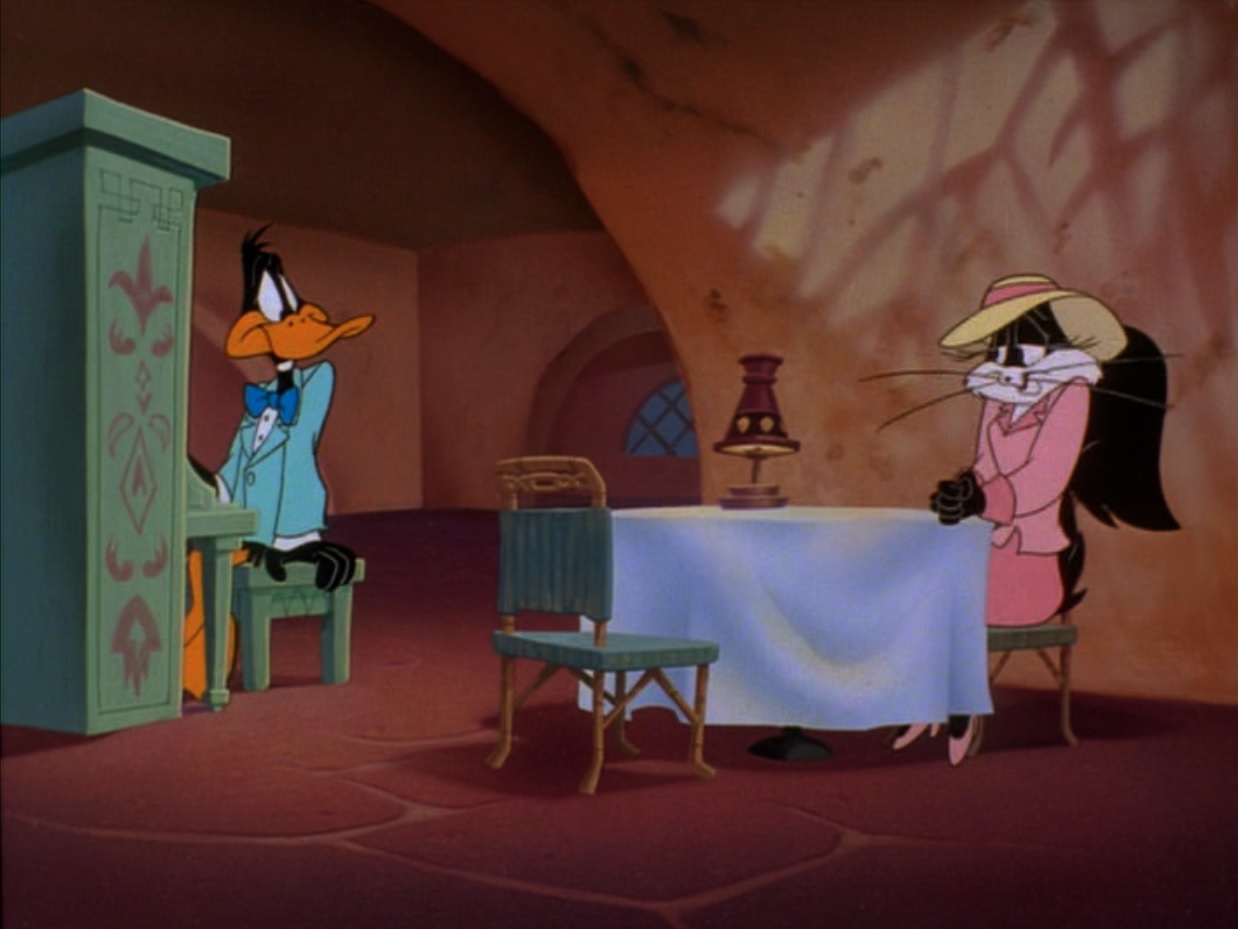
The most familiar faces have the starring roles, so we watch Bugs Bunny as Rick Blaine, Daffy Duck as Sam, Yosemite Sam as ‘General Pandemonium’, Tweety as Ugarte, Sylvester as Laszlo, Penelope Pussycat as Ilsa, and Pepe le Pew as Captain Louis. Also visible are e.g. Foghorn Leghorn, Sam Sheepdog, Porky Pig, the Crusher, Beaky Buzzard, Miss Prissy, Giovanni Jones and Pete Puma. Strangely absent are Elmer Fudd on the Looney Tune side, and Signor Ferrari on the Casablanca side.

The short compresses the original movie into a mere eight minutes, and parodies many of its classic scenes, including the flashback scene. As expected, the result is rather silly, but unfortunately not very funny, as somehow most of the gags fall flat (it doesn’t help that Tweety goes into a Peter Lorre impersonation four times). The film remains at its best when parodying the feature, but as soon as the cartoon characters go into their own routines the results get unpleasantly stale. Thus the film is more a product of nostalgia than one breathing new life into the decades old characters.

Thus ‘Carrotblanca’ may not be an essential film, yet it’s still a fun watch, I guess more for Looney Tunes lovers than Casablanca lovers. If anything, the short showed that the characters still had potential to entertain, a notion Warner Bros. cashed on with the feature length ‘Space Jam’ (1996).

Watch ‘Carrotblanca’ yourself and tell me what you think:

‘Carrotblanca’ is available on several Blu-Ray and DVD editions of ‘Casablanca’

Director: Bob Godfrey
Release Date: 1995
Rating: ★★ ★ ★
Review:

‘Know Your Europeans, UK’ is apparently the only entry in what should have been a series about all nations within the European Union, showcasing the best animation of each country.

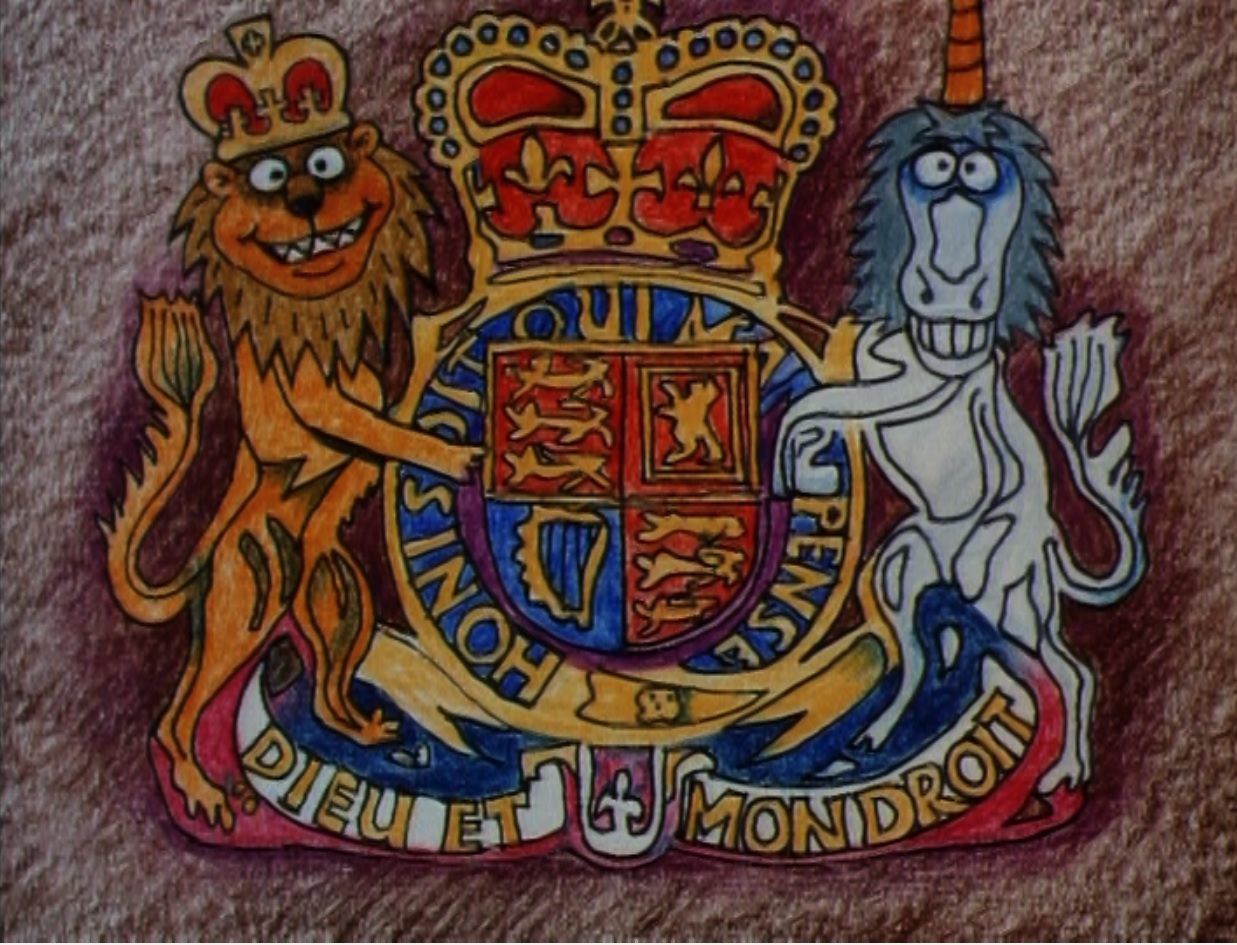
The British entry, of course, tells about the UK and its inhabitants, and Bob Godfrey and his team make the introduction to their country a particularly tongue-in-cheek affair. The film is more or less presented by (a caricature of) Prince Charles of Wales, and features a silly song (sung e.g. by the director himself, and penned to music by Sir Arthur Sullivan) and equally silly images in a rapid succession.

The short deals with British habits, British celebrities and the British weather, and is rendered in jolly pencil and cel animation. ‘Know Your Europeans, UK’ may be on the light side, it’s all in good fun.

Watch ‘Know Your Europeans, UK’ yourself and tell me what you think:

‘Know Your Europeans, UK’ is available on the DVD accompanying the book ‘Halas & Batchelor Cartoons’

Director: Chris Bailey
Release Date: August 11, 1995
Rating: ★★★½
Review:

When compared to ‘Mickey’s Christmas Carol’ (1983) and ‘The Prince and the Pauper’ (1990), ‘Runaway Brain’ is a much less classic or classy affair. Based on a story idea by Tim Hauser, it has a genuine modern setting (in the first scene we watch Mickey playing a Snow White video game) and a horror motive, not seen in a Mickey Mouse film since ‘The Mad Doctor’ (1933).

The premise of the film plays on the relationship between Mickey and Minnie: to celebrate their anniversary, Mickey has planned a trip to a miniature golf course, but Minnie mistakes it for a trip to Hawaii on the same newspaper page, and runs off, happy as she can be. Mickey, however, is horrified by this mistake, realizing he cannot afford the necessary $999,99.

Luckily, Pluto helps him out by showing him the wanted ads, and Mickey immediately finds one offering exactly this amount for only a day of mindless work. This, of course, is a less rosy proposition than it seems, and soon Mickey finds himself prisoner of a mad chimp called Dr. Frankenollie (the name is a nice reference to legendary Disney animators Frank Thomas and Ollie Johnston, and the character may be based on the mad professors Ecks, Doublex and Triplex from Floyd Gottfredson’s classic 1932 Mickey Mouse comic ‘Blaggard Castle’). This Frankenstein-like chimp swaps Mickey’s brain for a giant Pete-like monster, unfortunately dying during the process (this is the only death occurring in a Mickey Mouse film).

Mickey has never before been deformed so much as in this cartoon: while the real Mickey is trapped in giant Peg-leg Pete’s body, monster Mickey has become a rugged, wild character, running after Minnie in a chase that ends on top of a skyscraper, recalling that other great 1930s horror film, ‘King Kong’. Luckily, Mickey saves the day, and halfway a frantic chase, his and the monster’s brain get swapped back again when they both land on a power line.

‘Runaway Brain’ is a clear attempt to modernize Mickey: the short is fast paced, full of extreme angles and surprisingly gross gags (for a Disney cartoon that is). It’s not entirely successful in its attempt, however. The rather ugly color design is all too typical of the early 1990s, and Mickey’s playing of a video game actually makes the short look dated. This scene frankly adds nothing to the rest of the film, which has a much more timeless character due to its Frankenstein meets King Kong-like story.

Watching the distorted version of Mickey is rather unsettling, and it’s rather surprising that the studio allowed the animators to get away with such a deformation of their corporate symbol. Indeed, the merchandise department was far from happy with this short. Nevertheless, like the earlier ‘Mickey’s Christmas Carol’ ‘Runaway Brain’ was good enough for an Academy Award nomination, showing that Hollywood had not quite forgotten the mouse. Yet, the film understandably lost to the Wallace and Gromit film ‘A Close Shave’.

There’s much to say for the cartoon, however. The animation, supervised by Andreas Deja, is top notch, and a great example of the high standards of 2D animation of the Disney renaissance, before the threat of computer animation kicked in, and cut this development short. As one can expect, the action is relentless, and the short is over before you know it. The best gag may be when the monster discovers a picture from ‘Steamboat Willie’ (1928) in Mickey’s wallet, prompting our hero to say ‘that’s old’.

Watch ‘Runaway Brain’ yourself and tell me what you think:

This is Mickey Mouse cartoon No. 128
To the previous Mickey Mouse cartoon: The Prince and the Pauper
To the next Mickey Mouse cartoon: Get a Horse!

‘Runaway Brain ‘ is available on the DVD-set ‘Walt Disney Treasures: Mickey Mouse in Living Color Volume two’

Director: Yoshifumi Kondo
Release Date: July 15, 1995
Rating: ★★★★★
Review:

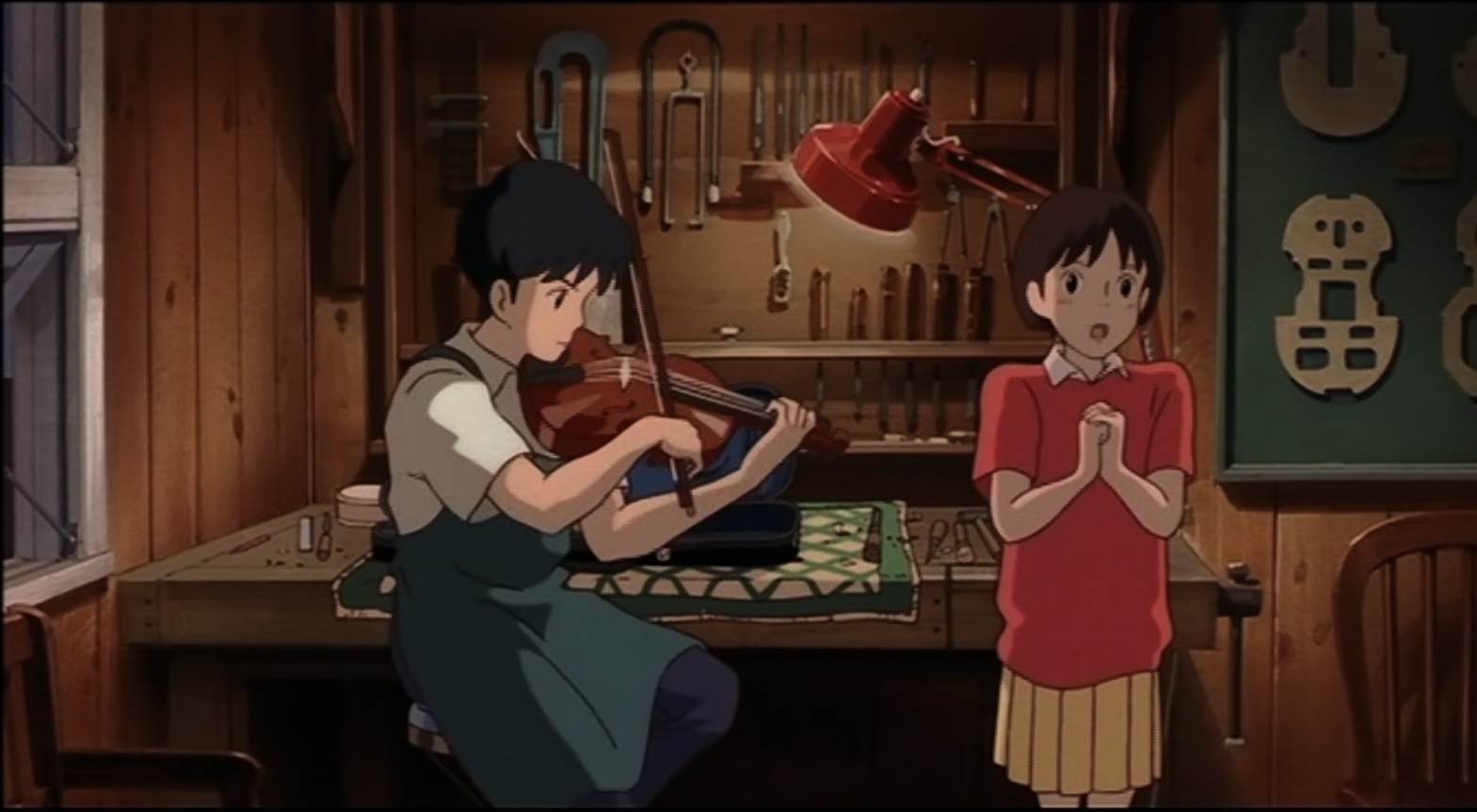
Surprisingly, ‘Whisper of the Heart’ opens with a rendition of John Denver’s ‘Country Roads’ by Olivia Newton-John, implying one of those Ghibli films with a longing for the old country side. Not so. Country Roads remains the theme song throughout the picture, but the story entirely takes place inside the city of Tokyo, and completely lacks the nostalgia of ‘My Neighbor Totoro‘ (1988), ‘Only Yesterday’ (1991) or ‘Pom Poko’ (1994).

‘Whisper of the Heart’ is one of the lesser known of the classic Ghibli films. Perhaps because it isn’t directed by either Hayao Miyazaki or Isao Takahata, but instead by the much lesser known Yoshifumi Kondō, being the first theatrical Ghibli film not directed by either founder (although it must be emphasized that Miyazaki both wrote the screenplay and storyboarded the film). Or it’s perhaps because the feature’s story is surprisingly mundane when compared to contemporary Ghibli films like ‘Pom Poko’ or ‘Princess Mononoke’ (1997). In fact, like the earlier TV-Feature ‘Ocean Waves’ the story of ‘Whisper of the Heart’ never really departs from reality, and has little need for animation. Only the scenes of Shizuku’s story, and perhaps the old clock and the journeys of the fat cat Muta may require the medium of animation.

The film is based on a manga by Aoi Hiiragi and tells about ca. fourteen year old girl Shizuku, who is very fond of reading, but who, during one hot summer, is obliged to leave her fantasy world and enter a more mature one of love and responsibility. ‘Whisper of the Heart’ thus is a coming of age story, and we remain with Shizuku and her inner development all the time.

There are times in the film that we, Western viewers, being used to certain tropes, are misled on what’s coming. For example, at one point, the imagery certainly invokes death, but not so. Also, in a Western film we would expect to watch Shizuku and her friends performing the song they’re talking about during the whole film. Or we would expect a loyalty conflict between Shizuku and her best friend Yuko. Again, nothing of the sort. Nor do Shizuku’s parents thwart Shizuku’s ambitions.

In fact, there’s absolutely no conflict, at all during the entire movie: Shizuku can boast to have loving friends, understanding parents, and a supportive older sister. Moreover, all the strangers she meets are absolutely kind. All the conflict Shizuku faces, takes place entirely in her own head. Yet, the Ghibli studio manages to craft a surprisingly engaging and deep story out of such little material, focusing not only on the love theme, but also on how to find your own talents and what it takes and what it means to be an artist. Thus the geode allegory forms the central message of the film, a message directed to us all.

Another aspect of the film is the extraordinary attention to detail of every day life, so typical of the Ghibli studio. Thus we get glimpses of Shizuku’s family living, studying and working in their tiny apartment. We watch dogs bark from a garden as Shizuku walks by, we watch shadows of trees moving on the pavements, the sun breaking through the clouds, etc. etc. All these little details enhance the realism of the film, which only departs into the whimsical when going inside Shizuku’s story. The animation, too, is of a high realism, as exemplified by e.g. Seiji’s effort to climb a steep hill on his bicycle. Only at a few takes the animation turns comical, for example when Shizuku’s class mates spy on her and Seiji.

‘Whisper of the Heart’ may lack the extraordinary fantasy of ‘Pom Poko’ or ‘Spirited Away’, and it’s certainly not as epic as ‘Princess Mononoke’, but it’s a moving film with a lot of heart, and certainly belongs to Studio Ghibli’s best feature films. Tragically, in 1998, Yoshifumi Kondō, who was thought of as the successor to the aging Miyazaki and Takahata, died prematurely at the age of 47, and ‘Whisper of the Heart’ remains the only film he directed. In 2002 Ghibli released a spin-off film called ‘The Cat Returns’, which incidentally became only the second Ghibli film not to be directed by either Miyazaki or Takahata.

Watch the trailer for ‘Whisper of the Heart’ yourself and tell me what you think:


‘Whisper of the Heart’ is available on Blu-Ray and DVD

Director: Ilze Burkovska Jacobsen
Release Date: June 15, 2020
Rating: ★★★½
Review:

The Dutch online Kaboom Animation Festival was not only about shorts, it also presented thirteen feature films, of which I have seen five, the first being ‘My Favorite War’.

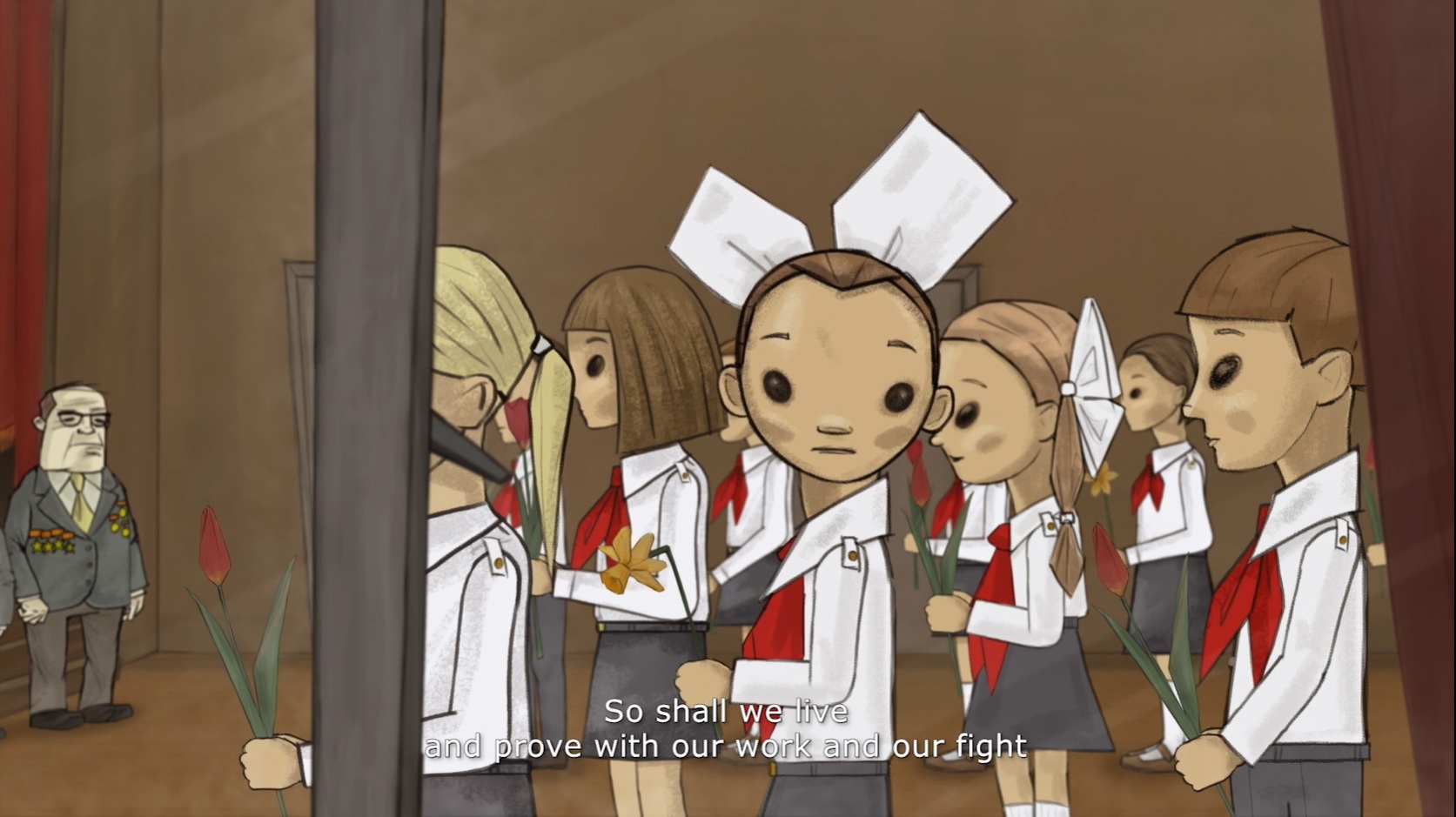
‘My Favorite War’ is an animated documentary and autobiography. In this feature film director Ilze Burkovska Jacobsen tells about her youth in Latvia when it was still part of the Soviet Union, “the self-proclaimed happiest country in the world” as she tells us at the beginning of the film. We follow little girl Ilze from 1974 until the singing revolution of the late 1980s, which resulted in Latvia’s independence of the Soviet Union in 1991.

Burkovska Jacobsen brings daily life in the communist, totalitarian regime back to life, which not only does look hopelessly old-fashioned when compared to contemporary Western Europe, but which also is strikingly preoccupied, even obsessed with its heroic past. Practically everything in Ilze’s life revolves somehow in defending the great Soviet Union against fascism, like the Soviets had successfully done during World War II (the favorite war of the title). In fact, much of Ilze’s life is devoted to a bleak and pointless preparation for a war that never comes.

Ilze lives near a site in which Nazi Germany managed to keep an isolated fastness until the general capitulation, called the Courland pocket, which Burkovska Jacobsen calls the Courland Cauldron, and near a Soviet army training site, and both localities make a marked impression on her daily education and social life. As if the Soviet Union wanted to make their inhabitants relive World War II constantly and persistently. Likewise, Burkovska Jacobsen’s tale often shifts back to the 1940s to tell what happened in the Courland pocket.

Even more tension comes from the contrast between Ilze’s father, a member of the communist party, and her grandfather, a so-called enemy of the state and a Siberia camp survivor. For example, to protect her grandfather and her mother, Ilze strives to become the best member of the communist party…

‘My Favorite War’ is a very sympathetic and welcome film, and tells very well how it is to live under an oppressive regime. Tales like this cannot be told enough, for they show us the values of freedom and democracy. But this does not mean that ‘My Favorite War’ is without its flaws: the film makes interesting use of collage techniques, but the designs are a little inconsistent, and could have done with bolder artistic choices. Worse, the cut-out animation is rather stiff, and at times downright amateurish, hampering the story. The dialogue, too, is dreadfully stiff, and too often fails to come to life, at all. Thus the characters on the screen remain wooden puppets, missing an opportunity to penetrate one’s heart. The best animation is when Ilze kicks the bucket of garbage she has to take outside. This is a rare moment of effective little realism in a tale of otherwise rather grand gestures.

In fact, the symbolic parts are the best. Especially entertaining is the sequence in which Ilze visualizes why her town is deprived from butter, supposedly because it’s saved for the Great War to come. And the film’s most harrowing tale, that of Ilze’s friend Ilga, is in fact told in live action, by the present Ilga herself. In the end one cannot escape the feeling that Burkovska Jacobsen has been relatively lucky to have lived in the twilight days of the Soviet Union, and to have experienced the thaw of Perestroika and the freedom following the singing revolution. But it comes to no surprise that the film ends as a pamphlet against all oppressors, for Burkovska Jacobsen knows well enough what she’s talking about.

Watch the trailer of ‘My Favorite War’ and tell me what you think:

‘My Favorite War’ is not yet released on home media

The Dutch Kaboom animation festival is over, but I’ll round up my reviews of the shorts in competition, ending with number six, which turned out to be the most satisfying of the seven programs on independent shorts.

Lèvres bleues (Blue Lips)
Philippe Hamelin
Canada, 2020
★★
A certain Steve tells about one night with his boyfriend. His tale is accompanied by dreamy computer generated images, showing parts of Steve and his boyfriend, interlaced with images of a canary and of Steve’s motor bike. Many of the images are shown in slow motion, and as there’s hardly any action, they are close to film stills. Steve’s tale is a sweet one, but the animated illustrations are rather boring and lifeless, and one gets distracted by images of Steve’s extraordinarily hairy body.

Praćka (Washing Machine)
Alexandra Májová
Czech Republic, 2020
★★★★★
‘Washing Machine’ is a fun little short about a man’s unconventional relationship to his washing machine. Májová uses the simplest designs and shapes on monochrome backgrounds to a great effect. Her animation and timing are spot on and even manage to turn a washing machine into an erotic element.

Jestem tutaj (I’m Here)
Julia Orlik
Poland, 2019
★★★★★ ♕
In ‘I’m Here’ we watch the last days of a dying elderly woman. Orlik explores stop-motion, using puppets of the upmost realism, not seen since the work of Suzie Templeton (e.g. ‘Dog’ of 2001). The dying woman is completely convincing and one of the most real personas I’ve seen in any stop-motion film. The story is told in many very short scenes, all taken from a single point of view, always focusing on the wrinkled lady, who isn’t able to either speak or move anymore. To watch her mostly silent distress is painful enough, but often more drama takes place in the background, as her father and daughter struggle to take care of the terminal patient.

Of the 55 shorts in competition ‘I’m Here’ was the only one that really moved me. When the title words were spoken I burst out in tears. Thus the more surprising that this film about dying was made by a student still in art school. ‘I’m Here’ won the Kaboom student award, and I say it is well deserved, because I’d crown this film the most impressive of the complete festival.

Black Snot & Golden Squares
Irina Rubina
Germany, 2020
★★★
‘Black Snot & Golden Squares’ lasts only one minute and promises us that one day we can hug again. The message is packaged in enjoyable 2D computer animation of Bauhaus-like semi-abstract images of blues, grays, yellows and blacks.

The Great Malaise
Catherine Lepage
Canada, 2018
★★★★★
In ‘The Great Malaise’ we hear a woman describing herself as for a personal ad. Her descriptions are accompanied by illustrative animations in a variety of styles and techniques, one even more original than the other. But halfway the visual metaphors get extra meaning. ‘The Great Malaise’ is a very graphic and highly original film showing the dangers of perfectionism. The film is as authentic as it is funny, and must be counted among the best of the shorts in competition programs.

Average Happiness
Maja Gehrig
Switzerland, 2018
★★★★½
‘Average Happiness’ starts with a Powerpoint presentation on statistics. Soon the graphs start to lead their own life, and the screen gets filled with diagrams, pie charts, bar charts etc. to form some very complex imagery, resembling cities and forests. Gehrig even manages to make graphs sensual. The abstract but mesmerizing mayhem is greatly enhanced by the weird soundtrack by Joy Frempong, and excellent sound design by Peter Bräker. ‘Average Happiness’ won the audience award for best short in competition, no mere feat for an abstract film!

Ja i moja gruba dupa (My Fat Arse and I)
Yelyzaveta Pysmak
Poland, 2020
★★★★½
‘My Fat Arse and I’ is a surreal and rather weird short on dieting. The short starts with the female protagonist not being able to put on her pants. This triggers a heavy diet, but the woman still sees herself as fat. On a dreamy visit to the land of walking butts she manages to beat “the God of the skinny bitches”with help of her fat image in the mirror. Pysmak explores a very rough, sketchy underground style, a modest color palette of blacks on yellow and green, and a rather rudimentary animation style. Pysmak is by no means a great animator, but her images are original and inventive, and her film, which also makes a nod to computer games, is a great joy to watch.

11:11
Alexander Dupuis
United States, 2020
★★★★
11:11 is a computer animated video clip full of ever changing, shiny and glowing abstract shapes, which form very apt images to the electronic R&B music by Raina and Jake Sokolov-Gonzalez.

My Exercise
Atsushi Wada
Japan, 2019
★★★½
‘My Exercise’ is a short comic film, lasting only two and a half minutes, in which a boy is doing exercises with help of his dog. Wada exploits his typical surreal style against a monochrome lemon background. The film is delightfully absurd, but even in these short and simple scenes Wada shows to be an excellent animator.

Hot Flash
Thea Hollatz
Canada, 2018
★★★★
This program of shorts features a lot of animation by female animators, and it’s clear that they can tackle subjects that will never be picked up by men. Thus, ‘Hot Flash’ covers a topic that I’ve never seen before in film, animated or otherwise: the menopause. In this comedy short Ace Naissmith, a weather presenter, experiences hot flashes, which hinder her greatly at her work. Not only is the subject matter highly original (which itself is weird as ca. half of humanity will experience this…), but Hollatz tells her tale very well, too. This means that men like me can relate to Ace’s plight, too. Hollatz exploits a very pleasing cartoon style, with an appealing color design. Her animation is top notch, too, and shows a great sense of comic timing.

Director: Guillaume Lorin
Release Date: 24 October 2020
Rating: ★★★★
Review:

I’m trying to cover as many films as possible from the Dutch Kaboom Animation Festival, which is completely online this year. It’s simply impossible to cover everything, as the festival shows more than 300 films, requiring several days of non-stop watching. One of the programs focuses on the French animation studio Folimage, which is known for its high quality animation films for children, like ‘Une vie de chat’ (A Cat in Paris, 2010) and ‘Phantom Boy‘ (2015). Part of this program is a new children’s film from 2020 called ‘Vanille’.

‘Vanille’ is a charming little children’s film, lasting half an hour, about Vanille, a little girl from Paris who’s sent off by her father on holiday to her aunt on the Caribbean island Guadeloupe, much against her will. Vanille has many difficulties adapting to the friendly but new environment, and she is pretty homesick. But then something magical happens, involving a so-called Soukounian, a magical creature from Creole folklore.

‘Vanille’ explores very charming human designs and sets. These are combined with live action background footage of the tropical island, and the drawings and real life pictures blend surprisingly well, despite the European cartoon style of the drawings. The story remains with Vanille and her emotions, but also shows some subtle human interaction in the background, lost on the little girl. ‘Vanille’ tells something about embracing one’s roots (a theme that revolves around Vanille’s hair), but above all it’s an exciting adventure for kids. The story of ‘Vanille’ may be a bit weird, the film is a delightful little piece for children and adults alike.

Watch a teaser for ‘Vanille’ and tell me what you think:

This will be my second-to-last review of the Shorts in Competition of the Dutch Kaboom Animation Festival, which is completely online this year, allowing you to watch the festival from your home, wherever you are. Please do so, for you can watch some very good animation films here, as well as, let’s face it, less compelling ones. Let’s find out how the fifth program fares!

Orgiastic Hyper-Plastic
Paul Bush
Denmark, UK, 2020
★★★★★
Paul Bush combines stop-motion and 2D computer animation techniques to produce a surprisingly colorful visual ballet out of ordinary plastic objects, like discarded bottles, and ditto bottle caps, lighters and combs. There’s no narration, but the images are no less than mesmerizing and accompanied by intriguing music and sounds by Andy Cowler. To me this is the most interesting film of the (Human) Nature program, and one of the best in the competition, overall. Highly recommended.

Polka-Dot Boy
Sarina Nihei
France, 2020
★★★½
‘Polka-Dot Boy’ is an intriguing traditionally animated film with hand-painted frames. The scenes are very surreal and hard to decipher, but apparently Polka-Dot Boy has some weird disease that causes polka-dots on his arms. Even worse, he gets some unwelcome attention from certain members of a religious cult. I can’t make head or tail of this film, which ends all too abruptly, but I cannot deny that Nihei’s tale is a captivating one.

Popcorn
Rafael Sommerhalder
Switzerland, 2020
★★★★
‘Popcorn’ is by far the shortest entry in the competition, lasting only 15 seconds. It doesn’t even appear to be animated. In these 15 seconds we watch a very original way of popping corn.

Candy Can
Anton Octavian
Romania, 2020
★★★
‘Candy Can’ follows a ca,. fourteen years old boy who seems to live in a slum near a garbage dump. He dreams of being a soccer player, and there’s a girl he’s clearly in love with, but otherwise it’s hard to make head or tale of this film. Nevertheless, I must say that Octavian exploits a very interesting, idiosyncratic style, strange perspectives, and attractive watercolor background art. Moreover he manages to tell his tale without dialogue. There’s a sad story looming somewhere in this film, and I wished Octavian’s images were less hard to follow.

Überfrog
Tuomas Kurtakko
Finland, 2020
★★
In ‘Überfrog’ a frog chases a dragonfly into a magical land. The tale of ‘Überfrog’ is on the shallow side, and seems only to be a frame on which Kurtakko can showcase his command of CGI. For ‘Überfrog’ is apparently the only animation film in the competition to exploit photo-realistic animation, and Kurtakko admittedly knows his trade. Unfortunately, the film feels as empty as a show reel. Much ado about nothing.

Freeze Frame
Soetkin Verstegen
Belgium, Germany, 2018
★★★
‘Freeze Frame’ is an artful black and white stop-motion film depicting ice pickers and animals trapped in ice. It’s not entirely clear wether this is a narrative film or not, but the cinematography is interesting and the sound design, by Andrea Mantignoni and Michal Krajczok very fitting, adding greatly to the film’s mysterious atmosphere.

Något att minnas (Something to Remember)
Niki Lindroth von Bahr
Sweden, 2018
★★½
‘Something to Remember’ is a curious stop-motion film in six scenes. In each scene an animal character, introduced in the scene before, sings a verse of a Swedish song. This short is well-made, with beautiful, intricate sets, but what’s the point? The film leaves me completely puzzled why it was made.

Flying Squirrels and the Pyrotechnician
Momoka Kato
Japan, 2020
★★★½
‘Flying Squirrels and the Pyrotechnician’ looks like an amateur version of anime, with garish designs, hand-colored frames and rudimentary animation. But in some respects Kato goes back to the roots of Japanese animation, albeit in color. He even exploits his own benshi, a traditional storyteller doing all the voices. Even the subject matter somehow reflects Japanese animated cinema of the 1920s. Some flying squirrels challenge the greatest pyrotechnician of the world, a little girl with an unmistakable anime design. Kato’s film certainly is no masterpiece of animation, but his short is funny and delightfully tongue-in-cheek.

Plantarium
Tomek Ducki
Poland, 2020
★★★★
‘Plantarium’ is a moody short about a man caring a garden inside a cave below the ground. One day he discovers a baby growing in one of his flower pots…

‘Plantarium’ is animated in emblematic but effective stop-motion. Ducki’s character design is intriguing, as the man and baby are seemingly made of wrinkled paper. Much better even is his lighting, which give the sets a mysterious, glowing atmosphere. At the end there’s also some traditional 2D animation.

Cage Match
Bryan Lee
US, 2019
★★★★½
A businessman finds himself trapped inside an elevator full of hostile warriors. ‘Cage Match’ is as bizarre as it is funny. Animated with ballpoint both the designs and the soundtrack are distinctly Japanese, with all the Japanese voices done by Brandon McNeil. The result is quirky, but irresistible nonsense.

This is my sixth review of the Dutch Kaboom Animation Film Festival, which is completely online this year, allowing one to attend the festival from one’s living room anywhere in the world. This time I’ll review the 4th program of Shorts in Competition, which, unfortunately, is the weakest of the seven.

De passant (The Passerby)
Pieter Coudyzer
Belgium, 2020
★★½
‘The passenger’ takes place in one long street in Belgium. We watch a character cycling this street, with the events happening in the background. All the action takes place on a very long background which we watch from right to left and back. This original idea is worked out in a kind of computer generated cut-out animation, rich in after effects. ‘The passerby’ is by all means a virtuoso piece of animation, but the drama remains distant, and the film never touches the heart. Moreover, the film uses way more dialogue than necessary, and lacks a certain show don’t tell quality, with some scenes played out way too thick.

The Last Train
Ross Hogg
UK, 2019
★★½
‘The Last Train’ tells about a very, very rowdy night train. Like in his earlier, much better film ‘Life Cycles’ (2016) Hogg uses a first-person perspective, as if the viewer is the principle actor in the film. And by all means the angular designs and the simple and tight color schemes are very appealing, but the whole film feels rather pointless and empty, and fails to make a lasting impression.

Naked
Kirill Khachaturov
Russia, 2019

In ‘Naked’ a man has the strange ability to walk through matter. This gift doesn’t bring him any joy, however. ‘Naked’ undoubtedly has atmosphere, with its faded images of degenerating buildings, but Khachaturov’s character designs are grotesque, and downright ugly. Even worse, his 3D computer animation is terribly wooden and stiff. At no point one has the idea his characters are even alive – they walk through the sets like zombies. In the end very little happens during the film, and the action is so terribly slow that these are fifteen very long minutes, indeed. Can I say I hated it? Yes, I can, I really hated this movie.

Wade
Kalp Sanghvi & Upamanyua Bhattacharyya
India, 2019
★★
Unfortunately, ‘Wade’ is not much better. This film takes place in Kolkata (Calcutta) in a near future, in which the whole city is flooded. A group of eight humans tries to survive in this hostile place. ‘Wade’ certainly is well animated, and Sanghvi and Bhattacharyya are very able to tell a story without dialogue. And yes, heads off to the background art, which is very evocative. But the characters are drawn in a semi-realistic comic book style that is, frankly, pretty ugly. Add some unnecessary gore, and a surprisingly pointless and empty story, and the end result is as disappointing as it is forgettable.

Asim C – Brown Skin
Ingi Erlingsson
UK, 2020
★★½
This is a video clip for the British rapper who tells us about institutional racism in the UK. Erlingsson exploits 2D computer animation to bring us an impressively drawing rich clip, in which Asim C floats down past all kinds of political symbols and images. This video is by all means well-made, if not too subtle agitprop.

My Galactic Twin Galaction
Sasha Svirsky
Russia, 2020
★★★
In ‘My Galactic Twin Galaction’ the film maker tells us what story he wanted to present us, and how it got different in the end. The voice over is accompanied by 2D computer animation in a very avant-garde, underground style, employing pen drawings and collage techniques. The tale itself is outlandish to begin with, and the images are downright insane. ‘My Galactic Twin Galaction’ resembles little else, and certainly is the most adventurous and one of the more satisfying films of this program, even if it never becomes near anything serious.

Affairs of the Art
Joanna Quinn & Les Mills
UK, Canada, 2021
★★★★½
In ‘Affairs of the Art’ a middle-aged woman tells us about her passion for art, about the quirky obsessions of her husband, her grandmother, and especially her elder sister, who even in her youth had a morbid fascination for death and decay.

‘Affairs of the Art’ is a very funny film, showing perfect comic timing, but most of all this is a very, very, very well-animated film. Quinn’s full animation style is refreshingly accomplished. She has perfect command of perspective and the human body, and exploits all classic techniques, like squash and stretch and follow-thru to a seemingly effortless effect. What a delight to watch such a high quality of animation again amidst all experimental, but often wooden and lifeless films crowding all the competition programs! Joanna Quinn is only 59 (in fact the same age as the narrating character in this film), but she already feels as a Nestor, as a master from a past in which full animation was practiced much more. I certainly hope she can pass on some of her extraordinary skills to a next generation.

Enter your email address to follow this blog and receive notifications of new posts by email.

Join 915 other subscribers
Bookmark and Share

Categories