I continue my reviewing of the Dutch Kaboom animation film festival with another entry of Shorts in Competition. The festival is 100% online, and can be viewed from everywhere. I’m watching complete programs, but you can easily browse and watch individual films, if you’d please. Anyway, on with the review!
Précieux (Precious) Paul Mas France, 2020 ★★★½ ‘Précieux’ is a rather disturbing stop-motion film about Julie, a little girl who doesn’t quite fit in in her class. Then one day, Émile arrives, an autistic child…
‘Précieux’ is a film about bullying and child cruelty. Mas’ stop motion is very effective in letting Julie’s complex emotions come across. In this film all the kids look the same, except for Julie and Émile, accentuating their disconnection to the rest of the class. The adults are not really helpful, either, and in the end the lesson Julie learns is a very doubtful one.
Genius loci Adrien Mérigeau France, 2019 ★★★★½ In ‘Genius loci’ we’re inside the head of Reine, a young black woman who appears to be seriously traumatized. Unfortunately, it’s hard to decipher what’s going on inside her head, because Reine seems to be hallucinating almost all the time. The narrative is difficult to follow, anyway, as the animation often switches from the real to the abstract and back. The images, partly based on the artwork of celebrated comic artist Brecht Evens, are absolutely gorgeous, however. Mérigeau en Evens exploit a form of digital water coloring, and often the images are reminiscent of Paul Klee and Der blaue Reiter. One part is done in another very attractive style evoking woodcuts. ‘Genius loci’ is a rather challenging, even hermetic film, but an absolutely beautiful one, with practically every frame being a beauty of art.
Wood Child and Hidden Forest Mother Stephen Irwin UK, 2020 ★★★ Animation films can be weird, but some are very weird. ‘Wood Child and Hidden Forest Mother’ is one of those films prompting the question how one comes up with this shit. The film’s story is no less than insane and the images are an amalgam of utter strangeness.
The film starts with a hunter shooting everything in sight. Then he discovers a little gnome… Irwin exploits a sort of digital cut-out animation, with lots of added aftereffects. His designs are a pleasant, if disturbing form of underground, akin to Gary Baseman and Dave Cooper. If you’re in for something mental, this is the film for you.
Já fólkið (Yes-People) Gísli Darri Halldórsson Iceland, 2019 ★★★★ This comedy short follows the life of six people living in the same apartment block. The only featured dialogue is ‘já’ (yes), hence the title. Halldórsson exploits a very handsome 3D computer animation style, making clever use of photographic backgrounds of 1970s interiors. The characters and backgrounds are blended by rendering them both into a grainy overall style. ‘Yes-People’ is less impeccable and less funny than the similar, but much more accomplished ‘Flatlife’ (2004), but still a fun short to watch.
Bach-o-matic Vincent Flückiger Switzerland, 2020 ★★★ ‘Bach-o-matic’ is a short comedy film in which Johann Sebastian Bach visits a photo booth. The result is amusing if forgettable nonsense in a charming black and white cartoon style, rendered in effective 2D computer animation. The best part may be when Bach plays a Moog synthesizer.
Dziewczyna z filmu porno (The Girl from the Porn Movie) Janek Koza Poland, 2020 ★ This is a music video to a song by Polish singer-songwriter Hiob Dylan. Dylan accompanies himself with a pleasing banjo, but unfortunately his song is rather talkative, and Koza’s black and white images full of simple, sketchy drawings rather uninteresting. It doesn’t help that many images recur within the short time frame of 5 minutes.
Mom – The Worst Punishment Su-kyoung Kim & Kyeong-wook Jo South Korea, 2019 ★★ This film starts at some space station called ‘Gonjan Doron-X’ but turns out to be a film about the plight of Korean mothers. Unfortunately, Kim and Jo try to tell their message in a rather ugly and wearisome comic style and fairly traditional 2D computer animation. The images are too often blunt and overblown, verging on downright propaganda, and one longs for a more sophisticated approach to get the welcome message across.
The third program of Shorts in Competition of the Dutch Kaboom Animation Festival is called ‘Stranger Things’, and rightly so, because this is quite a bunch of weird animation films. And to think there’s also a program called ‘Bonkers Shorts’… Remember, this festival takes place completely online, and you can tune in and watch endless animation films, anytime (until Sunday the 4th that is).
The Surrogate Stas Santimov Ukraine, 2020 ★★★ ‘The Surrogate’ is a body horror story in the tradition of Charles Burns. Santimov manages to tell his creepy tale without dialogue, and his digital painting animation fits the uncanny, even repulsive narrative very well. Unfortunately, the short seems to end prematurely.
Warum Schnecken keine Beine haben (Why Slugs Have No Legs) Aline Höchli Switzerland, 2019 ★★★★★ This funny little parable tells us about three very slow slugs (still with arms and legs), who lead a very relaxed life inside the fast and busy insect world. Unfortunately, they grow more and more at odds with their economical surroundings… ‘Why Slugs Have No Legs’ indeed reveals why slugs don’t have legs, and elevates the slug to a life-loving creature, free from the duties of the world. Höchli’s drawing style and traditional animation are both very attractive, and the tale is told very well through the animation only. The fun atmosphere is greatly enhanced by the use of two weird tunes by Bollywood singer Gurpreet Kaur.
Black Sheep Boy James Molle France, 2018 ★★★ In ‘Black Sheep Boy’ the main protagonist Boy tries to find the meaning of life. On his voyage he meets all kinds of characters, who are all struggling with life in their own way. Molle’s 8bit designs and vintage computer-game style of animation contrast greatly with the philosophical themes of this short. The dialogue is displayed under the scenes, while the characters utter electronic sounds. The result is a cartoon of utter weirdness, but also one that could have used some editing and with its 15 minutes length outstays its welcome.
Elo (Tie) Alexandra Ramires France/Portugal, 2020 ★★ ‘Tie’ is a dark, surreal and wordless tale of a man and a woman finding each other at a swamp. The events are bridged by images of a rotting carcass of a dog. Although ‘Tie’ is essentially a tale of love, the atmosphere is grim and rather unsettling, with Ramires’ scribbly animation taking place on a dark canvas. The result is weird and original, but also a bit tiresome, and not very rewarding, with the weirdness giving way to a fairly conventional ending.
Jo Goes Hunting – Careful Alice Saey France/The Netherlands, 2019 ★★★★ ‘Careful’ is a very attractive videoclip for the otherworldly indietronica music of Jo Goes Hunting. The strange sounds are accompanied by virtuoso 2D computer animation depicting circles, in which all kinds of plants, animals and humans can be detected. Sacy’s employs a handsome graphic style, and a beautiful color design. Both music and images are simply mesmerizing in their strangeness, and this non-narrative short is over before you know it.
Good Chun-ting Ou Taiwan, 2020 ★★½ In ‘Good’ a little girl tries to be good, in fact, way too much so. Ou’s 2D computer animation is attractive, but at times becomes quite disturbing. Some of the girl’s facial expressions are pretty unsettling. ‘Good’ may show us that mere perfectionism will bring us nowhere, on the contrary.
Strange Occurrences: Bukit Bulabu Shi Teng Wong, Gloria Yeo & Hana Lee Singapore 2020 ★★★ ‘Strange Occurrences: Bukit Bulabu’ is a spoof of ghost hunting programs on television. This ‘episode’ focuses on a supposedly haunted toilet and features interviews with three people. The short never becomes serious, but Wong, Yeo & Lee’s stop motion is top notch, giving the rather simple puppets a very believable presence during their interview sessions, giving their characters natural gestures comparable to the work of Aardman. Nevertheless, it’s nice to watch the use of jiggly pieces of paper as tears. ‘Strange Occurrences: Bukit Bulabu’ makes no sense, and cannot be taken seriously, but it does show that Wong, Yeo & Lee are very able stop-motion animators.
Seoulsori Kyoung-bae Kim South Korea, 2020 ★★★ Seoulsori is a music video for an instrumental track by South Korean rapper Peejay. The video starts with a bespectacled man looking at a painting. Before soon, he’s immersed into a nightmarish world. Kim’s 2D computer animation is accomplished, if rather derivative, and the constant flow of images is a perfect companion to Peejay’s attractive triphop music.
This is my third program review of the Dutch Kaboom Animation Festival, which is completely online this year, allowing one to watch more than 300 films from his own home. Today I’ll focus on the commissioned shorts in competition. This is a short program, lasting only 45 minutes, but with its 16 short films this turns out to be long enough.
Clipphanger: Waarom worden meisjes ongesteld? (Why Do Girls Get Their Period?) Natali Voorthuis The Netherlands, 2020 ★★★★ This Dutch animation short tells children in ninety seconds why women have a period. The voice over is accompanied by cartoony visuals in a traditional style that are simple and effective to get the message across.
#Stolen Memories: Johannes Leo Rey Germany, 2020 ★★★ In this very stylized short Johannes tells his life story. During the film it becomes clear that Johannes’s memories are reconstructed from the little material we know from his life, for Johannes perished in a concentration camp during World War II. Hence the title ‘stolen memories’. The narrating voice over is accompanied by stark and highly stylized black and white images rendered in effective 2D computer animation. The result is a very effective film on the cruelty of war.
A Dog by Your Side Selina Wagner United Kingdom, 2019 ★★★½ The message of 2 minutes long film I that “life is better with a dog by your side”. Wagner illustrates this with very beautiful 2D computer animation of semi-transparent silhouettes against gorgeous colored backgrounds. The film illustrates several phases of a life in rapidly succeeding short scenes set to music. Apart from the beautiful artwork Wagner’s inventive use of frames should be mentioned.
Halloween Promo -Veronica Sverre Fredriksen The Netherlands, 2020 ★★½ This is a very short promotional film, lasting only 27 seconds. The Halloween theme is evoked in rather old-fashioned stop-motion, which is as amateurish as it is evocative.
Clipphanger: wat was apartheid? (What Was Apartheid) Hilde Buiter The Netherlands, 2020 ★★★½ A second entry in the Clipphanger series, which apparently explains several subjects to children in a mere ninety seconds. Buiter illustrates the explaining voice over with images in traditional animation in a simple, cartoony style and rather jumpy animation, which, combined with the strong sound-effects, reach their goal easily.
De scheppende mens (The Creator) Maarten Treurniet The Netherlands, 2020 ★★★★½ This short showcases the importance of art and design, both intrinsically as economically. This message certainly is a very welcome one in The Netherlands, in which the attention for the arts have been in a steady decline the last ten years. Treurniet accompanies the explaining voice-over with very attractive moving infographics in 2D computer animation in a graphic style that harks back to the 1950s.
Facing Water Daphna Awadish Israel, 2019 ★★ ‘Facing Water’ is an acoustic song on water, illustrated with painted animation, combined with highly edited live action footage, resulting in a rather granular visual style. The images are poetic and evocative, but the film the film floats by calmly without making a lasting impression.
Gardener & Bumblebee Ignas Meilunas Lithuania, 2020 ★★★ In only 34 seconds Meilunas tells about the importance of bumblebees for gardeners in Lithuania. The narration is illustrated with very charming, if rather childish stop-motion, more fit for toddlers than the intended audience.
Gouda Cheese Experience Mindset Stef Holtz The Netherlands, 2020 ★ Some commissioned films feel more heavily edited by their commissioners than others. This opening short for the ‘Gouda Cheese Experience’ in Gouda comes across as if all heart has been taken out of it due to too much influence from the commissioning Cheese industry. Holtz’s 3D computer animation is of a reasonable quality (especially his rendering is very good), but his visual style is awfully conventional, and the end result pretty annoying. ‘The Gouda Cheese Experience Mindset’ completely misses the mark, and I pity the poor audience having to sit through it.
Let Love Live on Daniel Stankler UK, 2020 ★★★ ‘Let Love Live on’ is a ninety second promotional film for organ donation. Stankler illustrates this with 2D computer animation, in a very bold and handsome indie design, which is completely his own. Unfortunately, I’m not sure whether his vague images make the message come across.
Tonke Dragt: An Animated Biography Iris Frankhuizen The Netherlands, 2020 ★★★ A charming biography of Tonke Dragt, one of the best children book’s writers of The Netherlands. This biography only lasts ninety seconds, and makes clever use of several of Dragt’s famous book titles. Frankhuizen’s visual style and 2D animation is pleasant and colorful, if rather unassuming.
Letter to My Body Elyse Kelly US, 2020 ★★ ‘Letter to My Body’ is a poem, which Kelly illustrates with virtuoso 2D computer animation, partly based on drawn and painted material. Kelly’s sense of color must be noted, but the most interesting aspect of this film is the camera, which constantly moves to the right. Otherwise neither the poem nor the visuals make any lasting impression.
Life at Oranjehotel Studio Motoko The Netherlands, 2020 ★ ‘Life at Oranjehotel’ is by far the longest film in this program, lasting 12 minutes. Unfortunately, it’s also the most disappointing one. The short tells about a prison in Scheveningen in which people of the resistance were imprisoned during World War II. No doubt this black episode in Dutch history needs attention, but Studio Motoko uses a hideously ugly combination of 2D graphics and 3D computer animation, which they hardly master. Especially the human movement looks wooden and unnatural. In fact, the looks of this film are so deplorable, I stopped watching it after several minutes. This is a pity, because the concept art shown during the end titles is much, much more attractive.
Warming up: Vliegen Sverre Frederiksen The Netherlands, 2020 ★★★½ Frederiksen returns with another stop-motion illustrating the disastrous emissions of short flights within Europe. As in ‘Halloween Promo – Veronica’ Frederiksen’s stop-motion is very simple, even rather old-school, but highly effective. He certainly does manage to get the message across in a mere 41 seconds.
Whatever You Call It Moth Studio UK, 2019 ★★★★½ This is a delightful little short featuring a happy song about death. Moth studio illustrates all synonyms of dying featured in the song with charming, child-friendly 3D computer animation to a highly entertaining effect. These are 70 seconds very well-spent, indeed.
Jabberwocky Sjaak Rood The Netherlands, 2020 ★★★ The animator of ‘Coffee’ (2012) and ‘At First Sight’ (2018) illustrates Lewis Carroll’s famous nonsense poems in his idiosyncratic scribbly pen style. Unfortunately, Rood clearly makes some shortcuts in animation, hampering the illusion of movement, and some parts of this 2 minutes long film are hardly animated, at all. The result looks a little cheap. Moreover, Rood’s cartoony rendering of the poem fails to evoke its weirdness. Thus, ‘Jabberwocky’ may be fun, it’s not the best illustration of Carroll’s work. Nevertheless, ‘Jabberwocky’ is a nice little fun short. Note Mark Nieuwenhuizen’s quasi-medieval music in the background.
This is my second program review of the Dutch Kaboom Animation Festival, which is completely online this year, allowing one to watch more than 300 films from his own home. I’ll hope to review several more.
The Physics of Sorrow Théodore Ushev Canada, 2019 ★★★ Based on the novel of the same name by Bulgarian writer Georgi Gospodinov this half an hour long film use a voice over telling partly of youth memories and partly giving us a bleak, depressive outlook on life. The narration is accompanied by stunning painted images, mostly in browns and ochers. These images are essentially realistic, but often very expressive and sketchy, verging on the abstract, with the impasto strokes being very visible. Nevertheless, one can see that they’re often based on live action footage.
Ushev’s animated paintings are by all means a visual tour de force, but frankly the voice over is already very evocative without them, and one wonders whether the novel really required these moving illustrations.
Vieille Peau (Old Hag) Nicolas Bianco-Levin, Julie Rembauville France, 2020 ★★★½ ‘Old Hag’ is a short comedy film in which a French business man visits a voodoo witch doctor in the middle of a Louisiana swamp. He wants the witch doctor to do something for him… ‘Old Hag’ is animated traditionally and has a classic visual punchline. The result is entertaining, albeit on the shallow side.
Meow or Never Neeraja Raj UK, 2020 ★★ In this rather quirky mini-musical a kitten is on her way to planet B-206 in her cardboard box-shaped spaceship to find the meaning of life. Will she find it?
‘Meow or Never’ is as odd and tongue-in-cheek as it is trite and tiresome (especially the musical parts get on the nerve), but the stop motion animation is wonderful. Especially noteworthy are the gorgeous sets, which have a very attractive handicraft look. During the hallucination scene the film switches to traditional animation, which is also fine, if lacking the charm of the stop-motion scenes.
Pilar Yngwie Boley, JJ Epping & Diana van Houten The Netherlands, 2020 ★★★½ ‘Pilar’ tells about two people who are trying to survive in some post-apocalyptic world, barricading themselves against something rather unclear. However, more interesting than the story are the film’s visuals. The film uses no dialogue or music, but features very virtuoso painted animation on a visible canvas, and fitting sound effects. The color designs and animation are both of a stunning quality. It’s a pity the film makers couldn’t tell a more engaging story with their admirable command of technique.
Kosmonaut (Cosmonaut) Kaspar Jancis Estonia, 2019 ★★★★ ‘Cosmonaut’ tells about an aging ex-Cosmonaut, who lives in an apartment with his daughter and son-in-law. After some images of the young Cosmonaut in space we watch the apartment in a state of disarray, with the woman frantically trying to set things straight. We’ll soon learn how this has happened…
‘Kosmonaut’ is told without dialogue in very clear traditional animation, featuring Jancis’ own version of the ligne clair drawing style. The film exploits an almost perfect unity of space and time, with all the action taking place inside or just outside the tiny apartment. The film is much less absurd than we’re used to from Eesti Joonisfilm, but still has its quirks. The story has its funny moments, but is mostly tragic, with its protagonist living in the past, as the present clearly has nothing to live for.
The Dutch Kaboom Animation Festival, a 2019 fusion between the original Klik! and Holland Animation Film Festivals, has started yesterday. Because of the Covid-19 pandemic the festival is completely online, with few real-time events, allowing the viewer to complete his own program out of the more than 300 shorts and features. More on the festival, which can be watched in ‘total’ for a mere €14,99: www.kaboomfestival.nl.
The advantage of this is that one can make notes immediately after watching a film, the disadvantage, of course, is that making notes and blog posts means watching fewer films. I’m curious how I’ll balance this act. Anyway, I’ve chosen not to browse too much, but to watch complete programs of films. Yesterday I saw two of the seven Shorts in Competition programs: No. 1 and No. 7. This post will be about No. 1, which consists of eight brand new and very different films:
Kkum Kangmin Kim South Korea, US, 2020 ★★★★ In this intriguing black and white film Kangmin Kim tells about four dreams his mother had about him. The result is a gentle ode to the film maker’s mother, which stands out for its original looks and technique, using stop motion animation of simple, angular shapes out of Styrofoam.
On est pas près d’être des super héros (And Yet We’re Not Super Heroes) Lia Bertels Belgium, Portugal, France, 2019 ★★½ Animator Lia Bertels illustrates the musings of nine children on growing up with poetic images, mostly in blues. Her images are very beautiful, but also associative, and often only remotely related to the voice over texts. Unfortunately, the images are less interesting than the text, and add little to it. In this respect one must judge this film a cinematic failure.
Dayfly Baoxingchen Yi China, 2020 ★★★★½ ‘Dayfly’ is a strikingly beautiful film on life and death, using the mayfly as a central metaphor. Baoxingchen Yi exploits an extraordinary array of styles and techniques, even live action, and shows a stunning command of metamorphosis and perspective animation. Also noteworthy is her creative use of split-screen techniques, and the moving, melancholy soundtrack. The result is a surprisingly idiosyncratic film to come out of China.
Shapes.Colours.People. And Floating Down Peter Millard UK, 2020 ★ Simple painted faces change into abstract shapes and back, in hard primary and secondary colors, accompanied by a hectic soundtrack by the film maker himself, which is more interesting than the repetitive images. Clocking just over three minutes this film feels three times too long.
Little Miss Fate Joder von Rotz Switzerland, 2020 ★★★½ In ‘Little Miss Fate’ a man tries to reach his girlfriend in time, but God decides otherwise. But then God’s cleaning lady takes over… This is a rather strange, quite surreal comedy in a unique underground style, with a fitting synthpop soundtrack by Philipp Schlotter.
Invade Man Sze Wong Hong Kong, 2020 ★★ Abstract images, made with charcoal accompany the progressive rock music of More Reverb. The images are mostly fuzzy, organic shapes, but at times we can see squares. Unfortunately, the music is far more interesting than the images.
Cherry on the Cake Chloé Farr Belgium, 2020 ★★★★ ‘Cherry on the Cake’ is a very strange and highly original comedy. Farr’s visual style is completely her own, but the animation is clearly based on that of vintage video games, with fitting sound effects and dialogue in text balloons.
Ties Dina Velikovskaya Germany, Russia, 2019 ★★★½ In ‘Ties’ a young woman leaves her parents in Russia to live on her own in Berlin, but she remains tied to her parental home… literally. This film seems to want to say something about being connected to one’s parents and to start a life on one’s own, but unfortunately remains stuck in a nice, but one-dimensional gag. Much more interesting is the film’s visual style: the characters and objects in ‘Ties’ are animated in 3D pen, a technique I’ve never seen before. These animated images blend in cleverly with the real 3D wire objects, and are truly awe-inspiring.
Director: Steven Weston Release Date: 1995 Rating: ★ Review:
‘The Wrong Brothers’ features two brothers who attempt to fly all their lives. In fact, we watch four attempts at different ages.
Now, this may sound like a good and fun idea, but the execution is terrible. The whole film has a very ugly design, very dated computer animation, very bad timing, a very unappealing sound design. Add and an all too predictable ending, and the result is a film that unfortunately can best be forgotten.
‘The Wrong Brothers’ is available on the DVD ‘The Best of British Animation Awards 1’
Director: Ian Sachs Release Date: 1995 Rating: ★ Review:
‘Scat, the Stringalong Cat’ is a short children’s film clearly inspired by Osvaldo Cavandoli’s great La Linea series.
Like La Linea ‘Scat, the Stringalong Cat’ takes place on a single line in a monochrome background (this time blue). However, unlike La Linea, Scat consists partly of body parts not belonging to the line. Scat has visible eyes, red nose and whiskers that are completely his own.
In this film Scat goes fishing, but he only manages to catch boots.
The 2D computer animation is mediocre, and Sachs’s timing is terrible, with as a result that all his attempts at gags fall flat. What certainly doesn’t help is the ugly electronic soundtrack. In short, ‘Scat, the Stringalong Cat’ fails completely, where La Linea succeeds: in making us laugh.
‘Scat, the Stringalong Cat’ is available on the DVD ‘The Best of British Animation Awards 1’
Director: Erica Russell Release Date: 1994 Rating: ★★★★★ Review:
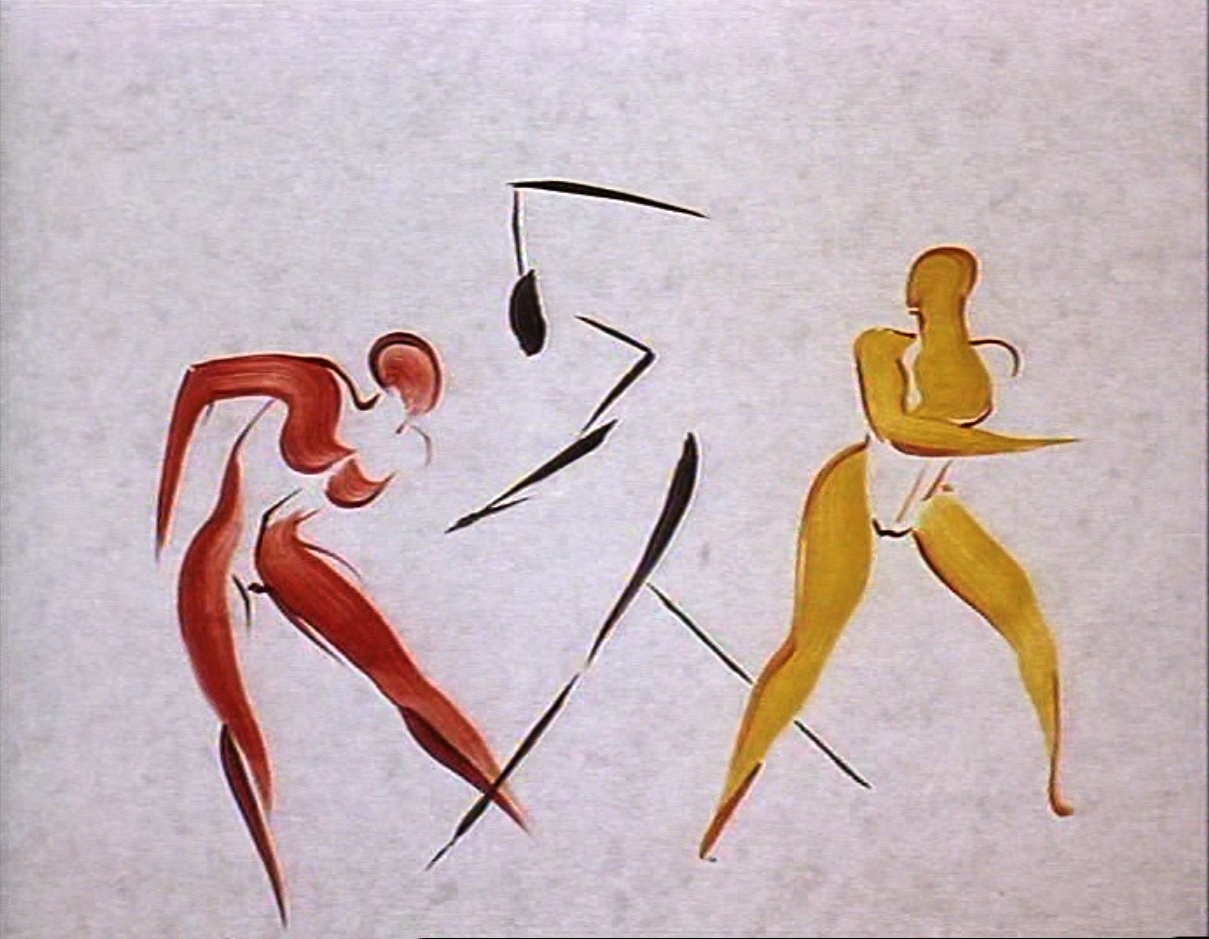
Six years after ‘Feet of Song‘ Erica Russell returned with another extraordinarily beautiful dance film, this time using three dancers in a triangular relationship.
During most of the dance two women compete for a man, and the film features several dances between the man and either one of the women, the two women together, and, in the end, all three together.
The fluency of the movement combined with the elegance of Russell’s paintwork make the film a delight to watch. During most of the film the three dancers remain recognizable as human forms, but at times they change into almost abstract forms, with a strong Bauhaus influence.
Despite the high level of abstraction ‘Triangle’ is a very sensual film, and one never loses the idea that the film is about three characters with solid bodies, no matter how sketchily drawn. Charlie Hart’s score fits the images very well with its quasi-African touch to it.
Watch ‘Triangle’ yourself and tell me what you think:
‘Triangle’ is available on the DVD ‘The Best of British Animation Awards 1’
Directors: Darren Doherty & Nick Smith Release Date: 1994 Rating: ★★★★ Review:
In ‘The Wooden Leg’ a girl is born with only one leg. One day she gets a wooden leg for Christmas, but the leg has a will of its own…
‘The Wooden Leg’ is an animation film made directly on film (apparently using a wooden twig) with a wooden twig and ink on white paper, with the images reversed later from black on white to white on black (many thanks to Darren Doherty for clarifying the method below!). Thus it features very simple, but surprisingly effective designs, all consisting of white lines on a black canvas. Yet, Doherty & Smith manage to put a lot of emotion in their simply drawn characters. Despite the rather dark subject matter, the film retains a lighthearted feel and stays with the girl and her special bond with the leg. The animation is accompanied by an effective piano score by Mike Taylor.
Watch ‘The Wooden Leg’ yourself and tell me what you think:
‘The Wooden Leg’ is available on the DVD ‘The Best of British Animation Awards 1’
Director: Brian Wood Release Date: 1994 Rating: ★★★ Review:
‘Mr Jessop’ tells the simple story of a man who goes to town to buy some perfume for his wife, who stays home, frantically cleaning.
This plot may not sound too interesting, but Brian Wood’s way of telling this story certainly is. In his vision even this every day action is depicted so uniquely that it becomes something completely different. In his world everybody is obsessed with looking, continuously watching each other and the products on the shelves.
The film has a very nervous atmosphere, greatly helped by the soundtrack, and at points reaches an atmosphere of pure paranoia. The animation itself too is nervous, with expressionistic images, lots of deformations, tunnel-perspectives and animated backgrounds. Wood’s drawing style is crude and expressionistic, even if it retains a certain cartoony quality. And even though the ending feels like a punchline, it’s Wood’s unusual, frantic style that stays in your head after watching the short little film.
Watch ‘Mr Jessop’ yourself and tell me what you think:
‘Mr Jessop’ is available on the DVD ‘The Best of British Animation Awards 1’
Director: Petra Freeman Release Date: 1994 Rating: ★★½ Review:
‘Jumping Joan’ is a dreamlike short about a girl who seems able to jump inside and outside reality.
The narrative is set around a house in the countryside, next to a forest and a river. Petra Freedman’s images are poetic and intriguing, but also very vague and incomprehensible. If there’s a story to this film I couldn’t detect it. What remains are the soft painted images of the girl moving through a garden and other-wordly places, meeting spirits of the earth, the wood and the sky, or so it seems.
The film turns particularly puzzling when the little girl drops two bunny-like creatures from under her skirt, which dance with a blue spirit, living inside a hollow tree, while the girl seems to change into some electrical firework(?) What this all might mean, remains an utter mystery to me.
Petra Freeman’s drawing style is soft, and a little spiritual. Her animation style is a bit slow, but very imaginative, and she uses a fair amount of metamorphosis to tell her story. The film is dominated by earthly reds and blacks, and the dreamlike atmosphere is greatly enhanced by the sound design, which uses strange sounds, and very little music.
Watch ‘Jumping Joan’ yourself and tell me what you think:
‘Jumping Joan’ is available on the DVD ‘The Best of British Animation Awards 1’
Director: Jonathan Hodgson Release Date: 1994 Rating: ★★★★★ Review:
This hilarious little film features the most outlandish bedtime story ever put to screen.
A father starts to tell this story when his disobedient son starts hitting him with a mallet. Unusually for an animation film, the spoken tale is by far the main attraction of the film, as it winds in unpredictable directions, far from the realms of the ordinary fairy tale. But Jonathan Hodgson keeps the images interesting, as they illustrate the story, sometimes vaguely, sometimes very directly. Thus we watch the father and his son wandering on Mars, driving, in a forest and on a stage.
The film’s atmosphere is wonderfully surreal, greatly enhanced by dreamlike lighting and great timing on the otherwise rather simple, but definitely effective puppet animation. ‘Hilary’ may not have gained the fame of a ‘The Nightmare Before Christmas‘ or ‘The Wrong Trousers‘, it still is one of the most enjoyable stop-motion films of the nineties.
Watch ‘Hilary’ yourself and tell me what you think:
‘Hilary’ is available on the DVD ‘The Best of British Animation Awards 1’ and on The Animation Show of Shows Box Set I
Director: Philip Hunt Release Date: 1994 Rating: ★★ Review:
‘Ah Pook is Here’ is a short but rather pretentious film using texts by avant-garde writer William S. Burroughs on the atomic bomb.
Read by William S. Burroughs himself from the book of the same name, the film mixes computer animation and stop motion to vaguely illustrate Burrough’s texts. The film is set on a small black planet, enircled by Gods, who look like satellites and bombs. Ah Pook is the destroyer, a.k.a. the atomic bomb. On the planet lives a red-headed alien who asks another flying alien about the nature of man, the nature of death and of democracy.
Unfortunately, the images are pretty irrelevant to the text: they neither illustrate nor counter it. Moreover, Burroughs’s text is pretty disjointed itself, making this short animation film remarkably aimless. For this reason ‘Ah Pook is Here’ must be regarded a cinematic failure, despite the virtuoso mix of computer animation and stop motion.
Watch ‘Ah Pook is Here’ yourself and tell me what you think:
‘Ah Pook is Here’ is available on the DVD ‘The Best of British Animation Awards 1’
Directors: Mike Gabriel & Eric Goldberg Release Date: June 23, 1995 Rating: ★★½ Review:
In the early nineties the Walt Disney studio was on a roll. Since 1989’s ‘The Little Mermaid’ all its features met with both critical acclaim and huge box office successes. Especially, the studio’s previous film, ‘The Lion King’ (1994) rather unexpectedly broke all box office records, being the highest-grossing motion picture of all time until ‘Finding Nemo’ came along in 2003.
Thus, not surprisingly, the expectations were high for Disney’s next feature, ‘Pocahontas’, only to be followed by a huge letdown, even though the feature did rather well at the box office. ‘Pocahontas’ fails in almost every aspect Disney’s previous features succeeded: the film lacks an engaging story, interesting protagonists, a threatening villain, appealing sidekicks, inspired humor or great songs. Of course, being a Disney film, the film’s animation is outstanding, and so is the film’s design, but that’s unfortunately not enough to rescue a film that collapses under its own pretentiousness.
The film is very, very loosely based on the historical John Smith’s accounts of Pocahontas (ca. 1596-1617), and is terribly unhistorical in almost every aspect. Worse, the film is saturated by political correctness to a fault, and can count as a document of historical revisionism. The film tries very, very hard to portray the native Americans as real people, but nevertheless falls into the trap of the ‘noble savage’, reinforcing the myth that native Americans were living in more harmony with nature than Europeans ever did. Of course, the coming of the Europeans was a tragedy to the native Americans, as it started their demise (only a mere handful of the Tsenacommacah, the tribe depicted, still survive today), and it is practically impossible to make a positive film, let alone an uplifting Disney musical, out of such subject matter. In that respect the film was doomed from the outset.
The film starts In London with governor Ratcliffe (1549-1609) wanting to explore the new world to regain status at the court of king James I. We watch Ratcliffe establish Jamestown , and in the finale of the film Ratcliffe is overthrown by his own men, a very unlikely event, by all means (in reality Ratcliffe was killed in an ambush by members of the Pamunkey tribe). While in Virginia Ratcliffe is obsessed with gold only, regarding the native inhabitants as mere pests.
The misunderstanding between the Tsenacommacah and the British almost leads to war, while the love between Pocahontas and John Smith shows that this does not need to be so. The film is one large advertisement for mutual understanding. A welcome message, for sure, but delivered with heavy-handedness and aplomb. In fact, the rather hippie-like message of love conquers all has been stale since 1970, and is in fact rather painful considering the real events following the establishment of the British colony in Virginia.
Additionally, the film suffers from dire dialogue, and an all too obvious emphasis on delivering its message. Most of the movie progresses slowly and sentimentally. What doesn’t help is the uneasy mix between the serious clashes between the human groups, and the fluffy child’s world of the animal sidekicks. Perhaps the film’s best scene is the final one, in which, against all rules of Disney logic, Pocahontas and John Smith part, never to be reunited again…
Part of the movie’s problems are the leads themselves. Admittedly, star animator Glen Keane has animated Pocahontas very well – especially the scenes just prior the first meeting between her and John Smith are outstanding. However, Pocahontas is presented as a brave, mature and independent woman, which contrasts highly with her childish animal friends, and, to be frank, with her rather irresponsible behavior. Moreover, she has very little to do with the historical Pocahontas, who converted to Christianity, while the movie Pocahontas practically converts John Smith to animalism, in a historically very, very unlikely sequence. Even worse, the real Pocahontas later married a planter, and died already at the tender age of 21. These facts are hard to bear when looking at the stout and proud woman Pocahontas is in the Disney film.
Yet, Pocahontas fares much better than her lover John Smith, Unlike Pocahontas, it’s pretty hard to love John Smith, who’s presented as a fearless and almost flawless hero from the outset. John Smith is surprisingly blasé, and pretty vain, too. In fact, in a way Smith has more in common with Gaston from ‘Beauty and the Beast’ than the animators would be willing to admit, and there’s nothing really interesting about him. In fact, Smith remains a remarkably blank character, having a bland design and a weak story arc, typified with the song ‘Savages’, in which Pocahontas teaches him a lesson on the subject of ‘savages’, the worst of the all too clear messages of political correctness in the film. Animator John Pomeroy must have had a hard time breathing some life into this dull character.
More interesting characters are Pocahontas’ friend Nakoma, who, to me, has actually a more appealing character design than Pocahontas herself has, and her father, Chief Powhatan, who arguably is the best designed character in the whole movie. These two Indians are more interesting than all Europeans. Best of these is Thomas, a youngster that is so clumsy he would have died within months in the real world. Governor Ratcliffe is a very unhistorical character, who looks more Spanish than British, and who is foolish enough to try to dig up gold at a random shore. In the 17th century they certainly knew better than that. Ratcliffe is a rather poor excuse for a villain: he’s more vain than scary, and at no point a real threat to anyone, as is proven by the film’s finale. He’s accompanied by a servant called Wiggins, who provides the only convincing comic relief in this all too serious film.
Wiggins certainly is more tolerable than the three animal characters, the overtly cute raccoon Meeko, ditto hummingbird Flit, and Ratcliffe’s pet pug Percy. The three steal considerable screen time, they have their own subplot of enemies befriending each other, and are completely out of tune with the serious subject of clash of civilizations, and threat of war. By the time ‘Pocahontas’ was released, one got the impression that ‘animal sidekicks’ were obligate additions to the rule book of Disney feature film making, a feeling that was corroborated by ‘Mulan’ (1998), in which the animal sidekicks (a dragon and a cricket for God’s sake!) were even more outlandish and superfluous.
Yet, the worst character in the whole movie is Grandmother Willow, a talking tree. Apart from the fact that she’s brought alive by dated computer animation, this is a concept that even in a world full of spirits I will not buy. Grandmother Willow is such an outlandish, unbelievable character, she hampers the whole movie, and makes it very, very difficult indeed, to take the more realistic events seriously. Someone should have vetoed her presence early in the conceptualization of the story.
The soundtrack isn’t of any help either. The songs are by composer Alan Menken, who provided the hit songs for ‘The Little Mermaid’ (1989), ‘Beauty and the Beast’ (1991) and ‘Aladdin’ (1992). Not one of the songs in ‘Pocahontas’, however, reaches these heights. Instead, we are treated by very generic and surprisingly forgettable nineties-musical songs. What certainly doesn’t help are the trite lyrics by Stephen Schwartz, which suffer from the same political correctness as the rest of the movie. The ‘Savages’ song forms the low point of the film in that respect.
No, the film’s unquestionably strongest point is its design, and it’s art director Michael Giaimo and artistic coordinator Don Hansen who should be praised most. More than any other Disney film of the Disney renaissance ‘Pocahontas’ looks back to the stylized designs of the late 1950s. For example, the film starts with a 1607 scene that is very reminiscent of the London scene in ‘The Truth About Mother Goose’ (1957), while in the rest of the film the background art, supervised by Cristy Maltese, is a straight echo of Eyvind Earle’s artwork for ‘Sleeping Beauty’ (1959), including square trees. The human designs, too, are more angular than ever, even to a fault, rendering some of the characters stiff and unappealing, especially some of the Indians, who at times look like technical art school drawings instead of living humans.
In fact, the film is most interesting for its outstanding color design, which with its grand greens, blues and purples is comparable to the best of ‘Fantasia’ (1940) and ‘Sleeping Beauty’, and one must admit that ‘Pocahontas’ certainly is a film worth looking at, if not necessarily one to watch. Indeed, I believe ‘Pocahontas’ will be remembered for its design elements, a clear product of the animation renaissance, especially as an early product of the school that looked back to the cartoon modern age (ca. 1948-1965), as exemplified by several television series from Nickelodeon and Cartoon Network from the second half of the nineties, which were, not surprisingly, often made by former CalArts students of Giaimo.
Watch the trailer for ‘Pocahontas’ yourself and tell me what you think:
Directors: Priit Pärn & Janno Põldma Release Date: May 6, 1995 Rating: ★★ Review:
‘1895’ is Priit Pärn’s homage to hundred years of cinema. 1895 was the year the Lumière brothers invented the cinématographe, and Pärn, with his colleague Janno Põldma, tells their story in his own unique way. In fact, for 99% of the film we have absolutely no clue what it’s all about.
The film depicts the life of one Jean-Louis, born on November 26, 1863, whose life story takes him all across Europe. Jean-Louis’ biography is told with a voice over and in a rapid succession of short scenes, one more absurd than the other. Sometimes the narration switches to the life of his twin brother, which takes place underground, and which invariably is accompanied by a completely black screen. Little of it makes sense, and often the images are in sharp contrast with the voice over texts.
The film is chock-full of references to famous people of the 19th century, paintings, literature, and, of course, cinema. There’s even a Tom & Jerry parody, which is accompanied by the narrator naming all kinds of French artists. In another scene we can watch Jean-Louis crushing the penguin from Aardman’s ‘The Wrong Trousers‘ (1993).
The film is mostly shot in traditional cel animation, but Pärn and Põldma use a wide range of styles, including rotoscope done in pencil. Unfortunately, the film relies heavily on the narration, and is more absurd than satisfying. In fact, ‘1895’ should be regarded as Pärn’s least successful films, tickling one’s fantasy less than his other works.
‘1895’ is available on the DVD-set ‘Priit Pärn integral 1977-2010’
Director: Jeff McGrath Airing Date: May 8, 1995 Stars: Duckman Rating: ★★★★★ Review:
Season Two of Duckman lasted only nine episodes, much shorter than the other three (13, 20 and 28 episodes respectively).
The season ends with a “cheater”, a cartoon consisting substantially of existing material. But this is done in a surprisingly sophisticated way, resulting in one of the most “meta” of all Duckman episodes. In fact, even the first scene is a cheater, showing the same footage no less than three times, as Duckman, tied to a hospital bed, tries to remember what happened.
It turns out he’s kidnapped by one Harry Medfly, “currently unemployed TV-critic”, who reveals to Duckman that he’s in fact star of a TV-show, which Medfly finds repulsive. Medfly proves his point by showing short clips from previous episodes, showing Duckman at his most sexist, at his most politically incorrect, at his most inapt as a detective, as most cruel to his employees Cornfed, Fluffy and Uranus, and at his most insensitive to his family. These five series of snippets are very entertaining in themselves, but the framing story is interesting, as well.
Highlight, however, is Medfly’s attempt to kill Duckman by signalling a huge mass of television history through his head. At this stage Duckman changes into several very different television personalities in a very rapid succession of metamorphoses. This is by all means great television animation, topped only by the self-aware dialogue at the finale.
Watch ‘Clip Job’ yourself and tell me what you think:
This is Duckman episode no. 22 To the previous Duckman episode: Research and Destroy To the next Duckman episode: Noir Gang
‘Clip Job’ is available on the DVD-box ‘Duckman – The Complete Series’
Director: John Eng Airing Date: May 1, 1995 Stars: Duckman Rating: ★★★ Review:
In this episode Ajax’s English teacher discover that Ajax is a poet. Soon Ajax recites his totally incomprehensible poems to a huge audience at a hip beatnik club called Kolchnik’s.
But then Duckman sells his son away to the ‘Watermark’ company (an obvious parody of Hallmark)… The introduction of the humongous Watermark company is a great little piece of cinema and involves some animated backgrounds, a rare feat since the early 1930s.
‘Research and Destroy’ is one of the most straightforward of all Duckman stories, with a clear story from start to end. Highlight is the screwball image that returns as a running gag throughout the picture, but most interesting is the supercomputer assembling metadata on all customers. In ten years time this would become more than true…
Watch ‘Research and Destroy’ yourself and tell me what you think:
When Cornfed gets a visit from one Ng claiming to be his son, he has to get back to Vietnam to find out the truth. He asks Duckman to come along. Duckman brings his family with him as Cornfed pays for the trip and the family demands a vacation.
While the Duckman family amuses themselves in the war-themed ‘Euro Asia Land’, Cornfed looks hopelessly for his wartime love interest Mai Ling. The Vietnam setting allows for some spoofs on Vietnam films, like ‘Apocalypse Now,’ ‘Forrest Gump’ and ‘Good Morning Vietnam’. Unfortunately, the pace is rather slow and rambling, hampering the flow of the episode.
Fluffy and Uranus have a larger role than normally: when the two cute teddy bears ask for a vacation for themselves after eleven years of hard work, Duckman makes them explode inside a microwave. Yet, later we watch them entertaining Ng by showing him slides, much to Ng’s distress.
This is the first Duckman episode to use a shortened intro, leaving out the introduction of Duckman’s co-stars.
Watch ‘In the Nam of the Father’ yourself and tell me what you think:
Director: Bob Hatchcock Airing Date: April 17, 1995 Stars: Duckman Rating: ★★★½ Review:
This episode starts with Aunt Bernice finding a crystal in her own backyard and taking the family to a new age fair to let it examine.
Against all odds it’s Duckman who gets the most spiritual journey of his life, when he talks to his late mother, who has reincarnated as a highly infectious germ. It turns out that Duckman was heavily neglected by his mother during his childhood, and in a flashback we see some rare footage of Duckman as a kid. Duckman’s mother explains her son that it’s all about karma, which prompts Duckman to better his life in his own unique way, by stuffing his kids full of bad food, by bribing their teachers, and by building a baseball field right on a railroad track.
Duckman’s encounter with his mother forms the heart of the episode, and this part is surprisingly sincere, despite the occasional joking, making this one of those welcome episodes exposing more of Duckman’s emotional side.
Watch ‘The Germ Turns’ yourself and tell me what you think:
Director: Paul Demeyer Airing Date: April 10, 1995 Stars: Duckman Rating: ★★★ Review:
‘America the Beautiful’ starts with a warning sign stating that “the following contains scene of heavy-handed and over-obvious allegories and is not recommended for small children and certain congressmen from the South”.
And indeed, this is an allegorical episode, with Duckman and Cornfed in search of America (who has taken form of a beautiful and noble woman) on behalf of some overtly cute little children. The quest takes them to a 1950s suburbia, a 1960s hippie university, a 1970s disco, and 1980s Wall Street. All the four have exploited America, giving nothing in return. Duckman finally finds America at a dump. The episode ends with a corny ‘We Are the World’-like song sung by all protagonists and the children called ‘We Are Here’.
The episode indeed suffers from heavy-handedness, and Duckman in particular, seems quite at loss here. The best part is when Duckman and Cornfed drive into the 1950s suburbia, which changes them from full color into black and white, prompting Cornfed to say “it appears they don’t allow people of color in this community“. Also remarkable, but much less functional is the beauty pageant-turning-into-a-big fight with which the episode opens.
Watch ‘America the Beautiful’ yourself and tell me what you think:
Animation Backgrounds
A blog dedicated to background paintings from animation films. Kept until 2016.
Animation Scoop
Animation historian Jerry Beck’s animation film news blog.
Cartoon Brew
Topical blog on animation film, led by animation historian Amid Amidi.
Cartoon Modern
Amid Amidi’s blog on modern design cartoon art from the forties, fifties and sixties.
Cartoon Research
THE site on classic animation research, hosted by cartoon historian Jerry Beck.
Cartoons Theory
Frank Beef analyzes classic cartoons. Kept until 2020.
Century Film Project
Michael reviews films of 100 years old and older, roughly in chronological order.
Classic Cartoons
A similar blog featuring many stills and comic strips. Kept until 2012.
Comet over Hollywood
Jessica Pickens reviews classic Hollywood films, especially musicals.
Deja View
Top ex-Disney animator Andreas Deja’s own blog.
Disney History
Esteemed Disney historian Didier Ghez on the latest books on Disney history.
Feeling Animated
Paul Astell brings us thorough reviews of animated features.
Flickers in Time
Short and to the point reviews of classic films (lately mostly pre-code talkies) by an anonymous retired Foreign Service Officer from California