Director: Friz Freleng
Release Date: March 16, 1957
Stars: Tweety & Sylvester
Rating: ★★
Review:

Tweety and the Beanstalk © Warner Bros.

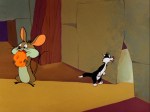
This short could better have been called ‘Sylvester and the Beanstalk’, because it’s Sylvester who finds himself on top of the beanstalk, and in giantland.

In the giant’s castle Sylvester discovers a giant Tweety, which he tries to catch in four attempts, before the giant chases him down. The cartoon ends rather poorly with the giant falling on the cat, making him fall straight through the earth, and ending in China.

‘Tweety and the Beanstalk’ is essentially a normal Tweety and Sylvester routine, making little use of the size difference (for example, at one point Sylvester uses a saw and a string fit to his own size – how on earth did he find those in giantland?). Freleng’s excellent timing cannot rescue the used and tried spot gags, and the result is a disappointing and forgettable cartoon.

Watch ‘Tweety and the Beanstalk’ yourself and tell me what you think:

https://www.dailymotion.com/video/x7o4y8f

‘Tweety and the Beanstalk’ is available on the DVD-set ‘Looney Tunes Golden Collection Volume Five’

Director: unknown
Production Date: 1960
Stars: Tom Puss and Ollie Bungle
Rating: ★★½
Review:

The Eastern Treasure © Toonder Studios‘The Eastern Treasure’ is based on the great Tom Poes comic strip ‘De achtgever’ (1957).

In this cartoon Ollie Bungle is visited by an Eastern treasurer and his obedient servant, called Kowtow. Ollie Bungle takes over the job as treasurer, and immediately the servant joins his side. In the end Tom Puss manages to get rid of him by making the servant into the treasurer.

The strong story of the comic strip is condensed to its bare essentials, and has lost most of its strengths. Moreover, the two Easterners hardly look that way. ‘The Eastern Treasure’ was the last of the Tom Puss shorts completed, before Toonder discovered he had been swindled. His Tom Puss television series was never aired, neither in the US, for which it had been made, nor anywhere else. A lot of money, effort and work had just been wasted on a scam.

‘The Eastern Treasure’ is available on the DVD inside the Dutch book ‘De Toonder Animatiefilms’


Director: unknown
Production Date: 1960
Stars: Tom Puss and Ollie Bungle
Rating: ★★
Review:

Little Faustus © Toonder StudiosDuring a stormy night Ollie Bungle brags he can teach everyone everything, and in one evening, too.

He’s overheard by a wizard, who immediately places his lazy son under Ollie Bungle’s tutelage. The little brat changes all kinds of objects into beds for him to sleep in, makes a pen write the writing lines he has to do, and makes objects taunting Ollie Bungle. Meanwhile Ollie Bungle doesn’t teach the boy a thing. Yet, the wizard is content, as his son has learned many new tricks during that one evening.

This short is one of the weakest of the eight surviving Tom Puss films. Tom Puss has hardly a role in it, and even behaves uncharacteristically fearful. In one scene he even looks like a real cat, instead of his normal rational self.

‘Little Faustus’ is available on the DVD inside the Dutch book ‘De Toonder Animatiefilms’

Director: unknown
Production Date: 1960
Stars: Tom Puss and Ollie Bungle
Rating: ★★★½
Review:

The All-Purpose Machine © Toonder StudiosAt the start of this cartoon Ollie Bungle is out of gas. He and Tom Puss meet a bearded fellow with a large box, and when they ask him for gas, he makes the large box change into a fuel station.

The little bearded man demonstrates that the box can change into virtually anything, and Ollie Bungle buys the machine on the spot. Unfortunately, the all-purpose machine turns out difficult to handle, and only causes for trouble.

The story makes little sense and is highly forgettable. Nevertheless, this short is noteworthy for its very beautiful limited background art.

Watch ‘The All-Purpose Machine’ yourself and tell me what you think:

‘The All-Purpose Machine’ is available on the DVD inside the Dutch book ‘De Toonder Animatiefilms’

Director: unknown
Production Date: 1960
Stars: Tom Puss and Ollie Bungle
Rating: ★★★★
Review:

Vengeance Valley © Toonder Studios‘Vengeance Valley’ is based on the Tom Poes comic strip ‘De wraakgier’ (which can be translated as ‘the revenge vulture’) from 1956.

The comic strip is one of the best in the series, and features Tom Puss encountering an island of vengeance-loving vultures. In the film the vultures inhabit a hick town in the mountains called ‘Vengeance Valley’. The whole concept of avenge, revenge and counter-revenge is played out well, and this short makes particularly well use of the limited animation. This makes this episode arguably the best of the whole series, despite the lame ending, in which a female vulture blows up the whole town, wiping it off the map, literally.

‘Vengeance Valley’ is available on the DVD inside the Dutch book ‘De Toonder Animatiefilms’

Director: unknown
Production Date: 1959
Stars: Tom Puss and Ollie Bungle
Rating: ★★★½
Review:

The Wonder Shoes © Toonder Studios‘The Wonder Shoes’ is one of the nine Tom Puss films the Toonder studios made in 1959-1960 for the American television market, which the series never reached.

This particular episode starts with Ollie Bungle capturing a large boot while fishing. Oddly enough he orders a shoe maker to make two shoes out of the boot. This is particularly puzzling as Ollie Bungle never wears shoes. The shoes possess a magic quality and fulfill Ollie Bungle’s wishes. So when he wishes them to walk to the moon, he is in serious trouble. Luckily, Tom Puss is there to save him.

‘The Wonder Shoes’ is a weak story that is saved by some slapstick comedy and silly situations, featuring criminal Bul Super and police officer Bulle Bas. Both characters are familiar to readers of the Tom Puss comics, but remain unnamed in the cartoon. Special mention should go to the minimal background art.

‘The Wonder Shoes’ is available on the DVD inside the Dutch book ‘De Toonder Animatiefilms’

Director: Hamilton Luske
Release Date: June 21, 1961
Stars: Donald Duck
Rating: ★★★★
Review:

The Litterbug © Walt Disney‘The Litterbug’ is the very last Donald Duck cartoon, ending a theatrical cartoon career that had lasted 27 years.

The cartoon uses a voice over in rhyme to describe ‘the litterbug’ as if it were some kind of harmful insect species. The short starts with live action footage of litter and garbage, then we cut to a book full of pests, containing the mosquito, the boll weevil, the termite, and… ‘the litterbug’, with Donald Duck representing the latter.

‘The Litterbug’ is one of the earliest environmental cartoons ever. Nevertheless the tone is light, helped by the joyful song by Mel Leven. Donald looks more angular than ever, and is clearly xeroxed. Al Dempster’s background art resembles that of ‘101 Dalmations’. Both xerox and background art give this short a particularly graphic look, which doesn’t suit Donald very well. Nevertheless, ‘The Litterbug’ is a fitting goodbye to a great career, and certainly better than Mickey’s last cartoon, ‘The Simple Things‘ from 1953.

Watch ‘The Litterbug’ yourself and tell me what you think:

This is the last Donald Duck cartoon
To the previous Donald Duck cartoon: Donald and the Wheel

‘The Litterbug’ is available on the DVD-set ‘Walt Disney Treasures: The Chronological Donald Volume Four 1951-1961’

Director: Hamilton Luske
Release Date: June 21, 1961
Stars: Donald Duck
Rating:
Review:

Donald and the Wheel © Walt Disney‘Donald and the Wheel’ is an educational special lasting almost 18 minutes.

The short features two ‘spirits of progress’, an old one and a junior, who are depicted by grotesque looking live actors, of whom we only see their silhouettes. These spirits are voiced by The Mellotones, who provide the rhyming dialogue, and who sing two swinging songs by Mel Leven: ‘Wheels of progress’ and ‘That’s the Principle of the Thing’. Donald Duck is only a pawn in this cartoon, and throughout the picture he’s depicted in his stone age appearance, introduced at the beginning: wearing a bear skin, and suddenly bearing a red scalp.

The educational value of this short is very limited: we watch how wheels are used in all kinds of transport, and in various machines – that’s about it. Thus soon the tiresome dialogue and the irritating duo of spirits wear out their welcome.

The short is further hampered by ugly colored live action footage of cars and industrial wheels, looking forward to the cheap look of Ralph Bakshi’s features from the late 1970s.

Watch ‘Donald and the Wheel’ yourself and tell me what you think:

This is Donald Duck cartoon No. 118
To the previous Donald Duck cartoon: How to Have an Accident at Work
To the next Donald Duck cartoon: The Litterbug

‘Donald and the Wheel’ is available on the DVD-set ‘Walt Disney Treasures: The Chronological Donald Volume Four 1951-1961’

Director: Charles Nichols
Release Date: July 1, 1959
Stars: Donald Duck
Rating: ★★★★
Review:

How to Have an Accident at Work © Walt Disney‘How to Have an Accident at Work’ is a clear follow-up to ‘How to Have an Accident in the Home’ from 1956.

Like its predecessor the tale is told by J.J. Fate, a little bearded variation on Donald Duck, who shows us that carelessness and fate are not the same thing. The short is more a spot gag cartoon than strictly educational, and features a running gag of Donald repeatedly ending up at the (human) first aid nurse. Luckily, Donald’s ways of getting an accident are less gross than they would have been in real life.

Extraordinarily, the short depicts our feathered friend as being married and as a father of a son. Also noteworthy are some beautiful depictions of industrial machines, wonderfully laid out by Eric Nordi, and artfully painted by background artist Al Dempster.

Watch ‘How to Have an Accident at Work’ yourself and tell me what you think:

This is Donald Duck cartoon No. 117
To the previous Donald Duck cartoon: Donald in Mathmagic Land
To the next Donald Duck cartoon: Donald and the Wheel

‘How to Have an Accident at Work’ is available on the DVD-set ‘Walt Disney Treasures: The Chronological Donald Volume Four 1951-1961’

Director: Hamilton Luske
Release Date: June 26, 1959
Stars: Donald Duck
Rating: ★★★★
Review:

Donald in Mathmagic Land © Walt Disney‘Donald in Mathmagic Land’ is a long educational special, lasting almost half an hour.

The film starts with Donald Duck entering a surreal landscape, dressed as a tropical hunter and wondering where he is. His questions are answered by the spirit of adventure, who remains unseen throughout the cartoon. The Spirit of adventure takes Donald on a trip through mathematics, trying to convince him it’s not only for eggheads.

The film tells about the golden ratio, the pentagram, and billiards. Also featured is a stop motion game of chess, of which the mathematics remain completely unclear. This episode shortly changes Donald into Alice in Wonderland, which makes him look particularly goofy.

The looks of this short are very beautiful: Mathmagic land is rendered in appealing reds, blues, pinks and violets, giving it a magical atmosphere, indeed. Pythagoras and his friends are rendered in Cartoon Modern style, echoing Ward Kimball’s earlier works from the 1950s. The short also uses some live action footage of a jazz band, and of a star billiard player.

The complete cartoon is a charming piece of education, if still rather shallow, and more impressive in memory than when actually watching it.

Watch ‘Donald in Mathmagic Land’ yourself and tell me what you think:

This is Donald Duck cartoon No. 116
To the previous Donald Duck cartoon: How to have an Accident in the Home
To the next Donald Duck cartoon: How to Have an Accident at Work

‘Donald in Mathmagic Land’ is available on the DVD-set ‘Walt Disney Treasures: The Chronological Donald Volume Four 1951-1961’

Director: Wolfgang Reitherman
Release Date: January 21, 1960
Rating: ★★
Review:

Goliath II © Walt Disney‘Goliath II’ is a slow and gentle children’s film, penned by storyman Bill Peet, about a tiny elephant, who is the shame of the herd, until he bravely defeats a cocky mouse, which scares all the others away.

With its fifteen minutes of length, Reitherman’s all too relaxed timing, George Bruns’s uninspired score, and studio favorite Sterling Holloway’s dull narration, ‘Goliath II’ is one of the most boring of the Disney specials. Moreover, there are several instances of reused animation (e.g. the tiger from ‘Tiger Trouble’ (1945), the crocodile from ‘Peter Pan’, and an owl from ‘Bambi‘), giving the film a rather cheap look.

Nevertheless, ‘Goliath II’ is a milestone, as it is the first animated film to exploit the xerox technique on cel animation, an innovation developed by Ub Iwerks in the 1950s. The xerox process meant the characters needn’t be retraced by the ink department, and could keep their vibrant animated lines, giving them a more graphic look. For better or worse, the xerox technique dominated Disney animation up to the late 1980s. By then it had long lost its charm, and was finally discarded (‘The Little Mermaid’ is the first film in the new style).

The xerox technique, combined with Reitherman’s direction, the film’s setting and elephant characters, make ‘Goliath II’ a forerunner of ‘Jungle Book’ (1967). The short even introduces the gag in which the elephants are forced to stop their march, and fall on top of each other.

Despite the new techniques, and fine animation, there’s little to enjoy in ‘Goliath II’, but I would like to single out the extraordinary background paintings by Richard H. Thomas, Gordon Legg and Thelma Witmer, which schematically indicate a jungle without going into too much detail.

Watch ‘Goliath II’ yourself and tell me what you think:

‘Goliath II’ is available on the DVD-set ‘Walt Disney Treasures: Disney Rarities’

Director: Bill Justice
Release Date: November 10, 1959
Rating: ★★★½
Review:

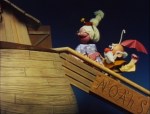
Noah's Ark © Walt DisneyThis is the second of no less than three Disney interpretations from the classic story from Genesis, the other ones being the Silly Symphony ‘Father Noah’s Ark‘ (1933) and a sequence from ‘Fantasia 2000’ (1999), starring Donald Duck.

This second version is the most extraordinary of the three as it exchanges the ordinary cel animation for stop motion, an animation technique not practiced at the Disney studio. Yet animators Bill Justice and X Atencio gave it a go. For novices in this particular technique, the stop motion is of a remarkably high quality, on par with other stop motion films of the time.

In classic animation tradition, the film start with human hands handling the material, and even the film’s title is animated in stop motion, using a string of wool. Justice’s and Atencio’s designs, too, are refreshing: all characters are mostly made of ordinary material, like corks, pencils and clothespins, often still very visible. The cinematography, too, is superb. For example, there’s a clever montage scene of Noah and his sons building the ark.

The story (by T. Hee) is told by Jerome Courtland in rhyme and features a jazzy score by George Bruns and several songs by Mel Leven. The makers don’t take their story too seriously, and at one point there’s even room for a blues song sung by an abandoned female hippo who grieves, while her husband Harry dances with all other female creatures.

In all, ‘Noah’s Ark’ is a nice departure for Disney, and the film’s looks remain unique within the Disney canon. At 20 minutes the short may be a little too long, but the sheer fun with which this film has been made is contagious.

Watch ‘Noah’s Ark’ yourself and tell me what you think:

‘Noah’s Ark’ is available on the DVD-set ‘Walt Disney Treasures: Disney Rarities’

Director: John Hubley
Release Date: 1959
Rating: ★★★½
Review:

Moonbird © John HubleyWith ‘Moonbird’ John and Faith Hubley entered the field of animated documentary.

The film is an illustration of a nightly fantasy adventure by their own two little boys Mark and Humpy (ca. five and three). The main narrative of their fantasy is that they try to catch a large bird, using candy for a bait. But being two little boys, their story meanders a lot, and is interrupted by random singing, and even crying.

John and Faith Hubley illustrated this unedited piece of recorded dialogue as if the boys’ adventure were real. What’s more, they added subtle action that is not in the soundtrack. For example, the Moonbird itself is seen much earlier than heard.

The background art is pretty avant-garde, rendered in bold black, blue and pink brush strokes. These images verge on the abstract, but manage to evoke a nightly garden, nonetheless. Animators Bobe Cannon and Ed Smith, however, animated the two boys in classic Disney style, even though they are rendered in monochromes and with the pencil lines still visible.

‘Moonbird’ is a charming little film, and an ode to children’s fantasy. It was immediately recognized as something new, and it won the Academy Award for best animated short.

Later, the Hubley’s made more films based on unedited dialogue, e.g. ‘The Hole’ (1962), ‘The Hat’ (1964) and ‘Windy Day’ (1968), the last film starring their two daughters. In the late 1970s the fledgling Aardman studio followed suit with their Animated conversations series (e.g. ‘Down & Out‘ and ‘Confessions of a Foyer Girl‘).

Watch ‘Moonbird’ yourself and tell me what you think:

‘Moonbird’ is available on the DVD’s ‘Selected Films of John and Faith Hubley 1956-1973’ within The Believer Magazine March/April 2014 and ‘The Hubley Collection Volume 2’

Director: John Hubley
Release Date: 1958
Rating: ★★★★
Review:

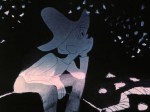
The Tender Game © John HubleyBy the end of the 1950s John Hubley had survived the McCarthy era that had hit him hard*, and with his Storyboard studio he could finally make the films he really wanted to.

‘The Tender Game’ is a wonderful example of Hubley’s great and gentle art. The short is a delightful little wordless film about love set to the song ‘Tenderly’, sung by Ella Fitzgerald, and accompanied by the Oscar Peterson trio. The cartoon’s setting is a city, vaguely reminiscent of Paris. Here a flower girl falls in love with a street cleaner.

The designs of this cartoon are very bold: for example, the two main protagonists don’t have solid bodies, but consist of loose parts, and sometimes it seems as if they’ve walked straight from a Pablo Picasso painting. Both their designs and that of the backgrounds have a strong painting quality, being rendered in broad brush strokes, and verging on the abstract.

The poetic artwork contrasts a little with the animation, done e.g. by fellow-UPA alumnus Bobe Cannon, which is still clearly rooted in the comic tradition. Highlight is the interior scene, in which the two lovers reluctantly try to court each other. This is a marvelous little piece of character animation, full of telling expressions and poses.

Watch ‘The Tender Game’ yourself and tell me what you think:

‘The Tender Game’ is available on the DVD’s ‘Selected Films of John and Faith Hubley 1956-1973’ within The Believer Magazine March/April 2014 and ‘Art and Jazz in Animation’

* for a full account on how McCarthyism affected the animation world see Adam Abraham’s excellent book ‘When Magoo Flew – The Rise and Fall of Animation Studio UPA’.

Director: Robert McKimson
Release Date: September 26, 1959
Stars: Foghorn Leghorn, Miss Prissy
Rating: ★★
Review:

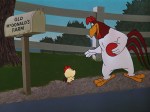
A Broken Leghorn © Warner Bros.As MGM and Disney more or less had stopped production of animated shorts, by 1959 the Warner Bros. shorts were easily the best looking animated cartoons around: the background art and the animation were both still top notch, and didn’t show any sign of cheapness, present at for example the Paramount and Lantz studios.

Unfortunately, story lines and gags were often another matter. ‘A Broken Leghorn’ is a good example: despite the clear quality of design, animation and background art, the story is a rather tired amalgam of blackout gags in which the Foghorn Leghorn tries to get rid of a young smart-alecky competitor.

His attempts to kill the competition includes making the little fellow cross the road (initiating a revival of Tex Avery’s road gag from ‘Señor Droopy‘), blowing him up with dynamite through a rain pipe, tying corn-to-the-cob to a gun, and attaching a fake worm to a landmine. Needless to say, all these attempts backfire.

The Foghorn Leghorn were always very talkative, and the large amount of dialogue wears down the comedy, hampering the already stale routines.

Watch ‘A Broken Leghorn’ yourself and tell me what you think:

https://www.dailymotion.com/video/x6cn68y

‘A Broken Leghorn’ is available on the DVD-box set ‘Looney Tunes Golden Collection’

Directors: Norman McLaren & Evelyn Lambart
Release Date: 1960
Rating: ★★★½
Review:

Lines Vertical © Norman McLaren & Evelyn Lambart

‘Lines Vertical’ is one of the most extreme films Norman McLaren ever made.

Together with collaborator Evelyn Lambart he manages to make a film consisting of vertical lines only, made directly on film. The whole film consists of white vertical lines moving across the screen against monochrome backgrounds. The film starts with one line, then two, then three, and so on, until ca. twenty lines fill the screen in a constant ballet.

At one point the lines get a three-dimensional quality, resembling rotating columns. The movements of the lines follow Maurice Blackburn’s serene score, which is clearly inspired by Chinese classical music. It’s a testimony of the genius of both McLaren & Lambart that they can even pull off such a boring concept, and turn it into a successful film, even if it’s not the most engaging one.

Watch ‘Lines Vertical’ yourself and tell me what you think:

‘Lines Vertical’ is available on the DVD-box set ‘Norman McLaren – The Master’s Edition’

Director: Norman McLaren
Release Date: 1959
Rating: ★★★½
Review:

Short and Suite © Norman McLarenIn ‘Short and Suite’ a jazzy score for clarinet, piano and double bass by E. Rathburn is interpreted by dots, shapes and lines, scratched directly on film.

The film knows no narrative, and is highly abstract, but at one point one can clearly see flowers and even human shapes. The film consists of several episodes, following more or less frantic parts within the score. McLaren’s images are very well-timed to the music, and the shapes get extra dimensions by the shadows they cast on the black and monochrome backgrounds.

‘Short and Suite’ may not be among McLaren’s best, it’s still a nice example of his great art.

Watch ‘Short and Suite’ yourself and tell me what you think:

‘Short and Suite’ is available on the DVD-box set ‘Norman McLaren – The Master’s Edition’

Director: Norman McLaren
Release Date: 1959
Rating: ★★★
Review:

Serenal © Norman McLaren‘Serenal’ is a film made directly on film and set to a Caribean score by the Grand Cunucaya String Orchestra Trinidad.

The images consist mostly of purely abstract shapes flashing on a black screen. The shapes are very rough, but surely colorful (the film was hand-colored), and the end result is a nice piece of abstract expressionism, if still one of McLaren’s less engaging films.

Watch ‘Serenal’ yourself and tell me what you think:

‘Serenal’ is available on the DVD-box set ‘Norman McLaren – The Master’s Edition’

Director: Norman McLaren
Release Date: 1959
Rating: ★★★★
Review:

Mail Early for Christmas © Norman McLaren‘Mail Early for Christmas’ is a short commercial, the message of which is in the title.

Set to a rather loud dixieland score McLaren has put his expressionistic and frantic direct-on-film style into action to make this message come across. The film lasts only 39 seconds and was made in chronological order, without any cuts. The film thus has a very spontaneous feel and features all kinds of abstract shapes splashing from the screen. In between we can see the words ‘Mail early for Xmas’ appearing and disappearing again.

It’s a wonder that such avant-garde film making was used for a message directed at such a general public.

Watch ‘Mail Early for Christmas’ yourself and tell me what you think:

‘Mail Early for Christmas’ is available on the DVD-box set ‘Norman McLaren – The Master’s Edition’

Director: Norman McLaren
Release Date: 1958
Rating: ★★★★
Review:

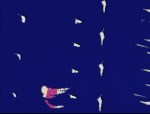
Le merle © Norman McLaren‘Le Merle’ is based on a French-Canadian addition song, in which a blackbird loses body parts, but regains them manyfold.

Sung by le trio lyrique, this spirited song is illustrated by cut-out animation of the simplest shapes, which together form the bird, which hops and flies around. However, during the film the bird undergoes constant metamorphosis, forever changing into pure abstract patterns and back again, and losing and gaining body parts, following the song closely. All the action takes place against a simple surreal, but long vertical background, which suggests that during the song the bird moves skyward, past the clouds and into a starry night. There’s also a mind-blowing scene in which the bird travels through the starry space.

‘Le Merle’ is as mesmerizing as it is pure fun. The film takes the cartoon modern style to the max in its elementary designs, and must be counted among McLaren’s masterpieces.

Watch ‘Le Merle’ yourself and tell me what you think:

‘Le Merle’ is available on the DVD-box set ‘Norman McLaren – The Master’s Edition’

Enter your email address to follow this blog and receive notifications of new posts by email.

Join 915 other subscribers
Bookmark and Share

Categories