Director: Bill Justice
Release Date: November 10, 1959
Rating: ★★★½
Review:

Noah's Ark © Walt DisneyThis is the second of no less than three Disney interpretations from the classic story from Genesis, the other ones being the Silly Symphony ‘Father Noah’s Ark‘ (1933) and a sequence from ‘Fantasia 2000’ (1999), starring Donald Duck.

This second version is the most extraordinary of the three as it exchanges the ordinary cel animation for stop motion, an animation technique not practiced at the Disney studio. Yet animators Bill Justice and X Atencio gave it a go. For novices in this particular technique, the stop motion is of a remarkably high quality, on par with other stop motion films of the time.

In classic animation tradition, the film start with human hands handling the material, and even the film’s title is animated in stop motion, using a string of wool. Justice’s and Atencio’s designs, too, are refreshing: all characters are mostly made of ordinary material, like corks, pencils and clothespins, often still very visible. The cinematography, too, is superb. For example, there’s a clever montage scene of Noah and his sons building the ark.

The story (by T. Hee) is told by Jerome Courtland in rhyme and features a jazzy score by George Bruns and several songs by Mel Leven. The makers don’t take their story too seriously, and at one point there’s even room for a blues song sung by an abandoned female hippo who grieves, while her husband Harry dances with all other female creatures.

In all, ‘Noah’s Ark’ is a nice departure for Disney, and the film’s looks remain unique within the Disney canon. At 20 minutes the short may be a little too long, but the sheer fun with which this film has been made is contagious.

Watch ‘Noah’s Ark’ yourself and tell me what you think:

‘Noah’s Ark’ is available on the DVD-set ‘Walt Disney Treasures: Disney Rarities’

Director: John Hubley
Release Date: 1959
Rating: ★★★½
Review:

Moonbird © John HubleyWith ‘Moonbird’ John and Faith Hubley entered the field of animated documentary.

The film is an illustration of a nightly fantasy adventure by their own two little boys Mark and Humpy (ca. five and three). The main narrative of their fantasy is that they try to catch a large bird, using candy for a bait. But being two little boys, their story meanders a lot, and is interrupted by random singing, and even crying.

John and Faith Hubley illustrated this unedited piece of recorded dialogue as if the boys’ adventure were real. What’s more, they added subtle action that is not in the soundtrack. For example, the Moonbird itself is seen much earlier than heard.

The background art is pretty avant-garde, rendered in bold black, blue and pink brush strokes. These images verge on the abstract, but manage to evoke a nightly garden, nonetheless. Animators Bobe Cannon and Ed Smith, however, animated the two boys in classic Disney style, even though they are rendered in monochromes and with the pencil lines still visible.

‘Moonbird’ is a charming little film, and an ode to children’s fantasy. It was immediately recognized as something new, and it won the Academy Award for best animated short.

Later, the Hubley’s made more films based on unedited dialogue, e.g. ‘The Hole’ (1962), ‘The Hat’ (1964) and ‘Windy Day’ (1968), the last film starring their two daughters. In the late 1970s the fledgling Aardman studio followed suit with their Animated conversations series (e.g. ‘Down & Out‘ and ‘Confessions of a Foyer Girl‘).

Watch ‘Moonbird’ yourself and tell me what you think:

‘Moonbird’ is available on the DVD’s ‘Selected Films of John and Faith Hubley 1956-1973’ within The Believer Magazine March/April 2014 and ‘The Hubley Collection Volume 2’

Director: John Hubley
Release Date: 1958
Rating: ★★★★
Review:

The Tender Game © John HubleyBy the end of the 1950s John Hubley had survived the McCarthy era that had hit him hard*, and with his Storyboard studio he could finally make the films he really wanted to.

‘The Tender Game’ is a wonderful example of Hubley’s great and gentle art. The short is a delightful little wordless film about love set to the song ‘Tenderly’, sung by Ella Fitzgerald, and accompanied by the Oscar Peterson trio. The cartoon’s setting is a city, vaguely reminiscent of Paris. Here a flower girl falls in love with a street cleaner.

The designs of this cartoon are very bold: for example, the two main protagonists don’t have solid bodies, but consist of loose parts, and sometimes it seems as if they’ve walked straight from a Pablo Picasso painting. Both their designs and that of the backgrounds have a strong painting quality, being rendered in broad brush strokes, and verging on the abstract.

The poetic artwork contrasts a little with the animation, done e.g. by fellow-UPA alumnus Bobe Cannon, which is still clearly rooted in the comic tradition. Highlight is the interior scene, in which the two lovers reluctantly try to court each other. This is a marvelous little piece of character animation, full of telling expressions and poses.

Watch ‘The Tender Game’ yourself and tell me what you think:

‘The Tender Game’ is available on the DVD’s ‘Selected Films of John and Faith Hubley 1956-1973’ within The Believer Magazine March/April 2014 and ‘Art and Jazz in Animation’

* for a full account on how McCarthyism affected the animation world see Adam Abraham’s excellent book ‘When Magoo Flew – The Rise and Fall of Animation Studio UPA’.

Director: Robert McKimson
Release Date: September 26, 1959
Stars: Foghorn Leghorn, Miss Prissy
Rating: ★★
Review:

A Broken Leghorn © Warner Bros.As MGM and Disney more or less had stopped production of animated shorts, by 1959 the Warner Bros. shorts were easily the best looking animated cartoons around: the background art and the animation were both still top notch, and didn’t show any sign of cheapness, present at for example the Paramount and Lantz studios.

Unfortunately, story lines and gags were often another matter. ‘A Broken Leghorn’ is a good example: despite the clear quality of design, animation and background art, the story is a rather tired amalgam of blackout gags in which the Foghorn Leghorn tries to get rid of a young smart-alecky competitor.

His attempts to kill the competition includes making the little fellow cross the road (initiating a revival of Tex Avery’s road gag from ‘Señor Droopy‘), blowing him up with dynamite through a rain pipe, tying corn-to-the-cob to a gun, and attaching a fake worm to a landmine. Needless to say, all these attempts backfire.

The Foghorn Leghorn were always very talkative, and the large amount of dialogue wears down the comedy, hampering the already stale routines.

Watch ‘A Broken Leghorn’ yourself and tell me what you think:

https://www.dailymotion.com/video/x6cn68y

‘A Broken Leghorn’ is available on the DVD-box set ‘Looney Tunes Golden Collection’

Directors: Norman McLaren & Evelyn Lambart
Release Date: 1960
Rating: ★★★½
Review:

Lines Vertical © Norman McLaren & Evelyn Lambart

‘Lines Vertical’ is one of the most extreme films Norman McLaren ever made.

Together with collaborator Evelyn Lambart he manages to make a film consisting of vertical lines only, made directly on film. The whole film consists of white vertical lines moving across the screen against monochrome backgrounds. The film starts with one line, then two, then three, and so on, until ca. twenty lines fill the screen in a constant ballet.

At one point the lines get a three-dimensional quality, resembling rotating columns. The movements of the lines follow Maurice Blackburn’s serene score, which is clearly inspired by Chinese classical music. It’s a testimony of the genius of both McLaren & Lambart that they can even pull off such a boring concept, and turn it into a successful film, even if it’s not the most engaging one.

Watch ‘Lines Vertical’ yourself and tell me what you think:

‘Lines Vertical’ is available on the DVD-box set ‘Norman McLaren – The Master’s Edition’

Director: Norman McLaren
Release Date: 1959
Rating: ★★★½
Review:

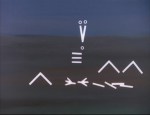
Short and Suite © Norman McLarenIn ‘Short and Suite’ a jazzy score for clarinet, piano and double bass by E. Rathburn is interpreted by dots, shapes and lines, scratched directly on film.

The film knows no narrative, and is highly abstract, but at one point one can clearly see flowers and even human shapes. The film consists of several episodes, following more or less frantic parts within the score. McLaren’s images are very well-timed to the music, and the shapes get extra dimensions by the shadows they cast on the black and monochrome backgrounds.

‘Short and Suite’ may not be among McLaren’s best, it’s still a nice example of his great art.

Watch ‘Short and Suite’ yourself and tell me what you think:

‘Short and Suite’ is available on the DVD-box set ‘Norman McLaren – The Master’s Edition’

Director: Norman McLaren
Release Date: 1959
Rating: ★★★
Review:

Serenal © Norman McLaren‘Serenal’ is a film made directly on film and set to a Caribean score by the Grand Cunucaya String Orchestra Trinidad.

The images consist mostly of purely abstract shapes flashing on a black screen. The shapes are very rough, but surely colorful (the film was hand-colored), and the end result is a nice piece of abstract expressionism, if still one of McLaren’s less engaging films.

Watch ‘Serenal’ yourself and tell me what you think:

‘Serenal’ is available on the DVD-box set ‘Norman McLaren – The Master’s Edition’

Director: Norman McLaren
Release Date: 1959
Rating: ★★★★
Review:

Mail Early for Christmas © Norman McLaren‘Mail Early for Christmas’ is a short commercial, the message of which is in the title.

Set to a rather loud dixieland score McLaren has put his expressionistic and frantic direct-on-film style into action to make this message come across. The film lasts only 39 seconds and was made in chronological order, without any cuts. The film thus has a very spontaneous feel and features all kinds of abstract shapes splashing from the screen. In between we can see the words ‘Mail early for Xmas’ appearing and disappearing again.

It’s a wonder that such avant-garde film making was used for a message directed at such a general public.

Watch ‘Mail Early for Christmas’ yourself and tell me what you think:

‘Mail Early for Christmas’ is available on the DVD-box set ‘Norman McLaren – The Master’s Edition’

Director: Norman McLaren
Release Date: 1958
Rating: ★★★★
Review:

Le merle © Norman McLaren‘Le Merle’ is based on a French-Canadian addition song, in which a blackbird loses body parts, but regains them manyfold.

Sung by le trio lyrique, this spirited song is illustrated by cut-out animation of the simplest shapes, which together form the bird, which hops and flies around. However, during the film the bird undergoes constant metamorphosis, forever changing into pure abstract patterns and back again, and losing and gaining body parts, following the song closely. All the action takes place against a simple surreal, but long vertical background, which suggests that during the song the bird moves skyward, past the clouds and into a starry night. There’s also a mind-blowing scene in which the bird travels through the starry space.

‘Le Merle’ is as mesmerizing as it is pure fun. The film takes the cartoon modern style to the max in its elementary designs, and must be counted among McLaren’s masterpieces.

Watch ‘Le Merle’ yourself and tell me what you think:

‘Le Merle’ is available on the DVD-box set ‘Norman McLaren – The Master’s Edition’

Director: Robert McKimson
Release Date: January 7, 1961
Stars: Speedy Gonzales, Sylvester
Rating: ★★
Review:

Cannery Woe © Warner Bros.‘Cannery Woe’ centers on Manuel and José, two poor mice, who live at the beach and who are starving.

They really would like to join the Grand Cheese Fiesta, organised by the mouse mayor for his re-election, but they are thrown out. Yet, the mayor has more problems: there’s no cheese at the fiesta (‘something new is added to the store’, explains one of the cheese committee mice). Luckily, José is friends with Speedy Gonzales, and only has to whistle to get Speedy’s help.

Speedy fetches the cheese from the store, unhindered by guarding cat Sylvester, who only gets hindered by his own tacks, mousetraps and cannon. In the end, José and Manuel are awarded as cheese inspectors, but Speedy gets even a better job as ‘chick inspector’.

‘Cannery Woe’ is a very mediocre cartoon with rather run of the mill gags. In fact, the mice José and Manuel are more interesting than anything that follows, and one wonders why storyman Tedd Pierce and director Robert McKimson didn’t devote more of the cartoon to them.

Watch ‘Cannery Woe’ yourself and tell me what you think:

https://www.dailymotion.com/video/x5bfqbq

‘Cannery Woe’ is available on the DVD-set ‘Looney Tunes Golden Collection Volume Four’

Director: Robert McKimson
Release Date: January 23, 1960
Stars: Speedy Gonzales, Sylvester
Rating: ★★★
Review:

West of the Pesos © Warner Bros.The setting of ‘West of the Pesos’ is a ‘veelage’, where several mice have been caught and put into cages inside the ‘ACME Laboratorio por experimentao’, guarded by Sylvester.

The remaining mice of the village would gladly rescue their comrades, so Speedy Gonzales is lured by the beautiful female mouse Camilla to come to the rescue. As the gags come fast and plenty, this is one of the more satisfying Speedy Gonzales cartoons, if hardly really funny. This time, Sylvester doesn’t stand a chance, and isn’t even given time to think of some counter measures.

Despite all the action, the main attractions of this cartoon are the attractive and strikingly modern backgrounds by Robert Givens and William Butler. The list of mice caught for the laboratory includes the names of animators Rudy Zamora, Manuel Perez and Gus Arriola, as well as painter Pablo Picasso.

Watch ‘West of the Pesos’ yourself and tell me what you think:

https://www.dailymotion.com/video/x5bd3gm

‘West of the Pesos’ is available on the DVD-set ‘Looney Tunes Golden Collection Volume Four’

Director: Friz Freleng
Release Date: August 29, 1959
Stars: Speedy Gonzales, Sylvester
Rating: ★★
Review:

Here Today, Gone Tamale © Warner Bros.‘Here Today, Gone Tamale’ starts with a cheese famine in a harbor village.

But then a ship called ‘Dutch Treat’ arrives, full of cheese. Unfortunately, the ship is protected by Sylvester, but the starved mice get Speedy Gonzales (he knows one’s sister – let me correct this – he knows everybody’s sister) to get the cheese. In some blackout gags Sylvester does his best to catch Speedy Gonzales, e.g. with a large mallet and a guillotine. In the end, Sylvester has to admit defeat, and adding ‘if you can’t beat them, join them’, he puts on some Mickey Mouse-club-like mouse ears and joins some dancing mice.

The best gag is when Speedy Gonzales locks Sylvester inside a storage room full of Limburger cheese, but otherwise there’s not too much to enjoy in ‘Here Today, Gone Tamale’ and one has ample time to enjoy the functional layouts by Hawley Pratt, beautifully painted by Tom O’Loughlin.

Watch the opening of ‘Here Today, Gone Tamale’ yourself and tell me what you think:

‘Here Today, Gone Tamale’ is available on the DVD-set ‘Looney Tunes Golden Collection Volume Four’

Director: Robert McKimson
Release Date: January 18, 1958
Stars: Speedy Gonzales
Rating: ★★½
Review:

Tortilla Flaps © Warner Bros.‘Tortilla Flaps’ is a Speedy Gonzales cartoon featuring a vulture as Speedy’s adversary.

The cartoon takes place during Cinco de Mayo. The mice are having their own little festival, where Speedy plays tennis with himself as an attraction at the fair. When the vulture threatens the festival, Speedy Gonzales takes care of him. Soon the vulture surrenders and he ends as an attraction at the fair himself.

‘Tortilla Flaps’ is one of the weaker Speedy Gonzales cartoons: the vulture is a poor substitution for Sylvester, and none of the chase gags are very funny. The best gag arguably is when Speedy makes the bird stop for a passing train, but the bird doesn’t make it in time…

Watch ‘Tortilla Flaps’ yourself and tell me what you think:

https://www.dailymotion.com/video/x5bd2v0

‘Tortilla Flaps’ is available on the DVD-set ‘Looney Tunes Golden Collection Volume Four’

Director: Max Fleischer
Production Date: 1959
Rating: ★★½
Review:

Imagine That © Max Fleischer‘Imagine That!’ is one of the last products by animation pioneer Max Fleischer.

On January 14, 1958 Fleischer founded a new animation studio, called ‘Out of the Inkwell Films, Inc’, with which he clearly returned to his roots. ‘Imagine That!’ is a product of that studio, scripted and drawn by Fleischer himself. The short is a pilot film for a proposed new nature series for television. In this short Fleischer returns to his earliest films, starting with an inkwell. Soon, a narrator asks the spectator what bird he would like to be if he could be one. In the end he settles on the swift, for sheer looks. What follows are some facts about the swift’s nature and behavior.

Unfortunately, there’s practically no animation, and even that is limited. Even worse, the still images have an extremely old-fashioned look, and the complete film looks like a product of the 1910s, not the late 1950s. One wonders how Fleischer ever thought this miscalculated product would ever work. In any case no one was interested in this product by the old man.

Fleischer had a better chance with a revival of Koko the Clown in a new ‘Out of the Inkwell’ series. This, too, suffered from low budgets and very limited animation, but the series at least reached television in the 1960s. Nevertheless, this new series was far from successful, and ‘Out of the Inkwell Films, Inc’ was finally dissolved at the end of 1964.

‘Imagine That!’ is available on the DVD ‘Before Walt’

Director: Friz Freleng
Release Date: July 4, 1959
Stars: Speedy Gonzales
Rating: ★★★★
Review:

Mexicali Shmoes © Warner Bros.In ‘Mexicali Shmoes’, Speedy Gonzales’s usual adversary Sylvester is replaced by a couple of slow dumb Mexican cats called Manuel and José.

When Manuel does an ill-fated attempt to catch Speedy, José tells him you need brains to catch the little mouse. As José provides the brains, the two immediately set out to catch the rapid rodent. What follows are some blackout gags, the best of which features a street full of landmines.

Writer Warren Foster saves the best gag for the finale: tired of trying to catch the fastest mouse in all Mexico, Manuel suggests they should try to catch Slowpoke Rodriguez, the slowest mouse in all Mexico. José immediately rushes away to do so, but Manuel still has to tell him something important about Slowpoke…

‘Mexicali Shmoes’ is no all-time classic, but it must be the funniest of all Speedy Gonzales films, thanks to the interplay between the two cats. Because of their characterization, the film actually works. Manuel may clearly be the dumber of the two, José fares hardly better, and is equally hilarious to watch. Speedy Gonzales, on the other hand, is as bland as ever, and only speaks during the opening scene. All the more a pity that the two cats weren’t used again.

Watch ‘Mexicali Shmoes’ yourself and tell me what you think:

https://www.dailymotion.com/video/x2xxt5j

‘Mexicali Shmoes’ is available on the Blu-Ray set ‘Looney Tunes Platinum Collection: Volume 2’ and on the DVD-set ‘Looney Tunes Golden Collection Volume Four’

Director: Lucjan Dembiński
Release Date: 1959
Rating: ★★
Review:

Pyza © Studio Filmów Lmów Lalkowych‘Pyza’ is based on children’s books by Polish author Hanna Januszewska (1905-1980).

‘Pyza’ starts with a mother making dumplings for her numerous children. One of the dumplings changes into a girl, who soon goes for a walk. Outside she meets a rabbit, and the two become friends and have some little adventures together.

‘Pyza’ features no dialogue and uses the simplest puppet designs. This children’s film looks attractive, but emotion is more suggested than felt, and the animation is rather lifeless and stiff. Moreover, Dembiński’s timing is pretty relaxed, and the film balances on the verge of boring. In the end, the directionless story and the uninspired animation render a film too poor to enjoy.

Watch ‘Pyza’ yourself and tell me what you think:


‘Pyza’ is available on the DVD set ‘Anthology of Polish Children’s Animation’

Directors: Jerzy Zitman & Lechosław Marszałek
Release Date: 1959
Rating: ★★½
Review:

Bulandra i diabel © Studio Filmów Rysunkowych‘Bulandra i diabel’ retells a story by Polish writer Gustaw Morcinek (1891-1963).

Unfortunately, the story is very hard to follow, not to say incomprehensible. It doesn’t help that there’s no dialogue (when the protagonists talk, you hear some sped up tape sounds). At least the narrative features a miner, a goat, a king and a devil.

Zitman and Marszałek have designed their film like a picture book, and all action takes place in absolute flat space. Neither the background art nor the cut-out figures get any feeling of depth. The background art is neatly designed, combining a naive folk-like quality with a stark cartoon modern design. The cut-out figures however, are animated rather poorly, and hardly display any sense of emotion. The result is rather disappointing.

In fact, ‘Bulandra i diabel’ is most interesting for featuring music by avant-garde composer Krzysztof Penderecki. During this time Penderecki was already experimenting with stochastic techniques and new timbres, but none of that in this film. Here he sticks to a way more accessible rather gritty Béla Bartók-like mid-century modernism.

Watch ‘Bulandra i diabel’ yourself and tell me what you think:

‘Bulandra i diabel’ is available on the DVD set ‘Anthology of Polish Children’s Animation’

Director: Władysław Nehrebecki
Release Date: 1958
Rating: ★★★★★
Review:

Myszka i kotek © Studio Filmów Rysunkowych‘Myszka i kotek’ is a very beautiful example of the cartoon modern style of the 1950s.

The film is a very playful tale of a real mouse chased by a line drawing kitten, which has jumped from a postcard. During the chase the cat repeatedly dissolves into a line only, and the animators play with the fact that the animal is outline only.

Both cat and mouse are pleasantly designed and very well animated, but it’s the gorgeous background art that draws the main attention. Every single panel is a beauty, depicting a nightly room in bold designs, verging on the abstract. The main background color is black, and the light blue outline of the kitten reads very well against the background art.

In short, ‘Myszka i kotek’ is a Polish little gem that deserves to be better known.

Watch ‘Myszka i kotek’ yourself and tell me what you think:

‘Myszka i kotek’ is available on the DVD set ‘Anthology of Polish Children’s Animation’

Director: Ward Kimball
Release Date: June 18, 1959
Rating: ★★★
Review:

Eyes in Outer Space © Walt DisneyWhile eight of the nine old men were busy with feature film animation, like ‘Sleeping Beauty‘, number 9, Ward Kimball spend his energy to quite different films, blending science with science fiction.

‘Eyes in Outer Space’ is an excellent example of Kimball’s trade. Made when satellite technology was still brand new (by the time of this short’s release ca. 13-14 satellites had been successfully launched into space, the majority by the U.S.), ‘Eyes in outer space’ tells how satellites can help mankind not only to predict, but even to control the weather. The film first shows us the new technology: rockets and satellites, then it shows the destructive and beneficial powers of the weather.

After this we cut to the animated sequence. This lasts not even five minutes, but is an absolute joy to watch: first we watch a funny sequence about how weather affects our emotions, and how we used to try to predict the weather in the past. This is a delightful little piece of cartoon modernism, but the designs get bolder and more abstract when narrator Paul Frees tells about the life-cycle of a droplet. This is a very beautiful piece of avant-garde animation, featuring bold colors and designs and greatly helped by the rhyming narration and George Bruns’s jazzy score.

Unfortunately, it’s not to last, and soon we’re back to live action footage telling how meteorologists predict the weather today and how satellites come in handy. The last eleven minutes are devoted to a particularly noteworthy piece of infotainment. Here we cut to a future in which we cannot only predict the weather (months in advance!), but control it, too. The film shows us how a global weather station alters the course of an Atlantic hurricane, with the help of e.g. robot planes and a space station. This is a nice piece of 1950s science fiction. Needless to say nothing of this has materialized, yet, and it’s highly questionable if it will ever.

Watch ‘Eyes in Outer Space’ yourself and tell me what you think:

‘Eyes in Outer Space’ is available on the DVD-set ‘Walt Disney Treasures: Tomorrow Land -Disney in Space and Beyond’

Director: Seymour Kneitel
Release Date: October 30, 1959
Stars: Herman & Katnip
Rating: ★★½
Review:

Katnip's Big Day © Paramount‘Katnip’s Big Day’ was the last of the Herman and Katnip cartoons. Fittingly, it’s a cheater, a compilation cartoon with Katnip looking back on his not too illustrious career in a ‘This is your life’-like television program.

Katnip sits on a throne and is visited by his old ‘pals’ Spike, Herman’s cousins (whose names are revealed to be Rubin, Dubin and Louie), Buzzy and Herman himself. They all reminisce how they tricked the poor cat in earlier cartoons, which lead to excerpts from ‘A Bicep Built for Two’ (Spike, 1955), ‘Cat-Choo’ (Buzzy, 1951), ‘Drinks on the Mouse’ (Rubin, Dubin & Louie, 1953) and ‘Mousetro Herman’ (1956).

What the cartoon manages to demonstrate is that Herman and Katnip never were really funny, but that only three years before they at least were well animated. Compared to the archive footage the animation of the actual cartoon looks terribly stiff, lifeless and cheap.

Watch ‘Katnip’s Big Day’ yourself and tell me what you think:

‘Katnip’s Big Day’ is available on the DVD ‘Herman and Katnip – The Complete Series’

Enter your email address to follow this blog and receive notifications of new posts by email.

Join 905 other subscribers
Bookmark and Share

Categories