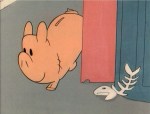
Director: Dave Tendlar Release Date: November 22, 1957 Stars: Herman and Katnip Rating: ★ Review:
‘One Funny Knight’ takes place in mystical medieval times.
Herman works as a servant in a tiny medieval castle in a forest. When Katnip kidnaps ‘beautiful’ princess Guinevere, Herman comes to the rescue. Rather incongruously, Katnip is dressed in 17th century style, and rides a scooter to his own, much larger, castle, followed by Herman on a bicycle.
There is more melodrama than humor in ‘One Funny Knight’, which makes the cartoon a rather boring watch. Nevertheless, there are some nice perspective stagings.
Watch ‘One Funny Knight’ yourself and tell me what you think:
‘One Funny Knight’ is available on the DVD ‘Herman and Katnip – The Complete Series’
Director: Seymour Kneitel Release Date: August 16, 1957 Stars: Herman and Katnip Rating: ★★ Review:
‘From Mad to Worse’ takes place at a department store, where Katnip is a night guard.
We watch Herman and his cousins playing with a toy train in the toy department. When Katnip tries to catch them, Herman and his fellow mice play tricks on the cat, making him think he has gone mad, much like Hubie and Bertie did to Claude Cat in the Chuck Jones cartoon ‘Mouse Wreckers‘ (1949). Katnip even goes to a psychiaCATrist (got it?).
Compared to Chuck Jones’s cartoon, ‘From Mad to Worse’ is a rather tiresome experience. The short is surprisingly dialogue-rich, hampering the gags, and in this short Herman ‘quotes’ Confucius twice, turning into a stereotyped China-man while doing so. The animation is full, but mediocre. In fact the cartoon’s highlight is the cartoon modern background art, especially the background paintings of the first scenes are very beautiful.
Watch ‘From Mad to Worse’ yourself and tell me what you think:
‘From Mad to Worse’ is available on the DVD ‘Herman and Katnip – The Complete Series’
Director: Frédéric Back Release Date: June 1993 Rating: ★★★★★ ♕ Review:
Following the extraordinary success of ‘The Man Who Planted Trees’, which inspired several tree planting projects, Frédéric Back turned his attention to Canada’s majestic St. Lawrence river in ‘The Mighty River’.
Clocking almost half an hour, this is Back’s last and most impressive film. Told by Donald Sutherland, the film is both an ode to this impressive river, showing nature’s grandeur and spectacular sights, and a tale of the river’s sad history, which with the arriving of the Europeans turns a dark page. Soon, the story is one of slaughter, exploitation, destruction, pollution, and greed.
The film’s pessimistic and environmentalist message at times contrasts greatly with the extraordinarily beautiful and highly virtuoso images, not only of the river itself, or of the abundance of creatures the river inhabits, but also of mankind living around the stream.
Back’s style ranges from highly naturalistic to impressionistic, pointillistic, and even Van Gogh-like. His animation style is in constant motion, taking the spectator from one image to another in an organic string of continuity, as if the film itself flows like a river. Metamorphosis and swooping camera movements add to the flowing nature of the film.
Despite the extraordinary beauty of the more peaceful images, Back shows us many pictures of death and destruction: images of the slaughtering of once abundant species, of decimation of the surrounding forests and of the emptying of life in the nearby Ocean bay. These images give the film a sad and disturbing outlook, and there’s makes no mistake that Black blames sheer greed for these atrocities.
Yet, by altering the images of woe with images of wonder, Back keeps his film from becoming a depressing work of agitprop. Still, his message is crystal clear: man has exploited this mighty river long enough, and now it’s time to give its nature rest and time to heal. And even then the once countless flocks of great auk and passenger pigeons will never return, as man has driven them to extinction.
In all, ‘The Mighty River’ is an impressive piece of work, a film that will leave no viewer unmoved, and a crowning achievement on Back’s already impressive oeuvre.
Watch ‘Le fleuve aux grandes eaux’ yourself and tell me what you think:
‘Le fleuve aux grandes eaux’ is available on the DVD-box ‘L’intégrale de Frédéric Back’
The fourth and last Stille Nacht film returns to the music of His Name Is Alive, and the rabbit and doll from the second film.
The most disturbing image is that of the girl doll somehow bleeding. In another scene a death-like man tries to steal the rabbit’s egg, using string. The rabbit saves his egg by cutting the string with his teeth, and hides the egg in a glass on the ceiling. This is the most story-like part of the film, which looks beautiful, but is drenched in mystery, just like the other three Stille Nacht films.
Watch ‘Stille Nacht IV: Can’t Go Wrong Without You’ yourself and tell me what you think:
‘Stille Nacht IV: Can’t Go Wrong Without You’ is available on the DVD-set ‘The Brothers Quay – The Short Films 1979-2003’
‘Stille Nacht III: Tales from Vienna Woods’ is the third of the Quay Brothers’ ‘Stille Nacht’ films, and somehow the most incomprehensible of them all.
Star of this film is a loose flying hand, which is saved from a bullet by a hanging table, which produces a long spoon to catch the bullet. The gun shot is the only sound besides the odd Czech soundtrack, featuring some orchestra and a voice reciting over it. The film is very beautifully made, and some forest feeling is created using numerous pine cones, but it’s hard to make head or tale of this highly surreal film.
Watch ‘Stille Nacht III: Tales from Vienna Woods’ yourself and tell me what you think:
‘Stille Nacht II: Are We Still Married?’ is the second of four ‘Stille Nacht’ films the Brothers Quay made: all four are very short and shot in black and white.
The second, like the fourth, is set to a song by the band His Name Is Alive, in this case their song’Are We Still Married’, and thus essentially is a video clip. The film features a small rabbit trying to catch a ping-pong ball which flutters across the room like a moth. Also featured is a breathing girl doll.
Like the other Stille Nacht films the Brothers Quay manage to evoke a wonderful atmosphere, while using various camera techniques from the silent movie era, sometimes zooming in on a very small detail of the scene. The Jan Švankmajer influence, too, is very present. The film may be very incomprehensible, it makes a very intriguing watch.
Watch ‘Stille Nacht II: Are We Still Married?’ yourself and tell me what you think:
‘Stille Nacht II: Are We Still Married?’ is available on the DVD-set ‘The Brothers Quay – The Short Films 1979-2003’
‘Dramolet’ is the first of four films the Brothers Quay made between 1988 and 1993 bearing the title ‘Stille Nacht’ (silent night).
This first film is by far the shortest of the four, but establishes the overall style of the series: black and white images featuring dolls and lifeless objects interacting, camera techniques from the silent era, moving in on very small details within the scene, a high level of surrealism, Jan Švankmajer-like animation, and no hint of a story.
In ‘Dramolet’ a rather rugged doll looks through a window into another room, where iron screw grows a plenty. Then he returns to his own table, where the same stuff appears in his bowl. When he tries to grab his spoon, the wall behind him sprouts several others.
This very short film was made for MTV and is a beautiful product of the highly creative atmosphere of the time, when MTV invited artists from the whole world to create short films for them.
Watch ‘Stille Nacht I: Dramolet’ yourself and tell me what you think:
‘Stille Nacht I: Dramolet’ is available on the DVD-set ‘The Brothers Quay – The Short Films 1979-2003’
In ‘Tall Time Tales’ Hubley had illustrated ‘dream time’, a concept from aboriginal mythology.
In ‘Cloudland’ she returns to the aboriginal mythology, illustrating three more concepts: 1. a creation myth, in which the sun woman wakes up the earth, 2. the story of hunger at the land of plenty, and 3. Gifts from the ancestors. Like in ‘Upside down‘ and ‘Tall Time Tales‘ the episodes are announced by a voice over (this time her daughter Emily’s) telling their titles.
Hubley’s style is particularly fit for mythology, and this film doesn’t disappoint. Especially, the creation myth is wonderfully done, yet the best part is the story of hunger, with its remarkably straightforward story. This part also features the most elaborate animation, on a bird, a kangaroo and a turtle. Most of the film, however, is filled with Faith Hubley’s characteristic primitive-looking things and beings, which vibrate, move, morph and dance in short and simple animation cycles.
Watch ‘Cloudland’ yourself and tell me what you think:
‘Cloudland’ is available on the DVD ‘The Hubley Collection Volume 1’
Like ‘Upside Down‘ the film consists of several parts, divided by a voice over. ‘Tall Time Tales’ consists of five parts: 1. Time waits for no one, 2. Tick Tock Clock, in which Hubley illustrates the grind of daily work routines, 3. The twin paradox (a concept from the relativity theory), 4. Dreamtime (a concept from aboriginal mythology) and the vague ‘Arrows or circles’, probably musing whether time is linear or circular. The film ends with a great finale of beautiful, if utterly incomprehensible images moving to Don Christensen’s percussive dance music.
‘Tall Time Tales’ is one of Faith Hubley’s more successful films, blending inspired music with ditto images. Its philosophy me be light, this is still one of those films that make you stop and wonder.
Watch ‘Tall Time Tales’ yourself and tell me what you think:
‘Tall Time Tales’ is available on the DVD ‘The Hubley Collection Volume 1’
According to the titles this film is inspired by ‘upside down poetry’ by 15th century Indian poet Kabir.
The film shows several ‘upside down’ situations, all introduced by a voice over, like ‘a sheep eats a wolf’, ‘a corpse eats death’, and ‘a fish jumps out of the ocean’. Most interesting is ‘an elephant is tied to an ant’s leg’, which features remarkably classic animation on the elephant, a standout between the circular and flat animation that dominates Hubley’s films.
As always, ‘Upside down’ features Hubley’s gorgeous Miró-like ritualistic designs, but the film is hampered by the trite voice over titles, and Don Christensen’s rather disjointed score. Moreover, the stream-of-consciousness-like scenes are little more than illustrations of the poet’s ideas, and there’s no story whatsoever.
‘Upside Down’ is available on the DVD ‘The Hubley Collection Volume 1’
With Amazonia Faith Hubley returns to her favorite subject, mythology, telling three myths from this area.
The first is a creation myth in which the moon goddess creates life, but is envied by two other god-like creatures. Unfortunately, it’s far from clear what’s happening during this part.
Much clearer is the second part, which tells about a clever and hungry tortoise, who defeats a jaguar, a fox and a deer by outsmarting them, and then devouring them… This is a surprisingly funny sequence for a Faith Hubley film, whose style normally is more poetic than anything else.
The last myth is the only one to use a piece of dialogue: we hear Dizzy Gillespie say “One day, when there are no trees left, the heavens will fall and the people will be destroyed.” This part is clearly against deforestation, but also shows that nature will doubtless survive mankind.
Hubley’s magical animation style enhances the mythical atmosphere, as does Don Christensen’s music. The complete film is very beautiful and poetic.
‘Amazonia’ is available on the DVD ‘The Hubley Collection Volume 1’
Director: Gil Alkabetz Release Date: October 1992 Rating: ★★★★★ Review:
With ‘Swamp’ Gil Alkabetz showed to be a strong new voice in the animation world.
Made at the Akademie der Bildenden Künste Stuttgart in Germany, Alkabetz uses a deceptively simple setting of only two dimensions, with no background whatsoever. In this world two armies of knights on horses, armed with giant balloons and giant scissors are fighting a senseless war over a swamp.
The film is a strong allegory on the folly of war. The film’s power is greatly enhanced by its simple yet very clear designs (all knights are drawn in black ink, the balloons in bright ecoline reds and blues) and by its great sound design. But most of all, the short shows Alkabetz’s strong sense of comic timing. ‘Swamp’ is one of the best student films of all time, and deserves to be shown over and over again.
Watch ‘Swamp’ yourself and tell me what you think:
‘Swamp’ is available on the DVD box set ‘The Animation Show of Shows Box Set 2’
‘Mass in A minor’ is the first computer animated film made in Croatia.
This single fact must be the sole reason to watch the film. Otherwise, ‘Mass in A minor’ is utterly forgettable. The short is an unremarkable mood piece with flames as its main theme. The motion is perfectly set to Marijan Brkić’s new age music, but this cannot save the film, which has a cheap, ugly and utterly primitive look.
‘Mass in A Minor is available on the DVD ‘The Best of Zagreb Film: Be Careful What You Wish For and The Classic Collection’
In this latter-day Zagreb Film studio short two grains change into a prince and princess who waltz around a remote water mill.
This film combines live action footage of the water mill with cell animation of the prince and princess. Unfortunately, the film is hampered by its poor story, its mediocre designs, and unremarkable music by Ozren Depolo. If anything this film makes clear that in the post-communist era the Zagreb Film studio was severely struggling. With films like these one can feel the Zagreb school dying.
Watch ‘Last Waltz in the Old Mill’ yourself and tell me what you think:
‘Last Waltz in the Old Mill’ is available on the DVD ‘The Best of Zagreb Film: Be Careful What You Wish For and The Classic Collection’
‘Paranoia’ is a short film (lasting only four minutes) about a young man who thinks he’s followed on the street.
The film is set in monochromes, with strong black and white contrasts. Sudžuka indeed includes in his images a reference to Corto Maltese, a comic hero by Hugo Pratt, an artist with a similar palette. Sudžuka’s own style is much more angular than Pratt’s, however, and more confined to the 1980s. The film looks well, but is hampered by its trite ending.
Watch ‘Paranoia’ yourself and tell me what you think:
‘Paranoia’ is available on the DVD ‘The Best of Zagreb Film: Be Careful What You Wish For and The Classic Collection’
Director: Milan Trenc Release Date: 1990 Rating: ★★★½ Review:
When a spoiled, rich brat is about to smash his piggy bank to pieces with a large hammer, the piggy bank flees. While the boy and his family are looking for him, the piggy bank has a good time at the fair.
This is a rather lightweight film, based on a story by Milan Milšić. Trenc uses a lot of different designs in this film, with the piggy bank itself being the most conventional. Like many other Zagreb films from this later period, the film is hampered by limited animation and an ugly electronic score, this time by Davon Rocco.
Watch ‘The Big Time’ yourself and tell me what you think:
‘The Big Time’ is available on the DVD ‘The Best of Zagreb Film: Be Careful What You Wish For and The Classic Collection’
‘Butterflies’ is a film from the Zagreb Film studio, when the once famous studio was already in its decline.
‘Butterflies’ is about a young woman who imagines the different lives she can lead with some very different men. This film uses strong, angular 1980s designs and colors by co-writer Magda Dulčić, and has a rather stream-of-consciousness-like structure, with a lot of metamorphosis and designs that verge on the abstract. The animation ranges from very limited to full, and from serious to cartoony. Unfortunately, Igor Savin’s ugly electronic score and Dulčić designs make the film feel dated, and more a product of its time than a timeless classic.
‘Butterflies’ is available on the DVD ‘The Best of Zagreb Film: Be Careful What You Wish For and The Classic Collection’
Director: Michel Ocelot Broadcast Date: 1992 Rating: ★★★★ Review:
‘Les Contes de la nuit’ (Tales of the Night) are three fairy tale films French animation master Michel Ocelot made for television, not to be confused with his feature film of the same name from 2011.
The three fairy tales are entirely original and are done in very elegant Lotte Reiniger-like cut-out animation, using black silhouettes only against handsomely colored backgrounds. Both the design and the animation are top notch throughout, making this mini-series a delight to watch.
‘La belle fille et le sorcier’ (Beauty and the Sorcerer) is first and shortest fairy tale of ‘ Les Contes de la nuit’ and features a fat ugly girl rescuing a wizard. Soon she’s turned into a handsome young lady… The film is more comical than the other two, and hard to take seriously.
‘La bergère qui danse’ (The Dancing Shepherdess) is the second story of ‘Les Contes de la nuit’. This fairy tale features a powerful fairy queen in love with a young handsome shepherd. He, however, prefers his shepherdess. But then the fairy queen takes the shepherd to ‘the tower of sleep’, to sleep for a hundred years, and it’s up to the shepherdess to rescue him… This is a particularly attractive fairy tale, showing the power of hope and love.
‘Le prince des joyaux’ (The Jewel Prince) is the third and last tale of ‘Les Contes de la nuit’. This fairy tale again is entirely original, but looks like a story from 1,001 Arabian Nights. The plot is rather Aladdin-like, and features a boy in love with a princess, whom he wins by defeating an evil old man, who cheats on him. Like the other two this is a delightful little film, even if it is a little heavy on dialogue.
‘Les Contes de la nuit’ are available on the French DVD ‘Les trésors cachés de Michel Ocelot’
Sure, the film boasts Brad Pitt and Kim Basinger as leading actors, and it even features a title song by David Bowie, but Ralph Bakshi’s product feels half-baked and derivative compared to Touchstone’s milestone film from 1988.
The film’s main problem is its story: it features a weird and obligate prologue to explain (unconvincingly) why Frank Harris (Brad Pitt) even wanders in the ‘doodle world’. Only half way we can extract this world’s core problem: ‘doodles’ and ‘noids’ (real people) cannot have sex together, because this will distort the universe. But sexy doodle ‘Holli Would’ (yes, that’s her name) would. And she does, with her own creator Jack Deebs (Gabriel Byrne).
This idea is preposterous to start with, but the execution is worse. Frank Harris, who apparently has become a cop, wanders through cardboard sets most of the time, aimless and clueless. All dialogues feel wooden and disjointed, and in several key dialogue scenes the actors clearly aren’t even together in the same room (!) with Bakshi falling back to a very unconvincing technique of suggestion of continuity of space that goes all the way back to the Keystone Comedy films of the early 1910s.
Kim Basinger acts more like a caricature of a sexy woman than being one, and the role of Jack Deebs remains vague and unclear to the very end: if he’s the creator, why did Cool World already exist in 1945, if he’s not, why is he the only one depicting it? Frank Harris somewhere suggests that more visitors are coming to this world, why then is Harris the only one allowed to stay? It just makes no sense.
The film’s main attraction, of course, is the animation. Supervised by Bruce Woodside, most of the animation is in fact is quite good (the crew even boosts a veteran animator like Bill Melendez), if completely arbitrary most of the time. Many scenes are filled with random animated scenes, mostly rather violent, sometimes grotesque, sometimes harking back to Max Fleischer, Warner Bros. or Tex Avery, at other times spoofing Disney (a cute rabbit, a hippo from Fantasia emerging from cigarette smoke, Gepetto and Pinocchio depicted in the inside of one of Holli’s ‘goons’). Being a Bakshi film, ‘Cool World’ also features a fair deal of rotoscope, most clearly so on Holli Would and Brad Pitt’s flat doodle girl friend Lorette.
Despite the high quality of the full animation, the animated scenes are mostly insane, not funny. The best attempt at humor is the finale, in which Deebs inexplicably changes into a rather pompous superhero, completely losing his former character.
Unfortunately, the scenes in which animated characters interact with humans have nothing of the sophistication of ‘Who Framed Roger Rabbit’. Instead, Bakshi only deploys static scenes, a technique in existence since ‘The Three Caballeros‘, and in no scene in which ‘doodles’ and humans touch each other, one has the feeling that this is really happening.
Sadly, we must conclude that a lot of animation talent has been wasted on a meandering, clueless, badly written and badly directed film, with an immature focus on sex. The film did bad at the box office, and I’m afraid I must judge rightly so.
Watch the trailer for ‘Cool World’ yourself and tell me what you think:
‘Porco Rosso’ is the strangest movie in Hayao Miyazaki’s filmography. The film eschews most laws of animated film story telling, seemingly just starting and ending in the middle of a bigger story.
Like ‘Laputa: island in the sky’ (1986) and the later ‘The Wind Rises’ (2013) the film is clearly born out of Miyazaki’s love for planes. Like ‘Laputa’ ‘Porco Rosso’ is set in an alternative history Europe (this time the Adriatic sea ca. 1930), and features flying pirates.
The title character is an ex-war pilot with the face of a pig (why this is so is never really revealed). Porco Rosso now is a bounty hunter, battling a federation of air pirates, and their leader, the American Curtis in particular, and secretly loving Gina, the owner of a hotel on an island.
Halfway the movie Porco has to take his injured plane to Milano to get it fixed. There he meets Fio, the young granddaughter of his old mecanic. There’s a vague sense of a Nazi threat, but this is hardly played out. The story evolves around Porco’s return to the Adriatic and final battle with Curtis.
The overal atmosphere is light and comical, but there are a few touching moments, especially between Porco and Fio. Typically for Miyazaki, the film features strong women, and women and children working (Porco’s plane is set together by a crew of women, only).
The animation is outstanding throughout, although it seems the animators didn’t do their best to lip-synch. Most interesting are the scenes of Porco’s take off and flight back to the Adriatic, which feature some spectacular animated backgrounds.
Watch the trailer for ‘Porco Rosso’ yourself and tell me what you think:
Animation Backgrounds
A blog dedicated to background paintings from animation films. Kept until 2016.
Animation Scoop
Animation historian Jerry Beck’s animation film news blog.
Cartoon Brew
Topical blog on animation film, led by animation historian Amid Amidi.
Cartoon Modern
Amid Amidi’s blog on modern design cartoon art from the forties, fifties and sixties.
Cartoon Research
THE site on classic animation research, hosted by cartoon historian Jerry Beck.
Cartoons Theory
Frank Beef analyzes classic cartoons. Kept until 2020.
Century Film Project
Michael reviews films of 100 years old and older, roughly in chronological order.
Classic Cartoons
A similar blog featuring many stills and comic strips. Kept until 2012.
Comet over Hollywood
Jessica Pickens reviews classic Hollywood films, especially musicals.
Deja View
Top ex-Disney animator Andreas Deja’s own blog.
Disney History
Esteemed Disney historian Didier Ghez on the latest books on Disney history.
Feeling Animated
Paul Astell brings us thorough reviews of animated features.
Flickers in Time
Short and to the point reviews of classic films (lately mostly pre-code talkies) by an anonymous retired Foreign Service Officer from California