Director: Paul Fennell?
Release Date: 1940
Stars: Gran’ Pop Monkey
Rating:  ★
Review:

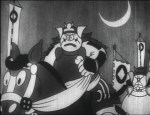
Baby Checkers © Ub Iwerks‘Baby Checkers’ is the last of three surviving Gran’ Pop Monkey cartoons, a cut series made in the last days of the Ub Iwerks studio.

The cartoon copies the story of the first, ‘Beauty Shoppe‘, in that Gran’ Pop Monkey and his two grandsons try a new business. This time they try their luck with a baby nursery. The first day is highly successful, with countless mothers bringing in their babies. Unfortunately, Gran’ Pop Monkey’s system to remember which baby is whose, soon runs haywire, and causes much discomfort among the mothers at the end of the cartoon. In between all kinds of things go wrong, like feeding and bathing the baby animals.

Nowhere ‘Baby Checkers’ gets near being funny, even if the short makes more sense than ‘A Busy Day‘. The action remains tiresome, the story is disjointed, and the grand finale anything but that. The terrible voice acting and erratic designs don’t help either, and like in the other two Gran’ Pop Monkey cartoons, only the musical score is of a high quality. This, of course, wasn’t enough, and although the reasons are unknown, the series was justly abandoned.

‘Baby Checkers’ has only survived in a black and white copy, which is available on the DVD ‘Cultoons! Rare, Lost and Strange Cartoons! Volume 3: Monkeys, Monsters & More!’

Director: Paul Fennell?
Release Date: 1940
Stars: Gran’ Pop Monkey
Rating:  ★
Review:

A Busy Day © Ub Iwerks‘A Busy Day’ is the second of three surviving Gran’ Pop Monkey cartoons, and arguably the worst of the trio.

The short starts excellently enough, with a rhythmical start of the day, with sound effects, music and images being in perfect harmony to evoke a bright and promising morning. However, this sequence is discarded all too soon, when we cut to Gran’ Pop Monkey, who’s still in bed. His two grandsons awake him, and we watch the trio on a working day in their office on a high tree in the jungle.

This setting itself strains the believability of the cartoon, but worse, from that point on, things just start happening on the screen. Somehow, they involve some sneezing by Gran’ Pop Monkey, but otherwise nothing makes sense. In the end of the cartoon an exhausted Gran’ Pop Monkey ends up in bed again, and we, as an audience, are glad that this endless cartoon is over, even if it’s only seven minutes long.

Watch ‘A Busy Day’ yourself and tell me what you think:

‘A Busy Day’ is available on the DVD ‘Cultoons! Rare, Lost and Strange Cartoons! Volume 3: Monkeys, Monsters & More!’

Director: Paul Fennell?
Release Date: 1940
Stars: Gran’ Pop Monkey
Rating:  ★★½
Review:

Beauty Shoppe © Ub IwerksThe Gran’ Pop Monkey cartoon were made during the aftermath of the Ub Iwerks studio (then called Cartoon Films, LTD), just before Iwerks sold the studio and went back to Disney himself.

The character Gran’ Pop Monkey was based on illustrations by British artist Lawson Wood (1878-1957), and in 1939 the studio announced it would make 24 cartoons with the character. However, only three are known today, which were all three released in 1940. In fact, as Yowp notices in his comment to Steve Stanchfield’s informative blog post on this cartoon, these three had already been finished by the end of 1938, so perhaps these were the only ones ever made. In any case, it remains unclear why the series was discontinued, but one thing is certain: they are far from classics.

All three Gran’ Pop Monkey cartoons were shot in Cinecolor, a 2-color system, lacking the vibrant color range of Technicolor, and although the animation is fair, the stories, the designs, voices and gags are not, and the three films make a tiresome watch. In fact, the most enjoyable part of these three cartoons is their excellent musical score.

The first, ‘Beauty Shoppe’ is arguably the best of the surviving trio. In this short Gran’ Pop Monkey is a barber, helped by his two grandsons (who look like macaques, while Gran’ Pop Monkey clearly is a chimpanzee). Business isn’t going well, however, in contrast to that of the beauty salon across the street (the film takes place in a jungle, but anyway). So, one of the grandson suggests to copy the salon’s formula. Soon, female animals rush into Gran’ Pop Monkey’s cabin-turned-beauty salon (including a colorful company of a badger, a penguin, a seal, a pig and a kangaroo). When a gangster-like gorilla demands they make his wife, a hippo, beautiful, things turn very bad for the trio, indeed. Curiously, ‘Beauty Shoppe’ starts with some dialogue in rhyme, which is discarded halfway.

Watch ‘Beauty Shoppe’ yourself and tell me what you think:

‘Beauty Shoppe’ is available on the DVD ‘Cultoons! Rare, Lost and Strange Cartoons! Volume 3: Monkeys, Monsters & More!’

Director: Dave Fleischer
Release Date: August 30, 1940
Stars: Popeye, Olive Oyl
Rating:  ★★★
Review:

Puttin on the Act © Max Fleischer‘Puttin on the Act’ reveals that Popeye and Olive had been a vaudeville duo once.

The short opens with Olive running to Popeye, full of joy, because she has read in the newspaper that vaudeville is coming back. This would be a surprise, as already during the 1920s vaudeville had gone into a steady decline, due to radio, film, and jazz.

But Olive and Popeye immediately revive their old routines in their own home. Most fun is Popeye doing impersonations, imitating Jimmy Durante, Stan Laurel and Groucho Marx (using some of Marx’s best quotes). Their routine ends with ‘The Adagio’, an acrobatic act that is very similar to the one by Horace Horsecollar, Clarabelle Cow and Goofy in ‘Orphan’s Benefit‘ (1935), proving this was a staple act in vaudeville. At the end of the cartoon, unfortunately, it’s revealed that Olive’s newspaper had been from 1898…

‘Puttin on the Act’ is nice piece of nostalgia. Most of the animators and story artists of the time had grown up in the vaudeville era, and this cartoon is a homage to a form of entertainment long lost since.

Watch ‘Puttin on the Act’ yourself and tell me what you think:

This Popeye film No. 86
To the previous Popeye film: Wimmin Hadn’t Oughta Drive
To the next Popeye film: Popeye Meets William Tell

‘Puttin on the Act’ is available on the DVD set ‘Popeye the Sailor Volume Two’


Director: Dave Fleischer
Release Date: August 2, 1940
Stars: Popeye, Swee’Pea
Rating:  ★★★½
Review:

Doing Impossikible Stunts © Max Fleischer‘Doing Impossikible Stunts’ is a cheater, a.k.a. a compilation cartoon. Yet within this genre, this short is a nicely told one.

In this cartoon Popeye heads for ‘Mystery Pictures, Inc.’ , to apply as a stunt man. He has brought with him some footage of his stunt work. Little Swee’Pea follows him, and at one time swaps Popeye’s footage for his own, gaining the job.

Popeye’s films are excerpts from ‘I never Changes My Altitude’ (1937), ‘I Wanna be a Lifeguard’ (1936) and ‘Bridge Ahoy’ (1936), and Swee’Pea’s is from ‘Lost and Foundry’ (1937).

The film company’s slogan, ‘If it’s a good picture, it’s a mystery’ echoes a similar gag involving Wonder pictures, in ‘Daffy Duck in Hollywood‘ (1938).

Watch ‘Doing Impossikible Stunts’ yourself and tell me what you think:

https://www.dailymotion.com/video/x3plrdp

This Popeye film No. 84
To the previous Popeye film: Fightin Pals
To the next Popeye film: Wimmin Hadn’t Oughta Drive

‘Doing Impossikible Stunts’ is available on the DVD set ‘Popeye the Sailor Volume Two’

Director: Dave Fleischer
Release Date: July 12, 1940
Stars: Popeye, Bluto
Rating:  ★★★½
Review:

Fightin Pals © Max Fleischer‘Fightin Pals’ is a cartoon devoted to the love-hate relationship between Popeye and Bluto. 

The short opens with Dr. Bluto boarding a ship for an African Expedition. Popeye and Bluto show their own tough way of saying goodbye, but as soon as Bluto has left, Popeye starts pining for his rival. Thus, when he hears on the radio Bluto has been lost, he himself sails straight into dark Africa to look for his lost pal. Soon, Popeye is in a bad state himself, and when he finally discovers Bluto, who is pampered by some beautiful natives, it’s Bluto who has to revive him by giving the poor sailor spinach. As soon as Popeye is on his feet, the two immediately resume their happy quarrel again.

‘Fightin Pals’ is a beautiful cartoon on friendship. Jack Mercer’s mumbling is particularly inspired in this cartoon. The short also shows a brief World War II reference: when Popeye sails passes Europe he encounters some violent fighting there.

After ‘Fightin Pals’ it looks as if Bluto stayed in Africa, for he was not seen in any Popeye cartoon for almost two years. He returned to the screen in ‘Olive Oyl and Water Don’t Mix’ (1942), this time to stay.

Watch ‘Fightin Pals’ yourself and tell me what you think:

https://www.dailymotion.com/video/x3plr1w

This Popeye film No. 83
To the previous Popeye film: Nurse-Mates
To the next Popeye film: Doing Impossikible Stunts

‘Fightin Pals’ is available on the DVD set ‘Popeye the Sailor Volume Two’

Director: Dave Fleischer
Release Date: June 20, 1940
Stars: Popeye, Bluto, Olive Oyl, Little Swee’Pea
Rating:  ★★★½
Review:

Nurse-Mates © Max Fleischer‘Nurse-Mates’ opens with Bluto and Popeye both visiting Olive to invite her to the movies.

Olive agrees, but first has to go to the beauty parlor, leaving the two rivals to take care of little Swee’Pea. This leads to several gags showing the two men’s original ways to bathe, feed, and dress the baby, while competing each other.

In this cartoon Bluto is no villain, only Popeye’s rival, and he gets ample screen time to show his parental instincts. Moreover, there’s no spinach involved, and Bluto’s and Popeye’s rivalry is almost playful, when compared to other entries. This more harmonious relationship between the two would be explored further in the next Popeye cartoon, ‘Fightin’ Pals’.

Watch ‘Nurse-Mates’ yourself and tell me what you think:

This Popeye film No. 82
To the previous Popeye film: Wimmen Is a Myskery
To the next Popeye film: Fightin Pals

‘Nurse-Mates’ is available on the DVD set ‘Popeye the Sailor Volume Two’

Director: Rudolf Ising
Release Date: June 22, 1940
Rating:  ★★★
Review:

The Milky Way © MGM1940 is arguably a turning year in the history of animation. This year marked the end of Disney’s domination, as the studio’s innovative Silly Symphonies series had stopped, while Disney’s ambitious, but expensive feature productions ‘Pinocchio‘ and ‘Fantasia’ had lost the studio dear money. These features plunged Disney brothers into huge debts, and forced them to go to the stock markets.

As to emphasize Disney’s loss, 1940 was also the first year in which a non-Disney cartoon won an Academy Award. In fact, in this year not a single Disney cartoon was even nominated. Moreover, among the nominations were two shorts that marked the strong debuts of characters that heralded a new era: Tom & Jerry in ‘Puss and Boots’ and Bugs Bunny in ‘A Wild Hare‘. These characters would dominate the 1940s, over Disney’s Mickey, Donald, Pluto and Goofy.

Yet, it was MGM’s ‘The Milky Way’, which won the Academy Award. To be frank, ‘The Milky Way’ is still firmly rooted in Disney-like 1930’s animation: it’s a Silly Symphony but in name, it features a saccharine song, and it borrows heavily from Disney’s ‘Wynken, Blynken, and Nod‘ (1939). Both cartoons feature three babies exploring the night sky. Such copycat behavior was all too typical for the Harman & Ising studio.

In ‘The Milky Way’ the main protagonists are the three kittens from the nursery rhyme. As they’ve lost their mittens, they aren’t denied pie, but a meal of milk, and sent off to bed without supper. With the help of balloons, the trio sails to the Milky Way, which turns out to be a Cockaigne of milk, with e.g. milk geysers and milk gas stations. However, the geyser milk gives one of the kittens a tremor belly, and soon the trio fall down back to earth.

‘The Milky Way’ is cute, lush and excels in high production values, even though it can’t compete with the stunning ‘Wynken, Blynken and Nod’. The short is also sugary and rather boring. The best part is the depiction of the fantasy world of the Milky Way. But the attention easily goes to the beautiful background art and to Scott Bradley’s excellent score. The designs of the kittens look forward to those of kittens in the Tom & Jerry series.

Watch ‘The Milky Way’ yourself and tell me what you think:

https://www.dailymotion.com/video/x5dyxaa

‘The Milky Way’ is available on the DVD ‘Warner Bros. Home Entertainment Academy Awards Animation Collection: 15 Winners’

Director: Walter Lantz
Release Date: March 28, 1941
Rating:  ★★
Review:

Scrub Me Mama with a Boogie Beat © Walter Lantz‘Scrub Me Mama with a Boogie Beat’ opens with scenes from ‘Lazy Town’, a place in the South full of lazy negroes, whose depiction is the epitome of racist stereotyping: everyone is asleep, doing things ridiculously slowly or with a minimum of effort. Oh! Those lazy Southern blacks!

Then a steamer stops, and a sexy, light-skinned woman steps out, immediately reviving the male population. She starts the title song, and all the villagers join in.

‘Scrub Me Mama With a Boogie Beat’ is rather tiresome to watch. The boogie-woogie song itself never really comes off, and is less swinging as it could be. But more importantly, the images accompanying the song are hardly funny, as most of the ‘humor’ comes from those ha-ha silly blacks doing things on the musical beat. As none of these gags work today, the short becomes surprisingly empty.

In fact, together with the Van Beuren cartoon ‘Plane Dumb‘ (1932) ‘Scrub Me Mama with a Boogie Beat’ is a likely candidate of being the most offensive racist cartoon around. Only the singing girl is given some dignity, but her race remains unclear, and she could as well be white.

Some of the animation on this girl was reused on the Andrews Sisters in the equally racist, yet less offensive, and much more entertaining ‘The Boogie Woogie Bugle Boy of Company B‘ from six months later.

‘Scrub Me Mama with a Boogie Beat’ was one of the first cartoons to evoke serious issues because of its racism, as upon its re-release in 1948, it was heavily criticized by the National Association for the Advancement of Colored People (NAACP). With help from the more powerful Jewish Labor Committee (JLC), the NAACP managed to make Universal withdraw the cartoon in February 1949. After this incident black stereotypes virtually vanished from the animated screen, except for the occasional cannibal here and there.

Watch ‘Scrub Me Mama with a Boogie Beat’ yourself and tell me what you think:

‘Scrub Me Mama with a Boogie Beat’ is available on the DVD ‘Lantz Studio Treasures Starring Oswald’

Director: Burt Gillett
Release Date: August 28, 1939
Stars: Lil’ Eightball
Rating:  ★★½
Review:

Silly Superstition © Walter Lantz‘Silly Superstition’ is the second of three cartoons starring Lil’ Eightball, a heavy caricatured black boy with a deep southern voice (by Mel Blanc).

In ‘Silly Superstition’ Lil’ Eightball’s mama warns him that it’s Friday the 13th, and that he shouldn’t walk under a ladder or let a black cat cross his path. Lil’ Eightball dismisses these warnings as superstition, doing deliberately these things. The ladder walk rather unlikely makes a complete building collapse, while the black cat immediately introduces an escaped lion. Luckily, Lil’ Eightball’s puppy dog saves the day, chasing the lion back to the zoo.

‘Silly Superstition’ is pretty hard to watch today. The animation in this short is very uneven, being sometimes strikingly modern, yet at other times disappointingly old-fashioned. But more importantly, Lil’ Eightball is too severe a stereotype to enjoy. The boy looks particularly goofy in this cartoon, having a balloon head, a ridiculously small body and over-sized, rather clownish shoes, emphasizing his stupidity. Most of the ‘humor’ of the cartoon stems from the fact that despite his uneducated background, Lil’ Eightball manages to use big words.

As Christopher P. Lehman notices in ‘The Colored Cartoon’ it’s a sad fact that Lil’ Eightbal starts atypically self-assured and brave, but ends up as a stereotypical fearful negro boy. This ‘morale’ is dubious to say the least. Luckily, contemporary reviewers weren’t impressed either, and Lil’ Eightball vanished from the screen after only three cartoons.

Watch a colorized version of ‘Silly Superstition’ yourself and tell me what you think:

‘Silly Superstition’ is available on the DVD ‘Lantz Studio Treasures Starring Oswald’

Director: Tex Avery
Release Date: July 27, 1940
Stars: Bugs Bunny, Elmer Fudd
Rating:  ★★★★½
Review:

A Wild Hare © Warner Bros.‘A Wild Hare’ marks the birth of one of the biggest cartoon stars of all time, Bugs Bunny.

The short had been preceded by four other Warner Bros. cartoons about hunting and rabbits, ‘Porky’s Hare Hunt‘ (1938), ‘Prest-O Chang-O‘ (1939). ‘Hare-Um Scare-Um‘ (1939) and ‘Elmer’s Candid Camera‘ (1940), which all contributed to the formation of the character.

Yet, it’s the character, design and voice the rabbit got in ‘A Wild Hare’ that made the rodent into the Bugs Bunny we all know now, even though he still looks a little different. Nevertheless, the difference between Tex Avery’s Bugs and his predecessors is less marked than sometimes advertised: Jones’s rabbit in ‘Elmer’s Candid Camera’ already was a calm character, and both the rabbits in ‘Porky’s Hare Hunt’ and in ‘Elmer’s Candid Camera’ had performed fake death scenes. Moreover, even in the first half of ‘A Wild Hare’ the rabbit still seems a bit loony, like his predecessors.

Still, the rabbit has become a lot cooler: in his first appearance (which surprisingly only occurs after two and a half minutes!) he calmly addresses his hunter with the first occurrence of that famous line ‘What’s up, doc?‘. And in the second half he kisses Elmer Fudd a few times (another Bugs Bunny trademark) and deliberately invites Elmer to shoot him, only to act out a superb death scene, animated to perfection by Robert McKimson.

Likewise, Elmer Fudd gets his definite design in this cartoon, and it’s here he utters his trademark opening words ‘Be vewy vewy quiet, I’m hunting wabbits‘ for the first time. He still has the red nose he had inherited from his predecessor Egghead, but that would soon go, too.

Priceless is the ‘guess who’ scene, in which Elmer guesses several beautiful Hollywood actresses as likely candidates (“Hedy Lamarr? Carole Lombard? Rosemary Lane? Olivia de Havilland?“), before deciding upon ‘that screwy rabbit’. The complete cartoon forms the template for many Bugs Bunny cartoons to come, up to such a late short like ‘What’s Opera, Doc?‘ (1957).

The cartoon itself at least was a success, and nominated for an Academy Award (which it lost to MGM’s ‘The Milky Way‘), and it prompted other cartoon directors to use the character, too. Five months later, Chuck Jones was the first, with ‘Elmer’s Pet Rabbit’. Thus this rabbit had to get a name. And in an era in which virtually all cartoon stars had alliterated names, he was christened Bugs Bunny. In fact, this name that already appeared on a model sheet for ‘Hare-Um Scare-um’ as ‘Bugs’ Bunny’, after director Bugs Hardaway, who had directed that particular cartoon. ‘Elmer’s Pet Rabbit’ has a separate title card to introduce this rabbit and his red-hot name.

With ‘A Wild Hare’ the Leon Schlesinger studio turned a new page. Together with MGM’s ‘Puss Gets the Boot‘, Tom & Jerry’s debut film, which had been released five months earlier, the short somehow heralds the wilder and more mature days of the 1940s. And although Elmer and Bugs don’t chase each other in ‘A Wild Hare’, the cartoon helped to shape the format of the chase cartoon, with the comedy played out well with just the two characters, in a clear antagonistic relationship. Now the fun could really begin…

Watch ‘A Wild Hare’ yourself and tell me what you think:

https://www.dailymotion.com/video/x4053d

This is Bugs Bunny cartoon No. 1
To the last proto-Bugs Bunny cartoon: Elmer’s Candid Camera
To the next Bugs Bunny cartoon: Elmer’s Pet Rabbit

‘A Wild Hare’ is available on the Blu-Ray set ‘Looney Tunes Platinum Collection: Volume 2’ and on the DVD ‘Warner Bros. Home Entertainment Academy Award-Nominated Animation: Cinema Favorites’

Director: Riley Thomson
Release Date: July 19, 1940
Stars: Donald Duck, Pluto
Rating:  ★★★★½
Review:

Put-Put Troubles © Walt DisneyIn 1940, the Donald Duck series really hit the stride, becoming a series of pure gag cartoons, with few real failures until the end.

By now, Donald had shed his childish feathers, and had become more or less a representative of the American average citizen, coping with familiar troubles, like in this case, a failing outboard motor.

In ‘Put-Put Troubles’ Donald and Pluto go for a boat trip on a lake. Pluto encounters a frog and gets stuck in a spring, while Donald has troubles with starting the outboard motor. The motor itself is excellently animated, behaving rather outrageously, and at one time even functioning as a can opener, destroying Donald’s boat within seconds.

This is arguably the first cartoon in which Donald has to battle with a well-known inanimate object. Donald was at its best when having to deal with common household objects, and this cartoon is a prime example. True, Donald had to deal with inanimate objects before, e.g. strange machines in ‘Modern Inventions‘ (1937) and a giant spring in ‘Clock Cleaners’ (1938), but these were hardly familiar things to the average viewer, while Donald’s struggle with the outboard motor is recognizable to many, adding to its comedy. Even better examples were to come (e.g. the folding chair from ‘Donald’s Vacation‘ (1940), the folding bed from ‘Early to Bed‘ (1941) and the leaking tap in ‘Drip Dippy Donald’ from 1948).

In contrast, Pluto’s antics with the spring are less inspired, and the cartoon’s exciting finale comes all too suddenly to an end.

‘Put-Put Troubles’ was the first Disney short directed by the unsung hero Riley Thomson, who would only direct seven shorts between 1940 and 1942, all of them hilarious. Thomson had started animating for Warner Bros. in 1935, but already in 1936 he exchanged Warner Bros. for Walt Disney. After his direction career, Thomson became a story man for the Goofy series, then moved on to comics. He spent the final days of his career at Walter Lantz, as a layout artist for the Woody Woodpecker show.

Watch ‘Put-Put Troubles’ yourself and tell me what you think:

This is Donald Duck cartoon No. 18
To the previous Donald Duck cartoon: Mr. Duck Steps Out
To the next Donald Duck cartoon: Donald’s Vacation

‘Put-Put Troubles’ is available on the DVD set ‘The Chronological Donald Volume 1’

Director: Jack King
Release Date: June 7, 1940
Stars: Donald Duck, Daisy Duck, Huey, Dewey and Louie
Rating:  ★★★★½
Review:

Mr. Duck Steps Out © Walt Disney‘Mr. Duck Steps Out’ opens with Donald Duck preparing to visit his love interest, Daisy Duck.

To Donald’s dismay, his nephews want to go too, and the kid trio seriously hampers his courting efforts. Even sending them off to get some ice cream doesn’t help. Nevertheless, when Huey, Dewey and Louie make Donald swallow a popping corn, Donald’s dance moves become so hot, he quickly wins Daisy over. Thus, in the end, the exhausted duck is smothered in kisses.

‘Mr. Duck Steps Out’ is a clear cartoon of the swing era, and we watch all ducks trucking and doing the lindy hop to the swinging music. The Disney composers weren’t capable of making real jazz, however, and the music remains rather tame when compared to the big bands of the era. It’s a pity, because the animation on Donald and Daisy dancing, and on the nephews are playing the music is marvelous, and certainly hotter than the music accompanying it.

‘Mr. Duck Steps Out’ is noteworthy for marking the debut of Donald’s long lasting girlfriend, Daisy Duck, Donald’s second love interest after Donna Duck had disappeared into the distance on her unicycle in ‘Don Donald‘ (1937). On the screen, Daisy remained a minor character, only appearing in ten more Donald Duck cartoons. However, she would become a regular in Al Taliaferro’s daily strip, making her debut on 4 November 1940, first as Donald’s new neighbor. Later, Carl Barks, too, made regular use of this character. In both comic strips Daisy’s appearance remained largely the same as in this cartoon.

Watch ‘Mr. Duck Steps Out’ yourself and tell me what you think:

This is Donald Duck cartoon No. 17
To the previous Donald Duck cartoon: Donald’s Dog Laundry
To the next Donald Duck cartoon: Put-Put Troubles

‘Mr. Duck Steps Out’ is available on the DVD set ‘The Chronological Donald Volume 1’

Director: Clyde Geronimi
Release Date: May 17, 1940
Stars: Donald Duck, Goofy
Rating:  ★★★½
Review:

Billposters © Walt Disney‘Billposters’ is the third of six cartoons co-starring Donald Duck and Goofy, and arguably the best in the series.

In this short Donald and Goofy are fanatical billposters, literally smothering the countryside with advertisements for canned soup. In the introduction we watch them reaching a barn, while whistling and humming ‘Whistle While You Work’ from ‘Snow White and the Seven Dwarfs’ (1937).

What follows are only two routines: Goofy’s problems with a windmill, and Donald’s problems with a hungry billy goat. These separate routines are a continuation of the trio cartoon formula, now only minus Mickey. The string of gags is impressive, as one gag flows naturally into another, building to the strong finale, in which the two separate story lines combine. Especially Goofy’s antics belong to the best in his career. Nevertheless, Geronimi’s all too relaxed timing hampers the picture, and make the gags less funny than they could have been, making ‘Billposters’ fall short of becoming a real classic.

Watch ‘Billposters’ yourself and tell me what you think:

‘Billposters is available on the DVD set ‘The Chronological Donald Volume 1’

Director: Jack King
Release Date: April 5, 1940
Stars: Donald Duck, Pluto
Rating:  ★★
Review:

Donald's Dog Laundry © Walt DisneyIn ‘Donald’s Dog Laundry’ Donald Duck has built a rather Rube Goldberg-like dog washing machine.

Donald decides that the unwilling Pluto is to be his first customer in bath, and tries to get him in bath, first with the use of a whistling rubber bone, and then with an all too lifelike cat hand-puppet. Of course, it’s the duck himself who takes the plunge, yet the cartoon ends with Donald cheering because his apparatus works.

‘Donald’s Dog Laundry’ is full of the mild and long character animation routines so typical of the Mickey Mouse cartoons of the second half of the 1930s. Where in later Warner Bros. or MGM cartoons the rubber bone and hand-puppet would have been only two of several attempts, in this short the two devices are milked at length. Especially, Pluto, probably animated by Norm Ferguson, gets ample screen-time, to a rather tiring effect.

Watch ‘Donald’s Dog Laundry’ yourself and tell me what you think:

This is Donald Duck cartoon No. 16
To the previous Donald Duck cartoon: The Riveter
To the next Donald Duck cartoon: Mr. Duck Steps Out

‘Donald’s Dog Laundry’ is available on the DVD set ‘The Chronological Donald Volume 1’

Director: Dick Lundy
Release Date: March 15, 1940
Stars: Donald Duck, Pete
Rating:  ★★★
Review:

The Riveter © Walt Disney‘The Riveter’ starts with Pete firing a pig from the building site and setting up a sign with ‘Riveter wanted’.

At that point Donald Duck walks by, and he immediately volunteers. Unfortunately, he is hardly suited for the job, having to work on the top of a tall skyscraper, and he’s soon a nervous wreck, only bothering Pete.

Pete had been introduced as Donald Duck’s adversary in ‘Officer Duck‘ from 1939, but he was still a criminal then. In ‘The Riveter’ Pete was cast as an authority figure, able to command Donald, a trend which had already started as far back as ‘Moving Day‘ (1936), in which Pete played the sheriff. The two characters suited each other well, and Pete’s authority was maintained in all subsequent Donald Duck-Pete-cartoons, save the last one, ‘Trombone Trouble’ from 1944.

In the Donald Duck series Pete appeared to be a softer, more ‘human’ character than in the former Mickey Mouse films. Even though he was Donald’s bully, he hardly was the villain he used to be. For example. in ‘The Riveter’ he gives Donald a job, even if he has clear doubts about Donald’s abilities. Moreover, it takes some time before Pete loses his temper, and at that time one can hardly blame him. Unfortunately, Pete was more or less sacked after’Trombone Trouble’, and he only had a short come-back in two shorts in 1953.

‘The Riveter’ is an inspired cartoon, with wonderful and inventive gags, with as a highlight Donald Duck drilling a dopey painter from tall to flat, without the character even blinking. Donald also revives Goofy’s dizzy walk from ‘Clock Cleaners’ (1937), and his ride up the elevator is a wonderful exaggeration of Mickey’s similar ride in ‘Building a Building‘ (1933), stretching Donald’s body to the max. The short ends with a long chase scene, typical of the new era, which ends with Donald covering Pete with quick-drying plaster, turning the hapless foreman into a Greek fountain.

Watch ‘The Riveter’ yourself and tell me what you think:

This is Donald Duck cartoon no. 15
To the previous Donald Duck cartoon: Officer Duck
To the next Donald Duck cartoon: Donald’s Dog Laundry

‘The Riveter’ is available on the DVD set ‘The Chronological Donald Volume 1’

Director: Dave Fleischer
Release Date: June 7, 1940
Stars: Popeye, Olive Oyl, Pip-eye, Pup-eye, Poop-eye and Peep-eye
Rating:  ★★★½
Review:

Wimmen is a Myskery © Max Fleischer‘Wimmen Is a Myskery’ opens with Popeye proposing to Olive.

Olive tells our favorite sailor that she’ll answer him next morning. That night Olive dreams of her married life. Popeye is nowhere to be seen, but she sure has a hard time with their children: Pip-eye, Pup-eye, Poop-eye and Peep-eye, who after taking spinach give her a good spanking.

‘Wimmen Is a Myskery’ is one of those cartoons in which cartoon characters dream of marriage, with unfavorable results. In this respect, Olive follows Mickey Mouse in ‘Mickey’s Nightmare‘ (1932), and Porky Pig in ‘Porky’s Romance‘ (1937). Like Mickey Olive’s main fear is numerous disobedient children, and indeed, Popeye’s offspring have none of his gentle character. No wonder Olive turns Popeye down in the morning….

Nevertheless, Pip-eye, Pup-eye, Poop-eye and Peep-eye would materialize in the real world as Popeye’s nephews in ‘Pip-eye, Pup-eye, Poop-eye an’ Peep-eye’ (1942), just like the little mice from ‘Mickey’s Nightmare’ had done in ‘Giantland‘ (1933). Obviously, Pip-eye, Pup-eye, Poop-eye and Peep-eye have more in common with Donald’s nephews Huey, Dewey and Louie, introduced in ‘Donald’s Nephews‘ (1938), and no doubt are inspired by them.

Watch ‘Wimmen Is a Myskery’ yourself and tell me what you think:

This Popeye film No. 81
To the previous Popeye film: Onion Pacific
To the next Popeye film: Nurse-Mates

‘Wimmen is a Myskery’ is available on the DVD set ‘Popeye the Sailor Volume Two’

Director: Dave Fleischer
Release Date: April 12, 1940
Stars: Popeye, Olive Oyl, Bluto
Rating:  ★★★½
Review:

Me Feelins Is Hurt © Max FleischerThis short opens with Popeye reading a letter in which Olive tells him she leaves him for real men in the West.

Undaunted, Popeye sails right into the prairie town, where he challenges the ‘real man’, cowboy Bluto. Bluto makes Popeye taming a wild mustang, in a delightful sequence.

When Popeye succeeds, however, he soon gets strangled by a rattlesnake. Time for spinach! Popeye clobbers the snake into purses, hand bags and a rattle, and soon knocks Bluto and all of his men unconscious, restoring Olive’s love for him.

‘Me Feelins Is Hurt’ is a nice, if rather average Popeye cartoon. Popeye’s sailing to the prairie town, a rather Tex Averyan sequence, is the highlight of the cartoon.

Watch ‘Me Feelins Is Hurt’ yourself and tell me what you think:

This Popeye film No. 79
To the previous Popeye film: Stealin’ Ain’t Honest
To the next Popeye film: Onion Pacific

‘Me Feelins Is Hurt’ is available on the DVD set ‘Popeye the Sailor Volume Two’

Director: Dave Fleischer
Release Date: March 22, 1940
Stars: Popeye, Olive Oyl, Bluto
Rating:  ★★★★
Review:

Stealin' Ain't Honest © Max Fleischer‘Stealin’ Ain’t Honest’ opens with Popeye and Olive sailing to Olive’s ‘secret gold mine’ on a small island. Bluto is after the gold, too, and soon a fight develops inside the mine.

‘Stealin’ Ain’t Honest’ is a cartoon of delightful nonsense. For example, Olive’s secret gold mine is advertised with arrows on the sea surface, and by a giant neon billboard. The fight itself produces all kinds of gold products from the mine, including coins, and a golden boxing glove. Bluto is a genuine villain in this cartoon and not a mere rival. Unfortunately, his design is very inconsistent, unlike that of Popeye and Olive.

Watch ‘Stealin’ Ain’t Honest’ yourself and tell me what you think:

This Popeye film No. 78
To the previous Popeye film: Females Is Fickle
To the next Popeye film: Me Feelins Is Hurt

‘Stealin’ Ain’t Honest’ is available on the DVD set ‘Popeye the Sailor Volume Two’

Director: Alex Lovy
Release Date: April 22, 1940
Stars: Andy Panda
Rating:  ★★½
Review:

100 Pygmies and Andy Panda © WaIn Andy Panda’s third film the little brat receives a package from a turtle postman, which is a clear caricature of a black man.

The package contains a magic wand, and Andy immediately uses it on the delivery boy and on his dad. Meanwhile, the pygmy witch doctor consults his magic mask, as if he were Snow White’s stepmother. The mask tells him Andy Panda now has more magic than he has. The witch doctor battles with Andy, but he loses. Then he summons countless pygmies, and soon Andy ‘s overwhelmed. Unfortunately, the witch doctor uses the wrong magic wand, and he and his pygmies are immediately transferred to some busy American town: we watch the pygmies fleeing in terror from cars and such in black-and-white live action footage. This last gag is the single entertaining one in an otherwise very tiresome film that hasn’t aged well, and not only because of the racial stereotypes it exploits.

Watch ‘100 Pygmies and Andy Panda’ yourself and tell me what you think:


‘100 Pygmies and Andy Panda’ is available on the DVD set ‘The Woody Woodpecker and Friends Classic Cartoon Collection Volume 2’

Enter your email address to follow this blog and receive notifications of new posts by email.

Join 918 other subscribers
Bookmark and Share

Categories