Director: Frank Tashlin
Release Date: May 14, 1938
Rating: ★★
Review:

Now That Summer Is Gone © Warner Bros.While Tex Avery and Bob Clampett were experimenting with a cartoon style totally different from Disney, Frank Tashlin made some Merrie Melodies that were still surprisingly Silly Symphonies-like.

‘Now That Summer Is Gone’ is one of the most conspicuous of them all, opening with autumn images of numerous squirrels collecting nuts for the winter. The industrious ways in which the squirrels collect nuts hark all the way back to early Silly Symphonies like ‘Autumn‘ (1930), ‘The Busy Beavers‘ (1931) and ‘Father Noah’s Ark‘ (1933). In any case these opening sequences feature complex scenes and lush production values.

This setting gives way to a story about a young squirrel who’s addicted to gambling. When his father orders him to collect nuts at the ‘First Nutional Bank’ he loses it all to a mustached stranger. In the end, it turns out to be the father himself, who gives the lying little brat a big spanking.

This humorless and cloying morality tale places ‘Now That Summer Is Gone’ deeply in the second half of the 1930s. Nevertheless, it’s still enjoyable to watch Tashlin’s experimental cinematography at play.

Watch ‘Now That Summer Is Gone’ yourself and tell me what you think:

http://www.dailymotion.com/video/x5qmfv5

‘Now That Summer Is Gone’ is available on the DVD-set ‘Looney Tunes Golden Collection: Volume 4’

Director: Chuck Jones
Release Date: April 22, 1939
Rating: ★★★
Review:

Daffy Duck and the Dinosaur © Warner Bros.After directing four films with stars of his own, fledgling director Chuck Jones first directed a major Warner Bros. Star in ‘Daffy Duck and the Dinosaur’.

Jones does a fairly good job in trying to capture the wacky spirit of contemporary cartoons by Tex Avery and Bob Clampett, although his animation is more Disney-like than that of his peers.

Daffy’s adversary is a grumpy caveman called Caspar, whose surprisingly elaborate design and voice anticipate Elmer Fudd a little. The dinosaur of the title is called Fido. He is the caveman’s pet, and a large brontosaur. However, the dinosaur hardly comes into action, and most of the comedy is between the duck and the caveman.

There are some nice gags, but highlight is the non-animated gag of an enormous string of billboards leading to a duck dinner. Jones is still uncertain with Daffy as a character, but let’s be fair, so was even Tex Avery himself at this point – and he invented the duck. Jones’s caveman in fact is a better opponent to Daffy than Avery’s Egghead was. However, only with his third Daffy Duck film, ‘My Favorite Duck‘ (1942), Jones directed the character to great comic effect.

Watch ‘Daffy Duck and the Dinosaur’ yourself and tell me what you think:

This is Daffy Duck cartoon No. 6
To the previous Daffy Duck cartoon: Daffy Duck in Hollywood
To the next Daffy Duck cartoon: Scalp Trouble

‘Daffy Duck and the Dinosaur’ is available on the DVD-set ‘Looney Tunes Golden Collection: Volume 3’


Director: Tex Avery
Release Date: January 1, 1938
Rating: ★★★
Review:

Daffy Duck and Egghead © Warner Bros.‘Daffy Duck and Egghead’ marks Daffy Duck’s second appearance. The short is the first film carrying Daffy’s name, and his first one in color.

The cartoon uses exactly the same premise as the first one, ‘Porky’s Duck Hunt’ (1937), but now with Egghead as the hapless hunter. Egghead never was much of a character, and Avery deliberately changed him for this cartoon, giving him a Moe-Howard-like hairdo, but otherwise making him less loony than before, and more of a straight man. Daffy Duck, on the other hand, is completely wild in this cartoon, and sings about himself on the melody of ‘The Merry-Go-Round Broke Down’, an idea that was copied in the feature film ‘Who Framed Roger Rabbit‘ from 1988.

Avery and story man Ben Hardaway tell some great gags here: for example, Egghead shooting down a man in the audience who won’t sit down, and a random turtle suddenly breaking in and ordering the duo to duel. This colorful short surely couldn’t be hardly be more removed from Disney for a 1938 cartoon. The Warner Bros. cartoon studio clearly was on its own course. However, Avery’s timing is still unsteady, wearing down the fun, especially in Egghead’s tiresome slow reactions to the duck’s antics.

Watch ‘Daffy Duck and Egghead’ yourself and tell me what you think:

http://www.dailymotion.com/video/x32rmg0

This is Daffy Duck cartoon No. 2
To the previous Daffy Duck cartoon: Porky’s Duck Hunt
To the next Daffy Duck cartoon: Porky and Daffy

‘Daffy Duck and Egghead’ is available on the DVD-set ‘Looney Tunes Golden Collection: Volume 3’

Director: Norman McLaren
Release Date: 1938
Rating: ★★★½
Review:

Mony a Pickle © Norman McLaren‘Mony a Pickle’ is a compilation film for the British ‘General Post Office’, made by several directors. In his contribution Norman McLaren turns to his homeland Scotland to tell a story about a poor young couple, still living with their family, but dreaming of a place of their own.

The dream sequence transforms the poor and crowded living room into a new stylish one, and uses a lot of stop motion of furniture. There’s a humorous sequence in which the two lovers argue about the legs of a table, which change back and forth for our very eyes. Unfortunately, in the end a little brother scatters all their dreams and puts them back into reality again.

‘Mony a Pickle’ is a nice blend of live action and stop-motion. The stop motion sequences in a long tradition of furniture animation, which started with Stuart J. Blackton’s ‘The Haunted Hotel’ (1908). McLaren’s animation is not too remarkable, but effective, and completely in service of the story.

‘Mony a Pickle’ is available on the DVD-box set ‘Norman McLaren – The Master’s Edition’

Director: Norman McLaren
Production Date: 1938
Rating: ★★★★★
Review:

Love on the Wing © Norman McLarenIn the late 1930s Scottish film maker Norman McLaren made several films for the British Post, like the promotional live action films ‘Book Bargain’ (1937) about how telephone books were made, and ‘News for the Navy’ about how letters were delivered worldwide.

Much more interesting than these films, however, is the small advertisement film McLaren made for Empire Air Mail, ‘Love on the Wing’. The film is clearly strongly influenced by the surreal movement. It uses, for example, music from Jacques Ibert’s quirky ‘Divertissement’, which was by that time only eight years old, and the film’s opening images are reminiscent of works by Max Ernst and Salvador Dalí.

In ‘Love on the Wing’ McLaren’s exploits his trademark technique of drawing direct on film, and he combines these images with beautiful painted and highly surreal backgrounds, reminiscent of the otherworldly landscape paintings by Giorgio De Chirico and Yves Tanguy.

The film tells a little love story, but is wildly associative, with metamorphosis and symbolism simply exploding from the screen. The three protagonists change into letters and back again, as well in numerous other symbols of love. So much is happening in the mere four minutes, it leaves the viewer breathless.

‘Love on the Wing’ surely must be one of the most avant-garde advertisement films ever made, and the short is without doubt McLaren’s first animated masterpiece. Unfortunately, the film displeased the authorities of the post office, and they never distributed this extraordinary short.

Watch ‘Love on the Wing’ yourself and tell me what you think:

‘Love on the Wing’ is available on the DVD-box set ‘Norman McLaren – The Master’s Edition’

Director: Dave Fleischer
Release Date: August 19, 1938
Stars: Popeye, Olive Oyl
Rating: ★★½
Review:

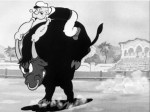
Bulldozing the Bull © Max FleischerIn ‘Bulldozing the Bull’ we suddenly find Popeye in either Mexico or Spain, fancying a latin version of Olive Oyl.

Popeye follows the Spanish Olive into the arena, but is suddenly forced to fight the bull himself, something he already had done in his third cartoon ‘I Eats My Spinach‘ (1933).

In that cartoon Popeye beat the bull into a meat market, but five years later he refuses to fight the bull, because it’s inhuman to do so. Indeed, the cartoon clearly turns anti-bullfighting, and in the end Popeye sings ‘Don’t be a bullfighter, because kindness is righter’ to his own tune.

This is all a clear result of the role model Popeye had become over the years. Indeed, already in Segar’s Sunday Pages, Popeye had been promoting kindness to animals and other gentle behavior. It’s this original mix of kindness and violence that made Popeye such a wonderful comic character, and in this film the Fleischers play that combination to an excellent effect.

Watch ‘Bulldozing the Bull’ yourself and tell me what you think:

http://www.dailymotion.com/video/x5v5ip6

This Popeye film No. 63
To the previous Popeye film: The Jeep
To the next Popeye film: Mutiny Ain’t Nice

‘Bulldozing the Bull’ is available on the DVD-set ‘Popeye the Sailor Volume Two’

Director: Dave Fleischer
Release Date: May 29, 1938
Stars: Popeye, Olive Oyl
Rating: ★★★½
Review:

I Yam Love Sick © Max Fleischer‘I Yam Love Sick’ opens with Olive Oyl reading a romance.

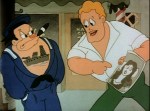
Popeye drops by, but Olive ignores him completely. Later she explains she has a new boyfriend now, Bluto. To win her back, Popeye feigns to fall very ill. This leads to a bizarre, and rather surreal series of hospital scenes, in which weird bearded doctors try to examine Popeye. In the end Popeye reveals he was only fooling, only to get clobbered by Olive.

‘I Yam Love Sick’ is full of delightful nonsense. The best gag is when Olive steps out of the panel to address the audience with an ‘is there a doctor in the house?’.

Watch ‘I Yam Love Sick’ yourself and tell me what you think:

This Popeye film No. 60
To the previous Popeye film: Big Chief Ugh-Amugh-Ugh
To the next Popeye film: Plumbing is a “Pipe”

‘I Yam Love Sick’ is available on the DVD-set ‘Popeye the Sailor Volume Two’


Director: Frank Tashlin
Release Date: June 25, 1938
Rating: ★★★½
Review:

Have You Got Any Castles © Warner Bros.‘Have You Got any Castles?’ is the second of Frank Tashlin’s three contributions to the Warner Bros. books-come-to-life-cartoons, a type of short unique to this studio. 

The cartoon doesn’t really have any story, but is built around four songs, of which the song ‘Have You Got Any Castles’ , from the film ‘The Varsity Show’ (1937) is the last.

This entry is one of the most Silly Symphony-like of all, starting with a particular lush opening, in which a town crier casts a huge shadow on a library. There’s also some beautiful shading on this character (a caricature of radio man Alexander Walcott) himself.

The Silly Symphony-like lushness notwithstanding, the cartoon is full of gags and caricatures of a.o. Greta Garbo, Cab Calloway (while Heidi sings hi-de-hi), Clark Gable, Charles Laughton and W.C. Fields. The animation is surprisingly mature, and shows how the Warner Bros. studio had improved in only a few years. The human figures are particularly lifelike, highlight being the town crier, and some scarcely dressed black ladies dancing to the swinging score.

The film features best-sellers from the 1920’s and 1930’s like ‘Topper’ (1926) by Thorne Smith, ‘Green Pastures’ (1929) by Marc Connelly, and ‘The Good Earth’ (1932) by Pearl S. Buck, which had been made into a film in 1937. It also revisits and improves on the thin man gag from ‘Speaking of the Weather’ (1937).

When the three musketeers rescue the prisoner of Zenda, the cartoon suddenly bursts into a frantic finale, with all kinds of book characters shooting at the four characters. After this frenzy we return to the town crier, rounding off this wonderful cartoon perfectly.

Watch ‘Have You Got any Castles?’ yourself and tell me what you think:

‘Have You Got any Castles?’ is available on the DVD-set ‘Looney Tunes Golden Collection: Volume 2’

Directors: Cal Howard & Cal Dalton
Release Date: June 11, 1938
Rating: ★★★★
Review:

Katnip Kollege © Warner Bros.At Katnip Kollege, all cool hep cats attend the swingology class. They all sure can swing, except bespectacled Johnny, who has no rhythm at all.

Johnny has to stay in the dunce’s corner, and at night he’s still there, while all other cats are having fun outside. But wait! Suddenly the clock gives Johnny the ‘rhythm bug’ and he rushes to the others to sing that swinging is ‘as easy as rollin’ off a log’ to his surprised girlfriend Claudia Kitty Brite. He also breaks into a hot trumpet solo, Roy Eldridge-style, which earns him kisses from his sweetheart.

‘Katnip Kollege’ is the second of only three films directed by the duo consisting of story man Cal Howard and animator Cal Dalton. The two Cals replaced Friz Freleng when he was lured away by MGM. After these three cartoons their unit was merged with that of Ben Hardaway, until Freleng returned from an all too short stint at the competing studio in 1940. In their films Howard, Hardaway and Dalton displayed not too much talent as directors, and although they produced some fun shorts, their cartoons are inferior to contemporary cartoons by Tex Avery, Bob Clampett, and Frank Tashlin.

‘Katnip Kollege’ is a clear example of their unsure style: the cartoon is low on gags, and the animation is erratic, with a lot of superfluous movement. At times it’s unclear whether the characters’ actions are supposed to be funny. Moreover, the school backgrounds feature incongruous over-sized tins, cans and clothes pins, as if the cat characters are supposed to be as tiny as bugs.

On the other hand, the swing music is genuinely intoxicating, the cartoon simply bursts with color, and the atmosphere is one of sheer joy, resulting in a really enjoyable cartoon. The cartoon easily beats ‘The Swing School‘ by the Fleischer studio, which was released only two weeks earlier, but which covers remarkably similar grounds.

Watch ‘Katnip Kollege’ yourself and tell me what you think:

http://www.dailymotion.com/video/x4ktvhi

‘Katnip Kollege’ is available on the DVD-set ‘Looney Tunes Golden Collection: Volume 2’

Director: Frank Tashlin
Release Date: August 27, 1938
Stars: Porky Pig
Rating: ★★
Review:

Wholly Smoke © Warner Bros.In ‘Wholly Smoke’ Porky Pig is still clearly a little boy.

We see his ma, and we watch him walking to Sunday school. On his way to school Porky encounters a street urchin smoking a cigar. The rascal challenges Porky to smoke like him, but, of course, Porky only gets sick, and in a state of delirium he walks into a tobacco shop.

There a ghostly figure called Nick O’Teen starts a song on the tune of ‘Mysterious Mose‘, which tells us that children shouldn’t smoke. This part of the cartoon is much in the vain of Warner Bros. typical books-come-to-life cartoons (e.g. the contemporary ‘Have You Got any Castles?‘), and features caricatures of the three Stooges, Bing Crosby, Rudy Vallee and Cab Calloway. In the end of this morality tale, Porky rushes back to Sunday school.

‘Wholly Smoke’ is a clear showcase of Tashlin’s excellent direction skills, with its interesting camera angles, speedy cuts, and special effects when Porky gets sick. Nevertheless, the short’s obvious moral, its saccharine ending, and the lack of gags makes it one of the more boring Warner Bros. cartoons, even though one couldn’t agree more with the short’s message.

Watch the colorized version of ‘Wholly Smoke’ yourself and tell me what you think:

This is Porky Pig cartoon no. 45
To the previous Porky Pig cartoon: Porky and Daffy
To the next Porky Pig cartoon: Porky in Wackyland

‘Wholly Smoke’ is available on the DVD-sets ‘Looney Tunes Golden Collection Volume Five’ and ‘Porky Pig 101’

Director: Frank Tashlin
Release Date: February 5, 1938
Stars: Porky Pig
Rating: ★★★½
Review:

Porky at the Crocadero © Warner Bros.‘Porky at the Crocadero’ starts with Porky showing his swing diploma and dreaming of becoming a famous conductor, like Leopold Stokowski, Rudy Vallee and Benny Goodman. Porky illustrates this by imitating these three bandleaders.

In order to reach his goal, Porky starts as a dishwasher at the Crocadero nightclub (an obvious take on the famous Trocadero in Hollywood). Unfortunately, Porky is fired quickly.

However, when none of the bandleaders show up, the walrus owner gives Porky a chance. Porky does an imitation of Paul Whiteman, of Guy Lombardo and of Cab Calloway, giving a particularly intoxicating performance by imitating the latter.

The complete cartoon is full of nice swing music and Tashlin’s lightning speed cutting. But there’s also room for a running gag featuring a penguin waiter, whose beers are stolen by a trombone player. In another particularly silly gag the walrus freezes only to tell the audience ‘schnell means quick’. The best scene, however, involves a very silly telegram delivery man.

Watch ‘Porky at the Crocadero’ yourself and tell me what you think:

http://www.dailymotion.com/video/x4ttl3l

This is Porky Pig cartoon no. 35
To the previous Porky Pig cartoon: Porky’s Poppa
To the next Porky Pig cartoon: What Price Porky

‘Porky’s Double Trouble’ is available on the DVD-sets ‘Looney Tunes Golden Collection Volume Five’ and ‘Porky Pig 101’


Director: Bob Clampett
Release Date: January 15, 1938
Stars: Porky Pig
Rating: ★★★★
Review:

Porky's Poppa © Warner Bros.‘Porky’s Poppa’ starts with a close harmony group singing a variation on ‘Old MacDonald had a Farm’, ‘Porky’s Poppa has a farm’.

On his farm Poppa also has a mortgage, and his prize cow, Bessie, is ill. So he orders a mechanical cow. Porky, however, revives Bessie, and makes her compete against the mechanical cow.

For his cartoons Clampett had redesigned Porky Pig, making him more boyish and more appealing than he was in Freleng’s, Avery’s and Tashlin’s shorts. Porky is still a child character in this cartoon, but the cartoon humor is not. Despite the sentimental Great Depression theme, this cartoon is delightfully silly and nonsensical.

‘Porky’s Poppa’ is only director Bob Clampett’s fifth film, and the short simply bursts with energy. The cartoon already shows what Clampett had in store for the world: nonsensical gags, zany animation and sheer fun.

Watch ‘Porky’s Poppa’ yourself and tell me what you think:

http://www.dailymotion.com/video/x51lt3j

This is Porky Pig cartoon no. 34
To the previous Porky Pig cartoon: Porky’s Hero Agency
To the next Porky Pig cartoon: Porky at the Crocadero

‘Porky’s Double Trouble’ is available on the DVD-sets ‘Looney Tunes Golden Collection Volume Five’ and ‘Porky Pig 101’

Director: Frank Tashlin
Release Date: November 13, 1937
Stars: Porky Pig, Petunia Pig
Rating: ★★★½
Review:

Porky's Double Trouble © Warner Bros.‘Porky’s Double Trouble’ is a comical crime cartoon, in which Tashlin plays the classic doppelgänger motif with gusto.

The short starts immediately with a shadow creeping behind the titles, followed by a great cinematic opening, setting the premise of the story: a dangerous killer has escaped Alcarazz prison. When the killer reads the newspaper, he discovers he looks just like the new bank teller of the Worst National Bank: Porky Pig.

The killer kidnaps Porky, and kisses Porky’s colleague, Petunia. She rings the alarm, and the police soon finds both Porky and the convict, who both claim to be Porky. However, Petunia identifies the right one immediately, and yet she runs off with the killer, exclaiming: ‘Boy, can he kiss!’.

‘Porky’s Double Trouble’ plays nicely with the immature Porky and his doomed relationship with Petunia Pig. However, the short’s opening scenes are the most impressive aspect of the cartoon. In these Tashlin unleashes many cinematic devices to create an exciting atmosphere.

Watch ‘Porky’s Double Trouble’ yourself and tell me what you think:

http://www.dailymotion.com/video/x430jlr

This is Porky Pig cartoon no. 32
To the previous Porky Pig cartoon: The Case of the Stuttering Pig
To the next Porky Pig cartoon: Porky’s Hero Agency

‘Porky’s Double Trouble’ is available on the DVD-sets ‘Looney Tunes Golden Collection Volume Five’ and ‘Porky Pig 101’

Director: Dave Fleischer
Release Date: June 24, 1938
Stars: Hunky and Spunky
Rating:
Review:

Hunky and Spunky © Max Fleischer

Hunky and Spunky are two donkeys. Hunky, the large black one, teaches her child Spunky, a little brown one, to open cacti by kicking them apart.

A little later Hunky goes to sleep, while Spunky plays with a little rabbit. Unfortunately, he’s caught by an evil red-nosed man who uses the little ass to carry his heavy load. Luckily, Hunky comes to the rescue to Hunky’s cries for help. She kicks both the man and his house to another hill, and all is fine.

Absolutely nothing is remotely interesting in this cartoon, let alone funny. The two characters form arguably the most forgettable cartoon duo of all time. Even Fleischer’s tabletop is not present (I was wrong about this as Chad points out below – the cartoon starts with a tabletop scene). The result is a sweet, but utterly boring cartoon, which starts and ends with a gentle country song.

The Fleischer studio had outstayed the Van Beuren studio and Ub Iwerks’s studio, but with films like these one almost can feel them losing the game, not only to the leading Disney studio, but also to the much peppier Warner Bros. studio. Nevertheless, ‘Hunky and Spunky’ got an Academy Award nomination (which it luckily lost to Disney’s ‘Ferdinand the Bull‘), and so this ill-conceived pair would star no less than six other cartoons, and lasted until 1941.

Watch ‘Hunky and Spunky’ yourself and tell me what you think:

‘Hunky and Spunky’ is available on the DVD-set ‘Somewhere in Dreamland – Max Fleischer’s Color Classics: The Definitive Collection’

Director: Dave Fleischer
Release Date: April 29, 1938
Rating: ★★★½
Review:

Hold It © Max FleischerIn ‘Hold It’ a bunch of cats sing a song with many stops in it, a rather lame variation on the 1937 hit song ‘Posin”.

At the stops everybody freezes, including the singing cat himself, who’s able to hang still in mid-air. Later, the cats’ song manages to stop apples from falling and water from flowing.

These rather original and silly gags save the cartoon, which otherwise is anything but interesting, The cats’ song is too trite to become a real classic, and apart from the threat of a dog, nothing really happens in the cartoon. And yet, ‘Hold It’ marks a welcome diversion from the childish morality tales that most Color Classics are. As is often the case with the Color Classics, the opening scene is the most memorable, with its beautiful 3D shots of a village going to sleep. This scene takes a full minute off the cartoon, while the song only enters after the third minute.

Watch ‘Hold It’ yourself and tell me what you think:

‘Hold It’ is available on the DVD-set ‘Somewhere in Dreamland – Max Fleischer’s Color Classics: The Definitive Collection’

Director: Dave Fleischer
Release Date: December 31, 1937
Rating:
Review:

Little Lamby © Max Fleischer‘Little Lamby’ is one of the most sickeningly sugary entries within Max Fleischer’s Color Classics series.

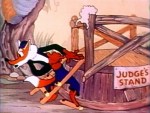
In this short we watch an evil fox entering peaceful ‘Animalville’. In order to catch some fresh meat, he organizes a baby contest with himself as the judge. He chooses an innocent little lamb as the winner. As the fox states it : “He’s the winner, and my dinner”, before he rushes off on a motorcycle to his hideout. Of course, the townspeople follow him, and during the film’s climax they try to enter the fox’s tree house, while the fox prepares the totally unaware lamb for dinner…

‘Little Lamby’ is totally devoid of humor, and the short is hampered by tiresome vocalizations, especially of the fox, whose wordless grunts get on the nerves. Moreover, the animation is erratic, with the quality often not exceeding that of cartoons from four/five years earlier. No, the only interesting thing about ‘Little Lamby’ is its opening shot, in which we watch the fox wandering through a beautiful 3D tabletop landscape.

Watch ‘Little Lamby’ yourself and tell me what you think:

‘Little Lamby’ is available on the DVD-set ‘Somewhere in Dreamland – Max Fleischer’s Color Classics: The Definitive Collection’

Director: Dave Fleischer
Release Date: October 29, 1937
Rating: ★★
Review:

Educated Fish © Max FleischerIn many Color Classics the opening sequence is the most interesting part, mostly because of the spectacular 3D effects of Fleischer’s tabletop backgrounds.

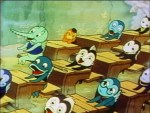
‘Educated Fish’ doesn’t employ the tabletop, but even in this short the opening scene is the most interesting part of the cartoon, with its convincing animation of rolling waves. The rest is a childish and tiresome cartoon about a small fish called Tommy who plays hooky and gets caught by a fisherman. In the end he clearly has learned his lesson.

True, there are a handful of nice gags, like the teacher eating the worm in the apple instead of the apple itself. And the sexy worm, with her Mae West-like voice, is nice to watch, but these factors cannot rescue a cartoon that almost collapses under its self-importance and lack of humor. Nevertheless, this cartoon was nominated for an Academy Award (which it understandably lost to Disney’s tour de force ‘The Old Mill‘), and thus, Tommy would return in ‘Small Fry‘ (1939), which is even worse.

Watch ‘Educated Fish’ yourself and tell me what you think:

‘Educated Fish’ is available on the DVD-set ‘Somewhere in Dreamland – Max Fleischer’s Color Classics: The Definitive Collection’

Director: Tex Avery
Release Date: July 23, 1938
Stars: Egghead
Rating: ★★★½
Review:

Cinderella Meets Fella © Warner Bros.‘Cinderella meets Fella’ is Tex Avery’s second take at a classic fairy tale after ‘Little Red Walking Hood’ (1937).

The cartoon’s opening scenes are one string of nonsensical gags, from the invitation card with which it starts to Cinderella’s arrival at the ball. For example, to get warm, Cinderella just adjusts her candle to get more flames. And when the fairy godmother is late, Cinderella calls the police to look for her. To get mice for the couch, the fairy godmother plays a slot machine, which incomprehensibly is built in the wall. Gags like these were completely unique at the time and could only be found in Warner Bros. films, and in Avery’s films in particular.

Prince Charming turns out to be Egghead, Tex Avery’s second cartoon star, after Daffy Duck. Egghead unfortunately is just too odd and too unsympathetic to carry the rest of the cartoon. So the short deflates a little after his entrance.

But the cartoon is revived by the extraordinary end gag: Egghead finds out that Cinderella got tired of waiting and has gone to a Warner Bros. show. Egghead is heartbroken, until he’s called by his love from the audience. We watch a silhouette standing up, and within seconds she’s back on the screen.

It’s great gags like these that made Tex Avery the undisputed innovator of cartoon comedy. ‘Cinderella meets Fella’ is undoubtedly one of the funnier cartoons of 1938, but when Avery would revisit this particular fairy tale seven years later, with ‘Swing Shift Cinderella’, the results would even be much, much better.

Watch ‘Cinderella Meets Fella’ yourself and tell me what you think:

https://www.dailymotion.com/video/x7tychp

‘Cinderella Meets Fella’ is available on the DVD-set ‘The Busby Berkeley Collection’

Directors: Ben Hardaway & Cal Dalton
Release Date: July 9, 1938
Rating: ★★½
Review:

Love and Curses © Warner BrosLove and Curses’ is set during the gay nineties and is a spoof of the classic melodrama, complete with mustached villain, a train track and a sawmill.

Unfortunately, the cartoon is hampered by the stiff melodramatic dialogue and the slow timing. Most of the ‘humor’ comes from the invincible hero Harold reciting proverbs all the time, but his appearances are tiresome, not funny. There are also a couple of throwaway gags, but these are mildly amusing at best.

This is one of those rather rare cartoons (not counting Popeye) featuring adult human designs, and the results are pretty unsteady. The animation of the girl singing at the nightclub is the most elaborate, but none of the animation is convincing.

Chuck Jones would visit the same kind of material four years later with ‘The Dover Boys‘, which seems light-years ahead of this cartoon.

Watch ‘Love and Curses’ yourself and tell me what you think:

http://www.dailymotion.com/video/xu5lrc

‘Love and Curses’ is available on the DVD-set ‘The Busby Berkeley Collection’

Director: Dave Fleischer
Release Date: August 12, 1938
Stars: Betty Boop, Pudgy
Rating:
Review:

Pudgy the Watchman © Max Fleischer

‘Pudgy the Watchman’ opens with an alley cat driving a mouse-like car in a beautiful 3D landscape, conceived with Max Fleischer’s unique tabletop technique.

This cat, called Al E. Katz, stops at Betty Boop’s house, and tricks Betty to hire him as a ‘mouse eradicator’ by using a toy mouse. Meanwhile we watch Pudgy playing with the little critters in the cellar. The cat disturbs this peaceful scene by catching the mice in no time and playing darts using them. But one escapes and sets them all free, while the cat gets drunk from Betty’s wine cellar. With help from Pudgy the mice chase the cat out of the house.

‘Pudgy the Watchman’ has a straightforward story, but that’s the best one can say about this cartoon. The makers forgot to provide it with anything resembling a gag. The result is an utterly forgettable cartoon, and certainly one of the most boring entries even in Pudgy’s already mediocre catalog.

Watch ‘Pudgy the Watchman’ yourself and tell me what you think:

This is Betty Boop cartoon No. 75
To the previous Betty Boop cartoon: The Swing School
To the next Betty Boop cartoon: Sally Swing

‘Pudgy the Watchman’ is available on the Blu-Ray ‘Betty Boop: The Essential Collection, Vol. 4’ and the French DVD Box Set ‘Betty Boop Coffret Collector’

Enter your email address to follow this blog and receive notifications of new posts by email.

Join 905 other subscribers
Bookmark and Share

Categories