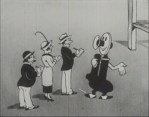
Directors: Harry Bailey & John Foster
Release Date: November 23, 1930
Stars: Milton Mouse, Rita Mouse
Rating: ★★
Review:

The Office Boy © Van Beuren‘The Office Boy’ is yet another Van Beuren cartoon featuring Milton Mouse and Rita Mouse, Van Beuren’s sloppy copies of Mickey and Minnie Mouse, indirectly showing the mouse’s enormous popularity.

This time Milton is an office boy, where Rita is a secretary. The story involves Milton getting jealous of Rita when the boss flirts with her. So Milton invites the boss’s wife to catch her husband red-handed. In the end we watch Milton and Rita jumping into a painting on a train to sing their end duet.

The designs and animation of Milton and Rita are terrible, but too close for comfort, and some of Mickey’s mannerisms have clearly been copied. As was the case in ‘Circus Capers‘, Milton and Rita are more vulgar than their Disney counterparts, despite the similar looks, and most of the fun of the cartoon lies in the rude behavior of these pseudo-Mickey and Minnie. The cartoon’s best gag, however, is when Rita starts typing frantically even when her boss hasn’t really dictated anything.

But Milton’s and Rita’s days were numbered. In 1931 Disney sued the Van Beuren company, and on April 30, 1931 the federal court prohibited the Van Beuren studio to display any of his Mickey Mouse-lookalikes. The Walt Disney company never asked for money, however. They simply wanted the plagiarism to stop.

Watch ‘The Office Boy’ yourself and tell me what you think:

‘The Office Boy’ is available on the DVD ‘Uncensored Animation from the Van Beuren Studio’

Directors: Harry Bailey & John Foster
Release Date: September 28, 1930
Stars: Milton Mouse, Rita Mouse
Rating: ★★★
Review:

Circus Capers © Van Beuren‘Circus Capers’ features Milton Mouse and Rita Mouse, Van Beuren’s Mickey and Minnie-like mice, whose resemblance to Disney’s originals is so striking, it’s pure plagiarism.

The Van Beuren Studio comes nowhere near Walt Disney’s high quality standards, however, and ‘Circus Capers’ can be used as a good counter-example to show how good contemporary Mickey Mouse cartoons (e.g. ‘The Shindig‘, ‘The Chain Gang‘ and ‘The Gorilla Mystery‘) actually were.

In ‘Circus Capers’ Milton (pseudo-Mickey) is a clown, while Rita (pseudo-Minnie) is an acrobat riding a horse. An evil circus master shoots Milton away as a human cannonball, meanwhile courting an all too willing Rita. When Milton discovers this, he’s heartbroken, and sings “Laugh Clown Laugh” from the 1928 musical of the same name. However, when the circus master becomes too insistent, Rita flees from him, back to Milton, who gives her the raspberry, making her pass out.

‘Circus Capers’ is hampered by primitive, crude animation, unsteady designs, and odd staging. Its curious story is enjoyable, however, for the real Mickey and Minnie would never behave like Milton and Rita, who seem to be their cruder cousins.

Watch ‘Circus Capers’ yourself and tell me what you think:

‘Circus Capers’ is available on the DVD ‘Uncensored Animation from the Van Beuren Studio’

Directors: Mannie Davis & John Foster
Release Date: August 17, 1930
Rating:
Review:

Laundry Blues © Van Beuren‘Laundry Blues’ is one of those cartoons that’s very hard to watch today.

This short features some extreme stereotypes of Chinese people, in animal form, plus one caricature of a (human) Jew. The Jew has his beard washed and ironed, only to fall into the mud with it shortly afterwards.

Apart from the vicious stereotyping, the short suffers from a lack of direction: things are just happening on the screen. The backward racism, the total lack of plot, and the scarcity of gags make ‘Laundry Blues’ endless. It’s everything but a classic, indeed. And yet, the part of the four Chinese ironing was reused in its entirety in ‘Chinese Jinks‘ from 1932.

Watch ‘Laundry Blues’ yourself and tell me what you think:

‘Laundry Blues’ is available on the DVD ‘Uncensored Animation from the Van Beuren Studio’

Director: Harry Bailey
Release Date: December 1, 1929
Stars: Milton Mouse, Rita Mouse
Rating:
Review:

Close Call © Van Beuren‘Close Call’ is one of Van Beuren’s earliest sound cartoons, and it shows. Its visual language is still from the silent era, including the use of words on the screen.

The short unashamedly features two clear ripoffs of Walt Disney’s Mickey and Minnie Mouse. We watch them frolicking in a field, when a large cat kidnaps “Minnie” and takes her to a sawmill. “Mickey” comes to the rescue, only to be tied up by the cat to a sawmill, in a classic scene. As luckily as incomprehensibly the North West Mounted Police rides off to rescue the loving couple. They kill the cat (!), and the two mice are married.

The animation on ‘Close Call’ is terribly primitive, and there’s a lot of squeaking, but apart from the final “I do”‘s, there’s no dialogue. Moreover, there’s more drama to the short than humor, making it a tiring watch. The Mickey and Minnie Mouse characters (which off-screen apparently were christened Milton and Rita) would return in several of Van Beuren’s ‘Aesop’s Fables’ cartoons, e.g. ‘Circus Capers‘ and ‘The Office Boy‘ from 1930.

Watch ‘Close Call’ yourself and tell me what you think:


‘Close Call’ is available on the DVD ‘Uncensored Animation from the Van Beuren Studio’

Director: Burt Gillett
Release Date:
 March 7, 1931
Stars: Mickey Mouse, Minnie Mouse, Peg Leg Pete
Rating: ★★★★★
Review:

raffic Troubles © Walt DisneyIn 1931 Mickey’s cartoons slowly but surely got better. ‘Traffic Troubles’ in particular is a gem, arguably being Mickey’s first great gag cartoon since his first cartoon, ‘Plane Crazy‘ (1928).

In this film Mickey is a cab driver driving an anthropomorphized car, resembling Flip the Frog’s car in ‘The Cuckoo Murder Case’ from five months earlier. His first customer is a fat pig, but he loses his passenger on a road, full of potholes and bumps. Mickey’s horror and surprise when he realizes his customer is gone, is priceless.

Mickey’s second customer is Minnie. When they get a flat tire, Peg Leg Pete makes an odd cameo as ‘Dr. Pep’ who revives Mickey’s car with some kind of potion, with disastrous results. This part leads to a great end scene in which Mickey’s car ends on a cow, rides through a barn, and crashes into a silo.

‘Traffic Troubles’ is a genuine gag cartoon without any songs or dances, but with fast action, plenty of gags building to a grand finale, and spectacular and flexible animation. It also contains a very funny scene in which a police officer asks Mickey many questions while silencing him at the same time. In short, ‘Traffic Trouble’ is arguably the best Mickey Mouse film from 1931, and Mickey’s first really great cartoon since ‘Steamboat Willie‘. But by now the Disney studio was making faster and faster strides, and Mickey’s best cartoons were still to come.

Watch ‘Traffic Troubles’ yourself and tell me what you think:

This is Mickey Mouse cartoon No. 26
To the previous Mickey Mouse cartoon: The Birthday Party
To the next Mickey Mouse cartoon: The Castaway

‘Traffic Troubles’ is available on the DVD ‘Walt Disney Treasures: Mickey Mouse in Black and White Volume Two’

Director: Walt Disney
Release Date:
 April 5, 1930
Stars: Mickey Mouse, Clarabelle Cow, Horace Horsecollar
Rating: ★★★★
Review:

The Barnyard Concert © Walt DisneyWhile other studios, like Walter Lantz and the Max Fleischer drew inspiration from jazz, and while Warner Bros. could draw from an extensive music catalog, in the early sound days Walt Disney turned to (copyright-free) folk songs and classical music.

After ‘The Opry House‘ (1929) and ‘Just Mickey‘, Mickey’s concert career reaches new heights in ‘The Barnyard concert’. In this highly enjoyable cartoon Mickey conducts a barnyard orchestra in Franz von Suppé’s overture to ‘Dichter und Bauer’. There’s one throwaway gag looking all the way back to his breakthrough cartoon ‘Steamboat Willie‘ (1928),in which Mickey torments some pigs, but most of the cartoon is forward looking.

Indeed ‘The Barnyard Concert’ looks like a blueprint for ‘The Band Concert‘ (1935), in which many of the gags introduced here are improved to perfection. The cartoon features no dialogue, whatsoever, but is full of clever sight gags.

Unfortunately, at this stage the animators still had problems with Mickey’s eyes: in one close-up in particular they are placed awkwardly in Mickey’s face.

Watch ‘The Barnyard Concert’ yourself and tell me what you think:

This is Mickey Mouse cartoon No. 17
To the previous Mickey Mouse cartoon: Just Mickey
To the next Mickey Mouse cartoon: The Cactus Kid

‘The Barnyard Concert’ is available on the DVD ‘Walt Disney Treasures: Mickey Mouse in Black and White Volume Two’

Directors: Mannie Davis & John Foster
Release Date: November 9, 1930
Stars: Waffles and Don
Rating: ★★
Review:

Gypped in Egypt © Van Beuren‘Gypped in Egypt’ is a cartoon set in Egypt. It predates Disney’s ‘Egyptian Melodies‘, which covers similar grounds, by nine months.

This cartoon was the last of four to feature Waffles and Don. The duo had finally reached distinct personalities in this short: Waffles, the tall cat, is constantly afraid, while Don, the small dog, keeps calm and unimpressed.

In the opening shot we watch the duo traveling through the desert on a camel. When the camel dies, a nightmarish scene starts, featuring a sphinx, pyramids and more camels. This brings our heroes inside an Egyptian tomb, where they encounter dancing skeletons and hieroglyphs. Suddenly, there are skeletons everywhere, and Don plays the piano with one of them. The cartoon ends abruptly with Waffles and Don running from a giant hypnotizing sphinx face.

‘Gypped in Egypt’ features several elements that were reused in Disney’s ‘Egyptian Melodies’: dancing hieroglyphs, nightmarish scenes, and even a corridor scene. However, Van Beuren’s cartoon is much cruder and more disjointed than Disney’s latter cartoon. Its greatest feature is it hallucinating character. Unfortunately, it is not retained throughout the picture, and the whole cartoon suffers from all too sloppy storytelling and ditto timing.

Watch ‘Gypped in Egypt’ yourself and tell me what you think:

‘Gypped in Egypt’ is available on the DVD ‘Aesop’s Fables – Cartoon Classics from the Van Beuren Studio’

Director: John Foster
Release Date: August 3, 1930
Stars: Milton Mouse, Rita Mouse, Waffles
Rating:
Review:

Hot Tamale © Van BeurenIn 1930 practically all American cartoon studios looked at Walt Disney to guide them through the fledgling sound era (the notable exception being Max Fleischer, who went entirely his own path).

None went so far as the Van Beuren studio, which already in 1929 introduced a couple of mice with an all too obvious resemblance to Mickey and Minnie Mouse. Van Beuren’s mice were called Milton and Rita, but I’ve no evidence the studio ever advertized their names on the screen. Why should it? All resemblance to the real Mickey and Minnie clearly was only beneficial to the studio’s output.

‘Hot Tamale’ is one of these films featuring these blatant Mickey and Minnie lookalikes. This time Milton is in Mexico, riding a mechanical horse (why?) to serenade his sweetheart. Rita dances to his music.

There’s still some acting that clearly stems from the silent era, but more disturbingly: Milton looks rather horny and seems more driven by lust than by love. At one point Waffles (who is Pete only but in name) arrives, also craving Rita. Of course, it’s our “hero” who wins her in the end.

In ‘Hot Tamale’ Van Beuren’s pseudo-Mickey and Minnie were nothing like the real thing. But it would become worse. In ‘Circus Capers‘ and ‘The Office Boy‘ both the resemblance and the abject behavior of these Mickey & Minnie-lookalikes was even more striking. It was a question of time before Walt Disney came into action…

Watch ‘Hot Tamale’ yourself and tell me what you think:

‘Hot Tamale’ is available on the DVD ‘Aesop’s Fables – Cartoon Classics from the Van Beuren Studio’

Directors: Mannie Davis & John Foster
Release Date: June 22, 1930
Rating: ★★★
Review:

A Romeo Robin © Van Beuren‘A Romeo Robin’ is a rather disjointed Silly Symphony-like cartoon, predating Disney’s Silly Symphony ‘Birds of a Feather’ (1931) by half a year.

Like the latter cartoon, its subject is birds. The short opens with birds whistling, and one yodeling. Then we cut to two birds dancing, while metamorphosing to their deaths in a bizarre scene that should be seen to be believed.

After this mind-blowing scene we’re introduced to an evil one-eyed cat who’s after the birds, and later to a bird who catches a worm to offer to his girlfriend. Together they go for a trip in a plane. When the plane falls down, the evil cat accidentally swallows the plane instead of its inhabitants.

‘A Romeo Robin’ looks like a crude parody of a Silly Symphony. It’s remarkable that at one point some story sets in, even if that remains rather pointless. But then again, around this time even the Silly Symphonies themselves made little sense.

Watch ‘A Romeo Robin’ yourself and tell me what you think:

‘A Romeo Robin’ is available on the DVD ‘Aesop’s Fables – Cartoon Classics from the Van Beuren Studio’

Director: Dave Fleischer
Release Date: July 18, 1930
Rating: ★★★★
Review:

Wise Flies © Max Fleischer

The Fleischer studio had already experimented with synchronized sound in 1924, four years before ‘Steamboat Willie‘, so of all cartoon studios they made the transition to sound the most easily.

The Fleischers’ first sound series were the Screen Songs, the first of which was released in February 5, 1929. Eight months later they were followed by the aptly titled Talkartoons. These Talkartoons didn’t have a single star, but like Disney’s Silly Symphonies explored a wide range of subjects.

These Talkartoons show the Fleischers’ disregard of lip synchronization. This feat was reserved for special scenes, like song sequences. Unlike Disney, the Fleischers recorded all dialogue after animation, inviting the voice actors to ad-lib at will. Thus the Fleischer cartoons were the most talkative of all 1930s shorts. This technique reached its peak when Jack Mercer became Popeye’s voice in 1935, but already peppers their earliest output.

The improvised dialogue suits the studio’s free spirited, and equally improvised animation style perfectly. Add a multitude of zany gags, strikingly jazzy soundtracks and remarkably adult subject material, and it’s clear why the Max Fleischer cartoons from 1930-1933 are among the most delightful of all studio cartoons from the golden age.

‘Wise Flies’, the seventh Talkartoon, is a perfect example. It uses the theme of ‘the spider and the fly’, a theme Walt Disney would also use one year later in ‘The Spider and the Fly‘ (1931). However, the Disney version lacks the sexual overtones present in this Fleischer’s version. In it a six-legged spider spots some flies on a hobo’s head. He tries to catch one, but returns home to his wife empty-handed.

However, later he seduces a female fly, playing ‘Some of These Days’ on his web (a delightfully fast piece of guitar jazz). He then starts singing this tune, popularized by Sophie Tucker in 1926, and a hit for Louis Armstrong in 1929. His song leads to a dance sequence much akin to Disney’s Silly Symphonies from the same era. The film ends when the spider’s wife gets jealous, and interrupts the spider’s courting.

The animation by Willard Bowsky and Ted Sears is crude and simple, but the swinging soundtrack is delightful. The end result is an enjoyable piece of rubberhose animation.

Watch ‘Wise Flies’ yourself and tell me what you think:

This is Talkartoon No. 7
To the previous Talkartoon: Fire Bugs
To the next Talkartoon: Dizzy Dishes

Director: Frank Moser
Release Date: 1930
Rating: ★★
Review:

Family Album © Audio Productions‘Family Album’ is a commercial by Charles W. Barrell for the Western Electric Company, glorifying the telephone, and its ‘offspring’: other inventions that are derived from telephone technology, including the microphone and the speaker.

The film reuses the character Talkie from Fleischer’s earlier film ‘Finding his voice‘ (1929), but its star is an anthropomorphized telephone, talking about his family. Although quite educational, the film is less interesting than Fleischer’s film. The animation, by veterans Paul Terry and Frank Moser, is rather poor and limited. There’s no rubbery animation whatsoever, and the designs are still in 1920s style.

‘Family Album’ is available on the DVD ‘Cultoons! Rare, Lost and Strange Cartoons! Volume 2: Animated Education’

Director: Cy Young
Release Date: 1930
Rating:
Review:

A Desert Dilemma © Audio Productions‘A Desert Dilemma’ is a short commercial for a car insurance, made by Cy Young (misspelled as Sy Young in the opening titles).

The cartoon is still rooted in the 1920s: its animation is from the silent era, and the designs are old-fashioned. The story is rather incomprehensible, and one wonders whether this commercial has ever been a success. However, it has a lively jazzy score to enjoy.

Nothing in this film indicates a rare talent, but a year later Cy Young would make a very early color short called ‘Mendelssohn’s Spring Serenade’, which is miles ahead from this short. Soon after he was hired by Walt Disney, and became a star effects animator at the Disney studio, providing stunning special effects for the studio’s first five features. Young left Disney in 1941, after the strike, and worked for the US Air Force. He ended his own life in 1964.

‘A Desert Dilemma’ is available on the DVD ‘Cultoons! Rare, Lost and Strange Cartoons! Volume 2: Animated Education’

Director: Walter Lantz or Bill Nolan
Release Date: July 14, 1930
Stars: Oswald the Rabbit, Kitty
Rating: ★★★½
Review:

Spooks © Walter Lantz‘Spooks’ is a nice early Oswald cartoon from the Walter Lantz studio.

It takes place in a theater where Oswald performs. It features a mysterious phantom who helps Oswald’s girlfriend Kitty to become a great singer by putting a record player in her dress. This leads to an absurd performance. The phantom fancies Kitty, but she prefers Oswald, who has to rescue her from the phantom’s clutches. This part of the film has horror overtones, commonplace in the early 1930s. The film ends with a rather lame gag.

‘Spooks’ features some very Mickey Mouse-like mice. Its animation, by Bill Nolan, Clyde Geronimi and Pinto Colvig is fair, and the story enjoyable, even if it’s rather inconsistent.

Watch ‘Spooks’ yourself and tell me what you think:

Director: Walter Lantz or Bill Nolan
Release Date: June 2, 1930
Stars: Oswald the Rabbit, Peg Leg Pete
Rating: ★★★★
Review:

Hell's Heels © Walter LantzIn the spring of 1929 Universal announced that it had set up an animation studio to make sound cartoons of its own. Head of the studio was Walter Lantz. This was the beginning of the Walter Lantz studio, which lasted well into the 1970s, outliving all other contemporary cartoon studios.

With this contract Walter Lantz inherited Oswald the rabbit, a character originally conceived by Walt Disney in 1927, but whose copyright was owned by Universal. Universal demanded no less than 26 Oswald cartoons each year, and the results were consequently of variable quality.

‘Hell’s Heels’, Lantz’s 23th Oswald cartoon, is one of the better ones. It opens with Oswald, Peg Leg Pete and an anonymous grey dog being a gang of bandits wandering and singing through the desert. The three decide to rob a bank and Pete and the Dog send Oswald inside with dynamite. Oswald blows up the bank, killing Pete and the dog(!). Later, Oswald befriends the Sheriff’s little boy, which leads to some song-and-dance scenes, which surprisingly features a number of skeletons.

It’s strange to watch Oswald and Pete being buddies in this film, and the story is rather inconsistent, but the cartoon is fast and funny, and full of gags. Its lively jazzy score by James Dietrich is highly enjoyable, and the animation by Bill Nolan and Clyde Geronimi is joyful and of a fair quality. ‘Hell’s Heels’ shows that in 1930 other animation studios still could match the Walt Disney studio.

Watch ‘Hell’s Heels’ yourself and tell me what you think:

Directors: Mannie Davis & John Foster
Release Date: May 25, 1930
Rating: ★★★
Review:

Noah Knew His Ark © Van BeurenThis short starts with a scene in which we watch Noah, who is dressed like a sailor, dancing to music a chimp plays on an elephant’s toes.

When Noah’s corns warn him rain is coming, all animals flee into his ark, including a dinosaur. Only the skunks are placed in a separate little boat (a gag more or less repeated in Disney’s ‘Father Noah’s Ark‘ from 1933). On the ship itself it’s suddenly dry and the animals start a very, very Silly Symphony-like dance routine, with dancing storks, monkeys, elephants, hippos, etc. Then they all sing ‘It ain’t gonna rain no mo”. But when the skunks enter the ark, all animals abandon ship. Iris out.

Like ‘The Haunted Ship‘, ‘Noah Knew His Ark’ shows a huge Disney influence. The cartoon is a Silly Symphony but in a name. In this stage Disney’s own cartoons were not really sophisticated themselves, and the Van Beuren Studio at times reaches the same level of animation. However, they bring little of their own, and ‘Noah Knew His Ark’ can hardly be called a classic.

Watch ‘Noah Knew His Ark’ yourself and tell me what you think:

‘Noah Knew His Ark’ is available on the DVD ‘Aesop’s Fables – Cartoon Classics from the Van Beuren Studio’

Director: Mannie Davis & John Foster
Release Date:
 April 27, 1930
Stars: Waffles and Don
Rating: ★★★½
Review:

The Haunted Ship © Van Beuren StudioWhen the Van Beuren studio lost their main character, Farmer Al Falfa to Paul Terry, they had to come up with new stars. Their first attempt was the animal duo Waffles and Don, a tall cat and a small dog who are the precursors of Van Beuren’s Tom and Jerry.

In their first film we watch them flying a plane before lightning strikes them down deep into the ocean. Here they meet an opera-singing walrus (probably inspired by Walt Disney’s ‘Wild Waves‘ (1929), which also features one). Then they enter the shipwreck ‘Davy Jones’, which is full of monsters swooping into the camera, and a skeleton. The skeleton orders Waffles and Don to play the piano and xylophone, which starts the song-and-dance-routine-part of this cartoon.

Most interesting are four drunken tortoises singing ‘Sweet Adeline’ (probably inspired by ‘The Karnival Kid‘ (1929) in which two cats sing exactly the same song). The dance routine ends when Davy Jones himself appears and chases Waffles and Don away. However, the last shot is for the singing turtles.

‘The Haunted Ship’ clearly shows Walt Disney’s influence on other studios. It’s obvious that The Van Beuren studio tried its best to copy Walt Disney’s formulas and standards. Indeed, the cartoon is a great improvement on ‘The Iron Man‘ from three months earlier. There’s song and there’s dance, and music and animation now are closely intertwined. The Van Beuren studio would never reach Walt Disney’s sophistication, but in these early years they were at least able to come somewhere near.

Waffles and Don’s career, however, proved to be short-lived. They only starred in three other 1930 cartoons: ‘Jungle Jazz‘, ‘Frozen Frolics‘ and ‘Gypped in Egypt‘.

Watch ‘The Haunted Ship’ yourself and tell me what you think:


‘The Haunted Ship’ is available on the DVDs ‘Aesop’s Fables – Cartoon Classics from the Van Beuren Studio’ and ‘The Complete Animated Adventures of Van Beuren Studio’s Tom and Jerry’

Director: John Foster
Release Date:
 January 4, 1930
Stars: Farmer Al Falfa
Rating: ★★½
Review:

The Iron Man © Van Beuren‘The Iron Man’ was one of the last of Van Beuren’s Aesop’s Fables to feature Farmer Al Falfa, before Paul Terry claimed this character to be his own.

It takes some time for we watch the title’s iron man itself. First we watch a cat with a hurdy-gurdy, then two fighting roosters with ridiculously large feet, and then some remarkable animation of a large tree falling down. This part is essentially silent, with music seemingly added.

Then Farmer Al Falfa receives a package with the iron man in it. Together they perform a bizarre slow dance, to psychedelic effects. It’s clear the Van Beuren studio was still struggling with rhythmical movement, for in this sequence both Al Falfa and the robot seem to float in air. There’s no weight or gravity involved, at all.

Then, when Farmer Al Falfa kicks the robot, it grows millions of miles tall, towering over the earth, before it explodes. This is a mindblowing piece of animated weirdness. However, the pieces fall together to form the robot again, which chases our hero into the distance. Iris out.

‘The Iron Man’ is in no sense a classic film, but it shows the difficulties of the sound age for the silent era studios. The second part also shows some embryonic weirdness that would become staple for the Van Beuren studio films of the early 1930s. Finally, ‘The Iron Man’ is one of the very first cartoons to feature a human-like robot. Other studios would follow years later, like Walter Lantz’s ‘Mechanical Man’ (1932), Max Fleischer’s ‘The Robot‘ (1932) and Walt Disney’s ‘Mickey’s Mechanical Man‘ (1933).

Watch ‘The Iron Man’ yourself and tell me what you think:

‘The Iron Man’ is available on the DVD ‘Aesop’s Fables – Cartoon Classics from the Van Beuren Studio’

Director: John Foster
Release Date:
 October 11, 1929
Stars: Farmer Al Falfa
Rating:
Review:

Summer Time © Van BeurenOf all American animation studios from the 1930s the Van Beuren Studio must be the least known.

This is no small wonder, for it was not only short-lived, lasting nine years, it was also the weakest studio of the lot, never reaching the heights of Max Fleischer or Walt Disney, and with only a few great cartoons in its entire catalog.

Thanks to Steve Stanchfield and his Thunderbean company, however, quite a sample of this studio’s output has been made available on DVD, so everybody can enjoy them (and incidentally making the Columbia/Screen Gem studio the least known studio – as its films remain utterly unavailable).

Before 1928 Van Beuren’s cartoons were made by Paul Terry, but in November 1928 the success of Disney’s ‘Steamboat Willie‘ prompted Amadee J. Van Beuren to announce that his studio would make the switch to sound, too. This led to a clash with Terry, who left mid-1929, leaving most of the staff and the studio’s main character, the bland Farmer Al Falfa, until Paul Terry reclaimed him in 1930.

The Van Beuren studio was more or less forced into the area of sound, and its crew totally unprepared, lacking experience. Indeed, ‘Summer Time’, Van Beuren’s 16th sound cartoon, is a strange blend of silent film and sound film: words and sound expressions are still visible on the screen, and while there’s music, there’s no rhythmical movement. Moreover, both design and animation are still firmly rooted in the 1920’s and there’s practically no plot, only three unrelated scenes.

The most interesting aspect of this film is Gene Rodemich’s music score, which still sounds fresh. In fact, Rodemich’s scores turned out to be the only constant quality within Van Beuren’s output, being among the best of all 1930s cartoon scores.

The three scenes of ‘Summer Time’ are 1) a frog and a monkey playing some music, waking up an angry owl. 2) A mouse playing in a fat woman’s shadow, attracting other mice, and scaring the woman away, and 3) Farmer Al Falfa being hot and making himself a drink. This story contains a weird scene in which the sun zooms into the camera to visit farmer Al Falfa at his own doorstep. This is the only interesting piece of animation in the entire film.

The cartoon ends with a moral, like many Aesop’s Fable cartoons before it. However, this practice was soon abandoned in 1930.

Watch ‘Summer Time’ yourself and tell me what you think:

‘Summer Time’ is available on the DVD ‘Aesop’s Fables – Cartoon Classics from the Van Beuren Studio’

Director: Walt Disney
Release Date:
 November 15, 1929
Stars: Mickey Mouse
Rating:
Review:

Jungle Rhythm © Walt Disney‘Jungle Rhythm’ opens with Mickey playing the harmonica while riding an elephant, the design of which is still rooted in the silent era.

Mickey shoots a vulture, but misses and is soon threatened by a bear and a lion. Luckily at that moment a monkey and a parrot start playing a tune on his harmonica, and a long dance routine can begin…

First we watch Mickey dancing with the lion and the bear, then two monkeys. Then Mickey plays the saxophone with two ostriches dancing. Mickey plays the whiskers of a little leopard like a harp, while a lion dances the hula, and he even returns to ‘Turkey in the Straw’, the tune that made him famous in his first sound cartoon ‘Steamboat Willie‘ (1928). After playing’Yankee Doodle’ on five tigers, a number of apes and a lion, the crowd applauds, and the cartoon ends.

‘Jungle Rhythms’ is easily one of the most boring entries among the early Mickey Mouse shorts: there’s no plot, no dialogue, no song, and the dance routines resemble the worst in contemporary Silly Symphonies. In fact, to me, ‘Jungle Rhythm’, together with ‘When The Cat’s Away‘ and ‘The Castaway‘ (1931), forms the worst trio of all Mickey Mouse cartoons. Luckily, weak cartoons like these remained a rarity within the series.

Watch ‘Jungle Rhythm’ yourself and tell me what you think:

This is Mickey Mouse cartoon No. 13
To the previous Mickey Mouse cartoon: The Jazz Fool
To the next Mickey Mouse cartoon: The Haunted House

Director: Walt Disney
Release Date:
 October 15, 1929
Stars: Mickey Mouse, Horse Horsecollar
Rating: ★★★★
Review:

The Jazz Fool © Walt Disney‘The Jazz Fool’ opens with Mickey playing the organ on a tilt car, which says ‘Mickey’s Big Road Show’, followed by a crowd of animals.

When settled down, Mickey produces a piano out of nowhere, and performs a mildly jazzy stride tune on it. We also watch Horace Horsecollar without his usual yoke performing some drumming to Mickey’s organ tune.

This is Mickey’s second piano concerto cartoon (after ‘The Opry House‘ from seven months earlier), and thus contains some new gags involving piano playing. Mickey severely mistreats the instrument, even spanking it, so, unsurprisingly, the piano takes revenge in the end. The music can hardly be called jazz, however, even though it contains some nice stride piano. It would take two years before Mickey would turn to real jazz, in ‘Blue Rhythm‘ (1931).

As one may have noticed ‘The Jazz Fool’ is one of those early plotless Mickey Mouse shorts. However, there’s plenty of action, and Mickey’s piano performance is still entertaining today. Nevertheless, Mickey would turn to the violin in his next concert cartoon ‘Just Mickey‘ (1930).

Watch ‘The Jazz Fool’ yourself and tell me what you think:

This is Mickey Mouse cartoon No. 12
To the previous Mickey Mouse cartoon: Mickey’s Choo-Choo
To the next Mickey Mouse cartoon: Jungle Rhythm

Enter your email address to follow this blog and receive notifications of new posts by email.

Join 915 other subscribers
Bookmark and Share

Categories