Director: John Halas Release date: 1981 Rating: ★ Review:
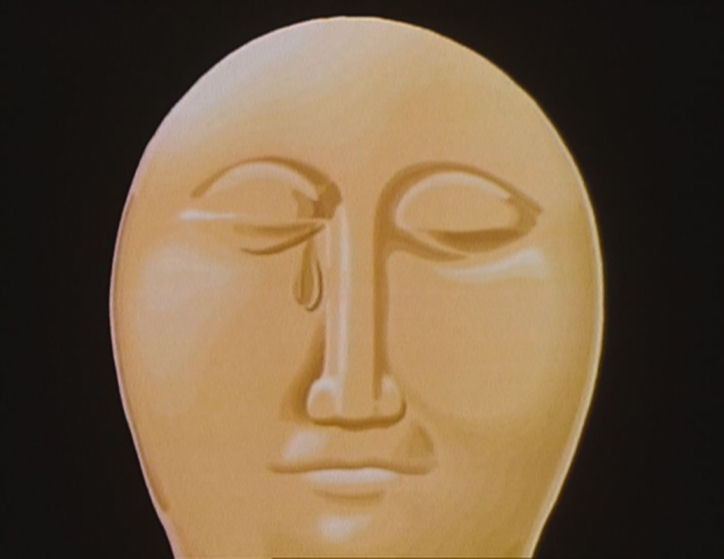
‘Dilemma’ is one of the earliest computer animation films ever, and probably the first fully digitally produced one.
Unfortunately it is a rather vague, non-narrative film, which seems to try to tell us that we could better use the human mind for art and science than for violence and war.
‘Dilemma’ doesn’t make any use of 3D effects, but stays in a very graphic 2D design style. The only clear additions of the computer are the very primitive morphing sequences. Outside these, the animation is very limited. The film uses the same static head over and over again to illustrate the human mind.
The designs are rather ugly, and so is the synthesizer music. Moreover, the filmmakers seem to want to tell us too much, resulting in a rather tiresome film, in spite of its avant-gardism. It was to other film makers to use the full potential of the new technique of computer animation.
Watch ‘Dilemma’ yourself and tell me what you think:
‘Dilemma’ is available on the DVD inside the book ‘Halas & Batchelor Cartoons’
Director: Ben Washam Release date: September 8, 1967 Stars: Tom & Jerry Rating: ★ Review:
‘Purr-Chance to Dream’ was Tom & Jerry’s very last theatrical cartoon.
It marks the rather welcome end to the Chuck Jones era, which, despite a few highlights, was a very disappointing age for the cat and the mouse. ‘Purr-Chance to Dream’ is no exception. In this short, Tom is haunted by nightmares about large bulldogs. But when Jerry has acquired a tiny bulldog, this reality is even worse.
The tiny bulldog is the same as was featured in ‘The Cat’s Me-ouch‘ (1965), and so ‘Purr-Chance to Dream’ reuses quite a lot of animation from the earlier cartoon. The good news is that this results in better designs of Tom and Jerry than usual in their 1967 cartoons. Carl Brandt’s music, however, is terrible, and so are the gags, making ‘Purr-Chance to Dream’ anything but enjoyable.
Watch ‘Purr-Chance to Dream’ yourself and tell me what you think:
Director: Ben Washam Release date: August 25, 1967 Stars: Tom & Jerry Rating: ★ Review:
‘Advance and Be Mechanized’ is the third of three science fiction cartoons starring Tom & Jerry, released in 1967, the others being ‘O Solar Meow‘ and ‘Guided Mouse-ille‘.
In their third science fiction short Jerry’s stealing cheese from a ‘cheese mine’ protected by police officer Tom. Both use the robots from ‘Guided Mouse-ille’ to fight each other. The film uses a whole scene twice and reuses a complete scene from ‘Guided Mouse-ille’, adding to a very cheap feel.
The end is particularly depressing when the two robots turn Tom & Jerry themselves into mindless robots… They could hardly be further removed from their glory days than in this cartoon.
Watch ‘Advance and Be Mechanized’ yourself and tell me what you think:
Director: Tom Ray Release date: June 23, 1967 Stars: Tom & Jerry Rating: ★ Review:
‘Shutter Bugged Cat’ is the fifth and last of Tom & Jerry’s compilation cartoons.
In this short Tom is playing 8mm films of his own injuries, while Jerry is watching, too. This compilation cartoon, like all others, makes exclusively use of Hanna & Barbera material. It is atypical, however, in its execution: the excerpts are much shorter and from many more films than earlier compilations, and many of them we see in reverse, as well, when Tom plays his 8mm films back.
The designs of Tom and Jerry in the framing story are different from those in other Chuck Jones Tom & Jerry cartoons, probably to match them more with the Hanna & Barbera designs. Unfortunately, the result turns out to be particularly bad, making Tom & Jerry look almost as bad as in their Gene Deitch films.
Watch ‘Shutter Bugged Cat’ yourself and tell me what you think:
Director: Abe Levitow Release date: May 5, 1967 Stars: Tom & Jerry Rating: ★★½ Review:
In this short, Tom and Jerry are apparently on a cruise somewhere in the Pacific.
When Tom sees people surf, he naturally wants to join in. This leads to a cartoon full of gags, one of which is reused from the Disney classic ‘Hawaiian Holiday'(1937), then thirty years old. It also contains one gag that would have made Hanna and Barbera proud if it had been timed better. Now, most of the action is plain tiresome, resulting in yet another mediocre entry in Chuck Jones’s Tom & Jerry series.
Watch ‘Surf-Bored Cat’ yourself and tell me what you think:
Director: Abe Levitow Release date: April 21, 1967 Stars: Tom & Jerry Rating: ★★★★ Review:
As the title implies, this is a parody on the popular secret agent series ‘The Man from U.N.C.L.E.'(which aired from 1964 to 1968).
in this short Jerry is a secret agent who is after a huge stock of cheese, kept in a safe and heavily guarded by the evil ‘Tom Thrush’ (THRUSH was the arch-villain organisation of U.N.C.L.E. In the original series).
Director Abe Levitow and story man Bob Ogle clearly enjoy spoofing the spy cliches. The two are greatly helped by composer Dean Elliott, who provides a very apt sixties spy film musical score. This makes this entry also enjoyable for people who have never watched the original series, but who are familiar with, for example, James Bond.
This short has little to do with Tom & Jerry as originally conceived by Hanna and Barbera, but it is an entertaining cartoon, nonetheless. The film was to be the duo’s last enjoyable theatrical cartoon.
Watch ‘The Mouse from H.U.N.G.E.R.’ yourself and tell me what you think:
Director: Chuck Jones
Release date: April 14, 1967
Stars: Tom & Jerry
Rating: ★
Review: Chuck Jones returns to direct one final Tom & Jerry cartoon. Based on a story of his own, ‘Cannery Rodent’, like ‘Much Ado About Mousing‘ (1964) and ‘Cat and Duplicat’ (1967) is set in a harbor. Tom’s adversary this time is a large, purple shark, which looks like it has been borrowed from a Hanna-Barbera television series.
Unfortunately, Jones doesn’t seem to be inspired and the film is not a success, but just another boring entry in Tom & Jerry’s last theatrical series.
Watch ‘Cannery Rodent’ yourself and tell me what you think:
Director: Abe Levitow Release date: April 7, 1967 Stars: Tom & Jerry Rating: ★★★★ Review:
After directing seven terrible cartoons, Abe Lebitow suddenly strikes with ‘Rock ‘n Rodent’.
The story, by Bob Ogle, is inspired, if not anything new (it’s in fact the reverse of the classic Tom & Jerry cartoon ‘Saturday Evening Puss‘ from 1950): when Tom goes to sleep, Jerry rises to play drums with his hep-cat mice friends in the nightclub ‘Le Cellar Smoqué’.
This, of course, keeps Tom awake, and he desperately tries to get rid of the mice, only to succeed in bothering a large bulldog living in the same apartment block.
Unlike the other Tom & Jerry’s by Chuck Jones’s unit, this short has a lively jazzy score penned by a remarkably inspired Carl Brandt. In short, everything seems to come together for once in this cartoon, making this one of the best of the Chuck Jones Tom & Jerry’s.
Watch ‘Rock ‘n’ Rodent’ yourself and tell me what you think:
Director: Abe Levitow Release date: March 10, 1967 Stars: Tom & Jerry Rating: ★ Review:
After ‘O-Solar-Meow‘ Tom and Jerry immediately return to the science fiction setting in ‘Guided Mouse-ille’.
The time is 2565 AD and again, Tom and Jerry fight each other with modern technology, including the robot cat from ‘O Solar Meow’. In the end, our heroes are inexplicably blown to the prehistory, where they continue their chase.
Written by story man John Dunn (as was O-Solar-Meow), ‘Guided Mouse-ille’ is a very bad and terribly unfunny cartoon. Luckily, Tom & Jerry’s next short would be much more fun…
Watch ‘Guided Mouse-ille’ yourself and tell me what you think:
Director: Abe Levitow Release date: February 24, 1967 Stars: Tom & Jerry Rating: ★★ Review:
In a cartoon that looks forward to ‘2001 A Space Odyssey’ (which would be released the following year), Tom and Jerry inhabit a roulette-like space station.
Here they fight each other using modern technology, including a robot cat. In the end, Tom manages to shoot Jerry to the moon, but luckily for Jerry, it turns out to be made out of cheese.
This cartoon contains nice settings and some original ideas, but none of them are executed well, resulting in yet another mediocre Tom and Jerry cartoon produced by Chuck Jones. Tom & Jerry’s next cartoon, ‘Guided Mouse-ille‘, also has a science fiction setting. Interestingly, both these shorts were penned by story man John Dunn.
Watch ‘O-Solar-Meow’ yourself and tell me what you think:
Director: Chuck Jones Release date: January 20, 1967 Stars: Tom & Jerry Rating: ★ Review:
The harbor was a popular setting in Chuck Jones’s Tom & Jerry series. Like the earlier ‘Much Ado About Mousing‘ (1964) and the later ‘Cannery Rodent‘ (1967), ‘Cat and Duplicat’ is set in a harbor.
Here Tom fights a rather dog-like cat over Jerry. The timing of this cartoon is remarkably slow and terrible, especially in an all too elaborate mirror routine. Eugene Poddany’s awfully sounding music wears down the action, like always.
Watch ‘Cat and Dupli-cat’ yourself and tell me what you think:
Director: Bill Meléndez Release date: December 4, 1969 Stars: Charlie Brown, Snoopy, Lucy and Linus van Pelt, Schroeder, e.o. Rating: ★★★★★ Review:
Made after six television specials, ‘A Boy Named Charlie Brown’ is Meléndez’ first feature film about the Peanuts gang.
It is a film with a slow, but steady pace: unhurried, yet not too slow. Being totally relaxed, the film takes a long time to introduce the characters, citing a lot of Peanut comic strip gags, and showing Charlie Brown’s troubles in flying kites and playing baseball. Only after 30 minutes the head story kicks in, when Charlie Brown enters a spelling bee.
The laid-back feel of the film is further enhanced by two surprising musical numbers: Snoopy’s playing of the American National Anthem and Schroeder’s playing of the complete second movement of Ludwig van Beethoven’s Sonata pathétique, which is arguably the film’s highlight. Snoopy receives a fair deal of screen-time, and two of his fantasies are shown: him as a pilot in World War I and as a skater in Holland and in an ice-hockey game. Nevertheless, the story remains with Charlie Brown and his doomed attempt to gain respect. His frustrations and failure are funny, but remain genuine and heartfelt. This focus make the film a well-made tribute to Charles M. Schulz’s strip of the early 1960s, when Charlie Brown’s frustrations were the strip’s main focal point.
Overall, the designs are gorgeous, especially in the musical interludes, which feature bold, colorful images. The jazzy score, too, is a delight, and enhances the film’s unique atmosphere. In all, ‘A Boy Named Charlie Brown’ is a great film which has a typical 1960s feel without ever getting cheap.
Watch ‘A Boy Named Charlie Brown’ yourself and tell me what you think:
Director: Ward Kimball Airing date: December 28, 1955 Stars: Walt Disney, Ward Kimball, Wernher von Braun Rating: ★★★ Review:
After ‘Man in Space‘ (1955), ‘Man and the Moon’ is the second of three Disneyland broadcasts documenting man’s plans to conquest space.
‘Man of the Moon’ deals with the conquest of the moon, and consists of four parts. The first, largely animated, tells about man’s fascination for the moon, depicting the moon in mythology, in literature, in folklore, in nursery rhymes and in song. This sequence is a highlight of ‘cartoon modern’ style, and is full of director Ward Kimball’s trademark zany humor. It’s also the highlight of the documentary, despite the studio’s efforts to evoke the first mission to the moon in the fourth part. The folklore section is the most bold part featuring a highly stylized man, but even better are the charming animated children’s drawings in the nursery rhyme section. The sequence ends hilariously with a silly tin pan alley song about the moon, in which the writers throw in every obvious rhyme word (June, swoon, spoon, honeymoon, and even Daniel Boone).
After 18 minutes of great animation, the live action sections start, beginning with the second part. This is the shortest of the four, and features Ward Kimball in real person, telling us facts about the moon. The third part is hosted by German rocket scientist Wernher von Braun, who tells about a possible mission to the moon. Surprisingly, Von Braun does not try to land on the moon, but merely wants to fly around it. His plans involve the assembly of a giant wheel-like space station before even one vessel is flown to the moon.
His plans are shown in the fourth part as an “on the spot account of the first expedition to the moon”. Unfortunately, this is not as exciting a finale it possibly was in 1955, despite the dramatic music and the inclusion of an emergency scene in which a small meteor hits one of the fuel tanks. Nevertheless, the special effects are quite good, showing the space station rotating, and smaller reparation vessel leaving the moon rocket. Especially, weightlessness within the moon rocket is shown quite convincingly.
In 1957 Disney even showed more ambitious space plans, in ‘Mars and Beyond’.
Watch ‘Man and the Moon’ yourself and tell me what you think:
Directors: William Beaudine & Wilfred Jackson Airing date: November 30, 1955 Stars: Walt Disney, Gertie the Dinosaur, Colonel Heeza Liar, Silas Bumpkin, Bobby Bumps, Felix the Cat, Koko the Clown Rating: ★★★★★ Review:
Walt Disney himself hosts a Disneyland television episode on the history of animation, from the humble attempts to capture movement in drawing in the caves of Lascaux to his own masterpiece ‘Fantasia’ (1940).
Disney demonstrates some early devices of animation like the thaumatrope, the phenakistoscope, the zoetrope and the praxinoscope, showing that animation in fact predates cinema. One of the highlights of the program is the complete showing of one of Charles-Émile Reynaud’s animated “films” for his own praxinoscope device. The other one is the reenactment of Winsor McCay’s vaudeville show with Gertie the Dinosaur (1914). This part alone makes the episode worthwhile watching, as McCay’s classic work becomes even stronger in its vaudeville context.
More animation from other early studios is shown, like Bray’s Colonel Heeza Liar, Raoul Barré’s Silas Bumpkin, Earl Hurd’s Bobby Bumps and Pat Sullivan’s Felix the Cat.
Disney also plays tribute to his old rival, Max Fleischer, by showing a Koko the Clown cartoon, accompanied by organ playing by his own cartoon composer, Oliver Wallace. The show ends with one of Walt Disney’s major achievements, the Nutcracker Suite from’Fantasia'(1940), which, unfortunately, is shown in black and white.
Watch ‘The Story of Animated Drawing’ yourself and tell me what you think:
‘The Story of Animated Drawing’ is available on the DVD ‘Walt Disney Treasures: Behind the Scenes at the Walt Disney Studio’
‘Yankee Dood It’ was the last of three propaganda cartoons Friz Freleng directed for the Alfred P. Sloan Foundation, following the earlier ‘By Word of Mouse‘ (1954) and ‘Heir-Conditioned‘ (1955).
This cartoon is an original take on the famous fable of the shoemaker and the elves. Elve company W is missing, and elven king (Elmer Fudd but smaller and wih pointed ears) is wondering where they are. They turn out to be still helping the old shoemaker.
In order to get the elves back, a little elf and the king tell the old shoemaker how companies work, thus telling the short’s propagandistic message. Unfortunately, the shoemaker’s exclamations of ‘Dear Jehosapath’ turn the elves into mice, much to delight of the cat Sylvester (who appears in all three of these shorts).
‘Yankee Dood It’ is a nice, if rather slow propaganda short that only sees advantages of the capitalistic system: lower prices and higher wages. Possible drawbacks like poverty, monopolization, unemployment and pollution are, of course, wisely left out.
Watch ‘Yankee Dood It’ yourself and tell me what you think:
‘Heir-Conditioned’ was the second of three propaganda cartoons funded by the Alfred P. Sloan Foundation (the other two being ‘By Word of Mouse‘ from the previous year, and ‘Yankee Dood It‘ from the next year).
In this cartoon Sylvester has inherited a fortune, and all the alley cats try to persuade him to spend it. But Elmer, who’s Sylvester’s financial adviser, persuades Sylvester, and all the listening cats, to invest the money, in a lecture celebrating the capitalistic system, now focusing on the importance of investment. Sylvester remains pretty much the straight man in this cartoon, with most of the comic relief coming from the alley cats.
Watch ‘Heir-Conditioned’ yourself and tell me what you think:
In the mid-fifties Friz Freleng directed three propaganda shorts celebrating the American capitalistic system. They were funded by the right wing Alfred P. Sloan Foundation and curiously, they all feature Sylvester the cat.
‘By Word of Mouse’ is the first of the three. In this cartoon we’re taken to the rather backward German town of “Knöckwurst-on-der-Rye”. Here mouse Hans tells his siblings about his trip to America. Cut to his memories: we watch him meeting his cousin Willie at the harbor. Willie takes the astounded Hans to a trip, showing the riches of the Americans. Because Hans doesn’t understand how this can be, Willie takes him to a university mouse, who lectures the two about mass production and mass consumption.
Comic relief is provided by Sylvester, who chases the three mice, interrupting the lectures. But he cannot hide the fact that, although being an ordinary Looney Tune, ‘By Word of Mouse’ is pretty informative, if rather propagandistic by single-mindedly glorifying the wonders of capitalism.
Director: Chuck Jones Release date: February 25, 1956 Stars: Bugs Bunny, Witch Hazel Rating: ★★★ Review:
‘Broomstick Bunny’ was the second of three Bugs Bunny cartoons, featuring Witch Hazel, the others being ‘Bewitched Bunny’ (1954) and ‘A Witch’s Tangled Hare’ (1959).
‘Broomstick Bunny’ is a halloween cartoon, in which Bugs Bunny, wearing a witch mask, tries to get trick or treat from Witch Hazel.
Unfortunately, she sees in him a competitor in ugliness. In the end, she drinks her own beautifying potion, turning into a beautiful redhead girl, soon being chased by the genie from her magic mirror. Hazel’s girl image was allegedly modeled after her voice actress, June Foray.
Jones’s animation style becomes close to a mannerism here, with a practically obligatory way to depict Witch Hazel speeding away, leaving numerous hairpins in the air. The cartoon is saved by Ernie Nordli’s extreme layouts and Philip DeGuard’s more than fabulous backgrounds, which belong to the most beautiful of the cartoon modern age.
Watch ‘Broom-stick Bunny’ yourself and tell me what you think:
Taking the cartoon modern-style to the max, ‘Jack and Old Mac’ brings jazzy versions of two familiar addition songs: ‘The House That Jack Built’ and ‘Old MacDonald Had A Farm’.
This simple and unpretentious idea leads to one of Disney’s most daring cartoons. The first song only uses characters made out of words and throughout the picture startlingly modern backgrounds are used, which constantly change and which are totally abstract, giving no sense of space whatsoever. The animation, too, is mostly very limited, although some animation is reused from the ‘All the Cats Join In’-sequence from ‘Make Mine Music’ (1946).
George Bruns’s score is strikingly modern for a Disney cartoon, using genuine bebop jazz. In comparison, Louis Prima’s dixieland jazz in ‘Jungle Book’ from eleven years later is much more old-fashioned.
In all, ‘Jack and Old Mac’ is a neglected little masterpiece, and Disney’s modest, but most daring contribution to the cartoon avant-garde.
Director: Jack Hannah Release date: April 27, 1956 Stars: Humphrey Bear Rating: ★★ Review:
In 1956 Jack Hannah directed two Cinemascope cartoons starring Humphrey the bear and the park ranger, without Donald Duck.
‘Hooked Bear’ is the first one. In this short the park is visited by fishermen. Humphrey, of course, wants to join in, trying to catch some fish, but he is entirely unsuccessful.
Even though Humphrey is a well developed and likable character, ‘Hooked Bear’ does not rank among Hannah’s most inspired cartoons. The short marks only Humphrey’s fifth appearance, but some routine already has sneaked in, and none of the gags ever seem to pay off satisfactorily.
Watch ‘Hooked Bear’ yourself and tell me what you think:
‘Hooked Bear’ is available on the DVD ‘Walt Disney Treasures: Disney Rarities’
Animation Backgrounds
A blog dedicated to background paintings from animation films. Kept until 2016.
Animation Scoop
Animation historian Jerry Beck’s animation film news blog.
Cartoon Brew
Topical blog on animation film, led by animation historian Amid Amidi.
Cartoon Modern
Amid Amidi’s blog on modern design cartoon art from the forties, fifties and sixties.
Cartoon Research
THE site on classic animation research, hosted by cartoon historian Jerry Beck.
Cartoons Theory
Frank Beef analyzes classic cartoons. Kept until 2020.
Century Film Project
Michael reviews films of 100 years old and older, roughly in chronological order.
Classic Cartoons
A similar blog featuring many stills and comic strips. Kept until 2012.
Comet over Hollywood
Jessica Pickens reviews classic Hollywood films, especially musicals.
Deja View
Top ex-Disney animator Andreas Deja’s own blog.
Disney History
Esteemed Disney historian Didier Ghez on the latest books on Disney history.
Feeling Animated
Paul Astell brings us thorough reviews of animated features.
Flickers in Time
Short and to the point reviews of classic films (lately mostly pre-code talkies) by an anonymous retired Foreign Service Officer from California

 ‘Dilemma’ is one of the earliest computer animation films ever, and probably the first fully digitally produced one.


 Dr. Grob's Animation Review