
Director: Ward Kimball
Airing date: December 28, 1955
Stars: Walt Disney, Ward Kimball, Wernher von Braun
Rating: ★★★
Review:

Man and the Moon © Walt DisneyAfter ‘Man in Space‘ (1955), ‘Man and the Moon’ is the second of three Disneyland broadcasts documenting man’s plans to conquest space.

‘Man of the Moon’ deals with the conquest of the moon, and consists of four parts. The first, largely animated, tells about man’s fascination for the moon, depicting the moon in mythology, in literature, in folklore, in nursery rhymes and in song. This sequence is a highlight of ‘cartoon modern’ style, and is full of director Ward Kimball’s trademark zany humor. It’s also the highlight of the documentary, despite the studio’s efforts to evoke the first mission to the moon in the fourth part. The folklore section is the most bold part featuring a highly stylized man, but even better are the charming animated children’s drawings in the nursery rhyme section. The sequence ends hilariously with a silly tin pan alley song about the moon, in which the writers throw in every obvious rhyme word (June, swoon, spoon, honeymoon, and even Daniel Boone).

After 18 minutes of great animation, the live action sections start, beginning with the second part. This is the shortest of the four, and features Ward Kimball in real person, telling us facts about the moon. The third part is hosted by German rocket scientist Wernher von Braun, who tells about a possible mission to the moon. Surprisingly, Von Braun does not try to land on the moon, but merely wants to fly around it. His plans involve the assembly of a giant wheel-like space station before even one vessel is flown to the moon.

His plans are shown in the fourth part as an “on the spot account of the first expedition to the moon”. Unfortunately, this is not as exciting a finale it possibly was in 1955, despite the dramatic music and the inclusion of an emergency scene in which a small meteor hits one of the fuel tanks. Nevertheless, the special effects are quite good, showing the space station rotating, and smaller reparation vessel leaving the moon rocket. Especially,  weightlessness within the moon rocket is shown quite convincingly.

In 1957 Disney even showed more ambitious space plans, in ‘Mars and Beyond’.

Watch ‘Man and the Moon’ yourself and tell me what you think:

Directors: William Beaudine & Wilfred Jackson
Airing date: November 30, 1955
Stars: Walt Disney, Gertie the Dinosaur, Colonel Heeza Liar, Silas Bumpkin, Bobby Bumps, Felix the Cat, Koko the Clown
Rating: ★★★★★
Review:

The Story of Animated Drawing © Walt DisneyWalt Disney himself hosts a Disneyland television episode on the history of animation, from the humble attempts to capture movement in drawing in the caves of Lascaux to his own masterpiece ‘Fantasia’ (1940).

Disney demonstrates some early devices of animation like the thaumatrope, the phenakistoscope, the zoetrope and the praxinoscope, showing that animation in fact predates cinema. One of the highlights of the program is the complete showing of one of Charles-Émile Reynaud’s animated “films” for his own praxinoscope device. The other one is the reenactment of Winsor McCay’s vaudeville show with Gertie the Dinosaur (1914). This part alone makes the episode worthwhile watching, as McCay’s classic work becomes even stronger in its vaudeville context.

More animation from other early studios is shown, like Bray’s Colonel Heeza Liar, Raoul Barré’s Silas Bumpkin, Earl Hurd’s Bobby Bumps and Pat Sullivan’s Felix the Cat.

Disney also plays tribute to his old rival, Max Fleischer, by showing a Koko the Clown cartoon, accompanied by organ playing by his own cartoon composer, Oliver Wallace. The show ends with one of Walt Disney’s major achievements, the Nutcracker Suite from’Fantasia'(1940), which, unfortunately, is shown in black and white.

Watch ‘The Story of Animated Drawing’ yourself and tell me what you think:

‘The Story of Animated Drawing’ is available on the DVD ‘Walt Disney Treasures: Behind the Scenes at the Walt Disney Studio’

Director: Friz Freleng
Release date: October 13, 1956
Stars: Sylvester, Elmer Fudd
Rating: ★★★
Review:

Yankee Dood It © Warner Brothers‘Yankee Dood It’ was the last of three propaganda cartoons Friz Freleng directed for the Alfred P. Sloan Foundation, following the earlier ‘By Word of Mouse‘ (1954) and ‘Heir-Conditioned‘ (1955).

This cartoon is an original take on the famous fable of the shoemaker and the elves. Elve company W is missing, and elven king (Elmer Fudd but smaller and wih pointed ears) is wondering where they are. They turn out to be still helping the old shoemaker.

In order to get the elves back, a little elf and the king tell the old shoemaker how companies work, thus telling the short’s propagandistic message. Unfortunately, the shoemaker’s exclamations of ‘Dear Jehosapath’ turn the elves into mice, much to delight of the cat Sylvester (who appears in all three of these shorts).

‘Yankee Dood It’ is a nice, if rather slow propaganda short that only sees advantages of the capitalistic system: lower prices and higher wages. Possible drawbacks like poverty, monopolization, unemployment and pollution are, of course, wisely left out.

Watch ‘Yankee Dood It’ yourself and tell me what you think:

http://www.b99.tv/video/yankee-dood/

Director: Friz Freleng
Release date: November 26, 1955
Stars: Sylvester, Elmer Fudd, Tweety (cameo)
Rating: ★★★
Review:

Heir-Conditioned © Warner Brothers‘Heir-Conditioned’ was the second of three propaganda cartoons funded by the Alfred P. Sloan Foundation (the other two being ‘By Word of Mouse‘ from the previous year, and ‘Yankee Dood It‘ from the next year).

In this cartoon Sylvester has inherited a fortune, and all the alley cats try to persuade him to spend it. But Elmer, who’s Sylvester’s financial adviser, persuades Sylvester, and all the listening cats, to invest the money, in a lecture celebrating the capitalistic system, now focusing on the importance of investment. Sylvester remains pretty much the straight man in this cartoon, with most of the comic relief coming from the alley cats.

Watch ‘Heir-Conditioned’ yourself and tell me what you think:

http://www.dailymotion.com/video/x5g7hhp

Director: Friz Freleng
Release date: October 2, 1954
Stars: Sylvester
Rating: ★★★
Review:

By Word of Mouse © Warner BrothersIn the mid-fifties Friz Freleng directed three propaganda shorts celebrating the American capitalistic system. They were funded by the right wing Alfred P. Sloan Foundation and curiously, they all feature Sylvester the cat.

‘By Word of Mouse’ is the first of the three. In this cartoon we’re taken to the rather backward German town of “Knöckwurst-on-der-Rye”. Here mouse Hans tells his siblings about his trip to America. Cut to his memories: we watch him meeting his cousin Willie at the harbor. Willie takes the astounded Hans to a trip, showing the riches of the Americans. Because Hans doesn’t understand how this can be, Willie takes him to a university mouse, who lectures the two about mass production and mass consumption.

Comic relief is provided by Sylvester, who chases the three mice, interrupting the lectures. But he cannot hide the fact that, although being an ordinary Looney Tune, ‘By Word of Mouse’ is pretty informative, if rather propagandistic by single-mindedly glorifying the wonders of capitalism.

‘By Word of Mouse’ was followed by ‘Heir-Conditioned‘ (1955) and ‘Yankee Dood It‘ (1956), covering similar grounds.

Watch ‘By Word of Mouse’ yourself and tell me what you think:

Director: Chuck Jones
Release date: February 25, 1956
Stars: Bugs Bunny, Witch Hazel
Rating: ★★★
Review:

Broom-stick Bunny © Warner Brothers‘Broomstick Bunny’ was the second of three Bugs Bunny cartoons, featuring Witch Hazel, the others being ‘Bewitched Bunny’ (1954) and ‘A Witch’s Tangled Hare’ (1959).

‘Broomstick Bunny’ is a halloween cartoon, in which Bugs Bunny, wearing a witch mask, tries to get trick or treat from Witch Hazel.

Unfortunately, she sees in him a competitor in ugliness. In the end, she drinks her own beautifying potion, turning into a beautiful redhead girl, soon being chased by the genie from her magic mirror. Hazel’s girl image was allegedly modeled after her voice actress, June Foray.

Jones’s animation style becomes close to a mannerism here, with a practically obligatory way to depict Witch Hazel speeding away, leaving numerous hairpins in the air. The cartoon is saved by Ernie Nordli’s extreme layouts and Philip DeGuard’s more than fabulous backgrounds, which belong to the most beautiful of the cartoon modern age.

Watch ‘Broom-stick Bunny’ yourself and tell me what you think:

http://www.ulozto.net/live/x5US9Dz/bugs-bunny-broom-stick-bunny-1956-avi

This is Bugs Bunny cartoon No. 120
To the previous Bugs Bunny cartoon: Bugs’ Bonnets
To the next Bugs Bunny cartoon: Rabbitson Crusoe

Director: Bill Justice
Release date: July 18, 1956
Rating: ★★★★
Review:

Jack and Old Mac © Walt Disney

Director Bill Justice had co-directed two educational shorts in 1943: ‘The Grain That Built a Hemisphere‘ and ‘The Winged Scourge‘, but ‘Jack and Old Mac’ marks his solo direction debut.

Taking the cartoon modern-style to the max, ‘Jack and Old Mac’ brings jazzy versions of two familiar addition songs: ‘The House That Jack Built’ and ‘Old MacDonald Had A Farm’.

This simple and unpretentious idea leads to one of Disney’s most daring cartoons. The first song only uses characters made out of words and throughout the picture startlingly modern backgrounds are used, which constantly change and which are totally abstract, giving no sense of space whatsoever. The animation, too, is mostly very limited, although some animation is reused from the ‘All the Cats Join In’-sequence from ‘Make Mine Music’ (1946).

George Bruns’s score is strikingly modern for a Disney cartoon, using genuine bebop jazz. In comparison, Louis Prima’s dixieland jazz in ‘Jungle Book’ from eleven years later is much more old-fashioned.

In all, ‘Jack and Old Mac’ is a neglected little masterpiece, and Disney’s modest, but most daring contribution to the cartoon avant-garde.

Justice would direct four more specials: ‘A Cowboy Needs a Horse’ (1956), ‘The Truth about Mother Goose‘ (1957), ‘Noah’s Ark‘ (1959) and ‘A Symposium on Popular Songs‘ (1962), all strikingly modern in design.

Watch ‘Jack and Old Mac’ yourself and tell me what you think:

‘Jack and Old Mac’ is available on the DVD ‘Walt Disney Treasures: Disney Rarities’

Director: Jack Hannah
Release date: April 27, 1956
Stars: Humphrey Bear
Rating: ★★
Review:

Hooked Bear © Walt DisneyIn 1956 Jack Hannah directed two Cinemascope cartoons starring Humphrey the bear and the park ranger, without Donald Duck.

‘Hooked Bear’ is the first one. In this short the park is visited by fishermen. Humphrey, of course, wants to join in, trying to catch some fish, but he is entirely unsuccessful.

Even though Humphrey is a well developed and likable character, ‘Hooked Bear’ does not rank among Hannah’s most inspired cartoons. The short marks only Humphrey’s fifth appearance, but some routine already has sneaked in, and none of the gags ever seem to pay off satisfactorily.

Watch ‘Hooked Bear’ yourself and tell me what you think:

‘Hooked Bear’ is available on the DVD ‘Walt Disney Treasures: Disney Rarities’

Director: Jack Kinney
Release date: October 15, 1954
Rating: ★★
Review:

Social Lion © Walt DisneyIn this narrated short a lion deliberately gets himself caught to scare the people in New York. Unfortunately, he’s all but unnoticed there.

‘Social Lion’ was the last of three ‘special cartoons’ Jack Kinney directed in 1954, after his own Goofy series had stopped. It is, unfortunately, not a very successful cartoon. Its narration is trite, its timing poor and its animation, by veteran Norm Ferguson, heterogeneous: the full animation of the lion is awkwardly out of contact with the highly stylized animation of the humans.

Unfortunately, ‘Social Lion’ would be the great animator’s last statement. the Disney studio fired Ferguson in July 1953. He died four years later of a heart-attack, at the premature age of 45.

The cartoon reuses the weird safari song from Kinney’s earlier, way more successful short ‘African Diary’ (1945).

Watch ‘Social Lion’ yourself and tell me what you think:

‘Social Lion’ is available on the DVD ‘Walt Disney Treasures: Disney Rarities’

Director: Jack Kinney
Release date: May 21, 1954
Rating: ★★★★
Review:

Pigs Is Pigs © Walt DisneyAfter his own Goofy series had stopped in 1953, Jack Kinney directed six other shorts at the Walt Disney Studio.

‘Pigs is Pigs’ is probably the best of the lot. It’s a story in rhyme and song about a railway station employee who does everything by the rules. At one day he has a dispute with a Scotchman about whether guinea pigs are pigs or not. The guinea pigs remain at the station until the bureaucrats of his company have found out the answer. Unfortunately, the animals multiply by the hour, soon filling the complete station.

The designs and animation of this short are highly stylized, making ‘Pigs is Pigs’ a prime example of ‘cartoon modern’, despite its 1905 setting. The scenes at the railway company are the best, ruthlessly parodying the aimless ways of bureaucracy.

Watch ‘Pigs is Pigs’ yourself and tell me what you think:

‘Pig is Pigs’ is available on the DVD ‘Walt Disney Treasures: Disney Rarities’

Director: Tex Avery
Release date: June 6, 1955
Rating: ★★★
Review:

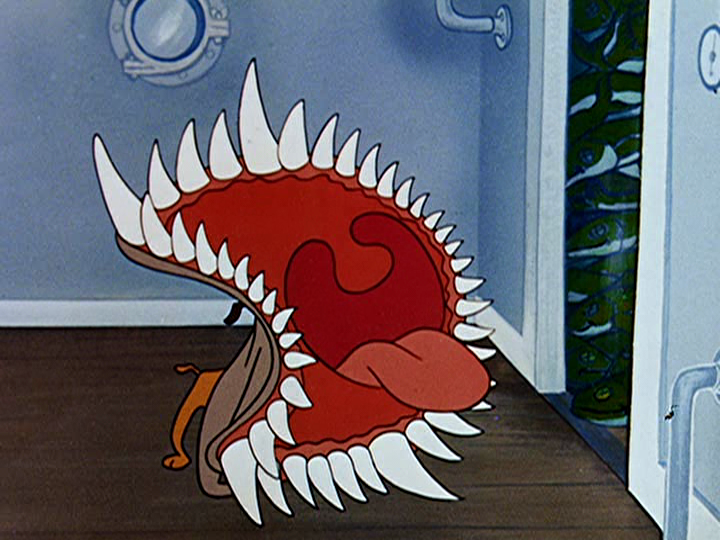
Sh-h-h-h-h-h © Walter LantzIn ‘Sh-h-h-h-h-h’ small, mustached Mr. Twiddle suffers from “trombonosis”.

He tries to calm down his nerves in an extraordinarily quiet hotel in the Swiss alps. But then some noisy neighbors drop in, who play the trombone and laugh all the time. In the end, they turn out to be Mr. Twiddle’s own doctor and nurse.

‘Sh-h-h-h-h-h’ was the last of only four cartoons Tex Avery directed at Walter Lantz. It is also the last theatrical cartoon he ever made. Unfortunately, it is not a great goodbye. Although excellently timed, ‘Sh-h-h-h-h-h’ is only a mildly amusing cartoon, which reuses many of Avery’s gag routines. It has some fatigued and sad feeling to it, as if Avery himself was tired of his own routines.

Having served his contract at Lantz, Avery left the studio on August 20th, 1954, only six months after he had started there. Avery founded his own company, Cascade Studios, with which he made several animated commercials for television. He kept this studio running until the late 1970s. After that he joined Hanna-Barbera, working on a few Saturday morning series until his death in August 1980.

After Avery had left Lantz, Alex Lovy took over his unit. Although the studio rarely hit Avery’s heights, Avery’s influence on the Lantz studio was strong, and kept being visible throughout the 1950s, leading to several inspired cartoons.

Watch ‘Sh-h-h-h-h-h’ yourself and tell me what you think:
Director: Tex Avery
Release date: April 11, 1955
Stars: Chilly Willy
Rating: ★★★★★ ♕
Review:

The Legend of Rockabye Point © Walter LantzIn ‘The Legend of Rockabye Point’ a polar bear tries to steal blue finned tuna from a ship which is guarded by a vicious bulldog.

However, he’s hindered by Chilly Willy, who does anything to awaken the bulldog. The polar bear repeatedly tries to save his skin by singing the bulldog back to sleep. In the end, it has become a habit, and we watch the old-aged polar bear singing his old friend to sleep in his arms.

Penned by Michael Maltese, this cartoon shares some ideas with ‘Deputy Droopy’ (which was made earlier, but only released six months later), but the result is fresh and original. ‘The Legend of Rockabye Point’ was the third of four cartoons Tex Avery made at Walter Lantz’s studio, and without doubt it is the best of the lot. Avery’s timing is, as always, excellent, and the gags come fast and funny. In fact, the cartoon is one of Tex Avery’s all time best, and it stands as Avery’s last masterpiece.

Watch ‘The Legend of Rockabye Point’ yourself and tell me what you think:

Director: Tex Avery
Release date: February 14, 1955
Rating: ★★★
Review:

Crazy Mixed-up Pup © Walter Lantz‘Crazy Mixed-up Pup’ was the second of four cartoon Tex Avery directed at the Walter Lantz studio. Unfortunately, it is not one of his best.

When a man and his dog are overrun by a car, mixed-up blood plasma results in mixing their behavior: the man starts to act dog-like, while the dog wins some human character traits. This is not a very exciting idea to start with, and Avery milks this premise to a nice finale, without ever getting really funny. Luckily, he would do much, much better with his next cartoon at Lantz, ‘The Legend of Rockabye Point‘ (1955).

The married couple, ‘Maggie and Sam’, were reused in three more cartoons in 1956-1957.

Watch ‘Crazy Mixed-up Pup’ yourself and tell me what you think:


Director: Tex Avery
Release date: December 20, 1954
Stars: Chilly Willy
Rating: ★★★★★
Review:

I'm Cold © Walter LantzIn 1954 Tex Avery left MGM to return to his first employer in the animation field, Walter Lantz, at whose studio he had been an animator in the early 1930s.

I’m Cold’ was the first of a mere four cartoons Tex Avery made at Walter Lantz’s studio. In this cartoon he sets his teeth on a character introduced in 1953 called Chilly Willy, a cute little penguin.

Like Pablo the cold-blooded penguin from ‘Three Caballeros‘ (1944), Chilly Willy finds it too cold in Antarctica. Avery, however, uses this premise with much funnier results. In an attempt to get warm, Chilly Willy sneaks into a fur coat store, guarded by a phlegmatic dog who shares a Daws Butler voice with the laid-back wolf from Tex Avery’s ‘Three Little Pups‘ from 1953. This phlegmatic dog was reused in at least four more Chilly Willy cartoons.

Avery is in excellent form here, delivering a perfectly timed cartoon. ‘I’m Cold’ demonstrates how genius can overcome small budgets and limited (animation) talent. Even Clarence Wheeler’s music sounds more inspired and certainly funnier than normal. Of course, the product was much cruder than Avery’s films at MGM had been, but at the same time it was much better than any earlier Lantz film from the 1950s. And, Avery’s second film featuring Chilly Willy, ‘The Legend of Rockabye Point‘ (1955) would even be better…

Watch ‘I’m Cold’ yourself and tell me what you think:

Directors: Clyde Geronimi, Wilfred Jackson & Hamilton Luske
Release Date: June 16, 1955
Rating: ★★★★★
Review:

Lady and the Tramp © Walt Disney‘Lady and the Tramp’ is a mild and friendly film based both on story ideas by Joe Grant that went as far back as 1939, and a short story by novelist Ward Greene. It tells the story of Lady, an upper class female Cocker Spaniel living around the turn of the century.

Lady’s life of luxury seems to be threatened by the coming of a baby, but it is the babysitter, aunt Sarah, who’s her real nemesis. The cat-loving old lady quickly has Lady muzzled, and it’s up to the tramp to rescue her. They spend a night out together, but in the morning, while they’re chasing chickens “together”, Lady gets caught and ends in the city dogpound. There she discovers that the tramp is quite a ladies’ man. It seems their short-lived relationship is over, but then the tramp helps her catching a rat that has sneaked into the house and into the baby’s room…

‘Lady and the Tramp’ was the first animated feature in Cinemascope. The film uses the new technique to great effects, with the action carefully laid out to the broad screen. Its backgrounds are very beautiful, and remarkably lush or, when necessary, highly dramatic. Only in the love scene they become somewhat stylized, showing a Mary Blair influence otherwise absent from the film.

The high quality animation is a delight to watch and stands out in an age of stylized and limited animation, something the 1950s more and more became to be. Like the animals in ‘Bambi‘ (1942), the dogs have a look and feel of real animals, while, at the same time, being full characters one can relate to, with a complete range of human expressions. Even the minor characters, like the dogs in the dogpound, are perfectly animated in that respect. The voices help in this dualism, often being a combination of human and dog-like sounds.

The humans, on the other hand, are hardly seen, and only the strongly caricatured ones, Aunt Sarah, Tony and Joe, have something of a character. It is telling that the most famous and probably most romantic kiss in animation history can be seen in this movie and is a kiss between two dogs. In this scene Lady and the tramp share a meal of spaghetti, accompanied by romantic music by the two Italian restaurant owners. This scene, animated by Frank Thomas, is the undisputed highlight of the film. Honorable mention goes to the very lifelike fight between the tramp and a large rat, a strongly dramatic scene animated by Wolfgang Reitherman, which can compete with the fighting scene in ‘Bambi’ in its impact.

Watch the dining scene from ‘Lady and the Tramp’ yourself and tell me what you think:

Director: Ward Kimball
Airing Date: March 9, 1955
Stars: Walt Disney, Ward Kimball, Wernher von Braun
Rating: ★★★★
Review:

Man in Space © Walt Disney‘Man in Space’ is a Disneyland special about man’s conquest of space, which, two years before the launching of Sputnik, was still a dream at that time.

The documentary includes information about rockets, weightlessness and concludes with an exciting account of man’s first space travel, based on the designs by rocket engineer Wernher von Braun. Von Braun is one of three German scientists featured in the program, the others being Willy Ley and Heinz Haber, demonstrating the enormous influence of German scientists on American science. Ley had fled Nazi Germany in 1935, but Haber stayed there till the end of the war, and Von Braun was even responsible for the deadly V2 rocket, a technical tour-de-force, but also the Nazi regime’s most fearful weapon.

‘Man in Space’ is shortly introduced by Walt Disney himself, quickly giving the presentation to director Ward Kimball, who remains the main host of the program. Kimball is clearly in his element here. His own wacky cartoon animation style is featured in a short history of man’s attempts to enter space, and in Haber’s accounts of ‘space medicine’. Indeed, he later called the space series, of which ‘Man in Space’ is the first entry, the creative high point of his career.

Throughout the movie, the use of animation is sparse, however, and the animation itself very limited. Nevertheless, its use is very effective, especially in the visionary concluding part, with its typical fifties science fiction designs.

‘Man in Space’ would be followed by ‘Man and the Moon‘ (1955) and ‘Mars and Beyond’ (1957), taking ideas on space travel even further.

Watch ‘Man in Space’ yourself and tell me what you think:

Director: Chuck Jones
Release date: August 8, 1955
Stars: Porky Pig, Sylvester
Rating: ★★★★
Review:

Jumpin' Jupiter © Warner Brothers‘Jumpin’ Jupiter’ was the last of three cartoons in which director Chuck Jones employed Porky Pig, and Sylvester as his frightened cat.

This time they’re camping out when they’re visited by a bird-like alien. The alien takes their complete camping site to outer space. As in the former cartoons, Porky remains completely unaware of what’s happening, while Sylvester sees it all, much to his horror. In the end we see them drive off into the horizon on a strange, strange planet.

‘Jumpin’ Jupiter’ is a beautiful and well animated cartoon, and arguably the most enjoyable of the Porky-Sylvester pairings. The action is helped by Carl Stalling’s particularly inspired music, which matches the science fiction setting perfectly.

Watch ‘Jumpin’ Jupiter’ yourself and tell me what you think:

https://www.dailymotion.com/video/xk2yb4_porky-pig-jumpin-jupiter_tv

This is Porky Pig cartoon no. 145
To the previous Porky Pig cartoon: My Little Duckaroo
To the next Porky Pig cartoon: Dime to Retire

Director: Friz Freleng
Release Date: August 7, 1954
Stars: Tweety & Sylvester
Rating: ★★★★
Review:

Satan's Waitin' © Warner BrothersDuring a chase Sylvester falls down and ceases to be.

He goes straight to hell, where a bulldog-like devil tells him he can return to earth because he has still eight lives left. Unfortunately, back on earth Sylvester loses his lives fast, especially during a chase at a carnival.

‘Satan’s Waitin’ shows some similarities to the Tom & Jerry cartoon ‘Heavenly Puss‘ (1949), including bulldog devils and a heavenly escalator. Nevertheless, it’s one of the most original and most inspired of the Tweety and Sylvester cartoons, on par with the celebrated ‘Birds Anonymous’ from 1957.

Watch ‘Satan’s Waitin’’ yourself and tell me what you think:

http://www.dailymotion.com/video/x1z2hgt_sylvester-the-cat-ep-46-satan-s-waitin_fun

Director: Jack Hannah
Release Date: January 14, 1955
Stars: Donald Duck
Rating: ★★★★
Review:

No Hunting © Walt DisneyIn ‘No Hunting’ Donald is encouraged by an off-screen narrator and by the spirit of his grandfather to join the hunting season.

This leads to a great satirical cartoon, ridiculing hunting and hunters. It even contains a parody on ‘Bambi‘!

‘No hunting’ feels like a Goofy short featuring Donald. Like in the Goofy shorts, most of the humor comes from the contrast between the narrator’s lines and what is shown on the screen. It’s a very enjoyable Cinemascope cartoon, which deserves to be more widely known.

Watch ‘No Hunting’ yourself and tell me what you think:

This is Donald Duck cartoon No. 110
To the previous Donald Duck cartoon: Grand Canyonscope
To the next Donald Duck cartoon: Bearly Asleep

Director: Charles Nichols
Release Date: December 23, 1954
Stars: Donald Duck, the Park Ranger
Rating: ★★★★★
Review:

Grand Canyonscope © Walt DisneyBy 1954 Donald Duck was Walt Disney’s only cartoon star to survive as, Mickey, Pluto and Goofy all had retired in 1953.

Following Tom & Jerry, who had entered the large screen one month earlier, he was to enjoy the last stage of his cinema career in Cinemascope, being the only Disney cartoon star to do so.

‘Grand Canyonscope’ is the first of Donald’s Cinemascope cartoons, and it uses the new technique to great effects. Donald is an annoying tourist in the Grand Canyon, repeatedly bothering the park ranger from ‘Grin and Bear it‘. The action makes excellent use of the wide screen, and the Grand Canyon is portrayed in beautiful scenic backgrounds, which are the real stars of this extraordinarily beautiful Donald Duck cartoon.

Watch ‘Grand Canyonscope’ yourself and tell me what you think:

This is Donald Duck cartoon No. 109
To the previous Donald Duck cartoon: The Flying Squirrel
To the next Donald Duck cartoon: No Hunting

Enter your email address to follow this blog and receive notifications of new posts by email.

Join 905 other subscribers
Bookmark and Share

Categories