Director: Sam Stephens & Christopher Mauch
Release Date: May 2013
Rating: ★★★
Review:

Tumbleweed Tango © Sam Stephens & Christopher Mauch‘Tumbleweed Tango’ is a charming little film about two balloon dogs falling in love in a menacing desert full of prickly cacti. The two dance a romantic tango, and together transform into a large bird, escaping the threatening cacti world. 

‘Tumbleweed Tango’ is a virtuoso computer animation film, full of swooping camera takes, elaborate landscapes, and convincing animation on the two balloon dogs. Even their metamorphosis into the balloon bird is believable.

Watch ‘Tumbleweed Tango’ yourself and tell me what you think:

Director: Bill Plympton
Release Date: October 11, 2013
Rating: ★★★½
Review:

Cheatin' © Bill Plympton‘Cheatin’ is Plympton’s sixth feature – no small achievement for an independent animator who insists on drawing everything on his own.

‘Cheatin’ is no exception to his rule. True, for this film Plympton had hired some staff to reproduce the looks of his watercolor illustration style, but he still drew every single frame himself. According to Plympton*, the costs of the extra staff broke him, and he had to go for a (luckily successful) Kickstarter campaign to be able to finish his film. Unfortunately, distribution in his homeland, the United States, will remain problematic, as, according to Plympton, ‘Cheatin’ is 1) no computer animation film, and 2) it’s not directed at children. Both ‘handicaps’ are enough to alienate the average American distributor. Add the absence of dialogue, and ‘Cheatin”s chances become mighty low, indeed…

This is a pity, for Plympton is in great shape in this film. His sketchy drawing style is as virtuoso as ever, and his human protagonists are drawn to the extreme – using weird camera angles and outrageous exaggeration. Practically every single frame is a beauty.

‘Cheatin’ is a surprisingly lighthearted love story. It tells about Ella and Jake, who meet each other at a bumper car stand – and it’s love at first sight. They marry shortly after, and nothing seems to stand in the way of their happiness. Unfortunately, more women take interest in the muscular Jake, and one of them frames Ella – making Jake belief she meets other men. Prostrated with grief, Jake decides to take revenge, and to pick up as many girls as possible himself…

At this point, the film starts to falter a little. Plympton steers away from reality to plunge into a weird plot using a strange machine to get to his happy end. This is a pity, for his outrageous portraits of the common aspects of love are perfect in itself. To me the film would have been better if he’d stuck to a more familiar pattern of love, rut, adultery, and revenge. For example, Plympton’s depiction of Ella opening her heart to let love in is the most endearing sequence in the whole film. And his depiction of the married couple’s happiness accounts for the film’s most stream-of-consciousness-like sequence, accompanied by the drinking song from Giuseppe Verdi’s ‘La Traviata’.

When Jake starts cheating, Plympton focuses on his behavior at the EZ motel. However, it remains a rather unclear how Jake behaves at home. He has clearly become cold and distant, and denies Ella the love and sex she desires. But at no point in the film there’s any trace of irritations, rows or fights between the two lovers.

Plympton says the film is based on a experience of his own, in which he discovered he wanted to strangle and to make love to his girl at the same time. There’s indeed a scene depicting this feeling. However, it gets a little lost in the strange plot twist. What it does show is that Ella’s desire to hurt Jake is weaker than her desire to be loved by him. Although both characters look rather cliche, in the end Ella is a far more interesting character than Jake, who remains a rather simple strong man loaded with testosteron. Plympton doesn’t show much of Ella’s character, but her more complex inner feelings can be distilled from several scenes.

Despite the plot flaws, ‘Cheatin’ remains a well-told film throughout, making clever use of Nicole Renaud’s gorgeous score, and of some classical pieces –  apart from Verdi, e.g. Leoncavallo’s ‘Ridi Pagliaccio’ sung by Caruso, and Maurice Ravel’s Bolero. The absence of dialogue never becomes a handicap –  on the contrary. And the emotions of the characters are played out well – sometimes grotesquely cliche, like Jake’s ride of grief; sometimes subtle and sincere, like Ella’s suffering from Jake’s rejection.

Plympton calls his film ‘anti-Disney’, but ‘Cheatin” is in no way a reaction to Disney’s world. One can say it’s decidedly non-Disney: the film stands on its own and shows us an animation world totally different from Disney’s, one in which American animated features are not synonymous to family films, but can be as wildly diverse as live action features.

I certainly hope Plympton’s world will once come true.

Watch the trailer for ‘Cheatin’ yourself and tell me what you think:

* quotations from Bill Plympton are taken from his introduction to the film at the screening at the Holland Animation Film Festival, March 19, 2014.

Director: Ah Da
Release Date: 1980
Rating: ★★★★
Review:

The Three Monks © Ah DaIn ‘Three Monks’* Ah Da retells an ancient Chinese proverb: one monk can carry two buckets of water, two can carry one, but three…

Three monks visit a house on a hill top to meditate and to worship Buddha. Unfortunately, they have to fetch their water in the lake below. Only after a fire they are willing to cooperate in this.

The film uses clear and simple designs and very elementary backgrounds. Its storytelling is very lean, and uses no dialogue. Unfortunately, like many other Chinese animation films, it also suffers from slowness. Ah Da clearly takes his time, telling his story on a leisurely speed. The result is a meditative film, the comedy notwithstanding.

Watch ‘Three Monks’ yourself and tell me what you think:

‘Three Monks’ is available on the French DVD ‘Impression de montagne et d’eau’

* this film is also known by its French title: ‘Les trois moines’

Director: Alexandre Alexeieff
Release Date: 1933
Rating: ★★★½
Review:

Une nuit sur le mont chauve © Alexandre AlexeieffPredating Disney’s film to the same classical piece by seven years, this ‘video clip’ to the music of ‘Night on Bald Mountain’ by Modest Mussorgsky is an impressive mood piece.

The Russian-French artist Alexeieff animated ‘Une nuit sur le mont chauve’ on a so-called pinscreen, a device he invented himself , and which consists of a screen with numerous pins, which can be pushed further in or out, to produce a shadowy image together. This technique is highly original, and the images produced are totally unique.The film’s imagery has more in common with surreal paintings from the era than with any other animation film from the 1930s. ‘Une nuit sur le mont chauve’ was Alexeieff’s first film on the pinscreen. Together with his wife Claire Parker he would animate five more, of which ‘The Nose’ (1963) is arguably the best.

The film does not tell a story, but shows us a string of expressionistic images of animal and human forms, floating through air, and morphing into disturbing creatures. The animation is sometimes excellent (with a human figure circling through the air as a particular standout), but at times primitive, too, and the film suffers a little from the crude montage. Both shortcomings are a direct result of the limitations of the pinscreen. However, Alexeieff’s vision overcomes the film’s drawbacks, and ‘Une nuit sur le mont chauve’ is rightly considered an animation classic.

Watch ‘Une nuit sur le mont chauve’ yourself and tell me what you think:

‘Une nuit sur le mont chauve’ is available on the DVD ‘Alexeïeff – le cinéma épinglé’

Director: David Hand
Release Date: December 19, 1936
Rating: ★★★
Review:

More Kittens © Walt DisneyThe success of Oscar-winning ‘Three Orphan Kittens‘ (1935) undoubtedly prompted this sequel, which is both less beautiful, less entertaining and less remarkable than the original short.

The film is aptly titled ‘More Kittens’, which shows its crowd-pleasing character. This time the kittens create havoc in the garden, while dealing with a fly, a tortoise and a teasing blue bird.

The cartoon is remarkable for introducing the good-natured St. Bernard Bolivar, who would become Donald Duck’s dog in the comic strip two years later. He’s not named here, but the likeness is so stunning, not only in design but also in character, that there’s no doubt it’s him. True, there was also a St. Bernard in ‘Alpine Climbers’ (1936), but this dog lacks Bolivar’s character, being more of a cliche St. Bernard instead.

Watch ‘More Kittens’ yourself and tell me what you think:

This is Silly Symphony No. 65
To the previous Silly Symphony: Mother Pluto
To the next Silly Symphony: Woodland Café

Directors: Pinto Colvig, Walt Pfeiffer & Ed Penner
Release Date: April 17, 1937
Stars: Mickey Mouse, Donald Duck, Clarabella Cow, Clara Cluck, Goofy
Rating: ★★★½
Review:

Mickey's Amateurs © Walt DisneyMickey is only the straight man while hosting an amateur night at the theater.

We watch Donald trying to recite ‘Twinkle Twinkle Little Star’ while forgetting the words, Clarabella Cow and Clara Cluck performing an operatic song, and Goofy with an automatic one man band that goes haywire.

Donald surprises not only his but also the modern audience by drawing a tommy gun to shoot at the audience(!). However, it’s Goofy’s silly musical machine which draws the biggest laughs in a hilarious sequence, with particularly silly animation.

‘Mickey’s Amateurs’ ends with Donald getting caught in the closing end circle. Self-awareness gags like this were rare at Disney’s (another example is the burning title card in ‘Mickey’s Fire Brigade‘ from 1935), but would become standard repertoire at Warner Bros. and in Tex Avery’s cartoons at MGM.

Watch ‘Modern Inventions’ yourself and tell me what you think:

This is Mickey Mouse cartoon No. 94
To the previous Mickey Mouse cartoon: Moose Hunters
To the next Mickey Mouse cartoon: Modern Inventions

Director: Frank Tashlin
Release Date: October 30, 1937
Stars: Porky Pig, Petunia Pig
Rating: ★★★★
Review:

The Case of the Stuttering Pig © Warner BrothersIn this cartoon Porky suddenly has three elder brothers (Peter, Portus, and Percy), while Petunia appears to be his sister.

The siblings inherit their estate from their late uncle Solomon (who’s a caricature of Oliver Hardy). Unfortunately, the evil lawyer Goodwill is after them, changing himself into a Dr. Hyde-like character. Strangely enough he insults somebody in the audience, the “guy in the third row”. This to his own regret, for it’s this guy who saves Porky and his siblings in the end! This type of dimension-defying humor was a novelty at the time and would become a Warner Bros. trademark in the late 1930s and early 1940s.

Watch ‘The Case of the Stuttering Pig’ yourself and tell me what you think:

This is Porky Pig cartoon no. 31
To the previous Porky Pig cartoon: Rover’s Rival
To the next Porky Pig cartoon: Porky’s Double Trouble

Director: Frank Tashlin
Release Date: December 19, 1936
Stars: Porky Pig
Rating: ★★★
Review:

Porky in the Northwoods © Warner BrothersPorky has a game refuge in Canada, in which he defends rather cute animals against an evil hunter.

The hunter is designed like the lieutenant from ‘Little Beau Porky‘, but we only see him appear after 4’30. Before this his threat is shown by his shadow only, a remarkably inventive device for a cartoon of the 1930s.

Like other early Warner Brothers films, ‘Porky in the North Woods’ looks very primitive, and rather Disney-anno-1932/1933-like. Yet it features an extremely fast sequence of a squirrel running a ridiculously long distance through the woods to get help (and back to fetch and apple). Such short and fast sequences of characters crossing ridiculously long distances would become a trademark of Tashlin’s colleague Tex Avery. Like his first two films, Tashlin’s third short at Warner Bros. features a battle sequence: this time we watch an enormous number of animals being called to arms.

Porky hardly talks in this cartoon – it seems Tashlin tried to avoid his tiresome stutter. Indeed, in 1937, the original voice artist would be replaced by Mel Blanc, who was able to make Porky’s stutter funny.

Watch ‘Porky in the North Woods’ yourself and tell me what you think:

http://www.dailymotion.com/video/x2xp64z

This is Porky Pig cartoon no. 17
To the previous Porky Pig cartoon: The Village Smithy
To the next Porky Pig cartoon: Porky the Wrestler

Director: Frank Tashlin
Release Date: October 24, 1936
Stars: Porky Pig
Rating: ★★★½
Review:

Little Beau Porky © Warner Brothers‘Little Beau Porky’ is Frank Tashlin’s second film at Warner Bros. It’s a more clearly gag-orientated effort than his debut film ‘Porky’s Poultry Plant‘.

Porky (with his old stutter) is a soldier at the foreign legion, being bullied by his lieutenant. However, in the end he manages to single-handedly save the fort and to overthrow an evil Arab and his gang.

Like in ‘Porky’s Poultry Plant’, both design and animation are primitive. But Tashlin unmistakably shows his cinematic talent, especially in the opening sequence and in the preparation for battle.

Watch ‘Little Beau Porky’ yourself and tell me what you think:

http://www.dailymotion.com/video/x2xp5o3

This is Porky Pig cartoon no. 15
To the previous Porky Pig cartoon: Porky’s Moving Day
To the next Porky Pig cartoon: The Village Smithy

Director: Frank Tashlin
Release Date: August 22, 1936
Stars: Porky Pig
Rating: ★★★★
Review:

Porky's Poultry Plant © Warner BrothersBoth director Frank Tashlin and composer Carl Stalling make their Warner Bros. debut in this film in which Porky (with his old ugly voice) has a fowl farm, threatened by a bunch of evil buzzards.

‘Porky’s Poultry Plant’ looks primitive when compared to Disney films of the same time, looking more like a Disney film from 1932-1933. Its story is sweet, and not very funny, but Carl Stalling’s music is fresh, and Tashlin’s staging is already very impressive. Especially the air battle sequence (in which Porky, in a small army plane, fights an air fleet of hawks ) is remarkably stunning, showing unparalleled fast montage and original ‘camera’ shots. Both these techniques would become Tashlin trademarks, and would contribute to a faster, more gag-orientated style at Warner Bros. Tashlin had replaced Jack King, who had returned to Disney, and with his first Warner Bros. cartoon he immediately proves to be a more inventive director than his predecessor.

Watch ‘Porky’s Poultry Plant’ yourself and tell me what you think:

http://www.supercartoons.net/cartoon/822/porky-pig-porkys-poultry-plant.html

This is Porky Pig cartoon no. 12
To the previous Porky Pig cartoon: Porky the Rainmaker
To the next Porky Pig cartoon: Milk and Money

Director: Jack King
Release Date: May 29, 1937
Stars: Donald Duck
Rating: ★★★½
Review:

Modern_Inventions © Walt DisneyAfter a short stint at Warner Brothers, veteran animator Jack King makes his debut as a director at the Disney studio.

King would remain a director of Donald Duck films until his retirement in 1948, directing only three cartoons without the duck (‘Farmyard Symphony‘ from 1938, and the propaganda shorts ‘Out of the Frying Pan into the Firing Line‘ and ‘Defense against Invasion‘, from 1942 and 1943, respectively).

‘Modern Inventions’ is Donald’s first real solo outing, sharing screen time only with mechanical objects. He visits a ‘museum of modern marvels’ , where he has to deal with a mechanical robot butler (the running gag of the film), a package wrapper, a ‘robot nurse maid’ and an automatic barber chair. Like in ‘The Band Concert‘ Donald shows an ability to produce numerous objects out of nothing, this time hats. He even manages to change his army cap into a baby cap.

‘Modern Inventions’ was the last of three Donald Duck shorts under the Mickey Mouse flag. With his next cartoon, ‘Donald’s Ostrich‘ he would have a series of his own…

Watch ‘Modern Inventions’ yourself and tell me what you think:

This is Mickey Mouse cartoon No. 95
To the previous Mickey Mouse cartoon: Mickey’s Amateurs
To the next Mickey Mouse cartoon: Hawaiian Holiday

Director: Ben Sharpsteen
Release Date: January 9, 1937
Stars: Donald Duck
Rating: ★★★★★
Review:

Don Donald © Walt DisneyAfter co-starring with Pluto in ‘Donald and Pluto‘ (1936), Donald really comes to his own in ‘Don Donald’. In this cartoon he only shares screen time with a new character, Donna Duck, a predecessor of Daisy with a temper that matches Donald’s own. 

In this film, we watch Donald in a Mexican setting featuring a surprisingly Krazy Kat-like palm in the background. He wears a large sombrero and tries to woo Donna, but his donkey spoils his efforts. Donald trades his donkey for a car (the small red car we would become so familiar with). The car makes a deep impression on Donna, and both go for a ride.

The animation of the car ride is a great showcase of animation of speed, while the hilarious sequence in which Donald tries to restart the motor again is a wonderful example of rubbery animation. The film ends marvelously, when Donna produces a unicycle out of her handbag and rides off into the distance. But the whole film is one of sheer delight and one of the classics of the 1930s.

Despite Mickey’s absence, ‘Don Donald’ is still part of the Mickey Mouse series. Only with ‘Donald’s Ostrich‘ from December 1937 Donald would get his own series.

Watch ‘Don Donald’ yourself and tell me what you think:

This is Mickey Mouse cartoon No. 91
To the previous Mickey Mouse cartoon: The Worm Turns
To the next Mickey Mouse cartoon: Magician Mickey

Director: Ben Sharpsteen
Release Date: September 12, 1936
Stars: Donald Duck, Pluto
Rating: ★★½
Review:

Donald and Pluto © Walt DisneyWhile Donald is plumbing, Pluto accidentally swallows a magnet, attracting all kinds of metallic objects, like his dish, a pendulum, a watch and eventually Donald’s monkey-wrench.

This short features elaborate gags based on character animation, surely building to a grand finale. One can admire the inevitable ‘logic’ of the film, yet the result is only mildly funny, and neither one of Donald’s or Pluto’s best films.

Although advertised as a Mickey Mouse cartoon, in ‘Donald and Pluto’ Mickey Mouse is not present at all. On the contrary, for both Donald and Pluto this is their first cartoon without Mickey (if we disregard the Silly Symphonies ‘Just Dogs‘ from 1932 and ‘The Wise Little Hen‘  from 1934). After getting more and longer sequences of their own within the Mickey Mouse series, this step was inevitable.

Pluto had come a long way, sharing five years and 33 films with Mickey before standing on his own, but Donald received his independence already within two years, after only twelve films with Mickey.

Both Pluto and Donald would get their own series in 1937. They would appear together in five more films, all within Donald’s series: ‘Beach Picnic‘ (1939), ‘Donald’s Dog Laundry‘, ‘Put-Put Troubles‘, ‘Window Cleaners‘ (all 1940) and finally ‘The Eyes Have It’ (1945).

Watch ‘Donald and Pluto’ yourself and tell me what you think:

This is Mickey Mouse cartoon No. 88
To the previous Mickey Mouse cartoon: Mickey’s Circus
To the next Mickey Mouse cartoon: Mickey’s Elephant

Director: David Hand
Release Date: October 10, 1936
Stars: Mickey Mouse, Pluto
Rating: ★★½
Review:

Mickey's Elephant © Walt Disney‘Mickey’s Elephant’s opens with Mickey receiving a cute young elephant from the Rajah of Ghaboon as a playmate for Pluto. Unfortunately Pluto is not amused, and he thinks ‘Bobo’ is an intruder with intentions to replace him.

‘Mickey’s elephant’ is similar to ‘Mickey’s Pal Pluto‘ (1933) and to ‘Mickey’s Kangaroo‘ (1935), in which Pluto is also jealous of an intruder and which also feature his evil side. Like in ‘Mickey’s Pal Pluto’ Pluto’s evil consciousness has materialized into a little devilish persona, who talks with a strong New York accent and who persuades Pluto to fix Bobo using red pepper. Sneezing along Bobo blows is own new house down, but unfortunately Pluto’s too…

‘Mickey’s Elephant’ is a rare example of a Mickey Mouse film inspired by the Mickey Mouse comic strip. Most of the time the influence was reversed. But in this case Bobo the elephant had made his entrance in Floyd Gottfredson’s strip two years earlier. Bobo is a completely innocent character, and Pluto’s little devil notwithstanding, the cartoon is more cute than funny.

Watch ‘Mickey’s Elephant’ yourself and tell me what you think:

This is Mickey Mouse cartoon No. 89
To the previous Mickey Mouse cartoon: Donald and Pluto
To the next Mickey Mouse cartoon: The Worm Turns

Director: Ben Sharpsteen
Release Date: August 1, 1936
Stars: Donald Duck, Mickey Mouse, the Orphan Mice, the Little Seal
Rating: ★★½
Review:

Mickey's Circus © Walt DisneyIn ‘Mickey’s Circus’ we watch Mickey and Donald perform in a circus for a pack of orphan mice.

Most of the time goes to Donald and his trained seals. Only after six minutes Mickey joins in again, struggling with Donald on the slack-rope, while being troubled by the orphan mice.

‘Mickey’s Circus’ was the last cartoon to feature the Orphan Mice (apart from the remake of ‘Orphan’s Benefit from 1941), until their unexpected return in ‘Pluto’s party‘ from 1952. It’s also the first Disney short featuring a cute little seal. Similar seals would reappear in ‘Pluto’s Playmate‘ (1941), ‘Rescue Dog‘ (1947) and ‘Mickey and the Seal‘ (1948).

Watch ‘Mickey’s Circus’ yourself and tell me what you think:

This is Mickey Mouse cartoon No. 87
To the previous Mickey Mouse cartoon: Alpine Climbers
To the next Mickey Mouse cartoon: Donald and Pluto

Director: Ben Sharpsteen
Release Date:
 June 20, 1936
Stars:
 Mickey Mouse, Donald Duck, Goofy, Pete
Rating:
  ★★★½
Review:

Moving Day © Walt DisneyBecause Mickey, Donald and Goofy can’t pay the rent, evil sheriff Pete will sell their furniture. The boys decide to move before that’s going to happen…

‘Moving Day’ is the this third of the classic trio cartoons featuring Mickey, Donald and Goofy. In this entry Mickey is hardly visible. Most of the cartoon is taken by his co-stars in two all too elaborate sequences: one featuring Goofy in a surreal struggle with a piano with a will of its own, and another featuring Donald’s trouble with a plunger and a fishbowl.

Despite the great animation, one gets the feeling that in this cartoon the artists were too much obsessed with character and less with gags, making this cartoon a bit slow and tiresome, when compared to the previous trio outings ‘Mickey’s Service Station’ and ‘Mickey’s Fire Brigade‘ from 1935. Luckily, in later trio shorts like ‘Moose Hunters’ or ‘Hawaiian Holiday’, the fast pace was found again.

‘Moving Day’ is the first cartoon to feature Pete in color. It was also the last of only three cartoons in which Art Babbitt animated Goofy. After he had done so much for the character in ‘Mickey’s Service Station’ and ‘On Ice‘, one can say that in ‘Moving Day’ he went a little too far in milking the goof’s scenes. Anyhow, Babbitt went over to feature films, but after these three shorts Goofy’s character was established well enough for others to take over with equally inspired results.

Watch ‘Mickey’s Fire Brigade’ yourself and tell me what you think:

This is Mickey Mouse cartoon No. 85
To the previous Mickey Mouse cartoon: Mickey’s Rival
To the next Mickey Mouse cartoon: Alpine Climbers

Director: David Hand
Release Date: October 26, 1935
Rating: ★★★
Review:

Three Orphan Kittens © Walt DisneyOn a winter night three kittens are thrown in a sack into a garden.

Luckily they can escape the cold by entering the house, which they explore. This sweet cartoon contains elaborate gags with a.o. pepper, a bottle of milk, and a pianola.

‘Three Orphan Kittens’ was penned by Joe Grant and Bill Cottrell, and benefited from Fred Moore’s appealing animation. Indeed, it won an Academy Award. Its success made it one of those rare Silly Symphonies to evoke a sequel (‘More Kittens‘ from 1936). Moreover, it clearly inspired other animation film makers: the milk bottle gag was more or less copied by Fleischer in ‘We did it‘ (1936) which also stars three kittens. And, some of the pianola gags may have inspired Hanna and Barbera in their ‘The Cat Concerto‘ (1947).

At least Hanna and Barbera copied the black maid (of whom we only see her arms and legs) for their own Mammy Two-Shoes in the Tom & Jerry series. The black maid would also return in a few Disney shorts: ‘More Kittens‘ (1936), ‘The Pantry Pirate‘ (1940, starring Pluto), and ‘Figaro and Cleo‘ (1943).

Watch ‘Three Orphan Kittens’ yourself and tell me what you think:

This is Silly Symphony No. 56
To the previous Silly Symphony: Music Land
To the next Silly Symphony: Cock o’ the Walk

Director: Ruth Lingford
Release Date: 1997
Rating: ★★★★★ ♕
Review:

Death and the Mother © Ruth LingfordWhen death takes away her child, a mother gives up everything to get her back.

‘Death and the Mother’ is Ruth Lingford’s re-telling of a classic fairy-tale by Hans Christian Andersen. It’s an animation masterpiece: its strong and gritty animation, the beautiful string quartet music by Nigel Broadbent, the subtle sound effects –  all add up to a very strong, dark and emotional film. Lingford makes clever use of the computer to create a very graphic film that looks like an animated woodcut. In an age in which computer animation almost equals 3D animation, this is a refreshing technique, with a stark impact and an imagery unparalleled in the animation field.

Moreover, Lingford captures Andersen’s tale of grief, love and sacrifice very well, without trying to update it. Just by staying true to the essence of the original story she has made a timeless classic. Her wordless film is as universal as it can get, and capable of communicating to audiences worldwide. It’s a welcome antidote to the Disney fairy tale retellings, which get more and more watered down, and which lose a lot of the originals’ charm with it.

Watch ‘Death and the mother’ yourself and tell me what you think:

‘Death and the Mother’ is available on the DVD inside the book ‘Animation Now!’

Director: Chris Wedge
Release Date: 1998
Rating: ★★★★½
Review:

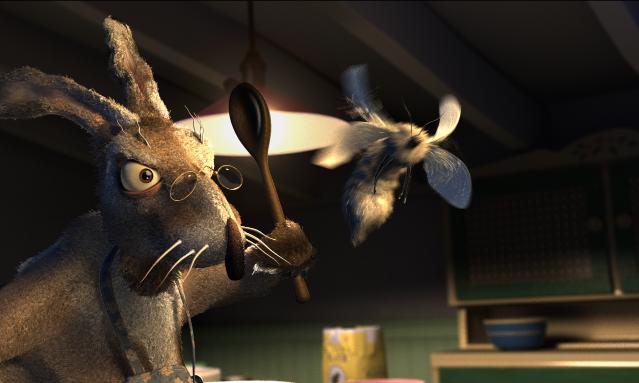
Bunny © Blue SkyAn elderly bunny tries to bake a cake, when she’s being disturbed by a giant moth.

After a wild chase the moth falls into the cake mix and she angrily bakes the insect with it. At this point the film takes a remarkable turn…

With Pixar’s ‘Geri’s Game’ (1997), ‘Bunny’ is one of the first computer animated shorts that make you forget you’re watching a computer animated film. With its quite original story and its beautiful execution, it transcends the medium, and its deservedly won the Oscar for best animated short in 1998.

Chris Wedge and his Blue Sky studio (founded in 1987, by Tron-alumni) later moved on to produce feature length computer-animated films, becoming the fourth American studio to do so, after Pixar, PDI/Dreamworks and DNA Productions. It would be especially successful with its Ice Age films. However, none of the sequential Blue Sky films would reach the emotional depths of this gentle little short.

Watch ‘Bunny’ yourself and tell me what you think:

‘Bunny’ is available on the DVD ‘Ice Age’

Director: Nick Mackie
Release Date: 1999
Rating: ★★
Review:

Minotaur & Little Nerkin © Aardman‘Minotaur & Little Nerkin’ is a curious 2d computer animation, which looks like it is designed for children.

However, its story is rather black. The film features a minotaur who lurks a duck into his home to eat a captivated human hand, only in order to eat the duck himself. Remarkable for its morbid humor and original technique, it is nonetheless an ugly and unfunny film, that fails to entertain, let alone impress the viewer.

Watch ‘Minotaur & Little Nerkin’ yourself and tell me what you think:

‘Minotaur & Little Nerkin’ is available on the DVD ‘Aardman Classics’

Enter your email address to follow this blog and receive notifications of new posts by email.

Join 918 other subscribers
Bookmark and Share

Categories