Director: Ivan Ivanov-Vano Release Date: 1972 Rating: ★★½ Review:
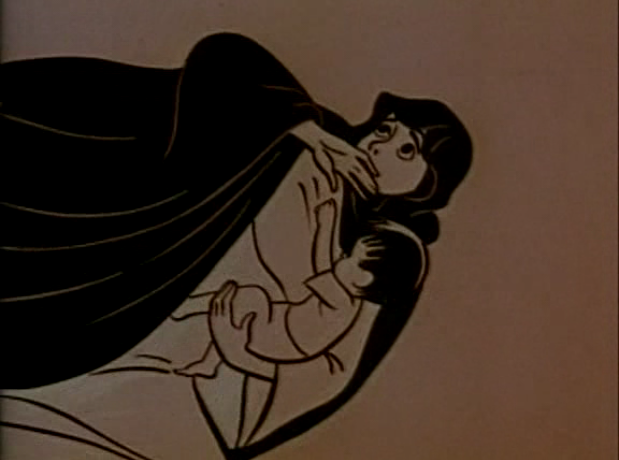
‘Ave Maria’ is a very grim anti-Vietnam film, made in the Soviet Union.
It combines paintings of the Virgin Mary with images of war. Its darkest moment is when a soldier in a gas mask kills a Vietnamese child. The film ends with live action footage of people protesting against the Vietnam war. Clever montage suggests that the protesters are being repressed.
Despite its disturbing character the film is too blatantly propagandastic and too directionless to be a classic. It also uses little animation.
Watch ‘Ave Maria’ yourself and tell me what you think:
‘Ave Maria’ is available on the DVD box set ‘Animated Soviet Propaganda’
Director: Vladimir Tarasov Release Date: 1977 Rating: ★★★½ Review:
‘Forward March Time!’ is a bold setting of a poem by soviet futurist poet Vladimir Mayakovsky (1892-1930).
The film illustrates the meandering poem with associative images of the 1905 revolution, the 1917 revolution, World War II and even a futuristic battle in space.
Using a combination of typical seventies designs (besides communist paintings) and rock music (besides an excerpt from Mahler’s fifth symphony), the film is both a markedly modern and interesting piece of soviet propaganda, if a bit too long. It shows Tarasov’s unique style, which he explored further in the much more lighthearted short ‘Contact‘.
Watch ‘Forward March, Time!’ yourself and tell me what you think:
‘Forward March, Time!’ is available on the DVD box set ‘Animated Soviet Propaganda’
Director: Ivan Aksenchuk Release Date: 1972 Rating: ★★½ Review:
‘Plus Electrification’ is a commissioned film for the State Commission for the Electrification.The film propagates the electrification of the Soviet Union.
Accompanied by a folky song glorifying electricity, we watch electricity pylons march through the countryside and Soviet electricity pylons shaking hands with Czech and Polish electricity pylons.
Its use of old-fashioned communist imagery, black-and white live action footage and ridiculously heroic music makes the film extremely dated. Despite the colorful images and even a look into the future, one can hardly comprehend that this film was made in the 1970s, not the 1940s.
Watch ‘Plus Electrification’ yourself and tell me what you think:
‘Plus Electrification’ is available on the DVD box set ‘Animated Soviet Propaganda’
Director: Vladimir Pekar Release Date: 1971 Rating: ★★ Review:
It seems that in the early 1970s Soviet Propaganda took a rather retrograde course, being more overtly propagandistic and using images that went all the way back to the 1920s.
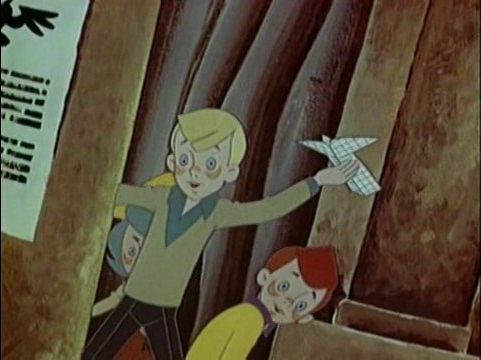
Films with a peaceful message, like ‘Proud Little Ship‘ (1966) or ‘We Can Do It‘ (1970) were interchanged for self-important glorifications of the Soviet Union, and its ‘heroic’ history. This period produced some of the most terrible propaganda films ever made. ‘The Adventures of the Young Pioneers’ is a prime example.
The film plays during World War Two, Russia’s Great War. When their village is occupied by some goofy Nazi Germans, three communist children decide to withstand their occupants. They are betrayed by a collaborator, however, and captured when raising a red flag. Luckily, they are saved by the red army.
This children’s film uses ugly designs and very old-fashioned looking caricatures of Nazis, while the children and especially the red army are drawn quite heroically. The result is as unappealing and unfunny as it is sickeningly propagandistic.
Watch ‘The Adventures of the Young Pioneers’ yourself and tell me what you think:
Director: Jan Švankmajer Release Date: 1971 Rating: ★★½ Review:
Animated sketches of drawings by Leonardo da Vinci are alternated with excerpts from stock live action films.
Atypically for Jan Švankmajer, this film uses pencil animation only (except for a short stop motion segment of a pencil drawing a hand). The animation of Leonardo da Vinci’s drawings is both stunning and very convincing. Unfortunately, the nonsensical interruptions with stock film wear the film down, rendering a boring film with an unclear message.
Nevertheless, the Czech communist authorities responded negatively to Švankmajer’s unauthorized post-production of this film, with the incorporation of images related to daily life – presuming a hidden political message. So after ‘Leonardo’s Diary’ Švankmajer was forced to lay down his work for seven years. Only in 1979 he would make the start of a second career, in which he would produce his best films. However, Švankmajer would never return to drawn animation, and ‘Leonardo’s Diary’ remains the only testimony of his skills in this form of art.
Watch ‘Leonardo’s Diary’ yourself and tell me what you think:
‘Leonardo’s Diary’ is available on the DVD ‘Jan Svankmajer – The Complete Short Films’
Director: Jan Švankmajer Release Date: 1971 Rating: ★★★★★ ♕ Review:
‘Jabberwocky’ has little to do with the poem from Lewis Carroll’s ‘Through The Looking Glass’, although we hear it being recited by a little girl during the opening sequence.
The film it is Švankmajer’s surrealistic masterpiece on the loss of childhood, depicted by several episodes, which are separated by a box of bricks, a labyrinth and a black cat crushing the box of bricks.
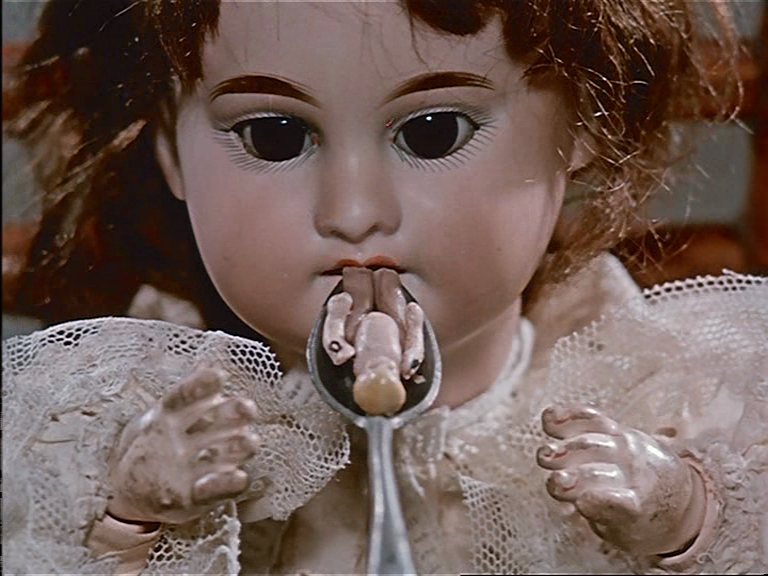
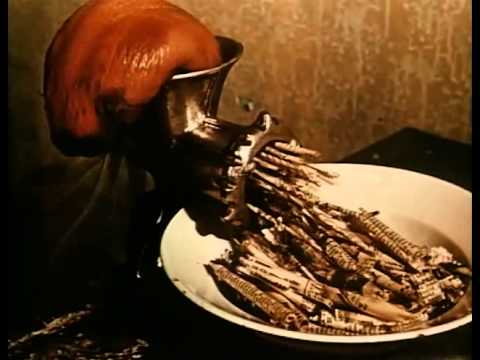
During the episodes we are treated on extremely surrealistic images of very active inanimate objects in a child’s room. First we watch a boy’s suit growing a forest in his room, defying both time and authority (symbolized by the portrait in the room). Then we watch large cannibalistic dolls grinding, ironing and eating little dolls, a china baby in a cradle destroying two tin armies, a pocket knife performing acrobatic tricks until it makes an ill-fated fall and stabs itself, and finally, schoolbooks producing paper boats and planes, which fly out of the window, while the father’s portrait produces pictures of beautiful women.
This last episode shows the child’s changing interests. In the end the labyrinth is solved, the cat – the only living thing in the entire film – is caged, and the boy’s suit is replaced by an adult one. The boy is free from his parent, but the days of imagination are over, the fantasy is gone.
For this film Švankmajer makes excellent use of 19th century imagery (sailor suit, vintage dolls and toys) to create a completely unique world. It’s the film maker’s most typical film, partly expanding on ideas explored in ‘Historia Naturae, Suita‘ (1967), and showing his fascination with fantasy, cruelty and decay, which roam freely in the child’s self-contained room. The rather morbid behavior of the everyday objects is quite unsettling and it shows how a child’s fantasy can be both imaginative and cruel.
‘Jabberwocky’ is without doubt one of Švankmajer’s most powerful films. He would only top it eleven years later, with ‘Dimensions of a Dialogue‘ (1982). Švankmajer would explore the imagination of children further in the moving ‘Down to the Cellar‘ (1983), and in his unique adaptation of Lewis Carroll’s most famous work ‘Alice‘ (1987).
Watch ‘Jabberwocky’ yourself and tell me what you think:
‘Jabberwocky’ is available on the DVD ‘Jan Svankmajer – The Complete Short Films’
Director: Jan Švankmajer Release Date: 1970 Rating: ★★★ Review:
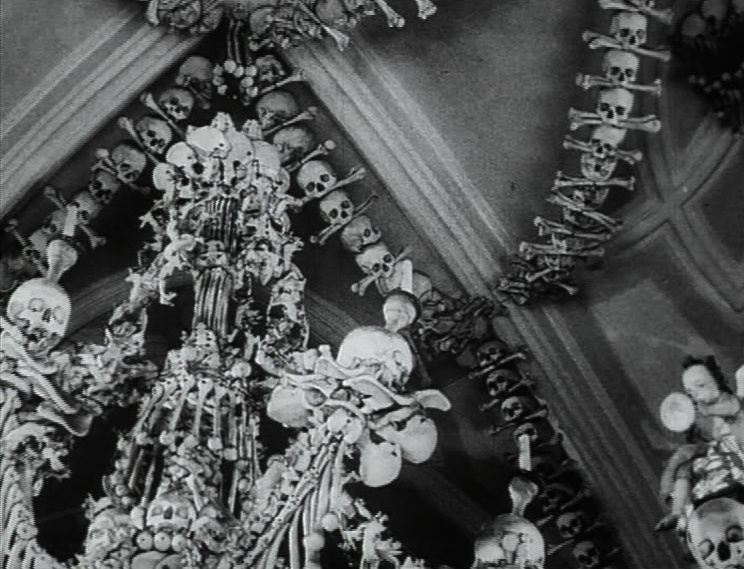
‘The Ossuary’ is a commissioned documentary film about a Czech chapel in Sedlec, which is decorated with thousands of bones and skulls of victims of the 1318 plague and of the Hussite wars of 1421.
Two versions of this film exists: one with a soundtrack of a rather mundane guide guiding a group of children, in which she repeatedly warns not to touch the bones on a penalty of fifty crowns. Her tour is mixed with the uncanny sound of a rattling bicycle. For unclear reasons this soundtrack was considered subversive and forbidden by the Czechoslowakian regime. Therefore a second version was made using a jazz soundtrack.
In both versions the soundtrack conflicts with the morbid images, which are composed in a rhythmical way that even appeals when watched silently. The film contains no animation, but is full of Švankmajer’s idiosyncratic cinematography.
Watch ‘The Ossuary’ yourself and tell me what you think:
‘The Ossuary’ is available on the DVD ‘Jan Svankmajer – The Complete Short Films’
Director: Lev Atamanov Release Date: 1970 Rating: ★★★★★ Review:
From a fascistic egg sprouts a military bird.
The young bird is fed by a capitalist and a general (who both are clearly American) with money and weapons. It grows into a huge black war-bird, which flies over the whole world, threatening loving couples in London, Paris, Moscow and Japan, and an old man, two mothers and several children in an unclear place. When the war-bird starts to attack, one mother turns Asian, Muslim and black, in order to illustrate that war can affect everybody everywhere. Eventually, however, the war-bird is overthrown by a multitude of peace doves, created by workers, writers, children, artists, musicians and pacifists.
‘We Can Do It’ is a beautiful and strikingly pacifistic film and undoubtedly one of the best propaganda films ever created in the Soviet Union. The film clearly is designed for international audiences, with its final message (the title) depicted not only in Russian, but also in German, English, Spanish and French.
Despite its anti-American sentiment, its pacifistic theme is timeless and universal. The film tells its clear message without any dialogue or voice over. Moreover, its designs are stunning and very effective, especially that of the war-bird.
Watch ‘We Can Do It’ yourself and tell me what you think:
‘We Can Do It’ is available on the DVD box set ‘Animated Soviet Propaganda’
In a sinister harbor, where cranes behave like giant dinosaurs and where pterodactyli fly a young flute player brings a mermaid to life. Unfortunately, the mermaid is captured by one of the cranes and dropped to death.
‘Sirene’ is a beautiful, surrealistic film with its own creepy and somber atmosphere. Luckily, there’s also space for some dark humor when the authorities arrest an innocent fisherman and when a zoo and a hospital argue about the mermaid’s body. ‘Sirene’ definitely among Servais’s best films, arguably only equaled by ‘To Speak or not to Speak (1970) and ‘Harpya‘.
Watch ‘Sirene’ yourself and tell me what you think:
Director: Jan Švankmajer Release Date: 1969 Rating: ★★★ Review:
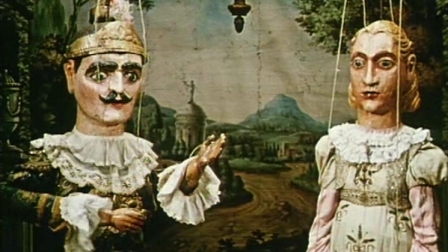
In ‘Don Juan’ Švankmajer’s retells a classic tale from the marionette theater.
The story unfolds in half an hour: Don Juan is a rogue who kills his father, the father of his beloved and his own brother, only to be taken into the depths off hell.
Oddly enough the film is enacted by people dressed as marionettes and behaving accordingly. This allows the marionettes to leave the theater and to perform in the real world, which is strangely intermingled with the marionette theater. This blend of the real and the artificial gives the film a weird and disturbing atmosphere. Švankmajer would reuse and improve upon this mix in his masterpiece, the feature film ‘Faust‘ (1994).
This film contains hardly any animation, and may therefore not be included in this blog. However, it takes a central part in Švankmajer’s oeuvre, who has always blended several different techniques into his works. It’s best to review his oeuvre as a whole, being animated or not.
Watch ‘Don Šajn’ yourself and tell me what you think:
Director: Jan Švankmajer Release Date: 1969 Rating: ★★ Review:
‘A Quiet Week in the House’ is the last film in a series of four involving people facing surreal settings, which Švankmajer made in 1968-1969.
in this film a fugitive seeks shelter in an abandoned house. Every day he digs a hole in one of the doors of the corridor in which he sleeps. Every day he looks through the hole to watch weird surrealistic images of inanimate things behaving strangely. After a week he sets up a device to blow up all doors.
The live action footage is shot in black-and-white, and is accompanied by the sound of a camera. The surrealistic images, on the other hand, are shot in color and completely silent. Unfortunately, the film is too long, and it fails to be as impressive as related films like ‘The flat’ (1968) or ‘Jabberwocky‘ (1971), being neither completely disturbing nor very entertaining. ‘A Quiet Week in the House’ remains one of Švankmajer’s rare weak films.
Watch ‘A Quiet Week in the House’ yourself and tell me what you think:
One could see ‘Songs of the Years of Fire’ as the Soviet answer to ‘Fantasia’.
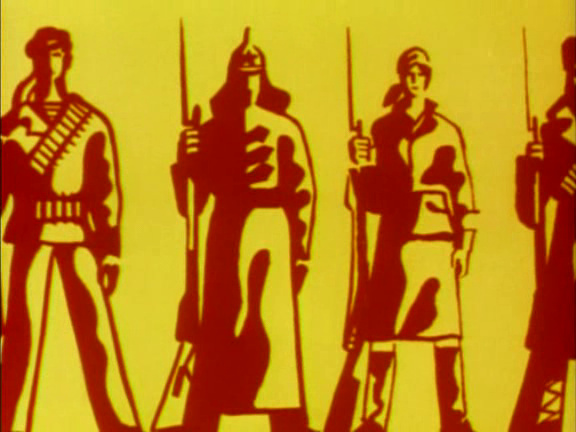
This propaganda film features songs from the Russian civil war (1917-1922). These songs are accompanied by revolutionary and shamelessly patriotic images of the brave soviet army, to which the film is dedicated.
The resulting film is as graphically interesting as it is boring and sickening. It’s hard to believe such blatant propaganda could be made as late as 1971.
‘Songs of the Years of Fire’ is available on the DVD box set ‘Animated Soviet Propaganda’
‘A Hot Stone’ is a Soviet propaganda film from the 1960s based on a children’s book by Arkady Gaidar from 1941.
In it a boy stumbles on an old stone in the woods, which has the ability to give someone a new life again. The boy wants to help an old and lonely man with it, but the man sees no need for it as he has led a happy life. Enter the propaganda, in which the old man tells about the revolution and the civil war. This part is not much of a story. but it’s full of symbolic images, like people breaking their chains, and a giant worker slashing the double headed eagle of the czarist empire with a giant hammer.
‘A Hot Stone’ is a slow and boring film, but it’s also beautifully designed, in an original graphic style, which makes use of bold ink strokes.
Watch ‘A Hot Stone’ yourself and tell me what you think:
‘A Hot Stone’ is available on the DVD box set ‘Animated Soviet Propaganda’
Director: Te Wei Release Date: 1960 Rating: ★★★★ Review:
‘Where is Mama’* is a charming little film in which we watch a school tadpoles seeking their mother.
They mistake two shrimps, a goldfish, a crab, a turtle and a catfish for their mother, before their real mother finds them.
Told by a voice-over, ‘Where is Mama’ is a genuinely Chinese film: it is based on an ancient Chinese fable, it is typically preoccupied with nature and water, its watercolor and ink style is based on classic Chinese painters (most obviously Qi Baishi), and it is set to a serene and leisurely speed.
The result is a film that is a bit slow, but poetic in feel and strikingly beautiful. The short looks timelessly Chinese, but at the time of its release the film’s style was completely new and daring within the Chinese animation film world. However, it would take ca. twenty years before its influence became clear, because five years after the making of this cartoon the Shanghai Animation Studio was shut down as part of the Cultural Revolution, and many of its employees were sent to re-education camps in the countryside. Only in the late seventies it would be up and running again. In the following decade ‘Where is Mama’ would be an inspiration to many Chinese animators, who would reuse several of this film’s key elements. In that decade, too, Te Wei made his own masterpiece, ‘Feeling from Mountain and Water‘ (1988).
Watch ‘Where is Mama’ yourself and tell me what you think:
‘Where is Mama’ is available on the French DVD ‘Impression de montagne et d’eau’
* this film probably is best known by its French title: ‘Les têtards à la recherche de leur maman’
Director: Grigori Lomidze Release Date: 1959 Rating: ★★★ Review:
Filmed in two colors, ‘Ali Baba and the Forty Thieves’ is a long puppet animation film from the Soviet Union.
The short takes half an hour to retell the famous story from One Thousand and One Arabian Nights quite faithfully. The film features the death of two characters, but the grim ending of the original story is lacking. Instead of being killed, the forty thieves are captured by the townspeople.
Interestingly, Ali Baba is not the real hero of the story, but rather his wife, a girl he bought on a slave market, unfortunately run by the very thieves he had robbed earlier. It’s this slave girl who decoys and fools the thieves to their own destruction.
The film uses a narrator who does all the voices, and a very lush score by composer Eduard Kolmanovsky. The film is quite slow and the puppet animation isn’t as sophisticated as in contemporary films by Jiří Trnka. The puppets have no facial expression whatsoever, and cannot move anything in their face, except for the gang leader, who can roll his one eye. Only occasionally their emotions become apparent. The best example of this may be the terror of Ali Baba’s neighbor when he realizes he’s trapped inside the thieves’ cave.
About the film’s director, Grigori Lomidze, little is known. He also directed the propaganda film ‘To You , Moscow‘ (1947), which combines live action and cel animation. Nothing points to a long experience in stop motion, and unfortunately, it shows. Nevertheless, ‘Ali Baba and the Forty Thieves’ is a charming film, succeeding in evoking the typical atmosphere of the Arabian Nights.
Watch ‘Ali Baba and the Forty Thieves’ yourself and tell me what you think:
Director: Jiří Trnka Release Date: 1954 Rating: ★★★ Review:
A young man on a motorcycle is on his way to his girl.
Along the way he stops at a bar, where a wedding is taking place. There he’s offered a drink, which he reluctantly accepts. However, one leads to another and he is quite intoxicated when leaving the bar. Driving at night he tries to speed against a car, a train and even a plane, but he finally crashes, never to see his girl.
This educational film warns us not to combine drinking with driving. In this respect the film is very dull and predictable, but Trnka’s illusion of speed and drunkenness is astonishing.
Watch ‘A Drop Too Much’ yourself and tell me what you think:
Directors: John Halas & Joy Batchelor Release Date: January 31, 1954 Rating: ★★★★★ ♕ Review:
Based on George Orwell’s famous fable (published only nine years before), Animal Farm is the first animated feature made in England, it’s one of Europe’s first feature films, and it’s undoubtedly among the masterpieces of feature animation.
The film falls into the tradition of Disney-style semi-realistic cel animation. However, it sets itself apart from the Disney tradition in its grim and political story, its lack of sentimentality and its open depiction of cruelty and violence. Moreover, the backgrounds are bold oil paintings, with visible brush strokes and darker colors than any Disney film had ever shown.
Nevertheless, the realistic and wonderful animation of the animals pays some depths to the Disney tradition (watch the Silly Symphony ‘Farmyard Symphony‘ for example), greatly helped by the presence of ex-Disney animator John Reed. The film even contains one sweet character for comical relief in a little duckling who tries to keep up with the other animals, echoing the turtle in ‘Snow White and the Seven Dwarfs’ (1937). However, when the story turns particularly grim, with the killing of the Trotsky-like pig Snowball by Napoleon’s dog henchmen, we do not see this cute character again.
The assassination of Snowball is the first of several alarming events in which the animals’ revolution is betrayed. The most disturbing of these is Boxer’s ride to a certain death. This scene is the emotional highlight of the film, and it creates strong feelings of outrage and alarm, still. The horror on the face of his friend Benjamin is very well captured, and moves to this day.
Using a voice over and evocative music by Hungarian composer Mátyás Seiber, the film retells Orwell’s story effectively, using only Orwell’s own words. Its only strong deviation from the book is its ending. Where Orwell’s novel ends with the Stalin-like pig Napoleon’s regime installed, the film ends with yet another revolution – some wishful thinking that in the real world never quite came true until the late 1980s, when encouraged by Gorbachev’s perestroika, the people all over Eastern Europe revolted against their communist oppressors.
‘Animal Farm’, which was released within a year after Stalin’s death, is still a moving portrait of the corrupting force of power. Even though its subject, the Soviet Union, has long been a state of the past, the forces depicted in this movie are still active. The world is not free of its Napoleons, yet…
Watch ‘Animal Farm’ yourself and tell me what you think:
Directors: John Halas & Joy Batchelor Release Date: 1948 Rating: ★★★★ Review:
‘Magic Canvas’ is rather pretentiously introduced as “something different (….), new and exciting”.
Luckily, the film is rather original and exciting: using a rather abstract score by Hungarian composer Mátyás Seiber, it consists of associative images with a strong sense of surrealism. It loosely tells the story of man struggling to be free. Even though it has to pay its debts to Disney’s ‘Fantasia’ (1940), ‘The Magic Canvas’ surely is one of the most avant-gardistic films of its time, and a testimony of Halas & Batchelor’s animation ambitions.
Watch ‘Magic Canvas’ yourself and tell me what you think:
‘Magic Canvas’ is available on the DVD inside the book ‘Halas & Batchelor Cartoons’
Director: Jiří Trnka Release Date: 1951 Rating: ★★★½ Review:
‘The Merry Circus’, is puppet-animator Trnka’s try at cut-out animation.
The film shows that Trnka was a master in this technique as well: the animation is superb: the sense of weight, muscular tensions and balance is nothing less than stunning. Moreover, the cut-outs seem to float in mid-air, casting wonderful shadows on the background.
Unfortunately, the film’s subject is not that interesting. We watch circus artists perform, among them two sea lions juggling, a girl on a horse, three trapeze acrobats and an acrobat bear balancing on a chair on a bottle on a glass. Even though some of the shown tricks are quite improbable, the only truly surrealistic act is the fish on the slack-rope.
Despite the lack of story, the film is an enjoyable watch: its visual design is beautiful and poetic, its animation fluent and convincing, and its circus atmosphere well-captured. ‘The Merry Circus’ may not be Trnka’s best film, but it’s only the high quality of some of his other films that makes this one second-rate.
Watch ‘The Merry Circus’ yourself and tell me what you think:
Director: Lev Atamanov Release Date: 1951 Rating: ★★★★ Review:
‘The Yellow Stork’ is a Russian fairy tale film set in China.
The film tells about a flute player, whose music is so vivid, it can bring a drawing of a stork to life. An evil mandarin captures the bird, demanding it to perform for him. But the stork will only dance to the flute player’s music, and when it hears this music, it flies away through the window.
This film, which uses song, seems to celebrate music and freedom and appears to be a pamphlet against oppression, which is remarkable for a film made under Stalin’s rule. The animation in this short is very good, with beautifully animated humans. The result is one of the more enjoyable Soviet films of the era.
Watch ‘The Yellow Stork’ yourself and tell me what you think:
Animation Backgrounds
A blog dedicated to background paintings from animation films. Kept until 2016.
Animation Scoop
Animation historian Jerry Beck’s animation film news blog.
Cartoon Brew
Topical blog on animation film, led by animation historian Amid Amidi.
Cartoon Modern
Amid Amidi’s blog on modern design cartoon art from the forties, fifties and sixties.
Cartoon Research
THE site on classic animation research, hosted by cartoon historian Jerry Beck.
Cartoons Theory
Frank Beef analyzes classic cartoons. Kept until 2020.
Century Film Project
Michael reviews films of 100 years old and older, roughly in chronological order.
Classic Cartoons
A similar blog featuring many stills and comic strips. Kept until 2012.
Comet over Hollywood
Jessica Pickens reviews classic Hollywood films, especially musicals.
Deja View
Top ex-Disney animator Andreas Deja’s own blog.
Disney History
Esteemed Disney historian Didier Ghez on the latest books on Disney history.
Feeling Animated
Paul Astell brings us thorough reviews of animated features.
Flickers in Time
Short and to the point reviews of classic films (lately mostly pre-code talkies) by an anonymous retired Foreign Service Officer from California

 ‘Ave Maria’ is a very grim anti-Vietnam film, made in the Soviet Union.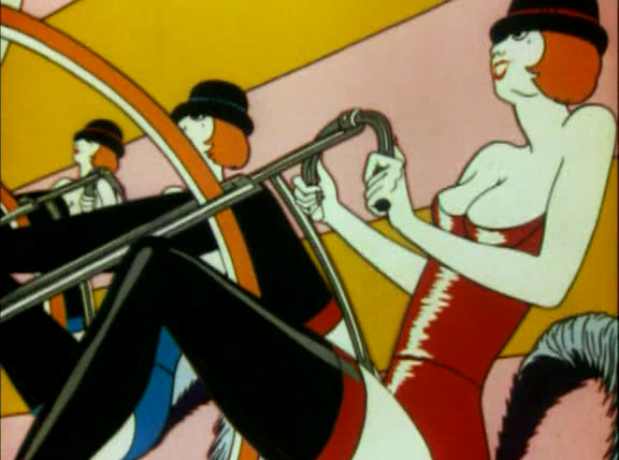








 Dr. Grob's Animation Review