Director: Charles Nichols
Release Date: April 18, 1953
Stars: Mickey Mouse, Pluto
Rating: ★★★½
Review:

The Simple Things © Walt Disney‘The Simple Things’ was to be Mickey’s and Pluto’s last theatrical cartoon (Pluto’s own series had stopped two years earlier).

Unfortunately it is a rather uninspired goodbye. The cartoon returns to the elongated situation comedy of the thirties. There are only two plots here, which hardly build up to a finale. First: Pluto’s encounters with a humanized clam and second, Mickey and Pluto’s fight with a hungry seagull. Both parts are executed routinely, without inspiration.

This makes ‘The Simple Things’ a sad ending to a career that started so phenomenally well, changing the course of animation, 25 years earlier. It would take Mickey another thirty years to return to the movie screen in ‘Mickey’s Christmas Carol‘ from 1983. Meanwhile, Mickey & Pluto director Charles Nichols would direct three Donald Duck cartoons, and one special, ‘The Saga of Windwagon Smith‘, before leaving Disney for Hanna-Barbera in 1962.

Watch ‘The Simple Things’ yourself and tell me what you think:

This is Mickey Mouse cartoon No. 125
To the previous Mickey Mouse cartoon: Pluto’s Christmas Tree
To the next Mickey Mouse cartoon: Mickey’s Christmas Carol

Director: Jack Hannah
Release Date: November 21, 1952
Stars: Mickey Mouse, Pluto, Chip ‘n Dale
Rating: ★★★★★
Review:

Pluto's Christmas Tree © Walt DisneyMickey chops Chip ‘n Dale’s tree down to use as a Christmas tree.

By doing so he accidentally brings the two little chipmunks home. Pluto soon discovers the duo, but Mickey only does so in the very end. The cartoon ends with a cameo of Goofy, Donald and Minnie singing Christmas carols in Mickey’s garden.

The cartoon’s overall atmosphere is cute, adorable and full of charm, making ‘Pluto’s Christmas Tree’ one of the most delightful Mickey Mouse cartoons from the post-war period. This short is the second of two Mickey Mouse cartoons directed by Jack Hannah, the other being ‘Squatter’s Rights’ from 1946. These are the only two cartoons to feature Mickey and Chip ‘n Dale. It’s also the third of Mickey’s four Christmas cartoons, the others being ‘Mickey’s Orphans‘ from 1931, ‘Mickey’s Good Deed‘ from 1932 and ‘Mickey’s Christmas Carol‘ from 1983.

Watch ‘Pluto’s Christmas Tree’ yourself and tell me what you think:

This is Mickey Mouse cartoon No. 124
To the previous Mickey Mouse cartoon: Pluto’s Party
To the next Mickey Mouse cartoon: The Simple Things

Director: Milt Schaffer
Release Date:
September 19, 1952
Stars:
 Mickey Mouse, Pluto, The Orphan Mice
Rating:
 ★
Review:

Pluto's Party © Walt DisneyMickey and Pluto celebrate Pluto’s birthday, which includes a huge pink birthday cake and the presence of several little mice.

In fact, this cartoon marks the unexpected return of the orphan mice, which we hadn’t seen on the screen since ‘Mickey’s Circus‘ from 1936. The little mice give Pluto a hard time and they eat all the cake. Luckily Mickey has saved a piece for our canine friend.

‘Pluto’s Party’ is the only Disney film directed by Pluto story man Milt Schaffer. Unfortunately it’s not a success. Mickey’s design is rather angular in this cartoon and the antics by the orphan mice are quite tiresome, not funny. In spite of the bright colors and the fast cutting, the overall mood is timid and listless. Only two Mickey Mouse cartoons would follow, and you can almost feel the series ending in this cartoon.

Watch ‘Pluto’s Party’ yourself and tell me what you think:

This is Mickey Mouse cartoon No. 123
To the previous Mickey Mouse cartoon: R’coon Dawg
To the next Mickey Mouse cartoon: Pluto’s Christmas Tree

Director: Charles Nichols
Release Date: August 10, 1951
Stars: Mickey Mouse, Pluto
Rating: ★★
Review:

R'coon Dawg © Walt DisneyThis cartoon starts with a Texan voice-over telling about raccoon hunting. Enter Mickey and Pluto who are exactly doing that.

Pluto’s pursuit is hindered, however, by the raccoon’s clever decoys and sidetracks. In his final trick the raccoon fools Mickey and Pluto by pretending having a baby, using Mickey’s coonskin cap.

Mickey has pretty little screen time in this cartoon, which is essentially Pluto’s. His visualisations of what he’s smelling are the highlights of this gentle if not very remarkable film.

Watch ‘R’Coon Dawg’ yourself and tell me what you think:

This is Mickey Mouse cartoon No. 122
To the previous Mickey Mouse cartoon: Mickey and the Seal
To the next Mickey Mouse cartoon: Pluto’s Party

Directors: William Hanna & Joseph Barbera
Release Date: February 16, 1952
Stars: Tom & Jerry
Rating: ★★★★
Review:

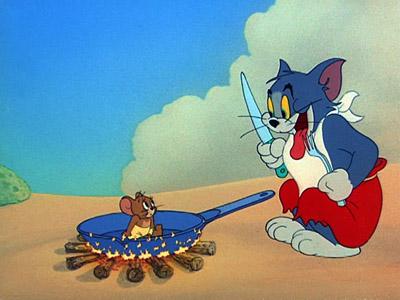
Duck Doctor © MGMTom is hunting ducks and he hits a little drake.

Jerry helps the duckling, dressing his wounds, but he has a hard time preventing the careless duck of being shot again. This cartoon builds up to a great finale involving an anvil.

The little drake looks and behaves like Little Quacker (see ‘Little Quacker‘ from 1950), but differs in having mature feathering. In fact, this overenthusiastic, but not too clever drake leads to greater comedy than the more famous little duckling. As a result ‘Duck Doctor’ is very entertaining, and one of the more inspired of the latter day Tom & Jerry cartoons.

Watch ‘Duck Doctor’ yourself and tell me what you think:

http://www.dailymotion.com/video/x2i51fs

This is Tom & Jerry cartoon No. 64
To the previous Tom & Jerry cartoon: The Flying Cat
To the next Tom & Jerry cartoon: Two Mouseketeers

Director: William Hanna & Joseph Barbera
Release Date: January 12, 1952
Stars: Tom & Jerry
Rating:
 ★★★★★
Review:

The Flying Cat © MGMIn ‘The Flying Cat’ Jerry teams up with a canary, whom Tom wants to eat.

The chase routine that follows, gets an unexpected twist when Tom accidentally acquires some wings (out of a corset) and becomes a flying cat. It makes him a real threat to the two little creatures.

Unlike the contemporary Tom & Jerry cartoons, the ugly ‘His Mouse Friday‘ and ‘Cat Napping’, ‘The Flying Cat’ uses the simplified character designs to great effects. The cartoon is fast and full of gags, many of which involving great and inspired deformations of Tom.

Watch an excerpt from ‘The Flying Cat’ yourself and tell me what you think:

This is Tom & Jerry cartoon No. 63
To the previous Tom & Jerry cartoon: Cat Napping
To the next Tom & Jerry cartoon: Duck Doctor

Director: William Hanna & Joseph Barbera
Release Date: December 8, 1951
Stars: Tom & Jerry, Spike
Rating:
 ★★★½
Review:

Cat Napping © MGM‘Cat Napping’ is a blackout gag cartoon, in which Tom & Jerry are fighting over a hammock  on a hot summer day.

‘Cat Napping’ is certainly not among Tom & Jerry’s best cartoons. The gags are not all bad (the best one is when marching ants make the hammock resonate), but the comedy feels uninspired. Moreover, the story is less consistent than usual, and the gags are rather disjointed. However, the cartoon is especially hampered by rather appalling designs on Tom & Jerry, which are on the same low level as those in ‘His Mouse Friday’ from earlier that year.

http://www.metacafe.com/watch/9404702/tom_jerry_cat_napping/

This is Tom & Jerry cartoon No. 62
To the previous Tom & Jerry cartoon: Nit Witty Kitty
To the next Tom & Jerry cartoon: The Flying Cat

Director: William Hanna & Joseph Barbera
Release Date: October 6, 1951
Stars: Tom & Jerry, Mammy Two-Shoes
Rating:
 ★★★½
Review:

Nit Witty Kitty © MGMWhen Mammy hits Tom on his head with a broom, he looses his mind and thinks he’s a mouse. This to great annoyance of Jerry, because Tom eats all his cheese and wrecks his bed.

‘Nit Witty Kitty’ is a well-told cartoon, if a little bit slow and low on gags. Highlight of the cartoon are Jerry’s attempts to deliver Tom a “sharp blow on the head”.

Watch ‘Nit-witty Kitty’ yourself and tell me what you think:

https://www.dailymotion.com/video/x2i35s0

This is Tom & Jerry cartoon No. 61
To the previous Tom & Jerry cartoon: Slicked-up Pup
To the next Tom & Jerry cartoon: Cat Napping

Directors: William Hanna & Joseph Barbera
Release Date: September 8,1951
Stars: Tom & Jerry, Spike & Tyke
Rating: ★★★
Review:

Slicked-up Pup © MGMWhile chasing Jerry Tom makes Tyke dirty.

Spike threatens Tom he’ll tear him limb for limb, when he makes Tyke dirty again. So Tom does his best to keep Tyke clean. To no avail, because, as expected, Jerry takes advantage of the situation. ‘Slicked-up Pup’ is based on a routine that goes all the way back to Tom & Jerry’s very first film (‘Puss gets the Boot‘ from 1940). Unfortunately, it has all been done before, even with cleaning (‘Mouse Cleaning‘ from 1948), and with Spike & Tyke (‘Love That Pup‘ from 1949). The result is less amusing than any of the previous films. The best gag may be when Tom pretends Tyke to be a chicken.

Watch ‘Slicked-up Pup’ yourself and tell me what you think:

https://vimeo.com/220541160

This is Tom & Jerry cartoon No. 60
To the previous Tom & Jerry cartoon: His Mouse Friday
To the next Tom & Jerry cartoon: Nit-witty Kitty

Director: William Hanna & Joseph Barbera
Release Date: July 7, 1951
Stars: Tom & Jerry
Rating:
 ★★
Review:

His Mouse Friday © MGMSomehow Tom is shipwrecked. He’s washed ashore a tropical island where he meets a Crusoe-like Jerry, whom he wants to eat.

In what must be the film’s highlight Jerry fools him by pretending to be a cannibalistic native, but in the end both characters have to flee for real cannibals, the first human beings we see in their entirety in a Tom & Jerry film

‘His Mouse Friday’ must be one of the least inspired Tom & Jerry cartoons ever. Not only are the two completely out of place on the tropical island, the comedy feels tired, the humor is offensive, and the designs of our heroes mediocre. Tom’s designs in the opening scene are particularly sloppy. It seems that these designs inspired the Gene Deitch cartoons, because they look remarkably similar, which is no advertisement.

Unfortunately, ‘His Mouse Friday’ is no isolated incident. From mid-1951 on, we see the quality of the series gradually deteriorate: character designs get simpler and sloppier, backgrounds less lush, and stories more routine or uninspired. There were still some great Tom & Jerry cartoons to come, and even two Oscar winners, but one nonetheless gets the impression that by mid-1951 their heyday was over.

Watch ‘His Mouse Friday’ yourself and tell me what you think:

This is Tom & Jerry cartoon No. 59
To the previous Tom & Jerry cartoon: Sleepy Time Tom
To the next Tom & Jerry cartoon: Slicked-up Pup

Director: Chuck Jones
Release Date: January 3, 1953
Stars: Sam Sheepdog & Ralph Wolf
Rating:
 ★★★★★
Review:

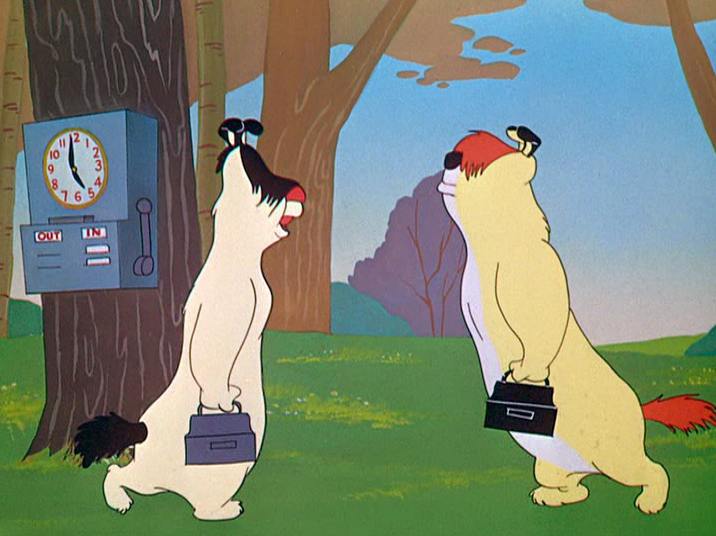
Don't Give Up the Sheep © Warner Brothers‘Don’t Give up the Sheep’ is the first cartoon in a series of seven cartoons featuring the excellent duo Sam Sheepdog and Ralph Wolf.

In their first entry Sam Sheepdog is called Ralph, while Ralph remains yet unnamed. Sam goes to work, relieving his colleague Fred in attending the sheep. He has to counter the attacks by Ralph the wolf, who looks like Wile E. Coyote’s scruffy cousin. The cartoon is full of excellent, Road Runner-like blackout cartoons. In his silliest attempt the wolf dresses up as the God Pan to lull the sheepdog to sleep. To no avail, of course.

In this cartoon the backgrounds (by Carlos Manriquez) are becoming more stylized, although they still look like real nature. Sam and Ralph would never become major characters, but their miniseries is a little delight within the Warner Brothers canon.

Watch ‘Don’t Give up the Sheep’ yourself and tell me what you think:

http://www.wimp.com/hilariouscartoon/

‘Don’t Give up the Sheep’ is available on the DVD set ‘Looney Tunes Golden Collection, Vol. 1’

Director: Chuck Jones
Release Date: February 2, 1952
Stars: Marc Anthony
Rating:
★★★★★ ♕
Review:

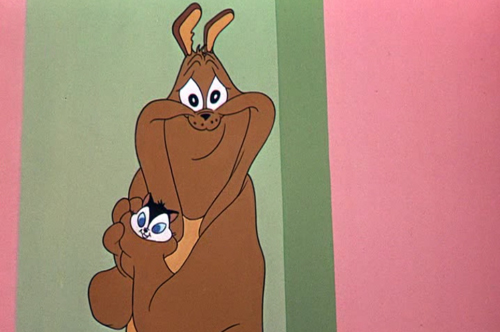
Feed the Kitty © Warner BrothersAmong all the masterpieces of animation, this must be the most inconspicuous one: it’s a seemingly classical dog and cat story, involving quite some dull dialogue (provided by the dog’s mistress, of whom we only see her legs), and its looks are quite traditional, with unremarkable layouts and backgrounds.

Nevertheless, ‘Feed The Kitty’ is a real masterpiece, and its reputation is entirely due to the acting of its main character, the gentle bulldog Marc Anthony. His facial expressions are so wide ranging, so extreme and so heartfelt that ‘Feed the Kitty’ can almost be regarded as a study in depiction of emotion. Silent acting really reaches its peak here, and director Chuck Jones is without doubt at his all time best in this sweet little cartoon.

In ‘Feed the Kitty’ Marc Anthony adopts a sweet little kitten, but he’s not allowed to bring anything into the house. This leads to various gags with the dog trying to hide the little kitten from his mistress. However, the highlight of the cartoon is the sequence in which Marc Anthony thinks his darling pet is dead. His emotions are both hilarious and heartbreaking. Never before has the anxiety of having lost a dearly beloved been so convincingly put to the animated screen. At this point I often can’t keep my tears from running.

Indeed, this sequence is so popular among animators that it was almost exactly copied in ‘Monsters, Inc.‘ (2001) as a homage to the original. I’d say, if cartoons were shown at funerals (and why not?), ‘Feed the Kitty’ would be a perfect candidate.

Watch ‘Feed the Kitty’ yourself and tell me what you think:

http://www.dailymotion.com/video/xjw9ms_feed-the-kitty_shortfilms

‘Feed the Kitty’ is available on the DVD set ‘Looney Tunes Golden Collection, Vol. 1’

Director: Wilfred Jackson
Release Date: August 8, 1952
Rating: ★★★½
Review:

The Little House © Walt DisneyHalf a year after ‘Lambert the Sheepish Lion‘, voice actor Sterling Holloway returns as a narrator for a Disney cartoon.

Here he tells the story of a little house on a hill in the country side who is soon surrounded by the city and forgotten. The house’s first neighbors are arrogant and aristocratic wooden houses, which soon burn down. The second neighbors are sloppy brick houses, which are pulled down in the end. Her third neighbors are enormous skyscrapers. When the little house thinks she’s finished, she’s moved to start anew on the countryside.

This sweet little story is based on a children’s book from 1942 by Virginia Lee Burton and uses a slightly different design to remain faithful to her original illustrations. Like ‘Lambert the Sheepish Lion’, the story is very sweet, not funny. Its main attraction are the humanized houses, excavators and such.

However, the story is well-told, thanks to story man Bill Peet. It contains heart and has a strong sense of nostalgia. In fact, conservative nostalgia has rarely been put more convincingly to the screen. The film is strongly anti-urban and anti-progress, and full of longing to the peace and quiet of a bygone era. Its message is expressed at the end of the cartoon, when Holloway tells us that “the best place to find peace and happiness is in a little house on a little hill way up in the country”.

Watch ‘The Little House’ yourself and tell me what you think:

‘The Little House’ is available on the DVD ‘Walt Disney Treasures: Disney Rarities’

Director: Jack Hannah
Release Date: February 8, 1952
Rating: ★★½
Review:

Lambert, the Sheepish Lion © Walt DisneyDisney’s  favorite voice, Sterling Holloway, returns for the first time since ‘Peter and the Wolf’ (‘Make Mine Music’, 1946), to lend his voice to a child-delivering stork like he did in ‘Dombo’ (1942).

Holloway tells the story of Lambert, a lion cub who’s accidentally delivered to a mother sheep. Because he’s different, he’s bullied by the other lambs, and he grows into a cowardly lion, until he rescues his mother from the clutches of an evil wolf.

Like the similar ‘Morris, the Midget Moose‘ from two years earlier, the story of ‘Lambert, the Sheepish Lion’ is slow, sickeningly sweet and terribly unfunny. What Lambert eats during his stay among the sheep remains a puzzling mystery. The cartoon’s only delight are the facial expressions on the adult Lambert.

Watch ‘Lambert, the Sheepish Lion’ yourself and tell me what you think:

‘Lambert, the Sheepish Lion’ is available on the DVDs ‘Walt Disney Treasures: Disney Rarities’ and ‘Melody Time’

Director: Jack Hannah
Release Date: November 24, 1950
Stars: Bootle Beetle
Rating: ★★
Review:

Morris, the Midget Moose © Walt Disney‘Morris, the Midget Moose’ starts with an eldery bootle beetle who tells two young bootle beetles the short’s story.

The beetle tells us about Morris, a very small moose with normal antlers who befriends Balsam, a moose with small antlers. They’re both outcasts, but together they defeat the reigning moose, the invincible Thunderclap.

This moralistic story is very sweet, but also slow and boring. It reuses a gag from ‘Moose Hunters’ (1937) of moose throwing each other on the ground, affecting the complete landscape, but the gag is executed less elaborately, and with less funny results.

‘Morris, the Midget Moose’ was the only cartoon featuring Bootle Beetle outside Jack Hannah’s Donald Duck series. It was also the little insect’s last appearance on the movie screen.

Watch ‘Morris, the Midget Moose’ yourself and tell me what you think:

‘Morris, the Midget Moose’ is available on the DVD ‘Walt Disney Treasures: Disney Rarities’

Director: Jack Kinney
Release Date: March 3, 1950
Rating: ★★
Review:

The Brave Engineer © Walt DisneyAfter the Walt Disney studios quit its package features, it started to release ‘specials’ again, one-shot cartoons featuring no recurring character.

These specials were essentially the successors of the Silly Symphonies, and a few were made during World War II. However, most of them were made in the fifties, if not necessarily to advance animation, then certainly to keep animators busy between feature films. Unfortunately, almost none of these shorts match the inventiveness of the Silly Symphonies or were really successful (the Academy Award winning ‘Toot Whistle Plunk and Boom’ (1953) is the prime exception).

For example, ‘The Brave engineer’, the first special from the fifties, looks like it has been a left-over from the compilation feature ‘Melody Time‘ (1948). Like this feature’s sequences ‘The Legend of Johnny Appleseed‘ and ‘Pecos Bill‘, it’s a half sung and half narrated tall-tale based on a poem about a legendary American hero from the 19th century.

This time comedian Jerry Colonna sings and tells the story of Casey Jones, a train engineer, a character who really existed. In the cartoon Casey desperately tries to deliver the western mail on time. On the way he encounters all the cliches featured in westerns involving trains: a damsel on the rails, train robbers and a villain who blows up a bridge. The ride ends in a clash with another train. Unlike the real Casey Jones, who died in the crash, the cartoon Casey survives and delivers the mail on time, almost…

Despite the relatively fast pace and many corny gags, the story never really takes off. The viewer somehow never gets involved in the story and remains uninterested to the end.

Watch ‘The Brave Engineer’ yourself and tell me what you think:

‘The Brave Engineer’ is available on the DVD ‘Walt Disney Treasures: Disney Rarities’

Director: Chuck Jones
Release Date: March 10, 1951
Stars: Bugs Bunny, The Crusher
Rating: ★★
Review:

Bunny Hugged © Warner BrothersThree years after ‘Rabbit Punch‘ (1948) Bugs Bunny faces the Crusher again.

This time Bugs is the mascot of ‘Ravishing Ronald’, a gay looking ballet dancer type of character with a hair net. This guy challenges the Crusher in a wrestling match, but is clobbered immediately.

In order not to lose his job Bugs Bunny challenges the Crusher, too, as the ‘masked terror’. Of course, he wins the game, by strategy in a rather boring and uninspired cartoon, especially when compared to the delightful ‘Rabbit Punch’. The best gags are in the beginning: the Crusher showing his enormous excess of muscles and the extravagant entry of Ravishing Ronald.

Watch ‘Bunny Hugged’ yourself and tell me what you think:

http://www.ebaumsworld.com/video/watch/82493307/

This is Bugs Bunny cartoon No. 80
To the previous Bugs Bunny cartoon: Rabbit Every Monday
To the next Bugs Bunny cartoon: Fair-Haired Hare

Director: Friz Freleng
Release Date:
 September 22, 1951
Stars:
 Tweety & Sylvester, Granny
Rating:
 ★★★
Review:

Tweety's S.O.S. © Warner BrothersSylvester is down in the dumps and hungry, foraging a harbor, when he discovers Tweety on a ship.

He climbs aboard, and what follows are several gags involving glasses and sea sickness. The best gag is when Sylvester paints Tweety on Granny’s glasses. Most of the other gags, however, are mediocre, and feel routinized. For example, Tweety reuses a sea sickness gag from Tex Avery’s ‘The Screwball Squirrel’ (1944), but much less well executed.

Watch ‘Tweety’s S.O.S.’ yourself and tell me what you think:

http://www.dailymotion.com/video/x1z27d9_sylvester-the-cat-ep-25-tweety-s-s-o-s_fun

‘Tweety’s S.O.S.’ is available on the DVD set ‘Looney Tunes Golden Collection, Vol. 1’

Director: Robert McKimson
Release Date:
May 5, 1951
Rating:
 ★★★½
Review:

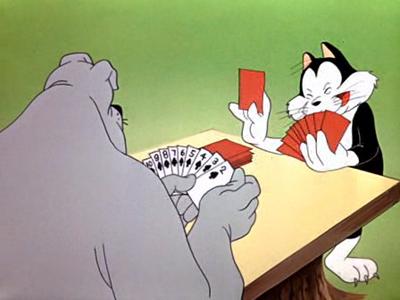
Early to Bet © Warner Brothers‘Early to Bet’ introduces the ‘gambling bug’, a bug that makes people want to gamble.

The little insect infects a cat who then starts to play gin rummy for penalties with an over-confident bulldog. The bulldog wins several times, and the cat has to pay the elaborate and rather zany, yet painful penalties. In the end, however, he plays against the bug, and wins, making the bug pay a penalty.

Apart from the original and pretty funny penalties, this is a mediocre cartoon, which lacks stars or even appealing characters.

Watch ‘Early to Bet’ yourself and tell me what you think:

http://www.supercartoons.net/cartoon/681/early-to-bet.html

‘Early to Bet’ is available on the DVD set ‘Looney Tunes Golden Collection, Vol. 1’

Director: Friz Freleng
Release Date:
 February 24, 1951
Stars:
 Tweety & Sylvester
Rating:
 ★★★★
Review:

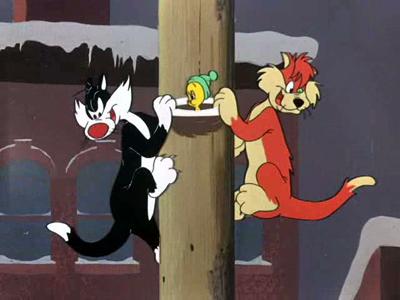
Putty Tat Trouble © Warner BrothersIt’s winter and Tweety is troubled by two cats (Sylvester and a red cat with a bad eye), who fight over him. Most of the comedy derives from the feud between the two, and only in the end Tweety himself comes into action, making the two cats fall into an icy pond.

With ‘Putty Tat Trouble’ Freleng returns to Tweety’s first solo films, Bob Clampett’s ‘A Tale of Two Kitties’ (1942) and ‘A Gruesome Twosome‘ (1945), in which also two cats fought for the little bird. Freleng’s humor is different from Bob Clampett’s, but once again, the feud works very well. Apart from Tweety’s talking, all the comedy is silent and brilliantly executed, too. This makes ‘Putty Tat Trouble’ one of the better Tweety and Sylvester cartoons.

In one scene we can see a Friz Freleng portrait in the background.

Watch an excerpt from ‘Putty Tat Trouble’ yourself and tell me what you think:

‘Putty Tat Trouble’ is available on the DVD set ‘Looney Tunes Golden Collection, Vol. 1’

Enter your email address to follow this blog and receive notifications of new posts by email.

Join 905 other subscribers
Bookmark and Share

Categories