Directors: William Hanna & Joseph Barbera
Release Date: July 17, 1948
Stars: Tom & Jerry, Spike
Rating: ★★★★★
Review:

The Truce Hurts © MGM‘The Truce Hurts’ starts with a chase involving Jerry, Tom and Spike (called Butch in this cartoon).

The chase ends in a triple fight, until Spike interrupts and they all sign a peace treaty. The treaty works until the three discover a giant steak dropped from a van. When they have to share it, their greediness and egotism win, and they start to fight again at the same spot and with the same tools as where they’d left them before.

‘The Truce Hurts’ is one of the most marvelous Tom and Jerry cartoons. Not only is the idea original, it has a perfect story that is wonderfully executed with great character animation of the three foes behaving like pals.

Watch an excerpt from ‘The Truce Hurts’ yourself and tell me what you think:

This is Tom & Jerry cartoon No. 35
To the previous Tom & Jerry cartoon: Kitty Foiled
To the next Tom & Jerry cartoon: Old Rockin’ Chair Tom

Directors: William Hanna & Joseph Barbera
Release Date: June 1, 1948
Stars: Tom & Jerry
Rating: ★★★
Review:

Kitty Foiled © MGMJerry teams with a canary to withstand Tom’s attempts to eat them both. Unfortunately, this first of several Jerry-and-a-bird-cartoons adds nothing to the elementary chase formula.

Jerry would team several birds after this one, the most famous being Little Quacker, a talkative little duck. These teamings would lead to very cute cartoons, but these are not Tom & Jerry’s funniest. At least ‘Kitty Foiled’ isn’t, despite a frantic pace (the first quiet scene only enters after 2:30!). It even would be one of the more forgettable Tom & Jerry cartoons, were it not for a marvellous scene in which Tom thinks he’s been shot.

Watch ‘Kitty Foiled’ yourself and tell me what you think:

https://vimeo.com/89586804

This is Tom & Jerry cartoon No. 34
To the previous Tom & Jerry cartoon: The Invisible Mouse
To the next Tom & Jerry cartoon: The Truce Hurts

Directors: William Hanna & Joseph Barbera
Release Date: September 27, 1947
Stars: Tom & Jerry, Spike
Rating: ★★
Review:

The Invisible Mouse © MGMDuring a chase Jerry accidentally falls into a bottle of invisible ink, rendering him invisible, too. In this condition he gives Tom a hard time.

The invisible mouse is wonderfully animated, especially in the scenes where Jerry’s presence is only suggested by forces on pillows and clothes. However, it suffers from an all too powerful Jerry. Tom doesn’t stand a chance against his invisible opponent, making him pitiful rather than a comical foe. The soundtrack, with its surprisingly low amount of sound effects, doesn’t help, but the main problem lies in the invisibility itself, for the Donald Duck short ‘The Vanishing Private‘ (1942), using the same idea, leads to an equally unfunny cartoon.

Watch ‘The Invisible Mouse’ yourself and tell me what you think:

http://www.dailymotion.com/video/x2x9ceo

This is Tom & Jerry cartoon No. 33
To the previous Tom & Jerry cartoon: A Mouse in the House
To the next Tom & Jerry cartoon: Kitty Foiled

Director: Chuck Jones
Release Date: June 25, 1949
Stars: Bugs Bunny
Rating: ★★★★★
Review:

Long-Haired Hare © Warner BrothersBugs Bunny is singing nearby a villa, where a huge opera singer, called Giovanni Jones, is practicing.

The singer is heavily disturbed by Bugs’s performance and without arguing destroys our hero’s banjo, his harp and his tuba. Only then Bugs is prompted into war, which he reserves for the opera singer’s concert at the Hollywood Bowl.

What follows are great blackout gags featuring a string of opera tunes, with Bugs as ‘Leopold’ as a major highlight. This impersonation is an obvious reference to star conductor Leopold Stokowski, famous for conducting ‘Fantasia’ (1940). Bugs destroys the conductor’s baton, to direct with his hands only, like Stokowski does. From now on he controls the singer almost like a puppeteer. Bugs finally destroys his opponent by making him sing a ridiculously long high note, which tears the complete bowl down.

With cartoons like ‘Long-Haired Hare’ director Chuck Jones really came into his own: it shows Jones’ attitude to Bugs Bunny, who, in Jones’s cartoons, is only a misschief when provoked. Giovanni Jones is one of Bugs Bunny’s particularly large adversaries, following The Crusher (‘Rabbit Punch‘, 1948), and the warehouse manager in ‘Hare Conditioned‘ (1945).

‘Long-Haired Hare’ also shows Jones’ love for high culture, like opera. For instance, we can clearly detect a painting by Roussau le douanier decorating the opera singer’s villa. Jones’s love for opera would lead to two of his most famous and best cartoons, ‘The Rabbit of Seville‘ (1950) and ‘What’s Opera, doc?‘ (1958), which also feature Bugs Bunny.

In 1950, the Hollywood Bowl would be visited by cartoon characters again, when Tom & Jerry both tried to conduct in ‘Tom and Jerry in the Hollywood Bowl‘.

Watch ‘Long-Haired Hare’ yourself and tell me what you think:

http://www.dailymotion.com/video/x2fdnv1

This is Bugs Bunny cartoon No. 61
To the previous Bugs Bunny cartoon: Bowery Bugs
To the next Bugs Bunny cartoon: Knights Must Fall
Director: Friz Freleng
Release Date: April 30, 1949
Stars: Bugs Bunny, Yosemite Sam
Rating: ★★★★★ ♕
Review:

High Diving Hare © Warner BrothersBugs is presenting a vaudeville show in some western town.

Yosemite Sam especially visits his show to see the high diving Fearless Freep. Unfortunately, Freep is delayed by a storm and can’t come to perform. The disappointed Sam urges Bugs to take Freep’s place.

What follows is a masterful series of gags, which all end with Sam falling from the ridiculously high platform. At one point Freleng doesn’t even bother to point out how Bugs makes Sam take the plunge once again. As if it’s a natural law, Sam will fall anyway. Bugs, on the other hand, defies the law of the gravity. But you know, he tells us at the end, he never studied law…

Penned by storyman Tedd Pierce, this wonderfully hilarious cartoon takes a single idea from Freleng’s earlier ‘Stage Door Cartoon‘ (1944) and milks it brilliantly to a superb finale. Freleng’s timing rarely was so effective as in this cartoon, and it must rank among his all time best.

Watch ‘High Diving Hare’ yourself and tell me what you think:

http://www.dailymotion.com/video/x2bdtkf_bugs-bunny-ep-73-high-diving-hare_fun

‘High Diving Hare’ is available on the DVD set ‘Looney Tunes Golden Collection, Vol. 1’

This is Bugs Bunny cartoon No. 59
To the previous Bugs Bunny cartoon: Rebel Rabbit
To the next Bugs Bunny cartoon: Bowery Bugs

Director: Chuck Jones
Release Date: December 14, 1948
Stars: Bugs Bunny
Rating: ★★½
Review:

My Bunny Lies over the Sea © Warner BrothersBugs misses a turn at Albuquerque and ends up in Scotland.

When he mistakes a Scotchman’s bagpipes for a monster attacking an old lady, he ends up playing golf against the angered Scotchman. Of course, Bugs wins the game, which consists of several blackout gags, and he even manages to defeat the kilted guy at playing the pipes.

The Scotchman looks like a cross between Elmer Fudd and Yosemite Sam, but who hasn’t got anything near the personality of either of the two. Therefore the interplay between our hero and the villain never really come to live, despite some nice facial expressions on Bugs’ adversary.

Peter Alvarado’s backgrounds do not help: they are too vivid to ignore, but have none of the beauty of either Jones early 1940s cartoons or his cartoons from the 1950s. Instead they express a strange mix of realistic and more stylized patterns. The result is a rather mediocre entry in the Bugs Bunny catalog.

Watch ‘My Bunny Lies over the Sea’ yourself and tell me what you think:

‘My Bunny Lies over the Sea’ is available on the DVD set ‘Looney Tunes Golden Collection, Vol. 1’

This is Bugs Bunny cartoon No. 55
To the previous Bugs Bunny cartoon: A Lad in his Lamp
To the next Bugs Bunny cartoon: Hare Do

Director: Friz Freleng
Release Date: February 2, 1946
Stars: Bugs Bunny
Rating: ★★★★★
Review:

Baseball Bugs © Warner BrothersIt seems an almost certain loss for the age-old Tea-Totallers, who get plastered by the tough team of the Gas-House Gorillas…

Bugs Bunny, who’s watching the game, wearing an innocent straw head, boasts that he can beat the Gas-House Gorillas single-handed, so he gets himself a game. Playing in every position he manages to win the ball game in this wild and hilariously funny cartoon, which is noteworthy for its great dialogue, excellent animation, and superb timing. Especially when Bugs Bunny starts batting, the gags role in in a remarkably fast tempo.

Highlight among the many gags may be Bugs’s constant jabbering. Some of it was copied by Jones in ‘Rabbit Punch‘ (1948). ‘Baseball Bugs’ reuses several gags from the Woody Woodpecker cartoon ‘The Screwball’ (1942), but with much better results, making it a classic, where ‘The Screwball’ was not. If the short has one flaw, it’s that it’s over before you know it, with the end coming all too soon.

Notice the advert for ‘Michael Maltese, Ace Dick’ in Bugs Bunny’s first scene.

Watch ‘Baseball Bugs’ yourself and tell me what you think:

https://www.dailymotion.com/video/x6tj0co

‘Baseball Bugs’ is available on the DVD set ‘Looney Tunes Golden Collection, Vol. 1’

This is Bugs Bunny cartoon No. 35
To the previous Bugs Bunny cartoon: Hare Tonic
To the next Bugs Bunny cartoon: Hare Remover

Director: Charles Nichols
Release Date: December 12, 1948
Stars: Mickey Mouse, Pluto, the little seal
Rating: ★★★½
Review:

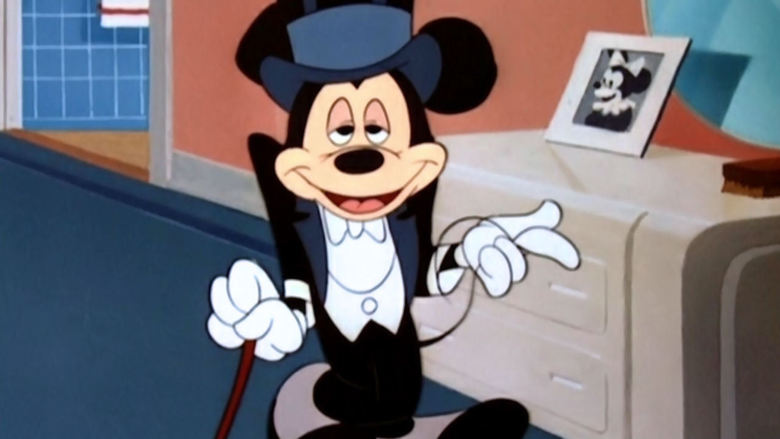
Mickey and the Seal © Walt DisneyAfter visiting the seals at the zoo, Mickey accidentally brings a little seal home in his basket.

‘Mickey and the seal’ is the third cartoon to feature the little seal (the other two are ‘Pluto’s Playmate‘ from 1941 and ‘Rescue Dog‘ from 1947). And like the earlier entries featuring this cute animal, ‘Mickey and the Seal’ is charming, but not very funny.

Nevertheless, it contains a lovely scene of Mickey and the seal in bath, which is a prime example of great silent comedy. Its finale, too, arguably is the funniest of all postwar Mickey Mouse cartoons. The bath scene renders a shot of Mickey completely naked (except for his gloves).

Watch ‘Mickey and the Seal’ yourself and tell me what you think:

This is Mickey Mouse cartoon No. 121
To the previous Mickey Mouse cartoon: Mickey Down Under
To the next Mickey Mouse cartoon: R’coon Dawg

Director: Charles Nichols
Release Date: March 19, 1948
Stars: Mickey Mouse, Pluto
Rating: ★
Review:

Mickey Down Under © Walt Disney‘Mickey Down Under’ features Mickey and Pluto in some Australian banana plantation.

Pluto has troubles with a boomerang, while Mickey encounters an ostrich. Even though the animation of Pluto is inspired, ‘Mickey Down Under’ is a boring cartoon, and one of the weakest entries in the Mickey Mouse series. Apart from the boomerang, the setting can hardly be called Australian. On the contrary, the cartoon depicts some flora and fauna not indigenous to Australia: toucans, bananas and ostriches. The title music is that of a Pluto cartoon.

Watch ‘Mickey Down Under’ yourself and tell me what you think:

This is Mickey Mouse cartoon No. 120
To the previous Mickey Mouse cartoon: Mickey’s Delayed Date
To the next Mickey Mouse cartoon: Mickey and the Seal

Director: Charles Nichols
Release Date: October 3, 1947
Stars: Mickey Mouse, Minnie Mouse, Pluto
Rating: ★★★★★
Review:

Mickey's Delayed Date © Walt DisneyFor the first time in five years (actually, since ‘Symphony Hour’) Mickey receives considerable screen time in his own cartoon, even though he has to share it once again with his dog, Pluto.

In the opening scene ‘Mickey’s Delayed Date’ we watch Mickey snoring at home, when the phone rings. It’s Minnie: she has been waiting an hour for him to come at a date with her for a dance. As soon as she has threatened him on the phone to break up if he doesn’t show up within fifteen minutes, Mickey rushes to the dance hall. Unfortunately he loses the tickets, which are brought by Pluto just in time.

Much screen time of ‘Mickey’s Delayed Date’ is devoted to Pluto in a rather long scene with a humanized tall hat. Nevertheless, it’s nice to watch Mickey in fine comic shape again, although he is less flexible here than in Riley Thomson’s shorts of the early forties. This short contains a shot of an almost naked Mickey (even without gloves).

‘Mickey’s Delayed Date’ was the first Mickey Mouse cartoon directed by Pluto-director Charles Nichols. He would direct five of the eight post-war Mickey Mouse cartoons.

Watch ‘Mickey’s Delayed Date’ yourself and tell me what you think:

This is Mickey Mouse cartoon No. 119
To the previous Mickey Mouse cartoon: Squatter’s Rights
To the next Mickey Mouse cartoon: Mickey Down Under

Director: ?
Release Date: May 27, 1948
Rating: ★★★½
Review:

Pecos Bill © Walt DisneyThe last sequence of ‘Melody Time‘ is framed by the sentimental ballad ‘Blue Shadows’, sung by country & western singer Roy Rogers and The Sons of the Pioneers.

After a while, we see them sitting in a cartoon-style prairie, accompanied by two children. The boy asks Rogers why the coyotes howl at the moon, which prompts him into telling the tall tale of Pecos Bill, his horse Widowmaker and his love interest Slue Foot Sue.

Although it only becomes funny after several minutes, the story itself is quite good, the highlight being the part where the cowboys sing of the mighty deeds of Pecos Bill, who singlehanded creates the Gulf of Mexico, the Rio Grande, the gold in the hills and the painted desert.

Unfortunately the cartoon is rather slow-paced and accompanied by mostly dull country & western music, preventing it of becoming a real classic. Disney would tell other tall tales from American folklore, in ‘Paul Bunyan‘ (1958) and ‘The Saga of Windwagon Smith‘ (1961).

Watch ‘Pecos Bill’ yourself and tell me what you think:

Director: ?
Release Date: May 27, 1948
Stars: Donald Duck, Joe Carioca, The Aracuan Bird
Rating: ★★★★
Review:

Blame it on the Samba © Walt DisneySung by Ethel Smith and the Dinning Sisters, ‘Blame it on the Samba’ looks like a lost sequence from ‘The Three Caballeros‘ (1944)

The short, the sixth segment from ‘Melody Time‘, reunites Donald Duck, Joe Carioca and the Aracuan bird. The latter serves as the cartoon’s surreal character, who can cross the three dimensions, not unlike the Do-Do in ‘Porky in Wacky Land’ (1938). It’s this feature that makes ‘Blame It On The Samba’ so enjoyable.

Again, the Mary Blair-inspired backgrounds are highly stylized, even almost abstract, and extremely colorful. It also features some live action footage of Ethel Smith dancing and playing the organ and a pair of conga’s. Unfortunately, the music seems to be more about samba than being it, and it never becomes really hot.

Nevertheless, ‘Blame It On The Samba’ is a welcome diversion after Melody Time’s three tiresome episodes ‘The Legend of Johnny Appleseed‘,  ‘Little Toot‘ and ‘Trees‘.

Watch ‘Blame it on the Samba’ yourself and tell me what you think:

Director: ?
Release Date: May 27, 1948
Rating: ★★
Review:

Trees © Walt Disney‘Trees’, the fifth segment from ‘Melody Time‘, is a mood piece, like ‘Night‘ (1930) and ‘The Old Mill’ (1937).

However, this religious poem about trees is easily the least interesting example of its kind, despite its rather beautiful images of trees and wildlife. Neither the music nor the poem (with its moral “only God can create a tree”) is remotely interesting, rendering this short sequence dull and forgettable.

Watch ‘Trees’ yourself and tell me what you think:

Director: ?
Release Date: May 27, 1948
Rating: ★★
Review:

Little Toot © Walt DisneyThe fourth segment of ‘Melody Time‘ is based on a children’s book by former Disney animator Hardie Gramatky

In ‘Little Toot’ the Andrews Sisters sing the story of the humanized tugboat Little Toot who’s expelled first, but who becomes a hero by saving an ocean liner from a terrible storm. This storm, which contains some very spectacular animation of water, is the most interesting part of this otherwise dull and sugary story.

‘Little Toot’ is very similar to ‘Pedro the airplane’ sequence from ‘Saludos Amigos‘ (1942), but much less successful.

Watch ‘Little Toot’ yourself and tell me what you think:

Director: ?
Release Date: May 27, 1948
Rating: ★
Review:

The Legend of Johnny Appleseed © Walt DisneyThe third segment of ‘Melody Time‘ tells about American folk legendary hero John Chapman (1774-1845), a.k.a. Johnny Appleseed.

In the legendary version he’s a apple tree planting youth, who’s visited by a guardian angel, who resembles a mustached pioneer and who tells him to go west. Somewhere in the west Johnny finds a spot where he plants his apple trees, befriends the local animals and facilitates the coming of more pioneers. At the end of the cartoon we watch an aged Johnny Appleseed die and following his guardian angel once more to plant apple trees in heaven.

However appealing this cartoon may be to Americans, its slow and annoyingly religious story probably fails to impress the rest of the world. Johnny Appleseed is one of the most boring characters Disney ever put to screen. His animator Milt Kahl, quoted in John Canemaker’s book ‘Walt Disney’s Nine Old Men & the Art of Animation’, sums up the character’s flaws perfectly:

“There’s nothing harder to do in animation than nothing. Appleseed was such a mild character. He never got mad. He was never elated about anything. Everything was kind of in the middle. He was a weak character. Insipid.”

The only interesting features of this feature sequence are its extraordinarily beautiful backgrounds, which are based on designs by Mary Blair, who used bright and unusual colors and designs.

Watch ‘The Legend of Johnny Appleseed’ yourself and tell me what you think:

Director: ?
Release Date: May 27, 1948
Rating: ★★★★
Review:

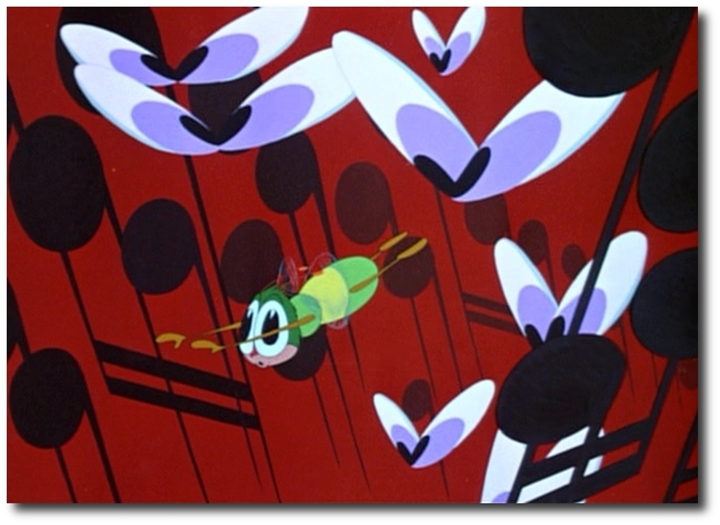
Bumble Boogie © Walt DisneyFreddy Martin and his orchestra play their jazzy variation of Nicolai Rimsky-Korsakov’s ‘Flight of the Bumblebee’ in this second segment from ‘Melody Time‘.

This music is accompanied by images of a little bumblebee fleeing from all kinds of things, in their designs loosely based on piano keys and music notes. The setting is semi-abstract and resembles the ‘After You’ve Gone’-sequence of ‘Make Mine Music’ (1946) a lot.

‘Bumble Boogie’ is far more colorful, however, with bright colors sometimes changing within semi-seconds. At one point, the little bumblebee is even rendered only in lines, anticipating the graphic style of the fifties, and of UPA in particular.

Watch ‘Bumble Boogie’ yourself and tell me what you think:

Director: ?
Release Date: May 27, 1948
Rating: ★★★★★
Review:

Once Upon a Wintertime © Walt DisneyOnce Upon a Winter Time’ is the first and easily the best sequence from ‘Melody Time‘.

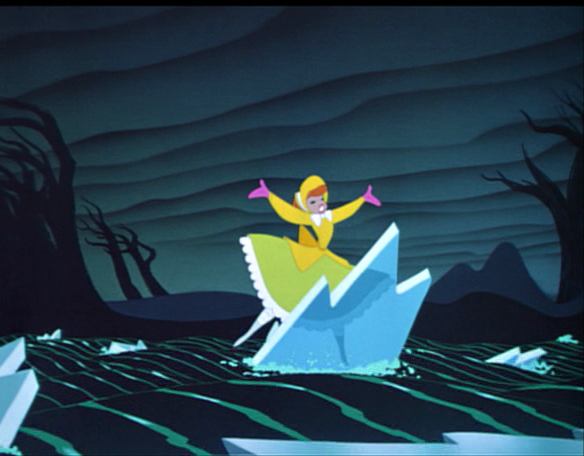
In this film, sung by Frances Langford, we follow a young romantic couple on a sleigh ride. They go skating and are joined by an equally romantic couple of rabbits. After a short break-up the two females are caught in drifting ice and heading for a waterfall. Surprisingly, they are rescued by the couple’s two horses, who get help from a pair of birds and a pair of squirrels. They return the ladies in distress to their male counterparts, restoring love.

This sweet story is particularly interesting for its highly stylized backgrounds based on designs by Mary Blair and featuring unnatural colors, like a yellow sky. The story looks back to ‘On Ice‘ (1935) and even ‘The Ugly Duckling‘ (1931), which both feature a rescue from a waterfall, too.

Watch ‘Once upon a Wintertime’ yourself and tell me what you think:

Directors: Clyde Geronimi, Wilfred Jackson, Jack Kinney, Hamilton Luske
Release Date: May 27, 1948
Stars: Donald Duck, Joe Carioca, The Aracuan Bird
Rating: ★★
Review:

Melody Time © Walt DisneyMelody Time’ is a compilation film in the same vein as ‘Make Mine Music’ (1946).

It consists of seven unrelated episodes, connected by a voice over and an animated brush. The songs of these sequences are sung by popular artists, who, except for the Andrews Sisters and Roy Rogers, are all but forgotten today. Even more obviously than in ‘Make Mine Music’, these songs are clearly designed for the cartoons, instead of the other way round, like in ‘Fantasia’ (1940). In any sense ‘Melody Time’ is a far cry from that latter film, and the most interesting feature of this film is not the animation, but the film’s beautifully stylized backgrounds, especially in ‘Once upon a Wintertime‘ and ‘The Legend of Johnny Appleseed‘.

The sequences themselves are mediocre, often slow and only moderately funny at best. Luckily, Disney would soon return to real features, for ‘Melody Time’ shows that the studio’s compilation features had outstayed their welcome.

Melody Time consists of the following episodes, which I will discuss in more detail, elsewhere:

  1. Once upon a Winter Time
  2. Bumble Boogie
  3. The Legend of Johnny Appleseed
  4. Little Toot
  5. Trees
  6. Blame it on the Samba
  7. Pecos Bill

Director: Chuck Jones
Release Date: April 10, 1948
Stars: Bugs Bunny, The Crusher
Rating: ★★★½
Review:

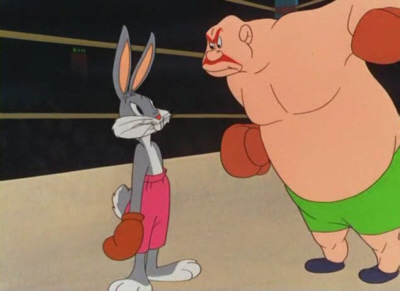
Rabbit Punch © Warner BrothersWhen Bugs jeers at the champion of a boxing game, he’s suddenly ‘invited’ to be in it.

The boxing game soon changes into a wrestling match with blackout gags, in which we only see round 37, 49, 73, 98 and 110. These blackout gags foreshadow the complete Road Runner series. In the last one the champ uses a train in order to ride over Bugs, but then the film abruptly breaks, a revival of a gag Jones used in ‘My Favorite Duck‘ (1942).

‘Rabbit Punch’ is one of the earliest cartoons in what we can call Chuck Jones’ mature style, which consolidated in 1949. Like in his earlier Bugs Bunny cartoons ‘Case of the Missing Hare‘ (1942) and ‘Hare Conditioned‘ (1945), Jones uses his sense of grace and deftness to portray a particularly large, human opponent to Bugs. And like in those cartoons he does that with stunning ‘camera angles’ and a cinematic approach. Bugs is pretty suave in this cartoon, acting out complete terror in the final scene, only to appear in full control, after all.

Watch ‘Rabbit Punch’ yourself and tell me what you think:

http://www.dailymotion.com/video/x2fby3f

This is Bugs Bunny cartoon No. 48
To the previous Bugs Bunny cartoon: A Feather in his Hare
To the next Bugs Bunny cartoon: Buccaneer Bunny

Director:Friz Freleng
Release Date: June 12, 1948
Stars: Bugs Bunny, Yosemite Sam
Rating: ★★★★★ ♕
Review:

Bugs Bunny rides again © Warner BrothersBugs Bunny dares to resist Yosemite Sam in this Western entry, which is both delightfully classic and totally absurd.

For example, when Yosemite Sam exclaims that ‘The town is not big enough for the two of us’, Bugs responds by building an enormous block of skyscrapers in a few seconds! Its finale, too, is hilarious. When Bugs tries to board an unwilling Sam on a train leaving town, they discover this train’s going to Miami and is full of dames in bathing suits. Then they both want to board it! Needless to say our hero wins the day.

‘Bugs Bunny Rides Again’ is a brilliantly hilarious cartoon full of great and flexible animation, and undoubtedly one of Bugs Bunny’s finest entries. The short reuses some footage of a dancing Bugs from ‘Stage Door Cartoon‘ (1944).

Watch ‘Bugs Bunny Rides Again’ yourself and tell me what you think:

http://ulozto.net/live/xvYBg55/bugs-bunny-bugs-bunny-rides-again-1948-avi

This is Bugs Bunny cartoon No. 50
To the previous Bugs Bunny cartoon: Buccaneer Bunny
To the next Bugs Bunny cartoon: Haredevil Hare

Enter your email address to follow this blog and receive notifications of new posts by email.

Join 907 other subscribers
Bookmark and Share

Categories