Director: Dave Fleischer Release Date: July 17, 1942 Stars: Superman
Rating: ★★★ Review:
In the aptly titled short ‘Volcano’, a dormant volcano is starting to erupt again on the island of Monokoa.
Daily Planet reporters Lois and Clarke are present, but Lois steals Clark’s press pass to work alone. She sneaks away to visit the volcano by herself, but when she’s up on the volcano, it suddenly erupts. Superman saves her and the village below by redirecting the lava to the other side.
Together with ‘The Arctic Giant’ and ‘Terror on the Midway‘, ‘Volcano’ is noteworthy for featuring no villain, let alone an evil scientist. Moreover, this Superman short probably contains the most spectacular effect animation within the series in its terrifying depiction of floating lava.
Watch ‘Volcano’ yourself and tell me what you think:
In the seventh Superman short New York is threatened by – whattaya know? – an evil scientist. But this evil scientist is more original than all the others before him: he is of Native American origin and he claims Manhattan for his own people.
Nonetheless, like all other evil scientists before him, he has a machine. His ridiculous machine causes earthquakes by using electricity. Oddly enough, the scientist first makes his threats at the Daily Planet. And when he returns to his secret hideout, Lois, of course, follows him. In his laboratory below sea level the scientist makes Lois watch the destruction of the city.
Luckily, Superman saves Manhattan by destroying the machine. However, he’s only able to rescue Lois because the scientist tells him that she’s still down in his laboratory, which is rapidly filling with water…
In any case the result is yet another routine entry.
Watch ‘Electric Earthquake’ yourself and tell me what you think:
This is Superman film No. 7
To the previous Superman film: The Magnetic Telescope
To the next Superman film: Volcano
Director: Dave Fleischer Release Date: April 24, 1942 Stars: Superman
Rating: ★★ Review:
In ‘The Magnetic Telescope’, the sixth entry in the Superman series, yet another evil scientist attracts ‘flaming comets’ with a ridiculously looking magnetic telescope.
As one comet has destroyed part of the city, the police tries to stop the villain from hauling in another one. But their attempts make the professor lose control over the comet, and while destruction is at hand, Lois phones the Daily Planet from the laboratory. When her call ends in a scream, Clark Kent rushes… er… takes a cab to the laboratory. Only when the cab is stopped by one of the comet’s offshoots, he changes into Superman and flies up there…
Superman, of course, saves the day. He first tries to stop the comet itself (which falls remarkably slowly), but surprisingly, this is too much for him, and his antics produce more offshoots, which destroy bridges and such. So, in a bright moment he restores power to the magnetic telescope, telling Lois to put the machine on ‘reverse’… (how Superman came to know how the telescope works, we’ll never know…).
The whole story is amazingly ridiculous, especially because the story is told in the most sincere fashion. It shows the Fleischer studio’s discomfort with realism all too clearly.
The all too powerful comet is a minor surprise within the formulaic Superman series. But ‘The Magnetic Telescope’ has two other deviations from the story formula: in this entry Clark Kent doesn’t say his usual ” this looks like a job for Superman”,’ and Lois manages to kiss Superman, who, unfortunately turns out to be Clark Kent, after all…
Watch ‘The Magnetic Telescope’ yourself and tell me what you think:
Director: Dave Fleischer Release Date: March 26, 1942 Stars: Superman
Rating:★★ Review:
Although it’s only the fifth Superman cartoon, ‘The Bulleteers’ already feels so formulaic, it’s depressing.
Like in Superman’s first two cartoons some evil scientists with some crazy machine threaten the city, Lois gets into trouble, superman saves her and Clark Kent discusses her story in the newspaper with her. This time the novelty is that we’re watching three villains.
The evil trio has invented a ‘bullet car’ (part car, part plane, part rocket), with which they destroy the police headquarters and a power-plant by flying through it. Lois foolishly climbs aboard the car, but Superman drags her and the villains out of it in flight.
The spectacular angular staging and effective lighting in this cartoon cannot hide the fact that with ‘The Bulleteers’ the series had reached an inspirational low point story-wise. Later in 1942, the war became a major theme in the Superman series, which fortunately led to more inspired story ideas.
Watch ‘The Bulleteers’ yourself and tell me what you think:
This is Superman film No. 5
To the previous Superman film: The Arctic Giant
To the next Superman film: The Magnetic Telescope
Director: Dave Fleischer Release Date: November 21, 1941 Stars: Superman
Rating: ★★★½ Review:
‘The Mechanical Monsters’ was Superman’s second cartoon, and it is almost a copy of the first one.
Again, there’s an evil scientist, this time a jewel thief, who robs jewelry using huge flying robots. Again, Lois gets herself into trouble by her curiosity and, again, after Superman has saved the day, Lois and Clark discuss Lois’s article in the newspaper.
This copying of a formulaic story format is the main weakness of the Superman series, and it’s saddening to see it already happening in the second cartoon. Luckily, the execution of the formula is better than in the first cartoon. This evil scientist is drawn more realistically, and the sidekick has gone. The elaborate intro has been shortened into a few seconds, leaving more room for the story. Moreover, watching Superman knocking down giant robots is more enjoyable than watching him defeating a ray.
Watch ‘The Mechanical Monsters’ yourself and tell me what you think:
This is Superman film No. 2
To the previous Superman film: Superman
To the next Superman film: Billion Dollar Limited
Director: Dave Fleischer Release Date: September 26, 1941 Stars: Superman
Rating: ★★★ Review:
‘Superman’ is the first Superman cartoon, the very first cartoon series to feature realistic characters, and the Fleischer Studio’s most ambitious cartoon series.
Superman, of course, was based on the comic strip hero who made his debut in 1938. For his screen debut, the studio made a long introduction of the character, which lasts almost two minutes.
After this intro a very simple story develops, which contains many elements to be reused in later Superman cartoons, becoming a routine all too soon:
1) an evil scientist
2) something big to beat (in this cartoon a deadly ray, which Superman ridiculously punches away)
3) Lois getting intro trouble due to her curiosity, and
4) an ending with Lois and Clarke reading a newspaper article written by Lois Lane.
Despite elaborate shadows and special effects, this first realistic theatrical cartoon (not counting the works by Winsor McCay) hasn’t aged very well. The scientist is still half cartoony, and he has an animal sidekick, which mimics his moves.
The rest of the characters are drawn realistically, but also stiff and expressionless. They look forward to the wooden realistic cartoons of the TV era. The character was very popular, however, and inspired a couple of parodies, most notably the Bugs Bunny cartoon ‘Super Rabbit’ (1943). It’s ironic that after Popeye the Fleischer again had to rely on a character created elsewhere to achieve success. Unfortunately, this meant they couldn’t exploit Superman’s popularity as much as they could have with a character of their own.
Superman would star in seventeen cartoons, all from 1941-1943, nine by the Fleischer Studios, and eight by its successor, Famous studios. In 1943 the series was dropped because it was too costly to produce.
Watch ‘Superman’ yourself and tell me what you think:
Both propaganda shorts Disney released in January 1943, ‘Der Fuehrer’s Face‘ and ‘Education for Death’, were the most powerful propaganda the studio ever released. However, the two couldn’t be more different: while ‘Der Fuehrer’s Face’ is an outrageously funny satire, ‘Education for Death’ is, some funny scenes notwithstanding, the most unsettling short the studio ever released. Its general tone is black, grim and its purpose is to shock, not to entertain.
Based on a book by Gregor Ziemer, ‘Education for Death’ tells us how Hans, a typical German boy, is indoctrinated by the rulers of the Third Reich. The short is conceived in a quasi-documentary style. The narrator makes us believe that the scenes we’re watching, are happening right before our eyes, and unlike any other cartoon of the period, the Germans speak real German, which is translated by the narrator.
Moreover, most of the human designs are quite realistic, with Hans’s mother, animated by Milt Kahl, being the acme in human naturalism by the studio thus far. On the other hand, all scenes are heavily dramatized, using colors like red and black, vast shadows, and extreme camera angles, which depict every Nazi as a towering and threatening figure.
In the beginning we are still allowed to laugh at a ridiculous version of Sleeping Beauty, in which Hitler, dressed like a ‘handsome knight’ rescues a fat, Valkyrie-like Germany from an evil witch (said to be democracy). But after the school scene, the short turns decidedly black, with images of book burning, a bible being replaced by ‘Mein Kampf’ and Jesus by a Nazi sword. In the final scene, Hans has grown into a grim soldier, who, wearing chains, blinders and a muzzle, marches to his own death. No matter how blatant this propaganda short is, this is one of the most disturbing endings of an animated film ever put on screen.
Watch ‘Education for Death’ yourself and tell me what you think:
‘Education for Death’ is available on the DVD-set ‘Walt Disney Treasures: On the Frontlines’
Director: Chuck Jones Release Date: June 12, 1943 Stars: Hubie and Bertie
Rating: ★★½ Review:
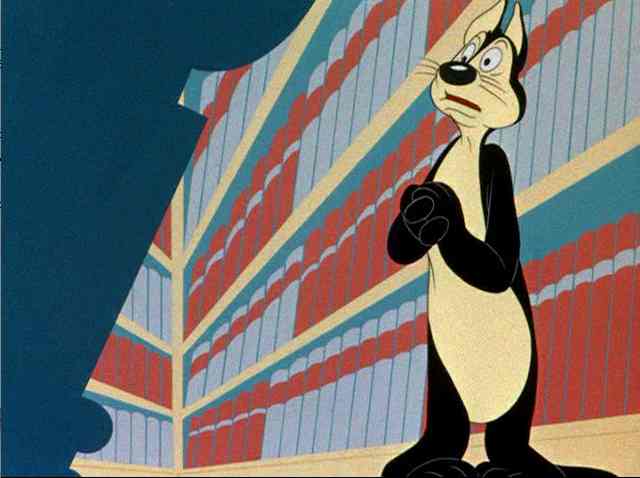
The aristo-cat is the pet of a rich lady. He nags the butler so much that the latter quits. Not knowing how to get food himself, the cat panics, until he learns from a book titled ‘the behavior of cats’ that cats eat mice.
He immediately sets out to get one, but when he encounters one (Hubie) he doesn’t recognize it and he’s scared to death. Hubie and Bertie take advantage of the situation to convince the cat that Rover, a vicious bulldog next door, is a mouse. This leads to several chase routines, until it is revealed that it was all a dream.
‘The Aristo-Cat’ is only moderately funny, and the aristo-cat has a rather ugly voice. But the cartoon’s highly stylized backgrounds are beautiful and an attraction on their own. They are based on layouts by John McGrew, who did some innovative work in a couple of Chuck Jones cartoons from 1942 and 1943, e.g. ‘Conrad the Sailor‘, ‘The Dover Boys‘, and ‘Flop Goes The Weasel’. The backgrounds in ‘The Aristo-Cat’ arguably form the apex of McGrew’s art with their expressionistic angles and patterns, supporting the cat’s agony and fear. In fact, such daring designs would not be seen again before the advent of UPA.
‘The Aristo-Cat’ marks the debut of the mischievous mouse duo Hubie and Bertie. Strangely enough, they were shelved for three years, although Hubie had one solo-outing in 1944 with ‘From hand to Mouse’. The duo returned in 1946 to star five more cartoons: ‘Roughly Squeaking’ (1946), ‘House Hunting Mice’ (1948), ‘The Hypo-Chondri-Cat’ (1950), ‘Cheese Chasers’ (1951) and the greatest of them all, ‘Mouse Wreckers‘ (1949).
Watch ‘The Aristo-Cat’ yourself and tell me what you think:
Director: Chuck Jones Release Date: February 14, 1942 Stars: Conrad Cat, Daffy Duck
Rating: ★★½ Review:
‘Conrad the Sailor’ is the third and last cartoon featuring the early Chuck Jones character Conrad Cat, who also starred ‘Porky’s Cafe’ and ‘The Bird Came C.O.D.’, all from early 1942.
Conrad’s most distinctive trait was his voice, provided by Pinto Colvig, who also voiced Goofy. Indeed, Conrad’s and Goofy’s voices are very similar. However, in ‘Conrad the Sailor’ his voice is rarely heard, as most of the comedy is silent.
In ‘Conrad the Sailor’ Conrad Cat works as a sailor on a battle cruiser (a setting reflecting the war time), where he is nagged by Daffy Duck. Their chase is stopped several times by a small captain who pops up at unexpected moments, a type of gag typical for early Chuck Jones cartoons (see e.g. ‘Inki and the Minah bird’ from 1941 and ‘The Dover Boys‘ from 1942).
‘Conrad the Sailor’ is not a very funny cartoon: neither Conrad nor Daffy behave sympathetically, and the origin of their conflict remains unknown. The Daffy-Conrad-encounters appear to be nothing more than a string of unrelated events. Moreover, Jones’s pacing is still rather slow at times, wearing the comedy down. Conrad’s personality is rather undefined, and after this cartoon he was shelved.
Notwithstanding its weaknesses, the cartoon is noteworthy for its remarkably stylized and surprisingly angled backgrounds, courtesy of lay-out artist John McGrew, who collaborated with Jones on a number of cartoons, before joining the navy himself in 1942. The backgrounds in these cartoons are often the real highlight of the short, and look all the way forward to UPA’s cartoon modern style of the early fifties. McGrew would push the limits even further in ‘The Aristo-Cat‘ (1943).
This is Daffy Duck cartoon No. 12
To the previous Daffy Duck cartoon: The Henpecked Duck
To the next Daffy Duck cartoon: Daffy’s Southern Exposure
‘Conrad the Sailor’ is available on the DVD-set ‘Looney Tunes Golden Collection Volume Four’
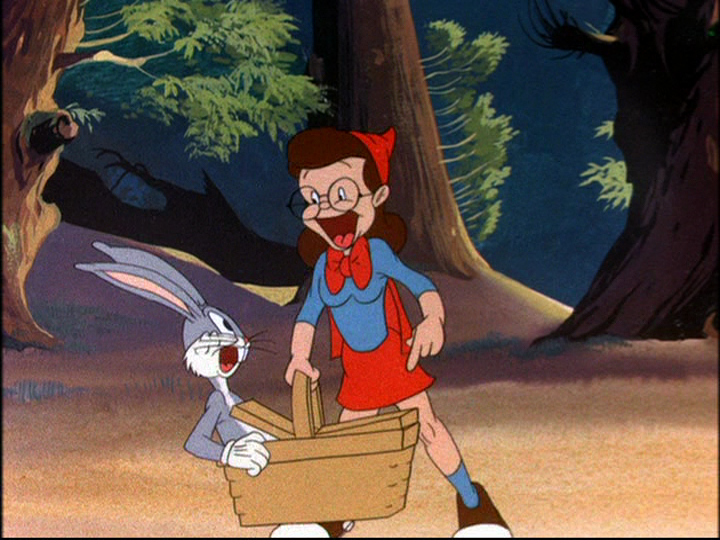
In this wacky take on the classic tale of ‘Little Red Riding Hood’, Red Riding Hood is a bespectacled, loud-voiced teenager taking Bugs in her basket to her Grandma, while singing Cole Porter’s ‘The Five O’Clock Whistle’ in her own idiosyncratic way (voiced by Bea Benadaret).
The wolf sends Red Riding Hood on a long and winding road across a mountain, while he takes a shortcut to grandma’s house, which appears to be just two meters away. The wolf doesn’t need to get rid of grandma, who’s “working swing shift at Lockheed’ (a typical war era reference), but oddly enough he has to get rid of some other wolves waiting in bed.
When Red Riding Hood arrives at grandma’s place, the wolf quickly disposes of the unappealing girl, and gets into a chase routine with Bugs, involving a marvelous door sequence, worked out perfectly in Friz Freleng’s typical timing.
However, at several points they’re interrupted by Red Riding Hood, who insists on asking her familiar questions. In the end, Bugs gets so annoyed that he punishes her instead of the wolf.
‘Little Red Riding Rabbit’ is one of the most successful of all fairy tale-inspired cartoons. It’s loaded with funny gags and one of the early highlights in the Bugs Bunny catalog.
Watch ‘Little Red Riding Rabbit’ yourself and tell me what you think:
‘The Hare-Brained Hypnotist’ was only the sixth encounter between Elmer Fudd and Bugs Bunny, and only the second by Friz Freleng, but already the routine was ripe for experiment.
In ‘The Hare-Brained Hypnotist’, penned by Michael Maltese, Elmer consults a book on hypnosis to catch Bugs. His hypnosis skill work on a bear, which Elmer makes think it’s a canary. It fails on Bugs however, who in turn manages to hypnotize Elmer, making him think he’s a rabbit. Elmer immediately swaps into a Bugs Bunny routine, leaving Bugs to play the straight guy. But after another hypnosis battle down the rabbit hole, Elmer returns to his former self, fleeing into the distance, while Bugs tells us he’s the B19, referring to the Douglas XB19, a huge experimental bomber plane, which had had its first flight on 27 June 1941.
‘The Hare-Brained Hypnotist’ is not a very funny cartoon. The comedy suffers, because Bugs is forced into the role of the straight guy, a problem the cartoon shares with e.g. ‘Tortoise Beats Hare‘ from 1941. Nevertheless, Elmer’s Bugs Bunnyarisms are quite hilarious, especially in a scene where he makes Bugs eat several carrots at one time.
Watch an excerpt from ‘The Hare-Brained Hypnotist’ yourself and tell me what you think:
‘Tortoise Beats Hare’ starts with one of the greatest openings of all Warner Brothers cartoons: Bugs walks along the title card, reading it aloud, mispronouncing all the names (Fred a-VEry).
When he reads the title, he gets angry, tears the title card apart and immediately looks up Cecil Turtle to make a bet. Cecil Turtle accepts, but when they’ve started off, he phones all his friends and relations to be his duplicate. This trick make the humble turtle seem to appear everywhere, driving Bugs mad.
‘Tortoise Beats Hare’ is Tex Avery’s first Bugs Bunny cartoon after Bugs Bunny’s debut in ‘A Wild Hare‘ (1940). In it Tex Avery immediately does a surprising experiment to his beloved character by letting him play the role of the straight guy. In ‘Tortoise Beats Hare’ it’s the humble Cecil Turtle who gets all Bugs’s routines, like kissing the rabbit at unexpected moments and addressing the audience with a “we do this kind of stuff to him all through the picture”. As Chuck Jones writes in his book ‘Chuck Amuck’:
‘The Tortoise in fact becomes Bugs, and Bugs becomes Elmer Fudd, outwitted and outacted, thereby losing control both of the tortoise-hare race and of the picture itself’.
This experiment is not a success: watching Bugs Bunny being humiliated gives the viewer an uncomfortable feeling, and outside the Cecil Turtle cartoons it was rarely repeated. Nevertheless, Bugs’ first double take is a delight, and so is the animation on the slow hopping Cecil.
”Tortoise Beats Hare’ was only Bugs Bunny’s third screen appearance, and it shows: his design is still somewhat unsteady, and so is his voice. When Bugs addresses Cecil for the first time, it sounds like we hear many Mel Blanc voices after another.
At MGM Avery would reuse the idea of a guy popping up everywhere driving his opponent mad to greater effect, in two Droopy cartoons, ‘Dumb-Hounded‘ (1943) and ‘The Northwest Hounded Police‘ (1946). In both cartoons Avery skips the explanation how the guy could be everywhere, making the result way funnier.
Meanwhile, Cecil Turtle would return in the Bob Clampett cartoon ‘Tortoise wins by a Hare’ (1942) and in the Friz Freleng cartoon ‘Rabbit Transit’ (1947).
Watch ‘Tortoise Beats Hare’ yourself and tell me what you think:
Director: Bill Justice & Bill Roberts Release Date: November 5, 1943 Stars: The Seven Dwarfs Rating: ★★★½ Review:
This war time educational short tells us about public enemy no. 1. This turns out not to be Nazi Germany or Japan, but the Anopheles mosquito, which spreads malaria. The film is quite insightful in how malaria is spread and how one can prepare oneself against it.
The film features the seven dwarfs from ‘Snow White and the Seven Dwarfs’ (1937) as volunteers to give an example. Their precautionary actions are staged to an instrumental version of the song ‘Whistle While You Work’, which was originally associated with Snow White and some forest animals doing the household in ‘Snow White and the Seven Dwarfs’ (1937).
It’s a bit surreal to watch these happy-go-lucky fairy tale characters fighting a serious disease in a modern (South) American environment. Especially because some of the precautionary methods against malaria are quite disturbing. They include spraying oil on ponds and the use of the poisonous gas Paris Green, methods with devastating results for the environment. Clearly, environmentalism was not yet on the agenda in the 1940s (in fact, it only hit the political agenda after the publishing of Rachel Carson’s book ‘Silent Spring’ in 1962).
The seven dwarfs were used earlier in the war propaganda short ‘7 Wise Dwarfs‘ (1941), but that consisted mainly of reused material. ‘The Winged Scourge’ has entirely new animation on the seven dwarfs. It was the last film to feature these happy little men.
‘The Winged Scourge’ was made for the Office of the Coordinator of Inter-American Affairs. It’s the first of a few educational health shorts made especially for the Latin American countries, other examples being ‘Defense Against Invasion‘ (1943), ‘Cleanliness Brings Health’ (1945), ‘What Is Disease’ (1945), and ‘Planning for Good Eating’ (1946).
Watch ‘The Winged Scourge’ yourself and tell me what you think:
Director: Jack King Release Date: January 7, 1943 Stars: Donald Duck Rating: ★★★★★ ♕ Review:
‘The Spirit of ’43’ is the follow-up to ‘The New Spirit’ from the previous year. The second half is exactly the same, but the first half is even better than the first half of its predecessor, making a clever use of strong symbolic imaginary.
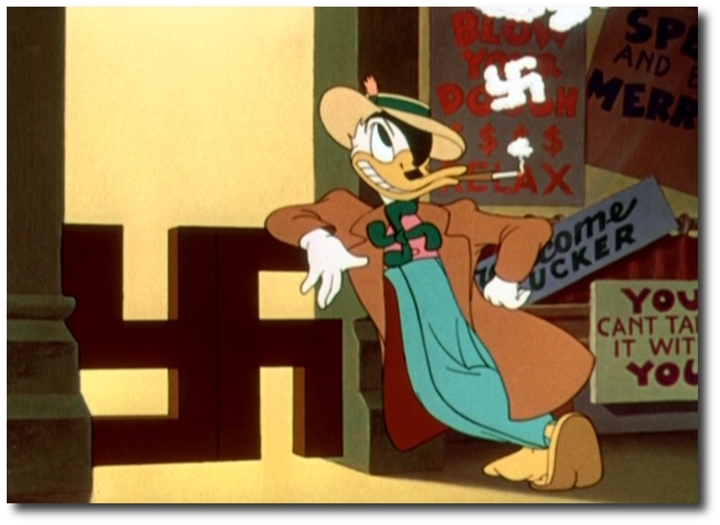
Donald just got paid and he’s divided between his two selves: the thrifty (a Scottish forerunner of Uncle Scrooge) and the spendthrift. These two characters struggle for Donald, in which they both fall down: the spendthrift into a tavern with a swastika-shaped swing-door and the thrifty into a wall, which, together with the stars his fall produces, resembles the American flag. This makes the decision for Donald easier, will he “spend for the axis or save for taxes”? He knocks his spendthrift side into the tavern, crushing the swastika door changing it into a V for victory. At this point the second half starts (see ‘The New Spirit‘ for a description of this part).
‘The Spirit of ’43’ is propaganda, and quite obviously so. But the film is both inventive and effective in its delivery of its message, and therefore surprisingly enjoyable.
Watch ‘The Spirit of ’43’ yourself and tell me what you think:
Director: Bill Justice & Bill Roberts Release Date: January 4, 1943 Rating: ★★½ Review:
‘The Grain that Built a Hemisphere’ is a war time educational short about corn in quite a propagandistic fashion.
The Disney studios made it “under the auspices of the Office of the Coordinator of Inter-American Affairs”, which means that it belongs to the ca. ten films Disney made in the context of America’s ‘good-neighbor policy’ .
‘The Grain that Built a Hemisphere’ is the most propagandistic of the lot. Its tone is set right away when the narrator pompously boosts that “corn is the symbol of a spirit that links the Americas in a common bond of union and solidarity”.
Luckily, the main part of the film is quite insightful, explaining about the origin of corn, and what products it can produce. We learn how inbreeding is used to produce bigger plants and how it can be used as food for livestock (this section reuses footage from ‘Farmyard Symphony‘ from 1938) and as a source for oils, starch, glucose and sugar. And maybe, in the near future, for plastics for all kinds of war machines? Thus ends this educational film as a typical war propaganda short, after all…
Watch ‘The Grain that Built a Hemisphere’ yourself and tell me what you think:
Director: Wilfred Jackson & Ben Sharpsteen Release Date: January 23, 1942 Stars: Donald Duck Rating: ★★★★ Review:
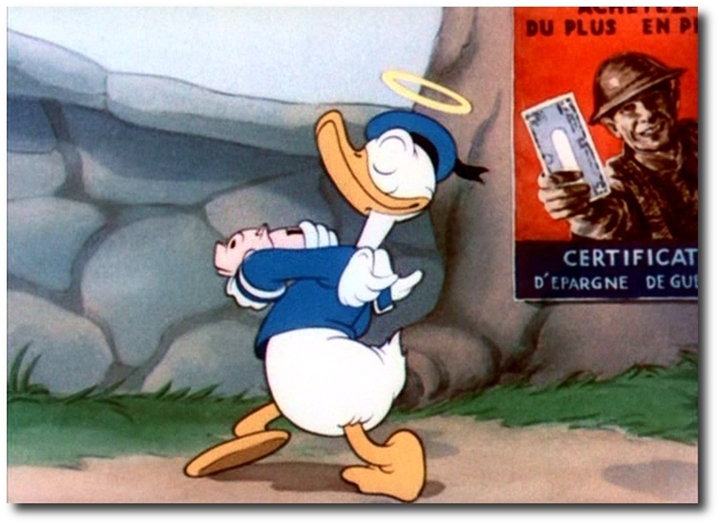
When the United States were forced into the war themselves, the government asked Disney to make a short to make the American citizens fill in their income tax forms in time. Disney gave them his biggest star of that time, Donald Duck, to play the everyman. The government was not impressed until the taxes came rolling in after the film was screened in cinemas.
In contrast to Disney’s earlier propaganda films for the Canadian government, this film uses entirely new animation, directed by Wilfred Jackson, and produced in the ridiculously short time period of a single month.
The short opens with Donald dancing to the energetic title song, which is sung by Cliff Edwards, the voice of Jiminy Cricket in ‘Pinocchio‘ (1940). The song is played on a slightly anthropomorphised radio. The radio then asks Donald if he wants to do his part for the country and Donald is growing more and more enthusiastic, until the radio reveals he has to pay his income tax. The radio has to persuade Donald once again, who grows enthusiastic again to the strong slogan ‘Taxes to beat the axis’ (with the axis referring to the Axis powers: Germany, Italy and Japan).
The film further explains the public how to fill in a new, simplified form, using an anthropomorphized pen, bottle of ink and blotter. Like the shorts Disney made earlier for the Canadian government (e.g. ‘The Thrifty Pig‘ and ‘7 Wise Dwarfs‘), the second half (directed by Ben Sharpsteen) consists of very limited and highly propagandistic animation with grim images of factories, guns, planes, war ships and tanks, while an intense narrator repeats the intoxicating mantra of ‘taxes to beat the axis’.
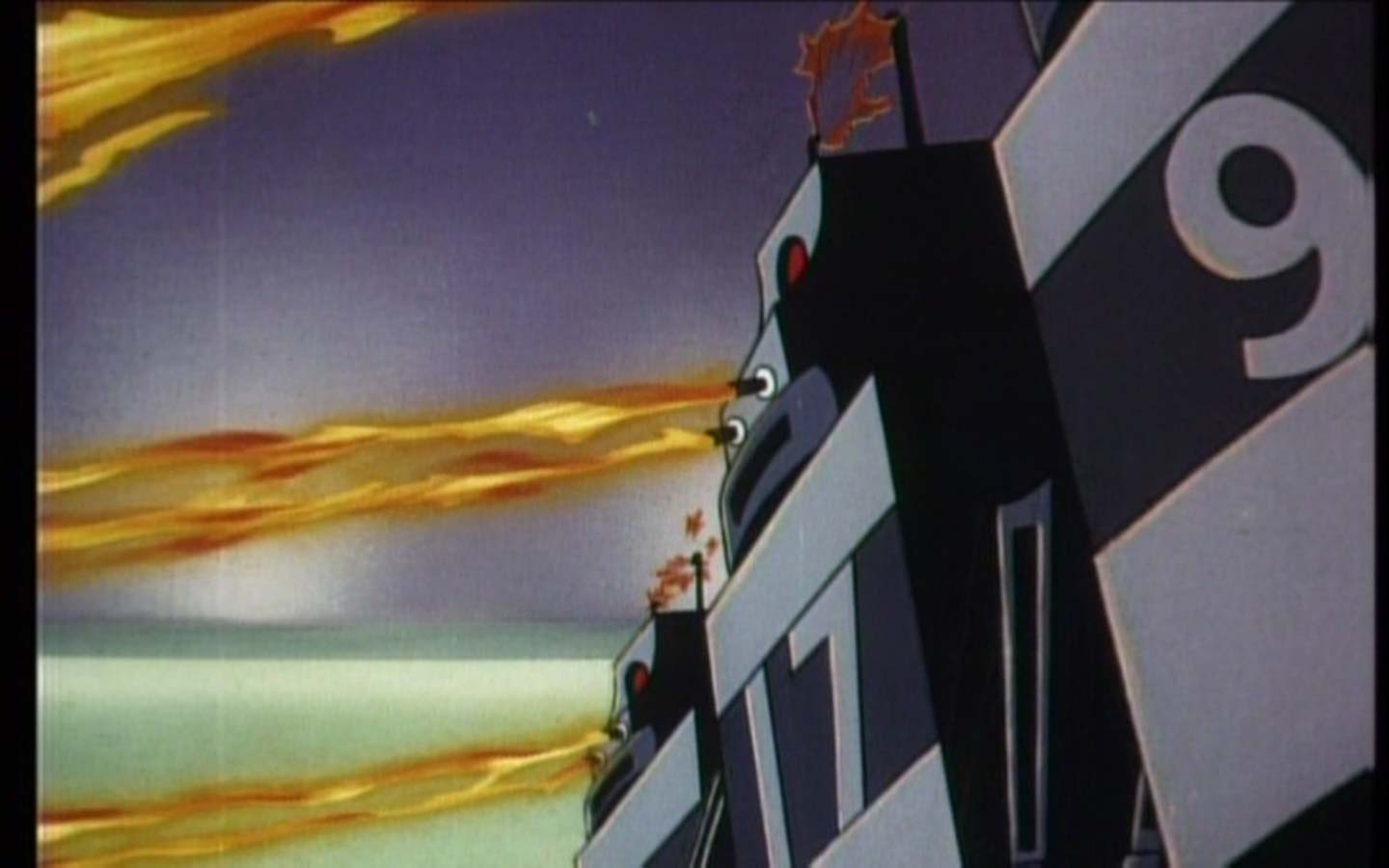
When he comes to the propagandist climax, the sentence “to beat to earth the evil destroyer of freedom and piece”, we watch a horrifying towering monster-like machine depicting the Nazi aggressor. This mechanical monster is defeated and makes place for a patriotic end shot with clouds resembling the American flag, tanks and guns rolling and planes flying accompanied by a heroic hymn, while the narrator tells us that “this is our fight”.
It’s important to note that the film goes at lengths to dehumanize the enemy. The average tax payer was not to help to kill people, but to destroy “the enemy”, in this case a vague mechanical monster. Succeeding propaganda films often eschewed the idea that making war is killing people, with the propaganda feature ‘Victory through Air Power’ (1943) being the prime example.
In case of “The New Spirit”, propaganda rarely was so obvious, but it works: after watching the picture I had its slogan in my head for days. Indeed, the film was so successful, that it got a follow-up the next year: ‘The Spirit of ’43‘.
Watch ‘The New Spirit’ yourself and tell me what you think:
Director: Fred Beebe Release Date: January 13, 1942 Stars: Clarabella Cow, Donald Duck, Figaro, Geppetto, Goofy, Horace Horsecollar, Huey, Dewey and Louie, Mickey Mouse, Pinocchio, Pluto, The Seven Dwarfs Rating: ★★★½ Review:
‘All Together’ is the last and the shortest of the four propaganda films Disney made for the Canadian government.
In the first half we only see some Disney stars parading on patriotic march music in front of the Canadian parliament building in Ottawa. This short scene reuses animation from ‘Pinocchio‘ (Pinocchio, Geppetto and Figaro), ‘Good Scouts‘ (Donald and his nephews), ‘Bone Trouble‘ (Pluto), ‘The Band Concert‘ (Mickey and the gang), ‘Mickey’s Amateurs‘ (Goofy) and ‘Snow White and the Seven Dwarfs’ (the seven dwarfs, who are clearly singing and whistling, although their voices are not heard). ‘All Together’ is the only propaganda short to feature Pinocchio stars.
The second half uses powerful imaginary to persuade the public to buy war certificates. Of the new images, the most striking is the one of coins marching with bayonets.
‘All Together’ is image only. It doesn’t feature any kind of story, making it the least interesting of the four Canadian propaganda films.
Watch ‘All Together’ yourself and tell me what you think:
The result is less convincing than in the earlier two cartoons, probably because the source material is weaker. Neither ‘Self Control’ nor ‘Donald’s Better Self’ belong to Donald Duck’s best. Besides, Donald only reluctantly does his part, in great contrast to the optimistic pigs and dwarfs from the earlier shorts. Indeed, when Disney had to convince the American public for government purposes, the studio came up with completely new animation for its biggest star (in ‘The New Spirit‘ and ‘The Spirit of ’43‘).
Watch ‘Donald’s Decision’ yourself and tell me what you think:
Directors: Dick Lyford & Ford Beebe Release Date: December 12, 1941 Stars: The Seven Dwarfs Rating: ★★★½ Review:
‘7 Wise Dwarfs’ is Walt Disney’s second propaganda film for the Canadian government, and it uses the same two-part formula as the first (‘The Thrifty Pig‘), this time reusing animation from Walt Disney’s most famous film of all: ‘Snow White and the Seven Dwarfs’ (1937).
The first part of ‘7 Wise Dwarfs’ reuses animation of the seven dwarfs singing the mining song and ‘Hi-ho’, but with altered lyrics and backgrounds. There is some new animation of the Dwarfs entering and leaving the bank to buy war bonds. The second part is almost the same as that of ‘The Thrifty Pig’, ending with the same powerful image of planes gunning the words ‘Invest in Victory’. The Seven Dwarfs would return in ‘The Winged Scourge‘ (1943), which features a lot of new animation on them.
Watch ‘7 Wise Dwarfs’ yourself and tell me what you think:
Director: Ford Beebe Release Date: 1941 Stars: The Three Little Pigs Rating: ★★★★½ Review:
Before The United States were dragged into the war by Japan’s attack on Pearl harbor, December 7, 1941, Walt Disney Studio already had made four propaganda shorts for the Canadian government.
Canada, had declared war on Nazi Germany on September 10, 1939, a week after the United Kingdom, following Germany’s invasion of Poland, September 1.
‘The Thrifty Pig’ is the first of Disney’s four propaganda films commissioned by the Canadian government to persuade their citizens to buy war bonds to invest in the war effort. The other three being ‘7 Wise Dwarfs‘ (1941), ‘Donald’s Decision‘ (1942) and ‘All Together‘ (1942). It’s also Disney’s first propaganda cartoon.
‘The Thrifty pig’ consists of two parts, The first part cleverly reuses animation from Walt Disney’s most famous short, ‘Three Little Pigs‘ (1933), but in this shortened version the wolf wears a Nazi costume, the bricks are made of war bonds and the union jack is waving at the wise pig’s house. The only new animation is when the wolf’s blows reveal war bonds beneath the plaster and when the wise pig says “these bricks not only stop his blowing, they will also get him going”.
The second part is more overtly propagandistic and uses limited animation of war machines and slogans to persuade the public to buy “more and more war certificates”. The end shot, where a plane shoots the words ‘Invest in Victory’ on the screen’ is the most powerful image of the complete film.
This two part formula would be reused in all succeeding propaganda films that had to persuade the public to invest in the governmental war industry. Apart from the Canadian commissions, we see this structure in ‘The New Spirit‘ (1942) and ‘The Spirit of ’43‘ (1943), which had to persuade American citizens to pay their income taxes in time.
Watch ‘The Thrifty Pig’ yourself and tell me what you think:
Animation Backgrounds
A blog dedicated to background paintings from animation films. Kept until 2016.
Animation Scoop
Animation historian Jerry Beck’s animation film news blog.
Cartoon Brew
Topical blog on animation film, led by animation historian Amid Amidi.
Cartoon Modern
Amid Amidi’s blog on modern design cartoon art from the forties, fifties and sixties.
Cartoon Research
THE site on classic animation research, hosted by cartoon historian Jerry Beck.
Cartoons Theory
Frank Beef analyzes classic cartoons. Kept until 2020.
Century Film Project
Michael reviews films of 100 years old and older, roughly in chronological order.
Classic Cartoons
A similar blog featuring many stills and comic strips. Kept until 2012.
Comet over Hollywood
Jessica Pickens reviews classic Hollywood films, especially musicals.
Deja View
Top ex-Disney animator Andreas Deja’s own blog.
Disney History
Esteemed Disney historian Didier Ghez on the latest books on Disney history.
Feeling Animated
Paul Astell brings us thorough reviews of animated features.
Flickers in Time
Short and to the point reviews of classic films (lately mostly pre-code talkies) by an anonymous retired Foreign Service Officer from California

 In the aptly titled short ‘Volcano’, a dormant volcano is starting to erupt again on the island of Monokoa.











 Dr. Grob's Animation Review