
You are currently browsing the tag archive for the ‘1938’ tag.
Director: Elmer Perkins
Release Date: October 5, 1938
Rating: ★★★½
Review:
 ‘Hollywood Bowl’ merges two genres that had become quite popular by the late 1930s: the concert cartoon and the Hollywood caricature cartoon. The result is pretty uneven, but nonetheless, ‘Hollywood Bowl’ is one of the most original cartoons to sprout from the Walter Lantz studio.
The short opens with a gala night at the Hollywood Bowl, with several famous stars in the crowd, e.g. Edward G. Robinson, Hugh Herbert, Greta Garbo, Groucho Marx, Clark Cable, Charles Laughton, Ned Sparks, Bing Crosby, W.C. Fields, and Charlie.
Leopold Stokowski is the conductor, conducting Franz Schubert’s unfinished symphony with the help of a few gloves. This leads to a great and very imaginative scene, in which we watch ghostly images of the gloves playing instruments on a black screen, and Stokowski casting a huge shadow on the bowl, which changes into a greyhound, which changes into a swallow. At that point this poetic part cuts back to the Hollywood caricatures.
As Schubert has left the symphony unfinished (quite literally), it’s up to the stars to finish it, Hollywood style, which means that radio star Ben Bernie starts conducting a swinging tune, with help of Fats Waller, Rudy Vallee, Benny Goodman, Fred Astaire, Jack Benny and Cab Calloway. This part reuses a lot of animation, and is a not too convincing end to the cartoon.
‘Hollywood Bowl’ is a very interesting entry in Walter Lantz’s oeuvre, but it’s harmed by a lack of story, rather bad voice imitations and at times sloppy animation. Nevertheless, the Schubert sequence is no less than marvelous, and the cartoon’s opening is greatly helped by Frank Churchill’s inspired score, which is simply packed with countless classical tunes. Notice that some of the backgrounds use photographic material, a very rare feat in classic cartoons.
Watch ‘Hollywood Bowl’ yourself and tell me what you think:
‘Hollywood Bowl’ is available on the DVD-set ‘The Woody Woodpecker and Friends Classic Cartoon Collection’
Director: Frank Tashlin
Release Date: December 16, 1938
Rating: ★★★
Review:
 ‘Cracked Ice’ looks like Frank Tashlin’s answer to Walt Disney’s ‘On Ice‘ (1935).
However, the familiar scene of animals skating is enhanced by the presence of a pig, who is an excellent caricature of W.C. Fields, both in voice and design. When he discovers the liquor storage of a phlegmatic St. Bernard, the pig goes at lengths to retrieve the alcohol. His best scene is in which he tries to get the drinks by talking to the dog, in real W.C. Fields style. In another great scene the pig goes into discussion with someone in the audience. The cartoon ends with an elaborate magnet gag, but it’s the man in the audience, who has the last laugh.
‘Cracked Ice’ is an entertaining film, if not a too spectacular one. It was Frank Tashlin’s last film at Warner Bros. for the time being, and his unit was taken over by Chuck Jones. Tashlin left Warner Bros. for Walt Disney, where he worked on films like ‘Donald’s Vacation‘ and ‘Mr. Mouse Takes A Trip’ (both 1940). However, the Disney studio was not his style, and he interchanged it for Columbia in 1941, working on the ‘Fox and Crow’ series. By June 1942 he was back at Warner Bros. where he would direct some superb films, like ‘Plane Daffy‘ and ‘The Stupid Cupid’ (both 1944).
Watch ‘Cracked Ice’ yourself and tell me what you think:
http://www.dailymotion.com/video/x4kttmn
‘Cracked Ice’ is available on the DVD-set ‘Looney Tunes Golden Collection: Volume 4’
Director: Frank Tashlin
Release Date: November 5, 1938
Rating: ★★½
Review:
 With ‘You’re an Education’ Frank Tashlin rounds up his trio of contributions to the Warner Bros. books-come-to-life-cartoons.
As with the earlier ‘Speaking of the Weather’ (1937) and ‘Have You Got Any Castles?‘ (1938) the cartoon consists of a bunch of musical routines, followed by an embryonic story of all characters trying to catch a criminal. This time the setting is a travel agency, and all gags and puns come from countries, cities and other places around the world.
‘You’re an Education’ is less lush than ‘Have You Got Any Castles?’ was, and feels like a repetition of the former film. However, the film moves at an incredible speed. The opening sequence, in particular, is rich in events, with the music changing quickly, forming a dazzling medley. The title song is sung by three fat black ladies, while the criminal is a guy from Bagdad stealing from the Transvaal Kimberly Diamond Mines. The film ends with the Bagdad criminal joining the Lone Ranger, a popular fictional radio star that had come to the movie screen in February 1938.
Watch ‘You’re an Education’ yourself and tell me what you think:
http://www.dailymotion.com/video/x2xp6h7
‘You’re an Education’ is available on the DVD-set ‘Looney Tunes Golden Collection: Volume 4’
Director: Frank Tashlin
Release Date: October 8, 1938
Rating: ★
Review:
 ‘Little Pancho Vanilla’ is one of Frank Tashlin’s particularly Silly Symphony-like Merrie Melodies. Indeed, the short’s star, Little Pancho Vanilla, looks like a grumpy cousin of Disney’s Little Hiawatha (1937).
Pancho dreams of becoming a bullfighter, especially when his three sisters admire a Clark Gable-like toreador. To prove his worth Little Pancho Vanilla rushes off to the arena, trying to join a group of amateur toreadors, to no avail. However, he accidentally lands inside, crashing the bull by falling on it, twice, and thus becoming a success.
There’s little to enjoy in ‘Little Pancho Vanilla’, the main hero is far from sympathetic, and the bullfight scenes are hardly interesting. The best gag is when the bull kicks all amateurs in all corners as if they were billiard balls. The end gag, however, only depicts these Mexicans as ignorant people.
At best Warner Bros. produced Silly Symphonies-lookalikes like this cartoon were better than Fleischer’s attempts in the same field, but it was a good thing Warner Bros. soon moved away from them, and embraced their own unique cartoon style wholeheartedly.
Watch ‘Little Pancho Vanilla’ yourself and tell me what you think:
http://www.dailymotion.com/video/x5qmfv3
‘Little Pancho Vanilla’ is available on the DVD-set ‘Looney Tunes Golden Collection: Volume 4’
Director: Frank Tashlin
Release Date: June 4, 1938
Stars: Porky Pig
Rating: ★★★★
Review:
 ‘Porky the Fireman’ is a delightful entry in the fire fighting canon, able to compete with great entries like Disney’s ‘The Fire Fighters‘ (1930) and ‘Mickey’s Fire Brigade‘ (1935).
The short wastes no time, and immediately plunges into action when the fire brigade rushes to the burning building, in a great perspective shot featuring animated backgrounds. These animated backgrounds are an example of some remarkably Fleischer-like gags typical for this cartoon.
Porky does his best, but the best laughs go to an extraordinarily phlegmatic dog who, when Porky yells to him to open the fire hydrant walks a great distance on a leisurely speed only to ask our hero ‘what’d you say?’.
The cartoon ends in a typical Tashlin-montage, placing several earlier scenes on top of each other to create an effect of chaos. Despite Porky’s attempts, the complete building burns down, and one flame has the last laugh.
Watch ‘Porky the Fireman’ yourself and tell me what you think:
http://www.dailymotion.com/video/x430j8t
This is Porky Pig cartoon no. 41
To the previous Porky Pig cartoon: Injun Trouble
To the next Porky Pig cartoon: Porky’s Party
‘Porky the Fireman’ is available on the DVD-set ‘Looney Tunes Golden Collection: Volume 4’ and ‘Porky Pig 101’
Director: Frank Tashlin
Release Date: May 14, 1938
Rating: ★★
Review:
 While Tex Avery and Bob Clampett were experimenting with a cartoon style totally different from Disney, Frank Tashlin made some Merrie Melodies that were still surprisingly Silly Symphonies-like.
‘Now That Summer Is Gone’ is one of the most conspicuous of them all, opening with autumn images of numerous squirrels collecting nuts for the winter. The industrious ways in which the squirrels collect nuts hark all the way back to early Silly Symphonies like ‘Autumn‘ (1930), ‘The Busy Beavers‘ (1931) and ‘Father Noah’s Ark‘ (1933). In any case these opening sequences feature complex scenes and lush production values.
This setting gives way to a story about a young squirrel who’s addicted to gambling. When his father orders him to collect nuts at the ‘First Nutional Bank’ he loses it all to a mustached stranger. In the end, it turns out to be the father himself, who gives the lying little brat a big spanking.
This humorless and cloying morality tale places ‘Now That Summer Is Gone’ deeply in the second half of the 1930s. Nevertheless, it’s still enjoyable to watch Tashlin’s experimental cinematography at play.
Watch ‘Now That Summer Is Gone’ yourself and tell me what you think:
http://www.dailymotion.com/video/x5qmfv5
‘Now That Summer Is Gone’ is available on the DVD-set ‘Looney Tunes Golden Collection: Volume 4’
Director: Tex Avery
Release Date: January 1, 1938
Rating: ★★★
Review:
 ‘Daffy Duck and Egghead’ marks Daffy Duck’s second appearance. The short is the first film carrying Daffy’s name, and his first one in color.
The cartoon uses exactly the same premise as the first one, ‘Porky’s Duck Hunt’ (1937), but now with Egghead as the hapless hunter. Egghead never was much of a character, and Avery deliberately changed him for this cartoon, giving him a Moe-Howard-like hairdo, but otherwise making him less loony than before, and more of a straight man. Daffy Duck, on the other hand, is completely wild in this cartoon, and sings about himself on the melody of ‘The Merry-Go-Round Broke Down’, an idea that was copied in the feature film ‘Who Framed Roger Rabbit‘ from 1988.
Avery and story man Ben Hardaway tell some great gags here: for example, Egghead shooting down a man in the audience who won’t sit down, and a random turtle suddenly breaking in and ordering the duo to duel. This colorful short surely couldn’t be hardly be more removed from Disney for a 1938 cartoon. The Warner Bros. cartoon studio clearly was on its own course. However, Avery’s timing is still unsteady, wearing down the fun, especially in Egghead’s tiresome slow reactions to the duck’s antics.
Watch ‘Daffy Duck and Egghead’ yourself and tell me what you think:
http://www.dailymotion.com/video/x32rmg0
This is Daffy Duck cartoon No. 2
To the previous Daffy Duck cartoon: Porky’s Duck Hunt
To the next Daffy Duck cartoon: Porky and Daffy
‘Daffy Duck and Egghead’ is available on the DVD-set ‘Looney Tunes Golden Collection: Volume 3’
Director: Norman McLaren
Release Date: 1938
Rating: ★★★½
Review:
 ‘Mony a Pickle’ is a compilation film for the British ‘General Post Office’, made by several directors. In his contribution Norman McLaren turns to his homeland Scotland to tell a story about a poor young couple, still living with their family, but dreaming of a place of their own.
The dream sequence transforms the poor and crowded living room into a new stylish one, and uses a lot of stop motion of furniture. There’s a humorous sequence in which the two lovers argue about the legs of a table, which change back and forth for our very eyes. Unfortunately, in the end a little brother scatters all their dreams and puts them back into reality again.
‘Mony a Pickle’ is a nice blend of live action and stop-motion. The stop motion sequences in a long tradition of furniture animation, which started with Stuart J. Blackton’s ‘The Haunted Hotel’ (1908). McLaren’s animation is not too remarkable, but effective, and completely in service of the story.
‘Mony a Pickle’ is available on the DVD-box set ‘Norman McLaren – The Master’s Edition’
Director: Norman McLaren
Production Date: 1938
Rating: ★★★★★
Review:
 In the late 1930s Scottish film maker Norman McLaren made several films for the British Post, like the promotional live action films ‘Book Bargain’ (1937) about how telephone books were made, and ‘News for the Navy’ about how letters were delivered worldwide.
Much more interesting than these films, however, is the small advertisement film McLaren made for Empire Air Mail, ‘Love on the Wing’. The film is clearly strongly influenced by the surreal movement. It uses, for example, music from Jacques Ibert’s quirky ‘Divertissement’, which was by that time only eight years old, and the film’s opening images are reminiscent of works by Max Ernst and Salvador Dalí.
In ‘Love on the Wing’ McLaren’s exploits his trademark technique of drawing direct on film, and he combines these images with beautiful painted and highly surreal backgrounds, reminiscent of the otherworldly landscape paintings by Giorgio De Chirico and Yves Tanguy.
The film tells a little love story, but is wildly associative, with metamorphosis and symbolism simply exploding from the screen. The three protagonists change into letters and back again, as well in numerous other symbols of love. So much is happening in the mere four minutes, it leaves the viewer breathless.
‘Love on the Wing’ surely must be one of the most avant-garde advertisement films ever made, and the short is without doubt McLaren’s first animated masterpiece. Unfortunately, the film displeased the authorities of the post office, and they never distributed this extraordinary short.
Watch ‘Love on the Wing’ yourself and tell me what you think:
‘Love on the Wing’ is available on the DVD-box set ‘Norman McLaren – The Master’s Edition’
Director: Dave Fleischer
Release Date: August 19, 1938
Stars: Popeye, Olive Oyl
Rating: ★★½
Review:
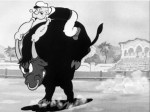 In ‘Bulldozing the Bull’ we suddenly find Popeye in either Mexico or Spain, fancying a latin version of Olive Oyl.
Popeye follows the Spanish Olive into the arena, but is suddenly forced to fight the bull himself, something he already had done in his third cartoon ‘I Eats My Spinach‘ (1933).
In that cartoon Popeye beat the bull into a meat market, but five years later he refuses to fight the bull, because it’s inhuman to do so. Indeed, the cartoon clearly turns anti-bullfighting, and in the end Popeye sings ‘Don’t be a bullfighter, because kindness is righter’ to his own tune.
This is all a clear result of the role model Popeye had become over the years. Indeed, already in Segar’s Sunday Pages, Popeye had been promoting kindness to animals and other gentle behavior. It’s this original mix of kindness and violence that made Popeye such a wonderful comic character, and in this film the Fleischers play that combination to an excellent effect.
Watch ‘Bulldozing the Bull’ yourself and tell me what you think:
http://www.dailymotion.com/video/x5v5ip6
This Popeye film No. 63
To the previous Popeye film: The Jeep
To the next Popeye film: Mutiny Ain’t Nice
‘Bulldozing the Bull’ is available on the DVD-set ‘Popeye the Sailor Volume Two’
Director: Dave Fleischer
Release Date: May 29, 1938
Stars: Popeye, Olive Oyl
Rating: ★★★½
Review:
 ‘I Yam Love Sick’ opens with Olive Oyl reading a romance.
Popeye drops by, but Olive ignores him completely. Later she explains she has a new boyfriend now, Bluto. To win her back, Popeye feigns to fall very ill. This leads to a bizarre, and rather surreal series of hospital scenes, in which weird bearded doctors try to examine Popeye. In the end Popeye reveals he was only fooling, only to get clobbered by Olive.
‘I Yam Love Sick’ is full of delightful nonsense. The best gag is when Olive steps out of the panel to address the audience with an ‘is there a doctor in the house?’.
Watch ‘I Yam Love Sick’ yourself and tell me what you think:
This Popeye film No. 60
To the previous Popeye film: Big Chief Ugh-Amugh-Ugh
To the next Popeye film: Plumbing is a “Pipe”
‘I Yam Love Sick’ is available on the DVD-set ‘Popeye the Sailor Volume Two’
Director: Frank Tashlin
Release Date: June 25, 1938
Rating: ★★★½
Review:
 ‘Have You Got any Castles?’ is the second of Frank Tashlin’s three contributions to the Warner Bros. books-come-to-life-cartoons, a type of short unique to this studio.
The cartoon doesn’t really have any story, but is built around four songs, of which the song ‘Have You Got Any Castles’ , from the film ‘The Varsity Show’ (1937) is the last.
This entry is one of the most Silly Symphony-like of all, starting with a particular lush opening, in which a town crier casts a huge shadow on a library. There’s also some beautiful shading on this character (a caricature of radio man Alexander Walcott) himself.
The Silly Symphony-like lushness notwithstanding, the cartoon is full of gags and caricatures of a.o. Greta Garbo, Cab Calloway (while Heidi sings hi-de-hi), Clark Gable, Charles Laughton and W.C. Fields. The animation is surprisingly mature, and shows how the Warner Bros. studio had improved in only a few years. The human figures are particularly lifelike, highlight being the town crier, and some scarcely dressed black ladies dancing to the swinging score.
The film features best-sellers from the 1920’s and 1930’s like ‘Topper’ (1926) by Thorne Smith, ‘Green Pastures’ (1929) by Marc Connelly, and ‘The Good Earth’ (1932) by Pearl S. Buck, which had been made into a film in 1937. It also revisits and improves on the thin man gag from ‘Speaking of the Weather’ (1937).
When the three musketeers rescue the prisoner of Zenda, the cartoon suddenly bursts into a frantic finale, with all kinds of book characters shooting at the four characters. After this frenzy we return to the town crier, rounding off this wonderful cartoon perfectly.
Watch ‘Have You Got any Castles?’ yourself and tell me what you think:
‘Have You Got any Castles?’ is available on the DVD-set ‘Looney Tunes Golden Collection: Volume 2’
Directors: Ben Hardaway & Cal Dalton
Release Date: July 9, 1938
Rating: ★★½
Review:
 Love and Curses’ is set during the gay nineties and is a spoof of the classic melodrama, complete with mustached villain, a train track and a sawmill.
Unfortunately, the cartoon is hampered by the stiff melodramatic dialogue and the slow timing. Most of the ‘humor’ comes from the invincible hero Harold reciting proverbs all the time, but his appearances are tiresome, not funny. There are also a couple of throwaway gags, but these are mildly amusing at best.
This is one of those rather rare cartoons (not counting Popeye) featuring adult human designs, and the results are pretty unsteady. The animation of the girl singing at the nightclub is the most elaborate, but none of the animation is convincing.
Chuck Jones would visit the same kind of material four years later with ‘The Dover Boys‘, which seems light-years ahead of this cartoon.
Watch ‘Love and Curses’ yourself and tell me what you think:
http://www.dailymotion.com/video/xu5lrc
‘Love and Curses’ is available on the DVD-set ‘The Busby Berkeley Collection’
Director: Dave Fleischer
Release Date: May 27, 1938
Stars: Betty Boop, Pudgy
Rating: ★★
Review:
 ‘The Swing School’ marks a return of Betty Boop to the animal world she came from in the early 1930s.
In this cartoon she runs a swing school for anthromorpic kid animals, including an elephant, a hippo, a giraffe, and Pudgy. Pudgy, like Pluto, had been only a half anthropomorphized dog and wasn’t able to speak. So in this cartoon, in which he’s more treated as a little kid than as a dog, all these animals are devoid of speech. However, they can sing and play the piano.
Unfortunately, Pudgy is not doing well at all, singing Betty Boop’s trite Lalala song way out of tune. So Betty makes him sit in the dunce’s corner. But when a female dachshund takes pity on the pup, and kisses him, Pudgy suddenly bursts into some serious scatting, making the whole class swing.
‘The Swing School’ surfs on the swing craze, which was in full swing (pardon the pun) by 1938. Although the catchy scatting part is a warm welcome back to Betty Boop’s early jazz days, most of the cartoon is terribly slow and extremely childish, and so tiresome that it comes close to the point of being unwatchable. In no sense the cartoon comes close to the Fleischers’ greatest swing cartoons, like ‘Swing, You Sinners!‘ (1930) or ‘Minnie the Moocher‘ (1932).
Only two weeks later, Warner Bros. would release ‘Katnip Kollege‘ covering the same subject, but with much, much more spirit.
Watch ‘The Swing School’ yourself and tell me what you think:
This is Betty Boop cartoon No. 74
To the previous Betty Boop cartoon: Out of the Inkwell
To the next Betty Boop cartoon: Pudgy the Watchman
‘Out of the Inkwell’ is available on the Blu-Ray ‘Betty Boop: The Essential Collection, Vol. 4’ and the French DVD Box Set ‘Betty Boop Coffret Collector’
Director: Dave Fleischer
Release Date: April 22, 1938
Stars: Betty Boop
Rating: ★★★½
Review:
 ‘Out of the Inkwell’ starts with live action footage of a black cleaner reading a book on hypnosis.
Hypnosis as conceived by the Fleischers is more like a magic spell, and has the power of making things come alive. The cleaner hypnotizes a pen that then draws an old-style Betty. He hypnotizes this miniature Betty, too, but she turns the tables on him, hypnotizing the broom and the fan, and finally, the man himself, making him clean the room rapidly.
‘Out of the Inkwell’ returns to the origins of Max Fleischer’s career, blending animation and live action using a character born out of ink. The result surely is one of the more original latter day Betty Boop cartoons, and a delightful mix of live action, stop motion and traditional animation.
The cartoon delivers less than it promises, however, and is particularly hampered by the black man’s extremely stereotyped lazy voice, which sounds like it has been dubbed. Highlight is the hypnotized Betty, who dives and swims in mid air, and who is animated extraordinarily rubbery.
Watch ‘Out of the Inkwell’ yourself and tell me what you think:
This is Betty Boop cartoon No. 73
To the previous Betty Boop cartoon: Be Up To Date
To the next Betty Boop cartoon: The Swing School
‘Out of the Inkwell’ is available on the French DVD Box Set ‘Betty Boop Coffret Collector’
Director: Dave Fleischer
Release Date: January 28, 1938
Stars: Betty Boop, Pudgy
Rating: ★★
Review:
 In ‘Riding the Rails’ Pudgy, Betty Boop’s cute puppy, follows Betty on her way to work.
He loses her on the subway, where he causes havoc. When he’s being chased by a rather poorly designed and ditto animated conductor he lands on the rails, where he’s almost killed. He hurries off home, and straight back into his bed.
Betty’s ride on the subway recalls a similar bus ride in ‘Judge for a Day’ (1935), and is most enjoyable in its depiction of subway annoyances. However, most of the cartoon deals with Pudgy’s terror, and plays on melodrama, not laughs. This makes ‘Riding the Rails’ a sympathetic, yet rather forgettable cartoon.
Watch ‘Riding the Rails’ yourself and tell me what you think:
This is Betty Boop cartoon No. 71
To the previous Betty Boop cartoon: Zula Hula
To the next Betty Boop cartoon: Be Up To Date
‘Riding the Rails’ is available on the Blu-Ray Betty Boop: The Essential Collection Vol. 3 and on the French DVD Box Set ‘Betty Boop Coffret Collector’
Director: Ben Sharpsteen
Release Date: June 17, 1938
Rating: ★★★½
Review:
 ‘Polar Trappers’ is the first of six cartoons co-starring Donald Duck and Goofy.
This mini-series, which lasted until 1947, is much less well-known than the trio-cartoons of the 1930s, and rightly so, for these cartoons are okay at best, and never reach the classic heights of a ‘Clock Cleaners’ (1937) or ‘Mickey’s Trailer’ (1938).
One of the problems of these shorts is that the studio never really succeeded in making comedy out of interaction between these two characters. Without the bridging Mickey, it was in fact, rather unclear why the two very different characters were actually together.
In ‘Polar Trappers’ Donald Duck and Goofy don’t share any screen time until the very end. This cartoon incongruously places them on some unknown expedition in the Antarctic. Apparently they want to catch walruses, but even Goofy has no clue why, as he sings in his opening scene.
Meanwhile Donald Duck is tired of cooking beans. He’d rather eat penguin meat, so he dresses like a penguin and tries to lure a population of penguins, much like the pied piper. This march of the penguins accounts for some beautiful shots, most notably one in which the penguins cast large shadows across the screen. The penguins’ design come straight from the Silly Symphony ‘Peculiar Penguins‘ (1934).
Donald’s evil plan is stopped by one tear of a little penguin he had sent away. This tear grows into a huge snowball, destroying the duo’s camp.
Shortly after this film’s release (August 15-27, 1938) Al Taliaferro’s Donald Duck comic strip drew inspiration from the same material, but now without Goofy.
Watch ‘Polar Trappers’ yourself and tell me what you think:
‘Polar Trappers’ is available on the DVD-set ‘The Chronological Donald Volume 1’
Director: Jack King
Release Date: April 15, 1938
Rating: ★★★★½
Review:
 ‘Donald’s Nephews’ marks the screen debut of Donald’s famous nephews, Huey, Dewey, and Louie.
Al Taliaferro had introduced them in the Donald Duck Sunday Page of October 17, 1937, and by April 1938 they had become regular stars of the Donald Duck comic strip. Their screen debut is explosive, however. Once inside the “angel nephews” initiate a game of polo on their tricycles, wrecking Donald’s house within seconds.
Luckily Donald Duck discovers a book on ‘Modern Child Training’, which gives him ideas to treat the three kids. First, Donald tries to sooth the brats by playing Pop Goes the Weasel on the piano, to no avail. Then he tries to calm them down with a nice turkey supper, still without success. In the end of the cartoon the three nephews rush off back to Aunt Dumbella, supposedly their mother, but they would return three months later, in ‘Good Scouts‘. In fact, Uncle Donald clearly became their surrogate father, as Aunt Dumbella was never seen in either comic strip or animated film.
‘Donald’s Nephews’ is a wonderful cartoon: the gags come in fast and plenty, and there’s a real battle of wits going on between Donald and his nephews. There’s nothing of the slowness of Donald’s earlier cartoons. Instead, there’s a lot of speed, and some remarkable exaggeration, like Donald Duck’s hand swelling up three times its original size, and the sound effect of horses galloping when the three nephews rush to the dinner table. Highlight of ‘Donald’s Nephews’ may be the saying grace scene, which is anything but devout. Donald’s attempts to pacify his nephews come from a book, a story idea later copied in e.g. ‘Goofy’s Glider‘ (1940), and the Tom & Jerry cartoon ‘Mouse Trouble’ (1944).
Speed, exaggeration, weird sound effects, the book idea – all these elements look forward to the zanier cartoon style of the 1940s, of which ‘Donald’s Nephews’ can be regarded as an early example.
‘Donald’s Nephews’ is an important cartoon: it clearly establishes Donald Duck as old enough to be an authority figure to the three kids. His school-going days of ‘Donald’s Better Self’ were now over. Moreover, the wrecking trio are a worthy adversary to the duck, really testing his temper. This would lead to many great cartoons, e.g. ‘Good Scouts‘, ‘The Hockey Champ‘ (both 1938), ‘Sea Scouts‘ (1939) and ‘Mr. Duck Steps Out‘ (1940). Huey, Dewey, and Louie starred 23 cartoons in total, lasting until Donald Duck’s very last theatrical cartoon, ‘The Litterbug‘ (1961).
Watch ‘Donald’s Nephews’ yourself and tell me what you think:
This is Donald Duck cartoon No. 4
To the previous Donald Duck cartoon: Donald’s Better Self
To the next Donald Duck cartoon: Good Scouts
‘Donald’s Better Self’ is available on the DVD-set ‘The Chronological Donald Volume 1’
Director: Jack King
Release Date: March 11, 1938
Rating: ★★★
Review:
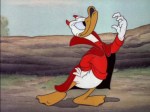 When ‘Donald’s Better Self’ was released, it was not yet firmly established whether Donald Duck was a boy or an adult.
This would be settled in the next cartoon, ‘Donald’s Nephews‘, with Donald clearly playing a rather unlikely role of authority figure. But in ‘Donald’s Better Self’ he’s young enough to go to an elementary school.
Throughout the cartoon, Donald is advised by both is angelic and his devilish self. The devilish self makes him skipping school and smoking a pipe, which renders Donald sick. Luckily, his angelic side comes to the rescue, mimicking a war plane, and clobbering the devilish side straight into hell.
‘Donald’s Better Self’ is animated wonderfully throughout, but as often, Jack King’s timing is terrible, wearing down the action. Worse, the tale is overtly moralistic (typical for the mid-1930s), and low on gags. The result is another mediocre entry in Donald’s fledgling series. Luckily, with the next Donald Duck cartoon, ‘Donald’s Nephews’, the studio would hit the jackpot.
Together with material from ‘Self Control‘, animation from ‘Donald’s Better Self’ was reused in the film ‘Donald’s Decision‘ (1941), a war propaganda film for the Canadian government.
Watch ‘Donald’s Better Self’ yourself and tell me what you think:
This is Donald Duck cartoon No. 3
To the previous Donald Duck cartoon: Self Control
To the next Donald Duck cartoon: Donald’s Nephews
‘Donald’s Better Self’ is available on the DVD-set ‘The Chronological Donald Volume 1’
Director: Dave Fleischer
Release Date: April 25, 1938
Stars: Popeye, Olive Oyl
Rating: ★★★
Review:
 The title character of this cartoon is a stereotype Indian chief who longs for a squaw, as he immediately tells us in his opening song.
Enter Popeye and Olive on a stubborn donkey. At one point the donkey kicks Olive inside the Indian camp, and she seems to fall for the chief’s advances. The Indians, meanwhile, order Popeye to perform some difficult tasks, and with spinach he does them much better than his Indian rivals.
‘Big Chief Ugh-Amugh-Ugh’ is an uneven cartoon, and suffers from inadequate storytelling, and severe stereotyping. The cartoon is saved by Jack Mercer’s constant mumbling, which is particularly inspired.
Watch ‘Big Chief Ugh-Amugh-Ugh’ yourself and tell me what you think:
This Popeye film No. 59
To the previous Popeye film: The House Builder Upper
To the next Popeye film: I Yam Love Sick
‘Big Chief Ugh-Amugh-Ugh’ is available on the DVD Box Set ‘Popeye the Sailor 1933-1938’


 Dr. Grob's Animation Review