
You are currently browsing the tag archive for the ‘1942’ tag.
Director: Dave Fleischer
Release Date: June 15, 1942
Stars: Superman
Rating: ★★½
Review:
 In the seventh Superman short New York is threatened by – whattaya know? – an evil scientist. But this evil scientist is more original than all the others before him: he is of Native American origin and he claims Manhattan for his own people.
Nonetheless, like all other evil scientists before him, he has a machine. His ridiculous machine causes earthquakes by using electricity. Oddly enough, the scientist first makes his threats at the Daily Planet. And when he returns to his secret hideout, Lois, of course, follows him. In his laboratory below sea level the scientist makes Lois watch the destruction of the city.
Luckily, Superman saves Manhattan by destroying the machine. However, he’s only able to rescue Lois because the scientist tells him that she’s still down in his laboratory, which is rapidly filling with water…
In any case the result is yet another routine entry.
Watch ‘Electric Earthquake’ yourself and tell me what you think:
This is Superman film No. 7
To the previous Superman film: The Magnetic Telescope
To the next Superman film: Volcano
Director: Dave Fleischer
Release Date: April 24, 1942
Stars: Superman
Rating: ★★
Review:
 In ‘The Magnetic Telescope’, the sixth entry in the Superman series, yet another evil scientist attracts ‘flaming comets’ with a ridiculously looking magnetic telescope.
As one comet has destroyed part of the city, the police tries to stop the villain from hauling in another one. But their attempts make the professor lose control over the comet, and while destruction is at hand, Lois phones the Daily Planet from the laboratory. When her call ends in a scream, Clark Kent rushes… er… takes a cab to the laboratory. Only when the cab is stopped by one of the comet’s offshoots, he changes into Superman and flies up there…
Superman, of course, saves the day. He first tries to stop the comet itself (which falls remarkably slowly), but surprisingly, this is too much for him, and his antics produce more offshoots, which destroy bridges and such. So, in a bright moment he restores power to the magnetic telescope, telling Lois to put the machine on ‘reverse’… (how Superman came to know how the telescope works, we’ll never know…).
The whole story is amazingly ridiculous, especially because the story is told in the most sincere fashion. It shows the Fleischer studio’s discomfort with realism all too clearly.
The all too powerful comet is a minor surprise within the formulaic Superman series. But ‘The Magnetic Telescope’ has two other deviations from the story formula: in this entry Clark Kent doesn’t say his usual ” this looks like a job for Superman”,’ and Lois manages to kiss Superman, who, unfortunately turns out to be Clark Kent, after all…
Watch ‘The Magnetic Telescope’ yourself and tell me what you think:
This is Superman film No. 6
To the previous Superman film: The Bulleteers
To the next Superman film: Electric Earthquake
Director: Dave Fleischer
Release Date: March 26, 1942
Stars: Superman
Rating: ★★
Review:
 Although it’s only the fifth Superman cartoon, ‘The Bulleteers’ already feels so formulaic, it’s depressing.
Like in Superman’s first two cartoons some evil scientists with some crazy machine threaten the city, Lois gets into trouble, superman saves her and Clark Kent discusses her story in the newspaper with her. This time the novelty is that we’re watching three villains.
The evil trio has invented a ‘bullet car’ (part car, part plane, part rocket), with which they destroy the police headquarters and a power-plant by flying through it. Lois foolishly climbs aboard the car, but Superman drags her and the villains out of it in flight.
The spectacular angular staging and effective lighting in this cartoon cannot hide the fact that with ‘The Bulleteers’ the series had reached an inspirational low point story-wise. Later in 1942, the war became a major theme in the Superman series, which fortunately led to more inspired story ideas.
Watch ‘The Bulleteers’ yourself and tell me what you think:
This is Superman film No. 5
To the previous Superman film: The Arctic Giant
To the next Superman film: The Magnetic Telescope
Director: Chuck Jones
Release Date: February 14, 1942
Stars: Conrad Cat, Daffy Duck
Rating: ★★½
Review:
 ‘Conrad the Sailor’ is the third and last cartoon featuring the early Chuck Jones character Conrad Cat, who also starred ‘Porky’s Cafe’ and ‘The Bird Came C.O.D.’, all from early 1942.
Conrad’s most distinctive trait was his voice, provided by Pinto Colvig, who also voiced Goofy. Indeed, Conrad’s and Goofy’s voices are very similar. However, in ‘Conrad the Sailor’ his voice is rarely heard, as most of the comedy is silent.
In ‘Conrad the Sailor’ Conrad Cat works as a sailor on a battle cruiser (a setting reflecting the war time), where he is nagged by Daffy Duck. Their chase is stopped several times by a small captain who pops up at unexpected moments, a type of gag typical for early Chuck Jones cartoons (see e.g. ‘Inki and the Minah bird’ from 1941 and ‘The Dover Boys‘ from 1942).
‘Conrad the Sailor’ is not a very funny cartoon: neither Conrad nor Daffy behave sympathetically, and the origin of their conflict remains unknown. The Daffy-Conrad-encounters appear to be nothing more than a string of unrelated events. Moreover, Jones’s pacing is still rather slow at times, wearing the comedy down. Conrad’s personality is rather undefined, and after this cartoon he was shelved.
Notwithstanding its weaknesses, the cartoon is noteworthy for its remarkably stylized and surprisingly angled backgrounds, courtesy of lay-out artist John McGrew, who collaborated with Jones on a number of cartoons, before joining the navy himself in 1942. The backgrounds in these cartoons are often the real highlight of the short, and look all the way forward to UPA’s cartoon modern style of the early fifties. McGrew would push the limits even further in ‘The Aristo-Cat‘ (1943).
This is Daffy Duck cartoon No. 12
To the previous Daffy Duck cartoon: The Henpecked Duck
To the next Daffy Duck cartoon: Daffy’s Southern Exposure
‘Conrad the Sailor’ is available on the DVD-set ‘Looney Tunes Golden Collection Volume Four’
Director: Friz Freleng
Release Date: October 10, 1942
Stars: Bugs Bunny, Elmer Fudd
Rating: ★★½
Review:
 ‘The Hare-Brained Hypnotist’ was only the sixth encounter between Elmer Fudd and Bugs Bunny, and only the second by Friz Freleng, but already the routine was ripe for experiment.
In ‘The Hare-Brained Hypnotist’, penned by Michael Maltese, Elmer consults a book on hypnosis to catch Bugs. His hypnosis skill work on a bear, which Elmer makes think it’s a canary. It fails on Bugs however, who in turn manages to hypnotize Elmer, making him think he’s a rabbit. Elmer immediately swaps into a Bugs Bunny routine, leaving Bugs to play the straight guy. But after another hypnosis battle down the rabbit hole, Elmer returns to his former self, fleeing into the distance, while Bugs tells us he’s the B19, referring to the Douglas XB19, a huge experimental bomber plane, which had had its first flight on 27 June 1941.
‘The Hare-Brained Hypnotist’ is not a very funny cartoon. The comedy suffers, because Bugs is forced into the role of the straight guy, a problem the cartoon shares with e.g. ‘Tortoise Beats Hare‘ from 1941. Nevertheless, Elmer’s Bugs Bunnyarisms are quite hilarious, especially in a scene where he makes Bugs eat several carrots at one time.
Watch an excerpt from ‘The Hare-Brained Hypnotist’ yourself and tell me what you think:
http://www.dailymotion.com/video/x2zqdzr
This is Bugs Bunny cartoon No. 13
To the previous Bugs Bunny cartoon: Fresh Hare
To the next Bugs Bunny cartoon: Case of the Missing Hare
Director: Wilfred Jackson & Ben Sharpsteen
Release Date: January 23, 1942
Stars: Donald Duck
Rating: ★★★★
Review:
 When the United States were forced into the war themselves, the government asked Disney to make a short to make the American citizens fill in their income tax forms in time. Disney gave them his biggest star of that time, Donald Duck, to play the everyman. The government was not impressed until the taxes came rolling in after the film was screened in cinemas.
In contrast to Disney’s earlier propaganda films for the Canadian government, this film uses entirely new animation, directed by Wilfred Jackson, and produced in the ridiculously short time period of a single month.
The short opens with Donald dancing to the energetic title song, which is sung by Cliff Edwards, the voice of Jiminy Cricket in ‘Pinocchio‘ (1940). The song is played on a slightly anthropomorphised radio. The radio then asks Donald if he wants to do his part for the country and Donald is growing more and more enthusiastic, until the radio reveals he has to pay his income tax. The radio has to persuade Donald once again, who grows enthusiastic again to the strong slogan ‘Taxes to beat the axis’ (with the axis referring to the Axis powers: Germany, Italy and Japan).
The film further explains the public how to fill in a new, simplified form, using an anthropomorphized pen, bottle of ink and blotter. Like the shorts Disney made earlier for the Canadian government (e.g. ‘The Thrifty Pig‘ and ‘7 Wise Dwarfs‘), the second half (directed by Ben Sharpsteen) consists of very limited and highly propagandistic animation with grim images of factories, guns, planes, war ships and tanks, while an intense narrator repeats the intoxicating mantra of ‘taxes to beat the axis’.
When he comes to the propagandist climax, the sentence “to beat to earth the evil destroyer of freedom and piece”, we watch a horrifying towering monster-like machine depicting the Nazi aggressor. This mechanical monster is defeated and makes place for a patriotic end shot with clouds resembling the American flag, tanks and guns rolling and planes flying accompanied by a heroic hymn, while the narrator tells us that “this is our fight”.
It’s important to note that the film goes at lengths to dehumanize the enemy. The average tax payer was not to help to kill people, but to destroy “the enemy”, in this case a vague mechanical monster. Succeeding propaganda films often eschewed the idea that making war is killing people, with the propaganda feature ‘Victory through Air Power’ (1943) being the prime example.
In case of “The New Spirit”, propaganda rarely was so obvious, but it works: after watching the picture I had its slogan in my head for days. Indeed, the film was so successful, that it got a follow-up the next year: ‘The Spirit of ’43‘.
Watch ‘The New Spirit’ yourself and tell me what you think:
Director: Fred Beebe
Release Date: January 13, 1942
Stars: Clarabella Cow, Donald Duck, Figaro, Geppetto, Goofy, Horace Horsecollar, Huey, Dewey and Louie, Mickey Mouse, Pinocchio, Pluto, The Seven Dwarfs
Rating: ★★★½
Review:
 ‘All Together’ is the last and the shortest of the four propaganda films Disney made for the Canadian government.
In the first half we only see some Disney stars parading on patriotic march music in front of the Canadian parliament building in Ottawa. This short scene reuses animation from ‘Pinocchio‘ (Pinocchio, Geppetto and Figaro), ‘Good Scouts‘ (Donald and his nephews), ‘Bone Trouble‘ (Pluto), ‘The Band Concert‘ (Mickey and the gang), ‘Mickey’s Amateurs‘ (Goofy) and ‘Snow White and the Seven Dwarfs’ (the seven dwarfs, who are clearly singing and whistling, although their voices are not heard). ‘All Together’ is the only propaganda short to feature Pinocchio stars.
The second half uses powerful imaginary to persuade the public to buy war certificates. Of the new images, the most striking is the one of coins marching with bayonets.
‘All Together’ is image only. It doesn’t feature any kind of story, making it the least interesting of the four Canadian propaganda films.
Watch ‘All Together’ yourself and tell me what you think:
Director: Ford Beebe
Release Date: January 11, 1942
Stars: Donald Duck
Rating: ★★★
Review:
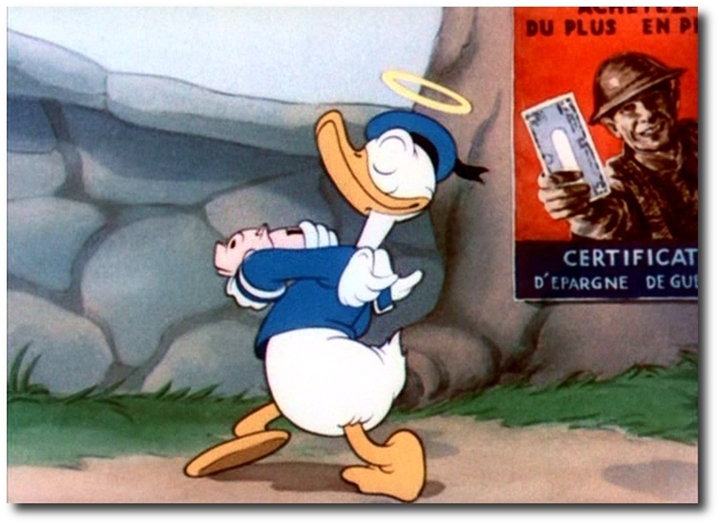 ‘Donald’s Decision is Walt Disney’s third short to persuade the Canadian public to buy war certificates.
This film has the same two-part formula as ‘The Thrifty Pig‘ and ‘7 Wise Dwarfs‘ from 1941. The first half combines reused footage from two Donald Duck shorts from 1938: ‘Self Control‘ and ‘Donald’s Better Self‘, but with altered voices. The second half resembles that of ‘The Thrifty Pig‘ and ‘7 Wise Dwarfs‘.
The result is less convincing than in the earlier two cartoons, probably because the source material is weaker. Neither ‘Self Control’ nor ‘Donald’s Better Self’ belong to Donald Duck’s best. Besides, Donald only reluctantly does his part, in great contrast to the optimistic pigs and dwarfs from the earlier shorts. Indeed, when Disney had to convince the American public for government purposes, the studio came up with completely new animation for its biggest star (in ‘The New Spirit‘ and ‘The Spirit of ’43‘).
Watch ‘Donald’s Decision’ yourself and tell me what you think:
Director: Jack Kinney
Release Date: December 4, 1942
Stars: Goofy
Rating: ★★★½
Review:

‘How to fish’ kicks off nonsensically when the narrator explains how astrology gives ‘man’ (Goofy) an urge to fish.
The cartoon consists of blackout gags involving various types of fishing, like angling and lake fishing. In the end Goofy manages to capture one fish, which turns out to be his own outboard motor.
‘How to Fish’ is one of Goofy’s less inspired sports cartoons, even though it’s pretty enjoyable. It is the first Goofy short to use oil background paintings. It contains one discontinuity incident: when he fishes himself into a tree, he shortly wears his socks again.
Watch ‘How To Fish’ yourself and tell me what you think:
This is Goofy cartoon No. 9
To the previous Goofy cartoon: How to Swim
To the next Goofy cartoon: Victory Vehicles
Director: Jack Kinney
Release Date: October 23, 1942
Stars: Goofy
Rating: ★★★★★
Review:

With ‘How To Swim’ director Jack Kinney really hit his stride. The film perfectly blends educational information with total nonsense.
The result is one of the best of Goofy’s ‘how to’ shorts, ‘How to swim’ starts off hilariously, when Goofy practices various strokes on a piano stool, unknowingly crossing the street while doing so. Other gags involve Goofy trying to change in a remarkably small beach locker and his attempts to bath in the surf.
The best part, however, is the diving sequence. Here, a great story device is introduced: the chart-like figure, borrowed from the educational shorts Disney made for the war effort at that time. The diving sequence also features the use of the ‘slow motion camera’, which was introduced in the ‘How to ride a horse’ sequence within ‘The reluctant Dragon‘ (1941). The combination of the slow motion camera’s ridiculously elaborate animation and the perfection of the chart figure is deadly funny.
It’s characteristic for the high quality standards at the Disney Studio that even regular gag cartoons contain beautiful and convincing effect animation, like the tidal waves in ‘How to Swim’.
Watch ‘How To Swim’ yourself and tell me what you think:
This is Goofy cartoon No. 8
To the previous Goofy cartoon: The Olympic Champ
To the next Goofy cartoon: How to Fish
Director: Jack Kinney
Release Date: October 9, 1942
Stars: Goofy
Rating: ★★★½
Review:
 ‘The Olympic Champ’ is Goofy’s fourth sports cartoon. Here, Goofy demonstrates the athletic sports of the Olympics: running, hurdles, pole vault jumping, hammer drawing and the decathlon.
Goofy has particular problems with the narrator in this short: he’s almost burned by the eternal flame while the narrator pompously chatters away, and he has to try to balance on a pole, while the narrator is reciting a poem.
‘The Olympic Champ’ is not the best of Goofy’s sports cartoons, but it is enjoyable in its successful blend of blackout gags and great animation.
Watch ‘The Olympic Champ’ yourself and tell me what you think:
This is Goofy cartoon No. 7
To the previous Goofy cartoon: How to Play Baseball
To the next Goofy cartoon: How to Swim
Director: Jack Kinney
Release Date: September 4, 1942
Stars: Goofy
Rating: ★★★
Review:
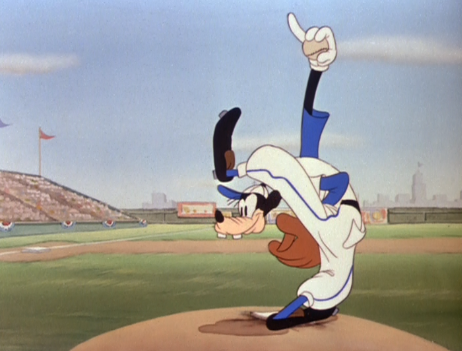 ‘How to Play Baseball’ is the third of Goofy’s sport cartoons, and the first with a title beginning with ‘How to’ (following the ‘How to Ride a Horse’ sequence in ‘The Reluctant Dragon‘ (1941).
The short forms the next and final step in Goofy’s evolution after the duplication of Goofies in the previous cartoon, ‘The Art of Self Defense‘: now multiple Goofies are together the stars of the cartoon. The character remains unique in the cartoon canon in this ability to duplicate himself and remain Goofy throughout, nonetheless.
The short has a highly entertaining way to explain baseball, ending with an exciting finale of the World championship. The gags come fast and plenty, depicting a lot of nonsense. Nevertheless, the cartoon is not only funny, it’s also surprisingly educational.
In the years following ‘How to Play Baseball’ baseball would return to the animated screen in the Woody Woodpecker cartoon ‘The Screwball’ (1943) and in the Bugs Bunny cartoon ‘Baseball Bugs‘ (1944).
Watch ‘How To Play Baseball’ yourself and tell me what you think:
This is Goofy cartoon No. 6
To the previous Goofy cartoon: The Art of Self Defence
To the next Goofy cartoon: The Olympic Champ
Director: Chuck Jones
Release Date: September 19, 1942
Rating: ★★★★★ ♕
Review:
 ‘The Dover Boys’ or, as it is actually called, ‘The Dover Boys at Pimento University or The Rivals of Roquefort Hall’, is director Chuck Jones’s first masterpiece.
The short introduces his trademark of extreme poses, which in this cartoon are combined with ‘smear animation’ to unique results.
The extreme posing leads to highly stylized animation, which in itself is hilarious in its unnatural depiction of movement. In ‘The Dover Boys’ we watch both movement through poses, especially in the animation on Dan Backslide, as well as non-movement, with Dora descending the stairs as a prime example. Both techniques are important steps away from the classic squash-and-stretch animation, and from ‘believability through full animation’. Indeed, the animation style of ‘The Dover Boys’ looks forward all the way to the fifties, the era in which stylization of design and animation would flourish and dominate the animation industry. Indeed, the short’s prime animator, Bobe Cannon, would play an important role at UPA, the most influential animation film studio of the fifties.
The subject of ‘The Dover Boys’ is a sophisticated parody on melodrama, consisting of an archetypical story of a villain (called Dan Backslide) kidnapping a damsel in distress (dear Dora), taking her to his cottage in the mountains, where she is rescued by the heroes, in this case, the three Dover Boys, Tom, Dick and Larry.
Or is she? In the final scene they knock each other out, and Dora runs off into a distance with an odd bearded character in a bathing suit, who, as a running gag, hops along rather randomly throughout the picture to the music of ‘The Good Old Summertime’. This character is a relative of the equally mysterious Minah Bird from Chuck Jones’ earlier cartoon ‘Inki and the Lion’ (1941).
‘The Dover Boys’ is both innovative and funny. Its humor is as sophisticated as it is silly. In any case, the gags come fast and plenty, with hilarious nonsense as a result. An all time classic.
Watch ‘The Dover Boys’ yourself and tell me what you think:
Director: Jack King
Release Date: December 18, 1942
Stars: Donald Duck, Pete
Rating: ★★★★½
Review:
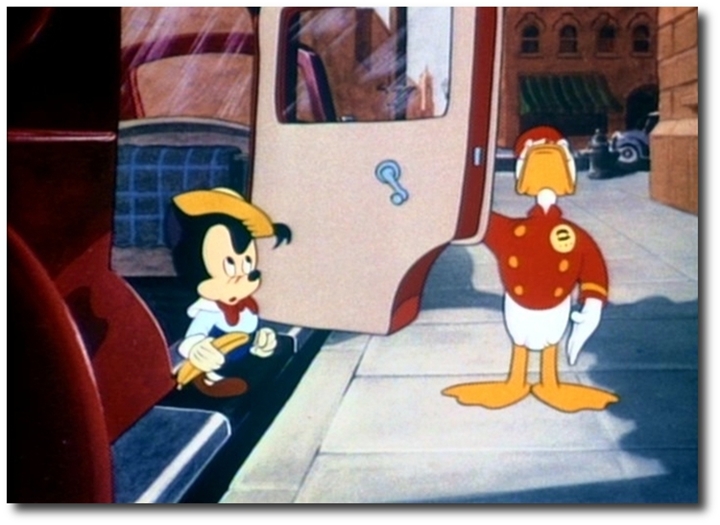 Donald is a bellboy at a chic hotel. He’s hindered in doing his job by Pete’s mischievous son (yes, Pete has got a son in this cartoon).
Pete manages to stay calm, but not Donald. In the end, Donald is fired, but he gets his chance to spank the wicked brat.
‘Bellboy Donald’, penned by Duckmen Carl Barks and Jack Hannah, is one of the better Donald Duck cartoon of the early forties. You won’t find any better interplay between Donald and Pete, with the exception maybe of ‘Trombone Trouble’ (1944).
Moreover, the cartoon contains some remarkably flexible animation of a type rarely seen in a Disney cartoon.
Watch ‘Bellboy Donald’ yourself and tell me what you think:
This is Donald Duck cartoon No. 37
To the previous Donald Duck cartoon: Sky Trooper
To the next Donald Duck cartoon: Der Fuehrer’s Face
Director: Dick Lundy
Release Date: July 12, 1942
Stars: Donald Duck
Rating: ★★
Review:
 In ‘Donald’s Garden’ Donald is a gardener, wearing a straw hat. We watch him having trouble with a water pump and with a gopher, which eats all his vegetables.
‘Donald’s Garden’ is a slow and boring cartoon. It’s hampered by particularly uninspired backgrounds, and it is one of the weaker entries in the Donald Duck series.
It has the same structure as ‘The Village Smithy‘ from earlier that year: it consists of only two situation gags: one with an inanimate object (the pump), and one with an animal (the gopher). Apparently, director Dick Lundy favored these types of gags, for they returned in ‘Donald’s Goldmine’, and in ‘Donald’s Tire Trouble‘, Lundy’s only successful cartoon in terms of situation comedy.
‘Donald’s Garden’ is the first Disney cartoon trying to be funny with gophers. But like the later Pluto shorts ‘Bone Bandit‘ (1948) and ‘Pluto and the Gopher‘ (1950), the studio doesn’t succeed. One may wonder whether gophers are funny, at all.
Watch ‘Donald’s Garden’ yourself and tell me what you think:
This is Donald Duck cartoon No. 33
To the previous Donald Duck cartoon: Donald Gets Drafted
To the next Donald Duck cartoon: Donald’s Gold Mine
Director: Jack King
Release Date: April 10, 1942
Stars: Donald Duck, Huey, Dewey and Louie
Rating: ★★★½
Review:
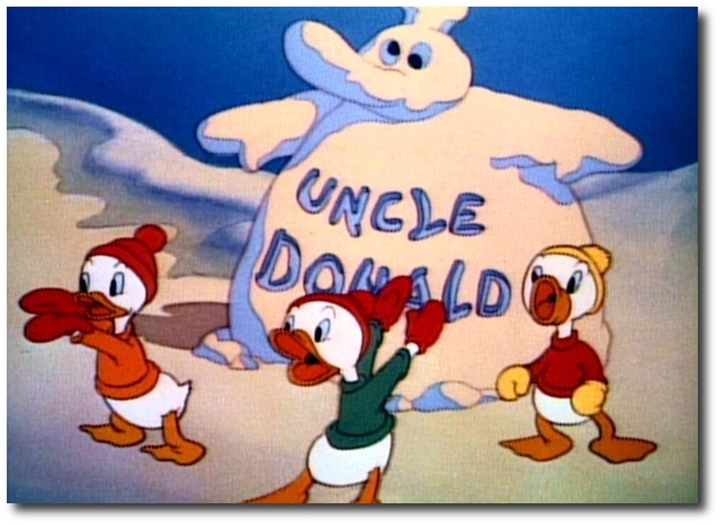 The world is covered in snow, and Donald goes for a sled ride, wearing a ridiculously broad fur overcoat.
He purposely ruins Huey, Dewey and Louie’s snowman by sledding right through it. They seek revenge and build a snowman resembling Donald around a rock. This feud leads to a snow-fight between admiral Donald on a battle ship made out of ice and his three nephews on an ice fort.
‘Donald’s Snow Fight’ is a classic Donald vs. his nephews cartoon, but the complete film is quite slow, due to Jack King’s tame directing. Despite some excellent gags, it doesn’t live up to ‘The Hockey Champ‘ (1939), the other classic winter cartoon featuring Donald and his nephews, or ‘Truant Officer Donald‘ (1941), which also features a battle between Donald and his nephews.
The short’s excellent story is by Carl Barks, who reused its theme two years later in his Donald Duck comic WDC 44-442.
Watch ‘Donald’s Snow Fight’ yourself and tell me what you think:
This is Donald Duck cartoon No. 31
To the previous Donald Duck cartoon: The Village Smithy
To the next Donald Duck cartoon: Donald Gets Drafted
Director: Dick Lundy
Release Date: January 16, 1942
Stars: Donald Duck
Rating: ★
Review:
 In ‘The Village Smithy’ Donald is a blacksmith who has to fix a large cartwheel and to shoe a stubborn female donkey. He succeeds in neither in this remarkably unfunny cartoon, which is one of the weakest within the whole Donald Duck series.
Long situation gags became a common feature of Disney shorts during the rise of the character comedy, in cartoons like ‘Mickey Plays Papa‘ (1934) and ‘Moving Day‘ (1936). Arguably, this time of comedy reaches its nadir in ‘The Village Smithy’. In it only two situations are milked to the length of the complete cartoon, with tiresome results. The wheel scene is the most interesting of the two, if still far from funny, and tributary to the spiral spring scene in ‘Clock Cleaners’ (1937).
The most interesting feature of this otherwise boring cartoon are its backgrounds, which belong to the first oil backgrounds in a Disney short, and which give the film a distinct, gloomy look. Donald, too, has a unique yellowish tan throughout this picture, setting the cartoon apart from all other Donald Duck shorts.
Watch ‘The Village Smithy’ yourself and tell me what you think:
This is Donald Duck cartoon No. 30
To the previous Donald Duck cartoon: Chef Donald
To the next Donald Duck cartoon: Donald’s Snow Fight
Director: Jack King
Release Date: July 30, 1942
Stars: Minnie Mouse, Pluto
Rating: ★★★
Review:
 ‘Out of the Frying Pan into the Firing Line’ is a short propaganda film aimed at American housewives.
In this propaganda short, Minnie is just about to give Pluto some hot bacon grease, when the narrator interrupts, telling housewives of America to save their kitchen fats in order to deliver them at a “neighborhood meat dealer, who is patriotically cooperating”. The fats are apparently used to make glycerine, which is used in ammunition.
This short contains a rare picture of Mickey as a soldier at the front. Otherwise, Mickey was left out of the propaganda, leaving that role to Donald Duck.
‘Out of the Frying Pan into the Firing Line’ is an interesting example of how the American government tried to make every citizen help in the war effort. It shows how World War II entered the life of the average citizen: even kitchen grease could be useful… It offers no one-liner, however, at the likes of the contemporary slogans ‘Save Your Scraps to Bomb the Japs’ or ‘Is Your Trip Really Necessary?”
Watch ‘Out of the Frying Pan into the Firing Line’ yourself and tell me what you think:
Director: Ben Sharpsteen
Release Date: July 21, 1942
Stars: The Three Little Pigs (in a cameo)
Rating: ★★★★
Review:
 Arguably the most ridiculous of all war time propaganda cartoons, ‘Food Will Win the War’ tells us about the successes of American agriculture.
A bombastic narrator makes all kinds of outrageous comparisons to illustrate the farmer’s huge production. Examples are baking all fruits of America into one big pie or frying all America’s meat on four Vesuvius volcanoes. The result is so absurd and its message so out to lunch that the short is actually great fun to watch.
Throughout the cartoon the animation is very limited, almost absent. The limited animation gives the short a poster-like quality. Full animation is limited to four short sequences:
1) a bowling ball bowling down skittles which resemble Hitler, Mussolini and a Japanese general
2) a giant pie thrown at the earth
3) Chickens laying eggs
4) The three little pigs leading an army of pigs.
‘Food Will Win the War’ was the last animated short directed by Ben Sharpsteen. In the 1940s he had moved more and more towards production. He would supervise the production of a.o. ‘Fun and Fancy Free‘ (1947), ‘Cinderella‘ (1950) and ‘Alice in Wonderland‘ (1951) before moving to live action, working on Disney’s True-Life Adventures (1948-1960). He retired in 1962.
Watch ‘Food Will Win the War’ yourself and tell me what you think:
Director: Jack King
Release Date: November 6, 1942
Stars: Donald Duck, Pete
Rating: ★★★½
Review:
 Sky Trooper’ is the third of six shorts dealing with Donald in the army.
The cartoon starts where ‘Donald Gets Drafted‘ ended: with Donald peeling potatoes. And like in the former cartoon Donald Duck wants to fly.
Sergeant Pete gives him a chance, letting him do some ridiculous test and sending him up to be a paratrooper. Unfortunately, Donald doesn’t want to jump and clings to Sergeant Pete. They both end up falling without a parachute but with a huge bomb in their hands. Surprisingly, they survive the fall, because in the end-shot we can see them both peeling potatoes.
‘Sky Trooper’ is surprisingly similar to the Woody Woodpecker cartoon ‘Ace in the Hole’ from five months earlier. However, the cartoon is an improvement on the former two Donald Duck army cartoons. The next ones would even be better…
Watch ‘Sky Trooper’ yourself and tell me what you think:
This is Donald Duck cartoon No. 36
To the previous Donald Duck cartoon: The Vanishing Private
To the next Donald Duck cartoon: Bellboy Donald


 Dr. Grob's Animation Review